

Sutter Home Napa Valley Marathon
PSSSST….PSSSST…. Come here. No, closer. Want to know the best-kept secret in long-distance running? It’s the Sutter Home Napa Valley Marathon (SHNVM). Shhhh….don’t tell anyone. Let’s just make it our little secret.
DOING WHAT IT DOES BEST
For 20 years, Napa has perked along, minding its own business, doing what it does best: putting the runners first and treating them to an unforgettable race on one of the most beautiful marathon courses ANYWHERE in one of the most picturesque regions of the country.
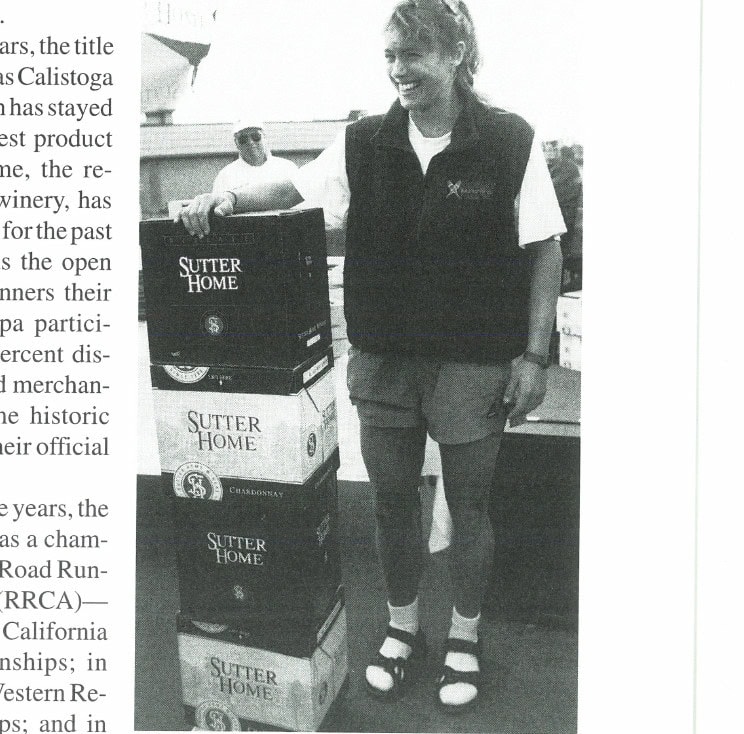
The now defunct Silverado Striders started the event back in the running boom days of 1979. During the early years, participant numbers hovered around 1,000, dipping as low as 750 one year. More recently, entries have been up around 1,500, with between 1,100 and 1,350 finishers. To celebrate the race’s 20th year, the race directors allowed the entrant pool to swell past 1,800. They won’t do it again, they say, because a bigger field—there was a record-high 1,532 finishers this year—”might jeopardize the quality of the experience for everyone. And that’s not fair.” You could tell there were nearly 200 more finishers this year mingling around—and occasionally getting bottlenecked—at the quaint Vintage High School where the race ends. And you could see the race directors making mental notes about how to improve the situation next year. Because if there’s ever a race that sweats the details, it’s Napa. For example, there were muffins, fruit, juice, and coffee in the lobby of the host hotel on race morning because runners had to be on the buses to get to the start before the hotel restaurant opened. Each finisher also received a personal escort out of the chute.
For the first 14 years, the title sponsor of the race was Calistoga Mineral Water, which has stayed on board as the largest product sponsor. Sutter Home, the renowned St. Helena winery, has been the title sponsor for the past six years and awards the open male and female winners their weight in wine. Napa participants receive a 10 percent discount on all wine and merchandise purchased at the historic winery by showing their official race number.
Over the past three years, the SHNVM has served as a championship race for the Road Runners Club of America (RRCA)—in 1996, as the RRCA California Marathon Championships; in 1997, as the RRCA Western Regional Championships; and in 1998, as the National Marathon Championships, a distinction it will repeat in 1999. The ever-popular Don Kardong, president of the RRCA and past Olympic marathoner, chose the 20th Napa as his 40th marathon and broke 3:00 for the first time in the ’90s. After attending the race last year as the keynote speaker, Kardong commented, “I thought Napa was the most beautiful route I had ever seen.”
Napa is definitely a destination marathon. Whatever you do, don’t fly in, race, and then fly out. Pad your trip on either end—or on both ends—with several days to sample the sights
| The Basics | |||||||||
|---|---|---|---|---|---|---|---|---|---|
| Sutter Home Napa Valley Marathon P.O. Box 4307 Napa, CA 94558-0430 |
|||||||||
| PHONE: | 707/255-2609 | ||||||||
| FAX: | 707/257-6515 | ||||||||
| E-MAIL: | SHNVM@napanet.net | ||||||||
| WEB SITE: | www.napa-marathon.com/ | ||||||||
| RACE DIRECTORS: | Richard Benyo, David Hill, and Gard Leighton | ||||||||
| CERTIFIED: | USATF | ||||||||
| START TIME: | 7:00 A.M. | ||||||||
RACE RECORD HOLDERS:
|
|||||||||
| PRIZE MONEY: | None, but the overall male and female winners win their weight in Sutter Home wine, while both open and masters winners also receive seven-liter bottles of Sutter Home Winery Zinfandel etched in gold with their winning accomplishments. | ||||||||
| TIE-IN EVENTS: | Three Rs 5K Run, 8:00 A.M. Begins and ends at the marathon finish line. | ||||||||
| NO. VOLUNTEERS: | 750 | ||||||||
| MARATHON FINISHERS IN ’98: | 1,532 | ||||||||
| PROPORTION MALE/FEMALE FINISHERS: | 59% male; 41% female | ||||||||
| COURSE MARKING: | Every mile | ||||||||
| NO. AID STATIONS: | 12 | ||||||||
| FUTURE RACE DATES: | 7 March 99; SHNVM is always the first Sunday in March | ||||||||
| ENTRY COST FOR 1999 EDITION: | $45 before 6 Feb 99; $50 until 5 March 99; $60 on 6 March 99; no raceday registration. | ||||||||
Official Hotel
The Napa Valley Marriott Hotel is the host hotel and race headquarters for the weekend (707/253-7433; fax: 707/258-1320). For information on other area hotels, contact the Napa Valley Conference & Visitors’ Bureau (see number below); for referrals for eight or more rooms, call 707/226–3610. Be sure to mention the SHNVM for applicable discounts.
For Info on the Napa Valley
Contact the Napa Valley Conference & Visitors’ Bureau, 707/226–7459.
Getting There
All the major airlines fly into the four largest cities near Napa—San Francisco, Santa Jose, Sacramento, and Oakland. If you fly into San Francisco and then drive to Napa, take the scenic Highway 101 north across the Golden Gate Bridge and through the wine country. Travel north on 101 to Novato, take the Highway 37 exit toward Napa and Sonoma, and then turn left onto Route 121 at Sears Point Raceway. Route 121 will connect with Highway 12, and both later connect with Highway 29. Turn north on Highway 29 and you’re there.
and tastes of Napa Valley: its famous wineries, spas, mud baths, hot air balloon and glider flights, Wine Train, quaint shops, and world-class restaurants. On some years the Napa Valley Mustard Festival coincides with the SHNVM.
The Course
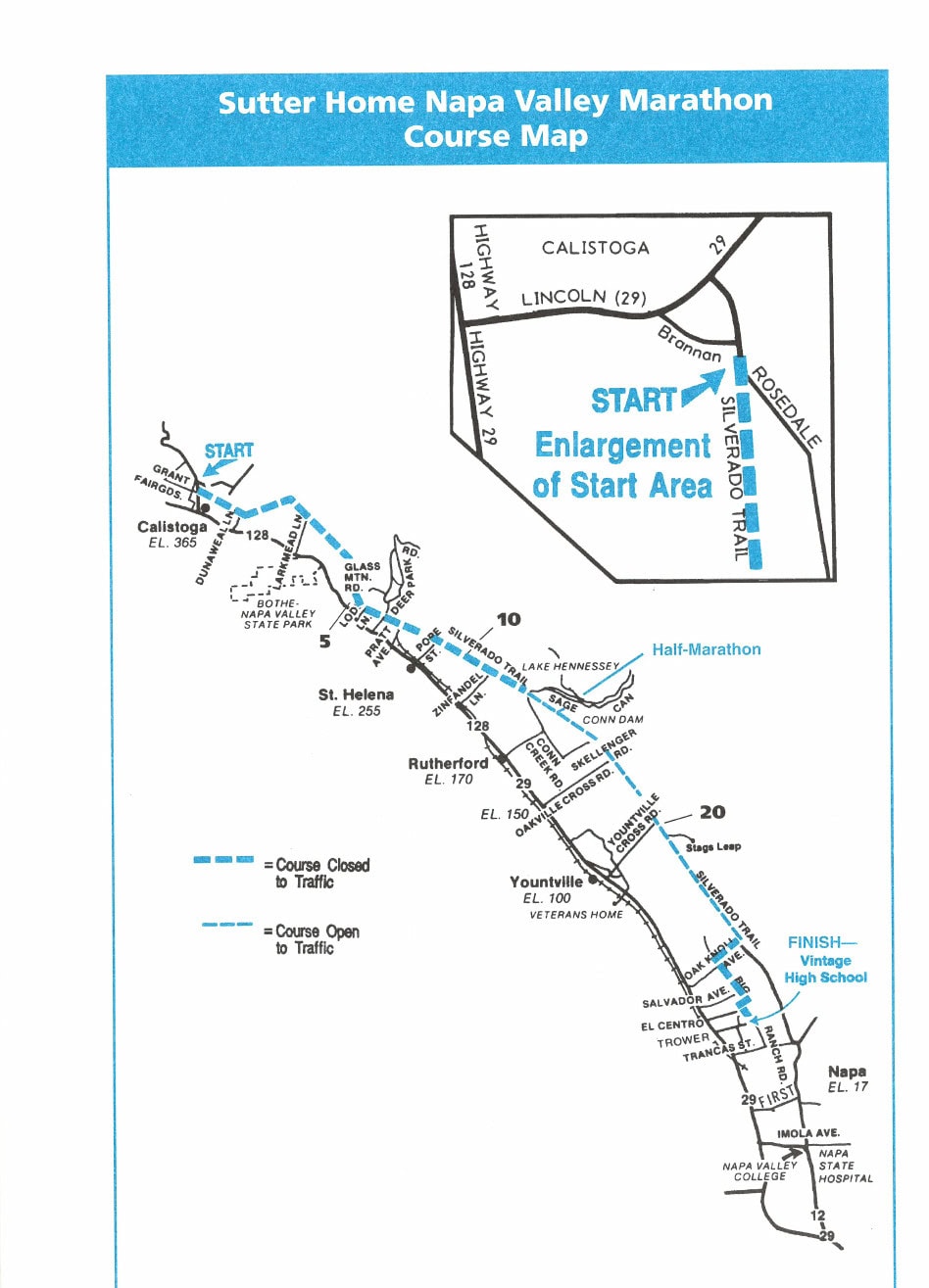
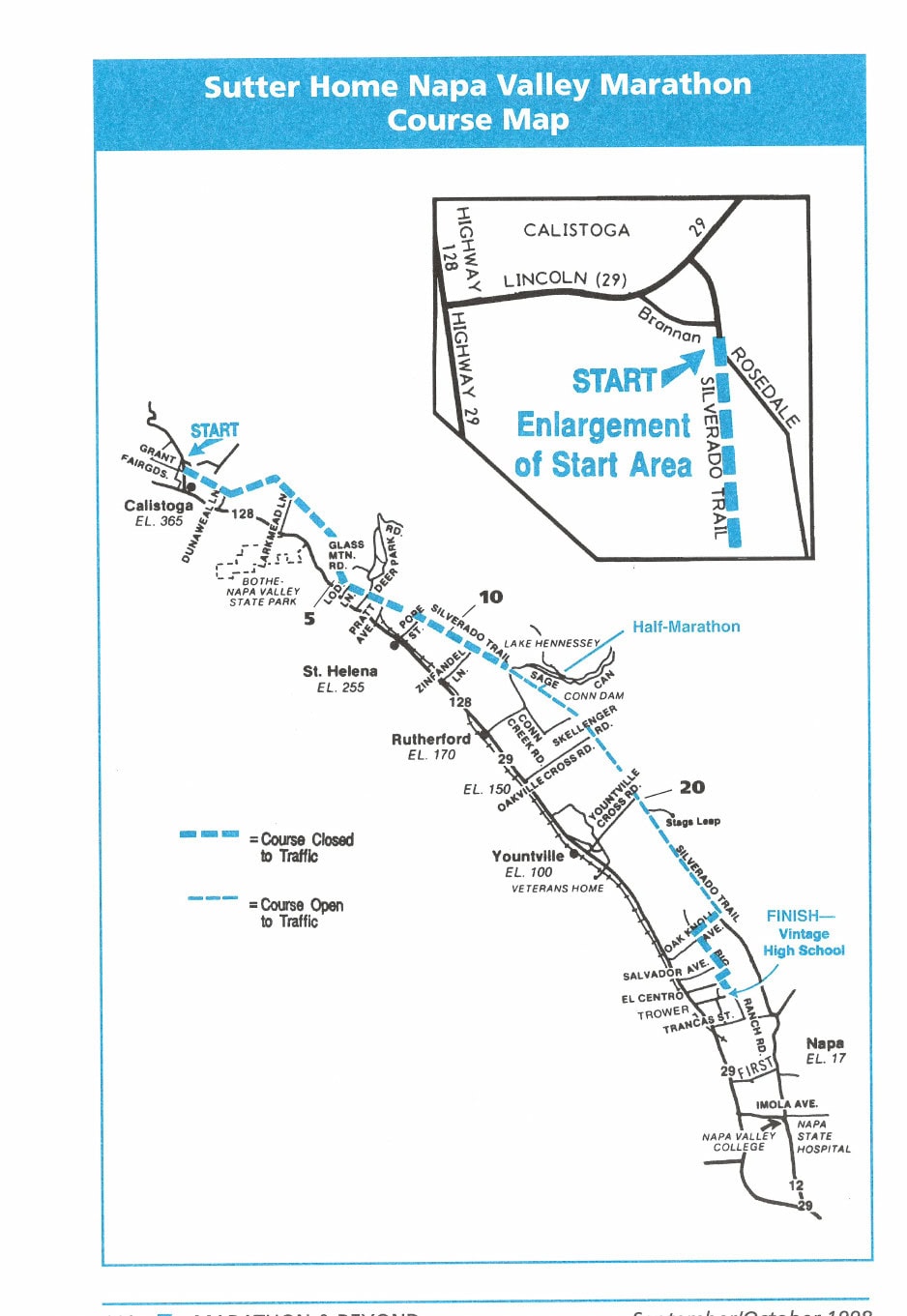
The splendor of the SHNVM course is unparalleled. The race starts at the corner of Rosedale Road and the historic Silverado Trail, just south of Calistoga, and runs the length of the Napa Valley along Silverado, progressing on a fully paved, point-to-point, rolling course through St. Helena, Rutherford, Oakville, and Yountville, before ending at Vintage High School in Napa. The first 13 miles and the last 3 miles are closed to traffic, and except for the last half-mile, the entire course is rural. Runners are treated to panoramic views of the valley, flowering fruit trees, and vineyards carpeted with golden mustard flowers. Keep an eye out for the hot air balloons that come popping over the fogged horizon during the race. And at mile 22, the eucalyptus-tree-filled air will clear your nostrils better than the best antihistamine money can buy.
There are three minor hills in the first 6 miles, and miles 7 to 19 are flat to rolling and gently downhill. There’s a decent hill between miles 19 and 20, and the biggest downhill comes right after the 20-mile mark. The final 5 miles are flat. Runners share the road with cars during miles 14 to 23, but there is a wide shoulder and the road is fully coned for safety. The course has been the same for the race’s entire history.
There are 12 aid stations on the course offering Gatorade, Calistoga water, Ripped Force Fruit Punch, and Clif’s Chocolate Peanut Shot. There is also fruit at some of the later aid stations. At Napa a nonelite runner can feel elite for a day by taking advantage of the personalized water bottle service offered. Runners who prepare and label special drinks can put them in premarked boxes, which are carried to the various aid stations along the route.
Raceday 1998
Weather-wise, Napa has lived a charmed life, having suffered through only one bad weather year—the 13th running. It has rained during the second half of the race only that once in 19 years. But with El Niño pounding northern California this spring, entrants were worried. Leading up to raceday, the troika of directors squelched rumors left and right that a) the race was cancelled due to excessive rains; b) part of the course had been washed away; c) boats would be used to ferry runners over certain sections of the course; and d) galoshes would be issued to every runner at mile 15.
The weather gods blessed the event again this year with ideal racing conditions. A record field shivered a bit at the start as they sang along with masters phenom John Keston, who belted out the “Star Spangled Banner” in 40-degree temperatures.
For the first half of the race, fog hovered over the course-bordering vineyards, which were carpeted in extra thick golden mustard flowers because of the spring rains. There was no wind to speak of, and two hours into the race, the sun was shining brightly. Runners take note: wear sunglasses or a hat, or both. The race may start out foggy, but it’s going to get sunny and beat full-blast on the your face all the way to Napa.
Irishman Eoin (pronounced Owen) Fahy, now of San Diego, took the lead at two miles and never looked back, winning his sixth marathon and his second straight Napa crown in a time of 2:28:53. “It’s not too often in the heat of a race that I look at the scenery,” said Fahy after the race; “but this is just awesome.”
German native Miriam Schmidt of Soquel, California, running her first U.S. marathon, won the women’s race in a PR time of 2:52:08. Schmidt, whose twin sister Uta finished 6th in the women’s field, took the lead just after mile 23, enroute to placing 31st overall.
Two other participants also achieved an enviable milestone: Harry Cadelago, Jr., and Steve Radigan became the only runners to complete all 20 Napa Valley Marathons. Cadelago, 50, a middle school teacher and band leader at Napa High School, ran with his now-deceased father every year until Cadelago, Sr., died in 1992. Harry now runs the event each year to
Must See/Must Avoid
Go See It
The Valley From Above. Unlike most of the temperate world, winter in Northern California means not bleakness but rain and verdant grasslands carpeted with acres of golden mustard flowers. The best way to get a feel for the Napa Valley is to see it from above. There are numerous hot air balloon companies in the valley that will be happy to get you high on nature. Those involved with the marathon include Above the Valley Hot Air Ballooning, Bonaventura Balloon Company, Napa Valley Balloon Inc., and Balloons Above the Valley. It would be best to call a few weeks in advance to check on availability.
The Calistoga Resorts. More than a century ago renegade Mormon bishop Sam Brannan (who orchestrated the California Gold Rush once he had cornered the market on mining equipment) purchased most of what is Calistoga today with an eye toward turning it into a hot springs resort area to rival Saratoga, New York. Unfortunately, there was a distillery on the premises, and on the day Brannan dedicated Calistoga, the story goes, he wove his way to the speakers’ platform and declared he was opening “the Calistoga of Sarafornia.” The name supposedly stuck. Brannan was promoting the natural hot springs and the restorative powers of Calistoga. If you long for the ultimate in pampering, schedule “The Works” at one of the Calistoga resorts after the race. The Works includes steam baths, mud baths, massage, and so on. Try any of the following: Calistoga Spa Hot Springs, Golden Haven Spa/Hot Springs, Indian Springs, or Dr. Wilkinson’s Hot Springs Resort.
Museums. Two of the most interesting museums in the valley are upvalley. The Silverado Museum (707/963–3757) in the St. Helena Library is dedicated to the works of Robert Louis Stevenson. The author came to Napa Valley in 1880 with his new wife and took up residence in an abandoned miners’ dormitory on the side of Mt. St. Helena above Calistoga, where his health improved. Stevenson’s The Silverado Squatters gives a wonderful profile of Napa Valley a century ago. Legend has it that Stevenson used Mt. St. Helena as the model for Spyglass Hill in Treasure Island. Another artist who made his home in Napa Valley (between his employment with Walt Disney Studios) was Ben Sharpsteen, who produced the
Disney animated feature Fantasia. A number of his nature shorts won Oscars. When he retired to Calistoga, Ben turned his artist’s hand to painting fanciful scenes of life in the valley, several of which are on exhibit at the Sharpsteen Museum (1311 Washington, Calistoga, 707/942–5911), as is one of his Oscars.
Hiking. To burn off excess energy build-up before the marathon or to help the legs recover afterward, consider going on one of several beautiful hiking trails in the valley. One site is the Bothe-Napa State Park (along Highway 29 between St. Helena and Calistoga). Much of the park is built on property once owned by Reason Tucker, one of the first rescue party leaders to go into the Sierra after the stranded Donner Party. There is an historical plaque to Tucker at the park entrance. At the northern end of the Silverado Trail (less than half a mile north of the marathon start line) is the head of the Oat Hill Mine Road trail, a long-abandoned mining road that winds its way up to and through the palisades that form the eastern wall of Napa Valley above Calistoga. If you go up far enough, you’ll encounter the marks of mine wagon wheels cut into the solid rock from the days when they hauled flasks of quicksilver out of the mountain.
Napa Valley Wine Train. An elegant way to see the lower half of the Napa Valley is to travel from Napa to St. Helena and back on the Napa Valley Wine Train (707/253–2111). The meticulously restored coaches are comfortable, there are several trips available each day, the food on the trips is very good, and you can wine-taste while the vineyards roll past.
Sutter Home Winery. The train runs past the Sutter Home Winery on the opposite side of the highway. The Sutter Home Winery is one of the largest in California and put itself on the wine map when CEO Bob Trinchero created white zinfandel. The Sutter Home Winery tasting room is large, warm, and inviting, and besides offering their wines, it also offers excellent olive oils, pasta sauces, and much more. The winery has been the marathon sponsor for six years. Winery president Roger Trinchero ran in the marathon the first year the winery sponsored the race. Runners who bring their race number by the tasting room receive a 10 percent discount. Their Web address is http://www.sutterhome.com.
AVOID IT
Terminal Mellowness. There really are no sections of the Napa Valley you need to avoid. Spend too much time in the valley sampling wine and enjoying mud baths, however, and you may suffer from near fatal relaxation.
honor his father’s memory. Radigan, 46, took third in his age group with a 2:55:29.
MARATHON COLLEGE AND AUTHORS’ BREAKFAST
One of the unique prerace activities at Napa is the Marathon College, which features legends of the sport who speak throughout the day on Saturday. The 20th anniversary race offered an expanded speaker/seminar program with Dick Beardsley, Amby Burfoot, Jeff Galloway, Joe Henderson, Don Kardong, John Keston, and Kathrine Switzer. Sessions this year included a roundtable discussion, “Whither the Marathon,” and “Secrets of Running the Napa Valley Marathon Course.” Switzer delivered the keynote address, which included the unabridged version of her famous encounter with Jock Semple in the 1967 Boston Marathon.
Another big reason to get into town early is the chance to rub elbows with the Marathon College luminaries at the Napa Valley Marriott Hotel on Friday evening from 5:00 to 6:30 at an informal wine reception hosted by Sutter Home. Saturday morning’s Author’s Breakfast is another best bet. Enjoy a delightful breakfast spread and hear informal presentations from running authors such as Amby Burfoot, Jeff Galloway, Joe Henderson, and Don Kardong. These authors’ books are also available for purchase and autographing.
OTHER AMENITIES
Napa offers two pasta feeds, one upvalley at the Community Center in Calistoga, where the race starts, and the other at race headquarters at the Napa Valley Marriott Hotel. You can dine on a variety of pastas, salads, sauces, and wines.
The Napa Valley Marriott Hotel is the official hotel of the SHNVM and race headquarters for the weekend. The host hotel tends to fill up early, so make reservations as early as possible.
A Sports and Fitness Expo is held all day Saturday, featuring more than 30 quality clothing, book, software, wine, pasta, and running shoe exhibitors. This year’s expo was a little too crowded, so plans are underway for next year to move it across the hotel parking lot to the conference center, where it will have double the space.
THE START, FINISH, AND POSTRACE
Buses leave Vintage High School (a 10-minute walk from the host hotel) between 5:15 and 5:30 A.M. Parking near the start in Calistoga is limited, so taking the bus from Vintage High School is the better choice for getting to the start. There’s plenty of parking at Vintage High School, and your car will be waiting for you after you finish. If you must drive to the start, you’ll need to use Highway 29 on the west side of the valley because the Silverado Trail will be closed off for the race. If you park in Calistoga, you must provide your own transportation back to the start after the race.
The prerace staging area is very low key. Basically, it’s the middle of a wine field: There’s you, the fog, other runners, porta-johns, and the buses. This year, in keeping with the Passport to Napa theme, all runners received a souvenir nylon-zippered travel bag, which doubled as a goody bag/sweatbag and included a luggage tag with your race number. At the staging area, after shedding unnecessary clothes, participants passed their sweatbags through the bus windows for safekeeping. The bags were transported to the finish area for easy retrieval.
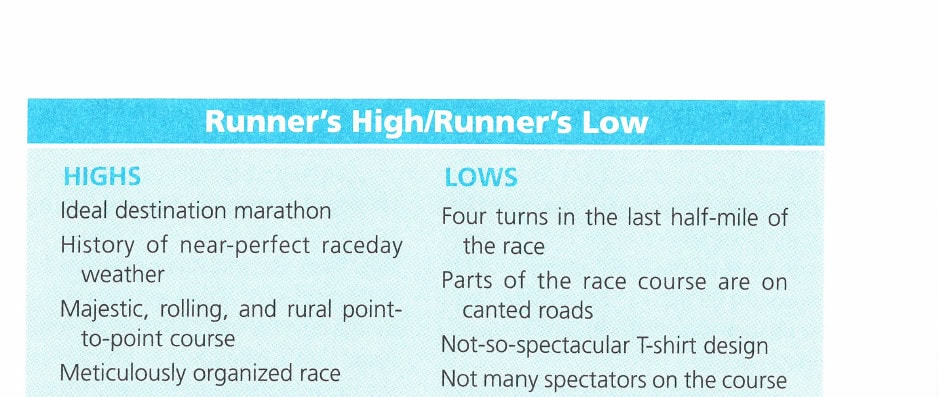
After nearly a 25-mile straight shot from Calistoga to Napa, four turns in the last half-mile pose a challenge for some runners. While there are only pockets of spectators along the rest of the course, the finish area is jam-packed. The community really comes out for this event in full force.
The last 100 yards along the east side of Vintage High School enhances that down-home, small-town race feel that so many participants love. Dipsea-Man Barry Spitz does a great job as finish line announcer. Every finisher is personally escorted through and out the finish chute by one of dozens of volunteers. Your personal volunteer will take you by the elbow, lead you out of the chute, put your finishers’ medal around your neck, and lead you to medical assistance should you need any or direct you to the food and drinks that lie in the Quad at the heart of the Vintage High School campus. There, you can eat and drink to your heart’s content: water and other beverages, fruit, yogurt, hot soup, and sourdough rolls. Showers are also available (bring your own soap and towel). Napa veterans know just where to go for the soup, but some of the newcomers stumble around a bit until a “Soup Here” sign is posted outside the high school cafeteria doors.
The greater-than-usual number of finishers throws a kink into the sweatbag retrieval system, which is organized meticulously but gets backed up because of volume. Delays at the sweatbag area clog traffic flow into the Quad somewhat but don’t create any real problems.
The Napa directors cap a wonderful event with a humorous awards ceremony, same-day race results on their Web site, and an impressive 32-page results book that arrives about a month after the race. The Sutter Home Napa Valley Marathon is a fixture on the race schedules of many Northern Californian long-distance runners and a “must” event for any serious marathoner with a hankering for travel. But remember, you didn’t hear it here.
SIMPLIFYING THE MARATHON
Last winter I was searching for the one plan that would lead me to my marathon PR. An article in your November/December 1997 issue by British coach Frank Horwill offered the most logical, credible, and easy-to-understand plan that I could find. Simply put, Horwill stresses practicing what you will do on the day of your marathon, that is, marathon pace running. Approximately three times per month the plan has you train at your marathon race pace. You increase a mile each session until you reach 18 miles at marathon pace. Horwill’s key to success is so simple many runners dismiss it for more outlandish workouts. But on raceday I knew what to expect. I simply did the same workout I had done nine times in the preceding 12 weeks and let adrenaline take care of the rest. The result was a personal best by 10 minutes (2:37:41) and a fourth-place finish in the Lake County Marathon in April. Part of the credit goes to Horwill, part to my hard work, but a portion needs to go to M&B for including authors who are tops in their field. That makes M&B stand out in the sea of running information. It is current, reliable, and, frankly, it works!
Mike Mallon
Rantoul, Ill.
WESTERN STATES
Our copies of the May/June issue arrived today, and we are thrilled with the results. The articles, layout, photo coverage—everything—is truly wonderful. We know how hard you had to work to produce the issue. Thanks again for doing such a great job.
Norman Klein
Western States Endurance Run
Race Director
Rancho Cordova, Calif.
Here’s a quick recap of events from the 1998 Western States Run (info via Norman Klein): After an initial climb of 2,550 feet in the first 4.5 miles, runners hit severe ice conditions for the next 19 miles. Considerable slipping and falling during this stretch drained runners’ energies, but they all got through injury-free. Snow in the high country made miles 24 to 43 inaccessible, so runners were diverted to Mosquito Ridge. After mile 43, however, conditions were excellent, especially due to lower than usual temperatures, which never exceeded 90 degrees. Ann Trason finished 4th in 18:44:16 to capture an unprecedented 10th-consecutive women’s title. Tim Twietmeyer won his fifth title in 17:51:20. Both runners came from behind for the wins. For the first time ever, not one but three 70-year-old runners completed Western States: Ray Piva, Link Lindquist, and Beacham Toler. There were 396 starters and 257 finishers (221 under 30 hours, and 36 between 30:01 and 32 hours). The official cut-off time was extended by two hours because of the snow in the high country.
This article originally appeared in Marathon & Beyond, Vol. 2, No. 5 (1998).
← Browse the full M&B ArchiveMore like this
1,000+ stories from 19 years of Marathon & Beyond
The complete archive of the legendary long-distance journal — digitized and free to read.
