

Tale Of Two Bostons
Race director David McGillivray, dressed in silver jacket and red cap, both bearing the logo of the Boston Athletic Association, moves like a water bug across the surface of a pond as he supervises the start of the 109th running of the Boston Marathon. Pointing and gesturing like the conductor of a symphony orchestra, McGillivray shifts a motorcycle policeman forward a few feet, coaxes several of the wheelchair athletes back behind the starting line, and next clears a lane so the elite women can warm up while waiting for their start six minutes after the wheelchairs.
It’s a normal day at Hopkinton Green—that is, if that day is Patriots’ Day, a holiday in Massachusetts, the day the marathon is held. The Green swarms with vendors, spectators, and local residents just walking about on a warm and sunny spring morning.
The narrow road leading to Boston contains, crunched together in corrals, 18,319 runners, most of them having posted fast qualifying times in order to enter what, arguably, is America’s most prestigious road race.
Standing beside the starting line with three press passes for access to various areas hung around my neck and prior to boarding the press truck for a ride (instead of a run) into Boston, I glance up at the flag-bedecked reviewing platform and see Senator John Kerry standing above me holding a starting pistol, hardly a weapon of mass destruction but effective enough for getting the show moving. Standing beside him is the B.A.A.’s executive director, Guy Morse, dressed nattily in a blue blazer with the organization’s unicorn logo on his breast pocket.
Morse’s job on race day includes attending to all the ceremonial aspects of Boston, everything from the firing of the start pistol to crowning the winners with laurel wreaths. Meanwhile, McGillivray does his water bug act, his main worry whether people to whom he has delegated responsibility (including 6,300 volunteers) complete their assigned tasks with dexterity and honor. If both men have done their jobs the preceding 364 days, the Boston Marathon will move forward like the smoothly oiled machine it is, and half a million spectators can watch 18,319 runners happily cover 26 miles, 385 yards from Hopkinton to Boston.
EQUIVALENTS ACROSS THE YEARS
© Fay Foto
Courtesy of B.A.A.
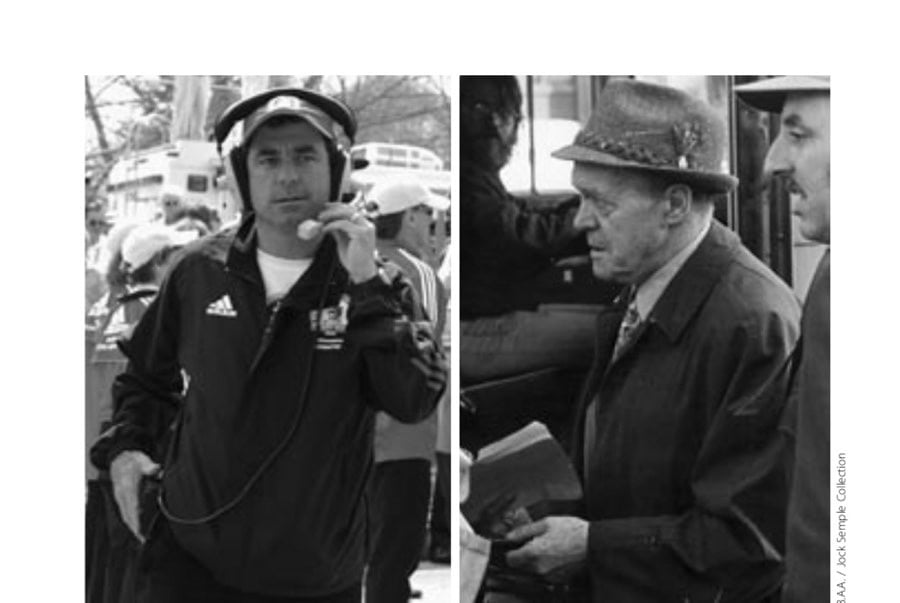
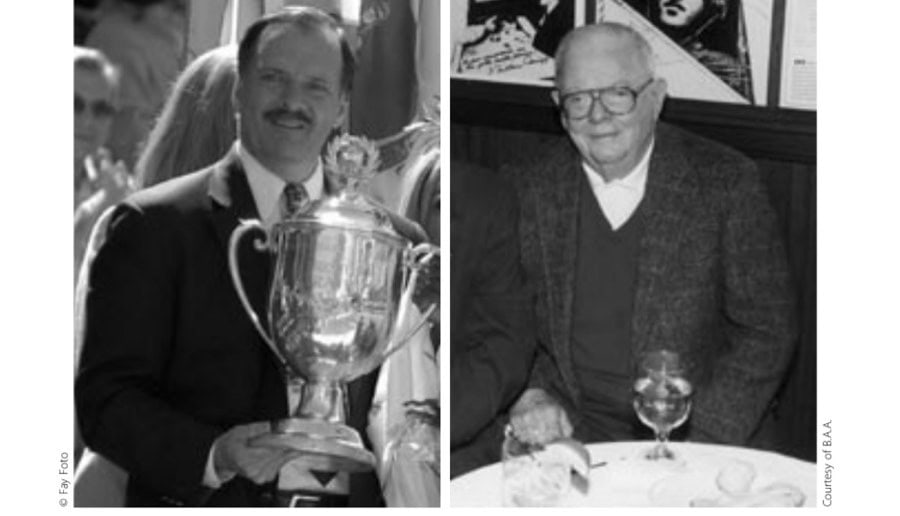
Considering the roles that Morse and McGillivray now fill, I thought back through five decades to 1959 and my first appearance in Boston as one of only 151 starters. Morse’s equivalent then was Will Cloney, teacher, reporter, and executive with
Keystone Custodial Funds. McGillivray’s equivalent was Jock Semple, trainer for the Boston Celtics and Bruins. Cloney had been tapped in 1946 by Walter Brown, owner of the Boston Garden where the Celtics and Bruins played, to direct the B.A.A.’s indoor track
meet and the following year added the marathon to his duties. Semple was a journeyman marathoner, ninth in the 1937 race, who comfortably filled the role of Cloney’s sidekick. They had a handful of volunteers—and I’m talking about
a handful—who made the race work. Shortly before the noon start, Cloney and Semple would herd us into a fenced-in pen on the Green and check our numbers before sending us to the line. If, regardless of talent, you wanted to edge into the front row and lead the Boston Marathon for the first few hundred yards, you could do so—as several
showboats often did. Poseurs often appeared smoking cigars or dressed in King Kong suits, causing Semple to gruffly shove them into the second row so as not to interfere with his favorite, John J. Kelley (no relation to the recently deceased
▲ Guy Morse (left) serves as successor to long-time race director Will Cloney.
Courtesy of B.A.A. / Jock Semple Collection
© Fay Foto
▲ David McGillivray (left) is the high-tech version of Jock Semple, minus the brogue.
John A. Kelley), who remains the only runner to win Boston (1957) wearing the B.A.A.’s unicorn singlet. Kelley was my nemesis—somewhat. From the mid-1950s and into the 1960s, Kelley the Younger (as he was called) was the dominant American presence at Boston, placing second five times in addition to his one win. I slipped past him once, finishing fifth and first American in 1964, a race won by Aurele Vandendriessche
of Belgium, two-time European champion. Kelley placed seventh, and we were the only Americans in the top 10 in an era where Boston winners most often were Finns or Japanese rather than East Africans.
Much has changed during the nearly half century I have observed the Boston Marathon both as a competitor (18 times) and as a reporter for Runner’s World and other media outlets. As I rode the course on the press truck in front of the
lead pack this year, I observed markers every mile, something marathoners today take for granted. Using digital watches or the more recent GPS watches, they can precisely monitor their pace. Runners from my era wore watches with hands
that moved, not that even those watches did us much good. Boston of old had checkpoints at traditional but irregular points related to train stations along the railroad line paralleling the course.
One surviving checkpoint from the 19th century was chosen because of its access to a stable, where officials following runners could change horses. Passing the Framingham Station, runners even into the late 1970s encountered a triangular sign in the middle of the road, announcing 19 7/8 miles to go—not very useful in judging pace. As I was running beside Kelley the Younger in my first Boston appearance, he kindly pointed to the clock on the steeple of the First Congregational Church in Natick and said I could use it to catch my time for 10 miles.
BOSTON OLD AND BOSTON NEW Aid stations? They didn’t exist back then. Gatorade? It had not yet become a popular drink for recreational sportsmen. Children along the course often offered runners orange slices, but if you wanted water, you needed a friend who knew the back roads well enough that he could intersect the course to supply you.
Lack of what most runners today would consider minimal support continued until Canada’s Jerome Drayton, winner in 1977, complained to reporters that the only fluids he got was when Bill Rodgers, who was being supplied by his wife, shared his plastic water bottle.
Cloney, always the gentleman, grumbled about Drayton’s lack of good manners but quietly added regular aid stations the following year. Among McGillivray’s planning tasks now is seeing that tables on both sides of the road at eight points contain specially prepared bottles for 60 or so elite athletes, who swerve to the left or right depending on whether they have an odd or even bib number. More of a logistic problem is caring for the remainder of the field, which required 9,000 gallons of water and 1.4 million cups at two dozen separate aid stations with 60 volunteers per station to hand runners their drinks. So ubiquitous have fluids become on the course that doctors now warn about drinking too much (and causing hyponatremia, a condition involving low sodium) rather than drinking too little.
Wheelchair racers now start at Boston at 11:25, the handful of elite women at 11:31, and elite men at noon. For the first time, this year Boston will feature a wave start for the remaining runners, half going at noon, and the remainder at 12:30. Bandits became part of the scene only after the B.A.A. established a qualifying time for entry into the field in 1971 after 1,173 entered the year before. The first qualifying standard was the ability to finish the marathon under four hours. “This is not a jogging race,” warned the B.A.A. on its entry form. The qualifying standards would be tightened over the next decade to 2:50 for men and 3:10 for women (although they now have been relaxed to somewhat less imposing times). The intent by Cloney and Semple was to limit the field to what they felt was a manageable thousand, but the result, ironically, was to inspire runners to train harder for the prestige of being a Boston qualifier (earning BQ status).
The results of the 1980 race listed 3,428 finishers under 3:00, after which B.A.A. officials apparently stopped recording names and times. The stiff standards also had the unfortunate side effect of creating “bandits,” that being the term used to describe those runners who, lacking qualifying times or being unwilling to pay the entry fee (currently $95), ran unofficially without numbers. The B.A.A. tolerates the several thousand runners who bandit their race each year, hoping only that they will wait to start until the officially entered runners cross the line.
But as I waited on the press truck, I noticed three young women with the names “Laurie,” “Wendy,” and “Amy” written on their shirts standing inside the fence ahead of the starting line. “Are you running?” I asked. They mostly giggled in response. I hoped that they would wait at least until the Kenyans had passed before jumping into the way of official starters. Not all legitimately qualified runners accept kindly the presence of bandits, and some resentment exists for the 1,100 charity runners that the B.A.A. officially permits into its field, resulting in $7 million in donations for 16 charities.
SEMPLE AND SWITZER Until 1972, all women were by definition bandits, since Amateur Athletic Union (AAU) rules at that time prohibited females from running more than a few miles in competition. The mostly male rules makers considered women incapable of running a distance as far as 26 miles, 385 yards.
Then in 1966, Roberta Gibb (Bingay), who ran for enjoyment and hadn’t heard of rules, tried to enter Boston, only to be rejected by Jock Semple. She ran anyway, finishing around 3:21:40. The following year, a student at Syracuse University named Kathrine Switzer entered under the name “K. V. Switzer,” innocently, she claimed. Not recognizing “K. V.” as female, Semple issued her a number, but when he spotted Switzer on the course several miles into the race, the irascible Scotsman bounded off the press bus and tried to reclaim her number. Switzer’s boyfriend, a hammer thrower who was pacing her, brushed Semple aside. Photos of the incident made newspapers around the world and inspired many women not only to become runners but to participate in other sports and activities previously closed to them as well. Would you like to know who, in my opinion, inspired the Title IX law in 1972 that provided equal rights for women? Consider the name K. V. Switzer. Gibb, who was the first female finisher at Boston for three consecutive years, and Sara Mae Berman, who won the three following years (until the AAU changed its rules) were considered unofficial champions for several decades, asterisks beside their names in the record books. Before the 100th running in 1996, I suggested to B.A.A. director of communications Jack Fleming that the B.A.A. remove the asterisks beside their names in its press guide. The B.A.A. did more
than that, including the names of Gibb and Berman on a bronze plate embedded in Copley Square listing the champions and also honoring them at a breakfast of champions at the 100th running, which attracted a record 38,708 entrants. I ran that race as my 100th marathon and have since gone on to run 11 more, although no more at Boston.
Riding a marathon course is less fun but also less stressful. The Boston Marathon attracts more on-site media coverage than any other single-day event in the world other than the Super Bowl: more than 1,100 media members, representing 250 outlets, requesting media credentials. The three press passes hanging from my neck (thanks to Fleming) offered me access to anywhere I wanted along the course, even a coveted position on the bridge over the finish line where normally only the best-known photographers go.
Our press truck with photographers snapping pictures almost continuously hovered anywhere from 50 to 100 meters in front of the lead runners. Also in front was a car with a TV camera on the back and a digital clock on the top showing the time. No need to glance at church steeples for today’s runners. David McGillivray rode on the back of a motorcycle beside us, sometimes darting ahead, sometimes darting back to check details.
Two state policemen on motorcycles rode before the lead runners. When they arrived at the border between Newton and Brookline, they would be replaced by Boston policemen on motorcycles, the Boston police carefully staking claim to the honor of leading the runners through their town.
PACKS OF SPECTATORS Spectators lined both sides of the road, sometimes scattered but more often in packs, particularly where the course passes Wellesley College, where cheering the marathoners has been a tradition at that all-women’s school, even in the first year of the marathon: 1897. While today’s runners may think that thick crowds are a recent phenomenon, huge numbers of spectators have cheered the runners from day one of the Boston Marathon.
And they cheer not only the runners but our press truck as well, applauding as we rolled past. “This may be the only place in the world where the press gets cheered,” said a reporter standing next to me.
A runner from Kenya and a runner from Morocco surged to an early lead that stretched to as much as half a minute by the halfway point in Wellesley. A pack of several dozen runners, what in the Tour de France would be called the peloton, contentedly trailed, then surged and swallowed them, spitting them out the back end. What was now the lead pack slowly got smaller and smaller through the Newton hills, until only a half dozen remained, including a lone American, Alan Culpepper. Then he began losing contact, leaving a single Kenyan and an Ethiopian, Hailu Negussie, heading up Heartbreak Hill.
Heartbreak Hill peaks at 21 miles, then it is a sharp downhill past Boston College into Cleveland Circle. Negussie ran that downhill mile in 4:28, and the race was his. Soon after, the press truck sped ahead to allow photographers time to position themselves for final photos. The photo bridge, a scaffolding that looms over the finish area just behind the line, is a device of the new era in marathoning, offering the best view possible for photographers and TV cameras, but its most practical use is for the handful of photographers who shoot pictures of each individual runner crossing the line, pictures that within the month will be framed and hung in offices and on den walls.
AN UNPARALLELED VIEW I climbed a narrow ladder to reach the top of the photo bridge, which had two levels, the first level for photographers, the second level mostly for TV cameramen, but I found an empty area off to one side where I could stand without blocking anyone’s view. It was a stunning sight. I could see for nearly a quarter mile down Boylston Street. Thousands of spectators stood on each side. A single runner, Negussie, rounded the corner. The cheers grew louder as he approached, breaking the tape and slowing to a walk as he disappeared beneath my feet. Within minutes, as other
ad
runners continued to finish, he was hustled onto an awards stand where the Ethiopian national anthem was played in his honor. I stayed on the bridge long enough to watch two Kenyans next cross the line and finally Alan Culpepper, the best finish by an American since Dave Gordon also placed fourth in 1987. With nobody close enough in front to catch and nobody behind to catch him, Culpepper seemed to slow, partly to wave to the crowd, partly to savor the moment. I couldn’t help reflecting on my best race at Boston, in 1964 when I placed fifth, first American. I cried after crossing the line, partly from joy at my performance but more from a realization that, at age 32, I had given my best shot at the end of my career and would never be quite good enough to win the Boston Marathon. Culpepper is that same age, and I wondered whether he would be back next year or in years to come.
Descending from the bridge, I spotted David McGillivray, now off his motorcycle and checking to see whether all finish line systems were functioning smoothly. I asked how the marathon had gone from an organizational standpoint. “I spotted a few aid tables that I might have moved a foot forward or backward, but nothing major,” he said.
In another half hour, David would accept a ride back to the starting line in Hopkinton and begin his personal Boston Marathon, finishing well after dark but continuing his streak of 33 consecutive Bostons completed. He is eighth on the list of runners with Boston streaks but at age 50 is younger than any of those ranked above him. Tops is Neil Weygandt of Drexel Hill, Pennsylvania, age 58, with 38 completed. The list of runners having completed 25 or more Boston Marathons had 38 leading into this year’s race, only one of them female.
Will one of these individuals eventually equal the recently deceased John A. Kelley, who ran 61 Bostons, completing 58 of them? Possibly, but it is doubtful that the person who does it will have won the race twice. As I departed the finish area headed for the press room, more to have lunch than to interview athletes, most of the 18,319 runners remained on the course. They would continue crossing the line almost to the time when Dave McGillivray returned from Hopkinton, 17,549 eventually finishing, 95.8 percent of those who started, a good percentage on a warm day.
I wished that I were one of them. Although now in my 70s and having determined several years ago to end my marathoning career on the nice-sounding 111 starts (half-marathons seem friendlier now), my return to the Boston Marathon had made me begin to regret that vow. 2006 would be the 110th running of the world’s oldest continually held marathon, another nice-sounding number. Would I be on the starting line in Hopkinton? It was too soon to decide.
This article originally appeared in Marathon & Beyond, Vol. 10, No. 2 (2006).
← Browse the full M&B ArchiveMore like this
1,000+ stories from 19 years of Marathon & Beyond
The complete archive of the legendary long-distance journal — digitized and free to read.
