

Taper Mao-Ness? The Being Marathon
PROLOGUE: THE ACCIDENTAL MARATHONER
I had no intention of running a fall 2005 marathon. In fact, “rest” was my running group’s overwhelming advice when I posted that I would miss the LaSalle Bank Chicago Marathon because of an opportunity to go to Beijing, but that maybe this was a blessing as I had been feeling on the edge of injury. Overwhelming, but not unanimous: one teasing reply noted that the Beijing Marathon was just two days after my conference. Was it Oscar Wilde who said, “I can resist everything except temptation?”
When I found the Beijing Marathon Web site, I was pleased to discover that it offered a half-marathon as well. If all I wanted was a chance to run the streets of a new city, that would be sufficient. Through the summer, that’s where I was headed, keeping overall mileage over 30 per week, but with no long runs over 13.1. The rest was doing me good, and the aches and strains I had been suffering receded.
Anyone who has followed my marathoning career could predict what would happen. As the trip neared, I began to think, If I only run 13.1, I’ll miss half the city. I tried the concept of running the full monty on my wife. No one could have been less surprised. “Of course you are,” was her only reply.
I ran one 20-mile LSD to be sure I could handle the distance, and, yikes! The entry deadline was just a day away, and there wasn’t exactly online registration. You could file your intent to run but had to wire the race fee to a Beijing bank by the deadline or be locked out. I raced to the bank, and was told it might get there in time, so I sent a pleading e-mail to the organizers not to banish me. Fortunately, a confirmation message arrived a few days later. I was in!
It’s not easy to research a race in such an unfamiliar place and culture. The race Web site bore some resemblance to the instructions in a China-made electronic gadget. Could the organizers really mean that they serve tea at the aid
© Patrice Malloy
▲ Antiquated plumbing was just one challenge of race week in Beijing.
stations? The course map was overlaid on a Beijing map in Chinese characters, so I struggled to figure out whether the start and finish were anywhere near my hotel. All I knew was that the race began in the infamous Tiananmen Square and ended at the Olympic Sports Center (not the new, 2008 one).
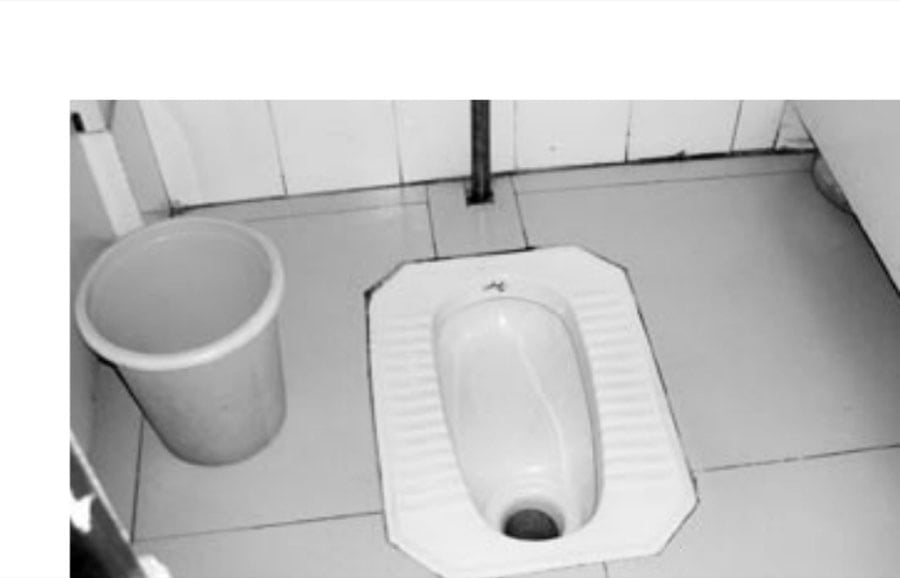
MarathonGuide.com had wide-ranging reviews about the race, but most agreed that the organization left much to be desired. Some praised the flat course for Boston qualification; others cited early crowds and late water shortages in flameouts. One recurring and worrisome comment concerned below-standard sanitation. I’m not a fussy man, but I had been warned about China’s squat toilets even in modern buildings. If U.S. race porta-potties were on the low end of my acceptable scale, what would Beijing’s offer?
Still, I kept telling myself, you can always drop out at the half, or the 10K, or the minimarathon distance of 4.2K (get it?). You can walk, you can catch the sag wagon: this is purely for the experience. And so, I was off.
RACE WEEK: HITTING THE WALL The conventional wisdom for the last week before the marathon is “don’t do anything different.” In a culture far different from my own, at a conference over which I had little control, with a unique opportunity to see a new and intriguing country, the question became instead, “What can you manage to keep the same?”
I toted along a bag of familiar taper foods: PowerBars, granola bars, peanut butter. I assumed in a rice-based culture, carboloading wouldn’t be difficult, though whole grains might be a challenge. As it happened, almost none of our meals were accompanied by rice, unless we specifically asked for it.
Hotel breakfasts were my main carboloading meal of the day. The buffet featured multiple cultures to accommodate the global clientele: you could mix and match from Chinese, Japanese, American, and European specialties. Most mornings I started with a bowl of congee (rice gruel with meat, much better than it sounds) or noodle soup with dumplings, continued with muesli with fruit and yogurt, and finished with bread topped with a fantastic spread of mixed nuts and seeds in honey.
At the conference, we—the international jury for the Asia-Pacific Children’s TV Festival—were kept well supplied with jasmine tea and fruits (including one particular favorite that I had never encountered before, with a thin red rind and crisp pearlike flesh dotted with black seeds). Actually, “well supplied” is an understatement—if you took a sip of tea, someone came to refresh your cup. The door to our meeting room was attended by young women in long silk dresses, and every corridor we walked was lined with young people just waiting for us to express a need. One night, five of us left a group dinner to find seven assistants waiting in the hall for us to finish, just to escort us to our bus. In a country with so many people, apparently it’s better to give people rudimentary service employment than to have them idle.
We were honored guests, so every lunch and dinner was a multicourse banquet. A few small dishes would be on a Lazy Susan in the middle of the table when we arrived—usually some saladlike greens and other veggies and a ubiquitous plate of cow’s stomach. After we sat down, the parade of dishes began to arrive: meats, fishes, shrimp, tofu, vegetables, sometimes identifiable and sometimes not. A fellow juror confided that he had been told one dish was dog. I think someone was pulling his leg, though one of our hosts did say that some Chinese eat dog (and for that matter, you don’t see many as pets on the street . . . hmm).
At a restaurant dinner one evening, our young hosts (we were escorted shopping by two student translators) ordered a dish they promised was a unique delicacy. Brought to the table in a massive tripod urn and ladled into our bowls, the soup wasn’t bad, until the first giveaway—a scraped-clean turtle shell on the side table. Asked what was in this special dish, the hosts began listing pork, duck, turtle, snake.
Dining in China presented two particular problems for taper. It was easy to overeat, since you never knew when the dishes would stop coming and since platters remained in the middle of the table, tempting you to pick at them (just one more bite of snake!).
The second problem was that everyone dips chopsticks into communal platters; properly, you serve from the dish to your own plate, but some people simply pick
up a morsel and pop it into their mouths. Either way, this method meant sharing germs among all the guests; by midweek, I was imagining cold symptoms that never materialized. Food wasn’t the only prerace challenge. The hotel had decent treadmills, but having been warned about Beijing’s pollution, I figured I had better do at least one outdoor run to acclimate. The hotel staff—gym attendants, concierges, bellmen—were reluctant to recommend a route. Most wanted me to run in their back garden, which was the size of a suburban backyard, rounded by a winding scenic path of bridges and cobblestones—more feng shui than fartlek.
THE CHALLENGE OF OUTDOOR RUNNING Finally, I found a concierge willing to admit that I could, indeed, run on the street in front of the hotel. Once on the road, I could see why they were reluctant. Within the first 100 meters, I had to climb a step bridge over a 10-lane highway, and the sidewalk on the other side was clogged with people headed for work. Running in the bike lane wasn’t an option; it was a constant stream of ancient one-speed bikes. Crossing even the smallest street was life threatening—legally, pedestrians may have priority in China, but you would die proving it. Right of way goes to the bold.
Culturally, outdoor running may have been a bad idea, as well. Outside the context of a race, the sight of a white man in shorts and a singlet drew curious and somewhat disapproving looks. Nonetheless, I managed to get in two 5K runs during the week.
Finally, the week-zero admonition to stay off your feet was impossible. On the Friday before the race, our hosts arranged a special tour of the Ming Tombs and a visit to the Great Wall. At least we didn’t climb up to the Wall; instead we were put onto plastic sleds that were hauled up the mountain like roller-coaster cars (and come down in free-fall, with a brakeman up front), then we were free to walk the Wall. Three notes on this excursion:
1. In the immortal words of Richard Nixon, “It truly is a Great Wall.” No matter how many photos you’ve seen, the real thing is awe inspiring, winding like a dragon’s back as far as the eye can see, over mountain
peaks in inhospitable territory. I’ve never seen the pyramids, but I imagine the impact is the same: “How the $%^&$% did they build this without modern construction equipment?” 2. As one of my German colleagues joked (several times too often), the national
anthem of China should be “You’ll Never Walk Alone.” Not surprisingly in a country with 1.2 billion people, it’s difficult just to get three seconds without traffic when trying to take a photo of a friend atop the Wall.
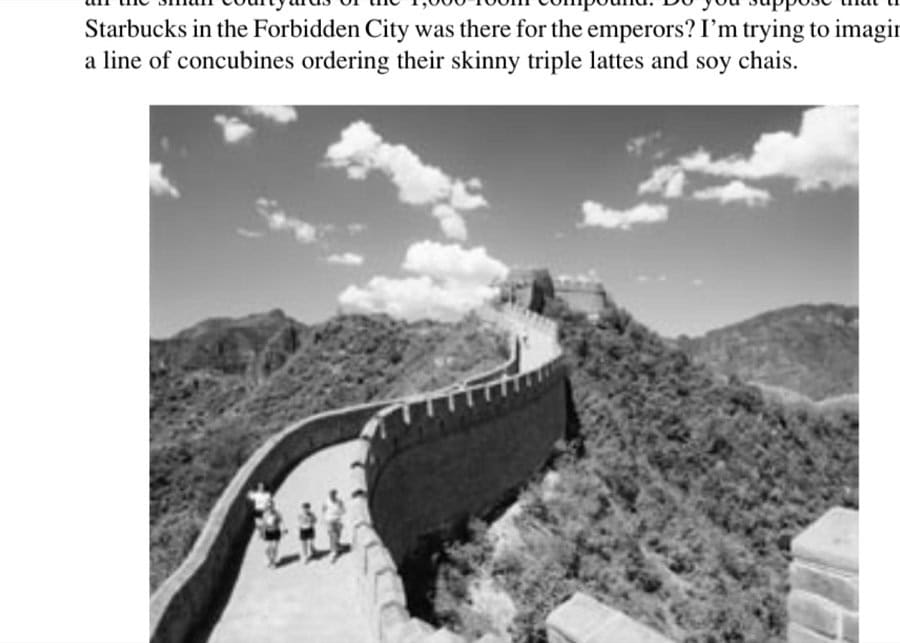
3. For anyone considering the Great Wall Marathon, know that it will make the hilliest run you’ve ever done look like Chicago’s pancake-flat marathon course. The ups and downs are steep, and where there aren’t uneven-height
steps, there is only slick stone. You would never be able to sustain any rhythm, and the probability of slips and trips is almost certain. Walking the Wall for about 90 minutes left my colleagues panting and complaining about tired legs. Of course, they suggested I was in such good shape that it wouldn’t bother me, but by the next morning (Saturday), my calves were twinging every time I took a step or curb.
Most of the international guests left on Saturday; for me, it was my only day to explore Beijing. The Forbidden City—home to the emperors—was the consensus must-see choice, so I got in a taxi (30-minute ride = 35 yuan = $4.25; try that in New York!). I carried water and Gatorade, PowerBars and granola bars, but the fact is that I was on my feet all day, probably walking a 10K as I poked into all the small courtyards of the 1,000-room compound. Do you suppose that the Starbucks in the Forbidden City was there for the emperors? I’m trying to imagine a line of concubines ordering their skinny triple lattes and soy chais.
▲ Exploring the Great Wall two days prerace isn’t in any recognized training plan.
KNOCKOFF CENTRAL
© Patrice Malloy
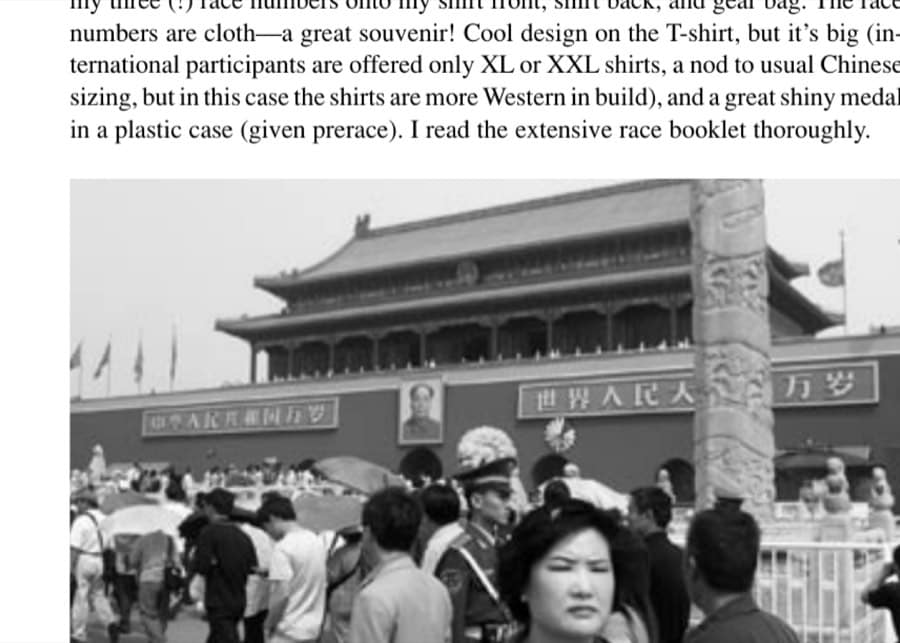
From the Forbidden City, I walked through Tiananmen Square to get my bearings for the next morning and then caught a cab to the Silk Street Market. Several of my colleagues had bought heavily in this eight-story building packed tight with booths selling knockoff jeans, suits, and jackets. Every vendor tries to lure, if not drag, you into his stall, offering “special price” or “Just come look.”
Bargaining is the norm, and if you pay more than 25 percent of the initial demand, you overpaid. One of my colleagues bought a full “Spyder” ski suit for the equivalent of $60, and several bought “Armani” suits for $100. They may unravel after three wearings, or they may be as well made as the real things. Either way, I wasn’t in the market for clothes or in the mood for haggling, felt oppressed by the constant come-ons, and left fairly quickly.
I navigated the Beijing subway (two lines now; 11 or more by 2008!) on my own and found a cab the rest of the way to the hotel. My race packet had been picked up for me and delivered to the hotel. I pinned my three (!) race numbers onto my shirt front, shirt back, and gear bag. The race numbers are cloth—a great souvenir! Cool design on the T-shirt, but it’s big (international participants are offered only XL or XXL shirts, a nod to usual Chinese sizing, but in this case the shirts are more Western in build), and a great shiny medal in a plastic case (given prerace). I read the extensive race booklet thoroughly.
▲ Pedestrian traffic across from Tiananmen Square was easy to navigate compared to cars and buses on the marathon course.
After a short nap and room service spaghetti Bolognese (you do what you have to, but I felt bad knowing the restaurant downstairs had a spectacular Asian buffet), I turned in very early.
RACE DAY: THE GREAT HAUL OF THE PEOPLE I slept fitfully and was up for good by 4:00 A.M. Good-looking weather: light wind, little pollution, but no clouds, either; it might get warm. Breakfasted on a banana, peanut butter, and granola bars, then lazed in bed with my usual prerace jitters.
At 6:45, my China Central TV hosts sent an escort to get me to the race. We took a cab, which started out going the wrong direction, took the most circuitous possible route to turn around, then took city streets the entire way to the center of town (every other cabdriver took the expressways). I watched the clock and wondered how close to the start line it could drop me.
The driver was able to get just a block from the square, but only runners were permitted to enter, so I made meeting plans for the finish with my young friend and folded myself into the crowd. As I crossed in front of Mao’s Tomb, international teams were warming up—this race seems to draw a large Scandinavian contingent—Chinese teams gathering under massive flags, and the usual sea of humanity. The first thing I noticed was how many people seemed inappropriately dressed for a marathon. The race numbers were printed on different color backgrounds for the four distances, so I could tell who was going the full 42.2, and many were wearing basic sneakers, cargo shorts, the cotton race T-shirt, or other unusual choices. Someone later told me that many young people—students in particular—are encouraged to run the marathon but given little in the way of training guidance. Since this is a point-to-point race, I first found my coach bus to drop my gear bag. Then, time to spin the wheel of fate on the bathrooms. I noticed some men urinating on the hedges outside Mao’s Tomb, but decided it was only a matter of time until the ubiquitous soldiers stopped that, and I had no desire to end up in prison for debasing the Great Leader. Instead, I joined a snaking line that seemed to disappear into an RV. The race booklet had said “mobile toilets,” and that seemed to be exactly what these were: drive-away coaches with men’s and women’s toilets at either end. The men’s had trough urinals down the sides and two airplane-style stalls. The cramped conditions and small number of facilities made Chicago’s john city look generous, but at least there were seats.
Seeking someone to take my picture at the start, I started a conversation with four Canadians wearing Boston gear. Two now lived in Beijing, and the others had come to visit them and run the marathon. One was running her second, one had run over a dozen in the past four years, and another was a rookie. They translated
the announcements being made from a passing car (“The elite start is at 8:00; the general start is at 8:15”). Then I left them to stretch and take my place. The start line was a balloon arch on the wide sidewalk outside Mao’s Tomb. I took a place about 30 meters back. Though this was a chip race, I had seen no starting mats. (We would cross chip mats every 5K, but I never heard the telltale trilling after 10K and suspect they weren’t turned on.)
The start-line procedure was ridiculous and backward. The marathoners lined up at the front, with no suggestion that people arrange themselves by pace. Supposedly, the half-marathoners lined up next, followed by the 10Kers and the minimarathoners. In other words, those who might anticipate running a fast pace in a shorter race were put at the rear. Of course, this lineup was only fitfully honored, as all colors of bib were dotted throughout the crowd. I later heard a story that the women’s marathon winner in a previous year had gotten in the back of the pack and worked her way all the way to the front to win.
Near the start line, I could see the colorful balloons marking the pace groups: 3:00, 3:30, 4:00, 4:30, and 5:00. I imagined that they would drop themselves into the pack at appropriate intervals, but in fact I passed the 4:30 leader at the 8K mark!
I suppose that this haphazard lineup was, at least, more practical to organize than what the program book stated: “All runners will line up in lines of 50 persons according to bib numbers from left to right in ascending order.” Ha!
AND THEY’RE OFF! I THINK Martial music played over loudspeakers as we waited. Then, at 8:00 A.M., a drum troupe (What is the Chinese equivalent of taiko?) gave a strong volley, and the elites took off—I assume. Everyone cheered and inched forward a foot or so.
Why they held us 15 minutes more is a mystery to me. It’s not like we would catch up to the 2:10 runners. Still, at 8:15 the drummers played again and we took off. No more than 100 meters from the start line, we made a right-left jog, just to move from the sidewalk to the street. (Why didn’t we start in the street?) Two-hundred meters later, we turned left onto Beijing’s widest and busiest street, Chang An, roughly 10 lanes wide, plus bike lanes. I had assumed that traffic would be stopped several blocks away, but as we turned the corner, the pack splintered around a block-long jam of idling cars and buses; it must have been quite a sight from inside the cars! I started to wonder if we would run the entire marathon in traffic. Even at the 2K mark, a minibus was driving along with us and trying to turn off Chang An Street. Though a number of people inside had cameras, I don’t think this was an official race bus, just a hapless tour driver who picked the wrong time to go through Tiananmen. Almost all the first 5K was on this wide boulevard, with good crowd support. Though there was lots of passing and being passed, it never felt congested. This
was the central business district, not unlike running a wider version of Michigan Avenue in Chicago. In the first miles, Chinese running groups stayed together, often with one member carrying a huge flag on a pole. Occasionally, one member of the group would shout out a call, and the others would respond.
We turned right off Chang An and onto another wide street, then left onto a smaller business road just at the 5K mark. I was feeling great—perhaps too good, as I had planned to run 5:15 per kilometer, and was a bit fast despite a slow start through the traffic.
In addition to the cheering crowds, every major corner had a thick knot of cyclists waiting to cross the street: hundreds of them. For cars and for cyclists, Beijing appears to move on a small number of roads; if one is blocked, there aren’t really convenient alternatives. Knowing that a 20-minute pack of runners was following me, I marveled at their apparent patience. We hit the first water station: the longest I’ve ever seen, with water and sportsdrink tables every 20 meters for a full kilometer, and still, people crowded the first tables. The rest of the race followed a pattern, water and sponge stations alternating with sports drink stations. The tables got shorter as mid-distance races ended.
IT ISN’T GATORADE, BUT IT SURE IS SWEET So, the race would have sports drink and not tea! At first, I wasn’t sure what was water and what was the replacement drink, since both were clear. I was carrying a bottle of Gatorade so as not to risk relying on a drink I had never tried. In fact, I didn’t taste it until more than halfway through the race, when I picked up what I thought was a water cup and got a shot of sugar water, without the contrasting “sweat” flavor of Gatorade. As the race wore on and the day got hotter, I did use the Chinese drink, and it never upset my stomach, though I’m not sure it did me much good, either. You may find better-supported marathons in the world, but never a better-monitored one. The entire 42-kilometer route was lined with crisp, green-uniformed army soldiers and blue-suited police. After two runners died in the 2004 race, the organizers also promised volunteers every 100 meters, and they delivered. White-T-shirted young people were stationed within sight of one another from start to finish. (Interestingly, another addition after the deaths was free accident insurance for all runners.)
The 10K mark came just after the biggest hill on the course, as the road crossed over one of Beijing’s ring-road highways. On the downhill, the 10K runners were shunted off to their finish line. Just after they left, I heard “David! David!” and looked to the side to see Wang Yan, the CCTV producer who had invited me to the festival. She and her family had a big sign with my name and number and an exhortation in Chinese characters. I smiled and waved and about
100 meters later thought, “That was dumb. I’m carrying a camera; I have exactly one cheering group on this course. Why didn’t I stop to get a picture with them?” But it was too late. At 12K, we turned onto the first of several highway sections, running either on an access road next to an expressway or sometimes even in the right lane of the fast road. Though I was running well still, it was here that I first knew it would be a long day ahead. Running next to traffic was tiring in many ways: the noise, the smell, and the comparative dullness of running a long, straight line on a road that featured sights typical to highways worldwide: industrial buildings and big box stores.
The next real turn didn’t come until 20K, just before the half-marathon finish. I was still running a bit faster than planned, and very evenly, and my footfalls felt very gentle compared with the “slap-slap” I was hearing from some of the sneaker-clad runners around me. But I could feel myself cooking and was already conducting the internal debate of when to start walking: 32K? 30K? Sooner? With each shorter race’s finish line, the crowd thinned, and the roads got smaller. We were now on a long, straight stretch through a city street of office buildings and a lot of retail stores. The crowds thickened again from the sparse turnout on the highway, and I fell into pace behind a Chinese man still carrying his huge flag. Whatever it said, it seemed to elicit strong support from the crowds, and I was happy to run on those coattails.
JAO YU! The most-frequent cheer from the crowds was something I heard as Jao yi, or sometimes Jao yu (I assumed regional accents were at work). I later asked Wang Yan, who said, indeed, it was Jao yu, and meant “Go,” and was what they had written on my sign. (At some point, it occurred to me that I should have found out the characters for my name in Chinese and put them on my singlet. Oh, well, that combination of characters probably means something dirty.)
By 25K, I was toast. We turned north onto another highway, there was no shade, and the thought of continued running as the traffic chugged by was just too much. The sight of a runner down with EMTs over him, paddles out, added to the burden (I read later that he had died). I began walking and calculating whether I could walk the entire final 17K and finish before the 5:00 cutoff.
Like the cheers of the drunks outside Fenway Park in the final miles of Boston, the Jao yu exhortations took on a less encouraging tone (in my mind only; the crowds smiled and clapped for me as they cheered, and I could only shake my head).
When I could run, my pace was as before: between 5:00 and 5:15 per kilometer. But I lost each bargain with myself sooner and sooner. Trying to run a full
kilometer before walking, I would make it only three minutes or so. Still, with every brief run, I was getting closer. We turned south again and then east and went through a science district: the Chinese Academy of Sciences, and similar buildings for individual disciplines. The course had one more nasty curve to throw. At the 35K mark, we turned north—away from the finish—and ran a loop around construction for the new 2008 Olympic Park. There were few spectators except the soldiers and course volunteers, all buildings in the area were razed, and the dust drifted off the construction sites. I was far from the only person walking here.
At about 38K, seeking a way to staunch the hemorrhaging time, I found a trick I wish I had tried earlier. I began running 500 paces and walking 200. Without structure, I was walking more than running; with a set goal, I was able to keep myself running, and the discipline of counting steps kept me distracted. This got me through to a kilometer from the finish, where the sight and sounds of the stadium where we would finish hurried me to the goal. Had I started this a few miles earlier, I might have still had a shot at a sub-4:00 finish.
At 40.5K, we actually ran past the road into the stadium, making an 800-meter out-and-back before turning into the sports park. I know it was 800 meters because the race winner, Kenyan Benson Cherono, skipped this loop. There was no race official directing him, so he followed the television truck that turned in ahead of him. After conferring, the race directors decided that he was ahead by so much that they would grant him the win but without an official time.
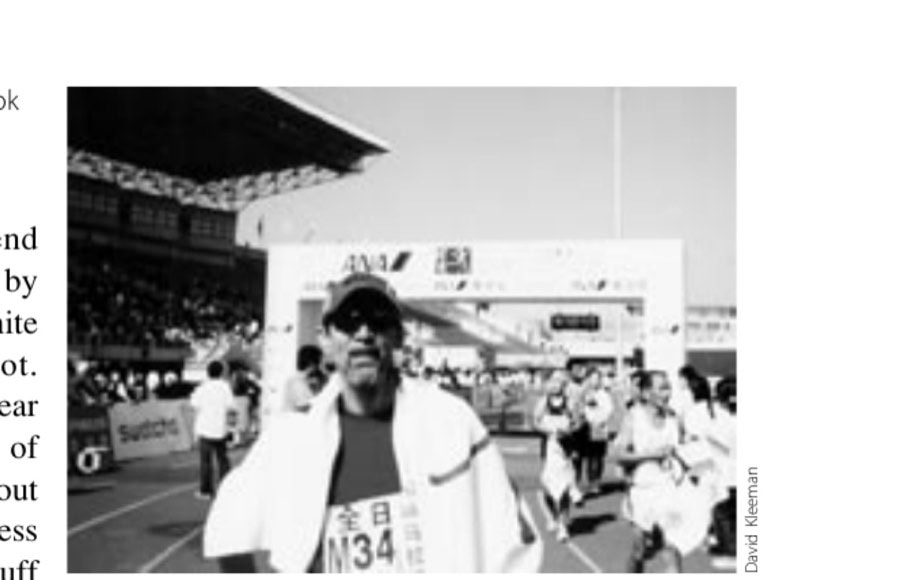
THE END, AT LAST Finally, we turned into the park, into the stadium, and onto the track to finish in around 100 meters. I can’t say I had a finishing kick, but I crossed the line running, at least (4:04:04). A volunteer draped a towel over my shoulders, and I asked another to take my picture with the finish sign in the background. I was desperate for water but first had to go to chip retrieval—a single desk for nonlocal participants where we had to take off our own chip. My CCTV handler had put out 100 yuan (about $12) of her own money for a deposit on the chip, so I had to be certain to get that back.
The snack table (plastic bags with water, a banana, and lemon custard cakes) and the finisher-shirt tables were side by side right next to the single exit from the stadium: a single-wide door. All three were pandemonium (pandamonium?), with people pushing to get in, pushing to get out, pushing in no particular direction. The exit was the worst—dozens of runners trying to exit at once, the people waiting for them crowded around the exit, and a few runners trying in vain to reenter. Policemen and race volunteers were yelling and shoving, trying to keep order. My legs were in no condition to fight the flow.
Fortunately, my friend from CCTV was waiting by the exit, and a tallish white guy wasn’t hard to spot. She walked me to the gear pickup, where hundreds of identical bags were laid out on the ground, more or less by number. We got my stuff and started a several-block walk to the street to find a cab. I tried not to let on how crummy I felt and hoped the water would revive me.
Back at my hotel, I trudged proudly through the lobby and went to my room. I had about four hours before leaving for the airport, just enough time for a cold bath, hot shower, quick e-mail home to report that I had survived, and a very welcome nap.
As I had hoped, the Beijing Marathon was a unique way to see the city, and it was quite a conversation piece at my conference and back home. Unfortunately, the race doesn’t really trace the city’s most beautiful face. In a city of history, parks, and lakes, it spends most of its time on highways and business streets. Still, I have no regrets for my accidental marathon.
POSTSCRIPT That night, I flew home. After napping on my Beijing-Hong Kong flight and getting a reasonable night’s sleep in a curtained napping room at the airport there, I was wide awake beginning the 14-hour flight from Hong Kong to Los Angeles. The movie selection was miserable, but what was this, a Korean film titled Marathon? Indeed, it was the true story of a Korean boy with Down syndrome who loves to run and whose mother finds a washed-up elite marathoner to coach him as part of a court-ordered drunk-driving settlement. The boy fails miserably in his first marathon attempt, ending up in the hospital, but runs sub-3:00 in his second.
David Kleeman
▲
Worldwide, finish lines look similar and very welcome.
This article originally appeared in Marathon & Beyond, Vol. 11, No. 6 (2007).
← Browse the full M&B ArchiveMore like this
1,000+ stories from 19 years of Marathon & Beyond
The complete archive of the legendary long-distance journal — digitized and free to read.
