

Terry Versus The Marathon: Round Three
Hey! Remember me, the kid who wrote that awful New York City Marathon report a year ago? Well, I caught the marathon bug, ran the Boston Marathon, and then signed up for Chicago. I was humbled in New York and Boston by the distance and was hoping to run a strong and consistent race in Chicago. I ran a strong race and was consistent when it counted, but don’t expect the same performance by this race report.
My training for Chicago was very short and sporadic because of a half-Ironman triathlon that I finished at the end of August. I had exactly eight weeks from race day to race day, and since biking and swimming were my main priorities during my triathlon training, the next five weeks were going to be hell on my legs.
I followed the Darryl Strawberry Marathon Training Plan, one of the lesserknown training plans nowadays since most people follow those of Hal Higdon, Jeff Galloway, and Pete Pfpfpfpfitzinger. The Darryl Strawberry Training Plan, for those of you who don’t know, is one of short periods of great training followed by consistent periods of underachieving, oversleeping, and cocaine. OK, maybe not cocaine, but the rest was true. At the height of my training, my junior year of college and work schedule were draining me completely. I had no desire to wake up at six in the morning after being up until midnight doing schoolwork, and running after school and work seemed just as bad, since it meant I’d be up even later doing my homework. Thanks to breaks between classes, I managed to get in as much running as I could. I somehow managed to complete two runs of over 20 miles in my last week of intense training. I was so burned out by the time tapering began that I was doubting my goal time and even worried about finishing.
THERE WE WERE My sister Kate and I arrived at Philly International around 5:30 A.M. on the Saturday of race weekend and enthusiastically made our way toward airport security. After failing the walk through metal detector three times, I was put in the plastic
holding cell made specifically for idiots like myself who forget to take off their belts. As my sister continued down the hallway to our gate, I considered yelling, “Write to me at Guantanamo!” but figured that would decrease my chance of being released quickly. After three minutes, I was released and led to another room to be frisked and wanded, which led to the inevitable Derrick Smalls moment of the metal-detecting wand passing over my groin and buzzing loudly. I pointed out that I was wearing a belt and was released with a warning. This was my first experience flying with Southwest Airlines, and up to this point I was pleased with the fares I had paid and the ease of check in. But then it was time to board. Our tickets were designated “Boarding Group C,” which I came to realize meant, “You’re pretty much screwed. Good luck getting off the plane within an hour of landing.” The boarding groups were arranged like the start of a horse race, with “Pre-Board,” “A,” “B,” and “C” being four corrals in which to stand in order to board the plane. Our boarding groups were probably assigned according to the amount of money we had paid for the tickets, but it was amazing to see the age gradation from group A to group C. I’m not sure if Southwest assigned boarding groups by ticket price or age, but there hasn’t been a higher concentration of permed hair and toupees since the last Neil Sedaka concert at Caesar’s Palace Atlantic City as there was in Group A. Nevertheless, boarding wasn’t too bad and our flight departed on time. Since it was 7:00 in the morning and I had slept five hours the previous night, I had three options for our two-hour flight:
1. Sleeeeeeeeep 2. Read 80 pages for my philosophy of science class 3. Peruse the SkyMall catalog Of course, I chose number 3! I mean, who wouldn’t? Is there a more amazing compilation of random crap in the world? I think not. By calling 1-800-SKYMALL, you can order anything and everything from a nine-and-a-half-pound ham to an iPod dock with an attached toilet paper roll. Page after page made me giddier and giddier, with each new product out-uselessing the last one. The joy of browsing through SkyMall (twice) could be beaten only by a solid nap, so I put my Bon Jovi Gold Record and robotic shark SkyMall order on hold and dozed off for the remainder of the flight.
IN THE WINDY CITY Chicago accepted 40,000 runners, regardless of a previous qualifying time or luck in a lottery. After gaining entry into New York last year by the lottery, I figured my chances at securing another spot in the New York lottery to be very small and instead signed up for Chicago. I was one of the last people accepted into Chicago, which was evident by my bib number: 7,023,917,769pi.
© The LaSalle Bank Chicago Marathon
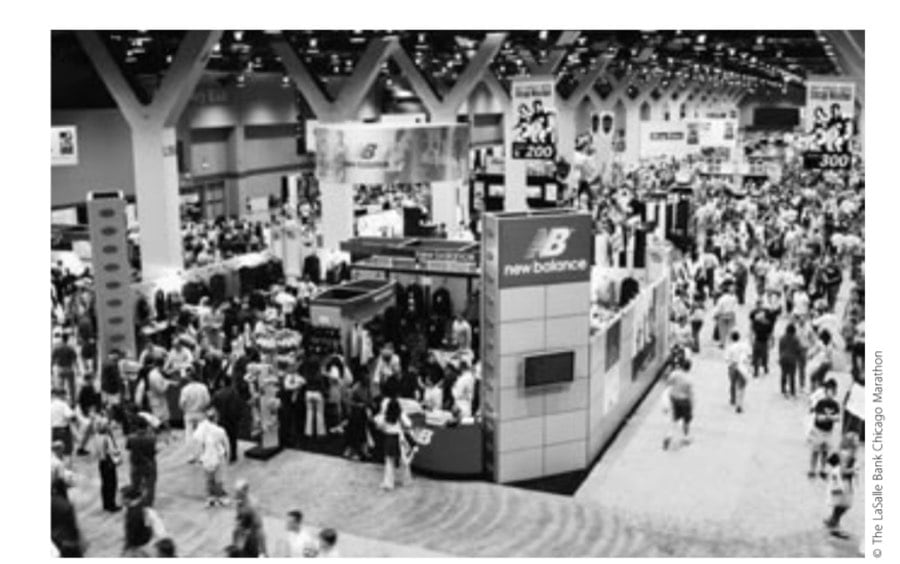
Okay, my real bib number was 40162. However, there was one key aspect of registration that I missed. Chicago has four different starting corrals that are arranged by pace. The elites and top 100 are in front, followed by the Competitive corral, Preferred Is and IIs, and finally the Open start. To be placed in the Competitive or Preferred corrals, you must have run a marathon within a certain time and provided proof of that time to the Chicago Marathon race organizers. Of course, I missed the proof part. My times in New York and Boston had qualified me for the Competitive start, but without proof, the marathon gods had no idea, and I was placed in the Open corral. I was a little annoyed that I could not transfer into a faster corral and dreaded the massive start.
At the expo, I managed to drink at least a gallon of free Gatorade and Powerade, as well as snag a PowerBar or six. While hunting for more free snacks, I came across the Marathon & Beyond booth and its lovely publisher Jan Seeley, with whom I worked during the publication of my New York City Marathon article. She reported that M&B subscriptions had plummeted 40 percent since my report was published, but she was still willing to run the magazine into the ground—I mean give my Chicago report a go. If you’re reading this in an actual copy of Marathon & Beyond, Jan would like to thank you for being one of the seven remaining subscribers.
After the expo, it was time to continue carboloading at Giordano’s Pizza. Did I say carboloading? I meant cheese-loading. I swear I ate like a combined pound and a half of cheese, and I only had two slices of pizza. Having eaten our fill and
▲ Expo—Wait . . . I get free Powerbars? Sign me up!
then some, we waddled through the city to the Chicago Architecture Boat Tour. I was very impressed with the cleanliness of Chicago (but it was being compared to New York, so I’m sure Calcutta would’ve impressed me). This was my first time in Chicago, and I was getting very good vibes from the city. I hoped the vibes would last until tomorrow.
At 9:36, I arrived back at my temporary home for the night. I had eaten dinner with a few friends who were also running the marathon and was ready to get some good sleep after my early wake-up that morning. After preparing my race outfit and bag, I sat down in my bedroom, grabbed my iPod, and prepared to stretch and meditate while listening to John Coltrane’s A Love Supreme. The whole stretch/listen/meditate thing has become a habit for me the night before a big race. I usually don’t have a problem falling asleep before a race, and I hoped that tonight wouldn’t be any different. However, when I turned my iPod on, the little low-battery icon popped up on the screen. Why didn’t you charge your iPod, you idiot! I stretched sans music and lay awake for longer than I would’ve liked, worrying that I may have jinxed the race since my presleep routine had been foiled.
NOT MY USUAL SLY STONE WAKE-UP I usually like listening to Sly and the Family Stone, however, not so much when it’s 5:30 in the morning and when it’s my cell phone alarm sound. I actually contemplated turning the alarm off and going back to sleep. But remembering I had a freakin’ marathon to run, I reluctantly turned on the lights, ate two ClifBars, and started pounding water like a sorority girl pounds Smirnoff Ice. Once I was dressed, I headed out the door to the train station.
Holy crap, it’s cold out! I had multiple layers, a knit hat, and gloves on, and I was shivering. I could’ve sworn that I saw snow flurries, too. Man, this is not looking so good. Standing for 20 minutes while waiting for a train didn’t make me any warmer, and by the time I got to the warm-up area, two trains and an hour later, I was ready to call it a day. But then the magic feeling of race day hit me, and I couldn’t wait to start running. I reluctantly peeled off my outer layers of warmth, checked my bag, and shiver-spaz-walked my way to the huge mass of people who had already lined up at the Open start. All I had left to keep me warm were a pair of shorts, a triathlon top, running gloves, and a nanometer of body fat. I seriously would not be surprised if Robert Cheruiyot (the eventual winner) has more body fat than I do. I put the heroin-chic European models to shame.
I made my way forward on the outside of the corral fence in order to get as close to the start as possible, since my pace was going to be about two minutes per mile faster than the front of the Open start. Just before the starting gun, I had to hop a terrifyingly rickety chain-link fence, putting my nether regions in extreme danger. Fortunately, I dismounted the fence unscathed just as the gun went off.
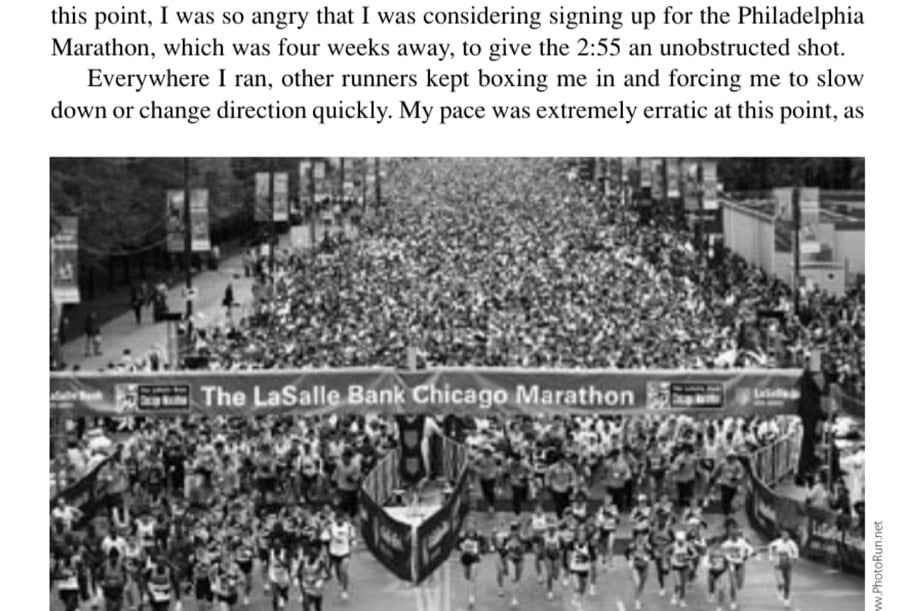
And, they’re off! The elites and other front-of-the-pack people, that is. I was still standing, hardly moving at all, but eventually the crowd in front of me began to shuffle forward, and around seven minutes later, I crossed the line. When I ran the New York City Marathon, I had the privilege of starting at the front of one of the starting lines as part of the Sub-Elite group. In Boston, the seeding system ensures that the people you start with are going to be running the same pace. Chicago was a different story, because of the time confirmation snafu. I realized that I was pretty much stuck with the people around me, which was frustrating as hell.
THE LOGISTICAL PROBLEMS OF A SUB-ELITE
© Victah/www.PhotoRun.net
Coming into the race, I had a time goal in mind of 2:55, which meant I had to run consistent 6:40 miles for the entire race. That 2:55 is a magical time because it is the automatic New York City qualifying time. I had done most of my training at or below 6:40 pace, so I knew what it would feel like on race day. So, here I was, running the first mile of the Chicago Marathon at a 7:40 pace. Are you kidding me? I’m only a mile in, and I’m already one minute behind for the entire race? At this point, I was so angry that I was considering signing up for the Philadelphia Marathon, which was four weeks away, to give the 2:55 an unobstructed shot.
Everywhere I ran, other runners kept boxing me in and forcing me to slow down or change direction quickly. My pace was extremely erratic at this point, as
▲ Start line—Some people get to start running when the gun goes off. They must be good or something.
was my direction, since I was slowing down, speeding up, and zigzagging through people in front of me. I figured this could only harm my leg muscles more and make them even more fatigued. Frustrated doesn’t even begin to describe how I was feeling at this point. All of the training (just eight weeks, I know) had been for naught as I was imprisoned by runners on every side of me. My pace was shot, and my goal time was almost impossible now, as I reached the 5K mark in 22:51, a 7:20 pace. After three miles, I was already two minutes off. If this kind of pace continued, even running under three hours was going to be a challenge.
Before I continue with the rest of the gory details, let me clarify that I have a tremendous amount of admiration for the four-, five-, and six-hour marathoners, because they are out there pushing, fighting, and enduring the pain of a marathon for hours longer than I am. That shows way more dedication than I think I could ever put into a race. All righty, back to the gore . . .
Since it was still cold, I was not sweating too much at all and blew through the first two water stations in order to pass some of the runners in front of me. By the time the fifth mile rolled around, I had made up some ground, and the mass of people was beginning to thin out a bit. I took my first energy gel of the day and started to feel a little better because of the extra space I had to stretch out. At the six-mile mark, I checked my watch: 41:24. Wow! That’s much better than I thought! I must have been clocking some 6:20s in there somewhere. Now I was slightly under a 7:00-minute-mile pace. If I could cut down the time by the half, and then even split, I may have a shot at this 2:55 thing!
BACK IN THE SADDLE AGAIN The thought of overcoming such a horrendous start must have had something to do with my 6:18 eighth mile, 6:20 10th mile, and 6:19 11th mile. By the half, I was right on track, crossing 13.1 at 1:27:17, a hair under 6:40 per mile. If Dick Vitale was doing the color commentary for this race report, he’d be yelling, “Terry’s back in business, baby!” Thankfully, he’s not. Now I only had to maintain a solid pace for the second half. Unfortunately, my second-half splits in my first two marathons had been positive (including a nine-minute positive split in New York). To keep pace, I would really have to focus.
Because of the possibility of attaining my goal, I paid very little attention to the racecourse. During the middle portion of the race, the course heads out west of the city, which wasn’t the most exciting area, and then turns back toward the city. There is one thing I do remember, however, around mile 15 when we were running back toward downtown Chicago: brownies. I could smell brownies for almost a half mile. I was tempted to drop out and seek them out but then remembered that I could not be distracted from keeping pace and also that I had over 10 miles left to run at that pace. Crap.
Until the 20th mile, I pushed the pace a little under 6:40, just in case the last few miles were really difficult. In my first two marathons, I had cramped or been on the verge of cramping in the last three miles (if you were unlucky enough to read my New York City Marathon report, I’m sure you remember the implosion around mile 23). I knew that slowing down was not an option if I still wanted a shot at 2:55.
Just before the 23rd mile, my legs began voicing their concerns about the remaining distance and the pace that they were running. I glanced at my watch and noticed I had just under 22 minutes to run the remaining 3.2 miles to break 2:55. Man, this was going to be close! I decided to run miles 24 and 25 a little slower, just under 7:00 pace, and then see what I had left for the last 1.2, rather than keep pace and risk major crampage. I was able to run the next two miles around 6:55 each, setting me up for the final showdown.
At the 25th-mile marker, I noticed that I had exactly eight minutes to finish under 2:55. By this point, my legs were screaming. It was here where I felt the first really strong wind of the day. Oh, great, the infamous Chicago wind waits until I’m within minutes of finishing and then it shows up. Battling ferocious wind and whiny leg muscles, I pushed on, repeating the mantra, The mind controls the body, over and over in my head. With one mile to go, I checked the old watch again and saw that I had exactly 6:40 to finish under 2:55. Are you serious? Disney couldn’t have scripted this any better! Someone get Michael Eisner on the phone! Six-forty was my goal pace, the pace I had trained for. Every aspect of my running life for the past eight weeks was devoted to the 6:40 mile, and now all I had to do was run one more.
WHO PUT MOUNTAINS IN CHICAGO? The wind continued as I picked up the pace and inched closer and closer toward the finish line. With 800 meters to go, the course turns right and proceeds up the
© Victah/www.PhotoRun.net
▲
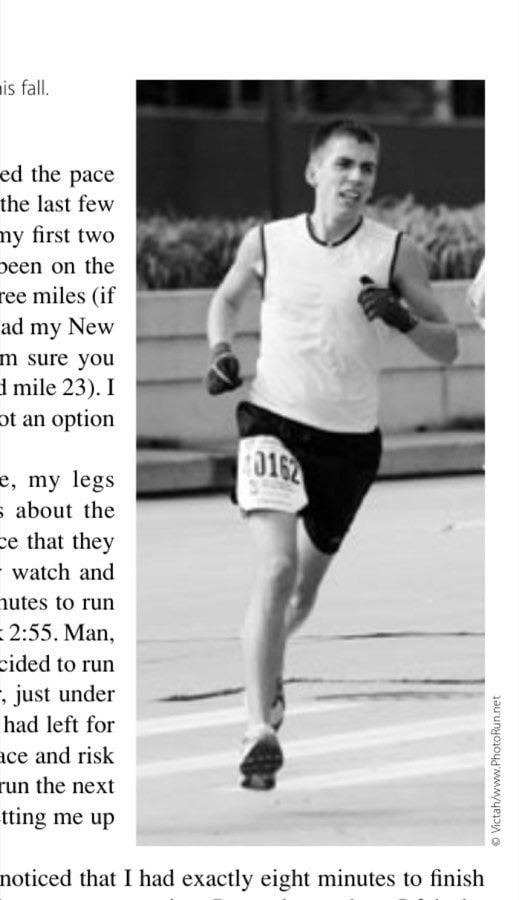
Running—Gloves are soooo in this fall.
• Chip time: 2:54:46 • 1st half: 1:27:17 • 2nd half: 1:27:29 (Damn, another positive split by 12 seconds. At least it wasn’t nine minutes.) • Avg. pace: 6:39/mile • Place: 661st • Donut and hot chocolate: $1.87
Kate Moore
only significant hill on the course. After running Boston, I had had my fair share of hills, which was another reason why I chose Chicago, but now I was faced with something that looked like a speed bump in comparison with Heartbreak Hill, and yet it felt like I was climbing a mountain.
The mind controls the body, the mind controls the body; come on, Terry, you’ve got this thing! I finally made it to the summit, reaching the “400 meters to go” sign. Just a little more, and I could stop. Seeing the finish line kicked me into another gear, as I zipped down the homestretch, legs ablaze. I clicked the stop button on my watch as I crossed the mats.
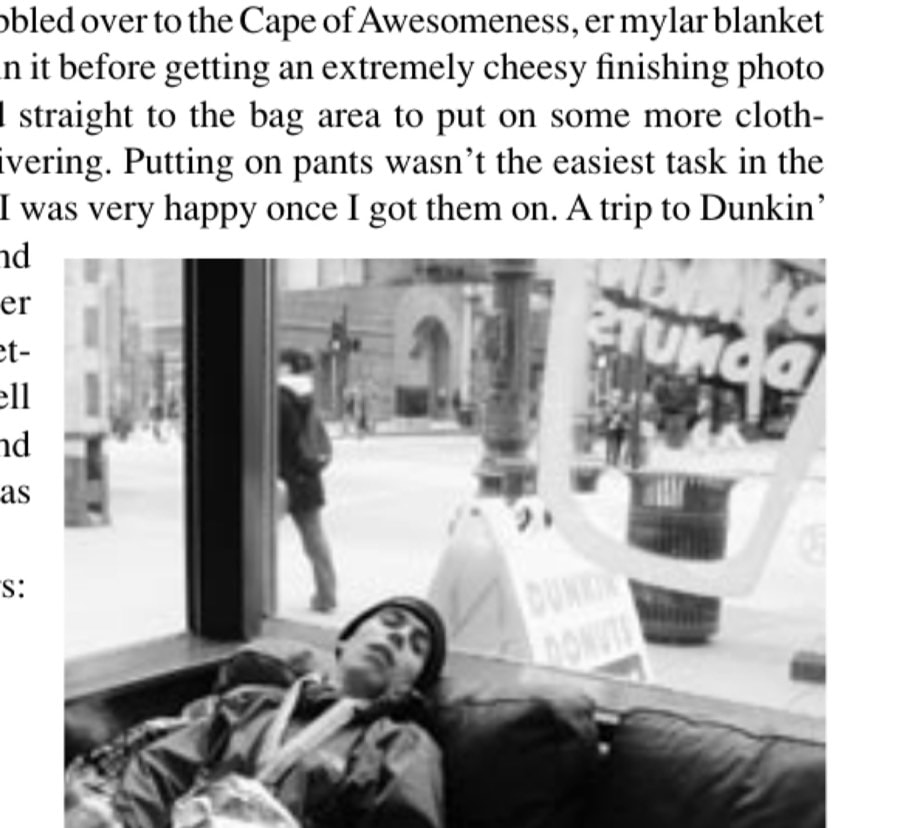
The guy next to me puked. Oooh, are those undigested Gummi Bears? Terry, check your time you idiot! Oh, yeah . . . 2:54:46 Woohoo! I excitedly hobbled over to the Cape of Awesomeness, er mylar blanket area, and wrapped myself in it before getting an extremely cheesy finishing photo taken. After that, I limped straight to the bag area to put on some more clothing since I was already shivering. Putting on pants wasn’t the easiest task in the world at that moment, but I was very happy once I got them on. A trip to Dunkin’ Donuts for hot chocolate and donuts with Kate and her friends was the key to getting warm again, and I’ll tell you, a hunk of trans fat and artificially flavored water has never tasted so good. Here are some numbers:
▲ Dunkin’ Donuts—Obviously ecstatic over my performance.
How could I not be pleased? I’m ecstatic that I broke my goal time after such an awful start, but I’m even happier to have been able to run this race and enjoy it.
This article originally appeared in Marathon & Beyond, Vol. 11, No. 5 (2007).
← Browse the full M&B ArchiveMore like this
1,000+ stories from 19 years of Marathon & Beyond
The complete archive of the legendary long-distance journal — digitized and free to read.
