

That Sinking Feeling
THE WATER taxi driver called me out of the warm, wood-paneled cab of his motoscafi and pointed through the pouring rain. The lights of my hotel reflected off the water of the Grand Canal, water that overflowed the canal, covered the hotel’s dock, and rippled over the sidewalk nearly to the hotel door.
“Izz impossible,” the driver said, steering the boat to a public landing a mile away. Toting my bags over the slick steps of an arched bridge and along the flooded sidewalk, I asked the question that people had been asking me ever since I announced my plans to run the Venice Marathon: “How do you run a marathon there?”
In the morning, everything was different. The tide had fallen, and as I set out to explore, a hazy sun sparkled across the canal’s ripples. Venice, quite simply, overwhelmed me. Every town in the world with more than one canal calls itself the “Venice of the North” or “Little Venice,” but unlike all these other “Venices” I’ve encountered, the canals here aren’t minor forays into a predominately land-based culture. Here, canals are the base, with “land” artificially built around them. Boats carrying everything from commuters to mail to freshly pressed laundry speed through the maze of waterways, stopping at docks where their goods continue on foot to their final destination.
Venice peaked as a world power in the 15th century. At the time, the smoothest, fastest, and most civilized way to travel was by boat. Although the Venetians had fled to these islands in the lagoon 1,000 years earlier to escape attacks from northern Teutonic raiders, their waterborne lifestyle was well suited to conduct the Eastern trade that fed their wealth, and to cater to the high society that wealth produced.
In contrast, land travel of the time was slow, bumpy, and dirty. In Venice, they could step smartly from their boats directly to their door, or gently walk the short, stone-paved streets and squares between the canals.
Five hundred years later, in the 20th century, the world travels by land and air. Venice, however, remains both a waterborne city and a pedestrian paradise. Not even Italy’s ubiquitous motor scooters are allowed past the parking lot at Piazza Roma at the end of the two-mile bridge from the mainland. In no city on Earth is it more necessary, or more pleasant, to go by foot.
Wandering this maze of traffic-free lanes, blissfully lost half of the time, I speculated that it might be possible to find 26.2 miles of “road” within the city’s three square miles. And that would certainly be a memorable run: winding through alleys, crossing ancient bridges, and splashing through flooded courtyards. But staging such a race, I realized, would require capping the field at 50 and evacuating the rest of the population. Another option might be to precede the race with uniformed “front-runners,” like those I saw clearing the way for a group of construction workers rolling a giant spool of cable through a narrow lane. Of course, at marathon pace, they’d be more like football blockers, which might get rather ugly.
So how do they run a marathon here? I continued to wonder. I discovered the answer when I examined the course map later in the day: They don’t run a marathon here. They do what many Venetians have done to live in the modern world: move to the mainland.
In the past 30 years, the city’s population has shrunk from 138,000 to fewer than 70,000. Vincenzo Sambo, the marathon’s consultant for foreign competitors, is one of those who left. He considers Venice home but says it is too expensive and too logistically difficult to stay there. His compromise is to live just across the bridge in the modern city of Mestre and commute into his work in Venice.
The marathon’s compromise is to start more than 20 miles northwest of the city and not enter pedestrian Venice until the final two miles. Even for this limited invasion, they have to modify Venice to accommodate the runners. Wooden ramps cover the steps of the 18 arched bridges along the route, and a special pontoon bridge spans the Grand Canal, keeping us on the relatively wide walkway bordering the southern waterfront.
I’ve never felt so high-maintenance. While I had to acknowledge that the alternatives were impossible, the compromise bothered me. I had never before made the connection between road running and . . . well . . . roads. I resented the realization that we need these wide, smooth, relatively straight throughways designed for automobiles to conduct a 20th-century mass marathon.
WHY WOULD YOU RUN A MARATHON HERE?
So, having answered “How?” I found myself asking “Why?” Why even bother trying to run a marathon “in” Venice? One answer is tied to the city’s uneasy balance between the modern and the medieval. The fact that Venice hasn’t changed in 500 years is what brings visitors here—visitors who often double the population and provide the majority of the city’s income. Yet Venice is more than a museum where tourists wander empty streets admiring the elegant decay. Venice also wants to present another image to the world: that of a living, modern, vibrant city.
In the early 1980s, Piero Rosa Salvo, former high-jumper, member of one of Venice’s leading families, and then head of the regional athletics federation, had a goal of raising the sporting image of the city. That he was able to convince the city’s leading businessmen that a marathon was the appropriate event reflects running’s place in the cultural life of the 20th century. No other single-day sporting event can attract as wide a base of participation and as much media attention while highlighting the city itself, thus projecting both sides of Venice’s somewhat schizophrenic character.
So, that’s the city’s reason for hosting a marathon. As for the runners, the simple answer to “Why run a marathon here?” is that marathons are what we do. We travel to marathons because marathons have become an excellent excuse to go places we’ve never been. Just like anyone else, a marathoner likes to say “I’ve been there; I’ve done that.” The fact that Venice is an improbable place to run just makes it all the more attractive.
A small few come for fast times, prize money, and reputation. Venice caters to all, striking a compromise between the scenic and the sporting. Up front, they’ve consistently drawn deep fields, led for many years by well-known Italian greats including New York City Marathon victor Orlando Pizzolato and Olympic and Boston champion Gelindo Bordin. Recently, the list of champions has expanded to Africans like Kenyan Japhet Kosgei, who won last year and went on to triumph at Rotterdam in the spring. The course record, set in 1995 by Italian Danilo Goffi, is a world-class 2:09:26.
Back in the pack, the marathon has become Italy’s largest by a wide margin, attracting close to 6,000 runners in this, its 14th year. Despite their efforts at making Venice runner-friendly, Julia Jones, head of Italian promotion, reports that the 1999 field is close to their limit. When a peak field of 8,500 showed up in 1995, the overcrowding disrupted the race from the start—the elites were pushed past the starting line, resulting in controversy of Olympic proportions—to the finish, where midpack runners had to queue for nearly five minutes to cross the finish line.
Like most of the other 6,000, I was here as one of the tourist pack, drawn by an image of crossing the Grand Canal with Piazzo Marco in front of me. I had no intention of setting a PR. Frankly, I was more interested in the experience and the T-shirt than the course elevation profile or split times locations. I hadn’t even examined a course map closely before I arrived.
HOW SHOULD YOU RUN A MARATHON HERE?
This variance from my usual MO confused me. My question had shifted to: How should you run a marathon here? The race organizers repeatedly assured me that this was a fast, PR course. The course map, however, showed clearly that the part that made the trip worthwhile didn’t start until the last two miles. More than once in the past my view of the last two miles had been the spot of ground where my next step would land, surrounded by a soft-focus tunnel. Could I justify the risk of stumbling through some of the most memorable running of my life in a postwall stupor, or worse, not making it there at all? Then again, it seemed a shame to waste good training and a fast course on a slow time.
I decided not to decide but to let it come as it may and try to focus on the experience. That was easy on race morning when I left my hotel at 6:30 A.M. In the predawn darkness, I felt squarely in the 15th century as I walked toward Academia Bridge along cobbles glistening from the night’s rain. Quiet conversation and laughter echoed in the lane as four locals walked toward me from the Grand Canal.
At the canal, I found one other runner waiting for the “vaporetto,” Venice’s water bus. He was from Rome and knew about as much English as I did Italian.
Our conversation was short. An older lady joined us, and we sat in silence watching the reflections and listening to the slap of waves against the piers as the first working boats of the morning glided up the canal.
Fifteen minutes passed. The vaporetto arrived, full of brightly clad, talkative, 20th-century runners. I stayed on the periphery to enjoy the anachronistic boat ride up the canal. The Rialto Bridge glowed elegantly as we glided beneath. Warm lights shone behind arches framing an open court below a sagging mansion.
The boat was a local, and the ride soon lost its tourist appeal as the time rapidly approached when the last bus was to leave Piazza Roma, and we made yet another slow, sliding stop. We eventually arrived and found several hundred others still waiting. A few minutes later, I squeezed onto a bus just before the doors closed. My companions in the doorwell were two Jamaican women who had come with a group of 20 others from their club in Kingston. They chose Venice because it was a great destination and reportedly a fast course. Several of their group wanted to qualify for Boston. I again wondered what my strategy should be.
Everyone on the bus, and later in the potty lines, seemed to be foreign to Venice, although I knew that foreign runners made up only 25 percent of the field. I understood that locals probably didn’t need the bus from Venice, but didn’t they need to use the toilet beforehand?
JUST DOING IT
I made it to the start line just as they released the gaps between corrals, and I nearly got trampled. Then we were off, right on schedule.
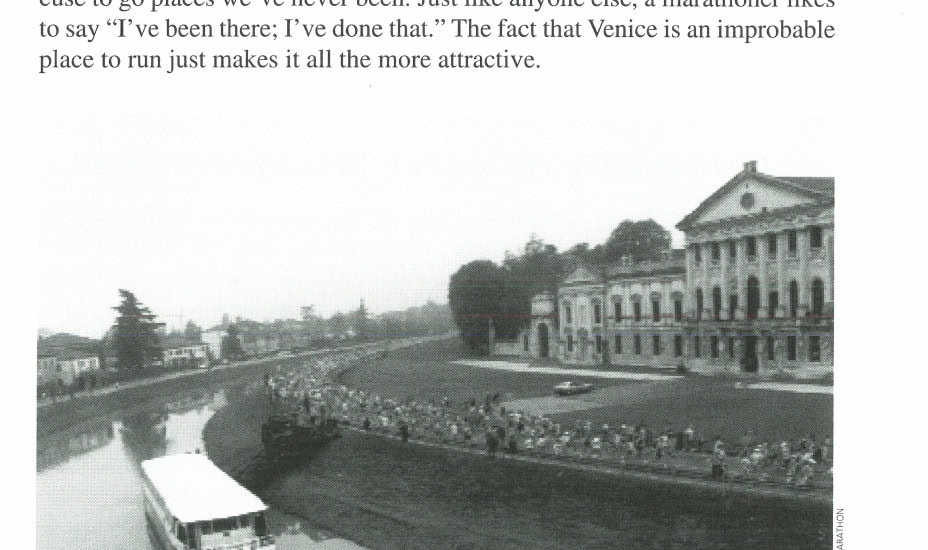
In a quarter-mile we were out of town, running on a road bordering the Brenta Canal. On the left we caught glimpses of the Villa Pisani mansion in its wide grounds behind tall, ornate gates flanked by spiral staircases. The runners stretched out before me, a colorful snake curling along the green banks of the canal, disappearing ahead into the thick fog.
This was the view for the first 20 kilometers: the canal on our right, bordered by gray-sided mansions with tile roofs and dark wood shutters. The mansions, I understood, were built by Venetians during the height of their wealth and power to escape the heat and humidity of the city. Occasionally, we passed a small vineyard. Several red and white gondolas plied the canal, most of them rowed by two to six standing men. One, though, was large enough for 20 rowers; white lettering on the side indicated the gondola belonged a local sporting club. Some of the rowers waved and cheered.
The road was perfectly flat; the air pleasantly cool, if a bit sticky in the fog. Without ever making a decision, I settled in to a 3:00 pace, about 10 minutes slower than I felt my fitness allowed, yet fast enough to feel like a race. Many of the runners around me wore red circles stating “My goal is 3 hours.” I tried to start a couple of conversations but failed, either because of language incompatibility or that the 3:00 quest was taking too much of their concentration.
Speaking of concentration, we passed a row of fishermen arrayed evenly along the far bank, each with a phalanx of long poles waving above him. Not a one even raised his eyes to watch us pass: obviously, 6,000 runners were less interesting than their fishing lines bobbing in the current of the canal. We attracted a bit more attention when we passed through town squares bounded by old churches and clock towers. It took me longer than it should have to figure out that “Bravi” was the plural of “Bravo” or “Brava.”
Just after 19K we turned away from the canal and immediately into a marshy industrial wasteland, the road slicing between fenced factories and smoking refineries. The industrial zone relented, and we ran through agricultural land, then entered suburbs that grew increasingly urban for the next 10K.
The run was growing long, and I tired. I struggled to maintain concentration and pace as we circled neighborhoods of concrete apartments and generic commercial streets. The scenery was not diverse nor unique enough to hold my attention, I had still failed to start a conversation with a fellow runner, and I didn’t have a time goal strong enough to occupy myself with hitting splits and maintaining form. The effort to continue seemed pointless. Finally we headed south, buoyed by a sign that read “Venice: 5km.”
Miles of more highways, ramps, and underpasses. Later we reached the bridge, stretching into infinity over the lagoon.
MAKING CHOICES AND MEMORIES
Approaching the 35K water stop halfway across the bridge, I calculated that I was close to pace and could still break three hours if I sped up just a little the last four miles. Somewhat to my surprise, I went the other way. I stopped, pulled the last GU from my shorts, took a bottle of Lete acqua minerale (I had grown accustomed to its “natural effervescence” by now), and walked until I had finished drinking. I watched two groups of runners I had just passed go by, then started again at about the same pace, but without pushing for a time barrier.
The Tronchetto parking garage slowly materialized out of the fog. We passed it, skirted the edge of the island, and descended an ugly roadway behind railroad tracks and industrial docks on Venice’s dark underbelly. I stopped again for a walk and drink at the 39K water stop, just because I felt like it.
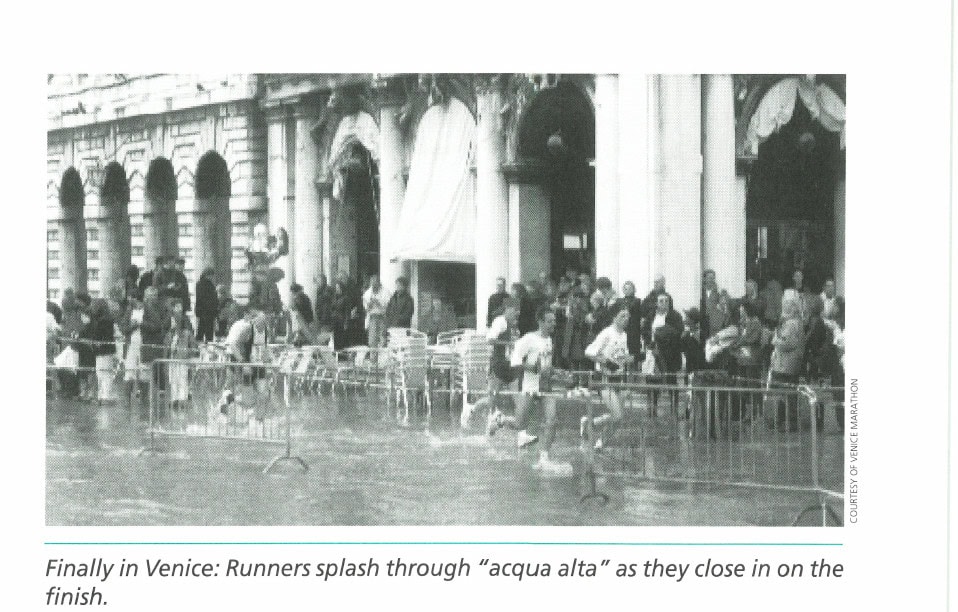
A few hundred meters later, I crossed over a small canal and under the balloon arch marking the entrance to pedestrian, medieval Venice, and it was a whole new run. Spectators cheered. We splashed childlike through flood waters rolling over the sidewalk in little waves. Even the sky seemed to brighten. It had the feeling of a trail run, but in the middle of incredible human scenery: old palaces on our left, gondolas and yachts on the Giudecca Canal on our right, domes and steeples rising out of the water in the foggy distance. We clattered up and down the boards over the arched bridges, negotiated rough cobbles, reduced to a single file along a narrow walkway and around sharp turns, and, too soon, crossed the Grand Canal on the marathon’s famous, and surprisingly stable, pontoon bridge.
Enrico Jacomini, the marathon’s president, had told me that the hours that the bridge is in place marks the only time in Venice’s history that the Grand Canal is closed to navigation. It had required three years of negotiation to convince the city to allow the bridge to be built: the first year the race finished in a square just past the bus station at Piazza Roma; the second year it ended at the Basilica della Salute on the south side of the canal. Finally won over by the success of the race, both numerically and financially, the council relented, and the pontoon bridge has been built every year since: a runner’s causeway direct to Piazza San Marco, Venice’s central square.
I bounced across the planks, trying desperately to capture and hold the brief, once-in-a-lifetime moments. After splashing through deep “acqua alta” at the edge of the Piazza and climbing over many more bridges, I began to tire of them and look forward to the finish. Eventually, I heard the announcers countdown to three hours from up ahead, and two minutes later I crossed the final bridge and finished strong with a smile on my face. A half-hour later I had found my wife, negotiated the maze of streets and high water back to the Academia Bridge, and was enjoying the view with the other tourists.
DOUBTS AND DENOUNCEMENT
I didn’t regret for one minute coming to Venice. I wouldn’t want to have missed this city—but I still felt ambiguous about the run. I didn’t have the satisfaction of having given my best effort, and I wondered about my choice to intentionally not break three hours, which somehow seemed antithetical to the entire idea of a race, with numbers, clocks, results, and all. If they’re going to go to all that trouble, and start all the way out in Stra so that I can do the run with 6,000 others, it seems I should have tried to set a time I could be proud of. Otherwise, I could have just gone for a run myself along the waterfront in Venice.
As more time passes, however, I find myself forgetting the long road through the mainland, my time and my doubts, and remembering only the rush of senses and emotion as I charged through those final two miles. I still don’t know if that short finale was worth the 24 miles of highway preceding it, but I’m happy to have the memories. Perhaps it requires a marathon distance to prepare us to fully appreciate running in such a setting. If nothing else, it made me glad to see the finish rather than disappointed that my Venice run didn’t last longer. And I do have a great souvenir T-shirt.
Venetian Recommendations
- Stay in Venice itself. Sure, it’s logistically complicated to navigate the canals on race morning and hard to find places to run. But this is Venice. As for running, how much do you need to do the days before and after a marathon anyway?
- Forget worries about being on your feet before the race and go out and explore, get lost, wander back alleys, avoid the crowds (which drain you more than walking), find a quiet corner, and sit on the steps of an old cathedral watching boats go by.
- Pass up the prerace pasta party (which was a disappointing selection served on picnic tables in a drafty tent in a parking lot) and find a restaurant near your hotel to eat the night before. I ate at a little place with a view across to Giudecca and afterward strolled along the canal in the cool evening, checking out the race course.
- Buy extra vaporetto (water bus) tickets and an extra public toilet access card the day before to use on race morning. You can find a public toilet near Piazza Roma where you wait for buses to take you to the start.
- Bring your own water and any food that you want before the race to the start. I never found water at the start and settled, regrettably, for half a cup of hot tea. I was very ready for my first water bottle at 5K.
- Decide beforehand to either run the course hard or very easy. The course is flat and conducive to fast times despite the small hills in the last two miles, and you can do your sight-seeing at other times. But, if you’re more interested in the experience, slow down enough to make friends, distract yourself for the first 24 miles, and don’t worry about falling well short of a respectable time when you cross the bridge into Venice.
- Whatever you decide, when you reach Venice, soak up every memory. The experience passes all too quickly. In six months you’ll look at pictures and have to work hard to convince yourself that such a magical place really exists and that, yes, you ran there.
This article originally appeared in Marathon & Beyond, Vol. 4, No. 4 (2000).
← Browse the full M&B ArchiveMore like this
1,000+ stories from 19 years of Marathon & Beyond
The complete archive of the legendary long-distance journal — digitized and free to read.
