

The 10 Best Ultras for First-Timers
So you want to run an ultramarathon, do you?
You want to run 26.2 miles and then keep going? You want to taste blood, salt, vomit, or whatever else goes in or out of your mouth over the course of many hours of running? You want to blister your feet so that some toes might not be recognizable? You want to mutilate your quadriceps muscles to the point that you can’t travel up or down a set of stairs for days?
Let me begin again.
You wish to gallivant through gorgeous natural settings? You want to spend a day (and maybe a night and another day again) with like-minded and oft-quirky people? You want the experience of pushing your body beyond a previously set limit and discovering a new version of you?
If so, you are not alone. Running an ultramarathon—defined as any run or race in excess of a marathon’s distance—is becoming a wickedly popular pastime. UltraRunning magazine, the long-standing print purveyor of race reports, schedules, and news from this niche sport, reports that 2008 saw 30,789 ultramarathon race finishes. And just four years later, in 2012, the magazine estimated that 60,000 ultra finishes happened. This massive increase in ultramarathoning popularity is evidence that the sport is growing rapidly, even as you read this. What I mean to say is that, if you would like to do something as loony as this kind of racing, you will have frequent company.
And I also mean to say that this article is here to guide you through the muddy waters of the marathoning-to-ultramarathoning transition. In this article, I’ve enlisted the help of longtime ultrarunners, the sport’s elite, a couple of my ultrarunning friends, and my own experience to create a list of 10 fantastic, first-timer, ultradistance races from around the United States and Canada. In addition to naming names, we’ll tell you why we think each race is a good fit for an ultra-noob. You’ll find that, while most of these races are shorter ultras, there is a wide range of terrain type—from road ultras to races held on fairly techy terrain—to satisfy lots of different kinds of runners.
Without further ado and in no order of preference, here we go!
Chuckanut 50K
This Fairhaven, Washington, ultra, which ran its 21st edition in March, gets the nod from two folks within our passel of ultra experts. The course is a lollipop, with 20 kilometers on a flat-and-fast gravel path and 30 kilometers on mountainous single track with 5,000 vertical feet of climb.
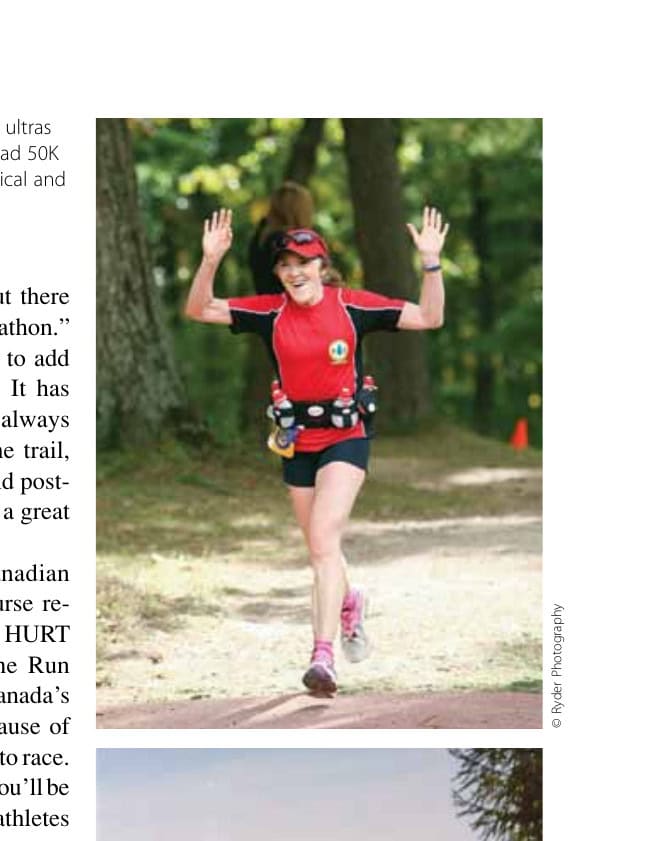
Ellie Greenwood, the 34-year-old course record holder for the Western States 100, says that this mixture of easier and more difficult terrain is the best part about this race. “This is a great event for someone who wants to tackle a little technical terrain yet still use some of their road-running speed on the flatter sections.” And California-based chef Devon Yanko, who has a marathon PR of 2:38:55 and a 50K PR of 3:32:02, adds, “Race director Krissy Moehl puts on such a fantastic event that everyone feels like family.”
Jed Smith 50K
Devon Yanko also recommends the Jed Smith 50K, held in Sacramento, California. “Jed Smith is a great race for you to ease into ultras. The only element you are adding from a marathon is additional distance, as it is flat, mostly pavement, and loops. And it makes for easy self-crewing so you’ll have access to all the nutrition you need.”
Many ultramarathons take place on some seriously burly terrain that you have to learn how to run, and that just plain takes more time to cover. But not at Jed Smith! The 4.5-mile bike path and wide, flat, trail loops are benign terrain that allow you to focus on pace and nutrition.
Pineland Trail Running Festival 50K
We’re skipping to the other side of the country with this excellent newbie ultra in May in New Gloucester, Maine. The race is part of a weekend-long festival during which it’s impossible not to feel the warmth of the trail- and ultrarunning community.
Vermont-based Aliza Lapierre, a Salomon-sponsored ultrarunner and educator, offers the following description of running this race: “The course gently rolls through open fields, wooded double track, and working farmland. The terrain is grass, pine needles, and some buffed-out track. The aid stations are lively, and you can easily see your crew and adoring fans during the race. And the best part after crossing the finish line is receiving a coveted cowbell and listening to live music as you enjoy food straight off the barbeque.”
JFK 50 Mile
Running 50 miles for your first ultramarathon? While some folks might find that mileage daunting, others are tempted to see just how far they can go. If you’re one of those mileage-hungry runners and you would like to experience the history of ultrarunning, Maryland’s JFK 50 Mile might be just right for you.
This race has taken place every year since 1963! And 40-year-old McMillan Running coach Ian Torrence has a long list of reasons he loves this race, including its long history: “I appreciate its long-standing tradition (well-dialed aid stations and race organization), large starting field (more folks to commiserate with), high level of competition, great fall weather, the fact that it takes place close to many urban centers, making it easy to get to, and its course variety.”
Prolific and supersuccessful runner Mike Wardian, who loves to race everything from road 5Ks to mountain 100-milers, also recommends the JFK 50 Mile as a first ultra. “It was mine!” Mike agrees with Ian that the race’s rich history makes running it a meaningful experience. He adds, “It’s also one of the biggest 50-milers in the country, and this adds excitement to the day.” Regarding Ian’s reference to course variety, Mike elaborates, “It has trails, a gravel towpath, and then roads, so someone with a road-running background won’t be too out of their element.”
The North Face Endurance Challenge 50K races
Mike Wardian also endorses The North Face Endurance Challenge races, which take place in a variety of locations around the country each year. In 2013, there are five race locations in New York, Washington, DC, Wisconsin, Georgia, and California. At each of these events, a half-dozen or more races of a variety of distances take place, including a 50K.
“The fact that these races take place all over the country makes them geographically accessible to many people,” begins Mike. “The 50K is a great distance to start with in ultras, and since The North Face puts on a first-class event that includes crazy-nice swag and well-marked and -staffed courses, these are easy environments to transition into ultramarathoning.” Wardian so loves these events that he has two of them on his 2013 race schedule.
Run for the Toad 50K
Two of our ultrarunning experts say that this race is a great environment in which to become an ultrarunner. About this race, Ellie Greenwood says, “In Canada, Run for the Toad 50K is held every October in Ontario and is a super event. It’s held on a 12.5K loop trail that’s nontechnical and rolling. This means that race times tend to be fast, so it’s a good way to test the waters, as it’s not an
event where you’ll be out there hours longer than a marathon.” Ellie has one more thing to add about the race: “People. It has a large field so there is always plenty of company on the trail, and there is a fab expo and post-race meal, and both have a great atmosphere.”
Gary Robbins, a Canadian race director and the course record holder for Hawaii’s HURT 100, also vouches for the Run for the Toad 50K, “It’s Canada’s most-attended ultra. Because of that, great talent turns out to race. The course is looping, so you’ll be inspired by watching top athletes duke it out.”
Le Grizz Ultramarathon
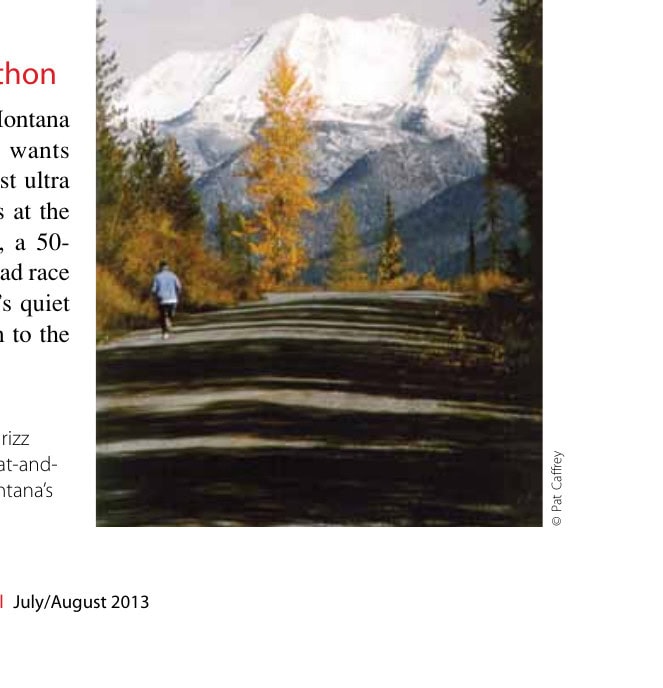
Multisport athlete and Montana lawyer Danni Coffman wants you to come run your first ultra in her neck of the woods at the Le Grizz Ultramarathon, a 50-mile, flat-and-fast, dirt-road race taking place in Montana’s quiet backcountry. “In addition to the easy terrain, the race takes place on a road,” explains Danni, “so you can have a crew the whole time.”
I raise my hand to vouch for this race. I ran its 31st edition last fall and had a fantastic time. I’ll also add that the course contours the shores of Hungry Horse Reservoir during October when the larch trees are often bright yellow in color, so the scenery will buoy you along your journey, too. And while this race is called Le Grizz and while it technically takes place in grizzly-bear country, there are enough runners and crew vehicles out there that your chances of seeing one of these ursine beasts is quite slim.
Pocatello 50-Mile Trail Run
Let’s stay in the Rocky Mountain region for one more race, the toughest-terrain race to make this top-10 list. Every once in a while, there is a budding ultrarunner who comes from a backpacking or hiking background, someone who has already spent a bunch of time climbing and descending big mountains. If you’re the kind of person who knows and feels comfortable in burly environs, you’ll enjoy the Pocatello 50-Mile.
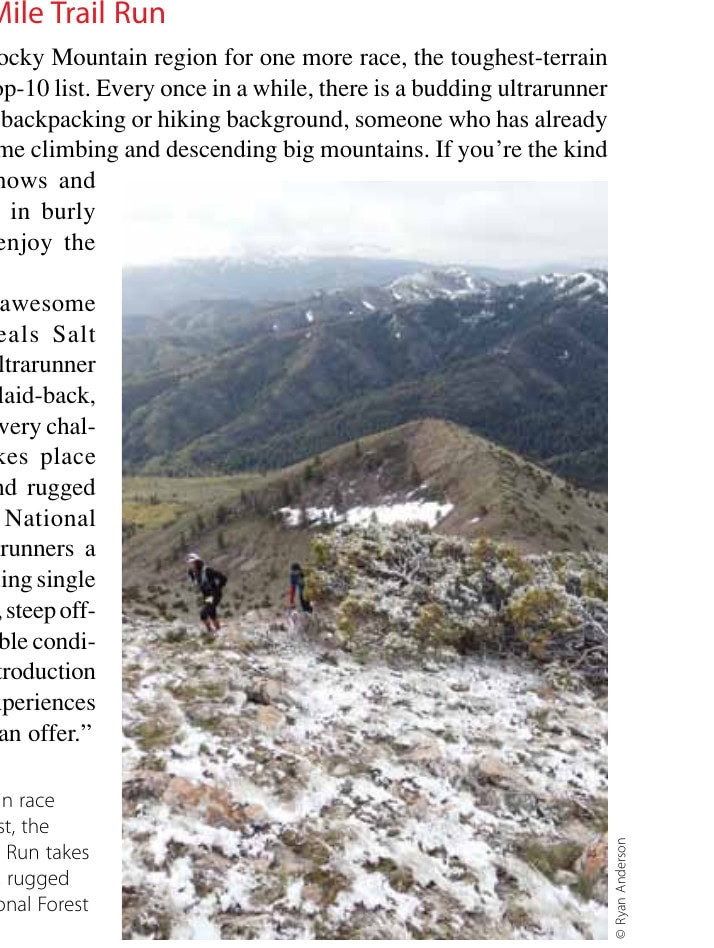
Why is it so awesome but tough? Reveals Salt Lake City-based ultrarunner Ben Lewis, “This laid-back, very well-run, and very challenging event takes place in the beautiful and rugged Caribou-Targhee National Forest and offers runners a combination of rolling single track, plentiful vert, steep off-trail sections, variable conditions, and a great introduction to the range of experiences that ultrarunning can offer.”
Let’s hold the phone a minute here; yes, indeed the Pocatello 50-Mile has a couple of off-trail-but-marked sections. Again, and only if you’re backcountry experienced, read on for the rest of Ben’s explanation. “It was my first 50-miler and my second ultra, and it immediately hooked me on challenging mountain runs.”
Pemberton Trail 50K
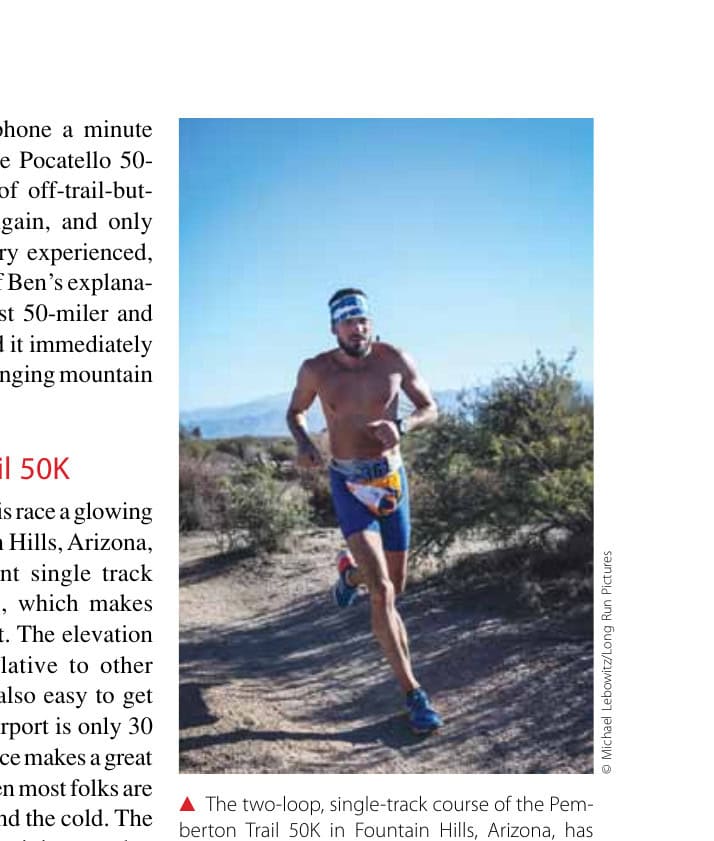
Ian Torrence gives this race a glowing review: “In Fountain Hills, Arizona, it’s now 100 percent single track run over two loops, which makes it difficult to get lost. The elevation gain is minimal relative to other trail 50Ks, and it’s also easy to get to, as the Phoenix airport is only 30 minutes away. The race makes a great February escape when most folks are fighting snow, ice, and the cold. The starting field is small, giving you that grassroots, low-key, ultralike feel.”
Glacial Trail 50K
The 27th version of this race will be run in October of this year outside of Greenbush, Wisconsin, in the Kettle Moraine State Forest. While I haven’t run this particular race, I have run and raced on the trails over which this race takes place, and it is this terrain that makes this race perfect for the ultra-noob. Glaciers gently carved this part of Wisconsin during the last Ice Age and, as a result, the land is constantly but mildly rolling.
The Glacial Trail 50K takes place on single track that winds side to side and up and down around all of these undulations but is not so technical and rough that it will slow you down and leave you out on the trails for a very long time. In addition, it is common among new ultrarunners, for example, to see their quadriceps fail them before other muscles. On this race’s terrain, because you are constantly changing directions, you are using different muscle groups and preventing one set of muscles from fatiguing too early.
This article originally appeared in Marathon & Beyond, Vol. 17, No. 4 (2013).
← Browse the full M&B Archive1,000+ stories from 19 years of Marathon & Beyond
The complete archive of the legendary long-distance journal — digitized and free to read.
