

The 10 “Easiest” Marathons in North America
Over the last 25 years, my husband, Steve, and I have run hundreds of marathons in all 50 states several times. The marathons have been in mountains, on flat courses, and in every possible weather condition. It may not make sense to folks who have never run a marathon to tell them that there are easy marathons. The nonrunners are probably more perceptive than those of us who do many marathons every year. A marathon is still 26.2 miles, and running that distance in and of itself is a difficult task.
Running many marathons doesn’t make the task easier; it just makes us more prepared to run in any condition. Our ideas of easy marathons have also changed through the years. We both ran our PR (personal record) marathons in mountains. Our list does not include the huge marathons with tens of thousands of marathoners. Large marathons provide their own challenges because of the logistics to care for so many runners. We have found small marathons to be more personable and relaxing. The races we have chosen as “easy” are races that had the following criteria: easier to travel to, fairly easy courses, and friendly running conditions.
B&A Trail Marathon in Severna Park, Maryland
The Baltimore and Annapolis Trail is an old railroad line that has been converted into an asphalt rails-to-trails path between Baltimore and Annapolis, Maryland. The course starts near the trail and runs on roads for the first few miles before runners get on the trail for the majority of the race. The event is hosted by the Annapolis Striders Running Club, which supports runners at the aid stations. The course is mostly flat with a few climbs over freeway overpasses and one significant hill. The race takes place in March, and the temperatures are usually very cool with occasional rain or snowfall. The trail is scenic, tree lined, and rural. The entry fees are very reasonable. Since the race is near the Washington, DC, area, there are several airports to fly to. Prerace and postrace activities are held inside a school to keep the runners as comfortable as possible.
Big Wild Life Runs Marathon in Anchorage, Alaska
As a destination site for a marathon, the Big Wild Life Runs do not disappoint. The marathon was previously named Humpy’s Marathon after the sponsor, Humpy’s Great Alaskan Alehouse. The marathon is now named the Moose’s Tooth Marathon after Moose’s Tooth Pub & Pizzeria. It runs along the Tony Knowles Coastal Trail near downtown Anchorage. The relatively flat trail runs in the woods along the coast. Wildlife are the highlight of the marathon. Runners must be prepared to give a wide berth to moose, porcupines, and other animals along the trail. Because the race is held on the trails and not run in the city, there are not many fans, so you are able to concentrate on the natural beauty and quiet of the trails. The trail is open to locals, so marathoners must watch for bikes and hikers. Anchorage in August has good weather for running. It is usually cool and some light rain is possible. Around Anchorage, there are many things for tourists to do and see. Within a short driving distance are wildlife rehabilitation centers, cruises, glaciers, Iditarod trails, sea-plane tours, and fishing. Marathoners should plan to set aside at least a week for touring the area after the race.
Chickamauga Battlefield Marathon in Fort Oglethorpe, Georgia
On the border between northern Georgia and eastern Tennessee is the Chickamauga and Chattanooga National Military Park. This park, which preserves the sites of two major Civil War battles, is the site of the Chickamauga Battlefield Marathon. Nearly 23 miles of the two-loop course wander through the park past hundreds of monuments and cannons. Many of these monuments are for troops from different states. Starting in 2007, the finisher’s medals have featured monuments from a different state each year. Civil War reenactors fire a large cannon to mark the start of the marathon. The early-morning fog over the battlefield looked the way we pictured the battlefield during the Civil War. The rolling hills are a little challenging but are not very steep.
Erie Marathon at Presque Isle in Erie, Pennsylvania
This two-loop course around Presque Isle State Park is very flat. The peninsula was formed on a moraine from an ancient glacial melt. The race is in September, and the weather is usually cool and dry. The views of Lake Erie are stunning, and running in the trees keeps the temperatures even cooler. With seven ecological zones within the park, it is a great place to see many kinds of birds. The volunteers with the Erie Running Club work really hard to make sure the runners are taken care of at aid stations every mile. Runners rave about the prerace pasta feed and nice shirts. Travel to Erie is simple because of the choices of airports nearby. Within a couple of hours drive are Cleveland, Ohio; Pittsburgh, Pennsylvania; and Buffalo, New York. With choices of several airports, you can shop for cheaper airfare. Two lighthouses built in the 1800s are on Presque Isle. The third was built in the early 1900s and now stands in the ferry landing. Luckily, the park had only minor flooding during Hurricane Sandy in October 2012.
Metro Health Grand Rapids Marathon in Grand Rapids, Michigan
Fall in Michigan with autumn leaves and wooded trails makes the Grand Rapids Marathon an ideal race. It is an event directed by a marathoner for marathoners, and Don Kern personally answers questions from participants. The registration also asks runners to tell their stories so that they can be highlighted on local media and on the race website. There is a training plan on the website, and for locals there are several training runs to prepare for the marathon. There are flights to Grand Rapids, but flying to Detroit or Chicago is also an option. The race starts and finishes at the YMCA, which provides a shelter in case of inclement weather. Race hotels offer shuttles to the race start. The course is mostly flat, and many runners qualify for Boston. There are a few hills, but none that are too difficult. The volunteers are very friendly and seem glad to see each participant. There is an early start for “velocity-challenged” marathoners. Celebrity pace teams are set up based on beating the marathon finish times of various famous people. The race director stays until every participant crosses the finish line. The postrace food is amazing. Participants can shower at the YMCA afterward.
ING Hartford Marathon in Hartford, Connecticut
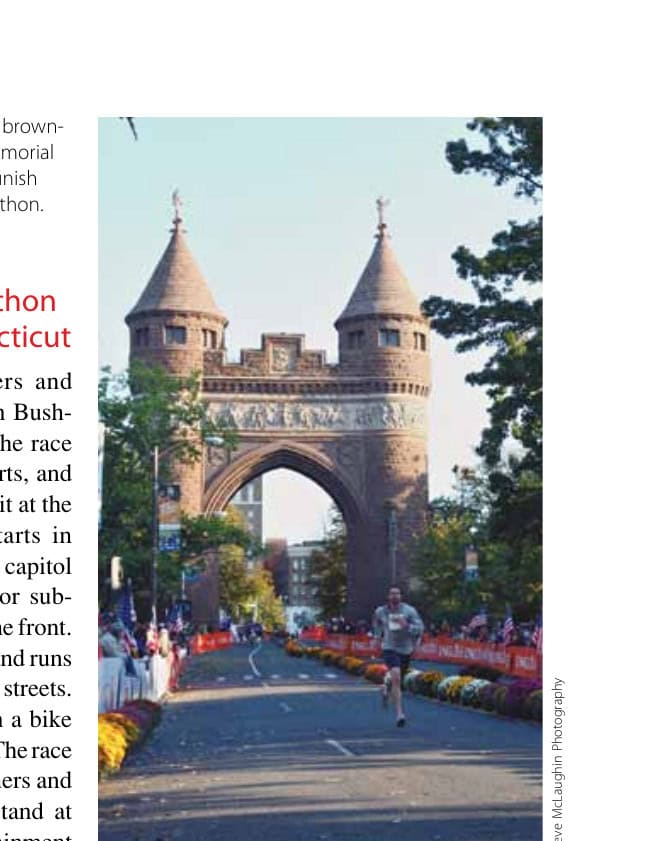
The brownstone Soldiers and Sailors Memorial Arch in Bushnell Park is featured on the race finisher’s medals and shirts, and marathoners run through it at the finish. The marathon starts in front of the beautiful state capitol building. Those with prior sub-3:30 times are seeded in the front. The course is mostly flat and runs through autumn tree-lined streets. Some sections are run on a bike trail along the river walk. The race is very supportive of runners and even includes a candy stand at mile 22. There is entertainment along the course and the finish is open through six hours. All finishers receive a medal. The finish in Bushnell Park has a party atmosphere. Bradley International Airport has many carriers, so airfare is usually reasonable. Connecticut in autumn is stunning, and the race provides a chance for the state to show off.
Maine Marathon in Portland, Maine
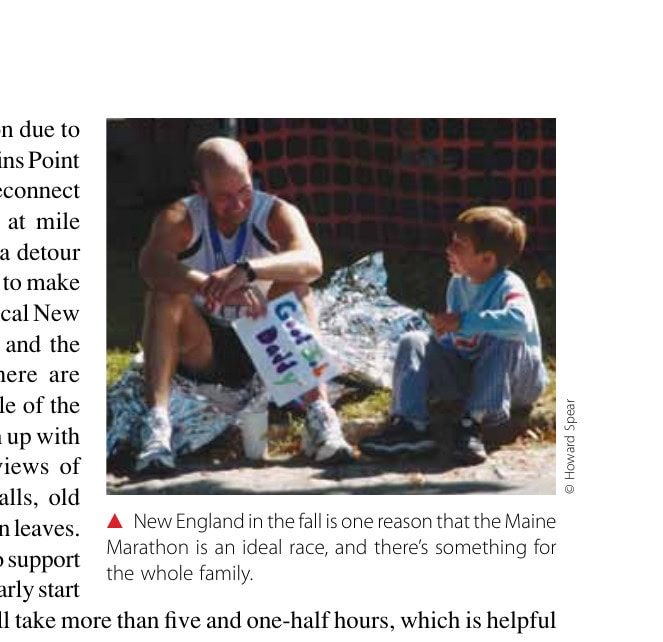
New England in the fall is only one reason that the Maine Marathon is an ideal race. From the time that marathoners pick up their packets until they shower after the race, the Maine Marathon officials seem to think of every detail to make the experience amazing for all participants. The packet pickup, parking, and postrace showers are at the University of Southern Maine. The start line is down the street from the university. The course runs through the countryside and on the coast in Maine. It usually takes place in early October when the fall foliage is at its peak. For a New England race, the course is easy. Crossing Casco Bay twice on the Martin Point Bridge provides spectacular views (note: for the 2013 race only, there is a reroute early on due to construction on the Martins Point Bridge. Runners will reconnect with the original route at mile 5). The course also has a detour through a neighborhood to make sure that runners see typical New England coastal homes and the beautiful shoreline. There are rolling hills in the middle of the race, but they are broken up with typical New England views of old cemeteries, rock walls, old homes, and lots of autumn leaves. The residents come out to support the runners. There is an early start for marathoners who will take more than five and one-half hours, which is helpful to those who run the nearby New Hampshire Marathon the day before. The race starts and finishes along Back Cove parallel to a popular running path used by locals. Occasionally there is rain, but the cool temperatures are good for running.
Marshall University Marathon in Huntington, West Virginia
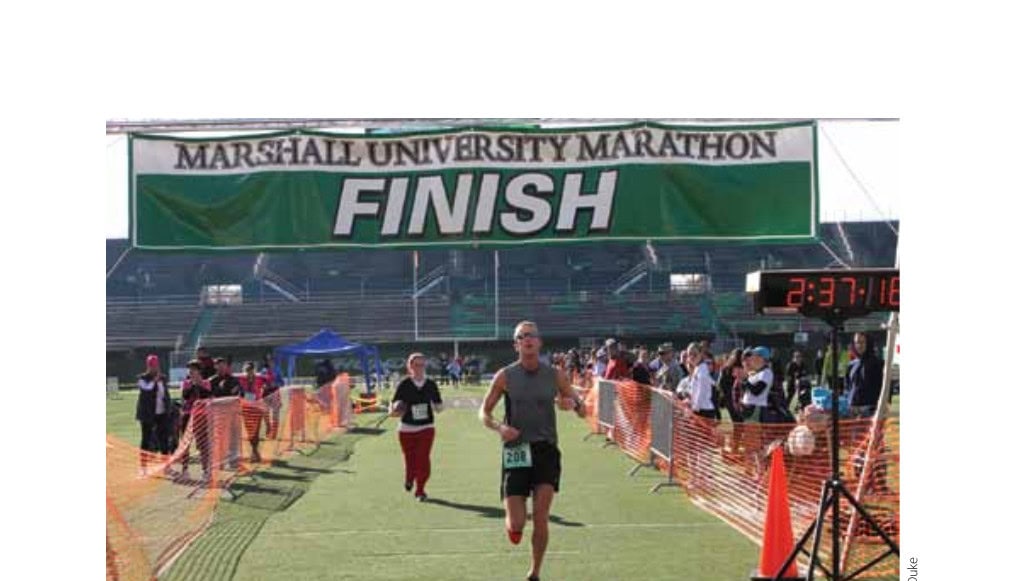
Anyone who saw the movie We Are Marshall is aware of the tragedy that struck the Marshall University football team in November 1970. Nearly the entire team and coaching staff, 24 supporters, and the flight crew died in a plane crash that killed 75 people. Finishers of the marathon carry a football across the Marshall University football field and finish in the end zone. The race has been rated in the top 10 for finishers who qualify for Boston. Huntington, West Virginia, is a small town that supports the marathon. The parking, start, and finish are all at the Marshall University football stadium. Since the race is in November, the temperatures are usually very cool. The course covers much of the city of Huntington, and runners pass several landmarks they will recognize from the movie. The course has some small rolling hills, and for West Virginia, this course is extremely easy. Charleston, West Virginia, is the closest airport, but Lexington, Kentucky; Cincinnati, Ohio; and Columbus, Ohio are all less than three hours away.
Rochester Marathon in Rochester, New York
Late September in New York is a good time of year for a marathon. Rochester is near the Finger Lakes area in upstate New York. The Rochester Marathon is relatively flat and a very fast course. Much of it is on the Erie Canal bike path. It also travels through several historic neighborhoods. The volunteers take care of the runners, and there are plenty of aid stations. For an urban marathon, the course takes runners through very nice nature trails. The race communicates with runners through social media and frequently posts ideas for training and travel to Rochester. The organizers also have a list of great viewing locations and tips on how to be an awesome spectator posted on the website. The course is open for seven hours. Niagara Falls is only a couple of hours away for those who have time to sightsee.
Seabrook Lucky Trail Marathon in Seabrook, Texas
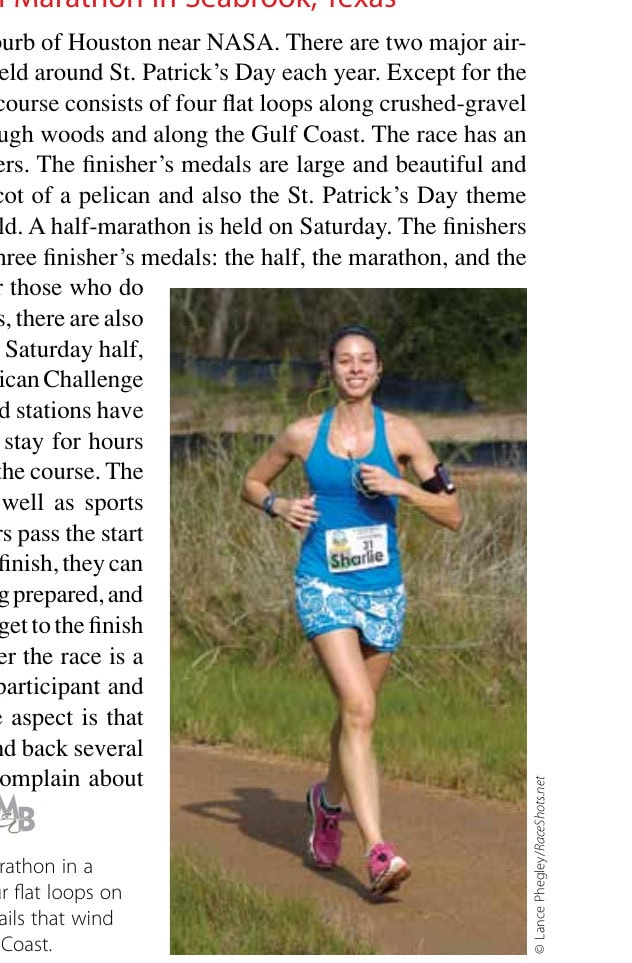
This small event is in a suburb of Houston near NASA. There are two major airports nearby. This race is held around St. Patrick’s Day each year. Except for the first mile on the street, the course consists of four flat loops along crushed-gravel nature trails that wind through woods and along the Gulf Coast. The race has an early start for slower runners. The finisher’s medals are large and beautiful and include the Seabrook mascot of a pelican and also the St. Patrick’s Day theme of rainbows and pots of gold. A half-marathon is held on Saturday. The finishers of the two events receive three finisher’s medals: the half, the marathon, and the Trail Challenge medal. For those who do the half-marathon both days, there are also three finisher’s medals: the Saturday half, the Sunday half, and the Pelican Challenge medal. The well-stocked aid stations have wonderful volunteers who stay for hours until all the runners are off the course. The aid stations have food as well as sports drinks and water. As runners pass the start line three times before they finish, they can smell the postrace food being prepared, and it helps motivate runners to get to the finish as quickly as possible. After the race is a postrace barbecue for the participant and a guest. The only negative aspect is that because the course is out and back several times, faster participants complain about congestion on the course.
The article content was not found in the provided page image. The visible page contains only the article “My 10 Most Difficult Marathons” by Lois Berkowitz. The requested article does not begin on this page.
This article originally appeared in Marathon & Beyond, Vol. 17, No. 4 (2013).
← Browse the full M&B Archive1,000+ stories from 19 years of Marathon & Beyond
The complete archive of the legendary long-distance journal — digitized and free to read.
