

The 10 Most Important Male Marathoners in History
Criteria: I chose not the fastest or the most famous but 10 who are “important” because they were transformative, creating positive change in the global marathon. That meant I had to omit my idol, Emil Zatopek, who brought his unique zest to the marathon but won only once. Haile Gebrselassie was another hard one, but historically, he was a very great time-trial marathoner. Unforgettable runners, both—but they did not transform the marathon into the race it is. The dates given with each runner refer to the years when each ran “historic” races.
Spiridon Louis (Greece) 1896
If the first Olympic marathon had been won by the American miler Arthur Blake or by the wealthy London-based Australian accountant Teddy Flack, there might never have been another “marathon.” It was the seven-minute victory by a Greek that lit up Athens’s marble stadium into a wild celebration party. As a modern Athenian triumphing against the odds, Spiridon Louis brought history to life and made the marathon into a hero’s journey. He added two other elements to the magic formula. By working quietly through the field while the eager fast starters wobbled and collapsed into medical carts, Louis demonstrated that this new event was a different kind of footrace, demanding perseverance on the edge of survival. And as a peasant water carrier, whose daily 14 miles’ plod trumped the college track boys, at one stroke Louis made the marathon the world’s most socially egalitarian sport.
Dorando Pietri (Italy) 1908-1912
He collapsed five times. The vast stadium crowd thought he was dead. Five times he staggered back to his feet and, with some well-intended assistance, stumbled to the finish. Dorando Pietri was disqualified but an instant legend. Never before had humanity’s eternal struggle between frailty of body and strength of will been so publicly enacted (well, not since you could watch people being burned alive for their beliefs). His brave persistence caught the world’s imagination, and for four years, huge gambling crowds revved up “marathon mania.” The marathon became firmly established, and the word entered the language. Pietri gave up baking pastries in Carpi and made a good living in America by winning 17 out of 22 pro races, many of them indoors. Irving Berlin wrote a song about him. He stayed cheerful, despite knowing that he had been robbed in 1908. The London Olympic organizers had tacked more than a mile on to the announced “40 kilometers” without telling the runners. At 25 miles (40 kilometers), Pietri was leading by several minutes. Then he hit the Wall, dehydrated, depleted, and disoriented. Somehow he kept going. Every time we run the last 1.2 miles, we are honoring the courage of Dorando Pietri.
Sohn Kee-Chung/Kitei Son (Korea/Japan) 1935-36
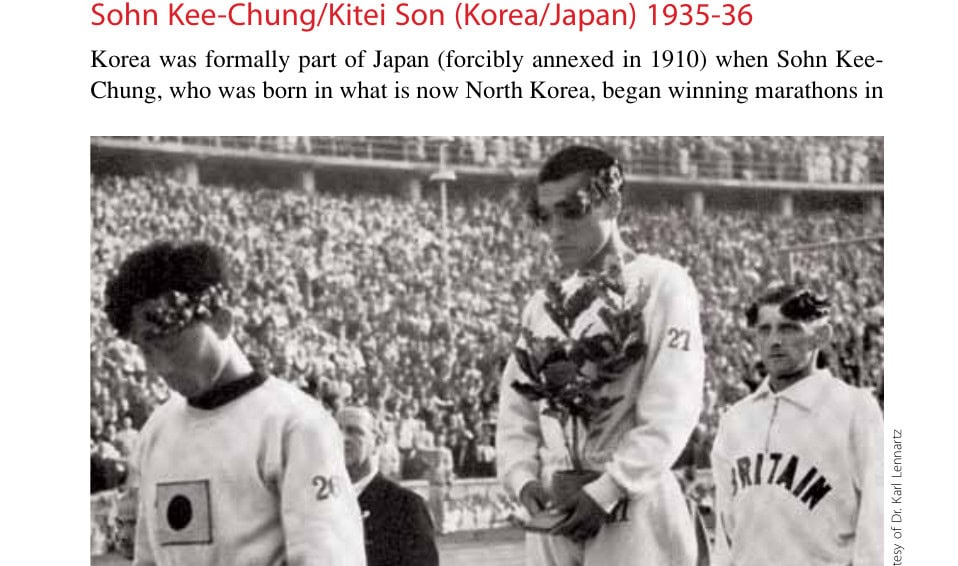
Korea was formally part of Japan (forcibly annexed in 1910) when Sohn Kee-Chung, who was born in what is now North Korea, began winning marathons in 1933 while attending university in Japan. So when he broke the world record, with 2:26:42 in 1935, and when he won the Olympic gold medal in an Olympic record 2:29:19.2 in 1936, it was as a Japanese, with the name Kitei Son. Another Korean Japanese, Nam Sung-Yong, was third in those Berlin Olympics, as Shoryu Nan. (Similarly, Algerians Boughera el Ouafi and Alain Mimoun won marathon gold medals for France.) Winner of 10 marathons in all (out of 13), Sohn was thus the greatest figure in the Asian and Japanese marathon upsurge in the 1930s, the third Japanese in succession to break the world record. The Japanese and Koreans began running marathons about 1913 and soon discovered that the race suited their fervidly self-disciplined temperament. In Japan, marathons became almost a religion, and in the 1930s and again in the mid-1960s, Japan was the strongest marathon nation. Yet Sohn/Son is still its only male Olympic gold medalist. When Korea could reclaim its identity, he became a successful coach, most famously of Yun Bok Suh, who broke Sohn’s own world record at Boston in 1947.
Jim Peters (Great Britain) 1951-54
“I bashed it night after night,” was how Jim Peters described his training. That was how he transformed the marathon. The London railworker’s son broke the world record four times, single-handedly slashing it from 2:25:39 (Yun Bok Suh at Boston) to 2:17:39.4. Eight minutes! More than nine minutes, if you apply today’s rules and discount Boston. No other marathoner has come close to that impact. Peters bashed out the miles on his local track, at relentless 5:00-5:15 speed, six miles at lunchtime, 10 at night. Don’t try this at home. Not imaginative as a training regimen, yet he already had the pace of an Olympic 10,000-meter runner (eighth in 1948). It was Peters who turned the marathon into a race that at top level demands speed as well as stamina. He made some mistakes. One (a private source informs me) was a belief—common at that date—that to drink water before or during a race was weakening. Instead, he chewed salt tablets. But for that folly, Peters might have beaten Emil Zatopek in the hot 1952 Olympic marathon and would not have collapsed so distressingly in the even hotter 1954 Empire Games in Vancouver, 200 meters from the finish while leading by three miles. He deserves to be remembered for that measure of superiority—three miles—for his victories, and for raising the sights of the whole sport.
Abebe Bikila (Ethiopia) 1960-68
Africa arrived on a sultry night in Rome in 1960. From the side of the Via Appia, suddenly emerging out of the darkness into the flickering torchlight, we saw not the Russian, the Belgian, the Brit we expected, but two lean, dark-skinned, flowing, incredibly fast Africans—Abebe Bikila and Rhadi ben Abdesselam (Morocco).
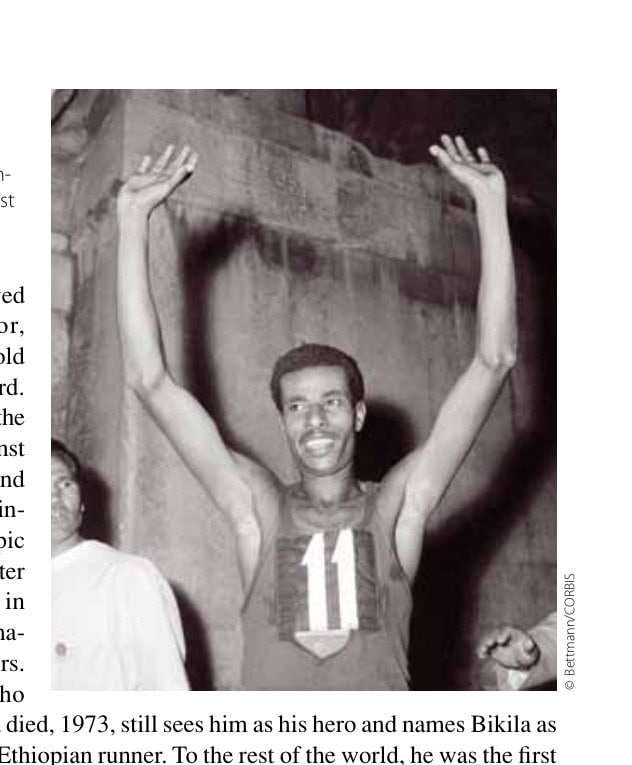
That night, Bikila achieved sport’s ultimate honor, winning the Olympic gold medal in a world record. And he did it again, with the same calm serenity, against an even stronger field and by a margin of two minutes, in the Tokyo Olympic marathon four years later (2:12:11.2). A legend in Ethiopia, he created a nation of great marathoners. Haile Gebrsellasie, who was born the year Bikila died, 1973, still sees him as his hero and names Bikila as the inspiration of every Ethiopian runner. To the rest of the world, he was the first to run a marathon close to five-minute miles and the first to show the wondrous running of the high-altitude East Africans. Since then, in Bikila’s footsteps, they have conquered the marathon.
Derek Clayton (Australia) 1967-69
Morio Shigematsu of Japan reduced Bikila’s world best by 11 seconds in 1965. The record, we were sure, would be trimmed by ever-smaller margins. But one day in December 1967, from Fukuoka in Japan, came news that an unknown Australian, with a previous best of 2:18, had not only smashed it but had run 2:09:36.4—2:09! We weren’t even thinking 2:11. And Derek Clayton? A big, gangling, 6 foot, 2 inch rough diamond, we learned, born in northern England, raised in Ireland, now an Aussie, with four modest marathons to his name. Then we found he was a “man of steel,” forged on 160 to 200 punishing race-pace miles every week. Between injuries (many), he was a phenomenon, with a low stride, fearless front-running tactics, and the resilient ability to high-cruise just below his VO₂ max almost forever. He didn’t medal (seventh) in the high-altitude 1968 Olympics. Then, suddenly, he stunned us again: 2:08:33.6 at Antwerp in 1969. For the second time, the marathon world’s battered brain couldn’t take it
in. There is ongoing dispute about the course. But all road times before about 1972 are a blunt instrument. There is no disputing that it was Derek Clayton who first made the world think sub-2:10, sub-2:09. He indisputably proved there are no rules about where you come from or what size you are. The only rule is work harder than anyone else.
Frank Shorter (USA) 1971-77
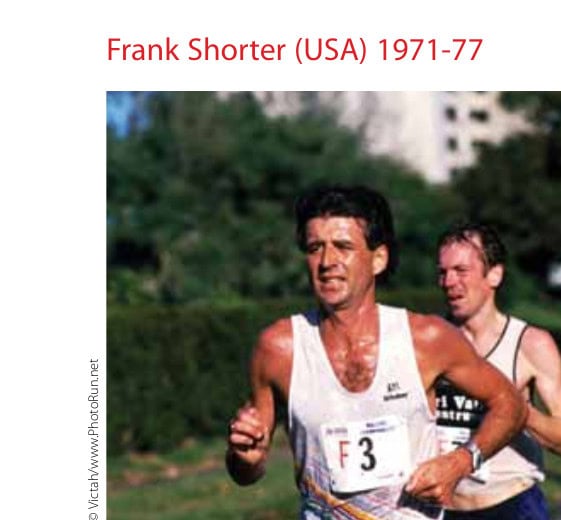
Frank Shorter was the first American to win the Olympic marathon since 1908, and he did it in 1972 with confidence, power, and flowing elegance. America was captivated—a new hero, brainy, articulate, good-looking, and a winner, one who could make two hours of gruelling endurance look like poetry in motion. Road running had been growing through the 1960s—Boston first topped 1,000 entries in 1969. But now it exploded. Shorter kept winning—Fukuoka four times, effectively the annual world championship, and an Olympic silver medal in 1976, shaded (I decline to say beaten) by an enhanced East German. Every win—and those of Bill Rodgers when he arrived in 1975—fanned the flame of running. More specifically, they showed Americans the magic of the marathon. From that moment in Munich, when an American beat the world’s best by two minutes, the marathon was mainstream. Once a minority eccentricity, by 1975 it was a way of defining your identity. Hostesses at parties introduced strangers to each other, “2:55, please meet 3 hours 19.” By 1982, the average time for 6,689 starters at Boston was 3:04. More than a hundred Americans a year were breaking 2:20. The marathon had become a movement.
Alberto Salazar (USA) 1980-84
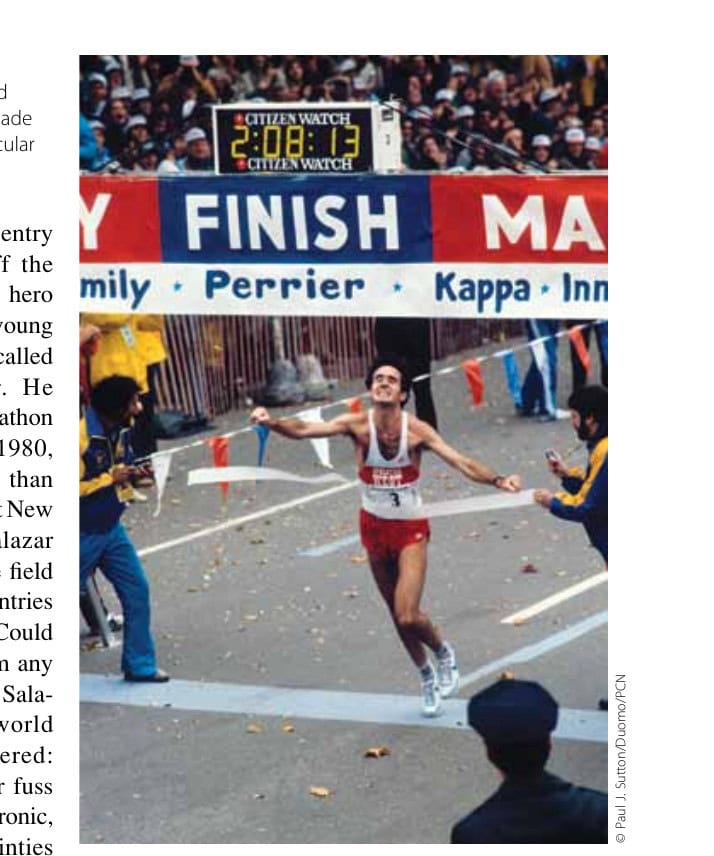
In 1981, The Runner wrote, “Everybody, it seems, wants to run a marathon.” The New Yorker began to include marathon cartoons. New marathons sprang up in every city, entry numbers went off the charts, and a new hero emerged, a feisty young Cuban-American called Alberto Salazar. He won his debut marathon at New York in 1980, in 2:09:41, faster than Shorter ever ran. At New York in 1981, Salazar was back, the elite field was stacked, and entries went over 20,000. Could the marathon boom any louder? Yes—first, Salazar promised a world record and delivered: 2:08:13. (The later fuss about the course is ironic, given the uncertainties around Clayton’s times.) But what really made Salazar big was TV. For the first time in history, a city marathon went on air live, across the nation and the world (I got up at 4:00 a.m. to do commentary in the New Zealand studio). Attempts at coverage in 1979 and 1980 had been bedeviled by technical problems. Now ABC came on board, bringing its high-tech arsenal. That New York Sunday morning, the marathon became a global showbiz spectacular. Starring the destructive, writhing brilliance of Salazar and the powerful Amazon-queen beauty of Allison Roe, both with world records, it was a dream script. That show was the booster rocket that thrust the marathon into space.
Douglas Wakiihuri (Kenya) 1987-90
Kip Keino, Naftali Temu, and others had made Kenya a force on the track since 1966, but its first winner in a major marathon was Douglas Wakiihuri in the 1987 World Championship in Rome. Two months later, Ibrahim Hussein won New York, and the floodgates were open. Hussein went on to win Boston three times, while Wakiihuri won London, New York, and the Commonwealth Games twice and took an Olympic silver medal in 1988. He was important because he was the first Kenyan to win a marathon medal of any kind, in the Olympics or world championships, and because he won in such a Kenyan way—upright, graceful, and fluent, seeming to glide through the ancient streets of Rome. An unknown with a modest best of 2:13, Wakiihuri was unperturbed by the might of title-holder Rob de Castella, Gelindo Bordin, Juma Ikangaa, and the like. At 38 kilometers, with no obvious increase in effort, he slipped away and won by 42 seconds. He was also the first successful Kenyan to be trained in Japan, a combination that later produced Olympic medals by Eric Wainaina (bronze and silver) and Sammy Wanjiru (gold).
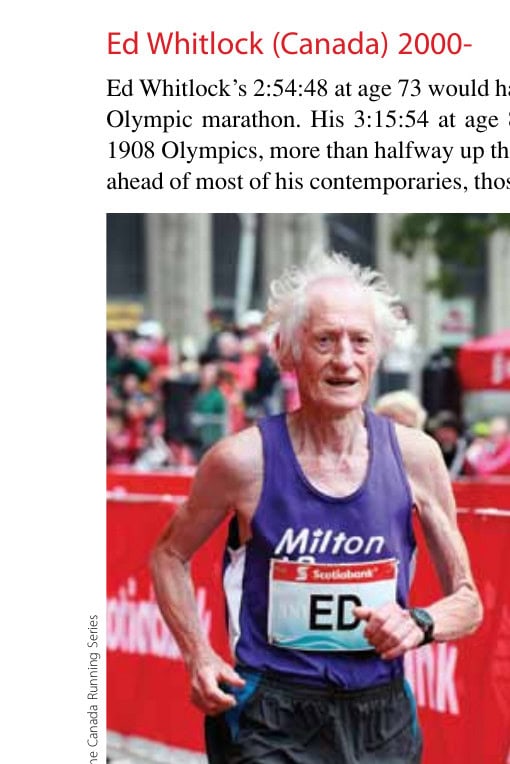
Ed Whitlock (Canada) 2000-
Ed Whitlock’s 2:54:48 at age 73 would have placed him in the top 10 in the 1924 Olympic marathon. His 3:15:54 at age 80 would have placed him 12th in the 1908 Olympics, more than halfway up the field. At 80! He is three or more hours ahead of most of his contemporaries, those few that can contemplate a marathon. It reflects well on our sport, and on the Scotiabank Toronto Waterfront Marathon that hosts most of Whitlock’s best races, that the performances of a man over 80 are recognized for the epoch-making achievements they are. Great precursors in the older age groups include Jack Foster, Norm Green, Clive Davies, Derek Turnbull, and John Keston. Still, Whitlock stands alone. He is not only an important marathoner; he is important for transforming attitudes about the human aging process and the knowledge of what is possible at that end of life. By the way, he is the only one of the top 10 still breaking records.
This article originally appeared in Marathon & Beyond, Vol. 17, No. 4 (2013).
← Browse the full M&B Archive1,000+ stories from 19 years of Marathon & Beyond
The complete archive of the legendary long-distance journal — digitized and free to read.
