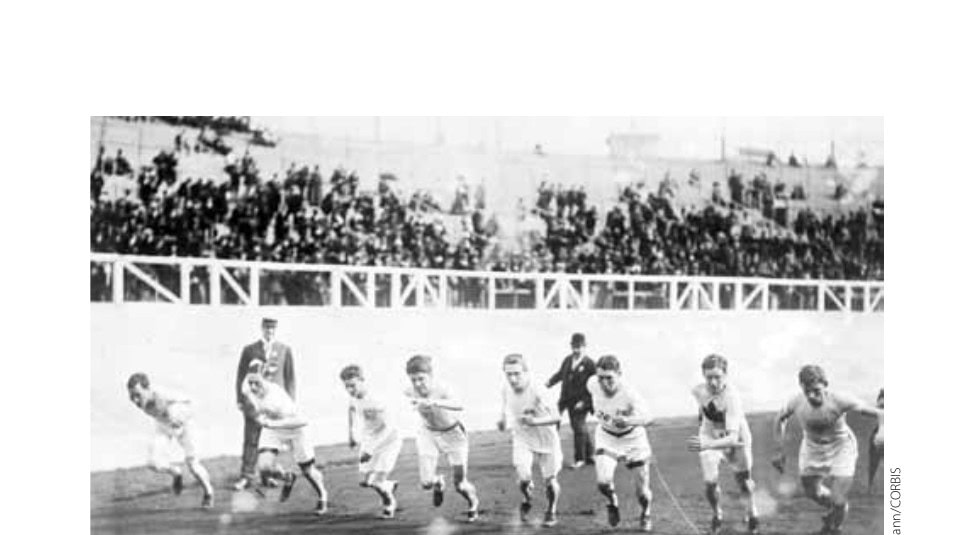
The 10 Most Important Marathons In History

The 10 Most Important Marathons In History

FeatureVol. 17, No. 4 (2013)201385 min read

to the 1968 Trials in Colorado. David L. Costill, PhD, a young researcher whose athletic background was in swimming, showed up with a bag of plastic bottles. He had been doing research at the newly formed Human Performance Laboratory at Ball State University. His discovery: runners who drank water (or Gatorade) performed better than runners who did not. Ironically, officials honoring the outdated international rule book prevented Costill from handing out fluids before 15K, but his continuing research provided the scientific base that today allows all of us to race in safety in warm weather and skip blithely past The Wall. Also worth noting at Alamosa was the appearance of a Yale student vacationing in the area. More a track athlete, this was his first semiserious attempt at the marathon distance. He failed to make it past 20 miles. His name was Frank Shorter.

Honolulu 1973

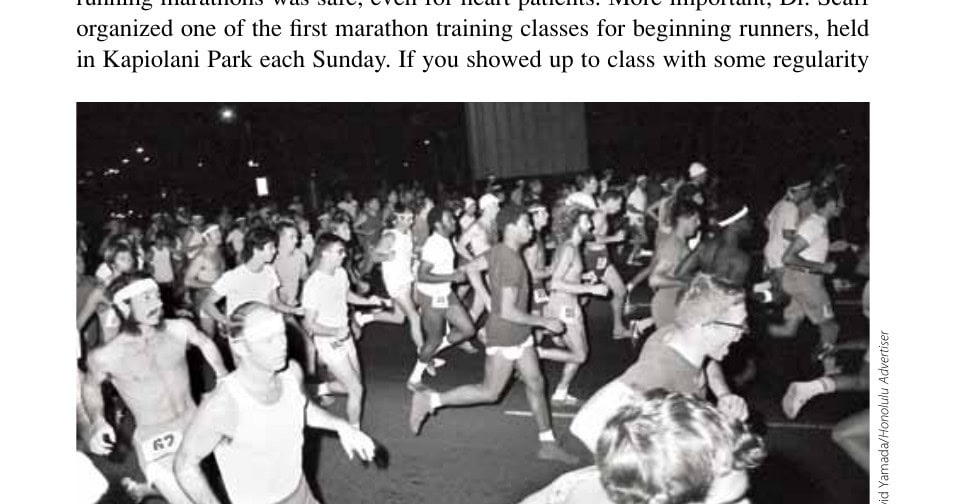
In 1973, Duncan Macdonald won the first Honolulu Marathon in a time that seems middling by today’s standards: 2:27:34. But Macdonald was a 5,000-meter runner, not a marathoner, one good enough to qualify for the US Olympic team. He would win Honolulu on two more occasions in faster times. Only 151 runners finished that first Honolulu Marathon, but the 1973 race was significant for two reasons. One: it was the first “destination marathon,” important less for the competition and more for where the competition was held (in a scenic locale). Two: one of Honolulu’s founding fathers, cardiologist Jack Scaff, MD, pioneered the idea that running marathons was safe, even for heart patients. More important, Dr. Scaff organized one of the first marathon training classes for beginning runners, held in Kapiolani Park each Sunday. If you showed up to class with some regularity

A The start of the 1973 Honolulu Marathon. Honolulu pioneered start-in-the-dark running.

la/Honolulu Adv

and listened to Dr. Scaff, you were almost certain to have one of the volunteers at the finish line hang a lei around your neck.
Eugene Olympic Trials 1976

Frank Shorter had won the Olympic Marathon in 1972, and who can ignore the historic significance of that fact or overlook Shorter’s four victories in the Fukuoka Marathon in Japan? But Eugene was the first time that Frank faced off with the man who would become his successor: Bill Rodgers. Rather than cruising the course, the two raced elbow to elbow for 26 miles, Shorter prevailing in the final mile. The Dynamic Duo’s final times: 2:11.51 and 2:11.58. Shorter also bested Rodgers in the 1976 Olympics, placing second while his rival had an uncharacteristic bad day, placing 40th. (Don Kardong missed winning the bronze medal by three seconds.) After that, it was all Bill for the rest of the decade, winning four New York City Marathons and four Boston Marathons. Frank rightfully has been given credit for igniting the first running boom, inspiring baby boomers just turned 30 to get off the couch and start jogging. But more than Frank, it was Frank and Bill who were the best marathoners of the decade, not merely in the United States but around the world.

New York City 1976

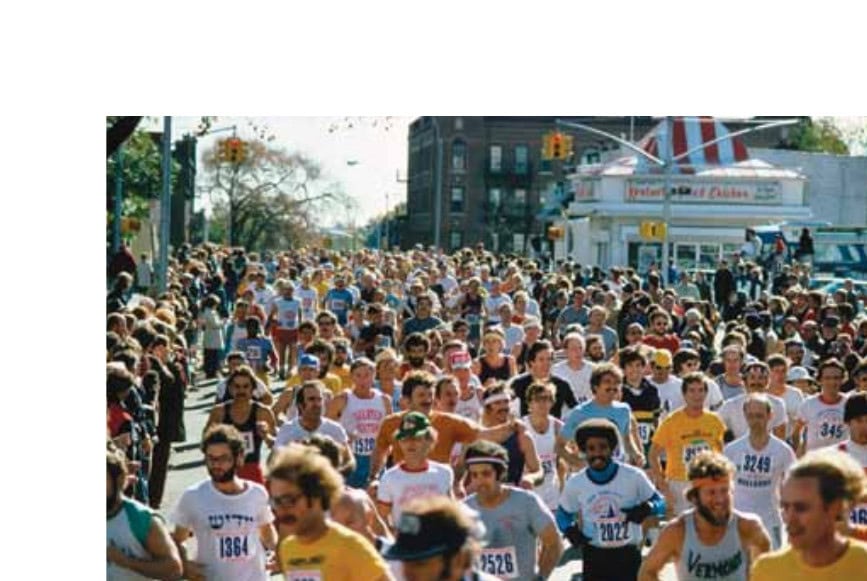
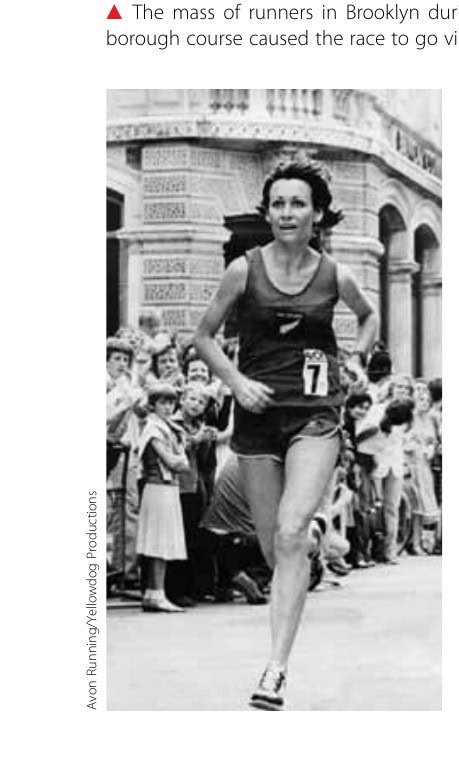
Later that same year, Bill bested Frank at New York, but less important historically than the race up front was the 26 miles and 385 yards of real estate beneath their feet. The course of the 1976 New York City Marathon became the true celebrity. Founded in 1970, the New York City Marathon originally utilized a multilap course in Central Park designed by entrepreneur Fred Lebow. That worked for the few runners early in the decade but not for the hordes that would follow. For 1976, Lebow repositioned the course so runners traversed all five boroughs from Staten Island to Brooklyn to the Bronx to Queens and Manhattan. New York burst all boundaries of how many runners could fit on a race course: 1,549 in 1976, peaking at 46,795 finishers in 2011. This was the first of the big-city marathons. Today, most of the major world cities have their own megaraces. New York now teams with Boston, London, Berlin, Chicago, and Tokyo plus the Olympic and World Championships for a Major Marathon circuit that awards $1 million in prizes each year.

Avon Marathon, London 1980

Kathrine Switzer attained fame as one of the early women to run the Boston Marathon. More important historically, however, was her developing with the sponsorship of Avon Products a marathon for women only. The first two Avon International

Avon Running/Yellowdog Productions

A The mass of runners in Brooklyn during the 1977 New York City Marathon. Fred’s fiveborough course caused the race to go viral.

TI’S Whee ++ ‘

Women’s Marathons attracted some attention in Atlanta (1978) and Waldniel, Germany (1979), and then Switzer brashly turned her attention to London. The United Kingdom had long served as a bastion of road running, but the only London marathon (the Poly) was on the outskirts of town. Ata reception before the Avon race in 1980, Chris Brasher (one of the runners who paced Roger Bannister to the first four-minute mile) told Switzer, “They said yes to you. They have to now say yes to us.” Brasher was talking about persuading those who ruled the City of London to allow a marathon run in the shadow of Big Ben. Perhaps even more significant was the fact that by demonstrating the latent ability of women runners from nations throughout the world, Switzer was able to persuade a

<4 Lorraine Moeller won the 1980 Avon International Women’s Marathon in London.

© Paul J. Sutton/Duomo/PCN

heel-dragging International Olympic Committee to add a marathon to the 1984 Olympic Games in Los Angeles. OK, it would have happened eventually (maybe by 1988 or 1992), but with Switzer being both pushy and charming, it happened in time for Joan Benoit to win her gold medal at Los Angeles.

Berlin 1990

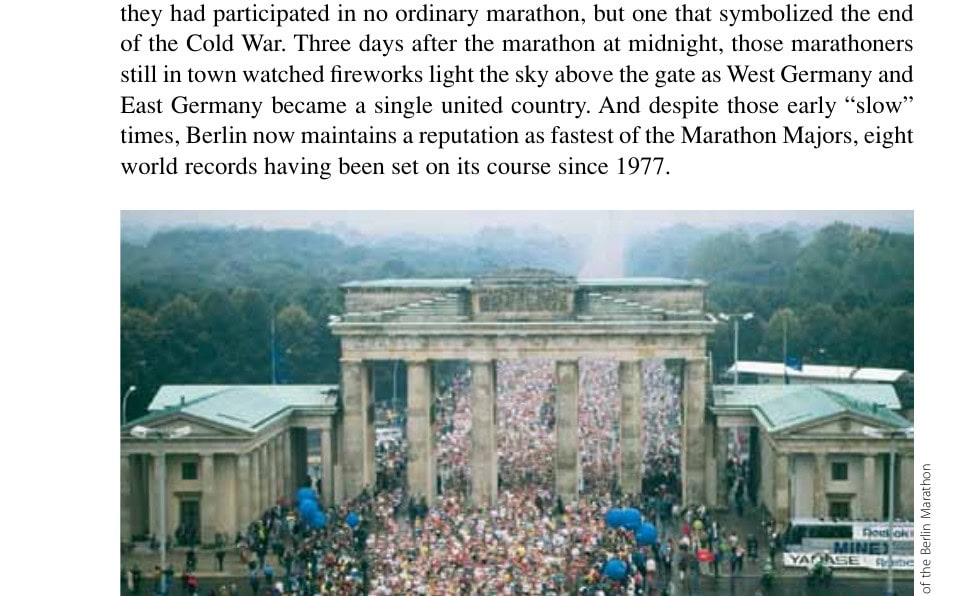
Like many such events, the Berlin Marathon had humble beginnings: fewer than 250 runners in 1974, the winning time being 2:44:53 for Giinter Hallas. Only 10 women entered, Jutta von Haase winning in 3:22:01. But the running boom had barely begun in the United States, and several years passed before that boom infected Europe with its focus as much on midpackers as fast elites. For the marathon’s early years, Berlin remained a divided city, an ugly wall separating East Berlin and West Berlin. Leading into the 1990 race, the wall still stood, but reduced tensions between East and West had softened sufficiently to allow marathon planners to consider a course that, finally, would include both halves of the once-divided city. By race day, the wall was gone, and the 22,806 runners who strode purposefully for the first time through the Brandenburg Gate found that they had participated in no ordinary marathon, but one that symbolized the end of the Cold War. Three days after the marathon at midnight, those marathoners still in town watched fireworks light the sky above the gate as West Germany and East Germany became a single united country. And despite those early “slow” times, Berlin now maintains a reputation as fastest of the Marathon Majors, eight world records having been set on its course since 1977.
s & € = S a

@ & ‘So a g

A After the wall crumbled, runners passed freely through the Brandenburg Gate during the 1990 Berlin Marathon.

© Victah/(www.PhotoRun.net

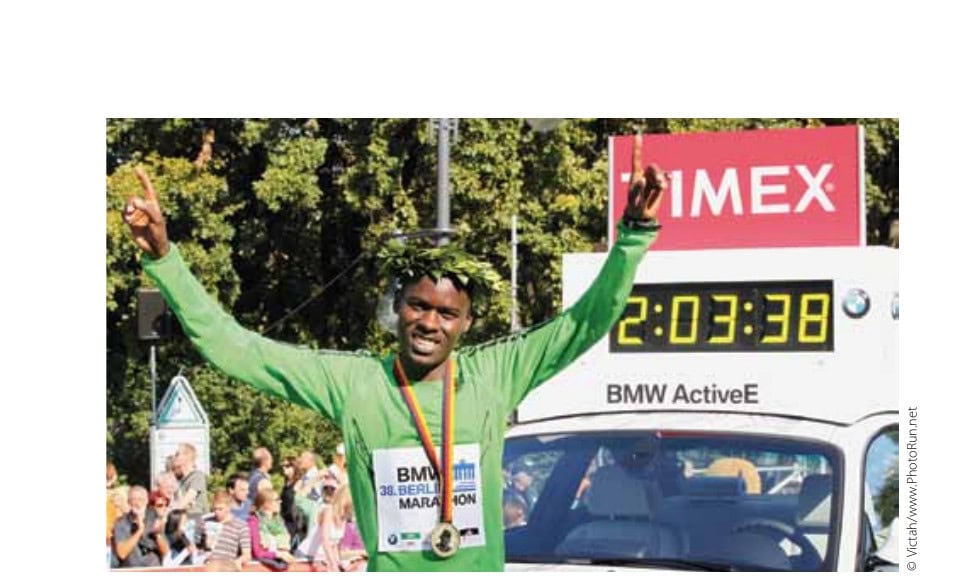
A Kenya’s Patrick Makau set the current men’s world record at the 2011 Berlin Marathon.

Men 2011 — Patrick Makau Musyoki (KEN) 2:03:38 2008 — Haile Gebrselassie (ETH) 2:03:59 2007 — Haile Gebrselassie (ETH) 2:04:26 2003 — Paul Tergat (KEN) 2:04:55 1998 — Ronaldo da Costa (BRA) 2:06:05 Women 2001 — Naoko Takahashi (JPN) 2:19:46 1999 — Tegla Loroupe (KEN) 2:20:43 1977 — Christa Vahlensieck (GER) 2:34:48

Boston 1996

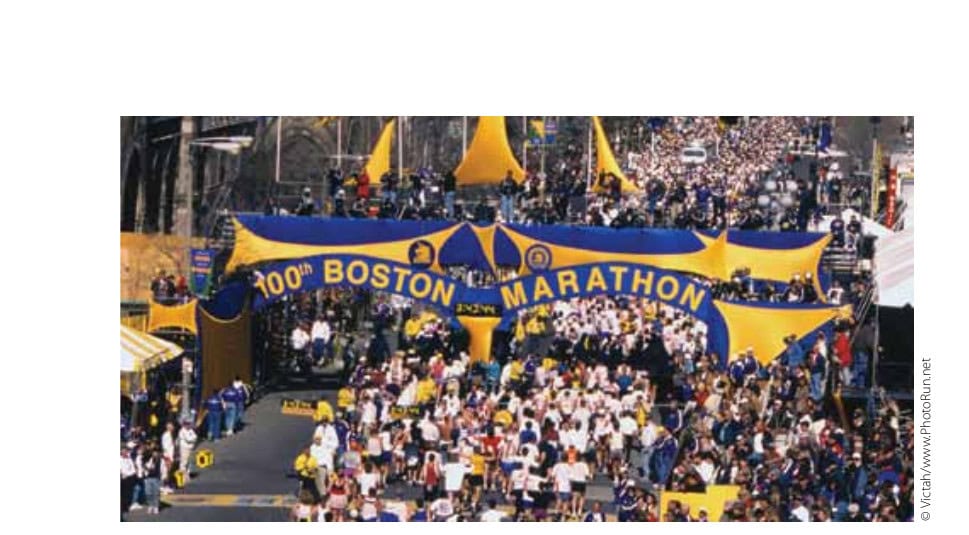
Leading into the last decade of the millennium, fields of 20,000 or more finishers had started to become common among major marathons, but for its 100th-anniversary celebration in 1996, Boston broke all boundaries, relaxing its qualifying standards to permit a lottery. Previously, if you wanted to run Boston, you needed to achieve a Boston qualifying time (BQ): 3:10 for men, 3:40 for women, the standards easing for runners in older age groups. Indeed, apart from its being the world’s oldest continuously run marathon, the great appeal of Boston was that you had to post a qualifying time and demonstrate your ability. Opening the field and filling it by means of a lottery allowed many who never would have achieved a BQ to be part of this historic run. Despite the narrowness of the road, particularly in the early miles between Hopkinton and Framingham, the B.A.A. managed to wedge 36,000 runners onto the course. After a hundred years, the marathon truly had come of age.
G € Ss

A Boston’s 100th running in 1996 set a new standard for marathon race numbers.

Chicago 2007

The Chicago Marathon (originally called the Mayor Daley Marathon) got its start in 1976, the same year New York switched to its five-borough course. Actually, that year Chicago had even more finishers. But through the 1980s, Chicago seemed to stay a half step behind New York in its attractiveness to runners, including those at the front of the field. That changed in 1990, when Carey Pinkowski became race director. With the help of a sponsor with deep pockets (LaSalle Bank, now Bank of America) he lured to his flat and fast course runners who set world record times, including Khalid Khannouchi in 1999 (2:05:42) and Paula Radcliffe in 2002 (2:17:18). But Chicago deserves its place at the end of this top-10 list not because of its successes but because of its one failure. Our vulnerability as runners was exposed in 2007 when the race-day temperature peaked at 88. Ten thousand runners chose not to start, and 10,000 were not able to finish. Volunteers found themselves unable to keep up with the demand for water, causing the marathon to be stopped, runners still on the course aimed back to the finish line early. Understandably, this angered a lot of runners, but in the aftermath of the Chicago meltdown, race directors all over the world did some soul-searching to assure the safety of the runners under their charge. And if Chicago was embarrassed in 2007, New York was embarrassed in 2012, when the devastation caused by Hurricane Sandy resulted in the race being canceled. Nobody was prepared for the bombs that exploded on Bolyston Street on April 15, 2013.

The sport of running 26 miles, 385 yards, which owes its origin to a legend more than 2,500 years old, endures, and the above races remain the 10 most important marathons in history. Ee

The 10 Most Important Ultraraces in History

raced 250 kilometers (155 miles) to Sparta in two days to request Spartan

aid against Persian invaders at Marathon, through today’s explosion of ultraraces, there are numerous contenders for the 10 most important ultraraces in history. Whether the list includes races where an individual such as Pheidippides set a mark in human performance or the ultrarace itself moved human performance forward, these are historically important events. Here are descriptions of important ultraraces that have expanded our understanding of human performance at ultradistances and have made a mark in history. These ultras are presented alphabetically by race title.

F rom the first record of an ultradistance run in 490 BC, when Pheidippides

1. Badwater 135 Ultramarathon, Death Valley National Park, California, USA

Comrades Marathon, Pietermaritzburg, South Africa

1990 IAU World Cup 100K, Duluth, Minnesota, USA

JFK 50 Mile, Boonsboro, Maryland, USA

Self-Transcendence Ultra Classic 24-Hour Race, Ottawa, Ontario, Canada Spartathlon, Athens, Greece

Transcontinental Races

Ultra-Trail du Mont-Blanc (UTMB), Chamonix, France

Western States 100-Mile Endurance Run, Squaw Valley, California, USA

SoD PN DY RF WN

Unknown Future Ultrarace, Unknown Location
The year 2012 marked the 35th edition of some variation of pioneering solos and competitive race crossings of Death Valley in California’s Mojave Desert. The Badwater 135 Ultramarathon, billed as “the world’s toughest footrace,” includes fewer than 100 endurance athletes from around the world. They race the 135 miles from the saline pool at Badwater, 282 feet below sea level, to the 8,360-foot trailhead of Mount Whitney (at 14,505 feet, the highest point in the continental United States). Hopefuls must apply with their competitive achievements and be invited to take part.

The course rises to roughly 5,000 feet at three points along the way. Death Valley temperatures in July, the usual race date, range from an average daytime high of 116 degrees Fahrenheit on the floor of Death Valley to 30 degrees Fahrenheit on the summit of Mount Whitney, where last season’s snow can readily mix with snow showers or lightning storms. The Badwater 135 ends at the Whitney Portals where the National Forest Service restricts the trail up Mount Whitney from use for racing and requires trail users to have permits. A few Badwater runners each year honor the “lowest to highest” tradition by running to the summit of Mount Whitney up an approximately 12-mile trail after their Badwater race finish.

The environment and the temperatures are not the only challenging aspects of the Badwater Ultramarathon. In 2012, American Mike Morton ran a race to challenge the course record, finishing in 22:52:55 to fall just short of the 22:51:29 course record set by Valmir Nunes of Brazil in 2007.

Anita Fromm during her recordsetting 2008 Death Valley double crossing.

© Luis Escobar

Why this ultra is historically important: In addition to the unique geology and geography, Death Valley’s very hot temperatures attract Badwater 135 Ultramarathon runners who want to test their racing stamina in an environment adverse to human survival.

Comrades Marathon, Pietermaritzburg, South Africa

The world’s oldest and largest ultramarathon is South Africa’s Comrades Marathon. The event has been run 87 times as of 2012 and was created by World War I veteran Vic Clapham. Born in London, he emigrated to South Africa as a child. When World War I broke out, he enlisted and marched 1,700 miles through Africa with the South African infantry. Surviving the hardships of his military service, Clapham worked to establish the 56-mile (90 kilometer) race between the South African cities of Pietermaritzburg and Durban to memorialize the sacrifices of his wartime comrades. The first Comrades Marathon took place on May 24, 1921, starting at Pietermaritzburg City Hall with 34 runners. It has continued every year since with the exception of the World War II years of 1941 to 1945. In 2012, of the 19,524 runners who entered the race, about 10,000 finished. Comrades Marathon runners earn a silver medal for completing the race between six hours and 7 hours, 30 minutes, and a bronze medal for finishing between nine hours and 11 hours.

The start of the “ultimate human race” alternates annually between Pietermaritzburg and Durban, with the change in the direction of the racecourse giving rise to the reference to the “up and down” (elevation) runs.

Why this ultra is historically important: Comrades Marathon is the oldest and largest ultrarace in the world, routinely producing significant marks in ultradistance running.

<4 Comrades is the oldest ultra in the world.

& > = Qo

1990 IAU World Cup 100K, Duluth, Minnesota, USA

With race founder and director Bill Wenmark’s statement, “The 1990 World Championship at the Edmund Fitz is still considered the greatest 100K road race in history,” the only World Cup 100K run on American soil is a ready pick for one of the 10 most important ultras in history. Since ultrarunning is not an Olympic sport, the International Association of Ultrarunners AU) World Cup 100K is the biggest venue for international ultraracing.

Coming within two years after the International Association of Athletics Federations (the world governing body for track and field) recognized the [AU world ultrarunning organization, the Edmund Fitzgerald 100K’s bid to host the world championship of ultraracing was a notable accomplishment. Federations from around the world sent top ultrarunners to Duluth, Minnesota, in October 1990. And despite the United States having come late to 100K road racing, fielding its first team at the 1987 World Cup, the US men’s and women’s teams both won silver medals.

Although the Ed Fitz ended in 2007, US teams have continued to compete well in European and Asian venues. US women’s teams won bronze medals in 1993, 1998, 2000, and 2002; silver in 1990 and 2008; and the gold medal at the 1995 and 2005 IAU World Cup 100K Championships. The US men won bronze in 1994 and 2007 and silver medals in 1990, 1995, and 2000.

Why this ultra is historically important: The 1990 Ed Fitz 100K is the only World Cup 100K run on American soil in the IAU’s 29-year history.

JFK 50 Mile, Boonsboro, Maryland, USA

Beginning as part of President John F. Kennedy’s initiative for physical fitness, the JFK 50-Mile Challenge was one of several 50-mile events held in 1963. With

sassination of President Kennedy. The race grew to 967 finishers in 2012, which produced stunning course records that are less than half the times of the original race finishers. The 2012 winner, Max King, set the men’s mark at 5:34:59, and Ellie Greenwood set the women’s record in 6:12:00 on a course that includes more than 1,000 feet of climbing up to a ridge on the rocky Appalachian Trail before descending the 1,000 feet to a gentle finish on the C&O Canal towpath and paved rural roads.

These course records well exceed President Kennedy’s challenge to his officers to meet Teddy Roosevelt’s 1908 requirement for his officers to cover 50 miles on foot in 20 hours. Throughout the race’s history, military participation has been encouraged and recognized with various special division awards.

One of the notable early participants in the president’s 50-mile fitness challenge was his brother, US Attorney General Robert Kennedy. Preceding the initial JFK

© Utsahi Nérée St-Amand

50 race by a month, Bobby Kennedy is reported to have completed 50 miles along much the same C&O towpath of the racecourse in 15 hours and 50 minutes.

Why this ultra is historically important: The JFK 50 is the nation’s oldest continuous ultramarathon.

Self-Transcendence Ultra Classic 24-Hour Race, Ottawa, Ontario, Canada

Begun by the spiritualist and endurance athlete Sri Chinmoy, a native of Bangladesh, the SelfTranscendence Ultra Classic 24-Hour Race in Ottawa is the oldest timed ultrarace. Where A Eighty-six-year-old Wally, veteran of most ultras are run on some configuration of 750 marathons and ultras, competes 4 point-to-point course or at least have a start in the Self-Transcendence Ultra Clas- sa : 1 . sic 24-Hour Race in Ottawa, Ontario. and finish line along with a timing clock, timed ultraracing has only a measured venue—usually a track and a timing clock. The Transcendence Ultra Classic 24-Hour Race is run on the 400-meter track in the Louis Riel Dome in Ottawa, which is North America’s largest air-supported structure. Racers compete to win by covering the most laps, equated to mileage, within the timed period. And while the Sri Chinmoy Marathon Team established in 1977 offers a variety of longer timed running events such as six- and 10-day races around the world, the 24-hour venue has become an ultra standard that is now contested at IAU sanctioned world championships.

“What gives life its value if not its constant cry for self-transcendence?”

—Sri Chinmoy

Why this ultra is historically important: At 32 years, the Ottawa SelfTranscendence Ultra Classic 24-Hour Race is “the longest-running 24-hour race in the world” and routinely produces high-mileage performances, often by members of the Sri Chinmoy Marathon Team.

Spartathlon, Athens, Greece

The Spartathlon was established when British Royal Air Force officers attempted to verify the historical account that Pheidippides, an Athenian messenger, ran 250 kilometers from Athens to Sparta to request help at the Battle of Marathon. The officers’ test in 1982 proved that it was indeed possible to cover the approximately 155 miles in 40 hours as reported by the historian Herodotus.

Since the RAF officers’ test, runners from around the world have run the Spartathlon’s roads and trails from the base of the Acropolis through elevation ranges from sea level to nearly 4,000 feet and through numerous checkpoints. The first Spartathlon was held in 1983 and was won by Greek ultrarunner Yiannis Kouros, who in 1984 produced the still-standing course record of 20 hours and 25 minutes. Kouros won twice more and still has the four best Spartathlon times. American Scott Jurek won three times, and his 22:20:01 in 2008 is the fifth-fastest time. He is the only North American male winner of the race.

Why this ultra is historically important: The Spartathlon is a modern-day commemoration of a well-known ultrarunning achievement run on the historic course.

Transcontinental Races

Perhaps it is the clear goal of coast-to-coast running that inspires transcontinental organizers and racers, and perhaps it is the monumental challenge of these events that makes them so intriguing, rare, and intermittent throughout history. In 1928, race promoter Charles C. Pyle offered $25,000 to the winner of the first-ever trans-America footrace race, staged between LA and New York City. The press nicknamed it the “Bunion Derby.” Nearly 200 men took up the challenge (55 finished)—most of them blue-collar workers who hoped to earn a share of the $48,500 in total prize money and make a better life for their families. Twentyyear-old Andy Payne of Oklahoma averaged about 10-minutes-per-mile pace over 3,422.3 miles to win. In 1929, Pyle held a second derby, but he reversed the course.

A The front runners, Andy Payne (#43) and Peter Gavuzzi (#103), on Route 66 in Oklahoma.

In 78 days of racing, 1928 veterans Johnny Salo and Peter Gavuzzi battled for the first-place prize money. Salo won by less than three minutes in a disputed finish. Sadly, Pyle went bankrupt and did not pay out the prize money. The logistics and financing of months-long transcontinental stage racing along with the emotions and tensions of such great efforts did not allow for a long event history. Page 47 provides summaries of some of the better-documented transcontinental races. Why these ultras are historically important: The daily high-volume mileage demands of transcontinental racing redefine human capacity, recovery, and possibility. After the 1928 derby, a team of Philadelphia doctors examined 20 finishers and concluded that normal human beings, given enough food and rest, were capable of running the trans-America distance without damaging their bodies.

Ultra-Trail du Mont-Blanc (UTMB), Chamonix, France

Using the popular Tour du Mont Blanc (TMB) course that circles Western Europe’s highest peak, 15,782-foot Mont Blanc, the 103-mile, single-stage Ultra-Trail du Mont-Blanc (UTMB) has grown to 2,300 entrants in its 2013 edition. While the classic TMB loop through the Alps typically takes hikers seven-plus days of trekking through France, Switzerland, and Italy, the winners of the mostly selfsupported UTMB finish in about 20 hours. Meeting the 46-hour overall cutoff is a remarkable feat because of the UTMB’s 31,168 feet of uphill.

Although a newer race, having begun in 2003, the UTMB’s popularity has caused tighter and tighter entry standards while expanding race offerings to accommodate the interest of mountain endurance runners. To enter the UTMB, all racers must qualify through a point system of running accomplishments.

Why this ultra is historically important: While North American 100-mile mountain trail races such as Hardrock, Leadville Trail 100, and the Wasatch Front 100 are run at substantially higher elevations, the UTMB’s venue showcases the character of alpine endurance racing and produces remarkably fast times.

Western States 100-Mile Endurance Run, Squaw Valley, California, USA

Inspired by the 100-mile Tevis Cup horse race that challenged equestrians to cover a rugged trail course in the Sierra Nevada Mountains and the canyons draining to the American River, the first and oldest 100-mile trail race was born. When Tevis Cup rider Gordy Ainsleigh was curious whether a human could cover 100 miles of mountainous trails on foot in one day, he joined the 1974 Tevis Cup event as a runner and completed the course in 23 hours and 42 minutes. With proof that humans could run the course in one day, the first official Western States 100-Mile Endurance Run was offered in 1977.

Transcon Race Date Start Finish Distance Winner Highlight Summaries First March 4 to Ascot Speedway, Madison Square 3,423.5 miles © Andy Payne (USA) _—199 starters and 55 finishers Trans-America May 26, 1928 Los Angeles, CA Garden, in 84 days averaged 10 ran Route 66 from LA to aka 1928 New York City, minutes and 4 Chicago for 2,400 miles, then “Bunion Derby” NY seconds per mile on to NYC to win the $25,000 to win in 573 first prize. hours. Second March 31 Columbus Circle, — Wrigley Park, 3,553.6 miles 1928 veteran 44 veterans from the first Trans-America to June 16, New York City Los Angeles in 78 days Johnny Salo derby joined 33 rookies in this aka 1929 1929 (USA) averaged 78-day footrace race across “Bunion Derby” 8 minutes and America. 19 finished. Pete 53 seconds per Gavuzzi of England battled mile to win in Salo for the $25,000 prize, 554 hours. losing the race by less than three minutes after 554 hours of racing. C.C. Pyle went bankrupt and did not pay the winners the $60,000 he had promised them. Trans-Australia January 6 to Perth, Canberra, 2,656.6 miles Anatoli Kruglikov Winner Kruglikov ran an Footrace, March 11, Western Australian (4274.5 km) (RUS) in 305 hours —_ average pace of 8.4 mph, “Race of Fire” 2001 Australia Capital Territory in 9 weeks 18 min 45 sec equivalent to 97 consecutive 3:10 marathons. Running the November 2, St. Louis, Near the 4,300 miles Charlie Engle Possibly an expedition more Sahara 2006, to Senegal Suez Canal (6,920 km) (USA), than a competitive race, but (across Africa) February 20, at the Red in 111 days Ray Zahab the event had a clear start 2007 Sea, Egypt (Canada) and finish and a ticking clock.

Three runners started and two finished.

© Joe McCladdie

WESTERN STATES 100-MILE 4 Gordy Ainsleigh ENDURANCE RUN y a en the 1974 eae VALLEY TO AZIBURN, CA 72#H Tavis Cup horse race,

proving that humans could cover 100 mountainous miles in one day.

Since the first official race in 1977, when 22-year-old Andy Gonzales won in 22 hours, 57 minutes against a field of only 13 other runners, stunning records of human endurance performances have been logged on the Western States course. After 36 years, the course records are down to 14:46 by Timothy Olsen and 16:47 by Ellie Greenwood, both set in 2012.

From the curiosity of one athlete nearly four decades ago, the challenge and satisfaction of competing in and completing 100-mile trail races have captured the interests of so many endurance athletes that ultrarunners can now compete in approximately 70 100-mile trail races in North America, from mountains to coasts, from torrid to frigid temperatures, and all the amazing destinations in between.

Why this ultra is historically important: Western States was the first 100mile trail race and established the concept and the model for 100-mile trail racing that contributed a distinctively American input to ultrarunning.

Unknown Future Ultrarace, Unknown Location
With the myriad of ultraracing options around the world in environments and conditions adverse to humans and the incredible records these races produce, it is difficult to imagine more challenging future races and their records. But there will be new ultrarunning marks set in new environments and on new courses. That is the nature of the human condition and the human spirit—to strive beyond current standards. All the races and performances described in “The 10 Most Important Ultraraces in History” have their place setting and recording standards that humans will use to establish new ones.

Why this ultra is historically important: This future ultrarace will redefine our current thinking and standards of human-endurance capacity and performance. /¥\p

The 10 Most Important Male Marathoners in History

because they were transformative, creating positive change in the global

marathon. That meant I had to omit my idol, Emil Zatopek, who brought his unique zest to the marathon but won only once. Haile Gebrselassie was another hard one, but historically, he was a very great time-trial marathoner. Unforgettable runners, both—but they did not transform the marathon into the race it is. The dates given with each runner refer to the years when each ran “historic” races.

( te Ichose not the fastest or the most famous but 10 who are “important”

Spiridon Louis (Greece) 1896

If the first Olympic marathon had been won by the American miler Arthur Blake or by the wealthy London-based Australian accountant Teddy Flack, there might never have been another “marathon.” It was the seven-minute victory by a Greek that lit up Athens’s marble stadium into a wild celebration party. As a modern Athenian triumphing against the odds, Spiridon Louis brought history to life and made the marathon into a hero’s journey. He added two other elements to the magic formula. By working quietly through the field while the eager fast starters wobbled and collapsed into medical carts, Louis demonstrated that this new event was a different kind of footrace, demanding perseverance on the edge of survival. And as a peasant water carrier, whose daily 14 miles’ plod trumped the college track boys, at one stroke Louis made the marathon the world’s most socially egalitarian sport.

Dorando Pietri (Italy) 1908-1912

He collapsed five times. The vast stadium crowd thought he was dead. Five times he staggered back to his feet and, with some well-intended assistance, stumbled to the finish. Dorando Pietri was disqualified but an instant legend. Never before had humanity’s eternal struggle between frailty of body and strength of will been so publicly enacted (well, not since you could watch people being burned alive for their beliefs). His brave persistence caught the world’s imagination, and for four years, huge gambling crowds revved up “marathon mania.” The marathon became firmly established, and the word entered the language. Pietri gave up baking pastries in Carpi and made a good living in America by winning 17 out of 22 pro races, many of them indoors. Irving Berlin wrote a song about him. He stayed cheerful, despite knowing that he had been robbed in 1908. The London Olympic organizers had tacked more than a mile on to the announced “40 kilometers” without telling the runners. At 25 miles (40 kilometers), Pietri was leading by several minutes. Then he hit the Wall, dehydrated, depleted, and disoriented. Somehow he kept going. Every time we run the last 1.2 miles, we are honoring the courage of Dorando Pietri.

Sohn Kee-Chung/Kitei Son (Korea/Japan) 1935-36

Korea was formally part of Japan (forcibly annexed in 1910) when Sohn KeeChung, who was born in what is now North Korea, began winning marathons in

Courtesy of Dr. Karl Lennartz

A Two Koreans representing Japan—on the victory stand, from left, bronze medalist Nam Sung-Yong/Shoryu Nan and gold medalist Sohn Kee-Chung/Kitei Son—led the Asian marathon upsurge at the 1936 Olympics in Berlin.

1933 while attending university in Japan. So when he broke the world record, with 2:26:42 in 1935, and when he won the Olympic gold medal in an Olympic record 2:29:19.2 in 1936, it was as a Japanese, with the name Kitei Son. Another Korean Japanese, Nam Sung- Yong, was third in those Berlin Olympics, as Shoryu Nan. (Similarly, Algerians Boughera el Ouafi and Alain Mimoun won marathon gold medals for France.) Winner of 10 marathons in all (out of 13), Sohn was thus the greatest figure in the Asian and Japanese marathon upsurge in the 1930s, the third Japanese in succession to break the world record. The Japanese and Koreans began running marathons about 1913 and soon discovered that the race suited their fervidly self-disciplined temperament. In Japan, marathons became almost a religion, and in the 1930s and again in the mid-1960s, Japan was the strongest marathon nation. Yet Sohn/Son is still its only male Olympic gold medalist. When Korea could reclaim its identity, he became a successful coach, most famously of Yun Bok Suh, who broke Sohn’s own world record at Boston in 1947.

Jim Peters (Great Britain) 1951-54

“T bashed it night after night,” was how Jim Peters described his training. That was how he transformed the marathon. The London railworker’s son broke the world record four times, single-handedly slashing it from 2:25:39 (Yun Bok Suh at Boston) to 2:17:39.4. Eight minutes! More than nine minutes, if you apply today’s rules and discount Boston. No other marathoner has come close to that impact. Peters bashed out the miles on his local track, at relentless 5:00-5:15 speed, six miles at lunchtime, 10 at night. Don’t try this at home. Not imaginative as a training regimen, yet he already had the pace of an Olympic 10,000-meter runner (eighth in 1948). It was Peters who turned the marathon into a race that at top level demands speed as well as stamina. He made some mistakes. One (a private source informs me) was a belief—common at that date—that to drink water before or during a race was weakening. Instead, he chewed salt tablets. But for that folly, Peters might have beaten Emil Zatopek in the hot 1952 Olympic marathon and would not have collapsed so distressingly in the even hotter 1954 Empire Games in Vancouver, 200 meters from the finish while leading by three miles. He deserves to be remembered for that measure of superiority—three miles—for his victories, and for raising the sights of the whole sport.

Abebe Bikila (Ethiopia) 1960-68

Africa arrived on a sultry night in Rome in 1960. From the side of the Via Appia, suddenly emerging out of the darkness into the flickering torchlight, we saw not the Russian, the Belgian, the Brit we expected, but two lean, dark-skinned, flowing, incredibly fast Africans—Abebe Bikila and Rhadi ben Abdesselam (Morocco).

Abebe Bikila in triumph
at the Arch of Constantine,
Rome, 1960: Olympic gold,
world record, and the beginning of East Africa’s conquest
of the marathon.

That night, Bikila achieved sport’s ultimate honor, winning the Olympic gold medal in a world record. And he did it again, with the same calm serenity, against an even stronger field and by a margin of two minutes, in the Tokyo Olympic marathon four years later (2:12:11.2). A legend in Ethiopia, he created a nation of great marathoners. Haile Gebrsellasie, who was born the year Bikila died, 1973, still sees him as his hero and names Bikila as the inspiration of every Ethiopian runner. To the rest of the world, he was the first to run a marathon close to five-minute miles and the first to show the wondrous running of the high-altitude East Africans. Since then, in Bikila’s footsteps, they have conquered the marathon.

Derek Clayton (Australia) 1967-69

Morio Shigematsu of Japan reduced Bikila’s world best by 11 seconds in 1965. The record, we were sure, would be trimmed by ever-smaller margins. But one day in December 1967, from Fukuoka in Japan, came news that an unknown Australian, with a previous best of 2:18, had not only smashed it but had run 2:09:36.4—2:09! We weren’t even thinking 2:11. And Derek Clayton? A big, gangling, 6 foot, 2 inch rough diamond, we learned, born in northern England, raised in Ireland, now an Aussie, with four modest marathons to his name. Then we found he was a “man of steel,” forged on 160 to 200 punishing race-pace miles every week. Between injuries (many), he was a phenomenon, with a low stride, fearless front-running tactics, and the resilient ability to high-cruise just below his VO, max almost forever. He didn’t medal (seventh) in the high-altitude 1968 Olympics. Then, suddenly, he stunned us again: 2:08:33.6 at Antwerp in 1969. For the second time, the marathon world’s battered brain couldn’t take it

© Bettmann/CORBIS

© Victah/www.PhotoRun.net

in. There is ongoing dispute about the course. But all road times before about 1972 are a blunt instrument. There is no disputing that it was Derek Clayton who first made the world think sub-2:10, sub-2:09. He indisputably proved there are no rules about where you come from or what size you are. The only rule is work

harder than anyone else.

Frank Shorter (USA) 1971-77

A Frank Shorter led the transformation of the marathon into a movement.

Frank Shorter was the first American to win the Olympic marathon since 1908, and he did it in 1972 with confidence, power, and flowing elegance. America was captivated—a new hero, brainy, articulate, good-looking, and a winner, one who could make two hours of gruelling endurance look like poetry in motion. Road running had been growing through the 1960s—Boston first

topped 1,000 entries in 1969. But now it exploded. Shorter kept winning—Fukuoka four times, effectively the annual world championship, and an Olympic silver medal in 1976, shaded (I decline to say beaten) by an enhanced East German. Every win—and those of Bill Rodgers when he arrived in 1975—fanned the flame of running. More specifically, they showed Americans the magic of the marathon. From that moment in Munich, when an American beat the world’s best by two minutes, the marathon was mainstream. Once a minority eccentricity, by 1975 it was a way of defining your identity. Hostesses at parties introduced strangers to each other, “2:55, please meet 3 hours 19.” By 1982, the average time for 6,689 starters at Boston was 3:04. More than a hundred Americans a year were breaking

2:20. The marathon had become a movement.

Alberto Salazar (USA) 1980-84

In 1981, The Runner wrote, “Everybody, it seems, wants to run a marathon.” The New Yorker began to include marathon cartoons. New marathons sprang

The dream script: Alberto Salazar’s world record at New York made the marathon spectacular TV entertainment.

up in every city, entry numbers went off the charts, and a new hero emerged, a feisty young Cuban-American called Alberto Salazar. He won his debut marathon at New York in 1980, in 2:09:41, faster than Shorter ever ran. At New York in 1981, Salazar was back, the elite field was stacked, and entries went over 20,000. Could the marathon boom any louder? Yes—first, Salazar promised a world record and delivered: 2:08:13. (The later fuss about the course is ironic, given the uncertainties around Clayton’s times.) But what really made Salazar big was TV. For the first time in history, a city marathon went on air live, across the nation and the world (I got up at 4:00 a.m. to do commentary in the New Zealand studio). Attempts at coverage in 1979 and 1980 had been bedeviled by technical problems. Now ABC came on board, bringing its high-tech arsenal. That New York Sunday morning, the marathon became a global showbiz spectacular. Starring the destructive, writhing brilliance of Salazar and the powerful Amazon-queen beauty of Allison Roe, both with world records, it was a dream script. That show was the booster rocket that thrust the marathon into space.

Kip Keino, Naftali Temu, and others had made Kenya a force on the track since 1966, but its first winner in a major marathon was Douglas Wakiihuri in the 1987 World Championship in Rome. Two months later, Ibrahim Hussein won New

© Paul J. Sutton/Duomo/PCN

York, and the floodgates were open. Hussein went on to win Boston three times, while Wakiihuri won London, New York, and the Commonwealth Games twice and took an Olympic silver medal in 1988. He was important because he was the first Kenyan to win a marathon medal of any kind, in the Olympics or world championships, and because he won in such a Kenyan way—upright, graceful, and fluent, seeming to glide through the ancient streets of Rome. An unknown with a modest best of 2:13, Wakiihuri was unperturbed by the might of title-holder Rob de Castella, Gelindo Bordin, Juma Ikangaa, and the like. At 38 kilometers, with no obvious increase in effort, he slipped away and won by 42 seconds. He was also the first successful Kenyan to be trained in Japan, a combination that later produced Olympic medals by Eric Wainaina (bronze and silver) and Sammy Wanjiru (gold).

Ed Whitlock (Canada) 2000Ed Whitlock’s 2:54:48 at age 73 would have placed him in the top 10 in the 1924 Olympic marathon. His 3:15:54 at age 80 would have placed him 12th in the 1908 Olympics, more than halfway up the field. At 80! He is three or more hours ahead of most of his contemporaries, those few that can contemplate a marathon. It reflects well on our sport, and on the Scotiabank Toronto Waterfront Marathon that hosts most of Whitlock’s best races, that the performances of a man over 80 are recognized for the epoch-making achievements they are. Great precursors in the older age groups include Jack Foster, Norm Green, Clive Davies, Derek Turnbull, and John Keston. Still, Whitlock stands alone. He is not only an important marathoner; he is important for transforming attitudes about the human aging process and the knowledge of what is possible at that end of life. By the way, he is the only one of the top 10 still breaking records. DE

<4. Ed Whitlock, the only one of the top 10 still making marathon history.

> E é s < g

S € 3)

The 10 Most Important Female Marathoners in History

Editor’s note: Unlike our assignments to the other authors in this section, M&B gave author Kathrine Switzer the assignment to profile nine of the most important women marathoners. We wrote the 10th—naming Kathrine one of the 10.

focused on the word “important” in making this historically chronological list,

because in the relatively new history of the women’s marathon, every woman

here is a pioneer in opening the sport physically, culturally, socially, racially, nationally, and even politically. We are very much a work in progress. Other names deserve inclusion in a longer list; my difficult task was to choose nine.

Roberta Gibb (1942), Nina Kuscsik (1939); USA, and other global pioneers

When an unregistered and hooded Roberta “Bobbi” Gibb (then Bingay) stepped from behind a forsythia bush in Hopkinton and into the slipstream of runners in the 1966 Boston Marathon, she received world acclaim and a handshake from the governor of Massachusetts as she finished in a fine 3:21.

Nina Kuscsik won the 1972 Boston Marathon, the first year women
were declared official entrants, and then went on to legislate for the
first American women’s national championship in 1974.

Kathrine Switzer/Marathon Woman

Bobbi Gibb just after running the 1966 Boston
Marathon. Gibb’s unofficial run caused a big
news splash and validated the less-publicized
marathon runs of women who preceded her.

What she gave was eye-popping realization that women could run marathons at all and ignited others—such as Nina Kuscsik—into action. Because Boston was the most famous and most publicized race in America, Gibb’s feat was big news and suddenly validated the often-overlooked marathons of other pioneers such as Arlene Piper (Pikes Peak, °59), Merry Lepper (Culver City, 63), Dale Greig (Isle of Wight, 64), and Millie Sampson (Auckland, ’64). Gibb ran Boston again in ’67 and 68. She is a lawyer, sculptor, and author. In 1996, her name was engraved in the winners’ circle in Boston’s Copley Square. Nina Kuscsik (1939) first ran Boston in 1969 and worked within the governing bodies of the sport to give women equal status. In 1972, due largely to her efforts, the Boston Marathon officially admitted women, and Kuscsik fittingly won that race in 3:10. Kuscsik legislated for the first American women’s national championship in 1974, ran 80 marathons with a PR of 2:50:22, and was a leader in the campaign to get the women’s marathon in the Olympic Games.

Kathrine Switzer (1947); USA

Kathrine Switzer will always be best known as the woman who ignited the women’s marathon revolution by registering for and running the 1967 Boston Marathon when it was a men’sonly race. Her entry infuriated the race codirector, who leapt from the press bus, attacked

Although best known for getting attacked for
officially registering for and running the 1967
Boston Marathon, Kathrine Switzer went on to
organize a global series of women’s races that was
crucial in getting the women’s marathon into the
Olympic Games in 1984.

Boston Herald

© www.marathonfoto.com

her, and tried to rip her bib numbers off. He was knocked out of the race instead by her boyfriend, and photos of the event were flashed around the world, drawing global attention to the unfair treatment of women in running. Switzer was radicalized by the incident and went on to organize women’s running events to create opportunities for their acceptance and development. She created the Avon Cosmetics International Running Circuit in 27 countries for more than a million women. These 400-plus events, which fulfilled the international representation requirement for Olympic inclusion, along with Switzer’s tireless lobbying, were a major force in getting the women’s marathon into the Olympic Games in 1984. Switzer ran 39 marathons, won New York City in 1974, and posted a personal best of 2:51:37 in 1975, her seventh Boston. Now an author and TV broadcaster, she still runs marathons and continues passionate advocacy to take running and empowerment to women everywhere.

Grete Waitz (1953-2011); Norway

She was a schoolteacher who had never run as far as a marathon, but in the 1978 New York City Marathon, Grete Waitz unwittingly changed the world when she ran a world record of 2:32:20. In Norway, Waitz was well known: she was a twotime Olympian (1,500 and 3,000), five times World Cross-Country champion, and 3,000-meter world record holder. But her run in New York showed everyone the huge potential that women have in distance events. Her fame was instant even though she was at first reluctant. Due to excited television coverage of her ever-improving performances (four world marathon records and a personal best of 2:24:54), she became the first superstar of women’s running, a poster child for women’s marathon equality in the Olympics, and won the New York City Marathon nine times. Winning the first IAAF World Championships women’s

Grete Waitz became the first superstar of
women’s running with nine victories in the
New York City Marathon, Olympic and World
Championship medals, and several world
records.

© Victah/www.PhotoRun.net

marathon in 1983 in Helsinki made her the gold medal favorite for the first women’s Olympic Marathon in 1984. After one of the classic marathon races of all time, Waitz had to settle for Olympic silver and did so graciously. Indeed, grace and fitness became her hallmarks, and she displayed both as she lent her name to races—including the 47,000-strong Grete’s Women’s Race in Oslo, and to charities, including heading the New York Road Runners’ Foundation. Even as she fought her six-year battle with cancer, she campaigned for the cancer charity “Aktiv mot kreft” and stayed fit until the very end, when she died gracefully in her sleep on April 19, 2011.

Joyce Smith (1937); Great Britain

At 41, after an illustrious 22-year career as an international runner, Joyce Smith decided it was time to retire. But first she wanted to run a marathon. This opened anew career for her, and it simultaneously launched the discovery of older-age top performance potential. Smith first ran in the 1950s, when the longest women’s Olympic distance was 200 meters. But she was better in longer races: she took gold, silver, and bronze in three World Cross-Country Championships and was a finalist in the new women’s 1,500 event in the 1972 Olympics. In 1979, her first marathon was 2:41, but by 1980, at age 42, she ran 2:30 in Tokyo, and in 1981 she won the first edition of the London Marathon in 2:29, becoming the first woman over 40 to run a marathon in less than two and a half hours. Smith now had no intention of retiring, as the Olympics had just introduced a women’s marathon and she was still improving. In an inspirational latein-life triumph for women everywhere, Smith ran in the first women’s Olympic Marathon in Los Angeles in 1984 at age 46, becoming the oldest female Olympic track and field athlete. She finished 11th, in 2:32:48, well ahead of many women young enough to be her daughters.

After an illustrious 22-year career in track
and cross-country, Joyce Smith took on the
marathon at age 41 and set the master’s standard when she ran in the Olympic Marathon (
at age 46, finishing in 2:32.

Courtesy of Kathrine Switzer

Ingrid Kristiansen (1956); Norway

Her world record 2:21:06, set in London in 1985, lasted 13 years and made Ingrid Kristiansen the “Paula Radcliffe” of her era. She put the marathon world record out there, and although other women (notably Joan Benoit, 2:21:21) got close, they couldn’t close the gap. Although Kristiansen could occasionally be beaten in close competition, as an individual runner she was unparalleled. Yet it was also in her personal life that she hugely advanced women’s running, because she first won London with a three-minute A Ingrid Kristiansen’s 1985 world record 2:21:06 stood for PR only eight months after 13 years. That year, she also set the WR in the 5,000 and giving birth and while still | 10,000—all soon after becoming a mother. breast-feeding. This was soon

followed by her setting world track records in both the 5,000 and 10,000 and then the marathon record, making her the first person, male or female, to hold all three records at once. Kristiansen spoke freely about how amenorrhea (infrequent menstrual periods) caused her not to know she was pregnant for five months, during which time she continued heavy training and could regain her form quickly after delivery. But it was the phenomenal improvement spike and her ability to balance motherhood and training that encouraged other women runners to start families. Kristiansen went on to win Chicago, New York, Boston twice, and London two more times, but her medical legacy—what happens in postpartum women’s marathon performances?—may become her greatest, if unintended, accomplishment.

Joan Benoit Samuelson (1957); USA

As Joan Benoit ran out of the dark tunnel of the Los Angeles Coliseum and into the shimmering stadium, 90,000 people rose in a roar at once. By winning the inaugural women’s Olympic Marathon in 1984, she became an indelible icon of women’s emergence. Millions more around the world watched on television, and

© Victah/wwwPhotoRun.net

By winning the inaugural womae i a TS
en’s Olympic marathon, Joan Benoit OLYM PIC MARATHON

Samuelson forever has her name

engraved in history. In this photo, Ee 1 N 1 S an she is winning the U.S. Olympic Trials Marathon only 17 days after Dédle knee surgery. =v bu 4

the significance of the moment etched itself on tradition-bound households: if you can run a marathon, you can do anything, women can do anything, and Benoit did it convincingly in 2:24:52. The race, which she led alone from 5K on, was a masterpiece of daring, determination, confidence, and strength—all attributes women had been denied from displaying for centuries. After first emerging as a Bowdoin College student who won the 1979 Boston Marathon in an eight-minute course record, she went on in 1983 to blitz Boston again in 2:22:43, broke the world record by two minutes, and set a Boston course record that stood for 11 years. Then, a year after Benoit’s Olympic victory, Ingrid Kristiansen set a world record in London of 2:21:06. The stage was thus set for these two titans to go head-to-head in Chicago in 1985 and, fans hoped, also break the magic 2:20 barrier. They ran together until 30K, when Benoit (newly married and now Samuelson), took off, won, and ran a personal best of 2:21:21, an American record that stood until 2003. Soon thereafter, Benoit Samuelson began her family. Today, at age 55, “Joanie” does not rest on her laurels. She is the founder and race director of the Beach to Beacon 10K and continues to set records, including a 2:47:50 in Chicago in 2010, the fastest performance by a woman over 52.

Tegla Loroupe (1973); Kenya

When she was born, Tegla Loroupe was so tiny that her father called her “useless.” She went on to open Africa to the world of women’s running when she won New York in ’94, becoming the first African woman to win a major marathon.

© Victah/wwwPhotoRun.net

A Overcoming great obstacles, Tegla Loroupe opened Africa to the world of women’s running when she was the first African woman to win a major marathon. She twice set world records and here receives a prize from race director Horst Milde after winning Berlin.

The 4-foot-6-inch, 86-pound saintlike sprite captured hard hearts in New York and around the world but had a tougher time at home when her Pokot tribe didn’t get it. When she won in New York again in ’95, she was truly honored when the Pokot made her a warrior, unheard of for a woman. Loroupe had to fight ancient traditions, cultural restrictions, and athletic bureaucracies just to run, but inspired by her heroine, Mother Teresa, Loroupe endured and prevailed, thus opening doors for the flood of Kenyan women to follow. She broke Ingrid Kristiansen’s 13-year-old world record twice and won London, Berlin, and Rotterdam, always pushing to break the 2:20 barrier. She came close, with a PR of 2:20:43. Loroupe is now organizing races to promote peace. The tiny body has a mighty voice that has been heard even at the UN General Assembly. In time, Loroupe’s legacy of peace may well outshine her athletic accomplishments.

Catherine Ndereba (1972); Kenya

Catherine Ndereba, perhaps the greatest of all female distance runners, may also be the greatest female or male Kenyan runner. She changed the landscape on highperformance longevity. From 1995 to 2011 (with a break in 1997 to give birth), she raced at the top, traveling around the world to race weekend after exhausting weekend, seeming to take her two Olympic silver medals (Athens 2004, Beijing 2008), two golds, and two silvers in four World Championships, and setting a world marathon record (2:18:47, 2001) in the same stride as winning the Utica Boilermaker. It wasn’t luck but Ndereba’s training focus, faith, and determination that

© Victah/www.PhotoRun.net

b> From 1995 to 2011, Catherine Ndereba had more quality performances (including a 2:18 WR) and won more titles (two Olympic silvers, two each gold and silver in World Championships) than any other woman in history, and thus is perhaps the greatest of all female distance runners.

kept her perfect running body durable and made her so good for so long. The price she paid for isolating herself for months at a time from home and family to train alone near Philadelphia and to live a plain life devoid of e-mail and entertainment was worth it when she was physically and spiritually ready to take on all contenders and conditions. She ran 21 sub-2:30 marathons and won the Boston Marathon four times, Chicago three times, and hundreds of shorter road races. Her home in Nairobi provides for an extended family for

© Victah/www-PhotoRun.net

which she is responsible and where she is an elegant, lively, and devoted wife and mother. Catherine the Great’s story still may be a work in progress if she perhaps parlays her drive into further transformative work in the sport.

Naoko Takahashi (1972); Japan

For 16 years, the marathon world waited for the first woman to break 2 hours, 20 minutes, and at last, Naoko Takahashi did it in Berlin in 2001 with her 2:19:46. Everyone knew it was possible, but it was Takahashi

After a 16-year wait, Naoko Takahashi
(left) was the first woman to break the
magic 2:20 marathon barrier. She also
won Olympic gold in Sydney 2000,
transforming Japan into a nation mad
for women’s running.

© Victah/www.PhotoRun.net

who got the day, the course, and the pacing right and first broke the barrier. While this assures her of marathon immortality, Takahashi had already achieved canonical status in Japan by becoming the first native Japanese to win an Olympic marathon gold medal (Sydney, 2000; 2:23:14, then an Olympic record). For years, male marathoners were demigods in Japan, but it was a woman who finally won gold. Her rock-star adulation was such that a weekly comic book celebrated her achievements as “Daughter of the Wind.” More important, in a country that only reluctantly allowed the first road race for women in 1979 (Avon, Tokyo), Takahashi and other women runners in Japan have created the country’s first female heroines and turned a marathon-mad nation into a nation crazy for women’s marathons. Takahashi retired abruptly in 2008, saying that she could no longer do the hard training and would become a jogger.

Paula Radcliffe (1973); Great Britain

Three minutes faster than any other woman and owning the three best performances make Paula Radcliffe the undisputed queen of the marathon. It was 10 years ago that she ran her 2:15:25 world record in London, and nobody has come close to that time since. Radcliffe’s legacy is that she showed what is possible, that maybe women have just begun. The men she was running with at the time said they believed she could have run 2:12 to 2:13. Of that moment, Paula says, “They weren’t pacing me; I was racing them.” She has won London, Chicago, New York twice, and the 2005 World Championships, but injuries plagued her for each Olympic year. Her devastation on the roadside in Athens in 2004 after dropping out of the race resonated with athletes everywhere who saw how very vulnerable even the greatest can be and how much it mattered to her. Her determination to train relentlessly despite numerous injuries is a lesson in unforgiving focus, while her decision to have children in the middle of her career is a lesson in calmly seeing a wider world beyond running. [¥y

Paula Radcliffe’s 2:15:25
says it all. Still three minutes
faster than any other woman
and owning the three best
performances in women’s
marathoning, Radcliffe has
set the standard in all-out
racing—and all-out training.

© Victah/www.PhotoRun.net

The 10 “Easiest” Marathons in North America

ver the last 25 years, my husband, Steve, and I have run hundreds of (tons in all 50 states several times. The marathons have been in

mountains, on flat courses, and in every possible weather condition. It may not make sense to folks who have never run a marathon to tell them that there are easy marathons. The nonrunners are probably more perceptive than those of us who do many marathons every year. A marathon is still 26.2 miles, and running that distance in and of itself is a difficult task.

Running many marathons doesn’t make the task easier; it just makes us more prepared to run in any condition. Our ideas of easy marathons have also changed through the years. We both ran our PR (personal record) marathons in mountains. Our list does not include the huge marathons with tens of thousands of marathoners. Large marathons provide their own challenges because of the logistics to care for so many runners. We have found small marathons to be more personable and relaxing. The races we have chosen as “easy” are races that had the following criteria: easier to travel to, fairly easy courses, and friendly running conditions.

B&A Trail Marathon in Severna Park, Maryland

The Baltimore and Annapolis Trail is an old railroad line that has been converted into an asphalt rails-to-trails path between Baltimore and Annapolis, Maryland. The course starts near the trail and runs on roads for the first few miles before

Runners cross an old railroad trestle in the scenic B&A Trail Marathon. The Baltimore and Annapolis Trail is an old railroad line that has been converted into an asphalt rails-to-trails path.

runners get on the trail for the majority of the race. The event is hosted by the Annapolis Striders Running Club, which supports runners at the aid stations. The course is mostly flat with a few climbs over freeway overpasses and one significant hill. The race takes place in March, and the temperatures are usually very cool with occasional rain or snowfall. The trail is scenic, tree lined, and rural. The entry fees are very reasonable. Since the race is near the Washington, DC, area, there are several airports to fly to. Prerace and postrace activities are held inside a school to keep the runners as comfortable as possible.

Asa destination site for a marathon, the Big Wild Life Runs do not disappoint. The marathon was previously named Humpy’s Marathon after the sponsor, Humpy’s Great Alaskan Alehouse. The marathon is now named the Moose’s Tooth Marathon after Moose’s Tooth Pub & Pizzeria. It runs along the Tony Knowles Coastal Trail near downtown

Runners enjoy the relatively flat course along the Tony Knowles Coastal Trail near downtown Anchorage in the Big Wild Life Runs Marathon.

© Rebecca Coolidge

Anchorage. The relatively flat trail runs in the woods along the coast. Wildlife are the highlight of the marathon. Runners must be prepared to give a wide berth to moose, porcupines, and other animals along the trail. Because the race is held on the trails and not run in the city, there are not many fans, so you are able to concentrate on the natural beauty and quiet of the trails. The trail is open to locals, so marathoners must watch for bikes and hikers. Anchorage in August has good weather for running. It is usually cool and some light rain is possible. Around Anchorage, there are many things for tourists to do and see. Within a short driving distance are wildlife rehabilitation centers, cruises, glaciers, Iditarod trails, sea-plane tours, and fishing. Marathoners should plan to set aside at least a week for touring the area after the race.

Chickamauga Battlefield Marathon in Fort Oglethorpe, Georgia

On the border between northern Georgia and eastern Tennessee is the Chickamauga and Chattanooga National Military Park. This park, which preserves the sites of two major Civil War battles, is the site of the Chickamauga Battlefield Marathon. Nearly 23 miles of the two-loop course wander through the park past hundreds of monuments and cannons. Many of these monuments are for troops from different states. Starting in 2007, the finisher’s medals have featured monuments from a different state each year. Civil War reenactors fire a large cannon to mark the start of the marathon. The early-morning fog over the battlefield looked the way we pictured the battlefield during the Civil War. The rolling hills are a little challenging but are not very steep.

Erie Marathon at Presque Isle in Erie, Pennsylvania

This two-loop course around Presque Isle State Park is very flat. The peninsula was formed on a moraine from an ancient glacial melt. The race is in September, and the weather is usually cool and dry. The views of Lake Erie are stunning, and running in the trees keeps the temperatures even cooler. With seven ecological zones within the park, it is a great place to see many kinds of birds. The volunteers with the Erie Running Club work really hard to make sure the runners are taken care of at aid stations every mile. Runners rave about the prerace pasta feed and nice shirts. Travel to Erie is simple because of the choices of airports nearby. Within a couple of hours drive are Cleveland, Ohio; Pittsburgh, Pennsylvania; and Buffalo, New York. With choices of several airports, you can shop for cheaper airfare. Two lighthouses built in the 1800s are on Presque Isle. The third was built in the early 1900s and now stands in the ferry landing. Luckily, the park had only minor flooding during Hurricane Sandy in October 2012.

KL A I

DV Ae

A Autumn leaves, wooded trails, and a mostly flat course make the Grand Rapids Marathon an ideal race for fall. There are a few hills, but “none liable to kick your butt”

Metro Health Grand Rapids Marathon in Grand Rapids, Michigan

Fall in Michigan with autumn leaves and wooded trails makes the Grand Rapids Marathon an ideal race. It is an event directed by a marathoner for marathoners, and Don Kern personally answers questions from participants. The registration also asks runners to tell their stories so that they can be highlighted on local media and on the race website. There is a training plan on the website, and for locals there are several training runs to prepare for the marathon. There are flights to Grand Rapids, but flying to Detroit or Chicago is also an option. The race starts and finishes at the YMCA, which provides a shelter in case of inclement weather. Race hotels offer shuttles to the race start. The course is mostly flat, and many runners qualify for Boston. There are a few hills, but none that are too difficult. The volunteers are very friendly and seem glad to see each participant. There is an early start for “velocity-challenged” marathoners. Celebrity pace teams are set up based on beating the marathon finish times of various famous people. The race director stays until every participant crosses the finish line. The postrace food is amazing. Participants can shower at the YMCA afterward.

© Rudy Malmquist

Runners pass through the brown- ay

stone Soldiers and Sailors Memorial

Arch in Bushnell Park at the finish line of the ING Hartford Marathon.

ING Hartford Marathon in Hartford, Connecticut

The brownstone Soldiers and Sailors Memorial Arch in Bushnell Park is featured on the race finisher’s medals and shirts, and marathoners run through it at the finish. The marathon starts in front of the beautiful state capitol building. Those with prior sub3:30 times are seeded in the front. The course is mostly flat and runs through autumn tree-lined streets. Some sections are run on a bike trail along the river walk. The race is very supportive of runners and even includes a candy stand at mile 22. There is entertainment along the course and the finish is open through six hours. All finishers receive a medal. The finish in Bushnell Park has a party atmosphere. Bradley International Airport has many carriers, so airfare is usually reasonable. Connecticut in autumn is stunning, and the race provides a chance for the state to show off.

© Steve McLaughin Photography

Maine Marathon in Portland, Maine

New England in the fall is only one reason that the Maine Marathon is an ideal race. From the time that marathoners pick up their packets until they shower after the race, the Maine Marathon officials seem to think of every detail to make the experience amazing for all participants. The packet pickup, parking, and postrace showers are at the University of Southern Maine. The start line is down the street from the university. The course runs through the countryside and on the coast in Maine. It usually takes place in early October when the fall foliage is at its peak. For a New England race, the course is easy. Crossing Casco Bay twice on the Martin Point Bridge provides spectacular views (note: for the 2013 race only,

there is a reroute early on due to construction on the Martins Point Bridge. Runners will reconnect with the original route at mile 5). The course also has a detour through a neighborhood to make sure that runners see typical New England coastal homes and the beautiful shoreline. There are rolling hills in the middle of the race, but they are broken up with typical New England views of old cemeteries, rock walls, old homes, and lots of autumn leaves. The residents come out to support the runners. There is an early start

A New England in the fall is one reason that the Maine Marathon is an ideal race, and there’s something for the whole family.

for marathoners who will take more than five and one-half hours, which is helpful to those who run the nearby New Hampshire Marathon the day before. The race starts and finishes along Back Cove parallel to a popular running path used by locals. Occasionally there is rain, but the cool temperatures are good for running.

© Howard Spear

In honor of the Marshall University football team members who died in a plane crash in 1970, runners often carry a football across the finish line of the Marshall University Marathon.

Anyone who saw the movie We Are Marshall is aware of the tragedy that struck

and coaching staff, 24 supporters, and the flight crew died in a plane crash that killed 75 people. Finishers of the marathon carry a football across the Marshall University football field and finish in the end zone. The race has been rated in the top 10 for finishers who qualify for Boston. Huntington, West Virginia, is a small town that supports the marathon. The parking, start, and finish are all at the Marshall University football stadium. Since the race is in November, the temperatures are usually very cool. The course covers much of the city of Huntington, and runners pass several landmarks they will recognize from the movie. The course has some small rolling hills, and for West Virginia, this course is extremely easy. Charleston, West Virginia, is the closest airport, but Lexington, Kentucky; Cincinnati, Ohio; and Columbus, Ohio are all less than three hours away.

Late September in New York is a good time of year for a marathon. Rochester is near the Finger Lakes area in upstate New York. The Rochester Marathon is relatively flat and a very fast course. Much of it is on the Erie Canal bike path.

© James Duke

It also travels through several historic neighborhoods. The volunteers take care of the runners, and there are plenty of aid stations. For an urban marathon, the course takes runners through very nice nature trails. The race communicates with runners through social media and frequently posts ideas for training and travel to Rochester. The organizers also have a list of great viewing locations and tips on how to be an awesome spectator posted on the website. The course is open for seven hours. Niagara Falls is only a couple of hours away for those who have time to sightsee.

Seabrook Lucky Trail Marathon in Seabrook, Texas

This small event is in a suburb of Houston near NASA. There are two major airports nearby. This race is held around St. Patrick’s Day each year. Except for the first mile on the street, the course consists of four flat loops along crushed-gravel nature trails that wind through woods and along the Gulf Coast. The race has an early start for slower runners. The finisher’s medals are large and beautiful and include the Seabrook mascot of a pelican and also the St. Patrick’s Day theme of rainbows and pots of gold. A half-marathon is held on Saturday. The finishers of the two events receive three finisher’s medals: the half, the marathon, and the Trail Challenge medal. For those who do the half-marathon both days, there are also three finisher’s medals: the Saturday half, the Sunday half, and the Pelican Challenge medal. The well-stocked aid stations have wonderful volunteers who stay for hours until all the runners are off the course. The aid stations have food as well as sports drinks and water. As runners pass the start line three times before they finish, they can smell the postrace food being prepared, and it helps motivate runners to get to the finish as quickly as possible. After the race is a postrace barbecue for the participant and a guest. The only negative aspect is that because the course is out and back several times, faster participants complain about congestion on the course. Mg

The Seabrook Lucky Trail Marathon in a
Houston suburb consists of four flat loops on
scenic crushed-gravel nature trails that wind
through woods along the Gulf Coast.

© Lance Phegley/Raceshotsnet

My 10 Most Difficult Marathons

BY LOIS BERKOWITZ

first had to decide what makes a marathon hard. When it is scheduled may make it hard (time of year), weather can make it nasty, and of course the elevation can make it hard. A marathon run in your first running years may seem difficult, but in the light of 10 or more years, it seems like a walk in the park! Your attitude of the moment will make one marathon more difficult than others. How you feel that day, how you rested the night before, what your training was like, how you ate, your age, your experience, and your companions—all of these things may tip the balance to the winner, the most difficult race you’ve done. First, I went over my list of marathons, and without analyzing why, I chose races that I remembered as particularly hard and that stood out in my mind. The list wasn’t as long as I thought it might be. Second, I remembered what I could of the courses. When the list was over 10, I started to make comparisons. Would I do any of them again? Sure, why not? I made it once, didn’t I? Elevation didn’t seem to be a factor; road races didn’t usually make the list. Rocks, tree limbs, sinkholes, and other common trail elements often did. Here are the results.

(ta my 10 most difficult marathons required some heavy reflection. I

Yukon River Marathon

In late 1999 and through most of 2002, I was on course to complete a marathon in each of the provinces and territories in Canada. There were many races on gorgeous and extreme terrain throughout this country. The Yukon River Marathon in Whitehorse, Yukon Territory, stands out among many in great terrain, though. We started out outside of town on a gravel path alongside a park. Suddenly, we began climbing high above the Yukon River on the edge of a… cliff? We achieved

The Yukon
River Marathon

in Whitehorse, Yukon Territory, stands out among many races for

its gorgeous and extreme terrain.

maximum height about 60 feet up—my guestimate. I am afraid of heights, and we were very close to the edge of the cliff, looking down on a bright-turquoise, fast-moving river. The trail occasionally moved inland through forested areas with surfaces of needles. At one point, alone, I moved into a clearing with no evidence of a trail. I stood there, contemplating my choices, when a late starter scrambled past me, straight up the rock—OK, that way. These examples were repeated for 26.2 miles. I believe I came out at 26.2 and in my most pitiful manner asked if I could stop now.

Monster Marathon

The Monster Marathon in New York was one of my early choices, in the mid-’90s. It was an out-and-back course, with the beginning and end along a moderately hilly road. I knew little about the structure of the course (some of the most interesting choices come after minimal thinking). I remember that there were lots of big dogs at the packet pickup in the park. I asked about them and found out that they were rescue dogs. I like animals anyway but made sure to introduce myself to as many of the critters as possible. At that time, I had developed a system to rate my clumsiness on trails. May I say that Monster was at the top of my rating system for years, with a four- to five-fall mark? You left the road to go straight up into a—forest? Jungle? Up rocks, dirt, the usual excess of tree limbs and sinkholes, onto a trail that was sometimes pleasant but usually treacherous. The stones, tree limbs, holes, and branches aimed right at your face were spectacular. For the most part, I was alone, so only the forest heard my opinions of it. When I came out of the woods, my husband was waiting for me at the start/finish/turnaround point. He said, “Are you sure you want to go back?” My unpleasant answer reflected my state of mind: “I didn’t come this far not to finish!” I said and took off back into

© Ken Sylvestre

P Rocks, dirt, tree limbs and sinkholes—all these elements. make up the trail at the Monster Marathon in New York. Members of Search and Rescue are ready in case anyone needs a hand.

the woods, this time knowing what was ahead. I did not finish last; I was next to the last. Luckily, an experienced trail woman had an injury, and I managed to struggle ahead of her. I kept the hat reading “trail monster” for many years.

Winter Buckeye Trail Marathon

The Winter Buckeye Trail Marathon was near Cleveland, Ohio, and had the same start/finish as the Towpath, a beautiful, flat-as-a-pancake autumn run. I needed a late-winter marathon, and this was a new experience. I was looking for marathons I could drive to from my area (southeastern Michigan). Luckily, I had just discovered crampons. I figured the race was a trail, so it would be good to try them out. A very short jog after the start, when the Towpath would go straight, the WBT took an abrupt left, straight up. And that pretty much described the terrain: severe ups and downs with rocks, tree limbs, the usual, and the added pleasure that most surfaces were covered with all colors of ice, including black. And those surfaces included several uneven stairs designed, I guess, to make it easier for hikers, not necessarily for runners. Bless our crampons. Somehow, I made this one with no falls. One of my musings on the trail was that I was grateful I hadn’t signed up for the 50K.

Mount Lemmon Marathon

Mount Lemmon was a kick! I have family in Tucson, Arizona, and Mount Lemmon presented an extra-special challenge. I pretty much liked the effect it had on people when I told them what I was doing—you know—“Are you nuts? You’re going to do what?” Tucson is something around 3,000 feet elevation. A little higher than that is the bottom of Mount Lemmon. The highest point is over 9,000 feet. The first Mount Lemmon Marathon went straight up from just over 3,000 to around 9,000 feet and then back to 8,000 to the finish. That first year you had 10 hours to

complete it. Let me say that this marathon is all road. There were short stretches of road that leveled off slightly, but basically, you go up, and up, and up. This was one of the first times I tried 5-Hour Energy. I consider it only for special occasions but credit it with keeping my energy level stable. Oh, and remember my fear of heights. The scenery was magnificent, but the side glances had to be brief to prevent dizziness. The aid stations were regular and well stocked. I was often alone again. A particularly nasty moment occurred near the top, when you went up to around 9,000 feet and then had to drop down again to 8,000. If I remember correctly, you could see and anticipate what you had to do.

Arelatively recent race for me was the Eco Marathon on Catalina Island, “26 miles across the sea” from the coast of Los Angeles, California. Friends helped me make the arrangements for boats and lodging. Out of town, you run up a gradual but long incline that looks deceptively easy and smooth. That’s pretty much as easy as it gets. And then—miles of steep mountain climbs and declines, some of the severest of which occur in the last miles! There were desert, pasture, and many single-runner passages. Luckily it was dry, because certain areas could have been worse. I never saw the buffalo that had been promised to me, but another hazard was avoiding stepping on the obvious evidence of their presence. Perhaps, also, they knew that I had eaten part of their cousins at one of the aid stations.

Runners at the Eco Marathon on Catalina Island—”26 miles across the sea”—run up steep mountain climbs, through desert and pastures, and along spectacular single-track trails.

© Meaghan Leon/Spectrum Sports

Old Farts Marathon

Kudos to my own state, Michigan, for providing one of the toughest races I’ve done, now called the Old Farts Marathon and sponsored by the Old Farts Running Club in and around Lowell, Michigan. Coach Droski advertises that if you can complete this marathon, you’ll be allowed to do it, no matter what your time. Each year he has added something nastier to the race, and velocity-challenged marathoners think, How hard could it be? It could be terrible. You can rationalize your previous attempts and do it again, but you’ll be surprised again

A Formerly the Fallsbury Marathon, the Old Farts Marathon has rocks, tree limbs, climbs, descents, pastures, sand dunes, and more. Race director Dan Droski says, “the scenic beauty is beyond compare, and the hills have names like when Coach and his students ‘The Fred’ (you’ll dread Fred) and ‘Little Chuck’ (guaranteed do their magic and change to make you walk)!”

the trail. It is a trail-lover’s

trail, again with the rocks, tree limbs, sinkholes, climbs, and descents that might not be as severe as some courses but are designed to wear you down. There are pastures with high grass and high sand dunes. There are occasional startled deer running across your path. There are some road sections, but they are steep and unrelentingly hilly, too. The finish last year was in a park with all sorts of food, including homemade snow cones as an apology. The goodies are terrific, too. One year I won grandmaster and got a huge gym bag. When I opened it to put food in for later, it was totally stuffed with clothes, toiletries, and such things as additional prizes. There must be something wrong with me. I ran the inaugural and believe I’ve missed only one year since.

Bataan Memorial Death March Marathon

The Bataan Memorial Death March Marathon commemorates the original Bataan Death March in the Philippines; it starts and ends at White Sands Missile Range, New Mexico. It is an amazing course that combines desert, unrelenting hills, quite a few rocks, and road/trail combinations. The year that I did it, military entrants with backpacks and full military clothing including combat boots started

© Dan Droski

A Runners stop to take a break in the poppy field during the Bataan Memorial Death March Marathon, a race commemorating the original Bataan Death March in the Philippines.

first. The wimp runners, those simply with running clothing and fancy high-tech running shoes, started later and were dodging around these first entrants, many of whom were marching across the breadth of the trail in groups. That of course made the course more difficult to traverse. While it didn’t affect us nonmilitary types physically, I felt a great deal of empathy for the small groups of military personnel stopping every mile, from early on, to remove boots and bandage their feet. This is the best and probably the toughest marathon in New Mexico. It is worth anything you have to put up with on the trail! You listen to survivors tell about their experiences; there is a free movie about the rescue of the survivors, starring, among others, Benjamin Bratt; there is free lodging at the base if you get there in time; and more.

Wild Wild West Marathon

The same friend who lured me into the Eco Marathon on Catalina Island had lured me into another California race called the Wild Wild West Marathon. The start is in the foothills of the Sierra Nevada near Lone Pine, California, and the elevation ranges between 3,700 feet and 6,600 feet; it covers desert, extreme heat, and nasty, rocky, steep climbs and descents. At one point, I remember being alone in the desert without a discernible path in front of me and not much water left. At another point, I was with a friend and we were both lost, but he had radio contact with another friend who directed us back on course. Without the radio, we might have had a really long day. The race website says that the temperature can reach 90 degrees; yup, that’s another difficulty. I remember little if any road. Try it; you’ll like it.

© Jim Eckles

Pikes Peak Marathon

The Pikes Peak Marathon is a legendary event. Friend Cathy and I got online the first second allowable and made it into the pool. Somehow I heard about the $15 home-bound book about Pikes Peak—it’s wonderful. The race starts in the town of Manitou Springs at approximately 7,000 feet, already rarefied air for most of us, and goes up to just over 14,000 feet; at just a little over halfway, you turn around and go mostly straight down. The book covered the history and construction of the trail, what the aid stations consisted of, what you should bring with you, what altitude problems you might experience and how to deal with them, how to train, and more. I didn’t have time to study it but got a good idea of what I would experience. Needless to say, a lot of climbing is involved. Near the top, there were rocks as tall as I was (I am a 4-foot-11-inch giant). The climbs are tough; tough also is the etiquette that requires that you flatten yourself against one side of the trail so faster runners coming down can get past you. I felt a mild headache throughout, which was helped by aspirin. Coming down is even tougher, if possible. In some places you need to brake yourself to avoid falling. There are switchbacks near the bottom that are quite treacherous; I managed to go down twice and trashed friend Ruth’s sunglasses on the way. The last couple of miles are on the road, and if possible, the severity of the downward angle increases. I also managed to get mildly lost on the way down and found my way back with the aid of some picnicking good Samaritans.

A The legendary Pikes Peak Marathon starts at approximately 7,000 feet in the town of Manitou Springs, Colorado, and climbs up to just over 14,000 feet. Above the tree line, you can see runners snaking their way to the summit before they head back down the same trail.

© Jenny Stinson

A Runners at the Marathon by the Sea in St. John, New Brunswick, Canada, experience the urban charms of a vibrant, historic city nestled up against the grand, natural allure of this world-famous bay.

Marathon by the Sea

Marathon by the Sea, Saint John, New Brunswick, Canada, was an unremarkable course as I remember it. But these people know weather. We started in the driving rain, and for at least the first two hours of the course, we ran through the same driving rain with the accompaniment of severe thunder and lightning. I have been in the United States for races that were canceled due to the threat of weather. We just kept on going, often wondering if we were on the course. Don McNelly, a megamarathoner when I was a running babe, sent word back to us when we were still on the course that he had gotten miserably lost and had given up and gone home. At least I had a few people to huddle with me under the lightning bolts. Roughly two and one-half hours into the race, the rain slowed, and we found ourselves on the side of an expressway back into town. By then it had gone from chilly to hot. Weather sometimes makes the difference between doable and impossible.

The selections are those of this writer and in no way reflect the opinions of the management! Ask me tomorrow, and I might change my mind. There were runnersup that might have made it on the list. My selections are not in order of toughness, either. These were all joys, and I repeat, I would do them again: maybe I will. Mp

© Mike Doyle

The 10 Most Important Ultrarunners in History

BY JOHN MEDINGER

ny top 10 list is potentially controversial, which of course is part of the Ae This assignment was to come up with the 10 most important ultrarunners, not just the 10 with the fastest times or deepest resumes. So, in addition to performance excellence, we’ve added a difficult-to-define factor that measures their influence—the degree to which they have helped shape the sport of ultrarunning and the culture around it. I’m not even going to attempt to list them in order of importance—they are listed in more-or-less chronological order.

Let the arguments begin!

Edward Payson Weston

In many respects, the origin of the sport of ultrarunning can be traced to the pedestrian competitions of the 19th century, and by far the most famed pedestrian of that era is Edward Payson Weston. His pedestrian career started when he lost a bet over the 1860 presidential election and walked the 479 miles from his Boston home to Washington, DC, for Lincoln’s inauguration. At first, he walked. But as competitions began to arise, he found he needed to run in order to win. And so he did, and he recorded 550 miles in a six-day competition in London in 1879—a total that would put him among the world’s elite even today. By all accounts, Weston was a flamboyant man with a keen gift for self-promotion. He became friends with P. T. Barnum, who helped promote his events. He was an inveterate gambler, a womanizer, and constantly in debt. He was also a teetotaler and a vegetarian and spent considerable effort promoting a healthy lifestyle. In 1910, at the age of 71, he walked from San Francisco to New York City in 87 days

Nineteenth-century pioneer Edward Payson Weston.

and was greeted by a crowd of a halfmillion people on Broadway. Weston was a showboat at heart and brought the sport of pedestrianism—the clear forerunner of ultramarathoning—to the public eye. He lived to be 90 years old, even surviving being struck by a taxicab when he was 88.

Frequently described as the father of ultrarunning in the United States, Corbitt was born in South Carolina in 1919. After moving to Cincinnati, he ran the mile in high school and at the University of Cincinnati but as a young African American athlete was often unable to compete in events due to racial barriers. After serving in the Army in World War II, Corbitt moved to New York City. At various times, he held American records at distances ranging from the marathon to 100 miles and was a member of the US Olympic Team in 1952. In 1959, he organized the first ultramarathon event in the United States, a 30-mile road race in the Bronx and Westchester County. Corbitt was a cofounder of the Road Runners Club of America and was the first president of the New York Road Runners Club. His constant lobbying for accurate road-course measurement

Courtesy of Ed Dodd

led to official road-course certification standards, set by the AAU. Corbitt’s

Ted Corbitt in 1958 at a race in Van Cortland Park in the Bronx.

@ £ .

training regimen was legendary—he would often run more than 200 miles a week. But perhaps as important as his illustrious career as an athlete and administrator was his approach to others. A quiet man with a calm demeanor, Corbitt set the cultural tone for the sport with his graceful encouragement of others. “Plan carefully, then go do it,” he would say, and he was as interested and concerned with slow runners as he was with the elite. His egalitarian approach has become the benchmark for the sport of ultrarunning.

Gordy Ainsleigh

Ainsleigh, with his seminal run at the 1974 Tevis Cup Endurance Ride, is widely regarded as the founder of ultra trail running. He completed the Tevis Cup in both 1971 and 1972 as a rider but didn’t ride in 1973 when his horse came up lame. With the encouragement of the Tevis Cup organizers, Ainsleigh set out on August 3, 1974, to attempt to cover the 100 miles of trail on foot. (It should be noted that it is common for endurance riders to run long stretches of the Tevis Cup. Horses are uncomfortable with the many steep, rocky downhills, and riders typically get off and lead their horses on foot through these stretches. And it is a lot of work for ahorse—almost all the horses at the Tevis Cup are Arabians, a very small breed—to haul a rider up the steep climbs, so riders follow their horses on foot on the uphills.) Ainsleigh finished the route in 23 hours and 32 minutes—and a sport was born. Ken “Cowman” Shirk duplicated Ainsleigh’s run the following year, and in 1977 the Western States 100 became an official event. Ainsleigh, now 65, has completed the Western States 100 22 times and is still an active trail runner. Today, more than 90 percent of US ultras are run on trails.

Gordy Ainsleigh at the 2012 Western
States 100, still competing 38 years
after his original run.

Bruce Fordyce in 1984, en route to setting a
world record for 50 miles that still stands.

Bruce Fordyce

Often referred to as “Mr. Comrades,” Fordyce was the face of pride for a nation under duress and set standards of excellence on three continents. He was ultrarunning’s first truly international star. The South African won the 89-kilometer Comrades Marathon nine times, eight of them consecutively. He also won the famed London-to-Brighton race three times and set a world record for 50 miles of 4:50:51 at the AMJA (now Chicago Lakefront) 50 in 1984 that still stands today. Fordyce was an early opponent of apartheid and wore a black armband to protest its existence at his first Comrades win in 198 1—attracting ire from South African sports officialdom but

plaudits abroad. He later said that the protest was “one of the proudest moments of my life” and quipped about “putting the word ‘comrade’ back in Comrades

Marathon.”

David Horton

The Virginia athlete has set speed records for both the Appalachian and Pacific Crest Trails, completed the Trans America Run, won the brutally tough Hardrock

100, and is one of only a dozen runners to complete the 100-mile Barkley Marathon. A professor of exercise science at Liberty University, he has mentored dozens of ultrarunners, many of them elite. But his selection here is as much for his defining role as a race organizer as for his highquality racing career. Horton is the

David Horton, shown with Ellie
Greenwood at the finish line of the
2012 JFK 50 Mile.

© UltraRunning magazine/Stan Wagon

é ec =

father of East Coast trail running and founder of many of the top ultra trail runs in Virginia, including Mountain Masochist 50 Mile, Promise Land 50K, Holiday Lake SOK, and Hellgate 100K. As a race organizer, he unfailingly gave back to his sport without any expectation of financial reward, a model that many (including this author) have copied over the years. Today, for-profit race organizers are becoming more common—it’s hard not to look at the explosive growth in ultra participation without seeing a commercial opportunity—but most events remain organized by volunteers. Volunteerism is alive and well in the sport, and for that we have the early race organizers to thank.

Yiannis Kouros and Ann Trason

These two living legends belong on any 10-best ultra list for sheer brilliance alone. Both have set innumerable records, and those records have stood the test of time.

Kouros, born in Greece in 1956 and now living in Australia, holds every world record from 12 hours to 10 days. He burst onto the ultra scene in 1983 with a victory at the 250-km Spartathlon run, his first ultra. Reaching the peak of his career from the late 1980s to the mid-1990s, Kouros set more than 100 world bests, most of which were significantly better than the previous marks. His record of 188.589 miles in 24 hours works out to an astonishing 7:38 per mile pace for an entire day! Most of Kouros’s records are more than 15 years old, and no one has even come close to breaking them since. As noted runner and historian Trishul Cherns said, ““There’s elite, there’s world class, and then there’s Yiannis.”

If Kouros is the king of the multiday events, then Trason is surely the queen of the trails. Beginning in 1989, she won the Western States 100-Miler 10 consecutive years, missed a year due to injury, and then won four more in a row. Trason loved the trails but was also a great road runner. The Californian won the Comrades Marathon in South Africa twice and was the World 100K champion twice. She set world records for 50 miles

Yiannis Kouros at a 12-hour race in Berlin
in 2012.

© srichinmoy.com

Ann Trason won Western States 14 times.

and 100 miles, both in 1991, that still stand. Ellie Greenwood broke her Western States course record in 2012, but Trason still holds the course records at the Leadville, Wasatch, Arkansas Traveller, and Vermont 100-Milers as well as most of the Northern California trail ultras. She retired from competition in 2003 following a series of knee injuries. These two superb athletes have stretched our collective thinking about what is humanly possible.

© Joe McCladdie

Karnazes’s 2005 book Ultramarathon Man surprisingly became a bestseller and brought the sport of ultrarunning to the mainstream for the first time. The book and his subsequent running of 50 marathons in 50 states in 50 days brought Karnazes squarely into the public eye. His friends tease him that he spent the following year posing shirtless for magazine covers. For many in the general public, he remains the only ultramarathon runner of note. This notoriety has turned Karnazes into somewhat of a controversial figure in the ultra community. Some have disdained his successful self-marketing, and others have complained about his relative fame when other

Dean Karnazes brought ultramarathoning to the mainstream.

© deankarnazes.com

runners with superior running careers continue to toil in relative obscurity. But for every complaint, there are a dozen others who cite him as inspiring them to give ultrarunning a try. Whether you love him or hate him, there is no doubt that he was largely responsible for creating awareness of the sport and doing so in a positive manner. The seeds of the current ultrarunning boom can be traced directly to his book.

Kilian Jornet and Ellie Greenwood

These last two selections probably deserve a bit of an asterisk, as both are still young and in their prime. They exemplify the youth movement in ultrarunning and the explosion in its popularity.

At the ripe old age of 25, Jornet has already won the Western States 100 and is a three-time winner at the Ultra-Trail du Mont Blanc, Europe’s most prestigious ultra event. He has set speed records at the 165-mile Tahoe Rim Trail and for an ascent and return at Mount Kilimanjaro. He is fast, strong, smart, and fearless. In Europe, he is already an icon—imagine an ultrarunner so well known that he joins the likes of Kobe, LeBron, and Ronaldo in being recognizable simply by the use of his first name. And it doesn’t hurt that the Spaniard, who grew up on the steep slopes of the Pyrenees where his father still works as a mountain guide, is humble and gracious and speaks five languages fluently. He is the epitome of the European trail-running boom.

Greenwood, a native of Scotland now living in British Columbia, set a spate of records in 2012, including course records at two of the most venerable ultras in the United States. In June she broke the course record at the Western States 100 and in November set a record at the JFK 50 Mile. When you consider that Western States has been around for 39 years and JFK for 50

Virtually untouchable in the
mountains, Kilian Jornet leads the
ultra-boom in Europe.

© Joe McCladdie

Western States winner Ellie Greenwood
holds the trophy, a sculpted bronze
cougar.

years, that is no mean feat. She is also a former world champion at 100K. The ebullient Greenwood has earned the nickname “Little Miss Sunshine” for her demeanor and is exceedingly popular among her ultra peers, fast and slow alike. She has inherited the informal mantle of most-approachable star that had been previously worn by runners like Scott Jurek, Tim Twietmeyer, and Marcy Schwam—and she

wears it well. Mp

© Joe McCladdie

The 10 Most Important People in Marathon History

BY TONI REAVIS

his list of the 10 most important people in marathon history is highly subjective, and there has been no attempt to rank them in the order of their importance

in marathon history. Instead, I have aligned them in chronological order. Pheidippides (530 BC-490 BC)—The man, the myth, the legend

Though most likely apocryphal, the story has nonetheless taken on a life of its own that in 490 BC, a professional courier named Pheidippides was sent from the battlefield on the plains of Marathon to the city of Athens to announce that the undermanned Greek army had beaten back an invading Persian force. Having previously run 150 miles to Sparta and back over two days in search of assistance before the invasion began—support that was not forthcoming—Pheidippides was then sent on a grueling 25-mile run into Athens to herald the subsequent Athenian victory. Upon arriving in front of city magistrates anxious to hear news of the battle’s outcome, Pheidippides had only the strength remaining to declare “Rejoice, we conquer!” before succumbing to his valiant effort in death. Thus, the myth of the marathon as the ultimate test of human endurance was born.

Michel Bréal (1832-1915)

A 19th-century French philologist often credited with founding the study of modern semantics, Breal also studied comparative mythology and pedagogy.

Pheidippides—professional currier

But beneath that scholarly exterior beat the heart of an athletic romantic. After learning that his friend Baron Pierre de Coubertin was championing the resurrection of the Olympic Games, Breal suggested that a race of long distance be included in the first modern Games and that the event be called the marathon. Though the ancient Olympics contained no race longer than 300 meters, Breal’s idea was accepted. To further commemorate the legend of Pheidippides, a course was laid out that followed the distance from Marathon to Athens. Thus was the marathon brought to life as an athletic competition. What’s more, due to the success of that original marathon, won by a Greek, Spiridon Louis, in 2:58:50, 1,500-meter bronze medalist Arthur Blake of the USA and other members of the Boston Athletic Association-sponsored US team decided on their boat ride home to stage a marathon race of their own the

€ S @

e < Q

following spring. And now you know how the Boston Marathon got its start.

Queen Alexandra (1844-1925)

The wife of King Edward VII, for whom the Edwardian period was named, and great-grandmother of the current British queen, Elizabeth II, Queen Alexandra was indirectly responsible for changing the distance of the marathon from 25 miles to 26 miles, 385 yards. While the original marathon course in Athens was a distance of 40 kilometers (24.8 miles), the British wouldn’t deign to use the metric measurement. Instead, they extended the distance an extra two-tenths of a mile to make the route an imperial 25 miles. But then, in the capricious manner that royals could command at the time, Queen Alexandra requested that the start of the marathon be moved beneath the windows of the nursery by the East Terrace at Windsor Castle so that the young royals could have a good view of the proceedings. From that starting location, the total distance to the stadium entrance was 26 miles. The extra 385 yards were added so the marathon would finish in front of the royal box in the White City Stadium. Though purely arbitrary, this 26 mile, 385 yard span would eventually become the internationally recognized distance for the marathon at the Paris Olympics of 1924. For this we have Queen Alexandra to thank. Though there are some who dispute this account and claim that crowd control was behind the course change, bowing to Queen Alexandra seems to be the more gallant salute.

Abebe Bikila (1932-1973)

Today the East African domination of distance running is an unquestioned reality. According to the Association of Road Racing Statisticians (ARRS), 89 of the top 100 marathon times ever produced belong to either Kenyan (58) or Ethiopian (31) runners. However, it was a rail-thin member of Emperor Haile Selassie’s Imperial Guards who first brought sub-Saharan Africa onto the sporting map. Selected as a last-minute replacement for the 1960 Ethiopian Olympic marathon team after another runner broke his ankle playing soccer, Bikila ran effortlessly (and barefooted) through the darkened streets of Rome, winning the gold medal over Moroccan Rhadi ben Abdesselam in the final 500 meters. Bikila’s worldrecord victory beneath the Arch of Constantine romanticized the marathon. He then sealed his place in history by becoming the first of only two men ever to repeat as Olympic Marathon champion four years later in Tokyo. East Germany’s Waldemar Cierpinski also won twice, Montreal 1976 and Moscow 1980, though his legacy has been tempered by secret-police files showing systematic drug use throughout the East German Olympic years. Bikila’s victory in Tokyo was earned while wearing racing shoes. His legend only grew after he was crippled in an auto accident in 1969, which led to his premature death in 1973.

Kathrine Switzer (1947- )

She wasn’t the first woman to run a marathon, an honor that belongs to Stamatis Rovithi of Greece in 1896, nor was she the first to run Boston, Roberta “Bobbi” Gibb having jumped into the race unofficially in 1966. But what Kathrine Switzer has managed to accomplish throughout the course of her adult life is to champion the cause of women’s running like no other person before or after. From her infamous on-course run-in with B.A.A. organizer Jock Semple at the 1967 Boston Marathon, when Jock tried to rip off the bib number Kathrine had gained through “subterfuge” —at the time it was an all-male event, and Switzer had entered using only her initials, K. V. Switzer —to her corporate work developing the Avon Cosmetics Interna-

© Lauren Thomas

Kathrine—lady pioneer

tional Racing Circuit that spread all-women’s marathons to enough countries and continents so it would qualify for Olympic inclusion (1984), to her 40 years of award-winning broadcast work and the three books she has penned, the breadth and scope of Switzer’s career stand as a living monument to what the women’s movement has come to symbolize to the generations that follow. Though she has run 39 marathons and won the 1974 New York City Marathon, Kathrine Switzer was inducted into the National Women’s Hall of Fame not for her running ability but for her untiring contributions to social advocacy and change.

Fred Lebow (1932-1994)

Cofounder of the original New York City Marathon in 1970, Lebow ran in that inaugural four laps of Central Park race, finishing 45th out of a field of 55 with a time of 4:12:09. For the next quarter century until his death from brain cancer in October 1994 at age 62, Lebow would become the most recognized (bearded) face in marathoning. With his distinctive logo-splashed cycling cap in place, Fred ran 69 marathons in 30 countries, spreading the vision of what an urban marathon could be. He even brought the best ideas from around the world back home to incorporate into his New York City juggernaut. And though he wasn’t the instigator of the five-borough marathon through the urban canyons of New York City in 1976, the Transylvanianborn one-time garment-district maven personified, sold, and championed the event that transformed the marathon into a worldwide big-city extravaganza. Lebow’s

A Fred—proselytizer in chief

travels and enthusiasm for the marathon along with his event’s worldwide television exposure on ABC helped spread the culture and popularity of the marathon, which now number more than 3,500 worldwide. With his dear friend, nine-time New York City Marathon women’s champion Grete Waitz of Norway by his side, Fred ran his final marathon in New York City in 1992 in 5:32:35. Besides the marathon, Fred helped create such popular events as the Empire State Building Run Up, the Fifth Avenue Mile, and the Legg’s Mini Marathon.

Frank Shorter (1947- )

Shorter was the 1972 Olympic Marathon champion and the igniter of the running boom. Looking back, the 1972 Olympic Marathon wasn’t a particularly difficult competition—Frank pulled away with a decisive move at 15 kilometers. But coming just days after the massacre of 11 Israeli athletes in the Olympic Village

© Victah/wwwPhotoRun.net

<4 Frank—leader of the pack

by members of the Black September terrorist organization, the 1972 Olympic Marathon was destined to be one of the most closely watched Olympic Marathons ever. So when a light-footed Yale graduate fresh off a fifth-place finish in the 10,000-meter final became the solo star of the ABC TV production, a production that included commentary by Yale professor Eric Segal, author of Love Story, the combination generated a spark that ignited an entire generation of baby boomers who were simultaneously confronting the onset of adult responsibilities and the limitations of their age-of-Aquarius communal idealism. Shorter would go on to earn Olympic silver in Montreal four years later while developing a rivalry with Connecticut-born Bill Rodgers, winner of four Boston and New York City Marathon titles in the late 1970s. That rivalry and Shorter’s leadership in the antidrug movement helped lift the sport and then steer it toward a standard that other sports are still trying to catch up with.

gS So &

Grete Waitz (1953-2011)

While women’s running had been accepted, it had yet to be accorded respect on par with men’s competitions. Then there came a schoolteacher from Oslo, Norway, to change the way people perceived women’s racing. With five World Cross-Country titles, track records, and a composed but radiant persona that easily crossed borders and cultures, Grete Waitz took women’s running into modern times and wide acceptance. Most noted for her record nine New York City Marathon wins, Grete also won the first women’s marathon at the World Championships in Helsinki, Finland, in 1983. One year later she won the silver medal at the inaugural women’s Olympic Marathon in Los Angeles. Though she lost to America’s Joan Benoit in Los Angeles, the two became fast friends. Grete’s final marathon came in New York City on November 1, 1992, where she joined her dear friend NYRR president Fred Lebow in the last race of his life as he was suffering from brain cancer. In 2007, Grete learned that she, too, had contracted an inoperable

b> Fred & Grete—speed & vision

form of the disease. With the elegance and grace that defined her running, Grete founded “Aktiv mot kreft,” Active Against Cancer Foundation, which established hospital physical training centers and helped purchase PET-scanners. The legacy of Grete Waitz will stand as the cool, elegant standard-bearer for excellence, sportsmanship, and international goodwill.

Tim Murphy (1945-_ )

In 1986, Tim Murphy created Elite Racing, Inc., in San Diego, California. His first race was a loop-course road 5K in Carlsbad, 30 miles up the coast. The now-famous Carlsbad 5,000 became the harbinger of things to come, as the 5K is the sport’s most popular racing distance. Next, Murphy took on the marathon. The race had been long staged for purely athletic purposes, but in 1998 Murphy originated the concept of a music-themed race with the first Rock ’n’ Roll Marathon in San Diego. With live bands along the course and a postrace concert featuring Huey Lewis and the News along with Pat Benatar, Murphy linked a world-class competition to a rolling block party while raising a record $15 million for the Leukemia & Lymphoma Society’s Team In Trainad

© Victah/wwwPhotoRunnet

© Victah/wwwPhotoRunnet

Tim—the re-inventor

ing. The party format and tie-in to big-time charity fund-raising revolutionized the big-city marathon and ushered in the second running boom with its emphasis on women’s participation. The Rock ’n’ Roll series quickly mushroomed across the country, soon adding the half-marathon distance to Murphy’s stable. Within just a few years, the Rock ’n’ Roll brand had become the biggest and most important series of events in the running world.

Sammy Wanjiru (1986-2011)

Though he never held the marathon world record, he changed the event more profoundly by how he raced than those who ran faster did. At the 2008 Beijing Olympic Marathon, Sammy Wanjiru broke every cardinal rule of the sport yet came away with the gold medal and the Olympic record. On a hot, humid day, Wanjiru threw caution to the overheated wind and lit out at a record pace, 4:41 for the first mile alone. By winning Kenya’s first Olympic Marathon gold medal, Wanjiru became a man of legend, inspiring thousands of fellow Kenyans to follow in his footsteps. By winning the Olympic Marathon in such a reckless, attacking fashion, he ended once and for all the notion that the marathon was an endurance event to be feared. Today, modern-day marathoners not only have no fear of the distance but treat it as just another speed race at distance. When Sammy Wanjiru died on May 15, 2011, from a fall off a balcony at his home in Nyahururu after a liquor-fueled domestic dispute, the world lost one of its greatest A Sammy—fearless flyer champions and a racing pioneer. Mp

im _—

Courtesy of Competitor Group

The 10 Most Important Innovations in Marathon History

BY ALLAN STEINFELD

was not always the case. At the first modern Olympics in 1896, it was 40 kilometers, or 24.85 miles. In 1908, it is rumored that the Prince of Wales wanted his children to watch the start of the marathon, so the starting point was

‘Ts marathon is now 26 miles, 385 yards, or 42.195 kilometers, but that

moved to his castle and the now-standard distance was established.

I’ve always wondered how they measured the course. Perhaps they used standard surveying equipment, which is not practical for the many marathons now run around the world.

More than 40 years ago, Alan Jones made one of the most important innovations in marathon history. He created the Jones Counter, which measures accurately the length of a marathon course. The counter attaches to the front wheel of a bicycle and typically indicates 20 counts per revolution of the wheel. The bicycle is then “calibrated” against a known calibration course that has been measured using a steel tape. A marathon course can now be measured using simple mathematical ratios.

Another innovation that was extremely important also concerned the measurement of a marathon course. The innovation was the short-course prevention factor. This is simply a factor that is added to all measurements to make sure that a marathon course is at least the stated distance of 26 miles, 385 yards or 42.195 kilometers. This factor is incorporated in the computations to allow for the fact that people may ride their bicycles differently.

The concept of measuring marathon courses using the bicycle method is now universally accepted and in fact is the only method approved by United States

Track & Field (USATF) and the International Association of Athletics Federations IAAF).

Now we could measure the correct distance for the marathon and the intermediate points such as the mile marks and kilometer points. This became extremely important because another innovation occurred, the development of the digital watch/stopwatch, which allowed marathon runners to determine their pace in training as well as in a marathon. Another innovation that came along with the digital watch was the digital clock, which could be placed at the finish line or at any other measured location. These could serve two purposes: displaying the elapsed time in the race for runners and spectators and providing another opportunity for “branding” either with a sponsor’s name or the name of the event.

Probably the most important factors for runners are that the course is the proper length and that they receive their correct time and place. In the early years, that was rather easy, as there were not very many runners. A long chute (to maintain the finishing order) and a stopwatch were all that were needed.

As marathons became more popular and many more people were competing, it was necessary to devise a system to help keep track of the finishing order, since you could no longer have the runners waiting in a single chute to be processed. Thus the innovation of multiple chutes/finish lines was created. This allowed thousands upon thousands of runners to run a marathon and get their correct time and place. By dividing the finish line into sections, each having a separate timer, it became possible to accurately time densities of a few hundred runners per minute crossing the finish line. It then became a matter of bookkeeping to track the chutes in each finishing lane and then merge all the finish lanes to arrive at the correct finishing order with times and places.

None of this could be done without the aid of another innovation—select times—in which a runner’s bib number and actual time were recorded using a stopwatch or the race clock at the finish line. While it was possible to record only certain “select” runners in this way, these times and numbers provided a way of making sure the stream of running numbers and times were being matched together accurately. A mismatch could be corrected by either interpolating or by extrapolating the time stream.

This was initially all done manually, but then the next innovation came along, which made the bookkeeping much faster and more accurate, and that was the computer. The computer allowed data associated with each runner to be entered prior to the race and then retrieved using the runner’s number. Once the runner’s time was added, lists could be sorted in finish order for results printing. No longer did you have to look up the runner’s entry form and type results lists after the race. Now it was possible for runners to see their race results shortly after finishing the race instead of waiting until the next day or even later.

The timing then simply became a matter of establishing the accurate time for first place (usually by three stopwatches), and then all the other times were an offset from that. But there still was room for error because the runner’s bib numbers had to be written down on recording sheets at the end of the finish chutes, and sometimes they would be written incorrectly or illegibly, especially in inclement weather.

What was needed was some type of foolproof system that would allow the runner’s number to be obtained without being written down. That innovation was the bar code. Bar codes were already in common use at retail checkout counters. Each bar code consists of a series of vertical black-and-white bars of varying widths and spacing that could be read by an optical scanner. This output was linked to a computer and provided information about the item and price to determine how much the customer owed as well as to help the store keep track of its inventory. Bar codes representing each runner’s number were attached to the number and then pulled off and spindled in order at the end of the finish chute. They were then scanned to provide an accurate list of finishers, which could then be matched up to the times from the finish line.

Inthe 1990s, the way we acquired finishing data was transformed when the RFID (Radio Frequency IDentification) tags or “chips” came along (from the company ChampionChip, which promoted their use in races). These work on the principle of radio excitation and reception. A mat with a built-in antenna at the finish line would send out a radio wave to excite the chip and cause it to send a signal back to the antenna, with the signal then sent to the computer for processing. For the first time, the runner’s bib number and time could be captured together right at the finish line. This did away with recorders, bar codes, and chutes in marathons.

Now it was possible to record not only finish times but also split times at various points along the course as well. Runners’ times and numbers could also be captured by mats at the start of the race so that a “net time” could be calculated for each runner. This is particularly important to runners in large races where it might take several minutes to cross the starting line.

It is often said that necessity is the mother of invention, and in the following case this is definitely true. It is known that marathon runners run out of energy before they have run the full 42.195 kilometers. Something was needed that could replenish their empty or almost-empty energy stores, and so the electrolyte replacement drink was created. This is now standard at almost all marathons. In the early days of marathon running, defizzed Coca-Cola was placed along the course to replenish the runners’ energy. There are now several brands of liquid electrolyte replacement, but not everyone can drink liquids while running, so these runners had difficulty receiving enough of the electrolyte. An enterprising company tackled this problem and came up with a gel-like substance in a tube to take the place of the liquid. Marathon runners could now grab these tubes on

the run and squeeze electrolyte into their mouths. Marathoners now use this gel while training as well as in races because it is very easy to carry.

In the early days of marathon running, it was easy to take care of the needs of the runners since there were not many of them. Today we have marathons with tens of thousands of runners, and it has become more difficult to tend to their needs. No longer are we able to take care of each runner as an individual, so we use stations beyond the finish where the runners quickly pass through and receive or take something such as water or food.

In 1981, it was time for another innovation, the lightweight, reflective, insulated blanket. These utilize body heat and the sun to protect runners after they finish. Placing the blanket with the highly reflective side facing the runner’s body keeps the heat from escaping and keeps the runner warm. This is especially important when the ambient temperature is low. However, the blanket serves a purpose in warm weather as well. By keeping the reflective side toward the sun (and not allowing the sun to penetrate the runner’s body), the runner can be kept cool. In either case, it will help the runner’s body temperature return to normal sooner.

lam sure that there will be more innovations to help marathoners and marathon races in the future. With the advent of microminiaturization, I feel that in the not-too-distant future every marathon runner will be able to be tracked by GPS every step of the way. The runners’ friends and family will be able to track them continuously instead of at fixed points and often not in real time as they are now. I also believe that every marathon runner will be tested for performance-enhancing drugs by a very inexpensive routine technique to make sure that everyone—not only the professional athletes—competes on a level playing field and.

I believe that whatever you can dream of concerning marathons, it will at some time become a reality. b

September/October 2013 M&B Sneak Peek

Here are just some of the stories we’re working on for the next issue: © A special section of research conducted on the participants of the Western States 100: ¢ Martin Hoffman examines what kind of person runs the WS100. ¢ Keith George & Rob Shave uncover secrets of the hearts of ultrarunners. ¢ Kristin Steumpfle details the kind of diet that works best at WS100. ¢ Tamara Hew-Butler checks for a connection between hyponatremia and rhabdomyolysis. ° Theresa Daus-Weber runs down 10 factors that make or break a race. c ° Jeff Horowitz looks long and hard at postmarathon recovery.

° Doug Kurtis knocks out a dozen sub-2:20s in one year.

M&B

This article originally appeared in Marathon & Beyond, Vol. 17, No. 4 (2013).

← Browse the full M&B Archive