

The 10 Most Important Ultraraces in History
From the first record of an ultradistance run in 490 BC, when Pheidippides raced 250 kilometers (155 miles) to Sparta in two days to request Spartan aid against Persian invaders at Marathon, through today’s explosion of ultraraces, there are numerous contenders for the 10 most important ultraraces in history. Whether the list includes races where an individual such as Pheidippides set a mark in human performance or the ultrarace itself moved human performance forward, these are historically important events. Here are descriptions of important ultraraces that have expanded our understanding of human performance at ultradistances and have made a mark in history. These ultras are presented alphabetically by race title.
- Badwater 135 Ultramarathon, Death Valley National Park, California, USA
- Comrades Marathon, Pietermaritzburg, South Africa
- 1990 IAU World Cup 100K, Duluth, Minnesota, USA
- JFK 50 Mile, Boonsboro, Maryland, USA
- Self-Transcendence Ultra Classic 24-Hour Race, Ottawa, Ontario, Canada
- Spartathlon, Athens, Greece
- Transcontinental Races
- Ultra-Trail du Mont-Blanc (UTMB), Chamonix, France
- Western States 100-Mile Endurance Run, Squaw Valley, California, USA
- Unknown Future Ultrarace, Unknown Location
Badwater 135 Ultramarathon, Death Valley National Park, California, USA
The year 2012 marked the 35th edition of some variation of pioneering solos and competitive race crossings of Death Valley in California’s Mojave Desert. The Badwater 135 Ultramarathon, billed as “the world’s toughest footrace,” includes fewer than 100 endurance athletes from around the world. They race the 135 miles from the saline pool at Badwater, 282 feet below sea level, to the 8,360-foot trailhead of Mount Whitney (at 14,505 feet, the highest point in the continental United States). Hopefuls must apply with their competitive achievements and be invited to take part.
The course rises to roughly 5,000 feet at three points along the way. Death Valley temperatures in July, the usual race date, range from an average daytime high of 116 degrees Fahrenheit on the floor of Death Valley to 30 degrees Fahrenheit on the summit of Mount Whitney, where last season’s snow can readily mix with snow showers or lightning storms. The Badwater 135 ends at the Whitney Portals where the National Forest Service restricts the trail up Mount Whitney from use for racing and requires trail users to have permits. A few Badwater runners each year honor the “lowest to highest” tradition by running to the summit of Mount Whitney up an approximately 12-mile trail after their Badwater race finish.
The environment and the temperatures are not the only challenging aspects of the Badwater Ultramarathon. In 2012, American Mike Morton ran a race to challenge the course record, finishing in 22:52:55 to fall just short of the 22:51:29 course record set by Valmir Nunes of Brazil in 2007.
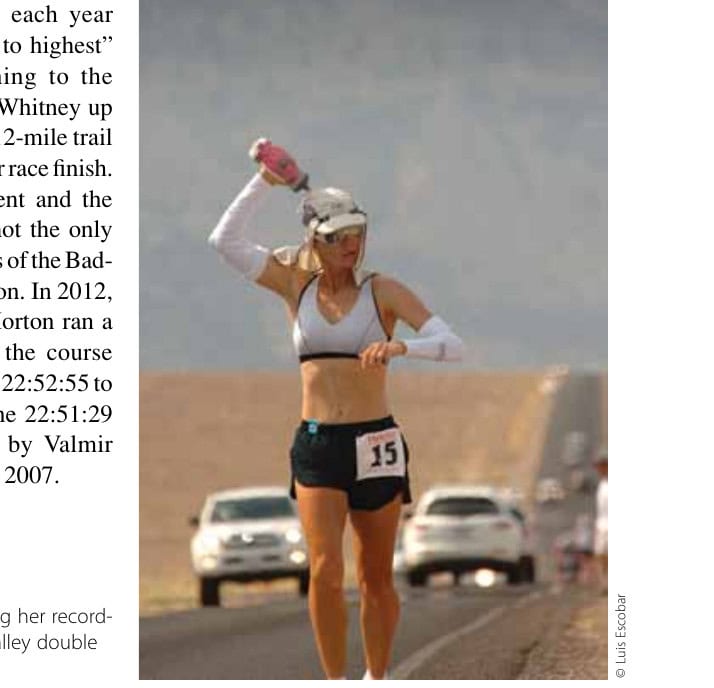
Why this ultra is historically important: In addition to the unique geology and geography, Death Valley’s very hot temperatures attract Badwater 135 Ultramarathon runners who want to test their racing stamina in an environment adverse to human survival.
Comrades Marathon, Pietermaritzburg, South Africa
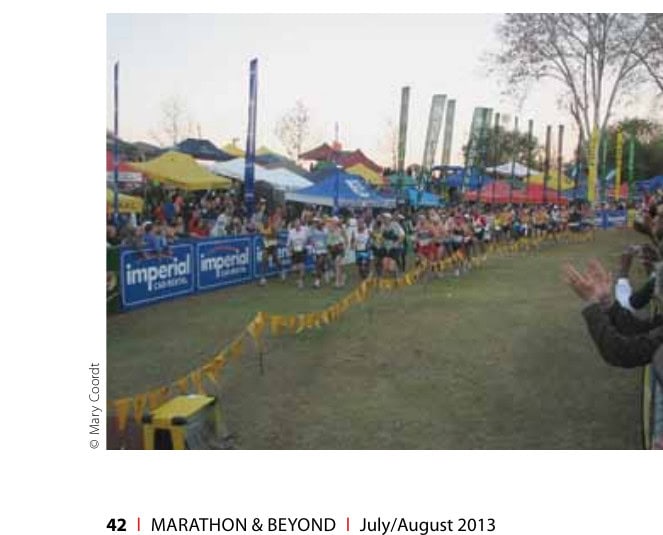
The world’s oldest and largest ultramarathon is South Africa’s Comrades Marathon. The event has been run 87 times as of 2012 and was created by World War I veteran Vic Clapham. Born in London, he emigrated to South Africa as a child. When World War I broke out, he enlisted and marched 1,700 miles through Africa with the South African infantry. Surviving the hardships of his military service, Clapham worked to establish the 56-mile (90 kilometer) race between the South African cities of Pietermaritzburg and Durban to memorialize the sacrifices of his wartime comrades. The first Comrades Marathon took place on May 24, 1921, starting at Pietermaritzburg City Hall with 34 runners. It has continued every year since with the exception of the World War II years of 1941 to 1945. In 2012, of the 19,524 runners who entered the race, about 10,000 finished. Comrades Marathon runners earn a silver medal for completing the race between six hours and 7 hours, 30 minutes, and a bronze medal for finishing between nine hours and 11 hours.
The start of the “ultimate human race” alternates annually between Pietermaritzburg and Durban, with the change in the direction of the racecourse giving rise to the reference to the “up and down” (elevation) runs.
Why this ultra is historically important: Comrades Marathon is the oldest and largest ultrarace in the world, routinely producing significant marks in ultradistance running.
1990 IAU World Cup 100K, Duluth, Minnesota, USA
With race founder and director Bill Wenmark’s statement, “The 1990 World Championship at the Edmund Fitz is still considered the greatest 100K road race in history,” the only World Cup 100K run on American soil is a ready pick for one of the 10 most important ultras in history. Since ultrarunning is not an Olympic sport, the International Association of Ultrarunners (IAU) World Cup 100K is the biggest venue for international ultraracing.
Coming within two years after the International Association of Athletics Federations (the world governing body for track and field) recognized the IAU world ultrarunning organization, the Edmund Fitzgerald 100K’s bid to host the world championship of ultraracing was a notable accomplishment. Federations from around the world sent top ultrarunners to Duluth, Minnesota, in October 1990. And despite the United States having come late to 100K road racing, fielding its first team at the 1987 World Cup, the US men’s and women’s teams both won silver medals.
Although the Ed Fitz ended in 2007, US teams have continued to compete well in European and Asian venues. US women’s teams won bronze medals in 1993, 1998, 2000, and 2002; silver in 1990 and 2008; and the gold medal at the 1995 and 2005 IAU World Cup 100K Championships. The US men won bronze in 1994 and 2007 and silver medals in 1990, 1995, and 2000.
Why this ultra is historically important: The 1990 Ed Fitz 100K is the only World Cup 100K run on American soil in the IAU’s 29-year history.
JFK 50 Mile, Boonsboro, Maryland, USA
Beginning as part of President John F. Kennedy’s initiative for physical fitness, the JFK 50-Mile Challenge was one of several 50-mile events held in 1963. With four finishers in March 1963, it is the only 50-mile event to continue after the assassination of President Kennedy. The race grew to 967 finishers in 2012, which produced stunning course records that are less than half the times of the original race finishers. The 2012 winner, Max King, set the men’s mark at 5:34:59, and Ellie Greenwood set the women’s record in 6:12:00 on a course that includes more than 1,000 feet of climbing up to a ridge on the rocky Appalachian Trail before descending the 1,000 feet to a gentle finish on the C&O Canal towpath and paved rural roads.
These course records well exceed President Kennedy’s challenge to his officers to meet Teddy Roosevelt’s 1908 requirement for his officers to cover 50 miles on foot in 20 hours. Throughout the race’s history, military participation has been encouraged and recognized with various special division awards.
One of the notable early participants in the president’s 50-mile fitness challenge was his brother, US Attorney General Robert Kennedy. Preceding the initial JFK
50 race by a month, Bobby Kennedy is reported to have completed 50 miles along much the same C&O towpath of the racecourse in 15 hours and 50 minutes.
Why this ultra is historically important: The JFK 50 is the nation’s oldest continuous ultramarathon.
Self-Transcendence Ultra Classic 24-Hour Race, Ottawa, Ontario, Canada
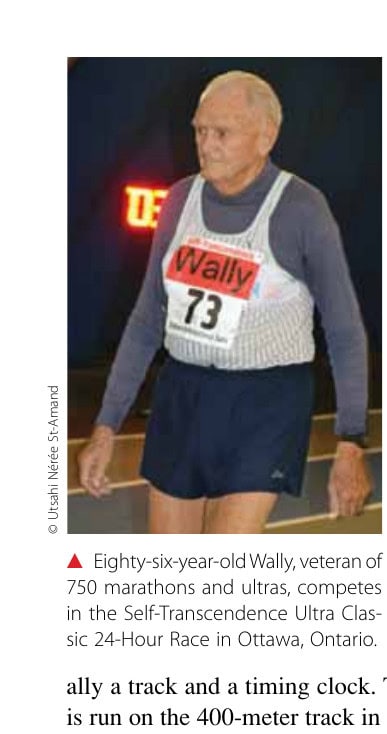
Begun by the spiritualist and endurance athlete Sri Chinmoy, a native of Bangladesh, the Self-Transcendence Ultra Classic 24-Hour Race in Ottawa is the oldest timed ultrarace. Where most ultras are run on some configuration of a point-to-point course or at least have a start and finish line along with a timing clock, timed ultraracing has only a measured venue—usually a track and a timing clock. The Transcendence Ultra Classic 24-Hour Race is run on the 400-meter track in the Louis Riel Dome in Ottawa, which is North America’s largest air-supported structure. Racers compete to win by covering the most laps, equated to mileage, within the timed period. And while the Sri Chinmoy Marathon Team established in 1977 offers a variety of longer timed running events such as six- and 10-day races around the world, the 24-hour venue has become an ultra standard that is now contested at IAU sanctioned world championships.
“What gives life its value if not its constant cry for self-transcendence?”
—Sri Chinmoy
Why this ultra is historically important: At 32 years, the Ottawa Self-Transcendence Ultra Classic 24-Hour Race is “the longest-running 24-hour race in the world” and routinely produces high-mileage performances, often by members of the Sri Chinmoy Marathon Team.
Spartathlon, Athens, Greece
The Spartathlon was established when British Royal Air Force officers attempted to verify the historical account that Pheidippides, an Athenian messenger, ran 250 kilometers from Athens to Sparta to request help at the Battle of Marathon. The officers’ test in 1982 proved that it was indeed possible to cover the approximately 155 miles in 40 hours as reported by the historian Herodotus.
Since the RAF officers’ test, runners from around the world have run the Spartathlon’s roads and trails from the base of the Acropolis through elevation ranges from sea level to nearly 4,000 feet and through numerous checkpoints. The first Spartathlon was held in 1983 and was won by Greek ultrarunner Yiannis Kouros, who in 1984 produced the still-standing course record of 20 hours and 25 minutes. Kouros won twice more and still has the four best Spartathlon times. American Scott Jurek won three times, and his 22:20:01 in 2008 is the fifth-fastest time. He is the only North American male winner of the race.
Why this ultra is historically important: The Spartathlon is a modern-day commemoration of a well-known ultrarunning achievement run on the historic course.
Transcontinental Races
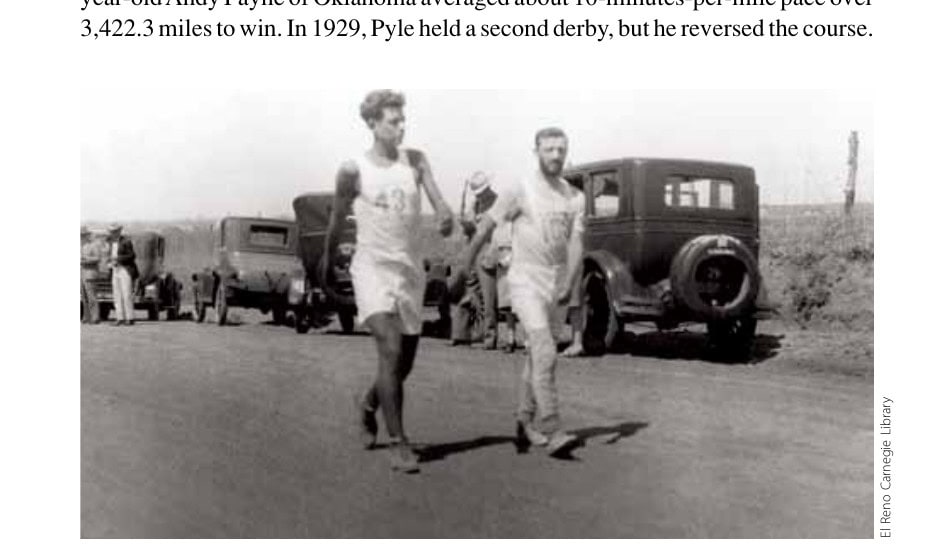
Perhaps it is the clear goal of coast-to-coast running that inspires transcontinental organizers and racers, and perhaps it is the monumental challenge of these events that makes them so intriguing, rare, and intermittent throughout history. In 1928, race promoter Charles C. Pyle offered $25,000 to the winner of the first-ever trans-America footrace race, staged between LA and New York City. The press nicknamed it the “Bunion Derby.” Nearly 200 men took up the challenge (55 finished)—most of them blue-collar workers who hoped to earn a share of the $48,500 in total prize money and make a better life for their families. Twenty-year-old Andy Payne of Oklahoma averaged about 10-minutes-per-mile pace over 3,422.3 miles to win. In 1929, Pyle held a second derby, but he reversed the course.
In 78 days of racing, 1928 veterans Johnny Salo and Peter Gavuzzi battled for the first-place prize money. Salo won by less than three minutes in a disputed finish. Sadly, Pyle went bankrupt and did not pay out the prize money. The logistics and financing of months-long transcontinental stage racing along with the emotions and tensions of such great efforts did not allow for a long event history. Page 47 provides summaries of some of the better-documented transcontinental races.
Why these ultras are historically important: The daily high-volume mileage demands of transcontinental racing redefine human capacity, recovery, and possibility. After the 1928 derby, a team of Philadelphia doctors examined 20 finishers and concluded that normal human beings, given enough food and rest, were capable of running the trans-America distance without damaging their bodies.
Ultra-Trail du Mont-Blanc (UTMB), Chamonix, France
Using the popular Tour du Mont Blanc (TMB) course that circles Western Europe’s highest peak, 15,782-foot Mont Blanc, the 103-mile, single-stage Ultra-Trail du Mont-Blanc (UTMB) has grown to 2,300 entrants in its 2013 edition. While the classic TMB loop through the Alps typically takes hikers seven-plus days of trekking through France, Switzerland, and Italy, the winners of the mostly self-supported UTMB finish in about 20 hours. Meeting the 46-hour overall cutoff is a remarkable feat because of the UTMB’s 31,168 feet of uphill.
Although a newer race, having begun in 2003, the UTMB’s popularity has caused tighter and tighter entry standards while expanding race offerings to accommodate the interest of mountain endurance runners. To enter the UTMB, all racers must qualify through a point system of running accomplishments.
Why this ultra is historically important: While North American 100-mile mountain trail races such as Hardrock, Leadville Trail 100, and the Wasatch Front 100 are run at substantially higher elevations, the UTMB’s venue showcases the character of alpine endurance racing and produces remarkably fast times.
Western States 100-Mile Endurance Run, Squaw Valley, California, USA
Inspired by the 100-mile Tevis Cup horse race that challenged equestrians to cover a rugged trail course in the Sierra Nevada Mountains and the canyons draining to the American River, the first and oldest 100-mile trail race was born. When Tevis Cup rider Gordy Ainsleigh was curious whether a human could cover 100 miles of mountainous trails on foot in one day, he joined the 1974 Tevis Cup event as a runner and completed the course in 23 hours and 42 minutes. With proof that humans could run the course in one day, the first official Western States 100-Mile Endurance Run was offered in 1977.
Transcon Race Summaries
| Transcon Race | Date | Start | Finish | Distance | Winner | Highlight Summaries |
|---|---|---|---|---|---|---|
| First Trans-America aka 1928 “Bunion Derby” | March 4 to May 26, 1928 | Ascot Speedway, Los Angeles, CA | Madison Square Garden, New York City, NY | 3,423.5 miles in 84 days | Andy Payne (USA) averaged 10 minutes and 4 seconds per mile to win in 573 hours. | 199 starters and 55 finishers ran Route 66 from LA to Chicago for 2,400 miles, then on to NYC to win the $25,000 first prize. |
| Second Trans-America aka 1929 “Bunion Derby” | March 31 to June 16, 1929 | Columbus Circle, New York City | Wrigley Park, Los Angeles | 3,553.6 miles in 78 days | 1928 veteran Johnny Salo (USA) averaged 8 minutes and 53 seconds per mile to win in 554 hours. | 44 veterans from the first derby joined 33 rookies in this 78-day footrace across America. 19 finished. Pete Gavuzzi of England battled Salo for the $25,000 prize, losing the race by less than three minutes after 554 hours of racing. C.C. Pyle went bankrupt and did not pay the winners the $60,000 he had promised them. |
| Trans-Australia Footrace, “Race of Fire” | January 6 to March 11, 2001 | Perth, Western Australia | Canberra, Australian Capital Territory | 2,656.6 miles (4274.5 km) in 9 weeks | Anatoli Kruglikov (RUS) in 305 hours 18 min 45 sec | Winner Kruglikov ran an average pace of 8.4 mph, equivalent to 97 consecutive 3:10 marathons. |
| Running the Sahara (across Africa) | November 2, 2006, to February 20, 2007 | St. Louis, Senegal | Near the Suez Canal at the Red Sea, Egypt | 4,300 miles (6,920 km) in 111 days | Charlie Engle (USA), Ray Zahab (Canada) | Possibly an expedition more than a competitive race, but the event had a clear start and finish and a ticking clock. Three runners started and two finished. |
Since the first official race in 1977, when 22-year-old Andy Gonzales won in 22 hours, 57 minutes against a field of only 13 other runners, stunning records of human endurance performances have been logged on the Western States course. After 36 years, the course records are down to 14:46 by Timothy Olsen and 16:47 by Ellie Greenwood, both set in 2012.
From the curiosity of one athlete nearly four decades ago, the challenge and satisfaction of competing in and completing 100-mile trail races have captured the interests of so many endurance athletes that ultrarunners can now compete in approximately 70 100-mile trail races in North America, from mountains to coasts, from torrid to frigid temperatures, and all the amazing destinations in between.
Why this ultra is historically important: Western States was the first 100-mile trail race and established the concept and the model for 100-mile trail racing that contributed a distinctively American input to ultrarunning.
Unknown Future Ultrarace, Unknown Location
With the myriad of ultraracing options around the world in environments and conditions adverse to humans and the incredible records these races produce, it is difficult to imagine more challenging future races and their records. But there will be new ultrarunning marks set in new environments and on new courses. That is the nature of the human condition and the human spirit—to strive beyond current standards. All the races and performances described in “The 10 Most Important Ultraraces in History” have their place setting and recording standards that humans will use to establish new ones.
Why this ultra is historically important: This future ultrarace will redefine our current thinking and standards of human-endurance capacity and performance.

This article originally appeared in Marathon & Beyond, Vol. 17, No. 4 (2013).
← Browse the full M&B Archive1,000+ stories from 19 years of Marathon & Beyond
The complete archive of the legendary long-distance journal — digitized and free to read.
