

The 2010 Kalahari Augrabies Extreme Marathon
Multiday journey-type ultramarathons have always fascinated me. We’ve all heard of the Marathon des Sables through the Sahara Desert. I picked a different part of Africa for my first experience with multiday racing. My adventure began on the 12th of October 2010 with an extreme travelthon from Hawaii to South Africa, eventually arriving in Johannesburg 36 hours later, followed by a 10-hour bus ride to Augrabies through a thirsty-looking landscape. All in all, a 46-hour journey just to get to the start of my 250K ultra, and the games hadn’t even begun!
How could a woman who didn’t start running until she was 40 end up here? It started, as these things do, with one fateful step: I wanted to get fit, and I started running short distances because I could easily squeeze them in between my hectic duties as a registered nurse and my responsibilities at home. It was that progressive thing: I thought four miles was a long way to run but was persuaded to run an eight-mile race, and that led inexorably to a half-marathon and then a marathon roughly a year after I started running. I next set my sights on the Comrades Marathon because I had grown up in South Africa, Comrades was an institution of sorts, and my father had run it three times. I decided to adopt a charity and settled on HOKISA (Homes for Kids in South Africa), a charity dedicated to caring for children affected by or infected with HIV/AIDS. To build toward Comrades, I ran several ultras in my current home in Hawaii: the Hilo-to-Volcano 50K and then the Run to the Sun, a 36-mile race that climbs 10,000 feet to the top of Mount Haleakala. I discovered the power of mind over body and successfully applied that to success at Comrades. Of course, as with many long-distance runners, that wasn’t nearly enough, so I scoured the Internet, and here I was at the Kalahari
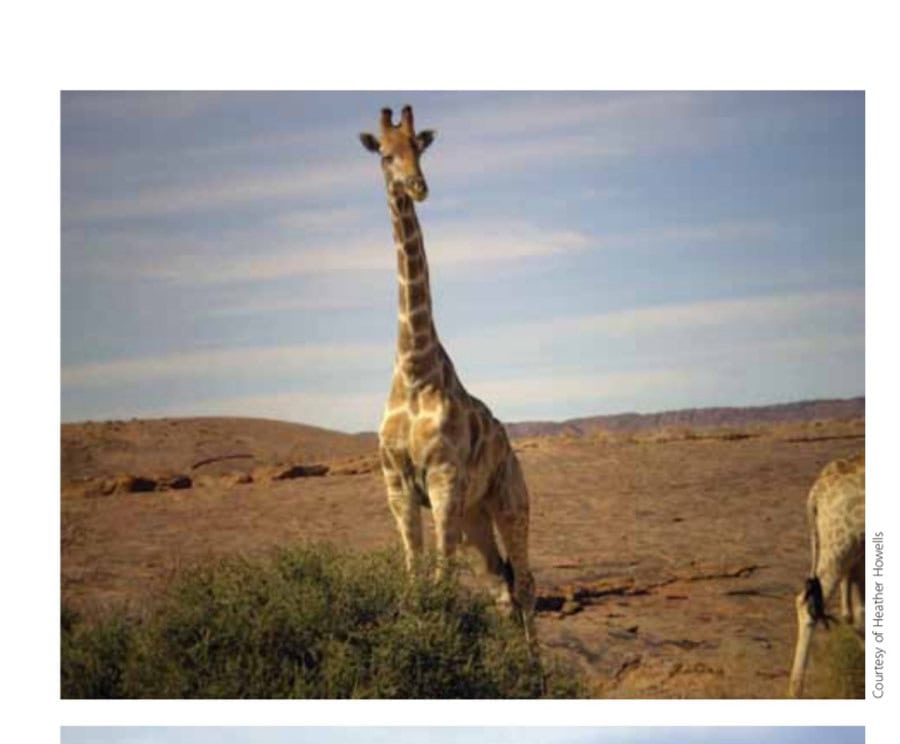
Augrabies, a 250K-six-legs-in-seven-days stage race—this from someone who at one time thought four miles was a long run. On arrival, we were housed in comfortable chalets at the Augrabies National Park and had a visit from vervet monkeys almost immediately. Within the near vicinity, we could view the spectacular Augrabies Falls and had the opportunity to take photos of quiver trees, dassies (rock hyrax), and Broadley’s lizards, which are found only within a 100-kilometer radius of the falls. The females are brown and black with three cream stripes on their backs, and the males are rainbow colored in order to attract a mate. A huge chunk of rose quartz was on display at the park, and I was soon to find out that the Kalahari is littered with the stuff. That evening a game drive ensued, and we came across several giraffes and a small herd of springbok and stopped off at a scenic overlook over a deep gorge, which the Orange River flowed through. That evening we had dinner at the Augrabies Lodge and met more of the runners and race crew.
Courtesy of Heather Howells
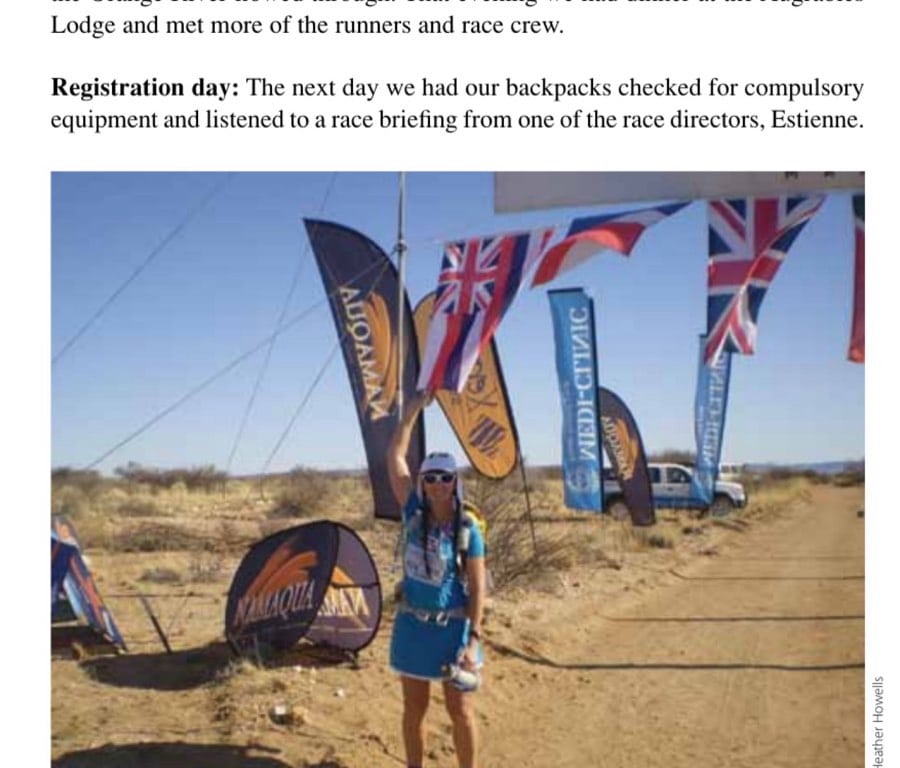
Registration day: The next day we had our backpacks checked for compulsory equipment and listened to a race briefing from one of the race directors, Estienne.
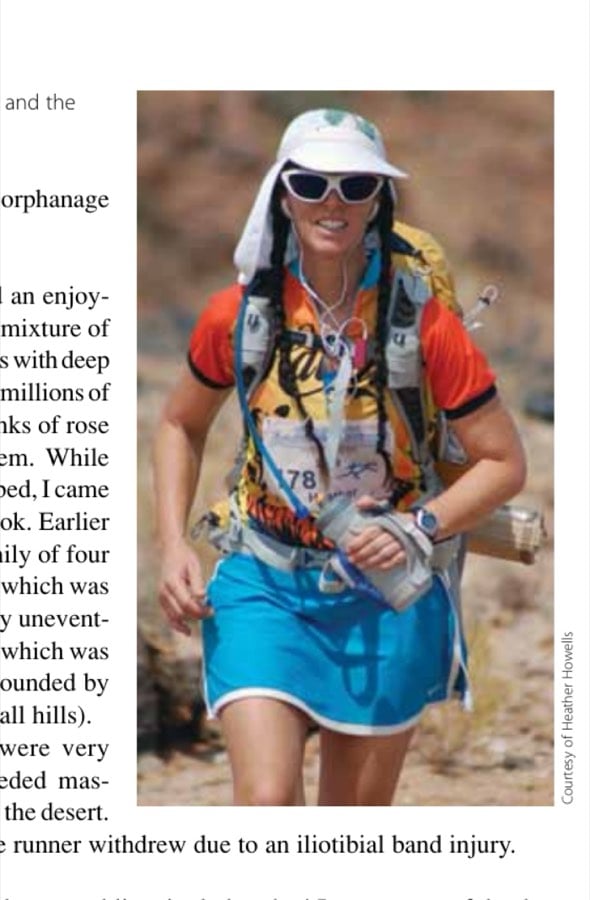
▲ The author representing Hawaii at the Kalahari Augrabies Extreme Marathon.
We were weighed and I weighed my pack, which was 10 kilograms dry weight, which fellow runners thought was too heavy, so I purged my bag of at least 1 kilogram of excess food, which I discovered I did not require.
A special mention needs to be made of the caterers, who made an effort to accommodate my vegan diet, which I’m sure was rather an alien concept to them. Day 1: I felt fantastic as the race started, as though I had wings on my shoes. I had elected to represent Hawaii in the race to pay tribute to my island home of the past decade and to perhaps add something unique to the event.
I found that after checkpoint #1, I was pretty much running on my own and followed the red-and-white striped tape that was tied to bushes. Somewhere along the way I stopped seeing the markers, but the terrain seemed to match the written description of the route. After a short while, I stopped and felt confused and could see runners’ footprints in the sand along the track. I backtracked, reread the instructions, and thought that I must be going in the right direction—which led to a dry riverbed in a gorge. I kept going but had a constant nagging feeling that I must be wrong and that I should have seen more tape.
I then saw a wet patch (of urine) in the sand and more footprints, which started to look confusing, going in both directions. I had a sick feeling in the pit of my stomach that I was going wrong and eventually came to a fence and looked for the supposed “gate” that was meant to be there and saw none. By now I had wasted more than an hour and decided to go back the way I had come, thinking, How wrong can I go? Just follow the dry riverbed back up the gorge and resume where I had deviated from the path.
As we had been briefed beforehand, once you turn around, nothing looks the same anymore, and I should have stopped when I first noticed that there were no markers. At this point, the potential to panic was there, but I decided to take out my safety whistle and mirror to attract attention. The act of blowing the whistle prevented me from panicking, but no one ever heard it.
It occurred to me that I might never be found. At this point, I stopped under the shade of a tree after drinking my last drop of water. Approximately two hours had passed since taking the wrong turn, and then I heard the beautiful sound of the quad bike and saw Estienne. He was furious with me, as I’m sure it must have been very worrying when the crew realized I was lost after not showing up at checkpoint #2.
At this point, Dr. Charl arrived in case I needed medical attention, but fortunately I was feeling 100 percent fine physically and was taken back to the trail to resume running, arriving at the finish much later than I had anticipated and a bit shaken from the sequence of events. I made an on-the-spot decision not to dwell on the misfortune and to continue to enjoy the adventure and make the most of it, which was my best decision of the day.
Courtesy of Heather Howells Courtesy of Heather Howells
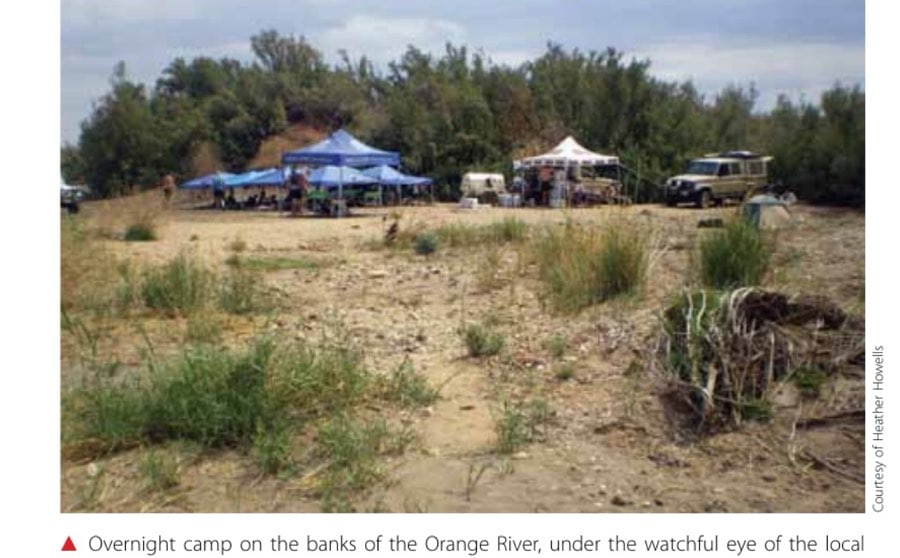
▲ Overnight camp on the banks of the Orange River, under the watchful eye of the local inhabitants.
The first camp was along the banks of the Orange River and was a blissful oasis of cool water with grassy riverbanks. We all swam and felt very refreshed. I photographed otter prints on the banks of the river, and we heard the beautiful cry of a fish eagle. During my extra 12K excursion, I had also seen three klipspringers bounding through the riverbed.
Each day I would have the opportunity to have fantastic interactions with fellow runners who were all friendly and encouraging. The camps consisted of open-sided canopy tents and a ground sheet. I had not brought a sleeping mat because I thought it would be too heavy, and this turned out to be a mistake. Just before the race started, I laid claim to a strip of cardboard cut from a box just long enough to pad my shoulders and hips, and this was now my bed. We all lay next to each other in rows, and every night I experienced jet-lag insomnia from the 12-hour time difference, waking up at 2:00 a.m. and finding it difficult to fall asleep again amid the snoring of 30 men and rustling of plastic bags.
That day I covered 26K (plus an additional 12K) in 5:33:33—a horrible time due to my misadventure. Apparently I was not the only runner to have lost the trail but had set the record for being the most lost.
Unfortunately, one runner had to withdraw from the race already and was taken to a hospital in the town of Uppington but was doing well. Day 2: We started out on the sandy banks of the river and then discovered that we had to rock climb out of the gorge with our heavy packs. I wasn’t expecting this but actually quite enjoyed it, and once we got to the top, the views were spectacular.
I spent the majority of day 2 running by myself and had the company of other runners only here and there. It was during these moments that I really bonded with fellow runners. I was extremely alert and vigilant for markers, as I did not want a repeat performance of the day before. Upon arrival in camp after having made up a significant amount of lost time after day 1, I was feeling very nauseous, and it took at least half an hour for me to feel remotely better.
The temperature under the tent canopy was 104 degrees Fahrenheit. At this point, the race director came to the camp and called me aside. He informed me that I was now in third position for the women and wanted me to know in advance that I would not be recognized with a trophy if I did come in third place due to my getting lost the day before and having to get into a support vehicle. For a few brief moments, I felt that I had been hit by a bus and then slapped in the face, but I managed to quickly compose myself and made my second decision to not allow this to affect my enjoyment of the event. I was happy to still be in the event, considering the distance I had traveled to be there and the immense support I had been given by friends and family in the fund-raising venture I had set up for this
▲
Day 4 was the longest (76K) and the toughest (114 degrees) leg.
Day 3: I felt great and had an enjoyable run. The terrain was a mixture of sandy riverbeds, gravel roads with deep sandy tracks, and trails with millions of small, loose rocks and chunks of rose quartz scattered across them. While running through a dry riverbed, I came across the skull of a gemsbok. Earlier in the day, I had seen a family of four gemsbok running together, which was marvelous. This was a fairly uneventful day, ending in camp #3, which was in a dry patch of veldt surrounded by beautiful rocky kopjes (small hills).
The physiotherapists were very sought after for much-needed massages after a hard day out in the desert. I covered 30K in 4:34. One runner withdrew due to an iliotibial band injury. Day 4: The long run took place on a blisteringly hot day! I spent most of the day with fellow runner Chanleigh. The company helped get me through the eternal bleakness of certain sections, interspersed with exquisitely beautiful sections. We cracked jokes, sang, went past runners, were passed by runners, and were in awe of the fact that people actually lived so remotely out there in the wilderness.
Much of the route was through private farmlands. The temperature soared to 114 degrees Fahrenheit, and we spent time at checkpoints on the balls of both feet to minimize the effect of the heat radiating up off the surface.
Just before the sun went down, at a very busy checkpoint #5 at 44K, my battle buddy urged me to go on ahead since she wasn’t feeling too good at the moment. I still felt great and headed off down the gravel road at a trot. It was stunningly beautiful as the sun set red and pink over the Kalahari and the full moon rose, illuminating the gravel track ahead of me. As I got to checkpoint #7, my wheels fell off. I must have reached a stage of calorie depletion and felt extremely nauseous. I had been consuming running supplements all day but had not eaten anything substantial. I crawled along the 10K from CP#7 to CP#8 in the bright moonlight,
Courtesy of Heather Howells
race in aid to HOKISA, an orphanage in South Africa.
moaning in a wretched state, forcing myself along mentally and trying to nibble on some almonds. It was at this moment that French runner Patrick came across me, and he could see that I was in fairly bad shape. He stayed with me all the time until we reached the next checkpoint, even though he was quite capable of running on ahead. I could not speak French, and he could not speak a word of English, but just having him by my side made a world of difference. I was a mess at the next CP and thanked Patrick with the only French word I knew—“Merci”—and he went on his way, knowing I was safe.
I nibbled some more, and pretty soon Chanleigh appeared, looking full of energy, and accompanied by Laura, our wonderful journalist who was covering the event. Later she told me that she had been pretty worried about me due to how I looked with my hair standing on end and the wild-eyed stare I had been reduced to. I now urged her to go on ahead, but not long afterward, I started to feel much better and set off again, catching up and making up lost time.
Chanleigh and I finished hand in hand in 16:19 for the 76K leg. It was excruciating doing the last few kilometers in the thick, sandy tracks leading to the dried riverbank of caked clay where camp #4 was situated. Unfortunately, we lost two more runners on the long day due to heat exhaustion and not feeling well enough to continue. Day 5: A day of resting, treating blisters, and drying them out. I spent much of the day lying on my strip of cardboard in the tent and hobbling around in flip-flops to wash my clothes and hair in the river, which was rather nice. Few people actually swam due to open wounds (mostly blisters) on their feet, but it was a refreshing camp for sure. With the long day behind me, I was confident that I would complete the event even if it meant crawling along on my painfully blistered feet. Race director Nadia sent out e-mails to us every night, which was extremely motivating for me, knowing that there were people out there rooting for me and tracking my journey. Day 6: One runner withdrew at the start of the day due to septic blisters that required IV antibiotic treatment at camp. This was to be a brutal 46K leg on painful blisters. During the course of the day, I had to constantly push the pain aside and keep running, which wasn’t always easy to do. Every time I stood on a small, loose rock or chunk of rose quartz, I experienced searing pain in the balls of my feet. The day was a process of one step in front of the other, and Chanleigh and I spent much of the day together, again finishing hand in hand in the time of 7:56. Day 7: The last day. In the morning I ceremoniously cremated my cardboard sleeping mat on the campfire. There had been moments during the event when I
Courtesy of Heather Howells
questioned my sanity: a 44-year-old woman running 250K through the Kalahari Desert with a piece of rolled-up cardboard on her back somehow seemed a bit crazy at times, but I was obviously in excellent, like-minded company.
Only 24K to go! The run was relatively easy except for the trail sections, which had lots of small, sharp rocks that seemed to dig into my blisters, causing me to sound like a bit of a sailor at times. Right toward the very end, I took a minor wrong turn through some reeds and had to backtrack again, losing more time, but it was not serious and then the end was in sight. What a relief! What a great feeling of accomplishment!
I had covered 252K in the Kalahari Desert. This was the first time I had ever attempted anything like this, but it won’t be the last. My total running time was 45:18:33. I was the fourth woman and 23rd runner overall.
Running an extreme marathon is a bit like natural childbirth: agonizing at times, but once it’s over and you’re holding the baby, it’s the best feeling in the world. The highlight of the experience for me was meeting the most incredible, humble, and wonderful people. The camaraderie was indescribable. When you’re with other people for seven days on foot in the desert under trying circumstances, you get to know a very special side of them. The crew from Kalahari Augrabies Extreme Marathon was also exceptional, many of whom were volunteers; it was often anything but an easy job. Race director Nadia was dubbed “the mother of
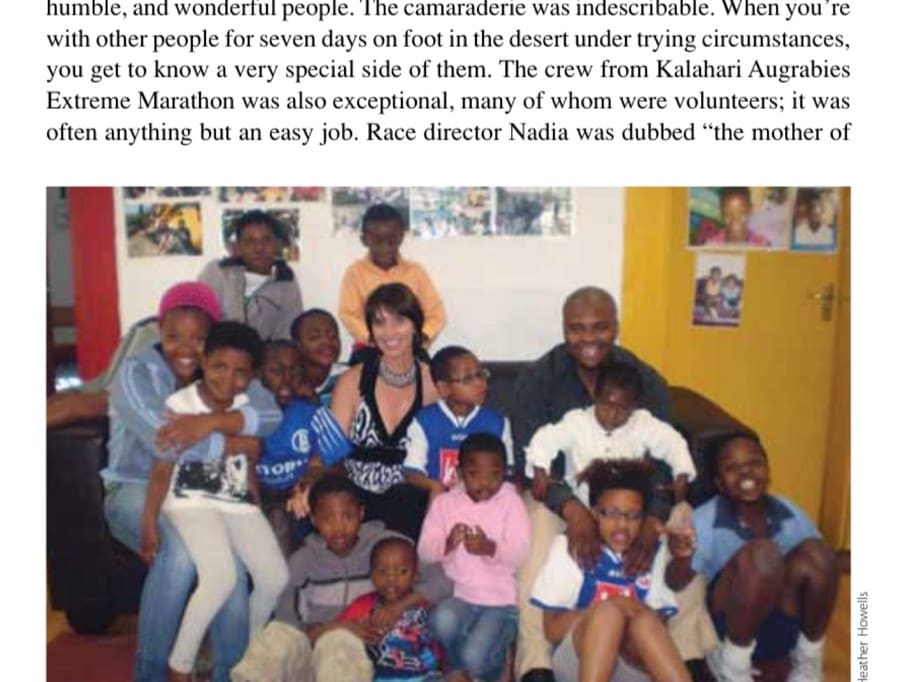
▲ The author has a postrace visit with the kids at HOKISA.
ad
KAEM” and had everyone’s well-being at heart. Simon, the third race director, who filmed the event, kept me laughing with his humor and witty banter. Estienne and I bonded at the end, and he requested my head lei of flowers that I had brought with me to wear at the finish. We were all weighed, and I had lost 6.6 pounds in the seven days—not necessarily a weight-loss program I would recommend to everyone.
After festivities and an awards ceremony, I headed off to Cape Town for a couple days to visit HOKISA, the orphanage for which I had been fund-raising. People at the orphanage had also been tracking my progress through the KAEM website, along with my friends, family, and coworkers. It was a fabulous feeling to arrive at HOKISA in the township of Masiphumelele and have the kids run up to me saying, “You ran for us. Show us your muscles.” They inspected my beautiful glass leopard finisher’s trophy, and we spent time together and took photos. I felt like a bear needing to retreat into a cave to process everything I had been through.
Now back home, my blisters have healed and I’m searching online to see which extreme event I can sign up for next… I would like to extend my thanks to my family, friends, and coworkers who very generously donated toward my fund-raising effort. I managed to raise $11,743 for HOKISA: a huge thank you to everyone who supported me.
This article originally appeared in Marathon & Beyond, Vol. 17, No. 4 (2013).
← Browse the full M&B ArchiveMore like this
1,000+ stories from 19 years of Marathon & Beyond
The complete archive of the legendary long-distance journal — digitized and free to read.
