

The Aloha Baghdad Marathon
December 21, 2006—It was a chilly morning in December as race entrants checked in, pinned on bib numbers, and huddled together in buses idling with heaters vainly attempting to hold back the cold, contemplating a course as different from its sister course, the Honolulu Marathon, as could be imagined. This was the start of what was billed as the Honolulu Marathon in Iraq. In many ways it mirrored any other prerace hubbub; but for 200 runners from numerous countries and various military services, it held more than the challenge of covering 26.2 miles on foot.
The about-to-begin marathon was the second one in three years to be hosted by the 25th Infantry Division, which is stationed in Hawaii. The two races were sponsored by the long-running and world-famous Honolulu Marathon. Two years before, a dozen or so soldiers had joined me on race day to run a satellite Honolulu Marathon in Tarin Kowt, Afghanistan.1
For us, the event would be the culmination of the Honolulu Marathon trifecta: Afghanistan, our home duty station of Oahu, and now Iraq. We were on the last leg of a three-year tour with the 25th Infantry Division. This would be our last chance to run together as part of the same light-infantry family.
SEEDS PLANTED IN OAHU The seeds for this Iraq marathon were planted when I dropped off my parents’ early-bird marathon registration in Oahu and inquired about registering for the Iraq marathon that was being promoted by the race in Honolulu. To my surprise, I learned that no one had yet been designated as the point person with our division, which was about to be deployed in what would be a 15-month tour. Still on a runner’s high from the tie-in marathon in Afghanistan that we had run, I slipped a cog from my better judgment and told Val Lawton from the Honolulu Marathon
Courtesy of Nicole Powell-Dunford
race organization that I would coordinate with my division and attempt to bring the same kind of event to Iraq. As one of the few flight surgeons in the division, I was already wearing several hats and perpetually busy. But the value of this event to my brothers- and sisters
in-arms was indisputable. I had so thoroughly enjoyed the Afghanistan event that I felt a responsibility to shoulder the additional work for my division as a way of once again sharing that very special opportunity for camaraderie.
Colonel A.T. Ball, our Combat Aviation Brigade commander, was immediately supportive. What followed the decision to put together the marathon were literally hundreds of hours of coordination, planning, and paperwork between 25th Combat
Aviation Brigade and the Honolulu Marathon. Without a doubt, the spectacular event would have been impossible without the full support of my own unit, 2nd Battalion, 25th Aviation Regiment—Task Force Diamond Head. Our Task Force
commander, Lieutenant Colonel Frank Tate, was instrumental in working with key division leaders, who would ultimately approve the event; Lieutenant Colonel Tate guaranteed that our unit would bear full responsibility for making the event
a “Go.” The 25th Infantry Division commander, Major General Benjamin Mixon, and Command Sergeant Major Jerry Taylor (hard-core athletes themselves) lent their full support. In the words of the Commanding General: “Well, why wouldn’t
we do a marathon here?” So many different entities became involved in the effort that we should have developed a scorecard to keep track of them. They included U.S. Air Force base
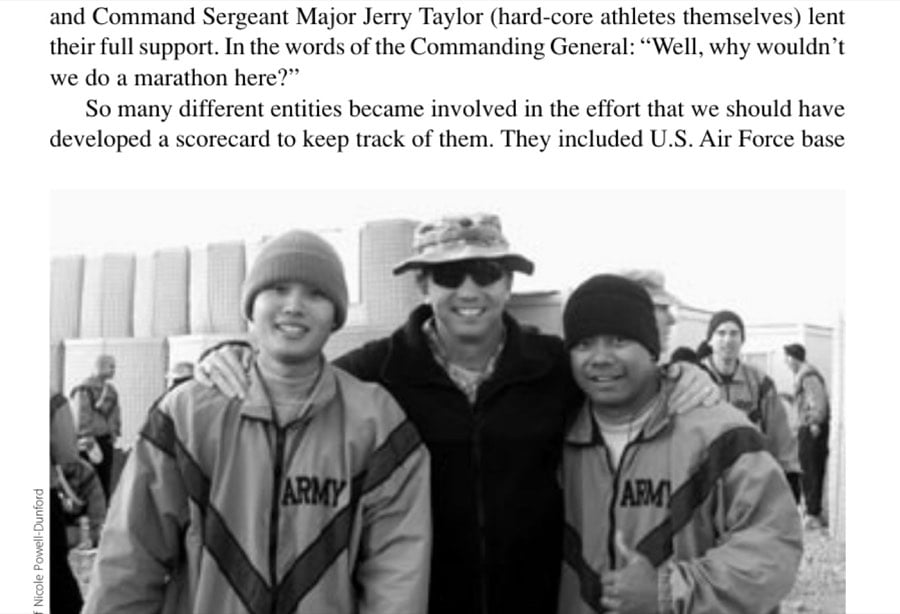
▲ Lieutenant Colonel Frank Tate, Task Force Diamond Head Commander (center), with marathon participants from 2-25 Aviation.
security; U.S. Army Morale, Welfare, and Recreation; 25th Division Headquarters; and virtually all medical personnel on base, just to name a few. Our Task Force executive officer, Major Rich Gordon, was crucial in making the vision of the Iraq marathon a reality; he organized everyone who was involved and set meeting agendas and deadlines. Captain Matt Yiengst, my company commander in Afghanistan, was another key organizer who, along with First Sergeant Michael Goolsby and First Sergeant Vince Aker, coordinated all the volunteers and race logistics while I performed race registration and racecourse brainstorming.
THE ROAD RUNNERS PROVIDED THE RACE’S BACKBONE E Company—the “Road Runners”—were the true hosts of the event, contributing numerous soldier volunteers who braved chilly conditions for race check in, course validation and preparation, pre- and postrace events, and cleanup.
Despite all the hard work, our unit felt that it was a privilege and an honor to host the deployed marathon for the rest of the division. Throughout the post, training teams sprang up, with E Company’s Road Runners going so far as to set up a formal running club that continues to function months after the event.
Captain Stanton Trotter, never a better-named, running-addicted chaplain, organized a large running team from the 82nd Airborne Division. Training in a combat zone is a mite different from training back in the everyday world. Runners had to squeeze training time into a 12- to 15-hour working day—a working day that could at any time be interrupted for pressing missions or base-wide emergency exercises. The use of iPods and other devices that might distract a soldier’s concentration is restricted due to the need to maintain constant situational awareness within a war zone. That said, the marathon would replicate as closely as possible the home-based Honolulu Marathon. We received special one-time-only authorization to allow runners to wear iPods during the race.
Virtually all participants, whether runners or volunteers, were allowed to take some time off for the race in order to effectively complete all event assignments. We had a rather large number of entrants who flew in from other regions in Iraq to take part in the race.
GENEROUS DONATIONS The Honolulu Marathon’s generous donation of running bibs, volunteer and race-finisher T-shirts, finishers’ medals, marathon race signs, and finishers’ leis, along with completely waived registration fees, was unbelievable. The show of support from the home front brought tears to some of our eyes as the numerous boxes of donations were opened. It was also heartwarming to see so many very senior leaders organize motivation stations that appeared on the course on race day. We had an island-themed area with senior leaders dressed as Gatorade- and
Courtesy of Nicole Powell-Dunford
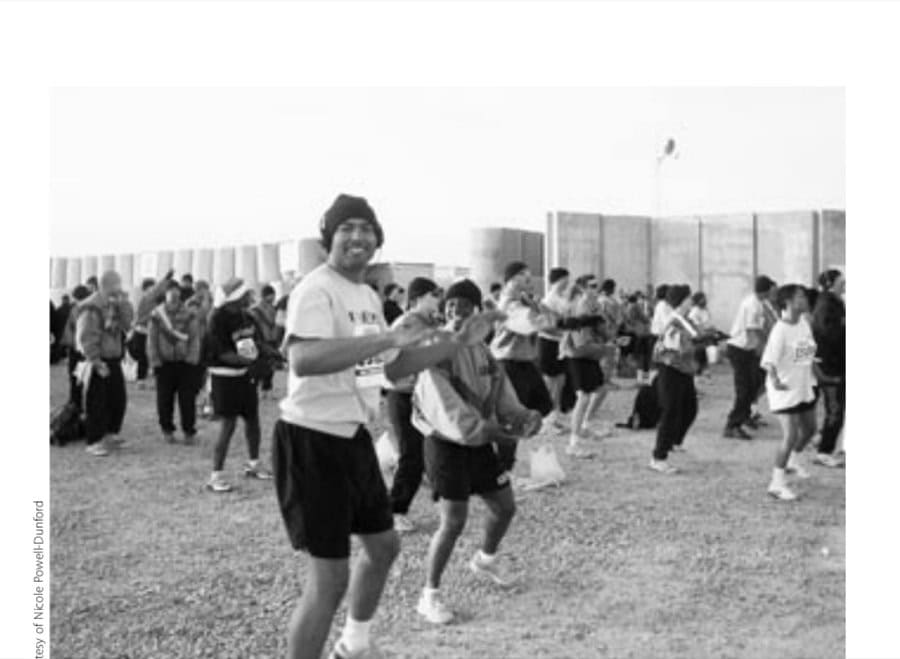
▲ Staff Sergeant Michael Thomas and First Lieutenant Tamla Henderson dance to a Hawaiian beat during the prerace warm-up.
water-bearing elves, along with a first sergeant Santa Claus. The 82nd Airborne’s highly-motivated motivation station showcased a bullhorned noncommissioned officer screaming the names of all runners as they whipped by, assisted by an
other airborne soldier armed with a pair of binoculars to make it easier to read bib numbers. The U.S. Army Reserve’s 399th Combat Support Hospital, based in New England, and 25th Combat Aviation Brigade provided the bulk of medical personnel and field ambulances along the course. The 2-25 Aviation’s air assault unit had a
station blasting hard rock AC/DC tunes out of loudspeakers where our own Task Force commander and outgoing Command Sergeant Major Robert Felder stood along the course and passed out drinks to runners.
As you can imagine, one of the most serious aspects of the race was runner safety and operational security. Preventing wartime injuries was the top priority for this event. We worked closely with various organizations to make the security plan rock solid, including specific plans in the event of incoming fire on race day.
Luckily, these contingencies are rehearsed regularly and are a standard aspect of combat-zone life. We had plenty of medical personnel and fluids and IVs, but fortunately we didn’t need to go to any emergency plans during the race.
A GROWING ASSOCIATION WITH TAPS
Courtesy of Nicole Powell-Dunford
The aspect of the war-zone marathon experience that I thought was most important to us was our partnership with TAPS—Tragedy Assistance Program for Survivors. A nonprofit organization that provides free services to the surviving families of fallen service members, TAPS has a long history of working with the Marine Corps Marathon through a program called Team TAPS. Runners from Team TAPS run in honor of a fallen service member and are linked up with surviving family members, many of whom turn out for the Marine Corps Marathon itself. Before the race, the runners learn more about the soldier, sailor, marine, or airman whose memory they are honoring; they are then able to establish ties with that service member’s family.
The Marine Corps Marathon Forward, run in Baghdad just a few weeks before our own Iraq marathon, was the inspiration for this partnership. Major Karl Kisch, a physician assistant and avid runner who also completed the Honolulu Marathon trifecta, was critical in establishing the initial connections with the TAPS program. Sadly, Major Meagan McClure, the race organizer of the deployed Marine Corps Marathon and an inspiration within our deployed running community, was killed shortly after our own event by a roadside bomb.
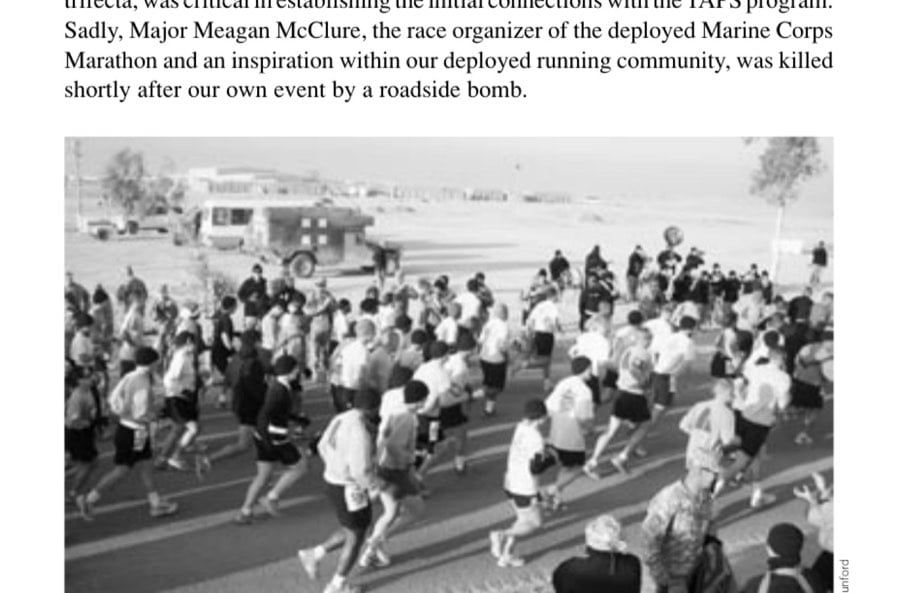
▲ Race start at Contingency Operating Base Speicher.
There have been several combat marathons over the past three years; these marathons in dangerous places must seem over the top to those outside the military community. But to those of us who recurrently deploy away from loved ones, it is a natural outlet for us—both as athletes and as combat veterans. The suffering that war brings can be overwhelming, particularly when it claims the lives of our brothers- and sisters-in-arms. The discipline of running is a powerful way to cope with the frustrations and heartbreak of war. Running in honor and support of those we have lost—to dedicate an entire event to their memory—is even more meaningful.
Prior to our race day, we showcased the letters that surviving family members had written to us and displayed beautiful listings of runners along with those they were honoring with pictures of the fallen service members. Virtually all registrants ran on behalf of another service member and most wore specially designed T-shirts on race day honoring our fallen comrades. TAPS had also preferentially linked us runners with Oahu-based fallen service members, including many members of our own division who had been lost in the war over the past three years.
Several helicopter crew members and I were able to run for pilots and crew chiefs from our own units who had made the ultimate sacrifice, including my former squadron commander, Lieutenant Colonel Mike McMahon. The inspiration of running for others drove home many PRs and dozens of first-time marathon finishes.
RAISING DONATIONS TO HELP TAPS The 25th Infantry Division and our fellow race participants were able to raise over $25,000 in donations for TAPS by race day through friends and family who contributed to the online Web site, www.taps.org. Many of us continue to remain in contact with the surviving family members on whose behalf we ran.
Several married couples who were separated by deployment but who were still together in spirit managed to run the marathon together. One ran the Honolulu Marathon on Oahu while the other ran the Iraq version of the race. One such runner was 2-25 Command Sergeant Major Allen Haynes. Several of them were also first-time marathon participants and were able to take part in a teleconference with their spouse just before race day. At the finish line, emotions were high and many of us who had run in Afghanistan were able to spend some time with each other for the first time in two years. We took great pains to ensure that our awards banquet would take place just as the Oahu event, on the other side of the world, was beginning. The Commanding General and Command Sergeant Major of the 25th Division appeared at our awards ceremony and presented division coins to the top three male and female finishers.
Courtesy of Nicole Powell-Dunford
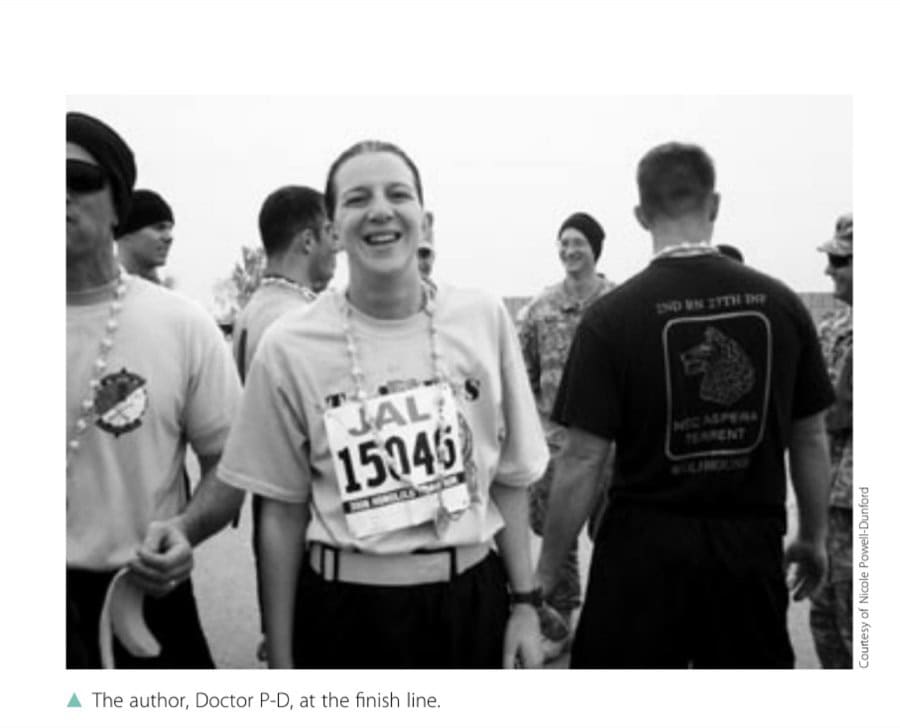
▲ The author, Doctor P-D, at the finish line.
The Honolulu Marathon, whose support I cannot overstate, went above and beyond by listing all of us deployed finishers on its official marathon Web site and also mailed us finisher certificates from race headquarters in Oahu. In a small token of our appreciation, we mailed back to them a huge thank-you banner signed by participants at the awards banquet. We are thrilled to report that the banner still hangs in Honolulu Marathon race headquarters.
This deployed marathon brought many new marathoners into the fold of the running community and gave us an incredible opportunity to honor the sacrifices of our country’s greatest heroes. In Hawaii, there is a special word for family: ohana. Ohana is the most important, sacred, and powerful bond imaginable—eternal and indestructible. On December 12, 2006, the Honolulu Marathon and the Hawaii-based 25th Infantry Division formed an ohana of runners, volunteers, and surviving family members—one that I will always be proud to be a part of. 1
See Marathon & Beyond, May/June 2005 or visit www.marathonandbeyond.com and click on “Other Editor’s Choices” and scroll to the bottom to read “You Want to Put on a Marathon—Where?” by Ivan Hurlburt.
This article originally appeared in Marathon & Beyond, Vol. 12, No. 1 (2008).
← Browse the full M&B ArchiveMore like this
1,000+ stories from 19 years of Marathon & Beyond
The complete archive of the legendary long-distance journal — digitized and free to read.
