

The Art of Peaking
No running distance is easier to prepare for than the marathon. The primary variable you deal with when training to run or race 26.2 miles is lactate threshold. Unlike shorter events like the 5K and 10K, in which you must train your body to run successfully after lactate forms in the bloodstream, you can successfully run a marathon only when you have trained your body to operate at lactate threshold (one’s anaerobic threshold).
You can’t successfully complete a marathon once large amounts of lactate have accumulated in the bloodstream. All those reactions you studied in biology (Krebs cycle, glycolysis and respiration, ATP, ADP, etc.) become your worst nightmare once your pace exceeds the lactate threshold. The key to marathoning, then, is to train your body to increase the lactate threshold pace while avoiding the formation of lactic acid in the bloodstream. Marathon training is that simple. Trust me.
But if it’s so simple, why is the marathon the most feared yet revered distance in the running world? Because, if done unwisely, the training required to reach the potential lactate threshold pace could open a Pandora’s Box of injury, illness, fatigue, and the powerful temptation to open a bottle of your favorite beverage and sit on the couch rather than lace up your running shoes and head out for a run.
Let me offer a conceptual framework that will help you understand the discussion on marathon training that follows. At times throughout the article, I will refer to beginners (new to running, whose goal is just to finish the marathon), advanced (whose goal is to improve on a finishing time or reach a certain time goal), and elites (whose goal is to run a national- or world-class time). Examine Figure 1.
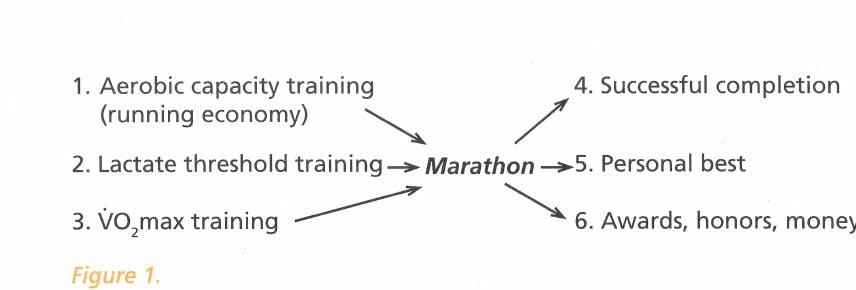
Numbers 1, 2, and 3 on the left side—aerobic capacity training, lactate threshold training, and V̇O₂max training—represent the independent variables that you must achieve while training for your marathon. If you’re successful, then you will achieve the dependent variables on the right side. Threshold training is the key variable. But, without aerobic capacity training and V̇O₂max training, you cannot do your best threshold training. Let’s look at each one.
Aerobic Capacity Training
Aerobic capacity training or running economy training (RE) allows you to advance your aerobic fitness level so you are training comfortably and consistently while stressing quantity over quality. You do this training by consuming submaximal amounts of oxygen as you run; that is, you’re not struggling for breath, and your muscles aren’t starving for oxygen as you run.
Your aerobic capacity advances by receiving a constant dose of consistent mileage done over several weeks’ time. What kind of training levels are involved? Up to 25 miles for beginners, 50 miles for advanced runners, and 80 miles for elites. Weekly mileage increases by approximately 10 percent every three weeks. Beginners run 15 miles per week for three weeks, then 17, then 20, then 25 three months later. Advanced runners log 35, 40, 45, then 50 miles. Elites run 70, 80, 90 miles, or more, depending on background. After a two- to three-month regimen of RE training, it’s time to incorporate the two other variables necessary to run a successful marathon.
Lactate Threshold Training
Threshold training refers to anaerobic threshold and lactate threshold. For the sake of this discussion, suffice it to say that they mean the same thing. In a nutshell, if you run continuously at a pace that is too fast for your body to comfortably utilize oxygen, lactate forms in the bloodstream. If you reach this pace too early in a race, your body builds up lactate until it is impossible for you continue at that pace—or at all, for that matter. Obviously, the faster you can run without triggering lactate production, the faster you’ll get to the finish line.
Your lactate threshold (LT) pace is 10 to 15 seconds per mile slower than your 10K race pace (which is approximately your 15K or 10-mile race pace). LT workouts are most satisfying because you can do them week after week with a noticeable increase in your fitness level over time. And these LT workouts are not so demanding on your body that it rebels against the thought of doing them. In contrast, training toward a faster 5K or 10K requires quick and demanding workouts.
Sample LT Workouts
The simplest LT workout is the standard tempo run, a 20- to 25-minute run done at 10 to 15 seconds slower per mile than your current 10K race pace. With a sufficient RE base under your belt, four months out from your marathon, you’d run one day a week at LT pace (in the case of the 45-minute 10K runner, that would be one 3-mile run at 7:30 pace). As your fitness improves during these four months, increase up to 15 percentage the amount of weekly mileage run at LT pace. So, by two months out from the marathon, a 40-mile-per-week, 45-minute 10K runner would log 6 miles (in two 3-mile runs) per week at 7:30 pace. The 30-minute 10K elite runner doing 100 miles per week should build up to handling 15 miles per week at LT pace (5:05 pace), divided into two or even three days.
As Table 1 shows, other types of LT workouts include long repetitions, such as 4 to 5 × 1 mile at 10K or 15K race pace with a three- to five-minute recovery between each, or 6 to 8 × 1,000 meters at 10K or 15K race pace with a two- to four-minute recovery between each. These workouts can be done on the track, trail, grass, road, or other surface.
Any successful training program always carries one warning: allow flexibility and room for adjustment if necessary. If you’re tired, skip the tempo run. If you’re bored with the route you’ve been using, do the tempo run elsewhere, hook up with someone else, use a race as your tempo run, or do another type of LT workout.
| Name | Pace | Time | When to do them | Frequency |
|---|---|---|---|---|
| *Tempo run | 10–15 seconds per mile slower than 10K pace | 25 min. | Four months out / Two months out | Once a week / Twice a week |
| *Long reps | 10K or 15K pace | 3+ min. | Four months out / Two months out | Once a week / Twice a week |
*Run a tempo run and long reps on alternate weeks.
V̇O₂max Training
V̇O₂max workouts are short, intense intervals at 5K race pace. This type of pure “speedwork” is very grueling both mentally and physically, and should only be undertaken by those fit enough to survive it. Examples of V̇O₂max work include about two miles worth of intervals lasting anywhere from a minute and a half to three minutes in length, with an equal recovery in between. These workouts train your body to better utilize oxygen by training it to consume oxygen while you are running very fast.
Mileage Guidelines
Table 2 shows marathon finishing time goals and the least weekly mileage necessary to obtain the time (all are ballpark figures). At least four months out from your marathon, you should be logging at least 40 miles a week if you wish to actually race it for time. If merely finishing is your goal, build up to 30 miles or so just before the marathon. But for you racers (advanced and elites), follow these guidelines:
- Five months from your marathon, run at least 70 percent of your ultimate goal for maximum miles per week.
- Four months out from your marathon, run at least 80 percent of your ultimate goal for maximum miles per week.
- Two months out from your marathon, run your maximum weekly mileage until two weeks prior to marathon, when you will begin to taper.
| Time goal | Five months out | Four months out | Two months out |
|---|---|---|---|
| 2:15–2:22 | 60 | 68 | 85 |
| 2:22–2:35 | 53 | 60 | 75 |
| 2:35–2:50 | 42 | 48 | 60 |
| 2:50–3:30 | 35 | 40 | 50 |
| 3:30–4:00 | 32 | 36 | 45 |
| 4:00+ | 21 | 24 | 30 |
The numbers in Table 2 aren’t etched in stone. I provide them as a guideline to prevent overtraining in the preparation phase of marathon training. The higher the mileage, the more likely advanced and elite runners will be able to reach their goal, as long as they don’t overtrain. For beginners, running more slow, easy miles doesn’t necessarily mean they will run faster. In the early months of marathon training, the mileage should be comfortable to handle, so that lactate threshold and VO2max training can be thrown into the training mix as early as possible. If you can’t handle the mileage, then you need to advance your aerobic capacity further before you can do more arduous training.
How much should first-time marathoners run, and how fast? For novice marathoners, more is not necessarily better. If you’re running 35 miles per week with four weekly workouts, moving up to six similar-intensity workouts and 50 miles per week probably won’t boost your marathon performance. Your performance times will improve after you’ve incorporated the fast-paced training into the weekly mileage mix geared specifically for the marathon.
Training at faster than marathon velocity will produce a higher fitness level compared to slower running, but it doesn’t teach the body to function well over a marathon-type span of time. Training long and slowly accomplishes the latter, but produces smaller gains in fitness. If your goal is simply to finish, then don’t worry about a fast pace. Build up to 30 to 45 miles per week, occasionally running long (up to 150 minutes) so you have confidence that you can complete the distance.
BUILDING A BASIC TRAINING PLAN
My basic training plan for marathoners of all abilities prescribes mileage totals and a time frame to run these miles, based on a goal finishing time. If your goal is merely to finish a marathon, you only need to run easy miles leading up to the big day, perhaps throwing in a few 20-milers. But if you want to reach an actual time goal, you’ve got to do more specific training.
What About Pace and Timing?
What should these weekly miles consist of in terms of pace? What are the workouts trying to accomplish? And when should you run a specific workout? First, you should run easy RE mileage five or six days a week up to five months out from your marathon. This allows your body to increase its aerobic capacity, thereby laying the foundation for more arduous workouts, which should begin weekly about four months out from the marathon. If you have trouble adjusting to the faster-paced workouts, then continue to build on your aerobic capacity. Difficulty with faster running is your body’s way of saying it’s not quite ready.
Incorporating faster running (LT training) four months out from your marathon is a ballpark estimate, so don’t sweat it if you’re not quite ready for the fast stuff. Table 3 shows you what your weekly mileage paces should be and what these paces accomplish.
| Type of workout | Pace | Quantity | Purpose |
|---|---|---|---|
| Running economy | 1:00–2:00 per mile slower than LT pace | 80% | Recovery, aerobic and musculoskeletal strength |
| Lactate threshold | 10–15 seconds per mile slower than 10K race pace (or 15K pace) | Up to 15% | Dealing with marathon pace |
| VO2max | 5K race pace | 5% biweekly | Increase oxygen consumption |
- Run 80 percent of your weekly miles at running economy pace, which is your most relaxed pace, or the pace you can run while carrying on a conversation. In general, this pace is about one to two minutes slower per mile than your LT pace. RE pace is designed to help you recover from the fast stuff while building your aerobic and musculoskeletal strength. It is also designed to help you relax and remember why you enjoy running in the first place. Let’s face it, the fast stuff ain’t easy.
- Run up to 15 percent of your weekly miles at LT pace. LT pace helps your body prepare for the specifics of maintaining marathon pace. You want your body to get used to running right at the border where lactate forms. LT pace is the fastest pace possible to train at without becoming unable to finish the workout. The 15 percent figure is again ballpark. Don’t fret if you only run 5 percent of your weekly miles at LT pace. You will still be building up your body to prepare for marathon pace. If you can handle the 15 percent total, you know you are ready to meet your ultimate time goal.
- If you can handle 15 percent of your weekly miles at LT pace, then every other week run 5 percent of your weekly miles at VO2max pace. Otherwise, run the remaining weekly miles at RE pace. As a matter of fact, begin the every-other-week regimen only during the final six to eight weeks of your marathon preparation, and only if you are aiming for a sub-3:15 marathon. Again, be careful with this stuff. It’s like playing with fire!
What Do the Numbers Mean?
Let’s apply the percentages in Figure 4 to a 40-mile-per-week individual who wants to run a 3:10 marathon. This runner can log a 5K in 21:30. Double this time and add a minute to get an idea of 10K pace. This person would be in roughly 44-minute 10K shape. Therefore, this runner would run 32 miles at 8:20 per mile (RE pace), 5 miles at 7:20 per mile (LT pace), and two miles at 6:55 per mile (VO2max pace). Hence, we’ve established a training regimen to begin about four months prior to the marathon.
FINE TUNING
After your last long run, three weeks before the marathon, resist the urge to do another one. You will have done sufficient work up to three weeks out. You can’t get any fitter. The best thing for your body is rest. However, this doesn’t mean you should stop running altogether.
You may want to jump in a local road race two weeks before your marathon to get a feel for the racing atmosphere. The weekend before the marathon, go out for an easy 10-miler. Practice your form, feel your relaxed strides. Imagine yourself running the marathon easily, effortlessly.
Bolster your confidence by reviewing your recent months of training. Remember how you went from running 10 miles at first to your last 20-miler, which felt more comfortable than the 10-miler. Be confident that the money is in the bank, and you’re ready to cash the check on raceday.
No later than two weeks before the marathon (and even four weeks if you’ve been training at a high intensity), you must cut back on your training. Two weeks before, cut back 20 to 40 percent of your previous weekly mileage. One week before cut back 40 to 60 percent. Run one workout two weeks before of three to four miles at LT pace, unless you’ve done a road race.
During the last week before the race, do some 400-meter repeats after warming up with one mile. The 400s should be quick and relaxed. Run up to 6 × 400 meters five days before the race, then 3 × 400 meters four days before. If you’ve been training at a high intensity, run another 3 × 400 meters three days before. See Table 4 for a sample last week of training.
Running 400s works the leg muscles enough to allow them to replenish great amounts of necessary fuel (glycogen) in the muscles without taxing them too much. This is the week to eat a lot of pasta and other high carbohydrate foods. Also, don’t do any long runs during the final two weeks: one longer run of 10 to 12 miles the weekend before the marathon is enough.
| Day | Workout | Purpose |
|---|---|---|
| 1 | Easy 1-hour run | Gain confidence, feel relaxed |
| 2 | Easy 30- to 40-minute run | Gain confidence, feel relaxed |
| 3 | Easy 1 mile, 6 × 400m quick and relaxed | Lightly taxing leg muscles, allowing subsequent glycogen storage |
| 4 | Same as Day 3, except run 3 × 400m | Lightly taxing leg muscles, allowing subsequent glycogen storage |
| 5 | Same as Day 4 | Lightly taxing leg muscles, allowing subsequent glycogen storage |
| 6 | Easy 10-minute run | Rest |
| 7 | Marathon |
MENTAL PREPARATION
At this point, one week from the marathon, there isn’t much more you can do to prepare physically for the race, but training goes beyond the physical. You can add some final touches before the gun goes off to be at your mental peak come raceday.
Try to get a couple of days of complete rest before the race. The day before the race, you may want to stretch your legs, probably by walking or by doing an easy jog for about 10 minutes. Don’t overexert or overexcite yourself. This is not the day to walk around the expo all afternoon, nor is it the time to concern yourself with finances or other life issues—you know, the things that can “play with your mind” if you let them. Instead, make sure you’ve taken care of all the little things, the details that will help you stay relaxed and minimize problems on raceday. To help you, here’s a prerace checklist:
- Get a good night’s sleep two nights before the race. Research has shown this is when sleep will benefit you the most. The night before your race, set up an alarm clock or get a wake-up call if you anticipate any difficulty rising in time to eat (if you desire), primp, and get to the start.
- Make certain you know how you’re getting to the start and how you’re getting home from the finish. At some races, there will be shuttle buses from different locations to the start. This information should be available
- Plan what you’re going to wear, based on current weather conditions. Don’t overdress: You don’t want to be overheated later in the race. To keep yourself comfortable while you’re waiting around for the start, bring an old long-sleeve T-shirt or sweatshirt that you can discard after the race starts (or leave it on if it’s too cold).
- Pin your number to your race shirt the night before. That will give you one less thing to do on race morning.
- Pack a bag that will be waiting for you at the baggage pick-up area at the finish, or with whomever is going to meet you. Make sure you include a bottle of water, some spare change, and warm clothes.
- Don’t vary your diet during race weekend. There’s no need to risk having an upset stomach right before the race. Stick with foods that you know work for you.
- Clip your toenails.
- Drink plenty of fluids.
- Don’t worry about the weather. Just try to prepare for it. If it’s going to rain, bring a hat; if it’s cold, wear gloves.
- Relax as best you can. Practice visualizing yourself during the race, feeling strong and effortless as you conquer the course. Read a good book, watch TV. The less tense you are going into the race, the better you’ll run. Don’t fret over the physical part. You’ve got money in the bank. Now it’s time to cash the check.
The Marathon Training Plan in Action
I use the same training plan with everyone I coach, from first-time racers to experienced veterans. I believe in increasing aerobic capacity via a steady dose of consistent weekly mileage. Eventually I incorporate lactate threshold work and, for more advanced runners, VO2max workouts. I work with people via fax, telephone, or e-mail. Following is the account of an advanced runner who was able to improve using my plan. Most important, he was able to learn how to train and reach a peak.
Joe Pendleton Plan
Twenty-eight-year-old Joe Pendleton sought advice on how to improve his marathon PR. He called me during November of 1994, just before running the California International Marathon, where he PR’d with a 2:47. His goal was to run under 2:30 at the same race the next year. As with all runners I advise, I asked Joe for samples of his past training, present fitness, and future goals. Looking at his past training logs, I noticed that Joe seemed to break down on a regular basis. His training log indicated that Joe ran too hard on his easy days. He could handle high mileage; it was a matter of finding the proper mix of lactate threshold and VO2max-enhancing workouts that would be the key.
After a month of advancing Joe’s aerobic capacity with a steady dose of relaxed mileage, I began to incorporate LT workouts once a week. Joe was about a 35-minute 10K runner at this time, so I wanted him to do his 4- to 5-mile runs and long intervals about 10 seconds slower than his 10K pace, or 5:50 per mile. The rest of his weekly miles were to be run no faster than 6:40 pace, preferably more in the 7-minute range.
After two months of this, along with an occasional road race, Joe set his sights on the marathon. I wanted Joe to build up to doing 10 to 15 percent of his weekly miles at LT pace, which by June of 1995 had dropped to 5:30 per mile. I also wanted to give Joe a taste of VO2max training, so I introduced biweekly workouts, which involved running 2.5 miles of intervals at 5K pace, which was about 5:10. Intervals ranged from 400 to 1,200 meters with a 400-meter recovery jog between each.
In September, I introduced LT training aimed at a sub-2:30 marathon. Table 5 depicts Joe’s training in August, four months prior to the race. This core week was followed consistently, with minor variations as raceday drew near.
By the second week of September, the “hard” day was 4 × 1 mile at 5:25 with a 4-minute rest. The first week in September had a hard day of five miles at 5:45 pace. We continued to alternate tempo runs and long repeats, while gradually dropping the pace each week. By late September, I reintroduced VO2max work every other week. Along with a 5-mile tempo run at 5:35 pace, Joe ran 4 × 1,000 in 3:12 three days later. The long run that week was a 17-miler. The next week it would be 20. By October, Joe could handle 3 × 1 mile at 5:20 per mile with a 3-minute rest, or 8 × 800 at 2:30 with a 3-minute rest, followed by 4 × 1,000 in 3:12 three days later. Again, the remainder of the weeks consisted of easy 6 to 8 milers and a long run.
By November, Joe brought his 10K PR down to 33:20 on a difficult course. We were on track for sub-2:30. He started peaking nicely, running 5 × 1 mile at 5:15 pace with a 4-minute rest, and 3 × 2-mile at 10:20 with a 5-minute rest. His weekly mileage was steady and consistently around 80 each week from mid-September until late November.
The marathon was on December 9, so Joe rested for two weeks by decreasing his mileage to about 50 miles a week. He ran a 15-miler two weeks prior and one final tempo run 10 days prior to the race. We decided Joe’s best bet to break 2:30 would be running evenly the whole way. I advised that a bit of conservative early running would be prudent because of the downhill nature of the first half.
Joe went out at 5:45 (2:30:45) pace and had the great fortune of a perfect day and a group of speedy Olympic Trials qualifying-time seekers who would become “dead meat” during the latter stages of the race. He worked himself into 31st by the finish and ran 2:29:40, a whopping 18-minute PR.
Says Joe, “The workouts have kept me from injuring myself as I’ve done in the past. All of the components in the training plan were brought in slowly and progressively. More importantly, I was able to set a mental foundation for future improvement.”
Table 5 — Week of Joe Pendleton’s Core Training
| Day | Workout | Purpose | Pace |
|---|---|---|---|
| 1 | 8 miles | Recovery, RE | 6:40 to 7:00 per mile |
| 2 | 8 miles | Recovery, RE | 6:40 to 7:00 per mile |
| 3 | 2 miles, then 4 × 1 mile, then 2 miles | Lactate threshold | 5:30 per mile, with 3-minutes rest between miles |
| 4 | 8 miles | Recovery, RE | 6:40 to 7:00 per mile |
| 5 | 7 miles | Recovery, RE | 6:40 to 7:00 per mile |
| 6 | 7 miles | Recovery, RE | 6:40 to 7:00 per mile |
| 7 | 20 miles | Strength for marathon | 6:40 to 7:00 per mile |
This article originally appeared in Marathon & Beyond, Vol. 1, No. 2 (1997).
← Browse the full M&B ArchiveMore like this
1,000+ stories from 19 years of Marathon & Beyond
The complete archive of the legendary long-distance journal — digitized and free to read.
