

The Art Of Ultrarunning
“A race is a work of art that people can look at and be affected by in as many ways as they’re capable of understanding.” –Steve Prefontaine
There is an artist in New York City named Shaun El C. Leonardo whose work I like. His paintings, drawings, and performances explore the masculine identity in his own life and in his Latin culture, in many cases through sports imagery, particularly the hypermasculine (or combat) sports of wrestling, boxing, football, and bullfighting. (“El C.,” or “El Conquistador,” is his masked wrestling alter ego.) In one performance in 2011, I saw him as one of 15 wrestlers in a blindfolded cage match, lasting until only one man was left—cool as hell, by the way. Since he was set up as the hero, I was surprisingly surprised when (spoiler alert!) he lost.
Fast forward to May 2012 when I ran the 48-hour race at Three Days at the Fair in Sussex County, New Jersey. I had set the American record for 48 hours at that race in 2011 with 257.34 miles, and in 2012 I was trying to break my own record. After 14 hours and 100 laps of the course, I suffered a mental letdown, a simple lack of motivation that is very tough to describe (and is not the point of this article), and I ended up dropping out just shy of 24 hours into the race, having covered fewer than 100 miles.
I soon thought of Leonardo’s wrestling match and the theme that runs throughout his work of the defeated hero—does El Conquistador ever actually conquer?—feeling like a defeated hero myself. (I should mention, of course, that I don’t mean hero in the literal sense of someone who sacrifices or takes significant risks for others but more in the literary sense of the protagonist, or possibly, in Leonardo’s case, a more mythological sense.) I’m no art expert, and my experiences and interpretation might not be what Leonardo had in mind, and running is not a hypermasculine sport anyway, I wouldn’t say, but it got me thinking: if he can incorporate athletic performances into his art, then why can’t I incorporate art into my athletic performances?
Inspired by Pre That started me thinking about the Steve Prefontaine quotation and how I might possibly think of my own running as a work or art and how that might influence my performance or at least enhance my personal experience. I don’t strictly mean my own performances necessarily but ultrarunning in general, all of us who undertake this activity. Just as a blindfolded cage match with 15 wrestlers might sound insane or extreme to some, so does running nonstop for 24 or 48 hours to others, or running across Death Valley in the middle of July. It all has meaning and contributes to our individual and collective human experiences. And for crying out loud, Pre ran 5Ks! If his races were a work of art, a 48-hour race, or a 24-hour race, or a 100-mile race has got to be the friggin’ Sistine Chapel!
So why and how can ultrarunning be art? I don’t know that it is; at least it would probably require some expansion of many people’s definition of the word “art.” And I’m not generally the envelope-pushing type. But if you think of art as a means of self-expression, putting yourself out there for the public to see, then just maybe it just might be something to think about. And I think ultras, especially the longer ultras of 100 miles or 24 hours or more, say a lot more about the athletes than other races do. It’s beautiful to watch Tyson Gay sprint down the track, but the zombielike shuffle of a runner in a 100-miler speaks a lot more to the soul.
And the race events themselves can be performances worthy of comparison to the great symphonies or operas, even if it’s not always apparent at first. Many people, even accomplished ultrarunners, can’t comprehend the significance and beauty of a 24-hour race, for example. A group of runners of all shapes, sizes, backgrounds, and abilities collectively run in roughly mile-long circles (usually) while feeding off each other, their supporters, and the event staff to accomplish goals and cover distances that are unimaginable for man, all in the course of one rotation of the earth. There is a definite arc of drama when you think about the excitement of the first few hours giving way to a more relaxed pace once the energy burns off; various ups and downs, pains and aggravations, a variety of adventures and adversities through the evening and night to which some people succumb and that others overcome; relationships of various types that develop with the other runners, whether spoken or unspoken, friendly or competitive, or both, all the while feeling those legs hurting just a little more with each passing hour, feeling those hot spots develop into blisters maybe, wondering what can be done to get the most out of your body; and finally the climactic final hours when the sun comes up and resting or struggling runners rise from the dead miraculously revived, and you push yourself to the fullest, often in that zombielike shuffle, until the 24 hours is up. This is not National Geographic, no beautiful scenery; it’s more Finnegan’s Wake and a meaningful and sometimes life-changing experience within each runner, which is shared with the other runners and the observers.
Thinking about scenery after all I shouldn’t dismiss the scenery entirely from the conversation. A beautiful environment—a high mountain trail or a secluded forest—can be personally fulfilling in many ways and one of the rewards of our efforts, but for the most part it’s not at the heart of what the sport is really about. I also don’t feel that greater inherent challenges, meaning more difficult courses, necessarily enhance the experience.
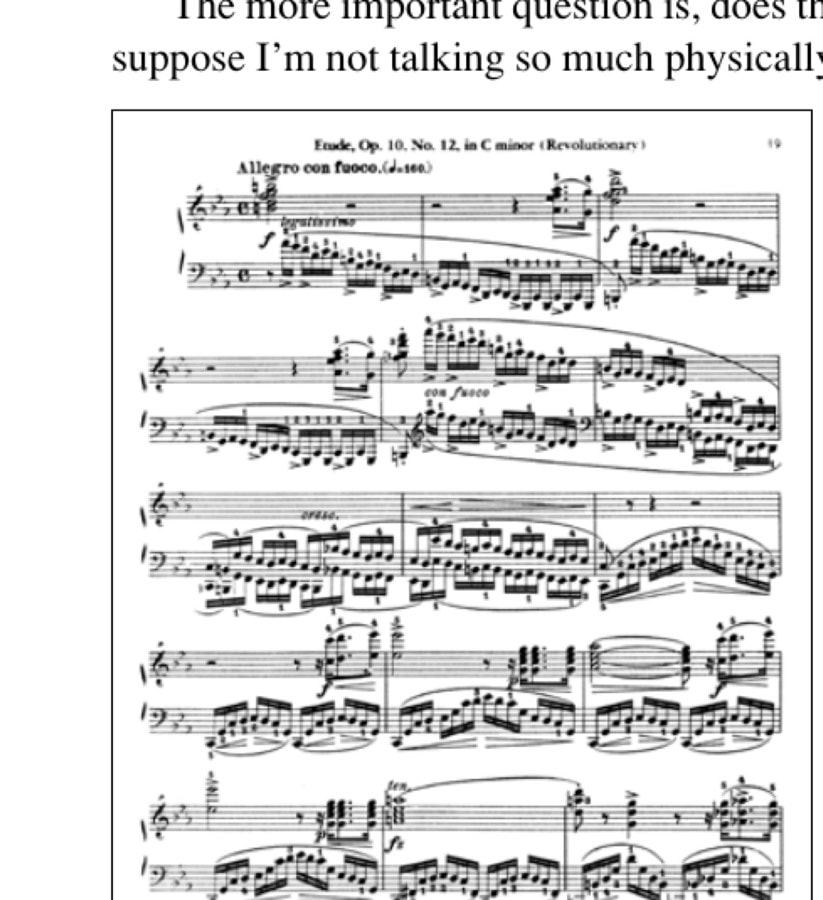
It brings to mind my college days as a piano major. My friends and I would sometimes discuss what the most difficult piano pieces or piano composers were, as college students tend to think that sort of thing really matters. My college piano teacher, the late, great Norwegian pianist Audun Ravnan, pointed out that a lot of composers are difficult only because of things like a lot of jumping around, meaningless fast and awkward passages. Even Beethoven and Mozart have their awkward moments. However, a composer like Chopin is difficult but is beautiful and satisfying to play because, as he said, “it fits the hand.” I’ve been seeing more and more race descriptions where the director or runners praise the course for its difficulty, almost as if a race’s value is directly proportional to the elevation change or the percentage of the course that’s not runable. I say that while there is definite value in tackling tough challenges, there is no value in being tough for the sake of being tough.
The more important question is, does the race “fit the feet”? In this question I suppose I’m not talking so much physically as emotionally. For all the work you put into it, what does it give back to you? I do most of my racing on
the roads, which always give back to me at least the satisfying sensations of running without worrying about footing, allowing me to some degree to transcend the immediate world around me. The biggest trail
races I’ve done, Western States, Vermont 100, and JFK, give back as well and are immensely satisfying experiences. Others are just tough and awkward. But one particular race known for its difficulty, the Badwater 135, is Chopin. No race gives back more. ▲
A passage from Chopin that fits the hand particularly well.
It is 135 miles from the lowest elevation in the United States up the side of the highest mountain in the Lower 48 states. For one thing, all of recorded human history is scattered with stories of people going to the desert or the mountains to seek solitude, wisdom, retreat, or enlightenment, or sometimes being sent there not of their own will but still coming through the experience changed in some major way.
Lowest, hottest, highest, an art in itself
© Elaine Acosta
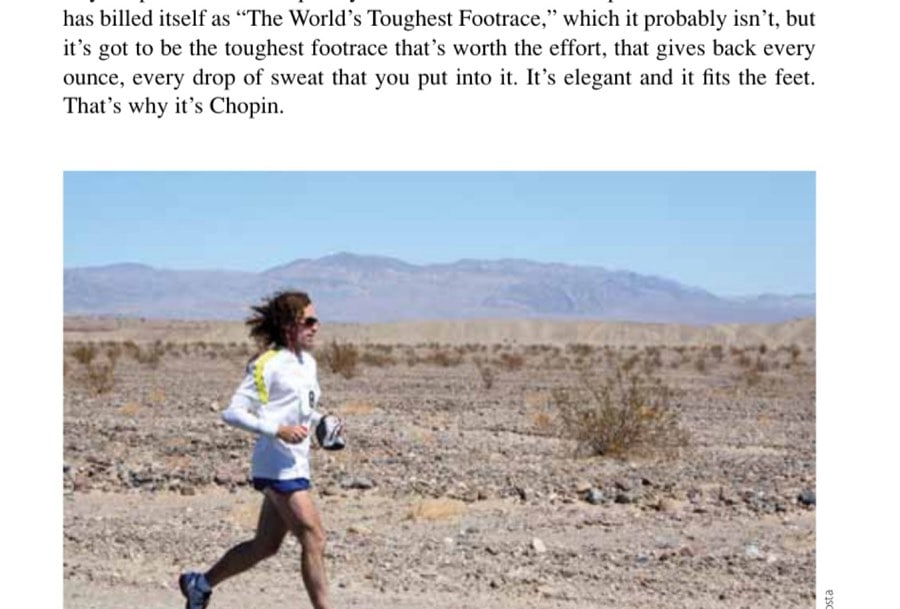
What could be more epic than a race combining the hottest desert in the world with the highest mountain? It is very tough. The difficulties include running more than 40 miles through heat that can reach 125 degrees or more in the shade and three relentless climbs of 5,000 feet, 3,500 feet, and another 5,000 feet to finish the race. But as with a 24-hour race, it’s the shared experience that makes the impression. You and your crew and 90 others and their crews and race staff are working together, feeding off each other, making yourselves greater than the sum of your parts in order to push you across the desert and up the mountainside. It has billed itself as “The World’s Toughest Footrace,” which it probably isn’t, but it’s got to be the toughest footrace that’s worth the effort, that gives back every ounce, every drop of sweat that you put into it. It’s elegant and it fits the feet. That’s why it’s Chopin.
▲ The author crossing Death Valley in the 2012 Badwater Ultra.
So I think those are some ways that an ultra could be thought of as art. Maybe someone should set up some sort of an art exhibit on a football field, include sculpture, performance, and whatever else captures the imagination, and include a runner running on the track, traveling around it for 24 hours. It might or might not really work, but I’d be up for it!
All this, of course, is in the eye of the beholder, and someone watching an ultra might not notice anything that resembled art. But if it affects the way you as a runner think about your race, it just might provide the emotional motivation you need to get you through your rough patches and get more fulfillment from your experience. I admit that I intended to run Badwater in 2012 thinking about it as a work of art, and occasionally during the race I told myself, This race is a work of art. But in the end, I don’t think it had any effect! Or maybe it did, since it was a two-hour PR for me. Who knows, just rambling words for thought. But give it a shot—be your own artist, be your own hero. Succeed or fail; tell your own epic adventure story.
This article originally appeared in Marathon & Beyond, Vol. 18, No. 4 (2014).
← Browse the full M&B ArchiveMore like this
1,000+ stories from 19 years of Marathon & Beyond
The complete archive of the legendary long-distance journal — digitized and free to read.
