

The Boston Experience
As one British journalist described my father’s effect on a crowd, “When listening to Sheehan, middle-aged men, gray-haired, level-headed and worldly-wise, become so enchanted that they behave like children at their first magic show. . . . He makes running sound like the elixir of life.” These runners were there to drink from that medicinal cup. This aid station was for the soul.
For here was the man who had been there from the beginning. Or, almost the beginning. Before “running.” Before “jogging.” That is, before the running boom of the 1970s.
Now, as I speak at running clinics, I tell the gathering that when my father began his midlife journeys to Boston, his running life was a self-creation, a constant work in progress. Injecting some hyperbole, I say, “In those days there were no races, no doctors, no women. . . . There were no timers at Boston after four hours!”
IN THE BEGINNING
George Sheehan, Jr.’s running odyssey began one hot afternoon behind our house. In those days being seen in public running “in your underwear” was cause for raised eyebrows. Schoolboys, maybe. But grown men? The seeds of revolution were planted in that backyard, as he ran enough laps to cover a mile.
Possessed of an Irish temper fueled by a large family at home and an even larger patient load, Dad nonetheless was not known for using foul language. So, his exhausted diatribe at the end of his first run surprised us as he staggered through the screen door into the house.
When he needed races, he would beg entry into our high school cross-country meets. If he ever got hurt, he found his physician friends ignorant of a cure. “Rest, or quit running,” would be their prescription. When he discovered that podiatrists often had the answer and said so in public, he was considered a heretic. You could see he was slowly breaking from the herd. He would find his own truth on the roads.
Training advice was hard to find. He had been a college runner, and my brother and I were on school teams, so we often discussed training theory. Exercise physiology was in its infancy. Human potential was still the subject of myth. Women’s running, for instance, was restricted in the Olympics to races no longer than 800 meters. Little Joan Benoit was probably having cookies and milk at the blue table in kindergarten.
So, my father learned on his own. That keen, come-through-the-back-door mind of his was open to almost any idea. Some worked, some didn’t.
Watching the tape, I thought about Dad’s journey down that running road less traveled. And how there always was a method to his madness. There was that race early in his career, when he decided to brew what he thought was the perfect prerace diet. It wasn’t the two-beer dosage he guzzled at Boston years later but simply a quart of orange juice and a quart of skim milk. He consumed it on the 90-minute drive to historic Van Cortlandt Park in New York. Needless to say, a torturous, 15K cross-country race awaited him.
He finished in heroic fashion. Old-timers still mention that race to me. Why not? Who could forget this moaning and groaning harrier as he raced to the finish . . . with one leg completely brown? Years later, I wondered if FloJo’s people had seen something in those contrasting legs?
In time, he learned how to avoid those problems with “number two.” As for “number one,” when racing, he recommended in so many words that we “just do it!” Short spurts worked best, he advised.
Turning the world of hygiene upside down, again, he confessed that his midday runs from his office were followed by a simple towel-down. No need to shower, he told his readers. Honest sweat is odorless. Anxious sweat is the culprit. In fact, he reasoned, it’s precisely those pressured souls who need the stress relief of a run. No need for a deodorant, then. His patients never complained.
THE MOAN FACTOR
I mentioned his “moaning and groaning” racing style. And I might add he was usually seen after races down on his hands and knees. “Help that old man,” I’ve heard spectators say at our summer race series.
“No, no, that’s Dr. Sheehan. He does that after every race!”
In extremis, he was. He always ran hard. But his behavior was in reality a product of “belly breathing,” discovered from the Oregon runners of Bill Bowerman. It’s the natural way to maximize your oxygen uptake. Groaning through pursed lips helps while running; going down on all fours is perfect for the postrace recovery. You see the method?
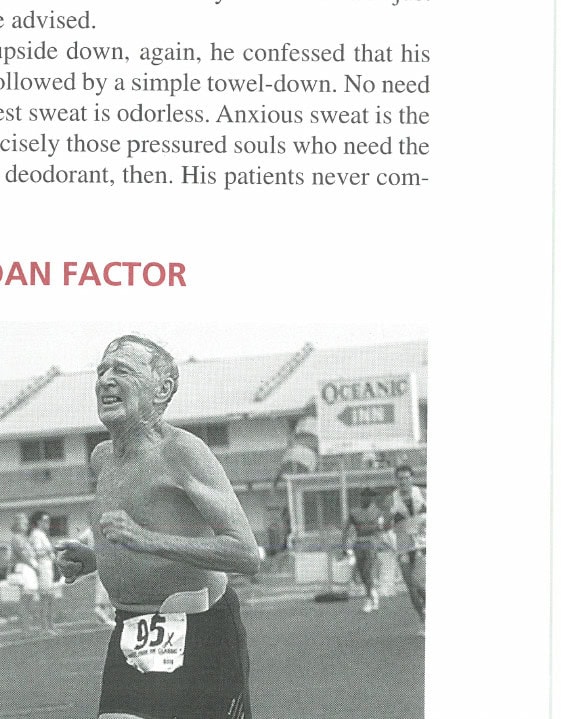
Oregon orthopod Donald Slocum published a pictorial analysis of running gait. Bowerman’s boys ran in a “sit-down” style, a la Groucho Marx, if you will. Dad quickly adopted a running style marked by what he called “The Three B’s”: Belly-breathing, for one; using the big muscles of the Buttocks; and, finally, pushing off with the Big toe.
MY FIRST BOSTON WITH DAD
My father earned a reputation for challenging the status quo. The unexamined experience was not worth having, he felt. So, he took his talents to the test. He began running Boston.
I finally joined him in 1970. Three years after my last college race, I decided to give this Boston thing a try. It would be my father’s sixth Boston. In that time the race had tripled in size to just over 1,000 entries. Negotiating a 90-degree turn on the town square at Hopkinton would soon force the race to change its route. Raceday seemed like Armageddon to the locals that day. The Russians weren’t coming, but it must have seemed that way.
The Boom could be heard in the distance.
The trip from the Jersey Shore would be a six-hour Sunday drive. As usual, Dad would putter up in his trusty Volkswagen Beetle. That was the “people’s car,” quite apropos for transit to a race that had few stars and mostly ordinary people toeing the starting line.
We were joined in our journey by another George, a mild-mannered schoolteacher, prone to using words like “golly,” and “gee.” His Brooklyn roots, similar to Dad’s, led to neighborhood stories. Race strategies were discussed. Everything would be new for George and me. Dad was on his sixth tour of duty. He was the vet. He knew there were plenty of minefields on the way to a successful finish. We listened carefully to his advice.
So there we were, the three Georges. We were a cozy, childlike threesome on the Yellow Brick Road to Boston. Gray skies and drizzle, thunderous trucks, and wicked traffic that beat the Beetle around like a Ping-Pong ball couldn’t put a damper on our excitement.
We checked into the Lennox Hotel, right on Boylston Street near the finish. Many of today’s newer hotels were still in the planning stage. Other long-time regulars at Boston checked in, too. I imagined each of these hardy individualists had raised some eyebrows back home, too.
Like Dad, they had broken from the herd. Their annual return to the Lennox had that “same time, next year” feeling. Each of us came to write his own script. Each hoped for a happy ending.
The Last Supper
But first, what to do for dinner. Blue laws in those days had most restaurants closed. So, there we were in the labyrinth of Back Bay Boston. Dad was our Moses, leading a pack of a dozen or so runners through the streets. We were searching for the Promised Land of Pasta. In truth, we looked like a band of what would years later be called “the homeless.” You see, fashion was not our strong point. Designer wear was not the running rage. After all, Frank Shorter’s victory at Munich was still two years away.
We finally saw a red neon sign in the darkness, signaling a chain restaurant. Now, arranging seating for 12 is not exactly a waitress’s delight. I could see that right away. There was an end-of-the-day tension as she returned for our order. As we reviewed the menu, we found that the carbos we needed were offered in only one selection. But it appealed to both our palate and our pocketbook. “The children’s portion of spaghetti, please,” each of us announced. Our orders shortened the waitress’s paperwork, for sure, but I’m afraid it had the same shortening effect on her temper as well. Our frugal tip couldn’t cover the damage.
Then it was back to the hotel and the Land of Nod.
Time to Go to War
Race morning brought gray, rainy skies and 40-degree chills. As I looked out my hotel window, I could see legendary race director Jock Semple furiously herding runners into buses on Boylston Street. He was hotter than the traditional postrace beef stew. Hardly a labor of love for him, I thought.
But the time was at hand. Time to go to war.
As it was, I survived. Negative splits saved me as I played defense with the course. My father had learned that strategy in his first Boston. Having crashed and burned in a previous race, he was told by an aging Austrian Olympian, “Use the first seven miles as a warm-up.” Dad was 202nd out of 225 when he went through Framingham. He crossed the finish 95th. Lesson learned.
I learned some lessons, too. My low-mileage training was barely enough. I ran really on the memory of my college fitness. My postrace stiffness lasted for days. Forget about the legs; I never knew biceps could be sore—or nipples, either, for that matter.
Two years later I came back with lots of training under my belt (and bandaids for my nipples), determined to improve my time. Two of my brothers joined my father and me at the starting line.
Yes, I was in better shape, but I didn’t factor in the weather. It was 25 degrees hotter. The three Sheehan boys all crashed and burned. “It’s not the heat that kills, it’s the pace,” my father would say.
I recall hitting the wall first, at about 17 miles. I gave in to Defeat, and not wanting to discourage the rest of the clan, I decided to hide behind some bushes. I silently blessed my brothers-in-arms as they plodded by. But their own Valley of Death awaited them.
Meanwhile, Dad patiently reeled us all in. Once again he had figured out a better way—negative splits!
As he partied back in the room at the Lennox, his second son lay nearby in his wife’s arms, dimly aware that he was alive. It was a solemn scene. Have you ever seen Michaelangelo’s statue “the Pieta”?
The videotape continued to stir old memories. . . . Over the years I saw, and felt, Dad’s medicine work its magic many times. He spoke not as a highbrow above it all but as a fellow sufferer. He had, in the words of our running president, felt their pain.
BAD DAY RISING
Dad knew bad days are part of the game, especially at Boston. He wrote about just such a day in his classic book Running & Being:
I was in Boston now and should have been home free. I wasn’t. I was running a poor marathon, and when you run a poor marathon you not only hurt, you hurt longer. I had been out on the roads longer than any time in my fourteen years of running. But through all the pain and not knowing whether I would finish, dragging out those last terrible miles, I always felt safe, I knew I was surrounded by friends and family and those who would take care of me no matter what happened. . . . And knowing, too, that if I stopped they would say, “You gave it your best, George.” Knowing that whatever I did, I would not disappoint them. There would always be a meal and a soft bed and a good day of running tomorrow. . . . Only a child still lives in a world where such days are possible.
So, here he was again at Boston. He couldn’t run, but he could preach. Despite his condition, I realized watching this tape that there was no whine in him. All his concentration was centered on this lovable but needy band of runners.
Dad knew that too much prerace worry could doom the training process. He also knew that just as his cancer called for a two-pronged hormone therapy, these worried runners needed additional attention, as well. His remedy was a protocol calling for a quote from G. K. Chesterton. It would add support to his idea that “there are no bad experiences.”
Chesterton, you may know, was a British writer and thinker, popular in the early 1900s. Much like my dad’s father, Chesterton was a portly man with a keen mind. But he was not an athlete. Running in his day was the rare pursuit of the leisure class, usually the lads at Oxford and Cambridge.
However, Chesterton’s words in this case could be perfectly applied to the marathon experience. So, Dad went deftly to his bag of quotes from dead philosophers and applied the treatment: “Whatever is worth doing,” he calmly told the huddled mass, “is worth doing . . . badly!”
Laughter raced through the room! Always a sign that the crowd had taken the cure. Suddenly that gray Boston chill was gone. With it, that prerace anxiety. Within moments, a sunnier mood enveloped this band of hardy foot soldiers.
To add icing to his philosophical cake, Dad gave them one more dose of British therapy with a quote from Roger Bannister: “The marathon,” he told them solemnly, “is the acme of athletic heroism.”
They would savor that thought over their pasta later that night. The treatment was done.
As the body has a mind of its own, these runners were now in a state of assured relaxation. They now knew everything would be all right, despite the enormity of their 26-mile challenge.
Whatever cruelties April in Boston could harbor, each of these “experiments of one” knew they would respond with their best effort. In short, they were confident they would find a way to “win.”
It’s a wonderful running life, I thought, as the tape came to its end. I was psyched for a run.
Dad had done it, again.
This is the third in an exclusive series of marathon memoirs by Johnny J. “The Younger” Kelley of Mystic, Connecticut. The other two articles by the 1957 Boston Marathon winner appeared in volume 1, issue 4, and volume 2, issue 1. Look for the next “chapter” in a future issue. —Editor
Jogging in light rain from our 477 Beacon Street, Back Bay apartment to Hayes-Bickford’s Harvard Square, Cambridge, cafeteria, my inward eye remains where it has centered for the past six weeks: on the approaching 56th Boston Marathon.
But my reverie swirls with images of a grim face, never seen, nor, as of now, to be seen by me in the flesh. It is mid-afternoon on Sunday, March 8, 1953. The marathon comes due on Monday, April 20th, this year.
News has filtered out of the Kremlin, 7,000 miles away: Soviet dictator Josef Stalin has died. I see the grim, mustachioed visage squinting from every tabloid on Central Square’s news racks.
Was the purported murderer of 21,000,000 the victim of a heart attack, or did he get his final payment stamped “in kind”? In fact, for a 22-year-old American male, a just-married college student, even Josef Stalin’s life or death poses no more than a piece to be fitted into the ever-emerging puzzle. For there will still be the Korean meat grinder, the “Cold War,” the bomb, the military draft, Senator Joe McCarthy. . . .
What’re ya gonna do, boy?
Cambridge’s Sunday drivers splash almost languidly along Mass. Ave. as I tackle a single, gentle uphill over undulating sidewalk bricks. Shaking plausibly dry in Hayes-Bickford’s cafeteria before taking my place behind the glass counter, I see our hard-bitten cook, Pete, cursing at his grill. Pete’s making it
This article originally appeared in Marathon & Beyond, Vol. 3, No. 2 (1999).
← Browse the full M&B Archive1,000+ stories from 19 years of Marathon & Beyond
The complete archive of the legendary long-distance journal — digitized and free to read.
