

The Comrades Marathon
| YEAR | POSITION | TIME |
|---|---|---|
| 1977 | 43 | 6:45:00 |
| 1978 | 14 | 6:11:00 |
| 1979 | 3 | 5:51:15 |
| 1980 | 2 | 5:40:31 |
| 1981 | 1 | 5:37:28 |
| 1982 | 1 | 5:34:22 |
| 1983 | 1 | 5:30:12 |
| 1984 | 1 | 5:27:18 |
| 1985 | 1 | 5:37:01 |
| 1986 | 1 | 5:24:07# |
| 1987 | 1 | 5:37:01 |
| 1988 | 1 | 5:27:42 |
| 1989 | DNR* | — |
| 1990 | 1 | 5:40:25 |
| 1991 | 328 | 6:57:02 |
| 1992 | DNR | — |
| 1993 | DNR | — |
| 1994 | 19 | 6:01:54 |
| 1995 | 2232‡ | 8:42:48 |
| 1996 | 329 | 6:59:30 |
# Course record
* DNR = Did not run
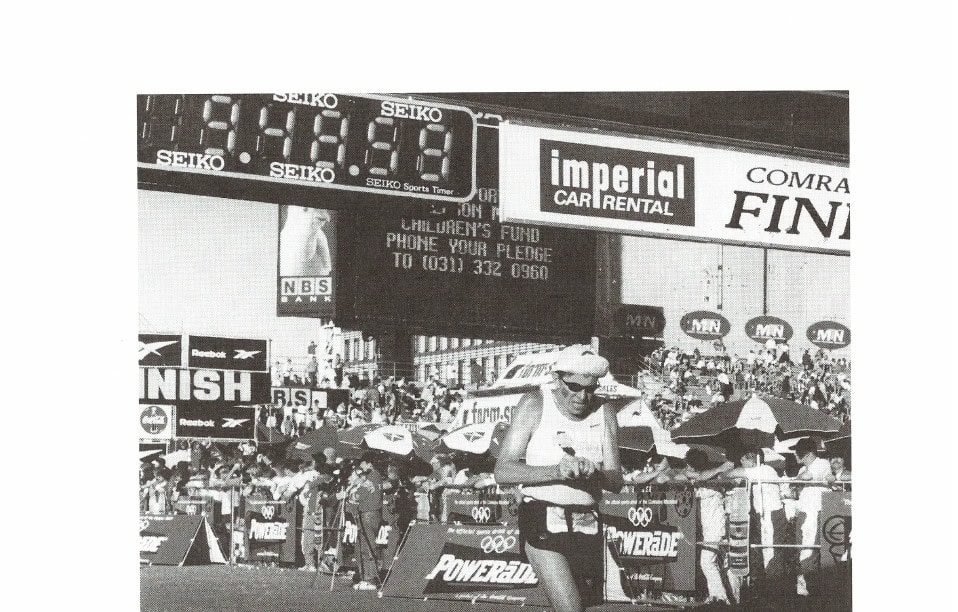
‡ In 1995, Bruce ran dressed up as a licorice man to raise money for charity.
INVASION OF THE FOREIGNERS
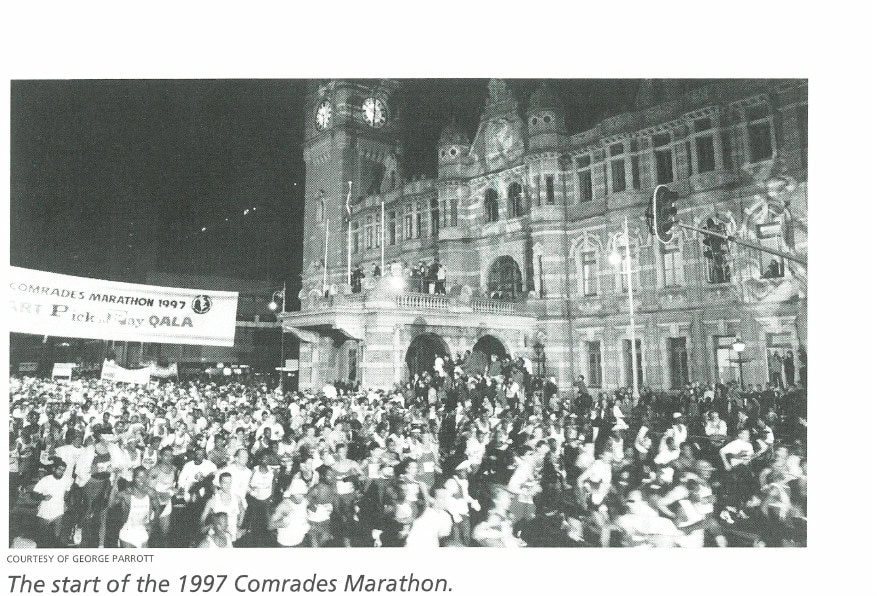
The South African dominance of Comrades was disrupted in 1993 when German Charly Doll swept the local competition aside to win in 5:39:41. The following year, American marathon legend Alberto Salazar won in 5:38:39, amazing spectators with his guts-of-steel approach.
In 1995, the first year offering substantial prize money, South African Shaun Meiklejohn won in 5:34:22 after a Herculean duel with fellow-South African Charl Mattheus. The Russians rolled in and dominated in 1996, with Dmitri Grishine winning in 5:29:33. Mattheus moved from bridesmaid to groom in 1997 when he won in 5:28:37.
Comrades can now be considered a truly international race: the 1997 edition included most of the best ultrarunners in the world—from 39 countries.
The ultrarunning women are not to be outdone, either. Elizabeth Cavanagh was the first woman to win the race, back in 1975, with a humble but noteworthy 10:08:00. Who would have thought then that the top women would ultimately be competitive with the top males? The American 100K world-record-holder Ann Trason won in both 1996 and 1997 with fantastic times of 5:54:43 and 5:58:25, respectively.
PREPARING FOR COMRADES
How do runners prepare for the race? Call together a group of Comrades runners for a roundtable, and the conversation inevitably drifts to the “best” method of preparing for the race. Traditionally, the basic rule to follow in preparing for Comrades is to accumulate as much mileage as possible in the five months leading up to the race. This high-mileage training approach began in the early years of the race three-quarters of a century ago. Take, for example, the training of Arthur Newton, who won five of the six Comrades he entered. In 1924 Newton averaged 17.9 miles per day for the five months preceding the race. The following year he won the race again, lopping off 33 minutes in the process, and this time “only” trained 14.9 miles per day for the same period.
Jackie Mekler won the race five times between 1958 and 1968. In 1958 he averaged 16.7 miles per day for the five months leading up to the race and won in 6:26:26. In 1963, when he “only” averaged 10.5 miles per day, he ran his fastest time ever: 5:51:20. In the five months before the race he trained by doing four runs longer than 44 miles, one run of 35 miles, four runs between 26 and 35 miles, and seven runs between 20 and 26 miles. He managed to do this while holding down a full-time job!
Not surprisingly, this high mileage training preparation has led many runners to overtrain, which resulted in poor performances. One of the most frequently cited references in the scientific literature on overtraining was a study conducted on overtrained Comrades runners (Barron, 1985: Journal of Clinical Endocrinology and Metabolism, 803–806). This study was the first to show that overtraining is associated with abnormalities that originate in the hypothalamus in the brain and explain many of the symptoms associated with overtraining.
Alan Robb won Comrades four times and is still running respectable times at the age of 43. He began running seriously in 1974 at age 20. In 1976 he won his first Comrades in 5:40:43. He is the owner of five age-group records set in the early years of his career. During his competitive career, Alan was a believer in high mileage, and he averaged about 100 miles a week throughout the year, increasing to 120 to 138 miles for the two months before the race. He also believed in speedwork, and he unleashed track sessions so grueling a world-class miler would take heed. His shuffling running style has probably protected his muscles to a certain extent and may explain why his running career has lasted longer than most of his competitors.
A NEW TRAINING PARADIGM
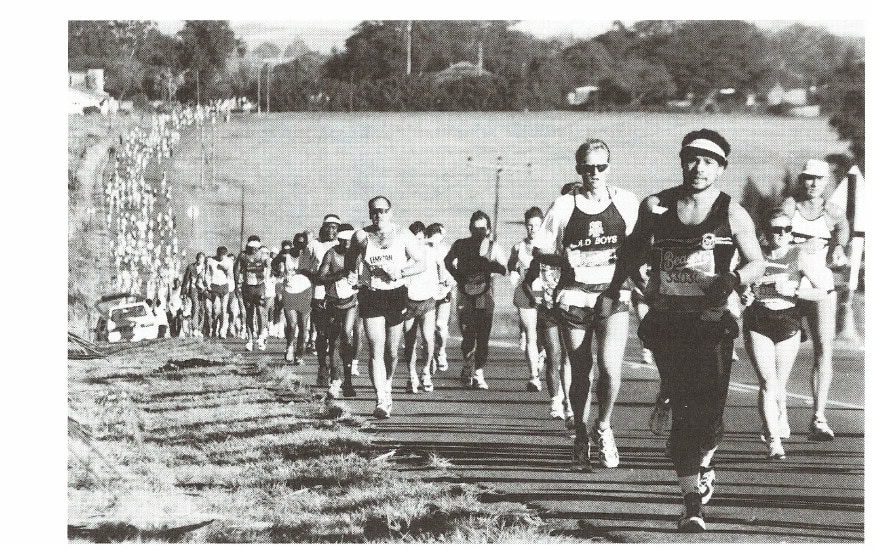
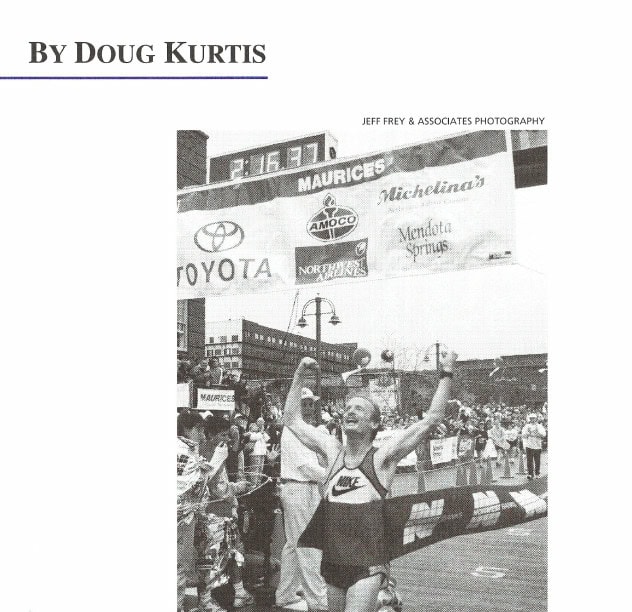
Bruce Fordyce has probably had the most influence on how runners prepare for the race. He popularized the scientific approach to race preparation and in so doing changed the approach of many runners. The Comrades Marathon was Bruce’s primary focus: all his other training and racing was geared toward helping him win Comrades. Bruce’s early success, beginning at age 23, enabled him to earn a living from running, which meant that he had more time to train and—perhaps even more importantly—more time to rest than most of his rivals. This enlightened approach to preparing for the race enabled him to peak at precisely the correct moment, year after year.
Bruce manipulated the variables that dictated his running success, and once he developed a winning formula for himself, he had the confidence to stick to it and was able to produce superb performances year after year. Bruce’s consistency in winning the race nine times is nothing short of miraculous.
Bruce won Comrades for the first time in 1981 and for the last time in 1990. Throughout his competitive career he averaged about 12 miles per day in the build-up to the race. Typically, he would do one 35- to 44-mile training run, eight 26- to 35-mile runs, three 20- to 26-milers, and six 20-milers during an eight-week period of hard training. He also placed great emphasis on speedwork in his preparation for the race. Professor Tim Noakes, author of Lore of Running, has summarized Fordyce’s approach to training into nine simple rules:
Nine Simple Rules for Comrades Training
- 1. Begin training gently five months before the race.
- 2. Begin ultramarathon-specific training after 2.5 months.
- 3. Do specific speedwork.
- 4. Don’t do too many long runs. (This seems to be in direct contrast to what Bruce did at the time, but in context he was running fewer miles than many of his competitors.)
- 5. When in doubt, rest. (Fordyce popularized a term, “the plods,” which describes a feeling in the legs after hard training. He advised taking a day’s rest if a runner felt “the plods.”)
- 6. Do not run an all-out marathon or longer race in the last 10 to 12 weeks before the ultramarathon.
- 7. Institute a decent taper before the race. (Many of the previous Comrades greats trained hardest in the month preceding the race. Fordyce modified this approach by training hardest one month before the race, followed by a tapered reduction in training.)
- 8. Gauge your fitness by performances in short-distance races and speed sessions.
- 9. Do specific strength training for downhill ultramarathons. (The Comrades Marathon has some wicked uphills and downhills that have been the downfall of many an under-prepared runner.)
THE FASTNESS OF FORDYCE
At present Fordyce still holds the record for the fastest Comrades: 5:24:07. Although it is only a matter of time before someone runs the race faster, it is a safe bet that his record of nine wins is untouchable, especially with competition increasing in intensity each year.
Although Fordyce is still a committed runner at the age of 41, he has lost his competitive edge. In his recent newspaper running column he ascribed his decline in running performance to “his undercarriage having fallen off.” Although he said this partially in jest, the phenomenon he describes is receiving attention at the Sport Science Institute of South Africa. This sudden decline in performance after several years of hard training has raised some interesting scientific questions:
- Does the human body have a finite ability to adapt to the stresses of exercise?
- Do the muscles lose their “spring” after a certain amount of training or racing?
- Alternatively, do muscles change irreversibly after cumulative training and racing?
Anecdotal observations of the top Comrades Marathon runners, particularly those who were competing in the late 1980s, suggest that these runners do age prematurely from a running point of view. The research is showing that after several years of competitive training and racing, many runners experience a rather sudden decline in running performance, which occurs at a more rapid rate than is expected for their age.
This evidence suggests that over the years a cumulative fatigue sets in, and the muscles lose the ability to regenerate adequately. The exact explanation of the mechanism causing this “premature fatigue” will no doubt be established in the next few years.
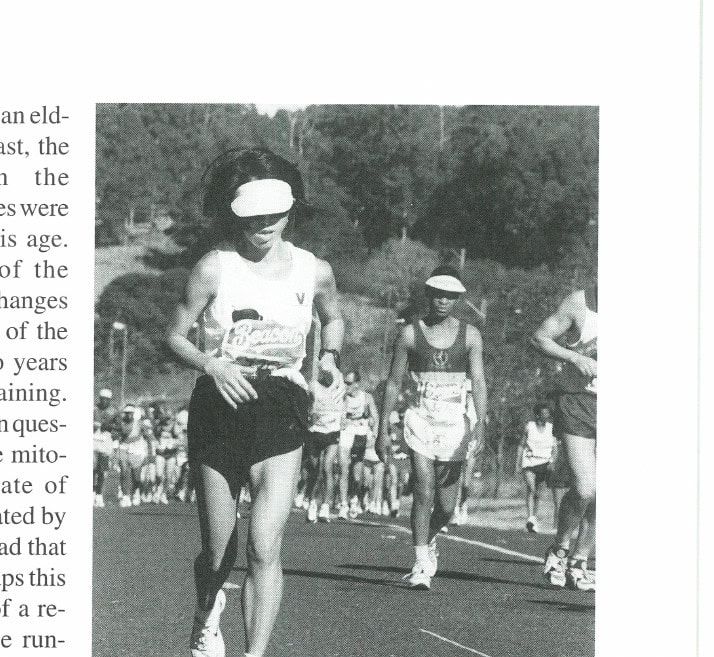
Clues are already emerging in the scientific literature, though. A study led by Dr. Zig St. Clair Gibson of Cape Town showed that after a sudden drop-off in running performance, a previously national-class long-distance runner had clinical examinations that showed that the mitochondria in his leg muscles resembled those of an elderly man. In contrast, the mitochondria in the runner’s arm muscles were quite normal for his age. The conclusion of the study was that the changes in the leg muscles of the runner were due to years of high-mileage training. Perhaps the runner in question had vulnerable mitochondria whose rate of aging was exacerbated by the high training load that he sustained? Perhaps this is a rare example of a response to excessive running training? No doubt future studies will answer these questions.
HOW SERIOUS IS TOO SERIOUS?
So where does this leave the serious runner logging 80 to 100 miles a week? Although it is too early to generalize these results and apply the research results to all runners, there is sufficient information to suggest that we should take a more conservative approach to training than was previously recommended—that is, if we want to make running a lifetime avocation. So, while waiting for research to more precisely answer the questions of chronic training, it may be prudent to incorporate more rest into training and try to avoid prolonged periods of excessive training and racing.
What of the Comrades Marathon runners of the future? It seems reasonable to assume that in future, the Comrades Marathon will nearly always be won by a full-time runner—someone capable of sustaining high training loads while having the time between training sessions to rest properly.
It also seems that altitude training is becoming fashionable again, with 3 of the top 10 runners in 1997 claiming to have undergone months of altitude training before the race. Charl Mattheus, the 1997 winner, attributed much of his success this year to the two months he spent training in Leadville, Colorado.
No doubt the folklore that has characterized Comrades since its inception will continue. Take, for example, the true story of an elderly runner who limped across the finishing line with a lemon taped to his sore knee. When asked the reason for the lemon, the old runner replied that it was his way of reducing the pain in his sore knee. The skeptical observer replied that the lemon treatment didn’t seem to be working very well because the runner was still limping severely. The runner’s reply was short and sweet: “No wonder. The lemon has dried out!”
At one end of the spectrum will always be the runners who try to make a living out of winning Comrades and at the other end of the spectrum will be the runner whose goal is just to finish the race with a little juice left in his lemon.
These contrasting styles have given Comrades its character and mystique and explain why the race has captured the hearts of so many so thoroughly.
PIETERMARITZBURG, SOUTH AFRICA, June 16, 1997—Some 30 miles into the famed Comrades Marathon in South Africa I was already in trouble. I had just run the toughest marathon of my life, and I still had 25 miles to go. Three questions went through my mind. Should I quit, or should I stick it out and finish? Can I finish? And how could I have prepared myself differently for this arduous and heart-breaking event?
In retrospect, I thought I had done all the right things. In January I decided that Comrades would be my initiation into the World of Ultras. I had six months
This article originally appeared in Marathon & Beyond, Vol. 2, No. 1 (1998).
← Browse the full M&B ArchiveMore like this
1,000+ stories from 19 years of Marathon & Beyond
The complete archive of the legendary long-distance journal — digitized and free to read.
