

The Death Of Jim Fixx
“Running has not yet been shown to make people live longer.” —James F. Fixx, The Complete Book of Running
During the summer of 1984, while lunching in New York with Hal Bowser, a former Science Digest editor, Jim Fixx mentioned that he wanted to obtain a telescope to use during his coming vacation. One of Bowser’s hobbies is optics. Bowser mentioned a friend who owned a Celestron, a very expensive telescope that was for sale.
Fixx purchased the telescope, then midway through July called Bowser from Cape Cod. “I’m here looking out over Waquoit Bay,” Fixx began. “The images I get don’t seem very bright. It could be haze, but maybe the telescope needs adjustment. I thought I would call you and ask, what am I doing wrong?”
Describing the incident later, Bowser thought that typical of his friend. Despite paying a lot of money for a device that should have functioned perfectly, he did not blame the device. Fixx worried that he was to blame.
Two days after the call, Jim Fixx drove to northern Vermont to spend the last month of the summer at Caspian Lake. He would relax, work on his latest book, watch the Olympics on TV, and take some 10-milers in the woods. It was Friday, July 20. Arriving late afternoon, Fixx decided to go for a run. At 5:30 p.m., a passing motorcyclist discovered a man lying beside the road clad only in shorts and running shoes. State police arrived quickly, but the man was dead of a heart attack.
The man was Jim Fixx. In his last few seconds of his life, did Fixx ask himself: “What am I doing wrong?” Had he misapplied everything he had taught so many others? Fixx had not invented running but had become one of the activity’s main proponents. He had helped launch the running boom, and the boom launched him to a level of celebrity so great that American Express featured him in a TV commercial. In The Complete Book of Running, his million-copy bestseller, Fixx had hinted that running would make us look better, feel better, live longer. “Running is more likely to increase than decrease longevity,” wrote Fixx, yet here he was, dead of a heart attack at age 52. This should not be. What happened to Jim Fixx?
As a fellow runner and fellow writer, I had a unique perspective on what happened to Jim Fixx. I did not know Jim well, but you might consider us at least distant friends. We knew each other professionally, fellow promoters of running as good for your health. Our first encounter occurred when Jim was traveling from city to city promoting his book. I lived in Long Beach, Indiana, a lakefront community about an hour’s drive around the bottom of the lake from my birthplace, Chicago. Jim Fixx visited Chicago soon after The Complete Book of Running had begun to sell in large numbers. Knowing it had a winner, Random House invested in a chauffeur and limousine to drive him from appearance to appearance. That included an early-morning talk show telecast from one of Chicago’s northwest suburbs. The show’s producer asked me to appear and also invited Erma Tranter, a fast recreational runner. (Erma would go on to help found the Chicago Area Running Association and currently serves as executive director of Friends of the Parks.)
I had to rise early to give me time to go for a run before driving to the TV station. My short run along the lakefront began in darkness and ended as the sun started to rise, a glorious time enjoyed by many runners who worked out in the morning before heading to work. Showering, I climbed in my car, tossing a bag of workout clothes in the back seat just in case Jim wanted to go for a run after our appearance.
The TV show went well, the three of us having much in common, spinning tales off each other, our comments promoting not merely Jim’s book or any of my books but the fact that running was fun and safe and could provide an important lifestyle change for those—no matter how badly out of shape—who would embrace it.
Jim had a gap in his schedule before his next interviews, so the three of us decided to drive to Erma’s house and go for a run. Erma seemed most impressed that I had actually risen earlier to run before coming into Chicago. She never considered herself a morning person. “I always run in the evening after work,” she confessed. “And it’s always a hassle what with getting dinner on the table for our family.”
Erma later told me that following our run with Jim Fixx, she shifted to running in the morning, and it became an important part of her daily schedule. And so did Jim Fixx, even indirectly, make our lives better. James Fuller Fixx was born in New York City on April 23, 1932. His father, Calvin Fixx, worked as a magazine editor for Time. Young Jim admired his father greatly. In school, a larger boy bullied him and his classmates. Jim came home bruised from a beating one day, causing his father to say, “We’ll have to do something about this.”
Rather than complain to the principal, which might merely have earned Jim another beating, the elder Fixx marched his son to Stillman’s Gym and introduced him to Jack Kearns, a well-known boxing manager.

Courtesy of Fixx family
▲
1935: Jim Fixx at three years old with his father and grandfather. At the time, the last name was spelled Fix. Jim’s father added the second “x” when he was a young writer before he became an editor at Time magazine.
Kearns put his arm around Jim Fixx’s shoulder. “I’m going to teach you the right cross,” said the manager. Kearns worked with the youngster until Jim could throw a respectable right cross. “Don’t I need another
punch?” asked Jim. The manager explained: “To succeed, you learn one skill. But you learn it extremely well.” Next week in the schoolyard, the bully again began pushing Fixx. Jim launched the right cross. Stunned,
the bully never bothered anyone again. Jim Fixx was still in high school when his father, age 35, suffered his first heart attack. During the war, the elder Fixx had been under great stress working long hours at Time. He smoked incessantly. “Until he died eight years later,”
wrote Jim Fixx, “he lived the life of an invalid. Once—just once—in those eight years I remember him tossing a football. The rest of the time he sat quietly, read, listened to music, and (as I came to realize much later) put his affairs in order.”
Despite the warning his father’s early death should have provided, Jim Fixx mimicked the habits that probably hastened Calvin Fixx’s death. After graduation from Oberlin College in 1957, Jim Fixx worked for a number of magazines,
including Saturday Review, McCall’s, and Life. As New York executives frequently did, he dined elegantly every noon, bulking to 220 pounds. He smoked two packs of cigarettes daily. Other than tennis, he exercised infrequently. He had a wife,
four children, and the pressure of providing them with a good life. When he later wrote The Complete Book of Running, Fixx would include a chart of risk factors identified by the American Heart Association as contributing
to a heart attack. These included: heredity, blood pressure, diabetes, smoking, weight, cholesterol, a lack of exercise, emotional stress, age, sex (better to be female than male), and build. Readers could rate themselves between 1 and 6
for each factor, obtaining a score that identified themselves as low risk (10-20), moderate risk (21-40), or high risk (41-60). In 1967, Fixx unquestionably ranked in that last group. That same year a woman named Kathrine Switzer ran the Boston Marathon. Kathrine was not the first woman to run Boston. Roberta Gibb-Bingay had run the race the year before but without a number. Kathrine, however, obtained a number, although later she would be accused of doing so by stealth. Kathrine entered the race as K. V. Switzer, seemingly disguising her sex. Later, Switzer would claim she always identified herself as “K. V.,” thus had not meant to deceive the Boston Athletic Association. Under the existing (archaic) rules of the Amateur Athletic Union (AAU), women were not allowed to run marathons, being limited to races less than 2.5 miles, presumably to protect their health. The worry among chauvinistic males, including many doctors who should have known better, was that if females ran farther, their uteruses would drop! Nevertheless, Kathrine obtained a number, which enraged B.A.A. official Jock Semple when he spotted her around four miles. Descending from the press bus, Jock tried to rip the number from Switzer’s sweatshirt but got knocked aside by her fiancé, a hammer thrower. Photos of the incident, as might be said some decades later, went viral in newspapers and magazines around the world. This launched not merely women’s running but also women’s fitness, as surely as had Billie Jean King’s hyped tennis match with Bobby Riggs. Within the next several decades, women would begin to dominate the sport of long-distance running. By the year 2011, women recreational runners would be more often seen than men along the roads and trails of America. Nearly 60 percent of finishers in half-marathon races were by then female.
Brooks Elder Associates Inc.
▲
Jim Fixx (left), at his heaviest, at McCall’s magazine in 1968 with Bob Stein (his boss) and, on the right, Truman Capote.
But by 1967, more and more men had begun to become interested in jogging, eventually competing in emerging 5K and 10K races. This was not yet the running boom but the boomlet that preceded the running boom. Bill Bowerman, the track coach at the University of Oregon, was coauthor of a small booklet, later expanded into a book, named Jogging. The book described a program Bowerman developed for housewives in Eugene, Oregon, having borrowed the concept after a visit to New Zealand with an American team of distance runners where he met Arthur Lydiard, the coach of Olympic gold medalists Murray Halberg and Peter Snell. At the start of the 1960s, little more than a hundred males entered the Boston Marathon. I wrote an article for Sports Illustrated in 1963 about the Boston Marathon. Entries came close to doubling the following year and by the end of the decade surpassed 1,000, forcing Jock Semple and his codirector, Will Cloney, to consider establishing qualifying standards to limit the field to a more manageable number.
A few waves that would soon become a tsunami: this is what awaited Jim Fixx in 1967 when he began to consider his own mortality. Like many men age 35, Fixx had not yet awakened to his own mortality. Later, he would describe the incident that started him running. He pulled a calf muscle playing tennis. The injury caused only a slight limp that lasted a few weeks. He did not bother to see a doctor. Nevertheless, the injury disturbed him, and he would write: “What was striking was the way I felt about the damage. My body had betrayed me, and I was angry.”
To recuperate, Fixx began jogging, gradually increased mileage, stopped smoking, lost weight, entered his first race (five miles long), and finished last. This was not surprising. In that preboom era, there were very few “slow” runners. Most of those entering the few road races available were what might be described as subelites, runners who would have little difficulty qualifying for Boston today. After them, there was nothing. Officials timing runners at the Boston Marathon usually headed for the bars well before the race’s four-hour mark. Almost nobody would remain on the course, slower runners having been picked up in what was not too politely described as “The Losers’ Bus.”
There is no question as to why, later, Jim Fixx would be able to write an amazingly successful book for beginning runners: he was their prototype, the complete runner. After moving to Riverside, Connecticut, Fixx developed a favorite 10-mile course along tree-shaded streets through Old Greenwich, past century-old homes and St. Saviour’s Church, where he attended services, out to Greenwich Point on Long Island Sound and back. Like millions after him, he had found a new “right cross” and changed his life—although on the heart attack chart, he probably had reduced his risk only to “moderate.”
Hank Morgan
▲ Fixx looking skinny at the end of the Memorial Day Road Race in Greenwich, Connecticut, in 1974.
Previously, Fixx had written two somewhat popular books: Games for the Superintelligent and its sequel. Accepting a modest advance from Random House, he began writing a third book, a self-help book about running. One wonders why the editors at Random House believed a book on such an obscure topic would sell. Jim’s selling ability must have been incredible. When his semiobscure book appeared in 1977, the dust jacket promised: “Runners feel better, become thinner, probably live longer, have a better sex life, and drink and smoke less than their sedentary companions.” The jacket also promised a “high” for anyone willing to pay $10 for this volume, which featured a stunning red cover.
Enough people accepted the dust jacket’s promise to keep The Complete Book of Running on the bestseller list for a year. By summer 1984, the book had sold 940,000 copies (not including 16 foreign editions). A sequel volume, Jim Fixx’s Second Book of Running, sold 180,000 copies. A third book about Fixx’s experiences promoting the book, Jackpot, despite offering some of his wittiest writing, proved less acceptable in the marketplace. It sold only 9,000 copies.
Ironically, today with Fixx’s books out of print, you can purchase copies on Amazon.com of the Complete Book and the Second Book for $3.86 and $3.52, whereas a new copy of the once obscure Jackpot lists at $395.45.
Numerous factors contributed to the Complete Book’s success, including the fact that his second wife, Alice Kasman Fixx, worked as a book publicist. (Fixx had divorced his first wife, Mary, in 1972, remarrying in 1974.) The book was
clearly written, was elegantly packaged by Random House, and appeared at just the right moment, both benefiting from and contributing to the running boom. Another subtle factor may have been the author’s almost perfect name: Jim Fixx. He was the Mr. Goodwrench, who was going to help people change (that is, fix) their lifestyles. There was also that dynamite red cover, which leaped off bookstore shelves daring baby boomers who had gained too much weight to buy it. The well-formed legs on the cover were those of Jim Fixx himself.
Courtesy of Fixx family
After the book became a bestseller, some of my running friends claimed to feel sorry for me. “You should have written that book. It should have been your bestseller.” I disagreed. Actually, a book written by me, Fitness After Forty, also was flirting with the bestseller list, becoming popular enough to get me an appearance on The Today Show in New York. Other running authors from Joan Ullyot to Joe Henderson to Dr. George Sheehan also were cashing large royalty checks and accepting hefty fees for appearances at the expanding number of road races throughout the United States and eventually around the world.
Ironically, I had written a book for Random House a half-dozen years earlier. Titled The Business Healers, it had nothing to do with running, being an expose
▲ Left: the never-before-seen cover of The Complete Book of Running that Random House decided not to use; right: the cover that was used. Fixx had the “original” cover in his bookcase around a copy of The Complete Book of Running, and it got passed along to his son John with many of his books when the elder Fixx died.
of the managing consulting profession. Random House created a cover as dynamic as that on Jim Fixx’s book. The Business Healers sold well through several printings and a half-dozen translations abroad, including Japan. If you wanted someone to publish your book, Random House was close to being the best choice. Shouldn’t my editor at Random House have picked up the phone and asked me to write The Complete Book of Running? Not really. And I never thought to pick up the phone and call her.
I never got a limousine and chauffeur, but I never resented Jim Fixx’s fame, nor the size of his royalty checks. The point was—as I told my sympathizing friends—I never could have written The Complete Book of Running. I was a semielite runner, someone fast, a person the new breed of runner might have had trouble identifying with. Jim Fixx, however, had come to running from outside the sport—smoker, drinker, overweight, a tennis player, but not really very fit. He was every average male baby boomer! And his unique point of view was what made The Complete Book of Running the bestseller that it became. Success did little to change Jim Fixx. One morning a carpenter remodeling Fixx’s Riverside home appeared minus assistants. Fixx enjoyed carpentry, so he began to help. At the end of the day, the carpenter asked, “What is it you do for a living?” “
I’m a writer,” Fixx responded. The carpenter pondered this a moment, then offered: “Well, if business ever gets slow, I’ll be glad to take you on as my assistant.” Fixx’s son John says: “After the book hit, he made more money than a writer is supposed to. The nice thing was he never had to do anything he didn’t want to. He liked things quiet.” Todd Benoit, a researcher Fixx hired to help him on later projects, says: “Jim was a very careful craftsman. Editors needed to do little to rewrite his copy. A paragraph written by Jim was a very clean paragraph. He started at 8:00. I’d see him for 10 minutes, 20 minutes again at noon, then at 4:00 when we might go out running together. He liked to plug away and put in a good day’s work.”
Visiting Manhattan, Fixx often joined the joggers in Central Park—although before his book appeared, there were few to join. Most joggers like the southernmost region of the park, the area near what was then the Tavern on the Green where the New York City Marathon finishes. Or they jog around the 1.4-mile cinder path that circles the midpark reservoir. Only the bravest, those requiring the most space for their long-distance treks, would venture into the park’s northernmost region bordering Harlem.
One day Fixx so ventured, passing several black teenagers, who shouted insults. Perhaps foolishly (although he still had his right cross), Fixx stopped, jogged in place, and asked, “What did you say?”
The teenagers seemed flustered that their insults had failed to intimidate the jogger. “Why are you running?” one finally replied.
“Because it’s fun,” offered Fixx. He beckoned them. “Come on. Why don’t you try it?” For several hundred yards the teenagers trotted behind Fixx as he expounded on the pleasures of running. Afterward, whenever he spotted the teenagers in the park, Fixx asked them to run with him again, and usually they did.
Fixx also may have disregarded his safety elsewhere: regular medical checkups. “He really was negligent in that area and rarely went to a doctor,” USA Today quoted his second wife, Alice. First wife Mary, however, recalls him obtaining an obligatory physical examination when joining the staff of McCall’s in the early 1960s. In the Complete Book, Fixx also mentions taking at least one physical, naming the date as November 25, 1968. Only after becoming a runner did Fixx’s name fail to appear in doctor’s appointment books. He was too healthy. Or thought he was too healthy.
Yet in November 1980, Fixx wrote to a friend, Peggy Palmer, about a cholesterol test he obtained while attending a meeting of the President’s Council on Physical Fitness. His triglycerides (“the bad guys”) he said were 57, compared with the average for a person his age of 160. HDL cholesterol (high-density lipoproteins, “the good guys”) was 87, compared with the average of 31-60. Total cholesterol was 253, compared with the average of 150-250, seemingly “moderate risk.” Fixx wrote that his medical advisor told him such a cholesterol level was common among athletes (because of the HDL factor) and that it was “nothing to worry about.”
Nothing to worry about? Maybe in 1980, and maybe among some medical advisors, but a total cholesterol level of 253 today would cause red lights to start flashing in the offices of most cardiologists. The thinking a quarter century after Jim Fixx’s death is that if you can drive cholesterol levels down under 150 through a combination of diet, exercise, and (if necessary) medication, you can significantly delay the onset of heart disease. Some doctors even believe you can reverse plaque buildup in the arteries, although proof of that seems lacking.
Paul D. Thompson, MD, a marathon runner and cardiologist at Hartford Hospital in Connecticut, believes that many medical experts oversold the so-called benefits of a high HDL count in protecting against heart attacks. Says Dr. Thompson: “A high HDL does not wipe out completely the damage of a high LDL cholesterol. With the benefit of hindsight, I think scientists a quarter century ago did the field a disservice by calling HDL the protective cholesterol. Sure, a high HDL count lowers risk, but it does not totally remove risk.”
In Jackpot, Jim Fixx told the following “black joke” on himself: HUSBAND: A guy was talking about this great book in the elevator today. He got off before I got the title, but everybody dies in the end. WIFE: It must have been The Complete Book of Running.
Courtesy of Fixx family
▲
Jim Fixx and Dr. George Sheehan signing books in Minneapolis on September 10, 1983, as part of the President’s Council for Physical Fitness and Sports initiative.
Hindsight always has 20/20 vision, but here is what Jim Fixx—or anyone else with a family history of heart disease—might have done: 1. Learn the heart attack symptoms. The so-called classic symptoms include
chest pain, “like a weight on the middle of the chest,” says cardiologist John A. Forchetti, MD, of Chesterton, Indiana. But symptoms can include any generalized pain between the eyeballs and the belly button, even a
toothache. It’s a myth that tingling occurs only in the left arm; it can appear in the right arm, too. 2. Seek medical advice. A trained cardiologist who asked Fixx if he ever experienced any “symptoms” (Jim later would report feeling his throat
tighten five minutes into a run) would immediately have recognized the problem. Anyone with heart disease in the family or who otherwise fits into a high-risk category needs to obtain regular physical examinations. “
Once every two years is not too much to ask,” states Noel Nequin, MD, former director of cardiac rehabilitation at Swedish Memorial Hospital in Chicago. 3. Obtain an exercise stress test. With a submaximum test, there is a 30 percent
chance physicians may fail to diagnose cardiovascular problems. Being a runner, Fixx could have asked for a “symptom limited” test on a treadmill, one with the capability of the runner’s reaching maximum oxygen uptake,
the point where the heart rate (pulse) can rise no further. False negatives
sometimes occur but not often enough to use as an excuse to avoid this important diagnostic procedure. Would such a test have identified Jim Fixx’s problem? Almost certainly, says Kenneth H. Cooper, MD, author of Aerobics. “We’ve discovered heart problems in patients with much less blockage than Jim Fixx had.” In the 29 years since the death of Jim Fixx, advances in cardiology, particularly as those advances relate to seemingly fit runners, have made it even more likely that Jim Fixx’s heart condition could have been properly diagnosed and his life extended for years, maybe decades. With the 20/20 of hindsight, I can now make those claims.
Ken Regan, camera Five, inc.
Considering the apparent risk signaled by his father’s early death, Jim Fixx was guilty of negligence in at least one area: he never obtained an exercise stress test, vital for diagnosing coronary heart disease. While researching the Complete Book,
he asked one of his regular running companions, Steve Richardson, to take such a test and report what it was like. Fixx would write: “After an hour of intensive scrutiny, he (Richardson) was told that he was in excellent shape and was in
virtually no danger of experiencing difficulties with his heart. As a result, he is enjoying his running more than ever.” Also while researching his bestseller, Fixx visited Muncie, Indiana, to interview
David Costill and Bud Getchell at Ball State University’s Human Performance Laboratory. They asked, would he like a stress test? He declined. During a later visit, Fixx departed, saying, “The next time I return, you’re going to have to put
me up on that treadmill.” Around 1980, according to second wife Alice, Fixx staggered inside after working in the yard, face drawn. She claims: “Jim had the classic symptoms of heart trouble. He had to stop, lie down, couldn’t move. He was sweating, short of
breath, nauseated, pain in the chest. After it passed, he just went about his work.”
▲
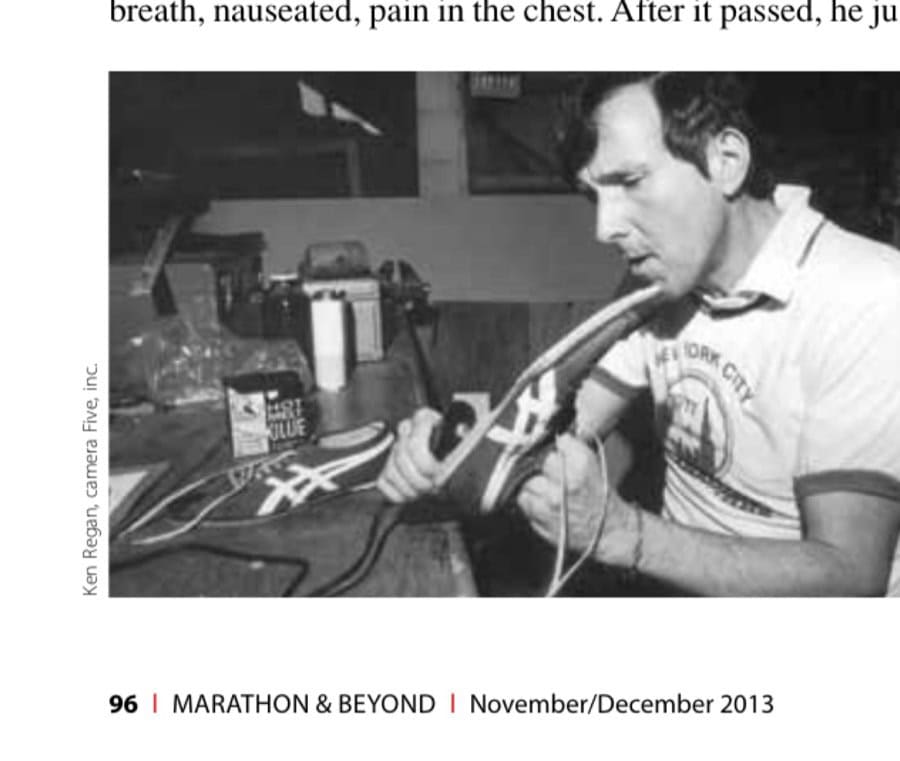
Fixx hot waxing his running shoes in the basement of his Riverside, Connecticut, home.
Courtesy of Fixx family
▲
Fixx giving a lecture as part of the President’s Council for Physical Fitness and Sports in 1983.
About the same time, Fixx visited Phoenix and ran with Art Mollen, DO, director of the Southwest Health Institute. Fixx experienced chest discomfort and a tired feeling. “He said he had had a cold the week before and wasn’t feeling that well,” recalls Dr. Mollen (who nevertheless was reluctant to identify the problem as cardiovascular).
Either incident could have been symptomatic of a heart attack—or could not. Later, Fixx’s autopsy would show one minor scar that might have been the result of an early cardiovascular incident—or might not!
Because of his research on medical subjects, Fixx certainly understood that cardiovascular disease was the number one disease in the United States: 1.5 million people at that time suffered heart attacks annually, 560,000 of them fatal. “Every fifth man you meet on the street will have a heart attack by the time he is 70,” says William Castelli, MD, of the National Heart, Lung, and Blood Institute. Among those whose fathers suffered a heart attack before 40, one-third will do the same.
Runners are susceptible to the same laws of probability, despite promises of immunity from sports zealots at the time. Dr. Thomas J. Bassler, a California pathologist and member of the American Medical Joggers Association, espoused a theory of “immunity” against heart attack for people fit enough to have finished a marathon. Dr. Bassler offered no conclusive proof but challenged others to disprove his theory by sending him medical reports of heart attack victims who happened to have been runners. As those reports trickled in, Dr. Bassler continued to maintain his theory, attributing death to reasons that did not diminish the powers of the marathon lifestyle in the eyes of the faithful.
Asked whether Fixx’s death disproved his theory, Dr. Bassler answered only that eventually he would examine the medical reports. How long would that take? “Two years,” suggested Dr. Bassler. “Maybe 10.”
One flaw in the reasoning behind Dr. Bassler’s immunity theories was that they were unscientific. Asking other medical researchers to disprove his theories was a bit like asking astronomers to disprove that UFOs exist. Just because none have appeared zipping across their telescopes does not mean that UFOs have not visited Earth and might do so again. In one respect Dr. Bassler did runners a service by providing a strong medical voice arguing that running as an activity, and marathon running as a primary goal of that activity, was safe, a lot safer than not participating in exercise. But in terms of providing a scientific basis for his immunity theories, simply stated, Dr. Bassler was wrong. His lack of proof was no proof. Several decades later, the running world has passed Dr. Bassler by. Yes, we may die of a heart attack while running. No, we are not going to stop running because of any perceived risks. Even the death of Jim Fixx would not discourage us.
Running is not normally considered a high-risk sport, like football, boxing, or auto racing. Yet people encounter risk any time they step outside their front doors. Dr. Thompson suggests that during the one hour or so we exercise by running or engaging in other physical activities, our risks are elevated. But during the other 23 hours of a day, our risks are much lower because of superior fitness.
Finishing the Honolulu Marathon one year, I walked past a runner collapsed on the ground being treated by medics. He failed to survive. Another runner died a half mile from the finish line in a half-marathon in Lake Bluff, Illinois, that I once ran. A good friend of mine from the University of Chicago, Arne Richards, in training for an ultramarathon, went running one day with his dog. They found him three days later, dead beside the road, his dog circling nearby. Ron Daws, a 1968 Olympian in the marathon also training for an ultra, died in his sleep of a heart attack that none of his friends could have anticipated. We are mortal.
Walt Stack, a former longshoreman who once served time on Alcatraz because of supposed communist sympathies, was a legendary member of the Dolphin South End club in the San Francisco area. He would swim in the frigid water of the Bay, then run to the Golden Gate and back as part of his daily routine. At a time when 8:00 per mile was considered a “slow” pace, it was said about Stack that if you threw him out of an airplane, he would still fall at a rate of 8:00 per mile.
Stack used to joke about “dying in the saddle.” He was referring not merely to dying while running but to dying during sexual intercourse. One time while jogging in the company of friends, several of them female, Walt initiated a long discussion about the pleasures of dying in the saddle.
Afterward, one of the woman runners commented to a friend: “That Mr. Stack certainly is a nice man, but I don’t understand his obsession with dying on horseback.”
Jim Fixx seemingly had beaten the odds, surviving longer than his father, who had his first heart attack at age 35 and then died at age 43. But in changing lifestyles, Fixx merely had moderated, not eliminated, his risk. Was he distrustful of doctors? Or was he merely afraid of what they might tell him?
His friend Hal Bowser, who does distrust physicians, never saw any evidence that Jim Fixx felt the same. “If there was any antidoctor sentiment on his part, I would have sniffed it out,” says Bowser. “All I ever heard from Jim was praise of doctors and what they were doing. He was excited by stress tests. He knew doctors who were pioneers in this field. They were on the cutting edge.”
Yet a subtle undercurrent of medical distrust does trickle through The Complete Book of Running. He quotes one friend as saying, “Running is my doctor.” He suggests later that most physicians don’t know much about running injuries. He supports the views of George Sheehan, MD, who says, “I’ve kind of given up on the medical profession.”
In this instance, Fixx was both nurturing and mirroring the feeling of invulnerability possessed by his fellow runners, the million who had bought his bestselling book. Kenneth H. Cooper, MD, suggested that Fixx was guilty of believing four myths: “One was that he couldn’t have heart disease. Two, even though Jim said he disagreed with Dr. Bassler’s theory that if you finish a marathon you’re immune to heart attacks, I think subconsciously he did agree. Three, he thought stress tests worthless because of too many false positives and that the average physician could not interpret the stress of athletic activity. Four, because running had changed his lifestyle, he felt he did not need to worry about his family history of heart disease.”
In December 1983, Fixx visited Dr. Cooper’s Dallas Aerobics Center while writing an article that was published in the May 1984 issue of The Runner, its focus on tests involving John A. Kelley. Kelley’s fame rested on his not only having won the Boston Marathon twice in 1935 and 1945 but also having run that classic race 61 times. “Jim was here for three or four days,” says Dr. Cooper, “and during that time it got to be a joke: why not take a stress test? He refused for reasons known only to himself.”
Despite his success—or possibly because of it—Fixx recently had undergone severe stress. In 1982, he and his second wife, Alice, divorced, an angry divorce, accusations flying on both sides. “When it was over,” says his son John, “Dad felt like a weight had been lifted from his shoulders. “
Ordinarily, he was the calmest person that I knew. He had a regular routine, was well organized. There was a certain place for salt and pepper on the table. His running shoes had to be in the right place. It was less that he was compulsive but that he liked things under control, rolling along smoothly.”
Through the spring of 1984, Fixx worked on his latest book, Maximum Sports Performance. The book was past deadline, although his editor at Random House,
Joe Fox, seemed unconcerned. “All writers miss deadlines,” says Fox. Fixx’s researcher, Todd Benoit, admits: “He was working very hard to get the book right. He was into sports he was not sure of: football, baseball.” But John Fixx says: “He had been under greater pressure finishing his first running book. He had worked 12-14 hours a day to get that done in time.”
Another son, Stephen, spent six months living with his father the previous year. “There were no hints to me that he was under great stress,” says Stephen. “He was running every day. I’d run with him four times a week, and weekends we would race.” Stephen’s twin sister, Betsy, also visited. “He seemed fine,” she says. “No clues.”
The clues were there, but nobody in Jim Fixx’s family, nor any of his close friends, picked up on them. Perhaps this was because, like an alcoholic hiding bottles of whiskey in closets and drawers, Jim had become adept at hiding any clues that might hint at an impending heart attack. Or, perhaps more justly, he had become adept at hiding those clues from himself. The summer of 1984 would be special: not merely for Jim, but for the entire Fixx family. For nearly a year, he and his sister Kitty (who lived in Santa Barbara, California, with husband Jim Bower) had planned to rent a house near Waquoit on Cape Cod. Peggy Palmer, a former girlfriend of Jim’s from high school whom he was seeing again, would join them. Jim’s mother, Marlys Fixx, was coming from Sarasota, Florida. Other family members promised visits. Kitty says, “This was a lifelong dream of having our vacation together, all the family.”
Mid-June, Fixx delivered the first draft of his new book to Random House. “The only thing he was complaining about was a sore calf muscle,” says Joe Fox. Todd Benoit recalls: “He was eager to get up to Cape Cod and see everybody. He
Ken Regan, camera Five, inc.
▲
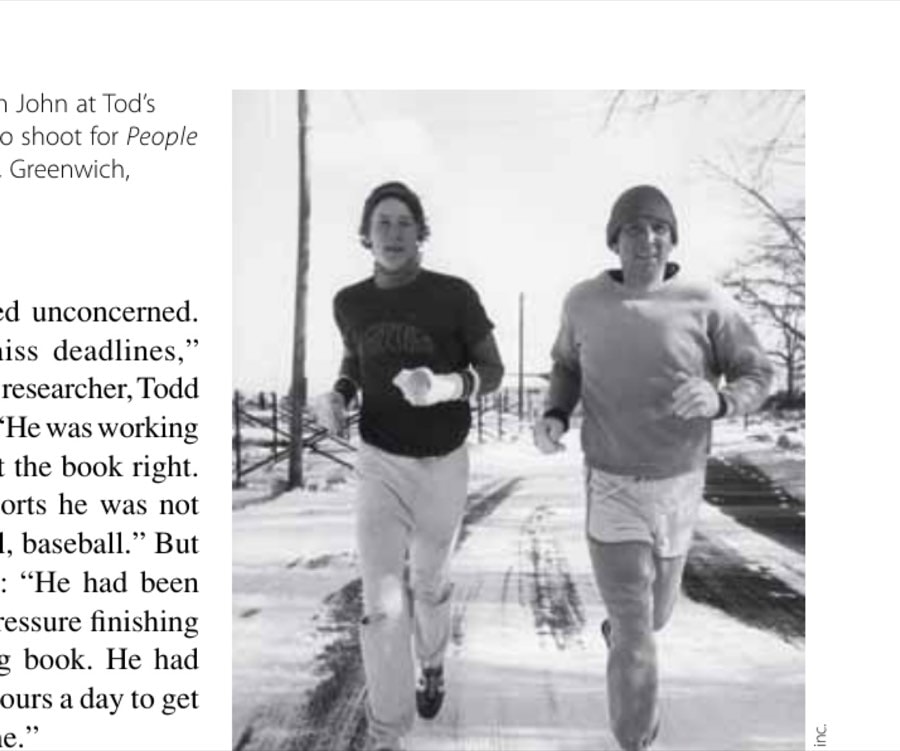
Fixx and his son John at Tod’s Point for the photo shoot for People magazine in 1978, Greenwich, Connecticut.
was planning on some work, but mostly vacation.” After a month at the Cape, Jim and Peggy would spend a month together in northern Vermont. Jim’s son John suspected his father might soon ask her to marry him.
During the month in Cape Cod, Jim ran four races: a pair of 5-milers in Sandwich and North Falmouth, a 10K in New Seabury, and a 20K in Bourne. Kitty’s daughter Martha was running her first long race in Bourne, and Jim paced her. Kitty ran two of the shorter races. Peggy also ran, placing first at New Seabury. “I was the only woman in my age category,” she apologizes. “I won a pair of shoes.” Jim also played tennis with different members of the family, two or three sets a day.
He talked about getting in shape for the New York City Marathon. Concerned because of a decline in performance, Jim Fixx, for the first time, was doing speed work: fartlek, surges in the middle of long runs. In the 10K, he ran his fastest recent time, about 7:10 pace. In one of the 5-milers, he broke 35:00, fast for a man who never claimed to be more than a middle-of-the-pack runner. “He had a good kick,” said his son John. “Maybe he was sandbagging.” Jim had run eight Boston Marathons, achieving a 3:12 PR in 1975. Theoretically, if you accepted Dr. Bassler’s immunity theories, he should have faced no threat of a heart attack, particularly during a training run.
One Sunday morning, everybody attended church services in Woods Hole. Kitty suggested they remain for a church brunch. “You stay,” said Jim. He stepped behind the car, removed his trousers, and emerged smiling, wearing running gear. He began what he thought would be a 10-mile run, covering part of the Falmouth course, back to Waquoit. It proved to be closer to 15. The day was hot; Jim needed to walk several times.
Later, someone would mention to his mother how tired Jim seemed. “Of course he was tired,” said Marlys Fixx. “He was sailing and playing tennis, pitching in and cooking. He took me out in a canoe. Everybody was tired!” After two weeks, she returned to Sarasota. Her son drove her to the Hyannis airport. She told him that since he was busy, he should leave before her plane took off. “He waited around because he wanted to wave,” she remembers.
The Bowers were fussy about what they ate. As a girl, Kitty had a heart murmur. Her husband had triple-bypass surgery, and they followed the low-fat Pritikin diet, popular at that time. Kitty noted that her brother’s eating habits did not differ much from theirs: “He ate sensibly, almost vegetarian. He liked pasta, salads, fruit. He didn’t eat sweets or butter. He did eat peanut butter. He was careful in the amount he ate, very moderate.”
After the North Falmouth race, Jim began mentioning what seemed to be a bad chest cold, “except it’s not a chest cold,” he said. John Fixx recalls, “Dad didn’t seem to think it was serious.” Jim spoke after that race to one of Peggy’s friends, Shirley Cullinane, a nurse. Cullinane expressed no concerns, although she might have had Jim fully described his symptoms. He would start a workout
and, after five minutes, feel tightness beneath his sternum. After several minutes the tightness abated. It didn’t bother him playing tennis, only running. “Maybe it’s pollen in the air,” he speculated one night, “but I don’t have allergies.” “
I don’t either,” said Kitty, “but my eyes have been watering.” They discussed whether the problem might be due to the warm, heavy air. Jim stroked his throat, pondering: “It’s too high to be the heart.”
Eventually, he called a physician friend and described the problem. After hanging up the phone, Jim told Peggy: “He said it could be caused by a number of things, and I shouldn’t overreact.” Jim nevertheless discussed seeing a doctor in Vermont if the condition continued. Maybe in the fall, it might be time for a long overdue medical checkup.
Later, Peggy would say, “He waited too long.” The rest of the world, meanwhile, was waiting for the Games of the XXIII Olympiad to begin in Los Angeles, California, in August. That included me, even though in the last decade the Olympic Games had fallen into decline, beginning with the 1972 Olympics in Munich, Germany. This was the Games that was to heal the wounds of World War II when a more belligerent Germany under the lead of the dictator Adolf Hitler had caused the deaths of millions, not merely the 6 million Jews who died brutally in death camps but an estimated total of 60 million deaths of Russians and other Eastern Europeans and French and English and a half-million Americans, who lost their lives trying to stem the spread of fascism not only in Europe but across the Pacific. Now, a friendlier Germany led by a new generation would welcome the world to Munich for a joyful celebration, in the words of Schiller used in the classic Beethoven Ninth Symphony: Alle Menchsen werden Brüder—“Brotherhood unites all men.”
And then a terrorist attack by a Palestinian group called Black September resulted in the murder of 11 more Jews, Israeli athletes and coaches. In 1976, 25 African nations boycotted the Olympics in Montreal to protest the failure of the International Olympic Committee to ban New Zealand because of its rugby team having toured South Africa, a pariah in world sports, its athletes not even being eligible for Olympic competition. Four years later the United States, pushed by President Jimmy Carter, stayed home from the Moscow Games, protesting the Soviet Union’s invasion of Afghanistan. In addition, the Montreal Games had lost so much money that nobody seemed to want to host the Olympic Games any more. Los Angeles became the only bidder for 1984. “Take it!” the rest of the world seemed to say. Businessman Peter Ueberroth reinvigorated the Olympic movement with the advantage of a good TV contract and support from American sponsors despite a boycott by the Soviet Union and other Iron Curtain nations.
Jim Fixx was looking forward to watching the Games on TV. I was looking forward to watching them live from the Los Angeles Coliseum, covering the
Courtesy of Fixx family
▲
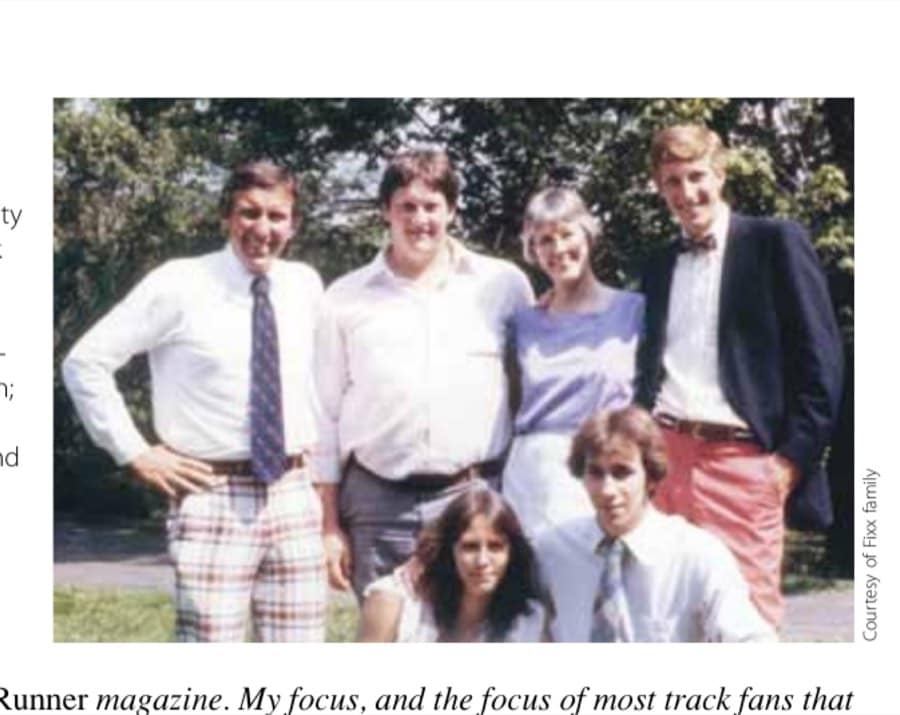
The Fixx family at John’s commencement from Wesleyan University in May 1983: back row, left to right: Jim Fixx, son Paul, ex-wife Mary Durling, and son John; kneeling in front: daughter Betsy and son Stephen.
action for The Runner magazine. My focus, and the focus of most track fans that summer, was on the Olympians who would compete in Los Angeles, elite athletes, the top of the competitive pyramid. Nobody was paying much attention, despite his fame, to a “jogger” named James Fuller Fixx and some health problems that had begun to prove troublesome. Early Thursday morning, July 19, Jim and Peggy went shopping. Peggy’s daughter Hillary and her boyfriend had appointed themselves chefs for the evening, presenting a shopping list that included an expensive wine. “We laughed over their extravagant taste,” recalls Peggy. “We usually drink Gallo.”
Leaving Angelo’s Supermarket, Jim suddenly bent. He picked a coin off the ground. “My first penny of the day,” he said. It promised good luck. Later, Jim played tennis with his sister Kitty and then ran four miles with her and six more with Kitty’s daughter Martha.
At 3:00 that afternoon, Jim called John A. Kelley, who lived nearby. Retired, Kelley was painting at his easel. He told Fixx about a 10K race in Hyannis that weekend. “No, I’m tired, very tired,” said Jim. “I’m leaving for Vermont tomorrow for a whole month of doing nothing. Give my love to your wife.”
Dinner that night consisted of oysters on the half shell, pasta, blueberry pie, and the expensive wine. “It was a wonderful family dinner,” recalls Kitty. Peggy says: “Jim was cheerful. He was always a great storyteller. When he worked, he worked alone, but when he relaxed, he liked having people around.” Afterward, they watched the Democratic convention on TV, Geraldine Ferraro accepting the vice-presidential nomination, the first woman to be so nominated. Because Jim was leaving early the next morning, he and Peggy soon retired.
Friday morning, Jim rose early. Each of the vacationers was obligated (under family rules) to clean two rooms before leaving. In the morning, Jim cleaned his
two rooms, then loaded his car, remembering a small TV set on which he planned to watch the Olympics. He started to help Peggy in the kitchen, but knowing he had a six-hour drive, she told him, “Get out of here.” She would be joining him in a week. He hugged everybody goodbye, family and friends, and left about 9:30 a.m. “I’ll call you tomorrow,” he told Peggy before driving away.
Around 4:30 p.m., he arrived at the Village Motel, outside the town of Hardwick, Vermont. The house rented for August on Caspian Lake would not be available for six days. He planned to spend those days, before Peggy’s arrival, revising Maximum Sports Performance and working on The Complete Runner’s Day-byDay Log and Calendar for 1985. He asked the motel owner about restaurants, then left for a run along tree-shaded route 15.
Walking to the beach near my home in Long Beach, Indiana, on that Saturday morning, I crossed the path of a jogger, paying him little attention. Since the publication of Jim Fixx’s landmark bestseller, joggers had become more and more common on the lakefront road in front of my house. The jogger recognized me and stopped. “Did you hear about Jim Fixx?” he said. “I just heard on the radio. He died of a heart attack while out running.” “
No,” I said, shocked. Jim and I hardly were close friends. Since our first meeting, where I had driven into Chicago to appear on a TV show with Jim and Erma Tranter, we probably had met fewer than a half-dozen times. Through the success of his book, Jim had created a cottage industry for running celebrities. Most of us celebrities from Dr. George Sheehan to Dr. Joan Ullyot to Joe Henderson to Frank Shorter to Jim Fixx knew each other reasonably well, meeting mostly at major running races and running clinics where we were paid to speak. Jim Fixx was always friendly, always cheerful. I liked Jim. We were fellow authors. In truth, I profited greatly from the spillover of his celebrity.
Running was supposed to make us all healthier people. If you lost weight, abandoned your two-pack-a-day cigarette habit, and started to jog—all things Jim had done himself—you might live longer. And there were the claims by Dr. Bassler and other zealous promoters of our sport that if you could finish a marathon, you could claim immunity from a heart attack. Yet here was Jim Fixx, dead of a heart attack at age 52, almost the same age as myself.
Sunday morning I read the obituaries. Jim, in death, had made the front page of The New York Times, not merely because of his celebrity as a best-selling author but because of the circumstances surrounding his death. It was the ultimate irony: Jim had died running! About an hour after Jim Fixx had left the motel in Hardwick to go for his usual 10-mile run, a motorcyclist spotted him lying beside the road, looking almost as
though he were asleep, except he was dead. His position on the right side of the road suggested Fixx probably was returning from his run when he fell. The autopsy by state medical examiner Eleanor N. McQuillen, MD, indicated death by heart attack. Fixx’s three main arteries showed 95 percent, 85 percent, and 50 percent blockage. Starved of blood, the heart apparently experienced ventricular fibrillation, uncontrolled beating. Under such conditions, the heart fails to pump blood. Oxygen cannot reach the brain. Within a few seconds, the victim loses consciousness. In the absence of instant medical assistance, the victim dies within a few minutes.
During the autopsy, Dr. McQuillen noticed scars in the heart, evidence of prior heart damage. “The majority of tiny scars were either two weeks or a month old,” she explained. “One small scar might have been earlier, but I tend to make light of that right now.” The scars were in the anterior (or rear) portion of the heart. When damage occurs in the anterior, the victim is less likely to experience so-called classic symptoms that might serve as an alert. Dr. McQuillen refers to this as “silent coronary heart disease.”
It was not unusual that Fixx could run for so many years yet show so few symptoms of the disease that killed him. “Atherosclerosis, the gradual closing of the arteries, begins in childhood and is progressive over many years,” says cardiologist Noel Nequin, MD. “The body adapts to insufficiencies. Blockage doesn’t happen overnight, but when it builds to a certain point, heart damage can occur within minutes. It’s like the straw that finally breaks the camel’s back.”
Did running, in a way, kill Jim Fixx? The run that he took that day in Vermont did “kill” him, although as Dr. Ernst Jokl of the University of Kentucky Medical Center points out, “Exercise does not kill. A preexisting disease does.”
On Monday after the death of Jim Fixx, I received a call from Marc Bloom, editor of The Runner. In addition to my writing duties at the Olympic Games for our special October issue, he wanted me to write a major article on the death of Jim Fixx, the expanded version of which you are reading now. “JIM FIXX: How He Lived, Why He Died” would become the cover story for our November 1984 issue.
I was about to leave for Los Angeles. I modified my travel arrangements and detoured through New York City on that Tuesday afternoon, renting a car to drive to Greenwich, Connecticut, where the funeral would be held the next morning, Wednesday. The funeral was quiet, unpretentious, about what Jim would have wanted. A few people spoke, but I hardly considered myself that close a friend of Jim, so I remained silent. The family was polite, friendly, about what one would expect; they invited us to Jim’s house afterward. I informed the family, particularly Jim’s son John, that I would be writing a cover story on why his father died. He promised to cooperate fully, and he did. With both his grandfather and father having died young from heart attacks, John was vitally interested in learning the answer to that question.
I noticed that several individuals wore running shoes along with coat and tie. That included New York City Marathon race director Fred Lebow and Runner’s World editor Amby Burfoot. I wasn’t sure whether this was a bad fashion statement or a tribute to what Jim Fixx meant to the sport of running.
After the funeral I traveled into New York City, stopping at the apartment of George Hirsch, publisher of The Runner. I ran through the streets of the city, where I was more at risk of getting hit by a taxicab than of dying of a heart attack. Arriving at Central Park, I did two laps around the reservoir, clocking 11 miles. I noted in my diary that my legs felt tight. After my workout, I headed to the airport and flew to Los Angeles to begin my coverage of the 1984 Olympic Games. For the next several weeks, my focus would shift from the joggers I had seen circling the reservoir to the elites, the fastest runners on the planet. I knew, however, that the elites and joggers had much in common. Jim Fixx had been responsible for making that connection. At the funeral on Tuesday, family and friends had gathered at St. Saviour’s Church in Old Greenwich. It was a hot, sticky day. People fanned themselves with a card saying, “A Service of Thanksgiving for the Life of James Fuller Fixx: 1932-1984.” With insufficient seating in the small church, people stood in the side aisles. Several were reporters trying to look inconspicuous. Baroque music softly filtered through loudspeakers. It stopped. The family tiptoed in, sitting in the front near a closed casket. An organist began playing. Mourners sang, “O God, Our Help in Ages Past.” Midway through the services, Hal Bowser rose and, speaking almost in a hush, told the story about Jim Fixx’s problems with his telescope, “What am I doing wrong?” For an hour afterward, those who once knew Jim Fixx lingered in the parking lot, talking, sharing memories, even laughing about silly incidents involving their lost friend. Several joggers passed, running Jim Fixx’s favorite 10-mile course. If they understood why a crowd was gathered by the church, they gave no sign. But they too had lost a friend.
Kitty Fixx Bower said: “People kept telling me, what a wonderful way to go, no pain, no awareness. But that doesn’t fit into anything I think my brother would accept. He was a person who loved life, who wanted to live.”
Soon afterward, Kitty returned home to Santa Barbara, where part of the American Olympic team was training. Several days before the women’s marathon, Kitty encountered Joan Benoit returning from a run. They talked. Benoit commented that Jim Fixx was one of the few among a group of experts polled by The Runner who had picked her to win the gold medal. Joan said she appreciated that. (Jim’s prediction would prove accurate.) “
He was looking forward to watching you on TV,” said Kitty. “Wherever he is,” said Joan. “I’m sure he’ll be watching.”
This article originally appeared in Marathon & Beyond, Vol. 17, No. 6 (2013).
← Browse the full M&B ArchiveMore like this
1,000+ stories from 19 years of Marathon & Beyond
The complete archive of the legendary long-distance journal — digitized and free to read.
