

The Death Valley 300
The 1987 United States versus United Kingdom race nudged the course to a new level. Part 2. by Richard Benyo
Chapter 2: The Long & Winding Road “Man’s mind, once stretched by a new idea, never regains its original dimensions.” —Oliver Wendell Holmes
On July 31, 1988, Tom Crawford threw a picnic at his home in the hills above Santa Rosa, California. The guest list was composed entirely of people who had been involved with the American team in the 1987 first-ever race on the Death Valley-to-Mt.-Whitney course. Tom and his wife Nancy hosted. Jean and Jeff Ennis were there; John Hollander and his wife Robin were there; Hollander is the Santa Rosa podiatrist who went along to take care of the runners’ feet. I was there with Rhonda Provost; I had covered the race for the San Francisco Chronicle and had then convinced Bob Gottlieb at The New Yorker that the subject was worthy of a place in their Sporting Scene department; I had been in the process of writing an eighteen-thousand-word piece on the subject since April.
I was using the occasion—before, in typical Crawford fashion, the picnic got too out of hand—to run some tape on year-old memories of the race that might fill in blank spots in my notes. At some point, it occurred to me that this was the one-year anniversary of the start of the 1987 race. I offered a toast. That was very much the wrong thing to do. One toast followed another until the context of the toasts went from silly to incoherently sublime.
By the time we had eaten our by-then-cremated hamburgers, everyone who had a recollection of the 1987 race was giving it, and after each story, more beer was passed around. The subject of Tom Crawford’s dream to be the first person to ever do the course out-and-back came up. I repeated the point I had made the previous year that because the one-way course requires a runner to reach the summit, and then descend back to Whitney Portal, eleven miles of the return trip
are already in the books. There isn’t any practical way to get back down off the mountain but to hypothetically begin a return journey. Tom, with the experience of already having done the one-way course twice, became cautionary. “Yes,” he said, “but when you come back down, the last thing on your mind is to go back out on that course.”
Fueled by the beer, John Hollander added, “Yeah, but it’s a downhill course on the way back!” Tom and I moaned, knowing that a downhill course can often take more out of a runner than an uphill course, and can certainly open him to more physical abuse as three to four times his normal body weight crashes down on already tired feet, ankles, and legs some two thousand times per mile. The serious discussion of potential overuse injuries broke the party up into smaller groups with separate conversations. “
So why don’t you do it?” I asked Tom. “What?” he asked. “The out-and-back.” “Well, maybe someday I will—” “Let’s do it next year,” I said. “You mean ‘Let’s’ as in ‘Let us’?” John Hollander asked. “Are you sure you know what you’re getting into?” Tom asked. “
Since nobody’s ever even tried the out-and-back course, of course I don’t know what I’m getting into.” Tom waxed serious, instinctively providing me with an out. “This might not be such a good idea,” he said. I failed to take either the hint or the out. “
Let’s organize it against the British team again,” I suggested. “They can add Dave Boiling to their team and you and Jeanie can add me.” “We don’t even know if Jeanie will do it,” Hollander said. “Sure she will,” I said on her behalf. “She’d love to do it.” “
Okay,” Tom said, “I’ll ask Jeanie, and if she’s up for it, we’ll do it.” The next morning, while going over my notes of the work I planned to do that day, it occurred to me that I may have volunteered to do Death Valley-toMt.-Whitney out-and-back next summer. “Hey, Rhonda!” I called. “I think I volunteered to do the Death Valley double next summer.” “
You what?” she said. “Why’d you do that?” “I guess I thought it was a good idea at the time.” A call from Tom Crawford later in the day confirmed that I had, indeed, volunteered to do that little thing, and yes, Jean Ennis was interested. We’d have to come up with a suitable way to entice Kenneth Crutchlow and the British team to enter the fray.
I walked back to my office, where I had notes, photos, tapes, maps, and books on the subject of the Death Valley area strewn about. I was still in the middle of working on the piece on the 1987 race for The New Yorker.
It was covering that race that had gotten me into this fix. Just as covering the 1977 New York City Marathon from the back of the photo truck had inspired me to train for and run my first marathon, so covering the 1987 Death Valley-toMt.-Whitney race had inspired me to set my sights on a double crossing. I was suddenly glad I had never covered guys putting out an oil rig fire. Or maybe I’d have been better off if I had. It would have kept me occupied doing something productive instead of drinking beer with Tom Crawford.
I momentarily put my own plight for 1989 out of my mind and went back to work on the 1987 race story. By October the eighteen thousand words were finished. Bob Gottlieb accepted the piece, sent it to Pat Crow to be edited, and it was immediately set in type. He hoped to run it sometime between fall 1988 and midsummer 1989. But due to overscheduling, the piece never ran. What follows is what the piece said about the course and about the 1987 race. (I have taken the liberty of putting back into the piece the incidents that occurred between Keeler and Lone Pine, which Pat removed because he felt they might encourage other people like the Saturday night thugs to do things like those described. “I don’t think people like that are New Yorker subscribers,” I argued. Pat apparently didn’t agree. Maybe he knows the West better than I do). * * * At the stroke of midnight on August 31, the window closes on the world’s most arduous running course: Death Valley to Mt. Whitney. The window is a two-month period during the summer’s hottest months when ultra-distance runners who are so inclined may make an attempt to run from the pits of Death Valley to the heights of Mt. Whitney, in southeastern California. The lure of the course is twofold: the tantalizing topography and the outrageous climatic extremes.
Death Valley, a region fifty percent again as large as the state of Delaware, was at one time an inland sea. In one of nature’s humorous perversions, it is now the driest place in the United States and in some years the driest place on earth, averaging an inch and a half of rain a year. The rainfall has exceeded four inches a year only twice in fifty years, and at one point during those fifty years some fifteen months passed without a trace of rain. In midsummer, clouds dropping rain frequently pass overhead, but the rain never reaches the desert sands, because the heat rising from the valley floor evaporates the moisture on its way down, sending it back into the atmosphere.
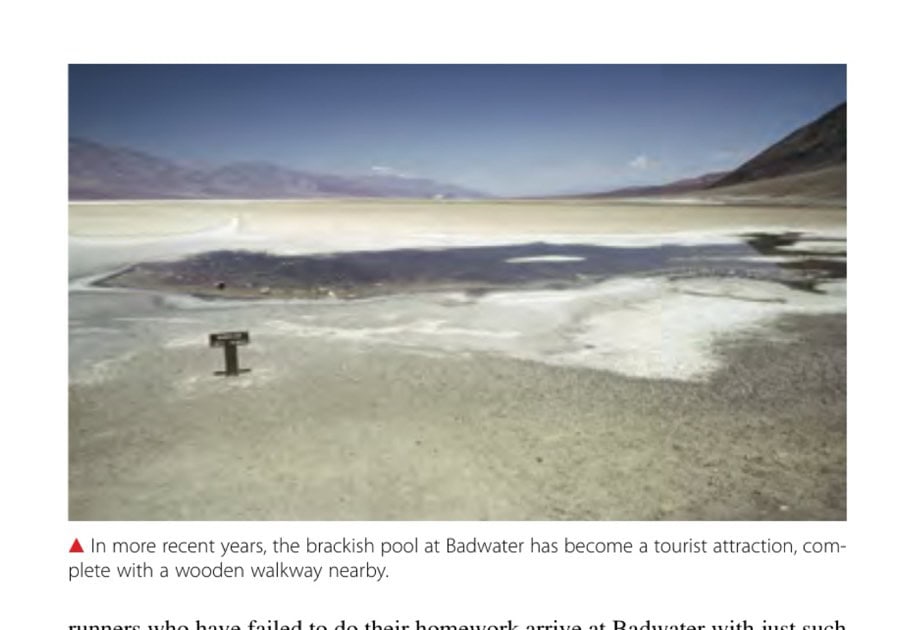
The running course begins at a brackish mineral pool called Badwater, at two hundred and seventy-nine feet below sea level, the lowest point in the Western Hemisphere to which a car can travel. (The truly lowest point, at two hundred and eighty-two feet below sea level, is four miles west, and is inaccessible by automobile.) People who have never visited the area imagine that to reach Mt. Whitney from Badwater one travels a seemingly endless flat valley filled with sand dunes to the base of Mt. Whitney, where the ascent begins. In fact, many
▲ In more recent years, the brackish pool at Badwater has become a tourist attraction, complete with a wooden walkway nearby.
runners who have failed to do their homework arrive at Badwater with just such a simplified profile drawn in their heads. In actuality the shortest route by road from Badwater to Mt. Whitney crosses several respectable mountain ranges (at least by Appalachian standards) before reaching the foot of Whitney. From Badwater, the course runs north-by-northwest for eighteen miles to Furnace Creek, which is at sea level. Furnace Creek is in effect the capital of Death Valley: it is the largest settlement, the site of the National Park Service’s visitor’s center, and the site at which temperature and rainfall for the valley are officially recorded. From Furnace Creek, the course continues north and northwest to Stovepipe Wells, twenty-five miles of undulating, monotonous, treeless road that dips below and rises above sea level half a dozen times. Stovepipe Wells sits at the foot of the Panamint Mountains. At that point, the course turns sharply to the southwest, making a seventeen-mile ascent up the Panamint Range to Towne Pass (elevation forty-nine hundred and fifty-six feet), where it officially leaves Death Valley and descends into neighboring Panamint Valley (fifteen hundred and sixty-six feet above sea level at its lowest point), which is crossed from east to west. At Panamint Springs, on the western side of the valley, the course again climbs, this time snaking through a fifteen-mile-long series of switchbacks that crawl up the side of the Argus Range, until they top out at fifty-two hundred and thirty-eight feet before beginning a series of long, sweeping curves into the Owens Valley, which lies at an altitude of thirty-six hundred and nine feet and whose principal attraction is a dry lake bed populated by dust devils. The lake evaporated when Los Angeles’ insatiable thirst diverted rivers and streams
that traditionally fed Owens Lake from mountain springs and melting snow. The course shoots across the edge of Owens Lake and ultimately strikes the town of Lone Pine (thirty-seven hundred and thirty-nine feet), where it ricochets due west on a thirteen-mile climb to Whitney Portal (eighty-three hundred and sixty-five feet), the last spot a vehicle can climb to before the mountain demands passage on foot. From Whitney Portal, there is an eleven-mile climb to the summit of Whitney, the highest peak in the contiguous United States (at fourteen thousand four hundred and ninety-four feet). The distance from Badwater to the summit of Mt. Whitney is roughly one hundred fifty miles.
The course is even more formidable meteorologically than it is topographically. On July 10, 1913, Furnace Creek Station recorded a temperature of a hundred and thirty-four degrees. Temperatures at Furnace Creek are taken from thermometers placed away from the sun, inside white louvered boxes raised five feet above the ground in order to measure the ambient air temperature untainted by ground temperatures and radiant heat. That same year, daytime temperatures for two weeks straight reached a hundred and twenty and above. Several years later, a weather station in the Sahara—at Azizia, in Libya—claimed to have recorded a temperature of a hundred and thirty-six. Ruth Kirk, the wife of a ranger stationed at Furnace Creek, in her book Exploring Death Valley, comments on the Libyan claim: “
Meteorologists regard Death Valley as the hottest place in the world. This is partly because they question the accuracy of the Libyan reading, and in addition because nowhere else is able to match Death Valley’s summer maximums, which consistently exceed those anywhere else in the world. July highs for the last fifty years average one hundred sixteen degrees and August highs one hundred fourteen. This is ten percent above the mean maximums for Azizia. “
Ground temperatures tend to be about fifty percent higher than air temperatures. A reading of two hundred and one degrees Fahrenheit was made at Furnace Creek in July 1972, the highest official reading ever made in Death Valley—and significant because it is the ground temperatures, not air temperatures at five feet, that plants and animals must contend with.”
Rangers who work at the Furnace Creek Station have their own criticisms of the thermometer box they use. “The box is situated in a nice area with irrigated grass and with plenty of shade trees,” one of them said. “It’s not like it’s out in the middle of the salt flats.” The rangers contend that temperatures down the road at Badwater are consistently several degrees higher than they are at Furnace Creek. So that would make Badwater the hottest spot on earth.
Fortunately, daytime temperatures in neighboring Panamint Valley are typically several degrees cooler than they are in Death Valley, and those in Owens Valley are even a few degrees cooler than in Panamint, although in none of the valleys does the daytime July and August temperature regularly fall much below
one hundred. Conversely, nighttime temperatures atop Mt. Whitney are frequently below freezing, and the unique weather patterns in the eastern Sierra Nevada typically cause late-afternoon rainstorms and hailstorms that are accompanied by lightning and that last from fifteen minutes to four hours.
Between the first solo attempt to run the course, in 1974, and the closing of the window in 1986, only six men had been successful on the course out of more than one hundred who had tried it. In 1987, nine people completed the course, seven of those successful attempts coming between July 30th and August 5th. When the 1988 window was open, ten runners publicly attempted to survive the course; of those, four were successful. (Rangers at Furnace creek require a use permit to run on the first seventeen miles of the course. The rangers reported that more than fifty such permits were issued for July-August 1988. Obviously, the majority of runners who attempt and fail on the course would rather not advertise their lack of success.) The relatively large number of attempts in 1988 was due in part to the recent belief that the course is easier than it appears on paper and in reputation. This belief was obviously encouraged by the nine successful attempts made in 1987.
The 1988 attempts were a varied lot of experience and naivete. The first publicized attempt was made in mid-July by John Bates, a captain in the U.S. Marines, who announced that he was going to attempt to break the course record, a p.m. start that recorded forty-five hours and fifteen minutes, which was set by Gill Cornell, an engineer at China Lake Naval Weapons Center, in 1987. Bates and his running partner, Max Hooper, a partner in an investment firm in Little Rock, had completed the course in late September of 1986, well out of the official window, in sixty-three hours and twelve minutes. In his 1988 solo attempt, Bates faltered at seventy miles when, thinking he was going through the door of his support vehicle, he was actually walking into a bush. His wife decided that that was quite enough and pulled him from the course.
At 2:46 a.m. on July 28th, the first “official” moneyed race on the course began. Sponsored by a British sportswear and running shoe company, the race offered five hundred dollars to the male and the female winners, and a thousand dollars to anyone who broke the course record. Seven competitors lined up at Badwater: Frank Bozanich, Frank Blazic, Tom Possert, Doug Mitchell, Jim Walker, Adrian Crane, and Linda Elam, the last two of whom had run the course over the July 4th holiday of 1987, becoming the seventh and eighth people to be successful. Another runner, Chuck Jones, planned to start later. The race was held despite formal refusal by the National Park Service district ranger to allow or condone such an event. A Park Service regulation prohibits wilderness areas from being used for the “purpose of conducting or participating in a contest.”
Use permits are required for activities conducted in the Death Valley National Monument and overnight camping permits are required on Mt. Whitney.
Bozanich, a former Marine, was the first to drop out; suffering from what he termed heat exhaustion, he quit after only twenty-two miles. Walker, suffering from a heel spur, quit at fifty miles. Blazic, suffering from chronic nosebleed, a badly blistered right foot, and broken bones in his left foot, quit at ninety miles. Crane, after a futile attempt to shortcut the course by cutting through salt flats, only to find that the thin crust would not support him and that it was impossible to be resupplied with water, dropped out near Stovepipe Wells, restarted, and then re-quit.
Possert reached the peak in forty-five hours and five minutes, beating the record by ten minutes. His effort was disallowed by official scorers when a park ranger reported he was literally dragged up the mountain by his support crew and when a national magazine carried a photograph of him being dragged over some rocks by a crew member. Elam completed the course in sixty-one hours and forty-seven minutes. Jones, who had started eighteen hours behind the others—he had waited for his wife, Donna, who works as a forest ranger, to get off work so she could act as his crew—finished in forty-five hours and fifty-four minutes, after suffering altitude sickness a mile from the top. Mitchell suffered altitude sickness, retreated, and then began another assault on the peak the following day, finishing in eighty hours and thirty-two minutes.
Late in August, a final public attempt for the year was made by Phillip Testerelli, of Los Angeles, who had been inspired by a magazine story about the course. He made it seventeen miles before calling it quits at Furnace Creek.
July 31, 1987, 6:25 a.m. Badwater, Death Valley, California There is a small parking lot at the western edge of a two-lane asphalt road. Across the road, a ragged cliff rises. More than five thousand feet above is Dante’s View, the famed overlook into Death Valley. Nearly two hundred and eighty feet up the side of the cliff is a sign that says “Sea Level.” A few feet below the parking lot is a sinkhole the size of a backyard swimming pool. Water stagnates in the pool, evaporates, and is replaced by more strong water from underground. The water is strong-tasting, metallic, but not dead. A close examination reveals the larvae of the soldier fly wiggling under the surface, while water beetles skim about looking for a meal of algae. To the west of Badwater is more than a dozen miles of salt flats, and on that opposite side of Death Valley is the Panamint Range, which is crowned by Telescope Peak, eleven thousand and forty-nine feet.
The sublime darkness of a night unaltered by city lights and pollution has been broken by dawn, but the salt flats are still in shadow. It is daylight on Telescope Peak, but it will be three more hours before the sun topping the Amargosa Range, that constitutes the valley’s eastern border, lights Badwater.
The parking lot is half filled with vehicles, few of them cars. A Southwind motor home dominates the lot. It is surrounded by a bevy of pickup trucks and four-wheel-drive vehicles. There is also a black London cab parked near the motor home. In a few minutes, the first race to ever be run on the Death Valley-to-Mt.Whitney course is scheduled to begin. Two teams are entered in the race—one American, the other British. Each team is coincidentially composed of a male and a female. Each runner will be required to run the entire course, and the total time of both runners will be the team’s official time.
Since 1974, when the first solo attempt was made on the course, by Albert Arnold, of Walnut Creek, California, only eight people have succeeded in completing it. One of them was Thomas Crawford, forty-one years old, a grade-school principal from Santa Rosa, California, who will be the leader of the American team today. Crawford will attempt to be the only human being to ever complete the course twice. “
After my military service and college, I had become pretty hefty—two hundred fifty pounds,” Crawford told me earlier. “I smoked cigarettes. All I was doing was going to school, teaching school, drinking coffee, smoking cigarettes, and eating hamburgers and French fries. I played a little softball on weekends, drank a lot of beer. One day, while I was principal at Sequoia School, I thought I was having heart palpitations. I looked down and could actually see my heart pounding through my chest. I called Bob Yee, a gynecologist who had three kids in my school. He was really on the cutting edge of running back then—1970 or ’71. He told me I was going to have to lose some weight and start exercising if I wanted to see my daughter graduate from kindergarden. So that’s what I did: dropped some weight, got down to a hundred and sixty-eight. When I first got running, I could run only a hundred yards, and then had to walk a hundred. I got up to where I was running marathons in just above three hours. Probably ran fifteen marathons in the three-hour-and-five-minute range. I did lots of tenkilometer races. In 1982, I ran my first ultramarathon, the American River 50. I did it as a fluke. Ended up running nine hours and twelve minutes. It was hot as hell, but, God, I loved it.”
Crawford’s partner is Jean Ennis, thirty-nine years old, also of Santa Rosa, who is a foreclosure specialist at a mortgage firm. Ennis was drafted to compete in this race eight days ago when Crawford’s partner, Dr. Michael Witwer, withdrew over a rule allowing team members to run independently of each other. Witwer favored requiring team runners to move in tandem, never opening more than a half-mile difference. “
I started running when I was thirty-three,” Ennis said two days ago. “I was going through a divorce. I couldn’t even run around the block. But I kept doing it. I eventually began doing ten-kilometer races. Then a girlfriend of mine went up to Annadel State Park, just outside of town, to run a fifty-mile race. I went up
▲ Jean Ennis, drafted as half of the U.S. team in the wake of her Western States 100 finish, went so far as to tape every individual toe as a hedge against blisters.
to watch, and I knew deep inside that it was what I wanted to do. As far as my running went, I started rather late in life, but I had the opportunity to stay home for about twelve years to raise my kids, so I feel rather fortunate about that, too. And now that they’re grown I can do something for myself and feel really good about it.”
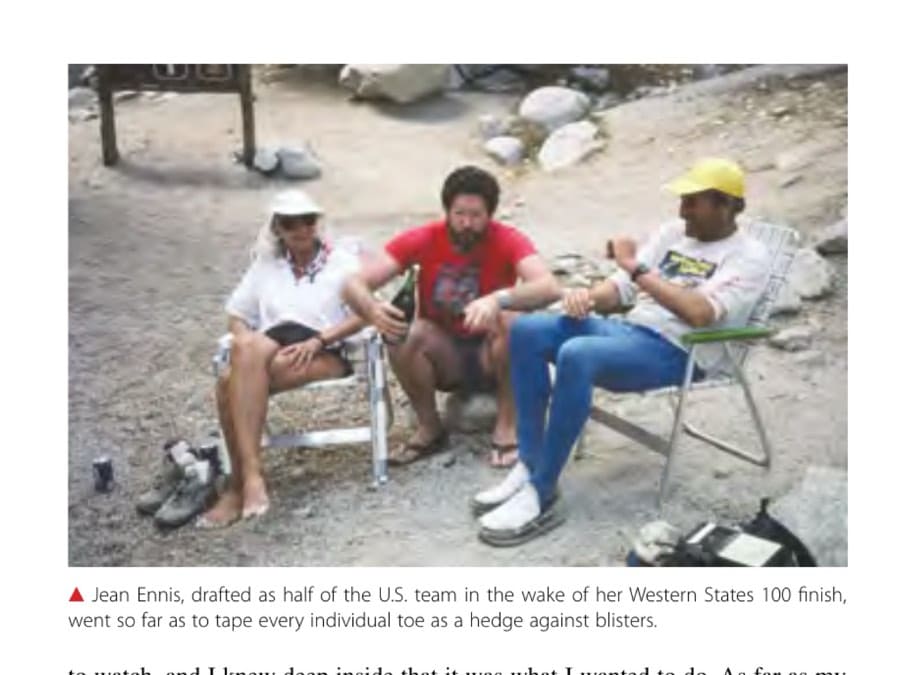
Ennis paused, and then said, “Taking up running after having had polio as a child isn’t the most difficult thing I’ve overcome. When I was twenty-one, I had rhuematic fever, and I was in bed for six months. The doctors told me that since I had heart damage I’d never do anything. I can remember that vividly. I lay there for six months. And after that I was on penicillin and all that, and forty-two cortisone pills a day, and I thought that, ‘No, this is not how I’m going to live!’ It’s too easy to feel you have to live your life around your problems. Years later, after I started running, I had a test done on my heart, and they couldn’t even tell it was the same heart. I think those things you’ve overcome in the past are what make you tougher. You’ve strengthened your heart by running, by becoming really healthy, and you’re not going to give that up and have a chance of getting sick again. To me, that’s the most significant thing I’ve ever overcome: to be told that you wouldn’t be able to have kids, or anything, and deciding to be a doer, not a sitter.”
Both Crawford and Ennis successfully completed the Western States HundredMile Endurance Race through the High Sierra in June—a race considered by
observers of endurance sports to be the most grueling in this country. Crawford finished a hundred and fortieth out of three hundred and fifty-four starters; Ennis was eight places behind him. Crawford ran the race as training for the Death Valley-to-Mt.-Whitney race.
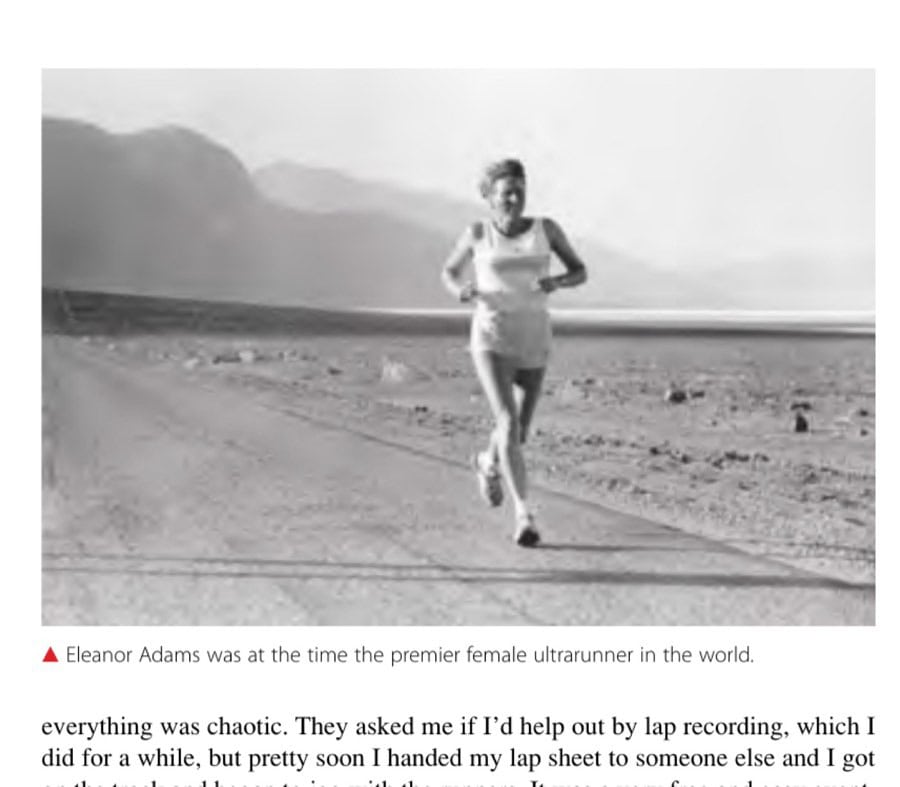
The Englishwoman in the race is Eleanor Adams, thirty-nine, a substitute teacher and mother of three children, who lives near Nottingham and is unquestionably the premier female ultra-distance runner in the world. She is the first woman ever to run more than two hundred miles in forty-eight hours; she holds the women’s world record, of a hundred and forty-one miles in twenty-four hours; and just two months ago she ran a thousand-mile stage race around England. The stage race covered various segments of the thousand-mile course over a period of seventeen days. The runner with the lowest total time for all seventeen stages was declared the winner. “
I’ve been running for eight years now,” Adams told me. “I started when I was thirty-one, just casually jogging to get fit and no thoughts at all of running competitively. If somebody then had told me what I’d be doing now, I probably wouldn’t have got started. Life’s full of coincidences, and one thing led to another, and a couple of months after I’d begun running I entered a five-mile road race and I did well enough to decide that I was going to train seriously and see what I could do. I was not thinking about running ultras; I was just thinking about doing ordinary road races—five to ten miles. But within ten months of starting I’d actually run my first marathon, which I did in three hours and twenty-four minutes. The actual time didn’t mean very much to me at all, but now I realize that’s a pretty reasonable time for a first marathon. All I knew at the time was that I hadn’t done sufficient training to cope with the distance. I’d only run about twelve miles [as a longest run] in training. Of course, the children were much smaller then, and it was difficult to get in the time to do long training runs. I realized then that I needed much more background if I was going to do a decent marathon, so I worked the next twelve months just at training specifically for the marathon, and I did another marathon the following year, in just over three hours. And soon after that it was down to the two-fifties. At this time, I was not doing just marathon running. I was doing track running, cross-country—whatever came up, I’d have a go at it. But I was mainly interested in road racing—that was what I enjoyed more than anything else.”
Adams continued, “At about this time, the first six-day race [in England] was held in Nottingham, which is only about eleven miles from where I live. I went along to find what it was all about. I missed the start, because it was on a Sunday and I was racing elsewhere. I went down at nine o’clock on Monday morning after I’d dropped the kids at school. I went down in my running gear, thinking I’d see what was going on, I’d go out for a training run and then go back home. When I got down there, I found that it was the first event they’d ever put on, and
▲ Eleanor Adams was at the time the premier female ultrarunner in the world.
everything was chaotic. They asked me if I’d help out by lap recording, which I did for a while, but pretty soon I handed my lap sheet to someone else and I got on the track and began to jog with the runners. It was a very free and easy event. There was no restriction on people running with the athletes, so I joined in. One or two of them I knew from reputation and some from years ago, as a teenager, when I’d run for Yorkshire, the county, on the track and cross-country teams. My older brothers had been involved in running, and several of the runners in the six-day race had been colleagues of my brothers from about twenty years ago. So I ran along with them and chatted with them. I went around quite happily. It was a comfortable, easy pace, and before I knew it, it was three o’clock in the afternoon and I realized I had to go and collect the kids from school. So I went home, and the next day I was down at the track again. Same thing. And by the end of the week, although I hadn’t kept up a tally, I realized that I must have clocked up a fair few miles during the week. I got interested enough to want to do one. “
The following year, there was a twelve-hour race put on, again in Nottingham. It was mainly a training session for six-day racers, but they opened the entry to anyone who wanted to have a go. You could enter any of about twelve distances, from the marathon up. I’d been planning, along with some clubmates, to run a marathon that weekend, and I thought, This track race is a lot nearer home, and it’ll give me a chance to see if I’m really interested in this sort of thing. So I thought, Well, if I only do a thirty-miler, at least I’ll have done more than I would
have done at the marathon. So I entered, along with two fellow clubmates, and we were told we could enter as a team, but we’d have to do a hundred kilometers, which was the team race. Well, I didn’t even know how far a hundred kilometers was. But, being me, I said, ‘Yeah, why not? I’ll give it a go.’ I sat down with my fellow clubmates and worked out a race schedule with lap times and intermediate times and so on. It looked easy on paper: ‘How can anyone run as slow as this?’ “
About a week before the race, there was a report in Athletics Weekly about a fifty-mile race that Lynn Fitzgerald had run. She’d started running about the same time as I had, and I’d followed her progress with interest. She started doing ultras. And there was a report where she’d got the world record. I read the article with interest, and when I read the schedule I’d made out for myself I realized my schedule was within ten minutes of the time she’d actually raced. I thought to myself that there must be something wrong here: this is a world-record time that I’ve got written down here. In my ignorance, it didn’t worry me a great deal. I felt, Oh well, obviously I’m going to come to grief somewhere along the line. The day of the race was really hot—for an English day. We started at eight in the morning. I guess there were about fifty runners in the race. Things went according to the schedule, but as I got nearer and nearer the fifty-mile mark, I got stiffer and stiffer. But I couldn’t believe how smoothly it was going. I thought, How on earth can I be running this well? But the opportunity was there, and I wasn’t going to let it go by. It was really tough over the last few laps. Being a novice, I didn’t realize that to account for lap-recording errors, you had to run an extra six laps at the end. So I put all my effort into doing fifty miles only to be told, ‘You can’t stop now. You’ve got another six laps to do.’ And I think that must have been one of the worst experiences of my life. This race was one of two occasions when I can honestly say I’d run myself right out flat into the ground. When the six laps were over, I just keeled over in the infield and I didn’t want to know about running anymore. And as soon as I hit the ground I cramped up. Oh, I was in agony! It was a hot day, and I hadn’t taken in any electrolytes, I hadn’t taken any fluids in, and I was in real trouble. But I just couldn’t quite believe what had happened. I wasn’t going to let myself get too excited, just in case it was a mistake.”
She went on, “But the significant thing to me was that I managed to get to the tent we had, and I took off my wet clothes and I lay down. I must have been in the tent about an hour and a half. To me, the race was over. One of my clubmates popped his head round the tent, and said, ‘Come on, then!’ And I said, ‘What do you mean?’ And he said, ‘Well, we’ve still got this team race to run. You’ve only got another thirteen miles to run for the one hundred kilometers. And you’ve got four, four and a half hours to do it. You can walk it!’ So I put my shoes on and got back on the track and walked. But after three or four laps, I started loosening up and jogging a little bit, and then it was much more fun to jog than to walk, and I finished the twelve hours. In fact, I finished second in the
race with something like seventy-four and three-quarters miles. Later that night, I received a call and learned that not only had I gotten the fifty-mile record but I’d also gotten the forty-mile and the fifty-kilometers. I didn’t even know any of those other records existed.”
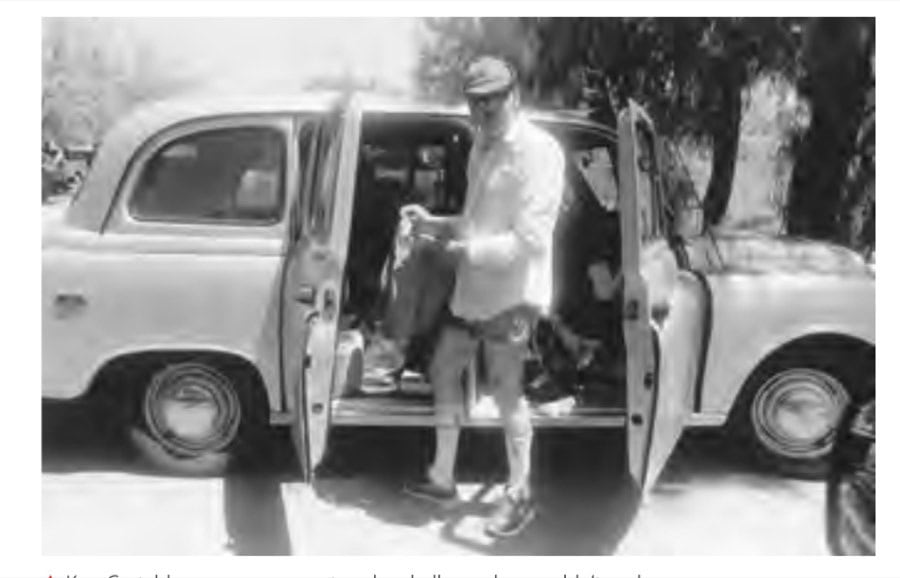
Adams’ partner and the leader of the English contingent is Kenneth Crutchlow, forty-three years old, an expatriate living in Santa Rosa, California. Crutchlow is a businessman who imports medical supplies; he is a self-described adventurer, and is described by others as a self-promoter. He is just over six feet tall and weighs nearly a hundred eighty pounds, fifteen pounds over his ideal running weight. He sports a bushy mustache, has a loose-jointed stance, and this morning he is the only person in Death Valley wearing a business suit. On moving closer to Crutchlow, one finds that the suit is frayed at the cuffs.
In 1974, Crutchlow bet a friend a pint of ale that he could ride a bicycle from San Francisco to Alaska faster than a steamship could make the same trip. He won, and besides his pint of ale, he and his bicycle received free passage back to San Francisco on the steamship. Crutchlow is the man responsible for igniting the competitive passion of ultrarunners for crossing Death Valley. “
I was in New York,” he said earlier this week at a pre-race party at his rented house. “I’d spent the previous seven years hitchhiking around the world, and had been involved in a number of different physical things. In those days, I was quite fit. Many friends of mine were with the Rupert Murdoch group, the News Limited of Australia, and I was always in their New York offices. I remember
▲ Ken Crutchlow never encountered a challenge he wouldn’t embrace.
distinctly being there on Forty-Second Street, at the Daily News building, and text came over the wires saying that a Frenchman had just completed the walk across Death Valley. Being as I’d heard of Death Valley but did not know much about it at all, I said to myself, ‘Obviously he’s a man to be congratulated, being the first to do something.’ And I didn’t think much more about it. But during the same time frame a friend of mine, John Fairfax, was rowing a rowboat from the Canary Islands to Florida. He wanted to be the first to row the Atlantic Ocean. I went down from New York to meet John arriving in Florida. After he arrived, he was telling some silly joke that he couldn’t quite get straight, and he said, ‘Though I walk through the valley of death, I fear no evil, because I’m the biggest son of a bitch in Death Valley.’ He made an error in saying it in that manner. But something about it just triggered something in me, and I said, ‘You could never get across Death Valley, Fairfax,’ and he said, ‘I wouldn’t want to.’ Then he bet me a pint of beer that I couldn’t run across Death Valley. I accepted that bet. At that time, I did not know where Death Valley was. But this seemed like the thing to do. He’d just done his Atlantic row, I was looking for something to do, and Death Valley was there, so I took his challenge. “
What I did was decide to run from Shoshone to Scotty’s Castle. And I decided it should be in July or August, because, obviously, if you do it any other time, you might as well come to Santa Rosa to run it. I can’t recall exactly what year it was. I’ve done it five times, and after a while they all run one into the other. But it was the early nineteen-seventies. In 1973, there were not that many really serious challenges left to do in this part of the world. And a close friend of mine at that time, Paxton Beale, was looking for something to challenge him. I looked on a map and noticed how close the lowest point in the Western Hemisphere was to the highest point in the lower forty-eight states. So we decided to do it in relay fashion. I considered it outrageous to even think that a man could do it solo.”
When Al Arnold read of the feat, he determined to run the same course solo. After abortive attempts in 1974 and 1975, and a hiatus in 1976 to get married, Arnold successfully made the trip solo in 1977. It took him eighty-four hours. Accounts of his accomplishment forever closed the runner’s imagination to the Shoshone-to-Scotty’s-Castle course as the official Death Valley course and elevated the Badwater-to-Mt.-Whitney course to prominence.
In the years that followed, dozens of attempts were made on the course, but the next successful attempt didn’t occur until 1981, when Jay Birmingham of Jacksonville, Florida made it in seventy-five hours and thirty-four minutes. The following year, the New Zealand superrunner Max Telford, who had previously done Crutchlow’s original Shoshone-to-Scotty’s-Castle course and who had previously failed in an attempt on the Badwater-to-Mt.-Whitney course, brought the Death Valley-to-Mt.-Whitney record down to fifty-six hours and thirty-three minutes. In 1983, Greg Morris, of Orange County, California, made a successful
attempt, but it took him seventy-six hours and thirty-eight minutes. Three years later, Tom Crawford and Dr. Michael Witwer, running together, set a new American record of seventy hours and twenty-seven minutes; their ascent of Mt. Whitney was especially grueling and perilous because of an unusually violent series of February snowstorms in California that left the mountain booby-trapped with decaying snowbridges, avalanched trails, and nearly impassable ice shelves.
Crawford and Witwer made their 1986 attempt a mere month after they had tried to put on the first race to be held on the course. All the necessary permits had been received, and twenty-two credible ultrarunners had signed up, but it became impossible to secure insurance to cover the support crews. Witwer and Crawford, well trained to participate in their own event, decided not to let their training go to waste, and ran the course over the July 4th holiday.
While others were making headlines in the sports pages by conquering his course, Crutchlow had gained thirty pounds over his running weight, and had fallen into dire disrepair. Several months after the Crawford and Witwer success in 1986, Witwer had lunch with Crutchlow to compare notes on the experience. At that lunch, a plan was hatched to put together a challenge race: America vs. Britain. In order to build interest, Witwer and Crutchlow concocted the story that Crutchlow had come upon Witwer and Crawford in a local pub and had challenged them to race across Death Valley and up Mt. Whitney for a thousand dollars and
ad
a pint of ale. To rub salt into the wound, Crutchlow claimed he would team up with a woman. Crutchlow next explained the bet to David Bolling, the executive director of an environmental protection organization called Friends of the River and a former newspaper owner and journalist, who had covered Crutchlow’s exploits in the past, and Bolling made arrangements with the Santa Rosa Press Democrat to carry major features on a weekly basis chronicling Crutchlow’s attempts to lose thirty pounds and to get his middle-aged body in shape for the big race. “
Kenneth has not—at least since his early days as a rower—been into serious training,” Bolling said a week before the race. “Kenneth strikes me as someone who, when it comes to physical things, is not terribly disciplined. And getting into training is obviously a very disciplined thing. As Kenneth always says, in his early days he’d get into shape by running. He stayed more or less fit just by doing these crazy things, and one thing prepared him for the next. He didn’t go through any serious training.”
Meanwhile, Crawford and Witwer went into training and waited expectantly to see whom Crutchlow would draft to run with him. Crawford and Witwer were concerned that he might somehow manage to lure someone of the calibre of Eleanor Adams to be his partner. “
There was no question in my mind that those two hotshots were going to beat me,” Crutchlow said. “I never for a moment thought I’d have a chance of running across the finish line in front of either of them. I put an ad in a British paper—the Daily Mail, a big national paper—saying that I was looking for a partner and anyone who wanted to apply should contact me. There was a friend of mine from the Associated Press whom I called when I didn’t get one response—not one solitary reply. I asked my friend at A.P. if she had any ideas of how I could get the word out. She asked someone at the office about my dilemma, and he said that Athletics Weekly was the one British publication that every runner read. So Athletics Weekly put a little blurb in, virtually a one-paragraph thing, and Eleanor Adams was the only runner to respond. This letter arrived, and I didn’t recognize the name, and I called her up and told her I was glad to get her letter, and I said to her, ‘Have you done any long-distance running?’ And she told me that she had forty world records for long-distance running, including the six-day race, and it became clear in no time at all that I was talking to a world-record holder. And I thought, Well, that’s good for my team, isn’t it?”
The rules for racing across Death Valley and up Mt. Whitney have never been difficult. The race must take place in July or August, to insure that the runners suffer the most excruciating heat the Valley can provide. It must start at Badwater and end at Mt. Whitney’s summit. A runner can leave the course for whatever reason, but must mark the spot and resume the contest at that point, and the clock continues to run at all times. For the 1987 America-versus-British race,
the stipulation was also included that the race must begin before noon, so that the runners would spend at least two full daylight sessions in the desert. (Crawford and Witwer began their 1986 run at eight in the evening, thereby spending only one full day of sunlight in the desert.) A further stipulation that Witwer wanted for the race was that both team members must run within half a mile of each other. Crutchlow disagreed. “I’m not going to hold an athlete like Eleanor Adams down to my feeble speed,” he said. Witwer contended that to allow Adams to run free would detract from the fact that the race was a team competition. Eleanor Adams reaching the top first would be the news, and such a scenario would overshadow the American team victory. Crutchlow felt that Witwer’s reluctance to allow each individual to run his or her own race was due to Witwer’s inability to cope with the prospect of being beaten by a woman—and beaten badly at that.
At a meeting in Michael Witwer’s office on July 16th, Witwer withdrew from the race. Crutchlow vowed that he and Eleanor Adams would run the course nonetheless. Crawford spent the next several days thinking about who could be his new partner, and he finally settled on Jean Ennis, who had finished nine minutes behind him at the Western States 100. Ennis had less than ten days to get ready for the race. The Death Valley 300 will continue in the May/June issue.
May/June 2015 M&B Sneak Peek Here are just some of the stories we’re working on for the next issue: • M&B’s medal team presents the best dern finisher medals of 2014. • Peter Harvey thoroughly studies the largest marathons in the world. • Hal Higdon picks the 10 best marathons in the world. • Zoe Romano runs across Texas and meets very interesting folks. • Gary Dudney shares secrets on how to survive the Western States 100. • Devon Kelts takes us to the San Francisco Marathon—twice in one day.
This article originally appeared in Marathon & Beyond, Vol. 19, No. 2 (2015).
← Browse the full M&B ArchiveMore like this
1,000+ stories from 19 years of Marathon & Beyond
The complete archive of the legendary long-distance journal — digitized and free to read.
