

The Death Valley 300
The hottest place on Earth and the highest peak in the Lower 48 within the same California county. What connects them? Summer running. Part 1. by Richard Benyo
Preface: Into the Valley of Death
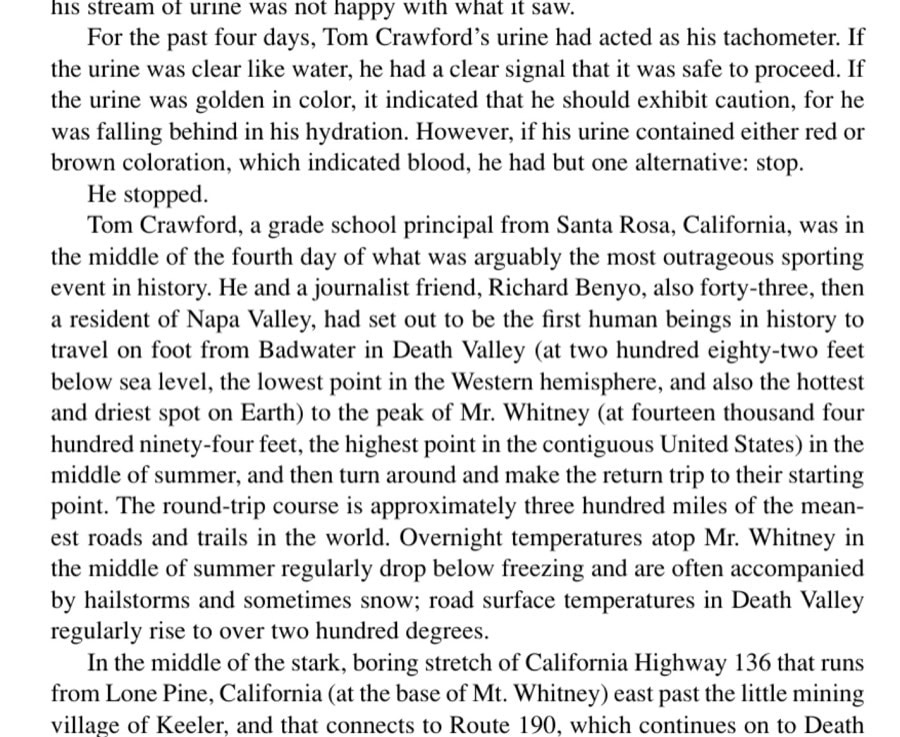
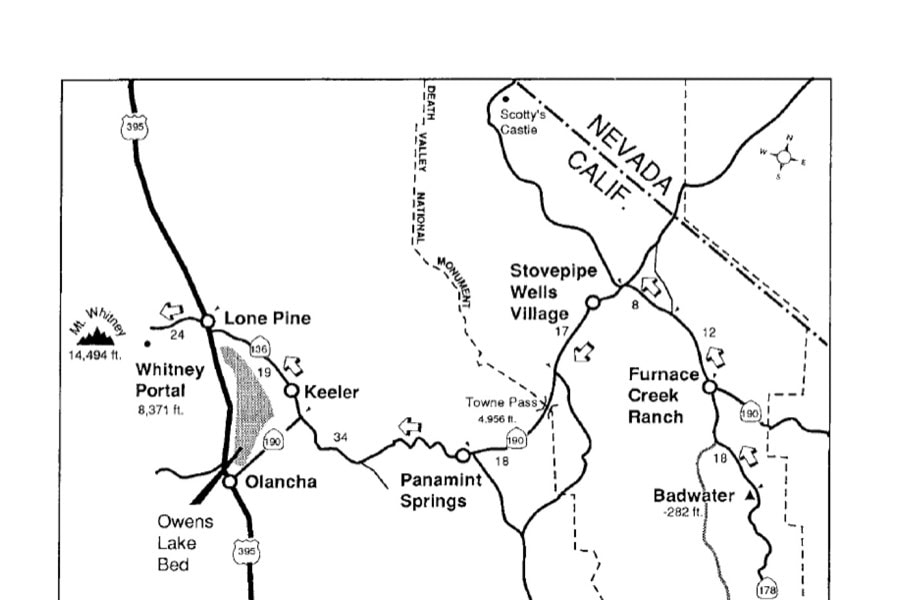
Death Valley has always been fascinating. It was once under water, a wrinkle in the great inland sea. If someone with a lot of money and a lot of time and a lot of steam shovels and trucks began digging the debris out of the bottom of the valley that has washed down over the eons, a trench nearly 10,000 feet deep would be exposed, making it much deeper than the Dead Sea, which is the lowest point on Earth. As it is, Badwater in the middle of Death Valley is the lowest point in the Western Hemisphere, at minus 282 feet.
Death Valley also has the distinction of having recorded the hottest temperature in the shade of any place on Earth; a century ago the temperature at Furnace Creek reached 134 degrees Fahrenheit. About 90 miles as the crow flies from Badwater, Mount Whitney is the tallest peak in the lower 48 states, reaching an altitude of 14,494 feet; it is still growing, thrusting up (in slow motion, of course) about an inch every century.
In the 1960s some runners decided that it would be a swell challenge to run from Badwater to the peak of Mount Whitney: lowest point in the Western Hemisphere (and hottest spot on Earth) to the highest peak in the lower 48, a distance by hot asphalt and then granite trail of nearly 150 miles. Many tried; many failed.
Al Arnold, a tall, rugged health club manager in Walnut Creek, California, became fascinated by the course and made several attempts. He failed in 1974, failed again in 1975, took 1976 off to get married, and then went back to the Death Valley course in 1977 and managed to complete the course, the first runner to ever do so.
Over the next decade there would be many more attempts, many more failures, and a handful of successes. In 1986 Tom Crawford and Mike Witwer, under the sanction of the Santa Rosa-based California Ultrarunners, attempted to put together a race on the course but gave up when faced with absurd requests from potential entrants: “Will there be child care?” “Can I bring my horse?”
Crawford and Witwer had been training to run in the race they were organizing. Faced with canceling the race, they didn’t want to lose all that training so they ran the course themselves and became the fifth and sixth runners to successfully complete it.
The next year would see the course explode, with nine successful attempts, including the first woman (Linda Elam) and, to then, the oldest runner (Richard Kegley). Within that onslaught was a USA versus UK race, Eleanor Adams and Kenneth Crutchlow representing the Brits and Tom Crawford and Jean Ennis representing the USA. Crawford would be the first runner to ever do the course twice.
In spite of the increase in successful attempts on the course, it was assumed that it was beyond human endurance for anyone to run, in the middle of summer, from Badwater to the peak of Mount Whitney and then turn around and run back to Badwater, a distance of nearly 300 miles. But in 1989, on their first attempt, the by-then Death Valley-addicted Tom Crawford and his running partner, Rich Benyo, were successful in running the course out and back, completing the Death Valley Double.
The book that follows, originally published in 1991, relates the history of Inyo County, in which the lowest point and highest point reside, as well as the history of the course as a running challenge, including the story of the 1987 USA versus UK race and the first Death Valley Double, the Death Valley 300.
Introduction: Diminishing Challenges “We didn’t come across the plains, foothills and valleys, climb the mountains, and sail the oceans, because we are made of sugar candy.” —Winston Churchill Every day the size of our world diminishes as science expands its influence. Satellites equipped with laser scanners photograph, map, and monitor every square inch of our Earth. A belt of satellites circling the Earth’s equator in stationary orbits provide a welter of information and communication services to television stations, cable systems, and backyard satellite dishes. Space probes to Mars and beyond send back high-resolution pictures of the surfaces of neighboring planets.
It is more than two decades since man’s first footprint on the moon resolved many of its age-old mysteries, and in the process changed the face of our world more profoundly than Columbus’ first footprint on North American shores changed the face of Europe five hundred years ago.
We studied the voyages of Columbus in grade school. We marveled at Columbus and his crew, brave men in frail boats on uncharted seas taking great risks by plunging headlong into the Unknown—with a capital U. Our class made crude, oversimplified renderings of the Nina, the Pinta, and the Santa Maria. We studied maps and plotted Columbus’ course, awed by the courage and stamina that drove him and his men onward into seas that reputedly dropped off into an abyss filled with monsters. As Catholic grade school students, we were instilled with and inspired by imaginings turbocharged with images of hellish monsters to fill that abyss. We naively simplified the Flat World concept by imagining a large oak table that was the known world, while the edges of the table were the edge of the world, off which Columbus and his crew feared they would drop and perish like an egg rolled off the table.
The following year, we were even more astonished to learn that Vikings may have set foot in The New World five hundred years before Columbus. It was astonishing to us because the Vikings came from farther away, navigated much colder seas, and made the arduous trip in even smaller, more fragile boats than Columbus had. The Viking boats were not much more than long rowboats. One summer, while spending a few days at nearby Lake Harmony in Pennsylvania, I borrowed a rowboat and my brother and I took turns rowing it until we had crossed the lake. We ate our lunch and then turned around and rowed back, nearly exhausted, two goofy little kids who were crushed to learn that they hadn’t rowed quite a mile. “Wow!” was our response. “Those Vikings were some guys!” When the film The Vikings was released in 1958 my brother and I couldn’t go back to the theater often enough to see our new heroes in action. We still figure our quarters made Kirk Douglas the big star he is today.
The element that made what the Vikings and what Columbus did so extraordinary was that they faced the challenge not so much of the physical world, but of the world of the Unknown. They had no idea what dangers they would face, they had no idea exactly where they were going, they were uncertain of the very shape of the Earth. The element of the Unknown loomed immense.
It was that element of the Unknown that for so long made Africa a wonderful setting for adventure and adventure stories. Africa was at that time known as the Dark Continent, implying (correctly) that there was much of it that remained unexplored and unmapped, and it almost certainly contained great elements of unknown dangers to be met and overcome. Edgar Rice Burroughs’ wonderful storytelling talents and the lure of the Dark Continent made the Tarzan books viable even into the early 1960s. Although our schoolroom in high school had a
map of Africa hanging on the wall, much of it appeared to be still unexplored— and therefore a very mysterious and unknown territory. Of course, that doesn’t take into account the fact that our school district was not a wealthy one and was still using maps of Africa that had been issued when Burroughs was developing Tarzan as a character back around the turn of the century.
My other reading staple in grade school and high school besides adventure stories was science fiction. Brave astronauts were regularly landing on unexplored planets and having incredible adventures. Ace paperback books was releasing four science fiction books a month, some of them as double novels, but even that supply wasn’t nearly enough to sate my addiction for adventures into the Unknown.
When the space race commenced, I followed it fervently. It was high adventure, men against the Unknown. I must admit, however, that I did find my interest waning the more science erased the Unknown element from outer space. By the time man stepped onto the moon in 1969, it was almost anti-climactic. The nearly flawless Gemini flights had made it clear that the success of the Apollo flights was almost assured. Even when trouble did hit one of the spacecraft, quick resolutions were forthcoming. And every night on network news shows, we all knew exactly where the space capsule was at all times. There was little that was blatantly Unknown by the time man landed on our moon.
It was the subject of risking your ass at the threshold of the Unknown that, in 1987, fueled some of the high-altitude rantings and ravings of Carl Nolte, a news reporter for the San Francisco Chronicle who had been spending his summer vacations backpacking the Sierra Nevada for a quarter of a century. Carl is a fourth-generation Californian, a bearded, bespectacled, somewhat disheveled fellow who at first meeting appears to have just been thrown out of a bar, and not a very good one at that. When he backpacks he doesn’t take along a tent or an air mattress. He simply throws his sleeping bag down on the ground and sleeps the sleep of the innocent, much like his hero, John Muir.
Carl’s greatest vice is that he reads voraciously and retains much of what he reads. His second greatest vice is that when he hikes to high altitudes, the lack of oxygen apparently causes some chemical changes in his brain cells, because he begins to lecture on whatever subject happens to be spilling out of one of the file cabinets inside his head. On the first day I ever hiked with Carl, I conservatively stayed behind him, and was treated to five hours of nonstop lecture on the Hapsburg Empire. The next day’s lecture centered on Arctic explorers and at one point Carl went off on a tangent. The Arctic explorers had no idea of what they were getting into, they had no support crews monitoring them, and they had no contingency plans if their main plan failed, whereas the astronauts knew where they were going, they were being followed closely, and they had one contingency on top of another. “Redundancy, we’d still be living in caves in Europe!”
To Carl, the age of heroes had long passed. Astronauts were not heroes. Rock stars were certainly not heroes. Politicians? Blah! There were no heroes left. And it was getting damned near impossible to put together a worthwhile challenge filled with sufficient risk for a potential red-blooded hero, he contended, because almost everything was known about everything. At least on the macro-cellular level. Lindbergh, he reasoned, may have been the last true hero. Why? For several reasons. Other air pioneers attempting to fly the Atlantic had died or been lost at sea within the two weeks leading up to Lindbergh’s attempt, so there was obvious risk, very real danger. “And there was no room for redundancy on the Spirit of St. Louis!” Carl claimed. “Redundancy adds weight and there was no room for redundancy on the Spirit of St. Louis!”
A year later, with Carl’s words still ringing inside my head, I found myself considering what some might deem a challenge that contained some element of risk and a bit of the unknown—with a lowercase u.
Recalling Carl’s high-altitude and high-octane speech from 1987, I was reluctant in 1988 to tell Carl Nolte that I would be honored to have him come onboard as part of my mountain support crew in a little . . . er . . . adventure . . . er . . . challenge I was cooking up for 1989. I was afraid that since the challenge I’d become involved in was to be done on well-mapped and well-worn roads and trails, Carl might find it unworthy and, finding it unworthy, might begin to lecture me on soybean production or on American cities that begin with the letter Q. Fortunately, I picked a day when we were not at a high altitude to explain my plan.
The week following our 1987 backpacking trip in the eastern Sierra with Carl and his brother Frank and local hot-shot runner Mike Duncan, I had gone to Death Valley to cover a race between a British and an American team (one male and one female on each team) from Badwater in Death Valley to the summit of Mt. Whitney. The course was approximately one hundred fifty miles long and went from the lowest point in the Western Hemisphere (two hundred eighty-two feet below sea level) and the hottest and driest place in the world (one hundred thirty-four degrees in 1913 and one-point-five inches of rain per year on average) to the highest peak in the contiguous United States (fourteen thousand four hundred ninety-four feet).
The race had been, to use an overworked word, awesome. It had not been the first time I’d heard of the course. In 1977, while I was managing editor of Runner’s World magazine, a fellow named Al Arnold came to visit. He told a rather incredible story of how, after two failed attempts (1974 and 1975), he’d become the first person in the world to run solo from Badwater to Mt. Whitney. It took him eighty-four hours. We carried his story in a new quarterly magazine we were publishing, The Marathoner. Some years later, I did a story for the San Francisco Chronicle on two Santa Rosa runners who, in 1986, became the fifth and sixth people in history to do the same course.
I’d never been to Death Valley and like most people I assumed that the course from the lowest point in the Western Hemisphere to the highest point in the lower forty-eight states sort of ran along at sea level for a long time and then shot up the side of Whitney. In 1987 I discovered otherwise. But more of that later.
The 1987 race between the British team of Kenneth Crutchlow and Eleanor Adams and the American team of Tom Crawford and Jean Ennis was both awesome and inspiring. I wrote several stories on the race and coincidentally was at a picnic at Tom Crawford’s home on the one-year anniversary of their 1987 race. The reminiscences that night increased, the beer flowed freely, and the talk turned tough. We recalled how Crawford had said that someday he wanted to be the first man to do the course out and back. To that point in time, no human being had even been brave enough or foolish enough to try. Reinforced by beer and looking for some challenge to prove to ourselves that being in our forties didn’t mean “middle-aged” the way it had meant “middle-aged” in our parents’ time (Crawford had been born in March of 1946, I’d been born in April), we concocted a plan. And, to make it interesting, we couched it in a challenge.
The 1987 race between the British team and the American team had been concocted by Kenneth Crutchlow in the wake of Crawford and Mike Witwer’s successful 1986 attempt on the course. We now concocted a challenge that Crawford would deliver to Crutchlow to meet back on the course in 1989, where we would field two teams of three athletes each: a male runner, a female runner, and a walker of either sex, each athlete to do the entire course out and back, the lowest total time being the winner, the loser buying pizza and beer for the winning team at the Pizza Factory in Lone Pine at the foot of Mt. Whitney.
Phone calls were made back and forth to arrange everything. The British team would consist of Kenneth Crutchlow, Eleanor Adams, and David Bolling, a journalist and executive director of Friends of the River, who’d accompanied Crutchlow on the course in 1987. Our team would consist of Crawford, Jean Ennis, and myself.
During a Santa Rosa radio talk show on which Crutchlow was the guest, Crawford called in and challenged him to the first-ever out-and-back race on the Death Valley-to-Mt. Whitney course at 6 a.m. on July 17, 1989. Crutchlow accepted.
What follows is the story of that challenge race—and of that unique course and region in southeastern California where the unknown is all too common. Now it is true that there are maps of the course—plenty of them. But as we were to learn the hard way, none of the maps in existence point out the peaks and valleys in the performance of a human body made to jog, walk, or stumble over some of the meanest roads and trails on Earth. That aspect of the course, at least, was very much Unknown.
Considering the radical topographical and meteorological conditions we would have to face and the fact that nobody had ever done an out-and-back attempt, Carl
Nolte acknowledged that the challenge was a worthy one, there was an element of risk (especially since it was well known that I did not function well in heat or at altitude, the two primary elements of the course) and that we could count on him to be part of the mountain crew. “But I’m not carrying two of anything up that mountain, except my two arms and legs,” he said. “No redundancy on this trip!” “I guarantee,” I told Carl, “there will be no redundancy.” Man, was I naïve! By the end of the week in July 1989 the word “redundancy” would take on new meaning. —Richard Benyo Forestville, Calif. 15 June 1991
▲ Tom Crawford and Jean Ennis motor uphill out of sea-level Stovepipe Wells in the middle of the 1987 USA versus the UK race. They’re approaching the 2,000-foot level.
Chapter 1: Fire & Ice “What they had done, what they had seen, heard, felt, feared—the places, the sounds, the colors, the heat, the cold, the darkness, the emptiness, the bleakness, the beauty. ’Til they died, this stream of memory would set them apart, if imperceptibly to anyone but themselves, from everyone else. For they had crossed the mountains.”—Bernard DeVote Tom Crawford stood beside the road, urinating. For a forty-three-year-old mustachioed man who stood six feet two inches tall, he seemed to exhibit an unnatural curiosity about the process of pissing in public. And the critical eye he cast upon his stream of urine was not happy with what it saw. For the past four days, Tom Crawford’s urine had acted as his tachometer. If the urine was clear like water, he had a clear signal that it was safe to proceed. If the urine was golden in color, it indicated that he should exhibit caution, for he was falling behind in his hydration. However, if his urine contained either red or brown coloration, which indicated blood, he had but one alternative: stop. He stopped. Tom Crawford, a grade school principal from Santa Rosa, California, was in the middle of the fourth day of what was arguably the most outrageous sporting event in history. He and a journalist friend,
Richard Benyo, also forty-three, then a resident of Napa Valley, had set out to be the first human beings in history to travel on foot from Badwater in Death Valley (at two hundred eighty-two feet below sea level, the lowest point in the Western hemisphere, and also the hottest and driest spot on Earth) to the peak of Mr. Whitney (at fourteen thousand four hundred ninety-four feet, the highest point in the contiguous United States) in the middle of summer, and then turn around and make the return trip to their starting point. The round-trip course is approximately three hundred miles of the meanest roads and trails in the world. Overnight temperatures atop Mr. Whitney in the middle of summer regularly drop below freezing and are often accompanied by hailstorms and sometimes snow; road surface temperatures in Death Valley regularly rise to over two hundred degrees.
In the middle of the stark, boring stretch of California Highway 136 that runs from Lone Pine, California (at the base of Mt. Whitney) east past the little mining village of Keeler, and that connects to Route 190, which continues on to Death Valley, Tom Crawford knew he was in big trouble.
Although he was enjoying the benefits of some cloud cover that blunted the radiant heat of the desert’s unremitting sun, and although he had only about one hundred eight miles of the course left to complete, he was falling apart, coming unraveled, the previous three days of effort demanding their eventual toll.
Early this morning, Tom Crawford had left Whitney Portal, at eighty-three hundred feet up the side of Mt. Whitney, the last point to which a car can be driven
before it becomes necessary to proceed on foot. He had run the thirteen downhill miles into Lone Pine at a vigorous pace, the severe downhill taking its toll on his thighs. From Lone Pine, he had run hard along the relatively level, boring road from Lone Pine to Keeler. He had taken fluids regularly but had sweated profusely. The perspiration had dried almost instantly due to the extremely low desert humidity, one hundred ten degree temperatures, and a buffeting, relentless wind that had accompanied him all day, further wicking away body fluids. What he had not been doing, however, was urinating. The fluids he took in were quickly processed through his body and sweated out to accommodate his running efforts. But now he had pushed too hard for too long. He had stopped sweating. He was slightly nauseated. His skin was forming gooseflesh. His concentration was splintering. He felt on the verge of collapse. When he looked at himself in the side mirror of his support vehicle, his pupils appeared to be dilated. And now, because the walls of his deflated bladder were being bruised, he was pissing blood.
His body was breaking down rapidly, his kidneys threatening to shut down. Carol Cognata, one of the support crew members who was leapfrogging the course in her Honda Civic station wagon in order to provide Tom Crawford with fluids, food, a change of socks, a change of clothing, etc., had been concerned with her charge’s condition for many miles. This was her first experience with being a support crew member and besides wanting to do everything right, she wanted to make Tom Crawford as comfortable as possible during her six-hour shift. Carol Cognata was a teacher at Tom Crawford’s school and, upon hearing of his proposed summer challenge, she had been moved to offer her assistance. She was beginning to question the wisdom of that decision.
She was concerned at the amount of time Tom was taking to begin to urinate on the side of the road. “Are you all right, Tom?” she asked. “I don’t know,” Tom said. “No. I dunno. No, I’d better stop here for a while.” Carol noted that Tom seemed on the verge of tears. “
Here” was roughly a mile east of the town of Keeler, a stone’s throw from the historic Keeler cemetery. “This seems like as good a place as any. If things go from bad to worse, you can just bury me here.”
Carol pulled a folding chair out of her car, unfolded it against the wind, and sat it beside the road, on the other side of the car from the direction of the wind, hoping to offer Tom some shelter against the maddening wind. Tom lowered himself carefully but awkwardly into the chair. A moan escaped his lips. He rested his elbow on the arm of the chair and lowered his face into his hand. He wept quietly. I can’t go on, he said to himself. I’m done, I’m finished. He moaned again and half-choked on a sob. He let the tears come, too weak to fight them. Carol looked up, saw Tom’s misery, and moved around to the opposite side of the car, wanting to comfort him, but intuiting that he needed to be alone for a few minutes. Five minutes later, Tom was quiet, seemingly back in control. “Get me
plenty of Exceed,” Tom Crawford said. Exceed is a carbohydrate replacement drink commonly used by endurance athletes. “I’m gonna have to stay here until my piss clears,” he said, shaking his head back and forth in resignation to the need for temporary inertia. His next request was a rather bizarre one: “Pull out all the saltine crackers you can find and scrape off the salt and give it to me.” Carol began methodically to scrape salt from the surface of a boxful of saltines and catch the salt in an envelope. Tom periodically wet a finger and stuck it into the envelope, eating the raw salt.
Tom had been the fifth man in history to do the one-way Death Valley-to-Mt. Whitney course in 1986; in 1987 he’d become the first human being to ever do the one-way course twice; yesterday, under ideal conditions, he’d ascended Mt. Whitney to become the first person in history to do the one-way course three times. Each time Tom Crawford had done the one-way course, he had lowered his time. His total time from Death Valley to Mt. Whitney’s summit this time had been fifty-five hours and eight minutes. His experience on the course gave him a unique and very realistic idea of what he had to do to survive this day relatively intact. The fact that within the past decade he’d also successfully done fifty-four other ultramarathon events (including three Western State 100s) only added to his knowledge of his own body’s limitations. He knew that by taking care of his body now, he’d be better off tomorrow and the following day. He felt that the blood in his urine was caused by having bruised his bladder and his kidneys from a combination of inadequate fluids over the past few hours and a deteriorating running
style that had increasingly sent impact shocks through his entire body, including his bladder and kidneys, thereby bruising them. He didn’t want to contemplate the possibility that he was on the verge of renal shutdown.
Settled comfortably into the chair and resolved to stay there drinking fluids until his urine cleared, Tom ran the back of his hand over his eyes to clear away the accumulated road grit, long-dried perspiration, and drying tears. Facing in the direction from which he’d just come, it was then that he saw the mountain he’d climbed yesterday, where he’d been greeted by such sunshine that he’d gotten a sunburn. “Carol!” he said.
Rummaging around in the back of her car in an attempt to straighten out her supplies and possibly locate more sources of salt, Carol thought something had happened to Tom. She turned around, startled. “What?” “
Look!” He was pointing toward Mt. Whitney. As she turned to look, they heard the rumblings of lightning striking far away. The top of the mountain had vanished, consumed by a huge black mass that was broiling madly, and through which jagged lightning bolts sawed their way, sending the sound of their anger over the twenty-five miles of desert that separated Tom from the turn-around point on the course. As they watched, the storm grew like a dark amoeba on steroids. It flexed itself, grew again, more lightning bolts highlighting it, until gradually the storm obscured the entire mountain. The wind, which had buffeted Tom from behind all morning, began howling, blowing sand into his face, startling him.
Tom glanced at his watch. It was nearly 2:00 p.m. “I sure hope Rich and his crew are off the mountain by now,” Carol said, at once held enthralled and appalled by the spectacle playing itself out in front of her. In the space of fifteen minutes the dark weather front had obliterated the entire Sierra Nevada range.
Recovered enough to do basic calculations based upon information he had from having met Rich Benyo walking up toward the Portal last night while he was riding down toward a well-deserved rest in Lone Pine after having conquered the mountain, Tom shook his head sadly. “I’m afraid he’s right in the middle of it. He planned to leave the Portal at 5:30 this morning. By now he’s right in the middle of it, with either a mile or so to go to reach the top, or he’s struggling through that rain and lightning about a mile from the summit on his way down. Either way, he’s in the middle of it.”
Tom continued to shake his head, helpless to help himself much less help his running partner stuck in the middle of that mess. “Jesus!” Tom Crawford muttered to himself. “Jesus!” “I hope he’s all right,” Carol repeated. “
I can’t believe this course,” Tom finally said. “Both Rich and I are having what are probably the low points of this race at the same time, but he’s on the mountain and I’m in the desert, he’s up high, I’m down low, he’s freezing and I’m burning up. Jesus! I hope he’s all right.”
ad
Perhaps the distinction of being the highest peak in the contiguous United States is enough. God knows, Mt. Whitney doesn’t offer much else. Compared to the Sierra peaks that surround it, Mt. Whitney is dog ugly. Instead of forming a peak the way a classic mountain does, Mt. Whitney just sort of slopes from the west like a hunchback bending over, and then drops off precipitously on the front (eastern) side. The non-mountain goat approach to the summit is to proceed from Trail Camp (at twelve thousand feet, the last place a tent can easily be pitched) up a series of nearly one hundred tight switchbacks fashioned into the rocky side of the mountain until Trail Crest (thirteen thousand seven hundred seventy-seven feet) is reached, at which point the trail to the summit whips behind a series of spires that separates Trail Crest from Whitney Summit. The trail along the western edge of the spires (and “edge” is the accurate word) rises and falls until it passes the last two-thousand-foot chute that marks the northernmost of the spires, and then the trail lazily switchbacks among talus rock for two miles until it eventually peters out at the top, which is marked by a clutter of larger talus at the northeastern edge and a stone survival hut with a metal chimney and roof just southwest of the surveyed peak. The chimney, technically, constitutes the highest piece of architecture in the lower forty-eight states. In front of the hut, there is a stone pedestal with a metal lid. Inside is a large book on which those who have ascended the peak can write their name and the date, and those who want to leave messages on slips of paper for friends who are expected later can do so.
Most people who hike to the summit of Whitney do so after hiking to one of the camping areas below the previous day. A local ranger estimates that only one out of every two hundred people at the summit has hiked from Whitney Portal (at eighty-three hundred feet) and will descend back to the Portal that same day.
One advantage of going to Whitney Summit (besides the fact that you can say you were at the highest place in the lower forty-eight states) is that on one of those rare summer days when the sky is clear, you can see for hundreds of miles. There is literally nothing to obstruct the view.
Most summer days, however, afternoons at Whitney’s summit are marked by hailstorms or rainstorms coming in from the west. A good barometer of the kind of weather you are likely to have at the peak comes merely from looking up at the sky from a lower elevation. If you are leaving Whitney Portal at 8 a.m. and hoping to make the summit and get back down in one day and the skies above are clear blue, you won’t be able to blame a failure to accomplish your goal on the weather. However, if at 8 a.m. you look up and there are already puffs of white clouds forming high above, you can expect storms by late afternoon and you’ll wish to regulate your rate of climb and your descent accordingly.
When the sun came up at 5:30 a.m. on July 20, there were already substantial clouds high above us. Mike Duncan, a San Mateo, California, distance runner and backpacker, and the leader of my mountain crew, tried to divert my attention and that of my medical director, Rhonda Provost, from the gathering clouds.
© Rhonda Provost
▲ Rich Benyo and his mountain crew are above the tree line and into the granite on their plodding way to the peak of Mt. Whitney during the 1989 out-and-back.
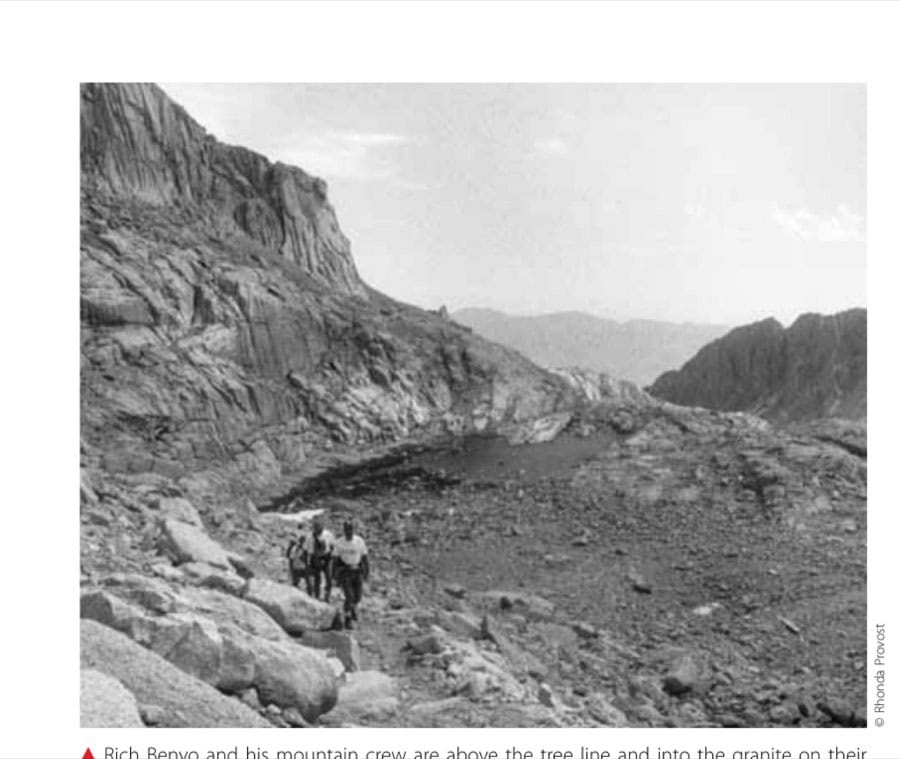
We had six miles to go to Trail Camp, where Carl and Frank Nolte, the remainder of my mountain crew, had gone the day before to pitch a tent. At that point we would rest, eat some chicken soup high in much-needed sodium, and then proceed the remaining five miles to the summit, where we would sign in and take a photo or two and then turn around and get back down the mountain—quickly. I hoped to be back to the Portal before dark so that I could have my feet treated. (My feet sported a variety of blisters and the great toes on both feet were swollen and sore from going down a steep mountain road two days before.) The plan called for me to then descend the thirteen miles into Lone Pine, at which point I would sleep in a real bed in a motel room until morning’s light. Because of my well-known malfunction at high altitude, my mountain crew,
Rhonda Provost, and I had traveled to Lone Pine three weeks before to make a practice ascent. I had never functioned well above twelve thousand five hundred feet. True to form, I did not function well above twelve thousand five hundred feet on that day. From that point to the top I walked as though intoxicated, unable to coordinate any movement without taking an inordinately long time to think
about it. Which was fine by me, since I was also unable to move quickly to start with, thanks to the thin air. We managed to walk from the Portal to the summit and back down in twelve and one-half hours. I looked at it as a victory: I had not only pushed myself beyond twelve thousand five hundred feet, I’d actually made fourteen thousand four hundred ninety-four feet and, since I’m six feet tall and I’d briefly stood at the very top of the mountain, I figured that the top of my head brushed fourteen thousand five hundred feet. My major concern was that I’d done that ascent on fairly good rest, and even then it hadn’t gone all that well. As we reached Trail Camp this time, I had three hard days and one hundred forty-five hard miles already on my body.
My strategy was a mite different during this ascent, however. I was continuing to drink my mixture of Exceed and Shaklee Performance carbohydrate replacement drink and I had done the ascent once before and therefore knew that I could do it, even though it might not be a pretty sight and might take an inordinately long time to complete.
I passed through twelve thousand five hundred feet just fine, and in fact still felt terrific as my mountain crew and I posed for a photo at Trail Crest. We then proceeded around the back of the spires and I still felt much better about my ascent than I’d expected to. We consciously ignored the gathering dark clouds overhead.
With two miles to go to the summit, Rhonda, who usually performs well at altitude, began experiencing several of the signs of altitude sickness: severe headache and nausea. She wisely decided to descend to Trail Camp and wait for us near the tent.
The four of us proceeded to the summit without a problem. I was ecstatic at reaching the summit successfully, in the process reaching one of my goals, bettering Al Arnold’s 1977 initial solo time of eighty-four hours, and proceeded to sign in. As I was laboriously writing my name and time (seventy-nine hours, twenty-three minutes) in the book, three male Canadian hikers who had been checking out the inside of the emergency hut came rushing out saying something about hissing and took off down the mountain. We laughed at them, certain they were suffering from some new form of altitude dementia. We continued laughing as we took some humorous summit photos in front of the hut, until Mike Duncan, who’d gone inside to see what the feigned fright was all about came out and told us to check it out. I stuck my head in the door and immediately realized that what the Canadians had picked up on was not a laughing matter.
The hut has a metal chimney and inside the hut, the chimney was hissing and humming. I stuck my head outside the hut and looked at the sky. It was decidedly darker than it had been ten minutes before. I stuck my head back inside the hut, where the hissing sound coming from the chimney was increasing. Mike and I looked at each other and didn’t need to say a word. The metal chimney was working up the right vibrations to act as a lightning rod for the incoming storm. The
static electricity in the clouds had already begun sending signals to the chimney that it knew of its existence as the highest point in the lower forty-eight states and that it would accommodate it as a “ground” at any moment.
Mike vaulted across the huge rocks to Carl and Frank, who were looking over the edge of the cliff into the open expanses down toward Trail Camp. I followed painfully behind, the big toes on both feet sore, tender, and painful. “Let’s get the hell out of here!” Mike yelled against the increasing wind. “This place is going to light up any minute and we’re like sitting ducks.”
Sitting ducks, indeed. There was literally nothing for the coming storm to use as lightning rods but the hut’s chimney—and us. Just as we turned toward the south, our route to escape, a bolt of lightning hit. Incredibly, it hit fifteen hundred feet below us and a few hundred yards to the south: between us and safety! It appeared that, as the summit had become more wreathed in the oncoming storm cloud, we had remained semi-safe. The body of the storm was going to occur below us, between us and Trail Camp. And we had no choice but to descend into it and hope to come out through it to safety. What followed was a nightmare. [
Ironically, on the afternoon of July 14, 1990, six days short of a year since the foregoing occurred, another lightning storm struck the peak of Mt. Whitney. Several groups of hikers at the summit converged on the stone hut and a total of
ad
thirteen hikers took shelter inside. A bolt of lightning struck the hut soon after, killing Matthew Nordbrock, twenty-six, of Orange, California, and injuring the remaining dozen hikers. Farther down the mountain, two other hikers were injured when another bolt of lightning struck near them.]
Tom Crawford slumped in his folding chair along Route 136. He attempted to clear his mind well enough to monitor his vital signs while also following the storm that had by now completely obscured the upper half of Mt. Whitney. He drank Exceed to increase his store of body fluids and to replenish important trace minerals he’d used up on his mad rush from Whitney Portal to exhaustion just beyond Keeler; he occasionally drank a ten-ounce bottle of Calistoga Mineral Water, which, besides containing naturally-occurring trace minerals, clears the stomach of annoying gas by encouraging belching; and he continued to lick the salt Carol Cognata had scraped from the saltines. Carol also sliced up a small watermelon she had with her and Tom greedily ate pieces of that. It tasted better than anything else he was ingesting, perhaps in part because it contained some fiber. He had leaned over the side of the folding chair at one point and retched out a slimy combination of Exceed and stomach acid that had burned his throat. “God, I feel terrible,” he muttered to himself.
He would later admit that at the moment he was vomiting the vile mixture from his stomach, he was prepared to admit defeat, to call it quits. “It seemed impossible that I would be able to get started again,” he said. “It was as though my body had revolted against the whole idea of this crazy thing, that it had had enough. And I was inclined to agree with it.”
But gradually, a little at a time, Crawford began to feel better. Well, if not better, at least less wasted. At one point he got the urge to urinate, and when he did, the few meager ounces of pee he managed to expel were not as red-tinged as they’d been when he’d crashed. He didn’t feel good, but he didn’t feel as badly as he had when he’d originally crashed and fallen into the folding chair, exhausted and sick. “Poor Carol,” he would say later. “She’d never seen an ultra run before. She didn’t know what to do. She thought I was going to die—and I felt so badly that I was hoping I would.”
When his stomach settled enough to take it, he began to drink Calistoga Mineral Water juices in an attempt to bring up his body’s sugar content. Lack of sugar during an endurance event can cause major mood swings as the body’s supply of sugar is diverted to the working muscles and away from the brain, which needs sugar to function properly. “After a few juices, my head began to feel better, but I knew that those juices were going to have another effect on me,” he said. Concentrated doses of sugar taken under these conditions typically bring on diarrhea. “Fortunately, Nancy [Tom’s wife and an ultra runner herself] came on duty about that time so Carol didn’t have to go through that experience. I had diarrhea a few
© Mike Duncan
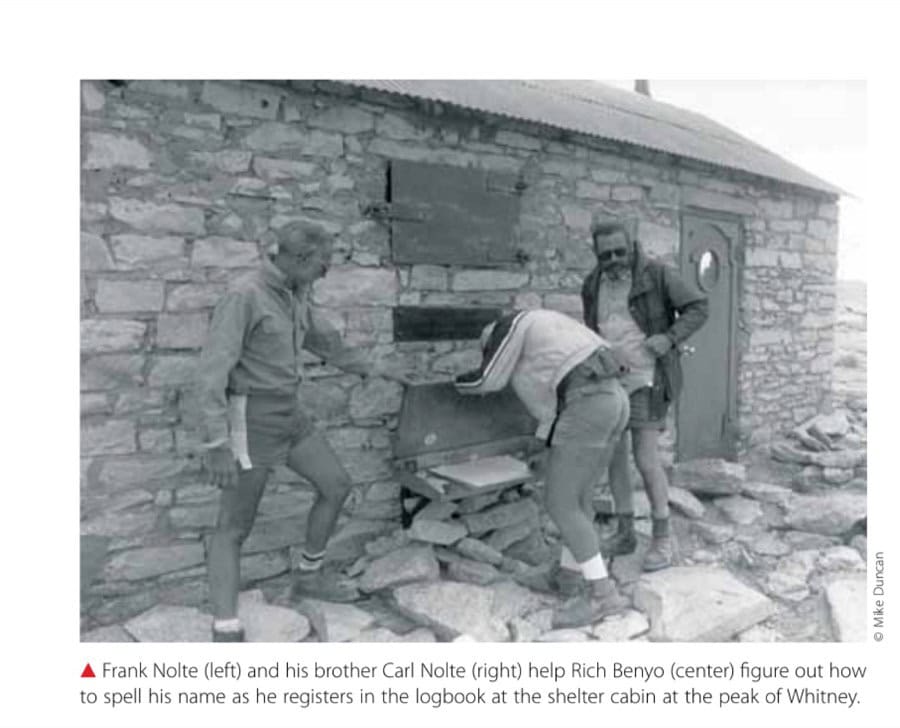
▲ Frank Nolte (left) and his brother Carl Nolte (right) help Rich Benyo (center) figure out how to spell his name as he registers in the logbook at the shelter cabin at the peak of Whitney.
times. I had to have Nancy help me get up out of the chair so I could squat down behind a sagebrush and get it over with.” Gradually, though, Tom Crawford began to pull things back together. His stomach settled, his diarrhea subsided, and he began to feel almost human again. After sitting for seventy-five minutes, he crawled out of the chair and had Nancy drive three-quarters of a mile up the road and wait for him. “I couldn’t bear to face the prospect of going a whole mile in that weakened condition,” he said. He was also concerned that he might collapse when he attempted to walk and he therefore didn’t want Nancy to get out of sight. She dutifully drove three-quarters of a mile and set up the next pit stop, turning the truck to shield the folding chair from the relentless wind. “Actually,” she later admitted, “I only drove up six-tenths of a mile. I was afraid he’d get too discouraged if he couldn’t make it the whole way.”
Tom Crawford hobbled what he thought was three-quarters of a mile and weakly collapsed into the folding chair, again sipping Exceed and Calistoga waters and juices. When he urinated now, he was relieved to find that it was no longer tinged with red or pink. He stayed in the chair looking for forty-five minutes in the direction of where he knew Mt. Whitney should be before he again tried to move.
This time he walked a half-mile and then sat down again for thirty minutes, constantly rehydrating. “I had committed the unpardonable sin coming down from
the Portal. I outran my body’s ability to process fluid. I was drinking regularly, but my body was processing everything I was drinking as perspiration to keep up with the working muscles. There wasn’t enough left over to send any fluid through the kidneys, a very dangerous situation. I got lulled into a complacency, I guess, because I felt good running and the wind that was whipping around me was a dry wind and was drying the perspiration as soon as it hit the surface of my skin, so I didn’t notice just how behind I was getting.”
During his bottoming-out period, it would take him seven and a half hours to travel six miles. “It was the worst I’ve ever felt in an ultra run,” he admitted. “And each time I sat down to rest, with the chair pointed back toward Mt. Whitney, I thought about Rich, and I said to myself, ‘No matter how bad I feel right now, I know I’m not the only one.’ I told Nancy that no matter how bad I felt, I’d much prefer to be here feeling like this and having my crew right here than to be up on that evil mountain during this kind of storm.”
From my first step off the summit I knew my progress was going to be agonizingly slow. Although I normally wear a size ten and one-half shoes, I was wearing hiking boots that were size twelve in recognition of the fact that during such an extended endurance event one’s feet swell several sizes. But even size twelve was not sufficient to provide enough toe-box space to accommodate my swollen toes that, with each downhill step, were sliding far enough forward to jam against the front of the shoes. Each step was an agony, but I took each step willingly if gingerly in order to get to Trail Camp and away from this storm as quickly and expediently as possible.
The four of us were strung out along the rocky, meandering switchbacks coming off the summit. Mike Duncan, clad in a light turtleneck and a windbreaker, was in the lead; Frank Nolte, more suitably dressed in a heavy parka, was next; Carl Nolte, dressed in an all-weather hiking coat, came third, and I brought up the rear, clad in a ski parka. The lightning bolts continued to assault the mountains around us, with an occasional bolt blasting so close to us that there was virtually no pause between the blinding flash and the crack of the accompanying thunder. I wanted to look up to see the lightning at the same time I was forced to keep my eyes on the rocky trail. Such is man’s perversity. We pushed ahead, each step for me a compromise between the bashing of my sore toes and the image of a burnt and charred skeleton wearing a ski parka and hiking shorts. We hadn’t gotten a quarter of a mile before the hail came. It was the size of buckshot or small ball bearings and we quickly found ourselves covering our ears with our hands to protect them from the stinging impact. The wind had whipped up to a furious anger and would regularly change the angle of attack of the steadily increasing hail. I attempted to take note of where I placed each step, looking for small portions of the trail that did not point downhill quite so prominently so that my feet wouldn’t
slide forward so radically, but the trail was so steep that it was nearly impossible to find any neutral or level segments. By watching my steps, I fell farther behind the others and began to note that the temperature had dropped so low that the hail that was falling was not melting. The ball bearing sized-hail was literally turning into ball bearings along the trail, making the footing doubly treacherous. I tried to step on small rises in the trail where the hail had not accumulated; that merely caused my toes to take more of a bashing.
When the trail reached the spires of rock around the back of which we’d travel to reach Trail Crest, I felt momentarily safer. We were no longer the tallest structures on the horizon, ready lightning rods. The flashes of lightning now seemed predominantly to the north of us and to the east, around the other side of the spires, down toward Trail Camp, our supposed refuge.
We were astonished to still encounter some hikers who seemed determined to reach the summit, in spite of the storm. Several of them blithely passed us, bundled up in warm coats and setting a course for the summit. We attempted to tell them how dangerous it was up there, but they seemed uninterested in our reports. I remember vaguely thinking that once they left the relative protection of the spires, the storm itself might make a better argument.
We had nearly reached Trail Crest when a tall, young Scotsman who was attempting to reach the summit asked if any of us was Richard. I volunteered that at least what was left of me was. He pulled two plastic rain ponchos, one yellow and one copper-colored, from his knapsack and said that Rhonda had sent them up from Trail Camp, asking him to continue asking for me until he found us. When Rhonda had left us due to altitude sickness, we had forgotten to take her knapsack, which contained our emergency clothes. We thanked the young fellow, made our by now canned speech about how dangerous it was up top, and Carl Nolte proceeded to stash the ponchos in his knapsack. It was so cold on the western side of the spire that the hail was not melting, and we felt we would be all right without the ponchos for the time being.
When we finally reached Trail Crest, however, the point that straddles the ridge, we found that the storm on the eastern side of the mountains was of a different consistency than the relatively mild assault of cold hail we’d been struggling through. We had to make our observations while on the move, though, because we wanted desperately to get off the damned mountain, our goal was nearly eighteen hundred feet below us, and we were becoming increasingly cold. Considering that I’d be spending six days under desert conditions and only one day on the mountain, I’d trained my body to handle the desert heat. Consequently, as I taught my body to tolerate temperatures over one hundred twenty degrees, my tolerance for cold diminished. As we made our way along the trails on top and approached what seemed like unending switchbacks, glances to the valley below gave us several facts very quickly: much more lightning struck on this side of
the spires, the winds swirled through the bowl of the valley below us, making it difficult to lean against it without being outflanked, and the hail was no longer cold enough to remain hail—it was a raw, miserable hard sleet that whipped down our necks, instantly soaked our parkas, and made the trail a water slide. The trail, which switchbacked interminably down this side of the mountain, had become a small stream, accommodating the downward flow of the melting sleet. Each step we took was a step into a flowing creek of cold water. Our shoes, which had remained dry on the western side of the spires, now instantly soaked through. The only positive aspect of this was that the chilled water partially anesthetized my swollen toes, thereby dulling the pain. Unfortunately, this advantage was offset by the fact that the trail was slick, rocky, and didn’t have a straight segment more than fifty feet long between here and Trail Camp.
Mike Duncan had sped up, now that he was soaked through and through. The most experienced mountaineer among us, he had unfortunately failed to pack against such obscene conditions. His low body fat coupled with the freezing temperatures caused his body temperature to drop quickly so he accelerated his pace correspondingly in order to attempt to generate body heat and escape the worst of the storm’s assault. Frank Nolte also picked up his pace, leaving Carl and me to bring up the rear. Carl dropped behind me to make certain I would be all right. As my problems multiplied, my pace deteriorated. My toes, although partially numb, throbbed with pain on each uncertain step I took. The lightning flashed around us and the wind whipped the cold rain at us from every conceivable direction. My ski parka was soaked through and I began to shiver convulsively. My shoes refilled with water at each step. I looked over the side at Trail Camp down below, and it never seemed to get any closer.
As the rain continued and in fact increased, the trail became increasingly treacherous and I deteriorated more, slowing perceptibly with each step. Carl patiently followed right behind me. Every step I now took was a project in itself. On several occasions I lost my footing and banged into rocks. Carl kept muttering assurances. I began to hear a low moaning that I thought was the wind but I eventually realized that it was coming from my own mouth as my toes got more bashed up with each step. I had been attempting to distance my conscious self from the pain, hoping that I could manage it better that way, but the fact that I was weakening in general was lowering my guard against the pain and it was again intruding. I was not looking forward to the moment when we would take the tape off my toes. I imagined that my toes were swollen and oozing pus and picking up all kinds of germs as the rainwater washed marmot stool down the path into which I was stepping.
At one point, well over halfway down the switchbacks, and moving hardly at all, my teeth chattering and my outlook on the chances of surviving rather bleak, I remembered that Rhonda had sent up the ponchos. I stopped and turned
to Carl. “We’ve got the ponchos in your knapsack,” I yelled above the storm noise. “Let’s put them on. They won’t get us dry, but they’ll prevent us from getting any wetter and maybe hold in some body heat.” Carl pulled them out of his knapsack and the wind whipped them around. I thought of the surface weather in the film Alien. We struggled to help each other to get them on over our parkas. They seemed too small, but we forced them on. I found that mine came without arm holes and when we put Carl’s on, we initially put it on backward so that his head was encased in the hood. We finally had them on as best we could and we proceeded downhill, as miserable as ever but working to convince ourselves that we felt much better. But Trail Camp, which we could see through the rainfall, did not seem to be getting closer.
I increasingly found it a project to make the turns at the end of switchbacks and on several more occasions slipped on slick rocks, banging my right leg against the always convenient rocks. I decided that since Trail Camp appeared to be getting no closer, I should concentrate on looking down at the trail, which I did. I didn’t go any faster, but it took the enticing idea of a dry tent out of my head for a while. My hands had gone numb and I attempted, under the protection of the poncho, to slide them inside my parka to warm them with some body heat. Either there was not enough body heat or my hands were too cold; they didn’t seem to want to un-numb.
At some point the trail began to open a bit and began to ease its downward angle. I looked up and found we were nearly at Trail Camp, although we still had about a half-mile to go to reach our tent. I pushed on, able now to pick up a little speed since I no longer had to negotiate turns.
Carl directed us to the tent. I was shivering uncontrollably. We called to Rhonda and got a quick response. Frank Nolte and Rhonda were inside the tent, vainly attempting to keep it dry. They urged me to get in but I couldn’t see how I could do that without bringing the storm inside with me. The process of lowering myself into the little tent was made doubly difficult by the fact that three days of traveling on foot aggravated by the cold rain had stiffened up my legs. Rhonda and Frank guided me in while Carl attempted to improve the trench that was supposed to guide the water away from the tent. At the moment, the rain water was running under the tent and some of it was coming in through the tent door and exiting out the back of the tent. Rhonda attempted to pull some of my wet clothes off and to put some semi-dry clothes on from the knapsack. It seemed to take forever, complicated by the fact that I couldn’t stop shivering. They finally wrestled me out of my wet clothes and into new dry clothes and then they rolled me into a sleeping bag and zipped it up. I lay shivering while Rhonda, a nurse anesthetist, put an I.V. solution of D5 Lactated Ringers into my arm, while Frank looked for a place to secure the I.V. bag to the inside top of the tent. “Jeeze,” Frank said, “this brings back memories. It’s been years since I was an army medic.” Outside
Carl had found a place to sit under a rock, from which vantage point he gave us updates on the storm’s progress while Rhonda and Frank futilely urged him to come into the tent. Where we were going to put him, I wasn’t sure. “This is the worst storm I’ve ever seen in these mountains in the summer,” Frank observed as a flash of lightning hit close enough to illuminate the inside of the tent and to elicit from Carl a startled comment of, “Jesus! Did you see that one?” His words were almost obliterated by the accompanying thunder.
I snuggled up inside the sleeping bag as best I could while keeping my arm outside the bag to continue the I.V. We’d used I.V.s on several occasions over the past few days to bypass the stomach in providing needed fluid, sodium, or sugar. It had been part of our strategy to give my stomach some relief from having to process literally gallons of fluid every few hours in the extreme heat. I wasn’t certain I really needed the one I was currently receiving, but I didn’t complain, since the accompanying sleeping bag internment felt too good to give up. It was also the first time all day that my toes weren’t getting banged up and that was a refreshing change.
The wind picked up in its fury, whipping the tent flap open. Frank reached out to pull it back. “We’re going to be blown away,” he said. “Hey Carl!” he yelled. “Are the stakes still in the ground out there?” “
Some of them are,” Carl answered. Frank turned to us. “I think the only thing holding the tent down is the I.V. bag.” For a moment I pulled myself inside myself, the sleeping bag taking away a little of the chill, feeling coming back into my hands. It seemed incredible to be at what was to this point the low point on this insane trip when just a few hours ago, victorious at the summit of Whitney, the eighteenth person to have completed the one-way course, at the top without puking out my guts and without fighting a tremendous headache, I had felt on top of the world. My ascension to the summit had easily been the high point (both literally and figuratively) of the first three and a half days, and now I felt as low as I’d felt high.
At the moment I faced how many hours before we could stumble down to the Portal? My plan of getting my feet treated and re-bandaged at the Portal and then walking down to Lone Pine during the dark was now out of the question. The four of us (Rhonda mentioned that they’d urged Mike Duncan to get off the mountain to prevent hypothermia) would be lucky to get down after dark, and in what kind of beat-up shape would we be? I would have to come back up to the Portal tomorrow morning to walk the thirteen miles down to Lone Pine when I had hoped to be able to get up tomorrow and leave the motel in Lone Pine on my way to Keeler. This would set me ten to twelve hours behind schedule—if we got off the mountain tonight at all. I wondered vaguely where Tom was. I wondered to myself how we’d ever gotten ourselves—and our friends—into this sorry situation. The Death Valley 300 will continue in our March/April 2015 issue.
This article originally appeared in Marathon & Beyond, Vol. 19, No. 1 (2015).
← Browse the full M&B ArchiveMore like this
1,000+ stories from 19 years of Marathon & Beyond
The complete archive of the legendary long-distance journal — digitized and free to read.
