

The Endless Run
In October 2007, I was reading a magazine article about how Alberto Salazar had nearly died from a heart attack earlier in the year. What caught my attention, however, was not how this legendary runner had rebounded from his near-death experience but rather a blurb mentioning that he had won the Comrades Marathon in 1994. Comrades? Never heard of it. Out of sheer curiosity, I put down the magazine and did a quick Google search to assuage my curiosity.
My eyes were instantly drawn to the headlines of the fifth Internet-search result: “Fifty-five brutal miles. Five torturous climbs. A ruthless clock. The Comrades Marathon may be the world’s greatest race.” With my interest piqued, I then clicked the link and was taken to an article that Amby Burfoot—himself a renowned sportswriter and former Boston Marathon winner—had written about the world’s oldest and largest ultramarathon.
According to the article, the Comrades Marathon is an annual race held every year between the South African cities of Durban and Pietermaritzburg—a grueling distance of 55 asphalt miles. To add to the madness, the race alternates between an uphill and downhill course every year, and runners have to complete the run within 12 hours or they will be unceremoniously disqualified. Comrades is allegedly so challenging that even the Kenyans shy away from the competition.
As ridiculous as this event sounded, I was immediately hooked. While I had been aware of endurance runs such as Badwater and Western States, I really never felt the compulsion to participate in one. But somehow, Comrades seemed different. Amby’s write-up triggered a primordial yearning to test my physical limits; later that evening, I went to the official Web site and signed up.
Stepping it up Seeking an extra edge for Comrades, I joined a running club in Boston called Heartbreak Hill Striders, named after the reknowned hills in Newton where the group regularly trains. Until this point, I had always run on my own and was skeptical as to whether group training would be beneficial, but I figured no harm would come out of the experiment.
During my first training session, I met a 40-something-year-old émigré from South Africa named Errol Yudelman. This slightly built, bespectacled man had the distinguished appearance of a college professor but did not fit the classic look of a marathon runner. I privately wondered whether training with this group of middle-aged, scholarly runners was going to prepare me adequately for the upcoming race.
Any preconceived notions I had of Errol’s athleticism were quickly shattered as soon as the run began. Errol quickly scampered to the front of the pack at an alarming pace and soon vanished from sight. I did my best to keep up with him, but just as I started to catch up, he effortlessly picked up the tempo and faded away. I later discovered that Errol was one of the top masters runners in New England, still capable of running a marathon in the 2:40s. Looks can be deceiving.
At the end of the run, I asked if he knew about Comrades. “Oh, yeah,” he smiled. “In fact, I’ve done it before.” What Errol did not mention was that in 1984 he finished the race in 6 hours and 46 minutes, placing him 178th overall. When I mentioned that I was planning to run Comrades, Errol politely replied that this was a noble goal, but his squinty look and slow nod suggested that he had probably heard this comment from many others in the past.
Errol pointed out that Jim Carroll, the coach of the club, had also run Comrades about 10 years earlier. It is quite uncommon to meet anybody in the United States— let alone two runners from the same running club—who have run Comrades. Of the 12,000-plus runners who ran the race in 2007, only about 40 participants were Americans. Now that apartheid has been dismantled and travel sanctions have been lifted, the global running community is finally beginning to take notice of this remarkable ultra. There remains, however, a lack of international participation due to the high travel expense of getting to South Africa.
As autumn gradually slid into winter, my obsession with Comrades became more pronounced. I read every online article that I could find about the race. I bought Tim Noakes’s Lore of Running, which contains numerous sections devoted to Comrades. I even sat through a painfully bad South African movie I found on Netflix called The Long Run, which details the fictitious story of a has-been running coach who trains a young Namibian woman to victory at Comrades (think Chariots of Fire meets Spike Lee’s Jungle Fever, only much worse).
Destination: Durban Getting to Comrades is no small feat. At best, it takes a minimum of 24 hours to fly from the United States to Durban. On June 10, I took a Delta shuttle from Boston to JFK, and after a three-hour wait in the poorly air-conditioned international terminal, I boarded Flight 128 to Cape Town. After eight hours of flying, we landed in Senegal for a crew change and refueling. Following the uneventful
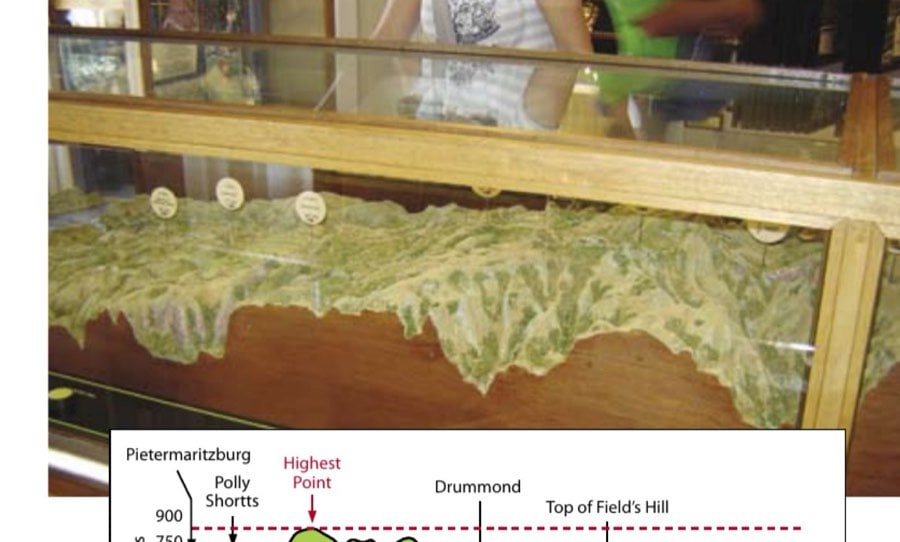
Height in meters
Pietermaritzburg 900 750 600
Polly Shortts
Drummond Top of Field’s Hill Pinetown
Umlaas Rd.
Durban Durban Inchanga Botha’s Hill Boundary Cato Ridge Berea Winston Park Subway Tumble Inn Camperdown Cowie’s Hill 10 20 30 40 50 60 70 80 89
Little 450 Mpusheni 150
Highest Point
Spencer Farrar photo
two-hour layover there, we then continued for 8 1/2 hours more before finally landing at Cape Town. After clearing customs around 4:00 p.m. local time, I took a taxi to a friend’s place in the city, where I fought off my jet lag.
Two days later, having caught up on some much-needed sleep, I took a morning hop to Durban on a British Airways flight. Although the flight was only two hours long, I was pleasantly surprised to be fed breakfast, a rare treat for American travelers accustomed to airline frugality. In keeping with English gastronomic tradition, the omelet was exquisitely bland and bore a physical resemblance to SpongeBob SquarePants, but it was much-needed nourishment.
As the Airbus A320 began its final approach into Durban, I was struck by how much the terrain resembled Southern California. From 10,000 feet, the azure water and green vegetation could easily be mistaken for La Jolla. It was hard to imagine that I was now entering the heart of KwaZulu-Natal—a region where Shaka, the great Zulu chief and military strategist, once led thousands of fierce warriors into battle. This is the same province where Britain fought some of its
Distance in km.
▲ While preparing for Comrades, runners should incorporate hill training into their regimen.
bloodiest military campaigns at hallowed grounds like Isandlwana and Rorke’s Drift. It seemed surreal that I was going to be running an ultramarathon here. I had reserved a room at the Royal Hotel in downtown Durban because of its proximity to the starting line. During the 20-minute cab ride to the hotel via the M4 Highway, the industrial zone surrounding the airport gradually gave way to a curious mélange of elegant colonial English edifices and gritty beachfront highrises. My taxi driver was a third-generation Bengali who explained that Durban was the home of the largest Indian population outside of India. During the turn of the 19th century, he explained, many Indians migrated to South Africa to work in the sugar cane plantations. For whatever reason, a large percentage had chosen to remain in the seaside city of Durban.
The Royal Hotel is a 140-year-old Durban landmark that straddles the bustling Smith Street to the north and the crowded Natal Bay to the south. (According to my guidebook, Durban is the ninth-busiest port in the world.) Though the façade was unremarkable, the hotel’s interior was deceivingly modern and in good taste. After registering at the front desk, I proceeded to room 405, which overlooked the starting point of the race in front of City Hall. I unpacked my luggage and meticulously arranged my running gear on the floor—an obsessive/compulsive ritual that I conduct before every race.
On to number pickup Satisfied that I had not misplaced any equipment, I departed the hotel and ambled toward the Exhibition Center to pick up my number and welcome packet. The warm, crisp air was a nice contrast to the dank and windy conditions of Cape Town, and I gleefully soaked in the unusual aromas and sounds that drifted on the wide boulevard. Crossing Smith Street, my reverie was dashed as I narrowly missed being hit by an erratically driven minivan taxi. I had been forewarned—rightly so, as it turned out—to be on defense against the notoriously bad South African drivers. Red lights and pedestrian crossings mean little to the Durban driver.
I wandered throughout the exposition, checking out the numerous vendors that were selling the usual fare of muscle ointments, sports drinks, and running apparel. As I was walking by one of the booths, I overheard two Americans engaged in a heated discussion with a Comrades official. Nosy to learn what the conversation was about and curious to meet fellow American runners, I approached the group and introduced myself. The person leading the debate was a wiry Californian named Ric Munoz, and his accomplice was a soft-spoken resident of Washington, D.C., named Steve Dunn.
Ric said that he was debating whether the Nike swoosh on his running shorts was, as the official had proclaimed, too large. Sensing that I had no idea what he was talking about, Ric explained that Comrades had a strict dress code that
forbade runners from wearing oversized logos unless they had the markings of one of the race’s major corporate sponsors. I was unaware of this dress code and out of curiosity, I asked the referee if my running hat was within regulation. After thoroughly inspecting my cap like a forensic pathologist, the clothing inspector declared that it was inappropriate because the adidas logo on the back exceeded the maximum size. But the referee then signaled willingness to compromise: if I concealed the logo with masking tape, I could wear the cap. However, the thought of tape rubbing against my scalp for nine or 10 hours did not sit well with me, so in the end, I simply purchased a new cap at the expo.
With the hat crisis resolved, I meandered to the food court for a late lunch. I instinctively went to the pasta stand and ordered a plate of spaghetti bolognaise. I glanced to my left and was horrified to see a large number of people waiting in line at a curry stand. As much as I enjoy a good curry dish from time to time, spicy Indian food was just about the last thing I could imagine eating before a marathon.
I returned to the hotel and turned on the television, hoping to get a dose of local African culture. To my dismay, the television picked up only three broadcasts: Oprah swooning over ’80s pop sensation Rick Springfield, a dull European Cup soccer match from Basel, and an African version of CSI spoken in Afrikaans. Uninterested by the entertainment choices and still feeling the effects of jet lag, I soon drifted off to sleep.
Day of reckoning The night before the race, I went to bed at 10:00 p.m., hoping to get a decent rest. As usual, I suffered from prerace jitters and was not able to doze off until 2:00 a.m.—a mere two hours before my wake-up call. After reveille sounded, I ate a stale chocolate pastry that I had bought the previous evening and stretched for about 15 minutes. At 4:45 a.m., I verified for the last time that my gear was still in order, laced up my fluorescent-green Newton running shoes, and departed for the starting line.
The sun was not due to rise for several hours, and the moonless sky was filled with a crisp coastal breeze. Hundreds of runners filed in an orderly manner to the tog bag drop-off on the corner of Aliwal and West streets, from whence they would proceed to the starter’s area. The racing corrals, northwest of the ornate City Hall and adjacent to the post office, were swathed in bright floodlights and quickly started to fill up. Loudspeakers blasted a mixture of rhythmic African and zouk music to which everybody sang and danced. This was carnival, Durban style.
About 10 minutes before the start, the public address announcer read the names of each country represented at Comrades and played an abbreviated version of the national anthems. Of the 11,000-plus registered runners, there were roughly 400 non-South African participants, with the United Kingdom, Australia, and
the United States constituting about 40 percent of the international population. A deafening roar erupted when the Chariots of Fire theme started to play—a sign that the start was imminent. As the announcer counted down, everybody eagerly awaited the sound of the rooster’s crow (a Comrades tradition), which would then trigger the firing of the starting gun.
Although runners from Kenya and Ethiopia dominate the elite marathon circuit, only a relatively small number of black Americans participate in marathons or ultras. This demographic disparity is especially pronounced in the predominantly white New England racing scene, and the panoply of black runners at the starting corral was a spectacular sight to behold. For the first time in a road race, I was now an ethnic minority. Yet throughout the day, there was a feeling of unity, and as one Xhosa runner proudly told me before the race: “This is one day in South Africa when everybody gets along. It’s too bad it can’t be like this always.”
With a minute remaining, I checked my Garmin watch for the last time to ensure that there was a satellite feed and took a final swig of my power drink. I retied my left shoelace for no reason and braced myself for the starting surge.
At 5:30 a.m., I finally heard the wailing of a rooster. The race had officially started. I commenced to take my first step. Fifty-five miles to go . . . I actually paid for this? What was I thinking? It’s so dark outside. I can barely see anything. What did I just step in? There’s a guy stretching his hamstrings already? Are my shoes too tight? How many kilometers in a mile again? Fifty-five miles to go . . .
Over hill and dale In the weeks preceding the race, I had committed the course profile to memory and had gone to bed visualizing key sections of the route. I also pinned an enlarged map of Comrades on my office wall, which loomed as a constant reminder of the upcoming challenge. On race day, I even wrote a cheat sheet on my left hand, scrawling down key mileage and landmark information with permanent ink. I felt that I knew the course like the back of my hand—literally.
The topography of Comrades can best be summarized as hills, lots of them. It is not coincidental that this part of South Africa is aptly called the “Valley of a Thousand Hills.” The first half of the race is dominated by three major inclines: Cowies, Fields, and Bothas.
While there are some plateaus during the first 24 miles, most of this distance is uphill and rises from sea level to an elevation of 2,500 feet. After the midway point at Drummond, runners must still overcome two nasty precipices before reaching the finish at Pietermaritzburg: Inchanga and Polly Shortts. The highest point of the course, situated 12 miles from the finish line, is a promontory called Umlaas, which stands at an elevation of 2,657 feet. Although the route is techni-
Courtesy of Action Photo
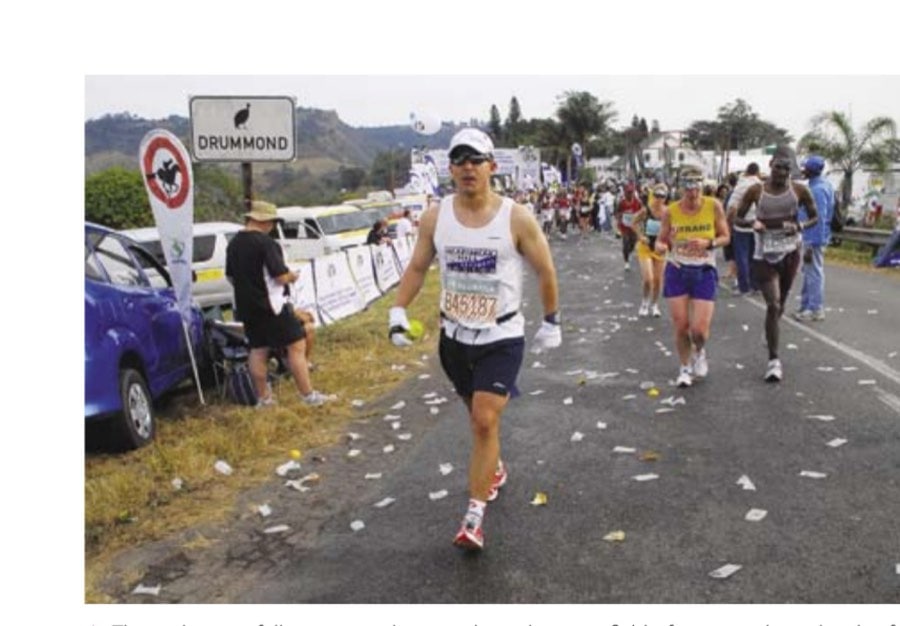
▲ The author carefully navigates his way through a minefield of water sachets shortly after reaching the midway point at Drummond. Runners who have the misfortune of stepping on these liquid bomblets risk soaking their feet.
cally downhill afterward, the undulating hills offer little repose and dishearten the fittest runners. Every road race that I have ever done included mile markers to indicate the elapsed distance. By contrast, Comrades’ markers are in kilometers and indicate the remaining distance. While my GPS watch conveniently provided real-time mileage information, I still found these signs to be distracting and did my best to ignore them, especially during the early stages when the numbers were depressingly high. There’s nothing like being reminded that 85K still remain.
Several people had advised me that the key to running a successful Comrades Marathon is to conserve energy during the first half of the race and to take frequent walking breaks on the inclines, even if your legs felt strong. The reasoning was that these minibreaks would prevent the buildup of lactic acid and also conserve much-needed energy for later use. This would prove to be invaluable advice.
Because the sky had been shrouded in darkness for the first hour and a half, I did not realize how much elevation I had gained until mile 14 as I was running up Cowies Hill and noticed an expansive valley below on my left. Several miles away I could make out a little village with wisps of smoke rising in the morning light. This peaceful image belied the hostile terrain that I was running on and prompted me to think of British infantrymen plodding on these same hills over a century ago. I could not imagine the hardship these rugged soldiers must have endured as
they marched from Durban to provincial headquarters in Pietermaritzburg, dressed in their woolen blouses and heavy packs. Those were some tough men. Against my better judgment, I ran to the top of Cowies without stopping because I did not want to be passed by a woman who was dressed in a pink tutu and sporting a bug antennae headband. As a former Marine who had done a combat tour in Iraq a few years before, how could I stomach such indignity? I sped up and left the dancer in my wake, while I reveled in this small victory. Gung-ho!
During the next two hills, I finally employed the run/walk strategy that had been advised and after every quarter mile of running, I would walk for about 20 to 30 seconds. While my senses told me that I was wasting time, especially because my legs felt strong, I reminded myself that I still had over 35 miles left. However, when I later caught sight of people on the side of the road suffering from heat exhaustion and cramps, I became convinced that this tactic might have some merit after all.
Again encountering Ric About five minutes after reaching the top of Bothas, I found myself surrounded by the nine-hour bus (that is what pacing groups are called here). As I weaved to the side of the road to avoid the congestion, I randomly ran into Ric Munoz from the expo. A youthful-looking 50 years old, this energetic Los Angeles resident was diagnosed with HIV over 20 years ago, but despite this setback, he has incredibly tallied over 150 marathons, including three Comrades finishes. Since the mid-1980s, he has averaged 80 miles of running a week and is a mainstay on the marathon circuit. Nike was so impressed by his endurance and inspiration that it profiled him in a television commercial a few years ago.
When Ric strode up next to me, he had a determined look on his face, but this quickly gave way to a wide grin, and he complimented my running form. “You hardly look like you’ve broken a sweat,” he lied. I tried to think of a witty reply but could only muster a not-so-profound, “Thanks, good luck to you,” as he effortlessly glided by me. He then turned around and encouraged me to keep up my pace. “Drummond is just around the corner,” he yelled. Charged with a renewed jolt of energy, I surged toward the midway point at Drummond.
My Garmin watch displayed a time of 4 hours, 26 minutes—slightly faster than my 10-minutes-per-mile target—when I finally arrived at Drummond. As I passed underneath the ballooned archway and heard the chirping of electronic timers, my adrenaline picked up. Knowing that I was halfway done motivated me, and I was pleased to see that the ground was finally leveling off.
Any sensation of relief that I had was dashed about a minute later when I rounded a bend in the road and took my first look at Inchanga. Inchanga. Even the name sounds foreboding. This two-mile-long mountain stretch, with its
serpentine trail and nasty gradient, renders the most battle-hardened runners into a cursing lot. “You have got to be kidding me!” I exclaimed aloud when I saw this geological monstrosity. All around me, I could hear profane cries of shock, anger, and disbelief from the runners at this impending obstacle. Others, too tired to say anything, simply shook their heads in dismay. As I observed the procession of ant-sized runners slowly trudging their way up this giant hill, I felt that I was witnessing the making of a Cecil B. DeMille epic.
With each step up Inchanga, my breathing became more labored and my leg muscles started to burn. To make matters worse, the morning breeze had ceased and the mercury was quickly rising. During the march up Inchanga, I had been conversing with a blind runner and his guide—a cheerful guy named “Guppy” who had an attention-grabbing green faux hawk. Both runners had previously run Comrades, but curiously, they did not seem fazed by this latest hill. I started to wonder whether not being able to see the terrain might actually be advantageous.
Upon reaching the summit of Inchanga, I heard a few half-hearted cheers from the runners, but the overwhelming silence indicated that most people were just relieved to be done with this hideous hill. During the nearly two-mile trek uphill, my split time slowed down to an embarrassing 13 minutes per mile (this would be my slowest pace all day). From the top of Inchanga, the road makes a sharp leftward turn downhill, and I somehow managed to run the next mile in nine minutes flat.
I had now traveled 31 miles and had been on the road for over five hours, subsisting exclusively on gels and Energade (a South African version of Gatorade). While runners at most marathons drink from cups or bottles, Comrades participants are provided water and Energade in “sachets,” which are little plastic packets that resemble intravenous bags. In order to drink the contents, runners must bite off a corner of the sachet and then nimbly suck out the liquid—a deceptively tough task when you are on the go. Thousands of these sachets—many still full of fluid—littered the roads like land mines, and careless runners who had had the misfortune to step on one of these bomblets would get their feet soaked.
At the beginning of mile 32, I developed an intense craving for salty food and starches, and for the remainder of the race, I could not stomach anything sugary like GU gels, sports drinks, or bananas. (This aversion to sugar lasted for several days after the race, and even the sweet minty flavor of my toothpaste later made me gag.)
Impromptu lunch break With each step I took, I became more famished and desperately scanned the road for a food station. But, alas, there was nothing in sight. I made another attempt to satiate my hunger pangs by eating a handful of carbohydrate-laden sport beans,
Spencer Farrar photo
but this sticky mush revolted me. In a fit of disgust, I tossed my remaining GU gels to a young child on the side of the road. “Ngiyabonga,” he said in appreciation. The boy curiously eyeballed the mysterious-looking packets of maltodextrin, probably having no clue what was inside.
My hunger pangs became worse by the second, and the sweet aroma of barbecue on the sidelines seemed like a cruel joke. About 100 meters ahead of me on the left side of the street, I spied a spectator holding a sandwich. Unabashed, I approached the gentleman and asked if he would mind sharing his lunch. The man seemed caught off guard by my request but then gave me a sympathetic chuckle and handed over what appeared to be a half-eaten bacon sandwich. Unlike traditional American-style bacon, which tends to be thinly cut and crispy, this salty meat was about a quarter-inch thick and laden with fat. Although I consider myself a healthy eater and would not normally recommend bacon as a running supplement, this food provided me with the lift I desperately needed.
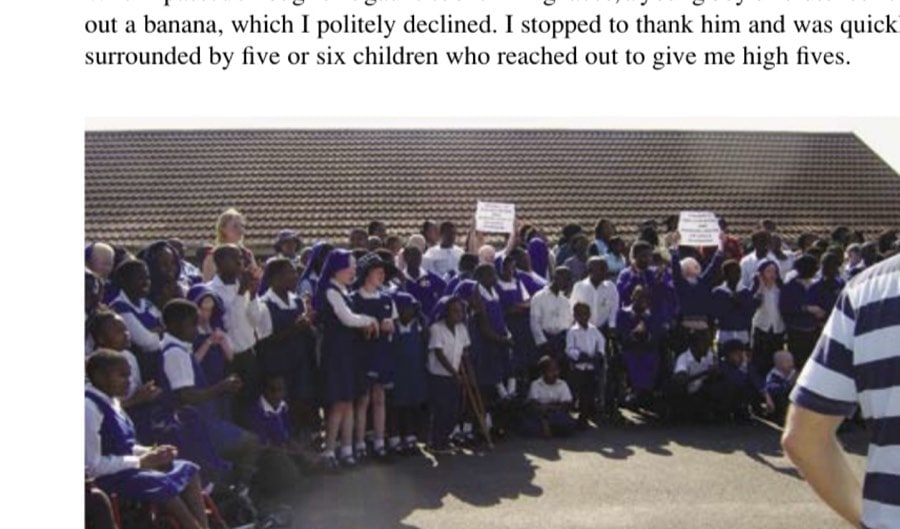
Reenergized by this fatty pork (at least that’s what I think it was), I soon arrived at the Ethembeni School, one of the Comrades Marathon’s most celebrated waypoints. Every year, several hundred students from this school for the physically and visually disabled line up along the course and cheer on the intrepid runners. When I passed through this gauntlet of smiling faces, a young boy on crutches held out a banana, which I politely declined. I stopped to thank him and was quickly surrounded by five or six children who reached out to give me high fives.
▲ The children of Ethembeni School make up for their physical limitations with an abundance of enthusiasm and spirit. Their presence provides motivation during an especially critical juncture of the race.
Polly Shortts, the last of the “big five” hills, is the final gut check that runners must undergo before descending to Pietermaritzburg. Located about five miles from the finish line, this hill compensates for its short length (it is only 1.25 miles long) with its brutish incline. For bragging rights, some runners attempt to run up this hill, but as I approached Polly’s, I noticed that everybody was walking, so I chose to follow suit. One brave man attempted to run, but less than a minute into the hill, he stopped short and crumpled to the ground, gasping for air. Better him than me, I callously thought as I continued my climb.
It took about 16 minutes of power walking and cursing to reach the top of Polly Shortts, but once I arrived at the crest of this hill and saw Pietermaritzburg’s skyline, my spirits were lifted. My legs now felt lighter, and the pulsating techno music from a loudspeaker made me pick up my cadence. According to my watch, I had now traveled 50 miles and had been running for 8 hours and 59 minutes. I marveled that I had run the equivalent distance from Boston to Providence.
Some revisionist math Recognizing that I would not finish the race in nine hours, I revised my goal to finish in less than 10 hours. I tried to figure out what pace I had to run for the next five miles, but the mental and physical fatigue was taking a toll on my quantitative skills, and the simplest mathematical calculations had become difficult. It took several seconds to figure out that at worst, I simply had to run a 12-minute-permile pace—quite manageable even under the present circumstances.
About one mile from the finish line, the course deviated off the highway and turned into a narrow, tree-lined promenade that was surrounded on both sides by hundreds of spectators. In turn, this grass path led to the finish area within the city’s cricket oval. When I finally made my way into the roaring stadium at 3:19 p.m., I was exhilarated that only 300 meters remained until the finish line. At the same time, however, I experienced a tinge of melancholy because the rush that I had been feeling during this ultimate journey was about to conclude.
At the 100-meter-to-go mark, I saw the finish line for the first time. What a glorious sight that was! This motivated me to make one last dash toward the end, and I deftly darted around five or six people in the process, thereby ensuring a great photo finish. Nine hours, 50 minutes, and 25 seconds after the race began—at 3:20 p.m.—I finally crossed the finisher’s line and was done for the day. Thank goodness.
Once is not enough While the Comrades Marathon is relatively unknown in the United States, this annual competition remains one of South Africa’s most popular spectator sports, and every year much of the country follows this nationally televised broadcast
in its entirety. In the days leading up to the marathon, it seemed that every South African had some sort of expert advice or commentary to provide. “I don’t think anybody is going to beat that Russian this year,” proclaimed a fruit vendor I met in Durban. She was referring to Leonid Shvetsov, the Russian who later repeated his victory from 2007 and set a course record in a sickening 5 hours and 24 minutes.
Those who finish the race join a small but proud fraternity of runners who can lay claim to the title of “Comrades veteran.” Runners who have done 10 or more Comrades earn a distinct green-colored bib and retain their race number for life. During the run, I met an older gentleman who was taking part in his 14th consecutive Comrades. I shook my head in awe and asked him what prompted him to return every year. “I don’t know,” he said with an aw-shucks attitude. “I guess it just gets in your blood.” He went on to explain that after his first run, he simply had to do the downhill course to “complete the circuit.” Subsequently, he felt compelled to do “at least” two more runs in order to beat his previous times. By this point, he explained, only six runs remained for the elusive green number. “Then after I received my green bib,” he continued, “I wanted to become a ‘double-green’ runner, so I just kept going.”
I think that Xhosa runner whom I met at the starting line had it right: it’s too bad this feeling can’t last forever. This is probably why so many people can’t do the run just once but return year after year. Once you’ve done a Comrades Marathon, there’s no stopping. It is truly an endless run.
Somehow, I have a feeling that I’ll be back in South Africa one day soon.
Courtesy of Action Photo
▲
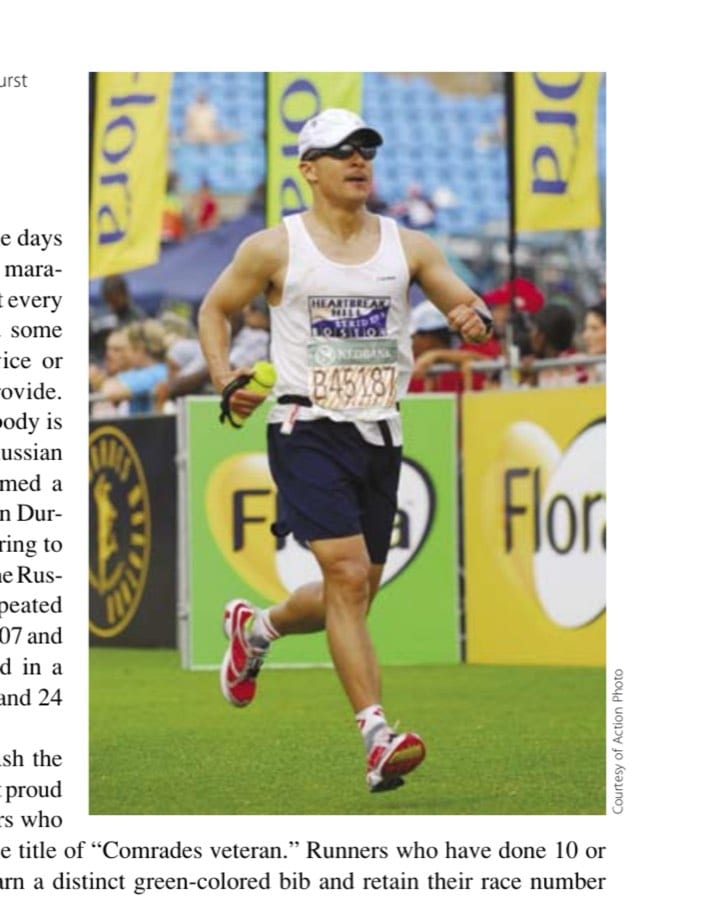
Making the final burst toward the finish line.
Epilogue: Back to Africa
Spencer Farrar photo. Inset: Michael Ellingsen photo
“Save energy for the downhill portion. That’s where you’ll need it most,” Coach Jim Carroll solemnly cautioned a few days before I returned to South Africa this past May for my second Comrades Marathon. Out of respect for his distinguished running career, I pledged to heed his advice—as counterintuitive as it seemed— but come on, save energy?
Having done the up run last year, I felt compelled to complete the circuit and earn my back-to-back Comrades medal by doing the down run this year. Last year’s course was unequivocally tough, but I took a measure of comfort thinking that the down run would surely be easier. Instead of scaling the dreadful Valley of a Thousand Hills, I would now be coasting down them. This time gravity would be on my side.
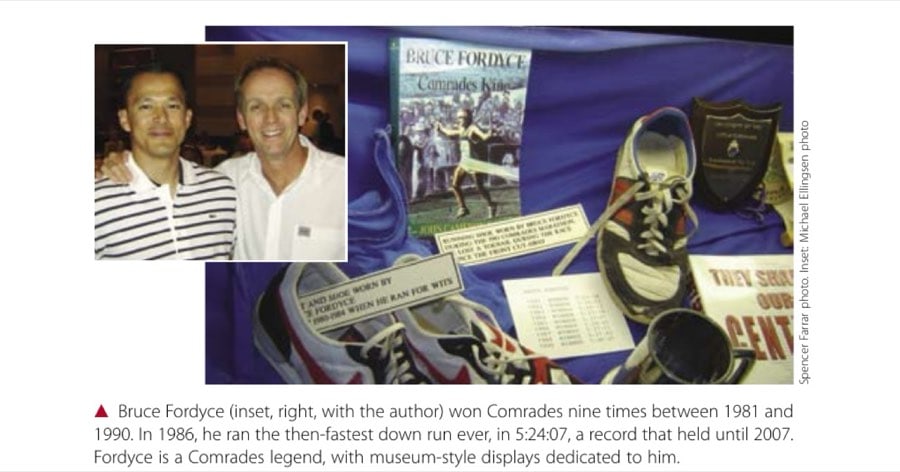
I breezed through the first 28 miles in a tad over four hours, which put me on pace to finish in the low eight-hour range. So far, everything was going according to plan. As the endorphins kicked in, I visualized myself as New England’s version of Bruce Fordyce and felt unstoppable. So what was the big deal about the down run again?
That was before I arrived at the final three descents of the race—Bothas, Fields, and Cowies. These hills constitute a large portion of the 20-plus miles of downhill between Drummond and Durban. At this point, the complexion of the race completely changed, and a harsh new reality set in.
The first hill I encountered was Bothas. I found myself uncontrollably accelerating to an unsafe speed down its steep pitch and had no choice but to slow
▲ Bruce Fordyce (inset, right, with the author) won Comrades nine times between 1981 and 1990. In 1986, he ran the then-fastest down run ever, in 5:24:07, a record that held until 2007. Fordyce is a Comrades legend, with museum-style displays dedicated to him.
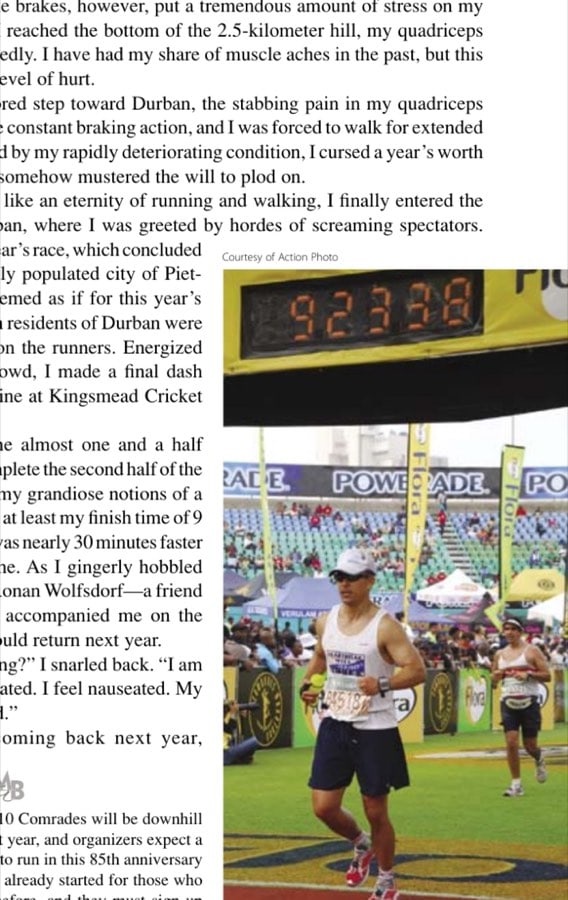
down. Applying the brakes, however, put a tremendous amount of stress on my legs. By the time I reached the bottom of the 2.5-kilometer hill, my quadriceps were burning wickedly. I have had my share of muscle aches in the past, but this was a whole new level of hurt. With each labored step toward Durban, the stabbing pain in my quadriceps intensified from the constant braking action, and I was forced to walk for extended intervals. Disgusted by my rapidly deteriorating condition, I cursed a year’s worth of obscenities but somehow mustered the will to plod on. After what felt like an eternity of running and walking, I finally entered the city limits of Durban, where I was greeted by hordes of screaming spectators. Compared to last year’s race, which concluded
Courtesy of Action Photo in the more sparsely populated city of Pietermaritzburg, it seemed as if for this year’s race, all 3.5 million residents of Durban were on hand to cheer on the runners. Energized by the frenzied crowd, I made a final dash toward the finish line at Kingsmead Cricket Stadium.
It had taken me almost one and a half hours longer to complete the second half of the race (so much for my grandiose notions of a negative split). But at least my finish time of 9 hours, 23 minutes was nearly 30 minutes faster than last year’s time. As I gingerly hobbled back to my hotel, Ronan Wolfsdorf—a friend from Boston who accompanied me on the trip—asked if I would return next year. “
Are you kidding?” I snarled back. “I am completely dehydrated. I feel nauseated. My quads are shredded.” “So, you’re coming back next year, right?” “Of course.” Editor’s note: The 2010 Comrades will be downhill for the second straight year, and organizers expect a record 20,000 people to run in this 85th anniversary race. Registration has already started for those who have run Comrades before, and they must sign up between September 1 and October 31. First-time runners—with a maximum of 5,000—can sign up between November 1-30. More details are available at www.comrades.com.
▲ Feeling a mixture of elation and relief, the author crosses his second Comrades finish line.
This article originally appeared in Marathon & Beyond, Vol. 13, No. 6 (2009).
← Browse the full M&B ArchiveMore like this
1,000+ stories from 19 years of Marathon & Beyond
The complete archive of the legendary long-distance journal — digitized and free to read.
