

The Fall And Rise Of A Leatherneck
With enough will and persistence, any barrier can be overcome. by Jonathan White Master Gunnery Sergeant, U.S. Marine Corps
You can’t know how you will react to being told you will never walk again until the moment you hear those fateful words. On 22 July 2003, I was going to work on the island of Okinawa, Japan. I was stationed there with my wife, Peggy, and three children. I had been a United States Marine for 16 years and was waiting for the inevitable combat deployment to Iraq with my unit. In the meantime, we trained diligently, honing our skills so that when we were called we would be ready. At 0900, my unit was conducting prejump training for what was supposed to be a normal day of parachute operations. Prejump refresher training ensures that all emergency procedures are in the forefront of your mind, in the unlikely event you find yourself in a jam and need to react quickly. No matter how many times you have parachuted, you will go through prejump training. Our jumpmasters are the best of the best and thoroughly go over every type of scenario you could imagine. You might think that an accident will never happen to you, but it can. It most certainly can.
When I was 4 years old, my mother and father participated in an event called the “Walk for Mankind” in our hometown of Rome, Georgia. I wanted to walk like everybody else but was too small, so my mom and dad pushed me in a stroller, which I escaped every chance I could get, only to be captured by my dad. At the end of the route, a man in a green combat uniform walked up to my parents and hoisted me up into a real live Marine truck. Well, at the time, I knew who GI Joe was, and that was him picking me up. In fact, I was told that he was a U.S. Marine and had recently returned from a combat tour in Vietnam. The Marines were assisting all those walking and shuttling them back to the start point in their trucks. The young Marine asked my mom if it was all right if I sat up front with him, and the next thing you know, my life had changed forever. Instead of playing
army with my friends, we played Marines. I never quite grew out of it. Whenever someone asked me what I was going to be when I grew up, I would reply that I was going to be a Marine. Shortly after my fifth birthday, my family moved to Appomattox, Virginia. My dad was an engineer, worked at a paper mill as a production manager, and was well respected in the community. My dad was a U.S. Navy veteran of the Korean War as well. My parents bought an old plantation house and restored it out in the country far away from the town. I had a bicycle, a BB gun, a dog, and a very active curiosity, not to mention imagination. Both of my parents worked, and I was the youngest of four children and often found myself at home alone after school. I learned how to shoot a rifle from my grandfather as soon as I was strong enough to pick it up and hold it steady. So you can imagine how living in the country with the closest neighbor being a mile away could turn a boy into an adventurer. I was blessed with the total family package. My oldest sister was a scholastic genius and tried to mentor me to become as smart as her. My brother was “cool” and to this day remains my hero. He passed away a few years ago, but in my whole life, I’ve never had a better role model. My other sister excelled in academics and athletics. All in all, I had as good a childhood as anyone could ask for. My family expected or assumed that I would grow out of my Marine phase and go off to college like the rest of my siblings, but I had other plans.
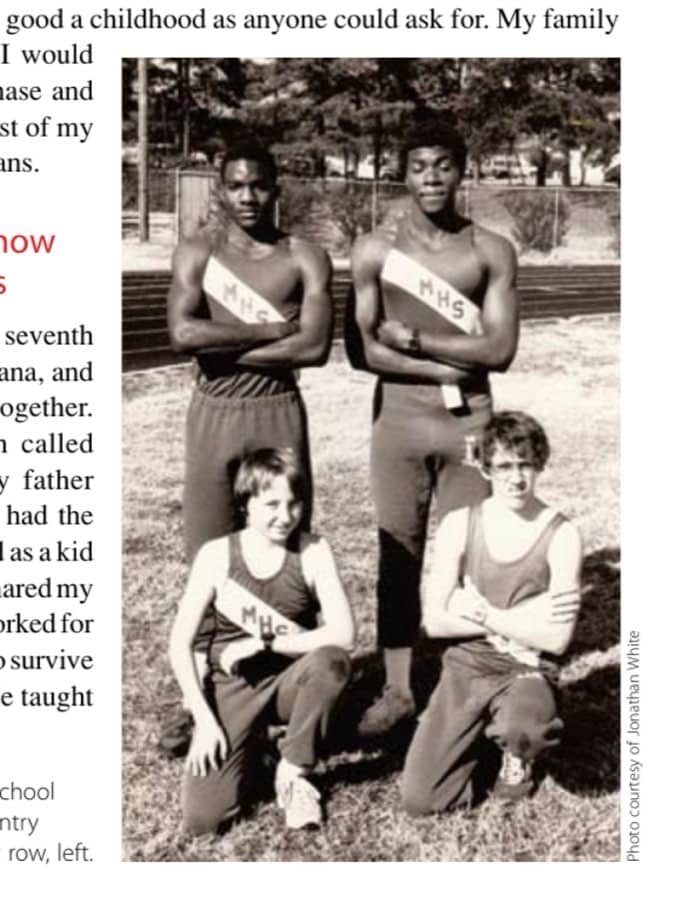
When I was going into the seventh grade, we moved to Louisiana, and that’s where it all came together. First, we lived in a town called Mansfield, again with my father working in a paper mill. I had the same interests that I had had as a kid and met a new friend who shared my love for adventure. Mr. S. worked for my dad and taught me how to survive with nothing in the wild. He taught ▲
Mansfield (Louisiana) High School Wolverines track and cross-country team. The author is in the front row, left.
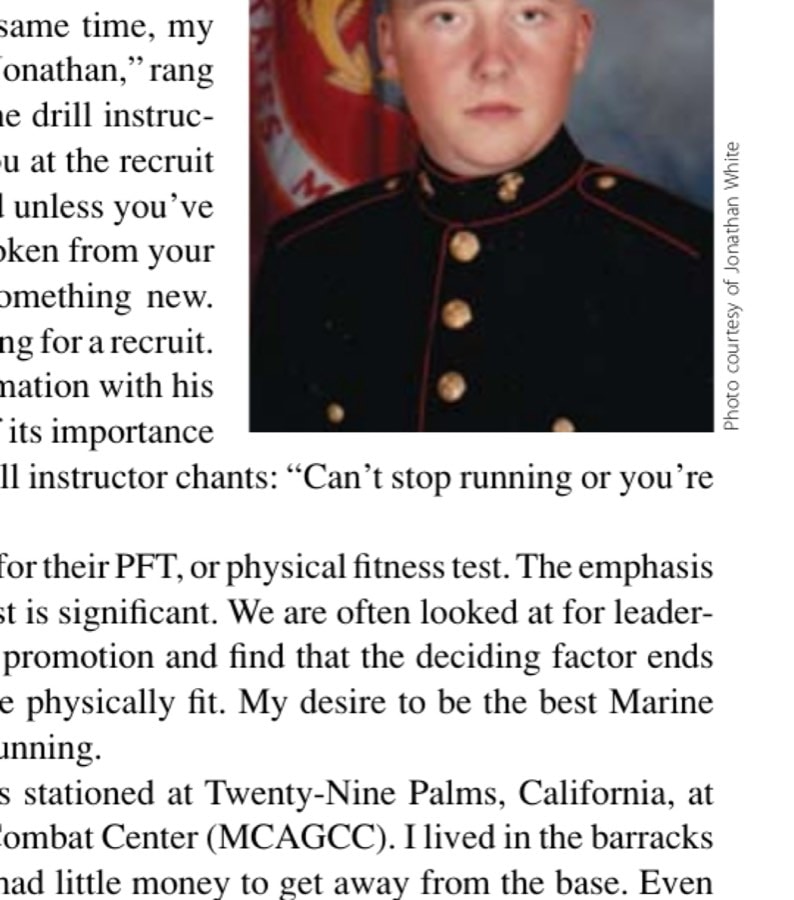
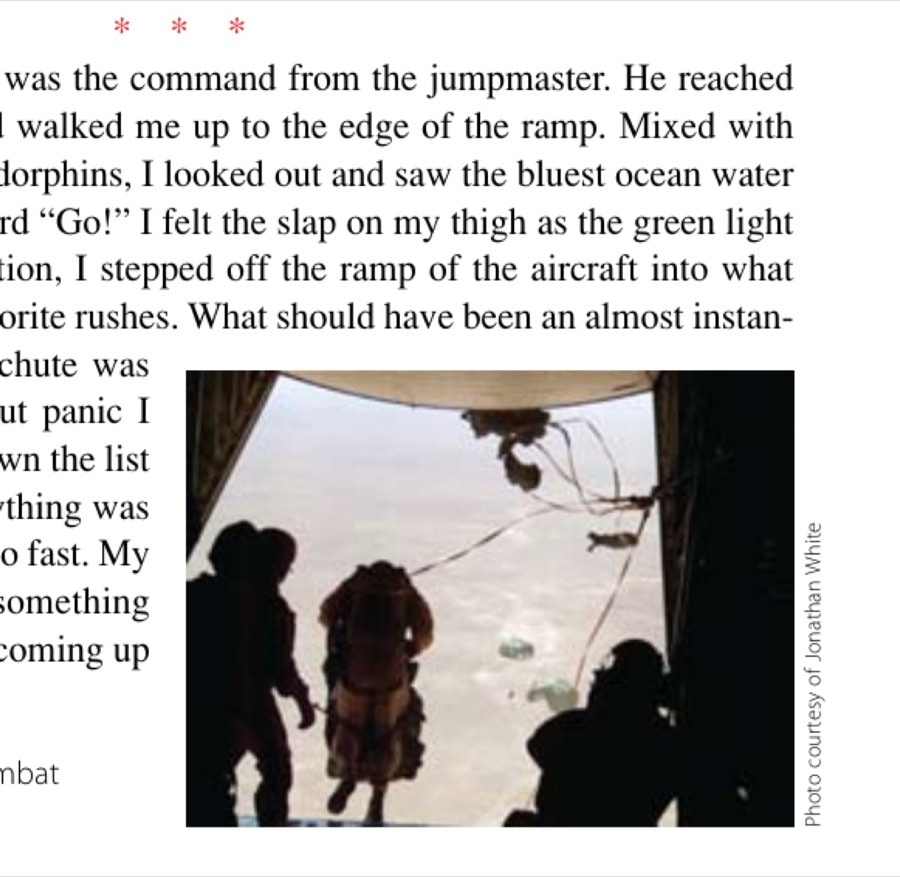
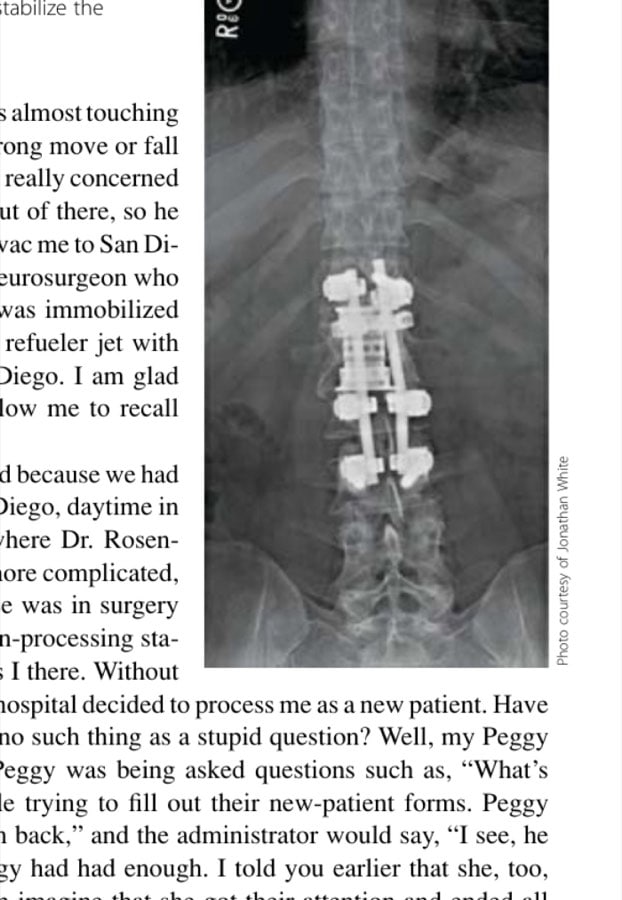
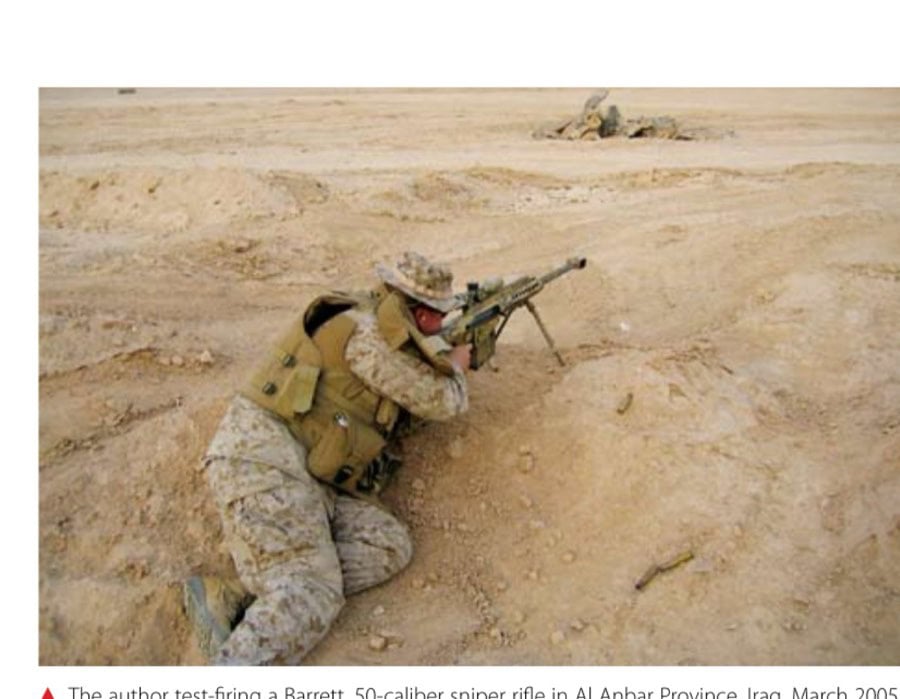
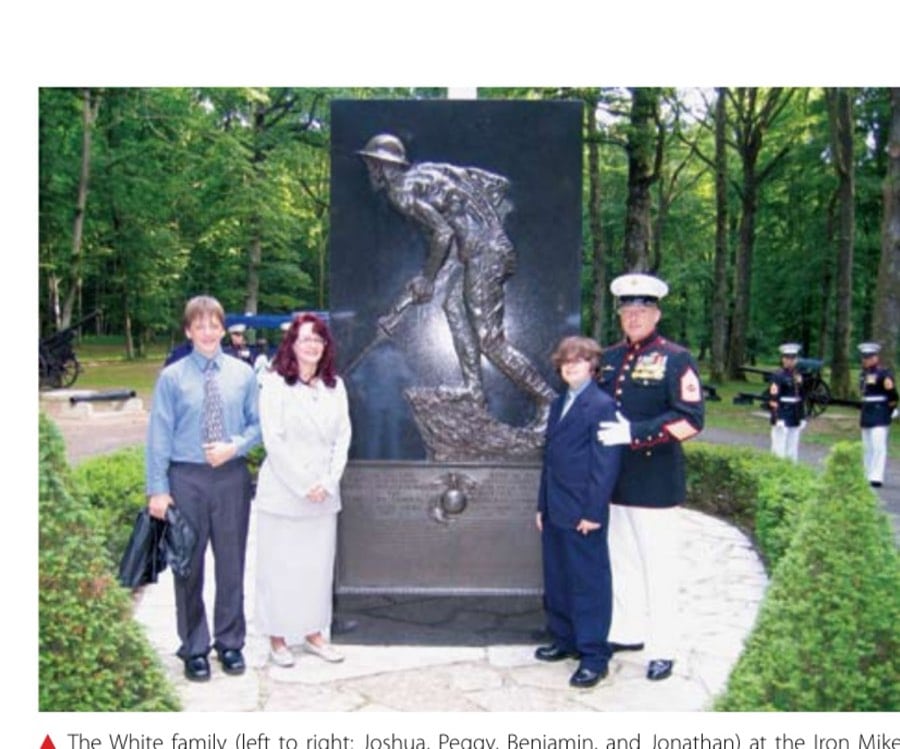
Photo courtesy of Jonathan White
Being mentored on how to survive by my wits
me how to rely on myself when I was in a bad situation. He had once tried to join the military but was medically denied. We would go on camping trips, bring nothing but matches, fishing gear, and a knife, and live off the land for a week at a time. He taught me how to hide and was always asking me what I would do if I got into trouble or hurt while alone. He made me think three steps ahead. To this day, I have used his lessons on more then one occasion in my adult life.
My father received a big promotion, and we moved to Alexandria, Louisiana, next. I remember my dad taking me to sign up for my junior year of high school in our new town. To my surprise, my new school happened to have a Marine Junior Reserve Officer Training Corps (JROTC) with real live Marine instructors. The master sergeant was a Vietnam veteran and as rough as sandpaper. When I told him I wanted to be a U.S. Marine, he laughed at me. He told me that the Corps wanted only the best and that nothing short of that would do. I joined JROTC and soon found out what the acronym “PT” stood for. The master sergeant took pride in destroying us in physical training, an area in which I was not naturally gifted. In fact, I could barely meet the minimum standards. The next thing I knew, I was a senior and the reality was setting in. If I wanted to live my dream, I didn’t merely have to get into shape—I had to get into Marine shape. This was the first time in my life where someone was betting against me. Whether it was to make me angry so I would try harder or whether it was authentic belief that I would quit, it made no difference. For the first time in my life, I began doubting myself.
I soon met a Marine recruiter who came to my house and met with me and my parents. I still believe to this day that my mom was in disbelief that I would go through with it. This Marine had just returned from action in Grenada and was a reconnaissance Marine. He was what we would refer to as a walking poster because he was everything the Marine Corps advertised and then some. He looked me in the eye and asked me if I was willing to do anything it took to become a Marine, and I told him yes. He replied with, “Good to go, let’s get you signed up.” I asked him if he thought I would be able to make it, and he said I could if I wanted it badly enough. Well, I did want it badly enough, and he went above and beyond to mentor me. This is probably where my real passion for running began. At the time, I never dreamed where it would take me and how important it would be to me on an elemental level.
Running under the drill instructor’s critical eye On 17 November 1987, while the rest of the country slept, I met a man who might as well have been 10 feet tall. His eyes were like high beams on a car, and his voice was like a cannon. His name was Drill Instructor. I could not help but think that the master sergeant might have been right about the mixture of the Corps and me, but my recruiter’s voice came back to me: “Are you willing to
do whatever it takes?” At the same time, my brother’s mantra of “Come on, Jonathan,” rang in my ears almost as loud as the drill instructor’s. Something happens to you at the recruit depot that you can’t understand unless you’ve actually been there. You are broken from your bad habits and molded into something new. Running is a major part of training for a recruit. A recruit is taught to run in formation with his fellow recruits and reminded of its importance by the echoing cadences the drill instructor chants: “Can’t stop running or you’re gonna die!”
All Marines run three miles for their PFT, or physical fitness test. The emphasis placed on doing well on this test is significant. We are often looked at for leadership positions and meritorious promotion and find that the deciding factor ends up being which Marine is more physically fit. My desire to be the best Marine possible sparked my love for running.
After recruit training, I was stationed at Twenty-Nine Palms, California, at the Marine Corps Air Ground Combat Center (MCAGCC). I lived in the barracks and because I was a private, I had little money to get away from the base. Even though at the time I didn’t think it was a very good thing, my lieutenant happened to be a running maniac. He would take us out running and wouldn’t stop for what seemed like hours. Well, I decided that if you couldn’t beat them, join them, so I started doing additional runs besides the Monday through Friday runs we did with our platoon. At first, it was just Saturday morning and a couple of miles. Later, it became long runs through the mountains of the Mojave Desert. I would find myself getting lost in thought while running, and before I knew it, an hour or longer would have passed. I got to a point where guilt would set in if I wasn’t out running every day. It became my edge. Then I ran into my Achilles’ heel. Her name was Peggy, and like me, she too was a U.S. Marine.
I say “ran into,” because that’s what happened, quite literally. I was once again back at the recruit depot, but this time it was Parris Island, South Carolina, and I was a corporal. I had traveled to the island to watch a friend of mine graduate from boot camp and become a Marine. At the end of the ceremony, I was going to get something to eat before I caught my plane back to my base and ran into Peggy. I was taken down hard when I saw her and knew instantly that I had met
Photo courtesy of Jonathan White
▲
The author’s boot camp graduation photo: PFC White, Platoon 2117, Company G (Golf ), 2nd Recruit Training Battalion. 05 Feb 1988.
the perfect woman. How could I know this? Well, Peggy and I had grown up together and had gone to the same high school. She never gave me the time of day then, but I always thought she was the most beautiful girl there. So I talked to her as long as I could and then ran for my plane. Much to my surprise, I was back at Twenty-Nine Palms a month later, and there she was again. I collected all my nerve and off I went to ask her out. Peggy and I were married three months later and have been married for 19 years. Three months doesn’t seem like much time, but I had asked her to marry me with the intention of giving her a big wedding and a honeymoon. Unfortunately, a man 10,000 miles away put a rush job on things when he invaded Kuwait. We were called to leave suddenly and told that it could be a year or longer before we returned home. Peggy and I did what seemed most logical and went to Las Vegas and were married. I would do it all again without thinking twice about it.
Many years later, I found myself on the weekends routinely waking up early on Saturday and Sunday morning while my wife was still asleep. I would slide out of bed, lace up my running shoes (aka “go fasters” to Marines), and head out the door to get rid of the past week’s stress (on Saturday) or plan out the next week’s agenda (on Sunday). I can run and talk to myself and solve almost all the world’s problems in a dozen or so miles. At the end of a good long run, I feel like I have released all the demons inside and am relaxed until the next run. It is my therapy. * * * 22 July 2003. “One minute” was the command from the jumpmaster. He reached out and grabbed my arm and walked me up to the edge of the ramp. Mixed with emotions, adrenaline, and endorphins, I looked out and saw the bluest ocean water I could imagine and then heard “Go!” I felt the slap on my thigh as the green light came on, and without hesitation, I stepped off the ramp of the aircraft into what promised to be one of my favorite rushes. What should have been an almost instantaneous opening of my parachute was substantially delayed. Without panic I started, in my head, going down the list of actions I could take. Everything was right, but I was falling way too fast. My canopy had deployed, but something was wrong. The ground was coming up ▲
U.S. Marines conducting a combat equipment parachute jump.
Photo courtesy of Jonathan White
Reverting to my trusted form of therapy
way too fast. I reached for my reserve parachute handle and saw that I had a bigger decision to make and that I was out of time. We are taught that when something is wrong, we either run away or we stand and deal with it. Psychologists call this ancient coping mechanism the “fight or flight” syndrome. Sometimes when the odds are overwhelming, running away is not so bad. In my case, it would have taken my mind off my landing and put it on deploying my reserve parachute. It is normally not a problem, but I was so close to the ground that my reserve would not have had time to deploy. Now, instead of just colliding with the earth, I would have done it unprepared because my focus was on the reserve chute and not on my imminent landing. I would have landed improperly and would have probably died. So remembering Sergeant Airborne from Fort Benning, Georgia, I made a decision as the pilot of my canopy that I would have to live with, and I decided to fight. “Sergeant Airborne” is the name that refers to all of the U.S. Army airborne instructors. Probably one of the most important classes in my memory from Airborne School was “Landing.” Sergeant Airborne’s words were loud and clear to me now: “The most important part of the jump is the landing.” Falling way too fast, with the treetops just below me, I had to resist the urge to look down. I had to prepare to land, which meant I needed to prepare to conduct a dynamic parachute landing fall. I would like to explain everything I did, but unfortunately, I don’t remember.
The “incident” as others saw it What follows is what was reported to me by those who were there. A U.S. Navy corpsman who was attached to our unit for the jump rendered first aid after my impact. He treated me as if I had a spinal cord injury and immobilized my neck and strapped me to a spine board for transport. A Marine helicopter was called in for medevac, and I was loaded on. The pilot was supposed to fly to the closest U.S. base and then a ground evacuation was to occur, but the corpsman told the pilot he was worried that I wasn’t going to make it. The Marine pilot disregarded routine and flew directly to the helicopter landing pad at the U.S. Navy hospital. I was then rushed into the emergency room. Things didn’t go all that smoothly from that point. Somewhere in my mind, I was wrestling with system overload on pain. Later it was estimated that I hit the ground at over 60 miles per hour. The problem is that my mind took me offline and tried to save itself. So what you might expect with someone severely injured doesn’t always happen. In fact, first responders look at yelling and screaming from a patient as a good sign—it indicates they are conscious. I, however, was just lying on the exam table and not making a sound.
By this time, my wife had raced into the emergency room, and the doctor on duty briefed her that I had the wind knocked out of me and maybe a bump
on the head.The ER doc initially didn’t think anything was really wrong with me. He thought I had just landed hard and maybe had a concussion. The reason was because I was calm and not complaining, not because I wasn’t in pain, but because I was in my survival mode. Peggy was standing there, and the doctor was asking me questions, and I was answering them accurately without duress. I fooled him, but as usual, I could not fool my Peggy. She said this is my husband, but this is not him talking. Something is wrong! I don’t remember much of this time period. Peggy described me as calm, coherent, but robotic. A doctor came running into the emergency room, and he looked as if he had been on vacation at the beach. In fact, he had been at the pool with his kids and had received a phone call, telling him about my accident. He left the pool immediately and came to the hospital. About the same time as he came running into the room, so did the X-ray technician with the routine film that was shot. The doctor ended up becoming one of the most important people in my life. His name is Commander Robert Rosenbaum, neurosurgeon, U.S. Navy. He barked orders like a drill instructor, and the entire emergency room sprang into action. I was taken into an MRI and, unsatisfied with the shots taken, Dr. Rosenbaum climbed right in the machine on top of me to hold me still. Face to face, he was explaining to my “other self” what was going on. Evidently, Doc struck a nerve and told my other self that I was paralyzed! When I came out of the first MRI, my other self was starting to panic and told my wife to hold my hand. She said, “I am holding your hand!” At that moment, reality was setting in.
Now it was time for the second MRI, and the doc came back in with me. This time I had him and caught him off guard. I demanded of him, “Promise me I will walk again.” Well, Doc had told me that this was not a practice that he was used to. In fact, as a rule, you never promise what you can’t deliver. But he said, “I promise.” Some might think that he was just calming me, but now that I know him so well, I know that he is truly the most talented neurosurgeon on the planet, and he somehow knew it was going to be OK. A few other doctors had different opinions and thought that I was done.
Awake and assessing the situation I awoke in a white room, and there was a man looking me in the eye and shining a light in my face. At first, his words were garbled, but eventually they became clear. Even though I had met him with my other self, I was really meeting him for the first time. “My name is Doctor Rosenbaum. Do you know where you are?” All I really knew was that I was in an extreme amount of pain. Doc explained what happened and that he had placed two 12-inch titanium rods in my back and had fused my back from the T12 to the L4 vertebrae with these rods and six large bolts to hold them in place. There were still other problems. A large chunk of bone
shaped like an arrowhead was almost touching my injured spinal cord. A wrong move or fall and I would be done for. This really concerned Doc. He wanted that bone out of there, so he told us he was going to medevac me to San Diego, California, to another neurosurgeon who would remove this bone. I was immobilized and placed on an Air Force refueler jet with my wife and flown to San Diego. I am glad that my memory doesn’t allow me to recall much of this.
We got to the hospital, and because we had come from overseas to San Diego, daytime in San Diego was nighttime where Dr. Rosenbaum was. To make things more complicated, the surgeon I was sent to see was in surgery and couldn’t explain to the in-processing station who I was and why was I there. Without having this information, the hospital decided to process me as a new patient. Have you ever heard that there is no such thing as a stupid question? Well, my Peggy would argue that there is. Peggy was being asked questions such as, “What’s wrong with him?” by people trying to fill out their new-patient forms. Peggy would say, “He has a broken back,” and the administrator would say, “I see, he hurt his back.” Finally, Peggy had had enough. I told you earlier that she, too, is a U.S. Marine, so you can imagine that she got their attention and ended all the unnecessary poking and prodding that was going on. Eventually we met the new surgeon, and in sort of a no-big-deal kind of way, he said OK, we’ll fix you up, kind of like taking a dent out of a car fender. I was at ease then (besides the pain), thinking that this next surgery would be a walk in the park—that is, until I met my nurse.
He came in and said, “I heard that they are going to go in and do a procedure on you to fix you up.” I said, “Yep, the doc made it seem like a simple process.” So the nurse proceeds to ask me if the entry would be from the front or the back. I know what I must have looked like, but I said, “You’re joking, right?” He said no, usually if they have rods in they will go in from the front. I won’t make anyone reading this over lunch sick by explaining the process, but as amazing as it sounds, they can do that. Ugh!
Photo courtesy of Jonathan White
▲
Titanium construction that CDR Robert Rosenbaum, USN, implanted to stabilize the author’s spine.
Nothing but complications The big day started at 0400. I was wheeled into the preoperating room and briefly told what would happen as the anesthesiologists took me down for the count. What seemed like an instant for me was almost a whole day, and then it happened. I woke to see a couple of doctors telling me to breathe. I was gasping, but nothing was coming in. I passed out and came to again to find that I still couldn’t breathe. Finally, I awoke and found out that I had a pneumothorax and that the doctors had to insert two chest tubes to reinflate my lung. Let me tell you, that is when I realized how much pain I could take. That was the worst of it, until they were ready to fit me a few minutes later with my brace—most commonly referred to as a turtle shell.
Now, imagine how you would feel with a 12-inch incision down the center of your back and 38 staples holding it shut. Add an 18-inch incision that goes from your bellybutton all the way around and almost touching your staples, and then add two chest tubes. Next, you have a guy standing there wanting you to sit up, roll over, and so forth, just so he can make sure your turtle shell fits. If my Peggy had not been there, I don’t think I would have made it. I was relieved to see her Marine temper boiling and once again coming to my rescue. After all this, I got to my room, met my new nursing team, and was finally starting to think there was light at the end of the tunnel. The morphine was wearing off and the pain increasing, but I wanted to be coherent because I was hearing rumors of my worst nightmare coming true: medical retirement.
When my surgeon at San Diego walked in, I kind of laughed and said I had heard that I was going to be retired. He explained that he recommended that I be retired because I would never walk again, and if I did, it would be with a walker and dragging my legs behind me. Now he had two hot-tempered Marines to deal with, and so I convinced him that he couldn’t retire me before I had a chance to rehabilitate. Agreeing with that, he sent the physical therapists in. When the physical therapist handed me a rubber ball, I almost lost it. I asked him what it was for, and he said that I was going to do some hand exercises. I told him my hands were fine, it’s my legs that don’t work. He said he knew that, but they were not going to work, so imagine his surprise when I asked him if he had ever worked with a Marine before. After he said no, I told him to leave because I would do the exercises myself. I ordered a walker and two canes. They were both brought to my hospital room, and pretty much without anyone except Peggy knowing, I embarked on the long road back.
It took me several days of sitting up, putting my turtle shell on, and trying to find my balance just to stand up on the walker. And then I was standing with mostly my arm strength. After about a week, I was able to drag walk, but my legs were numb so I couldn’t feel them when I made a step. The fact is that the
therapy folks never planned for me to walk. When my doctor came to my room and I was standing on my walker, he asked how far I thought I would get, and I told him I wanted to walk again.
They just didn’t get it He gave me a smirk and said it’s not going to happen. With my very meanest Marine scowl, I said not only is it going to happen, but when I’m done I’m going to run a marathon! Every doctor I talked to except for one, Dr. Rosenbaum, said it was impossible. The way I see it, difficult is easy, and impossible may take a few days, but the bottom line is: never tell a Marine he can’t do something.
When the retirement folks came to brief me, I was scared that I wouldn’t be able to hold them off. Peggy made the call to my commanding officer and told him what was going on. Next thing I knew, there was some action. I talked with my current doctor and told him I needed some time. I explained to him that I would behave and rehabilitate at home just as easily or better than if I went to a VA hospital.
A month had now gone by and I was still using the walker, but my legs were cooperating with my brain a little better. I say that because when I landed, I hit my head pretty hard on the ground. The hospital in San Diego initially thought that I had fractured my skull. Luckily, my head has always been on the hard side, but there was trauma, and teaching my legs to move on command meant that in my mind I had to say “left leg, right leg,” back and forth, to tell my legs to take a step. I gradually switched over to canes instead of the walker. This took total concentration. I found that my legs were paying attention to my commands of left, right, left, right, most of the time, but every once in a while, one of my legs would take a break, even though I was still moving, and down I’d go. I was more embarrassed than anything; it was very frustrating and very stressful on Peggy.
She would sit back and watch in fear of the one thing that could end my rehab for good, and that was a twisting fall. You see, during my second surgery in San Diego, the doctor implanted what is called a “construct.” He went in from the front of my spine and put in a titanium mesh cage to replace the vertebra that were destroyed. He collected all the broken bone fragments and removed two of my ribs to grind them up and put them inside the construct. The idea is that after about six months, this flimsy mesh cage would harden, with the bone fragments fusing together. At the end of this period, I would have a solid bone surrounded by a titanium mesh. The problem was that if I had a twisting fall, I could very well undo all of both surgeons’ work. Peggy was always worried, and when the news got to my Marines that this could happen, I often found myself on my rehab walks surrounded by Marines who just so happened to be walking in the same direction at the same time. Anyway, it’s good to know people care, even when it’s a little more than you want.
My accident was also very hard on my kids. They thought their Daddy was not coming home. All they knew was that things were bad, and it was possible I wasn’t going to either live or walk. Once I came home, it was a family affair of rehab. My kids and my wife were my motivation. In my mind, I had to succeed. If I did not and I just quit as the medical folks suspected, then I would simply set a bad example for my kids. Believe it or not, I was worried more about setting a poor example for my children than anything else.
On Super Bowl Sunday 2004, I found myself with my turtle shell on while standing on a treadmill in the gym waiting for the opening kickoff. This was going to be a great day, not because of the game (honestly, I don’t remember who played), but because I was going to run—OK, shuffle—my first mile. That’s right, no canes. With both hands touching the handles on the treadmill in case my legs protested, I was going to jog my first mile. I felt like I was being stabbed in the back every time my feet hit the deck of the treadmill. I was almost in tears, but I was happy. The next morning I could barely get out of bed, but I knew I was on my way. February: 1.5 miles. March: two miles and a pull-up. April: 2.5 miles and two pull-ups.
In secret training for the PFT test Remember the Marine Corps PFT I talked about earlier? Well, I had exactly one year to pass this test or I would not have any other choice but to retire. I had until July 2004 to be able to run three miles in 28 minutes, do three pull-ups, and do 45 crunches in two minutes. It was May, and I needed to be able to train to pass this test without the watchful eyes of everyone. I begged and pleaded and was allowed to deploy with my unit to Thailand. With temperatures in the high 90s and the humidity at 100 percent, I spent six weeks quietly training. Every morning at 0430 I would get up, get dressed in my “go fasters,” and step outside and begin my painful ritual—one step at a time with no watch. I just wanted to complete the distance, and then I would worry about the time. Honestly, my biggest fear was not the run at this point, but the fact that I had yet to attempt crunches.
I was not alone during this task. Two of my closest friends, Frankie and Scotty, were there every morning trying to talk to me about everything under the sun to take my mind off the pain. During week number five while on a run, I told Scotty that I had a different plan at the end instead of just walking it out. He said OK and asked what it was. When we ended, I took him away from our hooch and told him today is the day, and he was in shock when I got down on the ground and said hold my feet and keep the time. He knew he couldn’t talk me out of it, so he said go. I started, and the look on his face was bad. My back was popping and cracking, and he was looking sick. He finally said, “Stop! You did enough to pass, and I’m going to be sick.”
0630, 25 June 2004, Camp Schwab, Okinawa, Japan, at the pull-up bars. My mentor and one of the toughest Marines I have ever known looked me in the eye and said, “Bubba, you sure you want to do this?” I just told him, “Let’s get this started.” I muscled out nine pull-ups. Keep in mind that I was quite literally broken in half during my accident, so I felt as if like I had an additional person clinging to my back while doing the pull-ups.
Then I got ready for crunches and did 100 to max the test. Having a little trouble walking, I got up and headed up to the start line for the three-mile run. Frankie was waiting for me. My mentor and boss looked at Frankie and said he would hold him responsible if I ran myself into a problem. The run started, and I told Frankie I would not stop running unless I was dead. There were times on that short run when I thought I wasn’t going to make it. Frankie stayed silent and ran right next to me. This was the first day since the accident that I had done all three events together. I wished I had a morphine drip going because the pain was indescribable. Then at the finish line, there were a bunch of my fellow Marines rooting me on. I felt like I had won a gold medal when I crossed that line and my boss told me I not only passed, but with a first class, which was the highest rating. I was relieved, and so was everyone else. I took my family home on leave right after I passed my PFT test as a celebration and a break. Up to passing that test, 100 percent of my time and focus was on rehab. My leave was a month and our whole family got together at our parent’s house.
Able to go with my guys After returning from leave, I heard that my battalion was going to combat. My commanding officer came to me and said don’t even think about it. Every day I begged him, and every day he told me no. As fate would have it, he got orders to leave, and we got a new commanding officer. I talked to him, and he said as long as my doctor cleared me, I could go with my men. I got in my car and went to see the doc. Doctor Rosenbaum knew exactly what I wanted and told me that he couldn’t make up a reason why I couldn’t go and so he signed me off. I went back to my battalion and reported the news.
My battalion left for combat in January 2005 and returned home the last week of October 2005. While there, a couple of Marines who were wounded talked to me from their hospital and rehab centers. Many expect soft and gentle treatment during recovery. I soon realized that was not what they needed, so I didn’t give it to them. They would tell me how they hurt or ache, and I would respond with that’s awesome, so you know you’re still alive. Are you going to lie there and feel sorry for yourself, or are you going to get up and do something about it? Both of these Marines not only returned from mind-boggling injuries, but they also returned to full duty, just like me.
Photo courtesy of Jonathan White
▲ The author test-firing a Barrett .50-caliber sniper rifle in Al Anbar Province, Iraq, March 2005.
I got promoted and received orders to my new unit in Stuttgart, Germany. Constantly training to maintain my conditioning, I ran a lot, or so I thought. Peggy said she wanted to start going to the track with me, and our older son, Joshua, was on the high school cross-country team already, so we started going to the track to walk or jog. In April 2008, while we were on the track jogging, I told her, “I’m going to do it.” Of course, she asked what I was going to do, and I told her I was going to finally train and run a marathon—not just any marathon, but “the People’s Marathon,” the Marine Corps Marathon. That was about all that was said. A week later, and we were on the track, and she said she wondered if she could run a marathon. I told her that would be awesome, and so we began our odyssey. Within a couple of months, we had read the marathon 101 books and everything we could find about completing a 26.2-mile race.
I was at the gym and saw a race poster that announced “2008—A Race to Remember,” which was a half-marathon and 5K in honor of fallen servicemen and -women. A couple of my friends were taken during the war, and I felt compelled to run on their behalf. So my whole family signed up, with my older son and me signing up for the half and my wife, daughter, and younger son for the 5K. This was the first race for all of us; we were moving into new territory. The only problem with the race was that someone forgot to advertise that it was an off-road half-marathon. My son and I were very excited and finished with no problem. Joshua is only 15, and he won the 15-19 age group.
Photo courtesy of Jonathan White
▲ The White family (left to right: Joshua, Peggy, Benjamin, and Jonathan) at the Iron Mike memorial, Belleau Woods, France. Memorial Day, 2008.
Making travel plans The win only served as fuel to feed him. The very next week, he said that it would be cool to run the marathon with me. Well, it would be, but the first thing that popped into my head was that it would be a lot of money to fly from Germany to Washington to race. At the time, another friend of mine and many other Marines, soldiers, sailors, and airmen were corresponding with me by e-mail and had been following our progress throughout the past few months. Even though my friend thought my whole family was crazy, she was rooting us on. I told her how great my son did on the run and how he would like to run the Marine Corps Marathon with me, so she asked why he didn’t. Well, without a good reason why, I talked with him, I talked with my wife, and we all agreed that he should run. I called to buy another ticket, but there were none left!
Peggy and I had joined Team Semper Fi, which raises money for wounded Marines returning home to help them in adjusting to their new lives. Many are burn victims and amputees. Marines are trained from birth at the depot to overcome obstacles—in fact, another saying we live by is “Whatever doesn’t kill you makes you stronger.” (Thanks for putting it into words, Mr. Nietzsche.) You would be surprised to know that the first thing you miss when your legs are gone
or don’t work is how much you wish you could run again. Team Semper Fi and the Wounded Marine Fund focus on that, and I was honored when asked to run for them. My e-mail pen pal was busy beating the bushes for donations, but all the entries were sold out, so there was no entry for my son to run the race. Luckily, a gentleman by the name of Edward Ross had an entry and couldn’t run. Once he heard about my son, he donated his number. Everything was falling into place, including an angel that assisted with a flight for my son to and from Germany. Now there was nothing except me that would keep me from starting the race.
Slowly but surely, my distance began to increase. All the while, I found myself training all over the world: Germany, USA, France, Azerbaijan (three times), and Israel. The three of us were training by e-mail, telling each other what we had done. In September, I was away and my family signed up for the Stuttgart 24-hour marathon. This is an event on the base track where every unit comes out, including families, and competes for a trophy for each category. All the proceeds go to the school athletics programs to pay for equipment and uniforms.
Peggy completed a full marathon during this event, and our 12-year-old completed 31 1/2 miles, earning him a trophy and title of Junior Ironman. (What father could be prouder?) My older son was able to run only 14 miles because he had to compete in a tennis tournament. I had to settle for competing against my wrist navigator in the 100-degree desert of Israel. The day I returned home, a week later, Peggy informed me that our son was waiting for me because our 18-miler was scheduled for that day. Yes, I wanted to postpone, but I had told my son that a lot of people were counting on us to train and be ready, so I had already dug my own hole. This was our longest run together and he, as usual, was holding back, making me look like I was leading the whole way. I know his mother secretly has him watching me to make sure I’m not overdoing it. Joshua is a natural runner and glides across the ground. Oh, to be 15 again. It’s really fun to have him alongside.
Finally, race weekend 0830, 24 October 2008, Washington, D.C.—Peggy, our son Josh, and I for the first time walked underground to the Metro and followed the herd of runners going to pick up their race packets. When I asked a friend on the phone where to go, he laughed and said go underground to the Metro and follow the crowd. We did and were all equally excited and scared. I don’t have to explain to those reading this that because this was our first marathon, we were being flooded by a lot of emotions. 0400, 26 October 2008, Washington, D.C.—Race day. Double-checking: train tickets, GPS tracking tag, rash guards, gels, nerves—what have I gotten
us into? I was plain nervous and what-ifing us to death. Peggy and Josh were as calm as ever. We turned in our bags to the guy at the UPS truck and headed for the starting corrals. Peggy lined up in the six-hour slot, and Josh and I headed for the 4:30–5:00 slot. When we got there, it was all I had dreamed it would be. The energy was fantastic! In just 10 minutes, over half of my family would become marathoners! I was so excited.
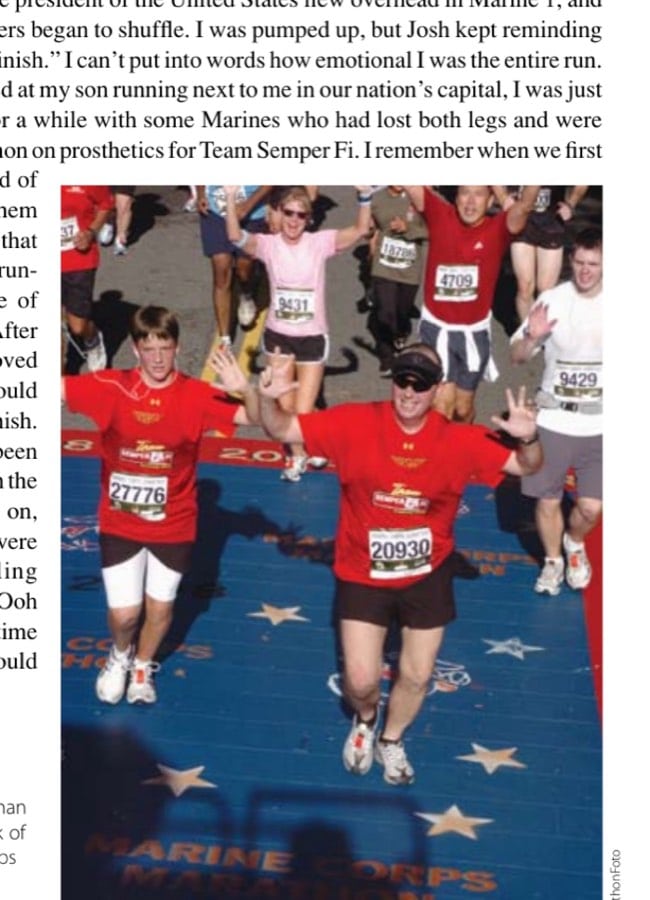
A lady asked me how many marathons this made for me, and I said it was my first and my son’s first. She gave us a “Woo hoo!” and a high five and told us it was her tenth Marine Corps Marathon. Then everyone was high-fiving us. The cannon blasted, the president of the United States flew overhead in Marine 1, and thousands of runners began to shuffle. I was pumped up, but Josh kept reminding me of our goal: “Finish.” I can’t put into words how emotional I was the entire run. Every time I looked at my son running next to me in our nation’s capital, I was just floored. We ran for a while with some Marines who had lost both legs and were running the marathon on prosthetics for Team Semper Fi. I remember when we first saw them up ahead of us; I ran up to them and told my son that this is why we are running this, because of these two heroes. After high-fiving, we moved on and said we would meet them at the finish. There must have been a million people on the street cheering us on, and the Marines were everywhere yelling “Semper Fi” and “Ooh rah!” at just the time when my mind would start to wander.
© MarathonFoto
▲
Joshua and Jonathan at the 13.1 mile mark of the 2008 Marine Corps Marathon, still motivated! What dreams are made of.
I had logged over 750 miles in preparation for this day, but my longest run had been only 18 miles. What about this Wall I had read about? Even though I never hit a Wall, I found out what it was when I saw countless runners hit it. My son was my anti-Wall and acted like he could have easily run the marathon again the same day.
When we got to the finish and crossed that mark and they put the medals on us, I couldn’t believe it. We did it! And man, what a support team. I felt like a professional athlete because of all the attention and support. Many of you reading this have run dozens of marathons and have experienced your own highs racing, but just when I thought I couldn’t be prouder standing at that finish line, I watched my Peggy come across the finish line. We had done it, 26.2 miles, and it was worth all the effort we had put into training.
Dr Rosenbaum always believed in me. He believed anything was possible and that I could succeed if I wanted it bad enough. The rehabilitation doctors did not believe I would ever walk again! I heard that so many times a day that it made me angry. It made Peggy angry. So, we decided to do something about it.
I have to say there is a list of proud moments in my life, and I thank God for all who have contributed to my success. I have truly been a blessed individual: born in this wonderful country; great parents, sisters, and brother; a career as a U.S. Marine; fabulous wife and children; and now this—marathoner!
This article originally appeared in Marathon & Beyond, Vol. 13, No. 3 (2009).
← Browse the full M&B ArchiveMore like this
1,000+ stories from 19 years of Marathon & Beyond
The complete archive of the legendary long-distance journal — digitized and free to read.
