

The Founding Father Of Ultrarunning
Arthur Newton was a modest man, a quintessential Englishman born while Victoria was still on the throne. Diffident and self-effacing, he would never have contemplated that long after his death in 1959 he would be widely regarded as the founding father of modern ultrarunning.
Newton took up the sport relatively late in life—he was almost 40 years old—and didn’t do so for competitive or leisure reasons but as a carefully planned publicity stunt. Having emigrated to South Africa in 1902, he became embroiled in a bitter dispute over land with the Union government and was desperate to draw public attention to his cause. Noticing that the new Comrades Marathon had gained wide coverage in the press—and had made a hero of a fellow farmer called Bill Rowan—Newton decided he would take part himself. It was the only way he could think of to get his name known!
One small problem: Newton was not a runner; he was a 38-year-old farmer who smoked heavily, but he lived alone on a remote farm in Natal where there was nobody around to tell him his idea was ludicrous.
More than 10 years earlier, Newton had tried his hand at running but back then only dabbled in shorter-distance work and never won anything of note. But he was a hardy soul, in good health and driven by a burning sense of injustice. He also had plenty of time on his hands to do some training, since production of cotton on his farm had virtually ceased due to problems caused by a chaotic government resettlement program. Newton had pleaded to be reinstated on a farm elsewhere or be given compensation for his losses, but his plea fell on deaf ears. Now, he concluded, the only way to succeed would be to gain public sympathy by becoming famous through sport.
He explained: “Genuine amateur athletics were about as wholesome as anything on this earth. Any man who made a really notable name [in athletics] would
always be given a hearing by the public. I decided that what with my age, it would be quicker and probably easier to achieve publicity through long-distance running than by any other method.” The very first 54-mile Comrades Marathon had taken place six months earlier in 1921 from Pietermaritzburg to Durban, and Newton had read how Bill Rowan won thanks to a training regimen of weekly 20-mile runs around his farm plus daily stints of skipping. Rowan had become a star overnight, and Newton reckoned he could do likewise, despite the handicap of having an older and less-experienced body to carry him. He sent off his entry for the 1922 race and set about devising a training schedule designed to transform himself from zero to hero in just five months.
On New Year’s Day 1922, with the sun rising behind the Natal hills, Newton set out slowly on his first proper running in years. The first few jaunts were short and not very sweet, the thin high-altitude air leaving him gasping. But as the days passed, he learned more about his capabilities and with astute planning slowly developed stamina. Halfway through his 20-week training program, he knew he had to test himself with a seriously long run. He devised a solo race against the local passenger train, which would be traveling 35 miles though nearby hills, while he ran a slightly shorter road route to the same destination.
A workable plan comes from a disaster The event ended in near disaster. Having set off at speed, Newton soon collapsed in agony at the top of a hill. He later recalled: “Quite suddenly, I pulled up with an abominable ache around my heart, so distressing an experience that I knew, without any expert advice, that I had in some way damaged the organ. Even walking was out of the question for a time, and I sat down on a rock and waited in the hope that I might recover.” He hobbled to a nearby hotel and requested a lift home. Shaken and deeply worried, he refused to go to a doctor, convinced that he would only be told to give up running. He revised his schedule, dropping all time trials and relying far less on his stopwatch. He would now travel “ever so casually and quietly,” concerning himself only with distance and not speed. It was a change of philosophy that would shape the rest of his life.
It worked well, and a month before the Comrades he was running consistently, albeit slower than originally planned. He developed an economic shuffling style that allowed him to run for hours while expending a minimum of energy. Almost by accident, he had discovered the benefits of LSD (long slow distance) that in later years would become a staple of distance training. A week before the race— Empire Day, May 24—Newton packed a bag, left his farm, and walked 17 miles into the town of Harding. Nervously boarding a train to Durban, he hoped he was ready for the ordeal.
Private collection
In the tense moments before the race’s early-morning start, Newton cut himself off from the laughter and banter to be alone with his thoughts. Here he was, the bookish son of a church minister, embarking on a trip into the unknown. His
20 years as an office worker, schoolmaster, and latterly farmer had been largely uneventful, but now he was attempting to conquer 54 miles of heat, dust, and crippling hills in order to make himself famous. As an essentially shy man who
hated attention, it was a situation that beggared belief. The Pietermaritzburg Comrades Marathon was the brainchild of Vic Clapham, an engine driver on South African Railways, who had been inspired by tales of the
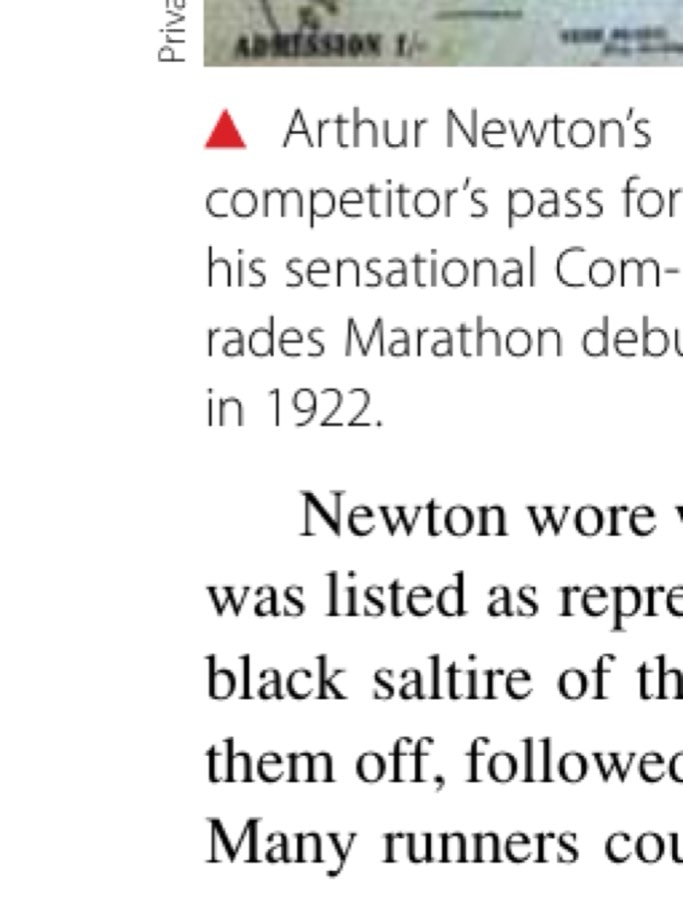
English 50-mile “Stock Exchange Walk” from London to Brighton. Only 34 had toed the start line in Clapham’s 1921 inaugural race, but this time 114 brave souls signed Arthur Newton’s up. Some fell foul of injury, illness, or pure fear, meaning competitor’s pass for
his sensational Com89 started. This year’s race would be much tougher, as it rades Marathon debut was heading up the hills to Pietermaritzburg from Durban, in 1922. instead of the other way round. Newton wore white kit with black trimmings and was entrant number 77. He
was listed as representing Harding Sports, although his shirt bore the prominent black saltire of the Thames Hare and Hounds club. The Mayor of Durban set them off, followed by helpers aboard cars, rickshaws, bicycles, and motorbikes.
Many runners couldn’t resist the temptation to “bolt like startled rabbits,” but novice Newton wisely held himself in check. With barely 20 miles completed, he was able to pass groups of men reduced to a walk by the never-ending hills.
And before halfway, he had passed well over half the field. Progress was startlingly good considering he didn’t change pace at all. It was the classic tortoise-and-hare scenario. Hours of training around hilly Harding meant
he coped comfortably on hills, while others suffered badly and looked ready to quit at any moment. Up ahead, race leaders Harry Phillips and Bill Rowan became locked in a grueling battle that would effectively ruin either’s chance of winning.
By halfway at Drummond, Newton was told from the roadside that there were only four men ahead of him. He was astonished. At the top of Inchanga Bank (32 miles), he shuffled past Phillips, stretched out at the roadside being massaged.
His spirits were lifted further when told Rowan was also prostrate and in big trouble. Newton was now second and only had to keep going to achieve his goal of attracting publicity for his campaign. Having never run so far in his life, he cautiously declined tempting offers of
food and drink from the roadside. He restricted himself to a few sips of Bovril and tea and toward the end risked only a couple of tots of brandy. Running without a hat, he regularly called for his neck to be doused with water. At the foot of a
grueling 800-foot climb, he suddenly spotted a small figure going over the top
up ahead. A spectator confirmed it was race leader Purcell, who was struggling. Purcell duly caved in just before Camperdown (38 miles), cutting a forlorn and dusty figure as Newton went smoothly by.
Finally, in the lead
▲
A weary Newton crosses the finish line in Pietermaritzburg, winning the 1922 Comrades against all odds.
Private collection
With less than a third of the race left, Newton knew the spoils of an unlikely victory were surely his—as long as he could conquer the last killer hills in the Polly Shorts Cutting area. He recalled later: “Great James! It was terrible work! It might have been nothing desperate for a man who was quite fresh, but when you had already run a much longer distance than you had ever tackled before in your life, the thing became a sheer nightmare.”
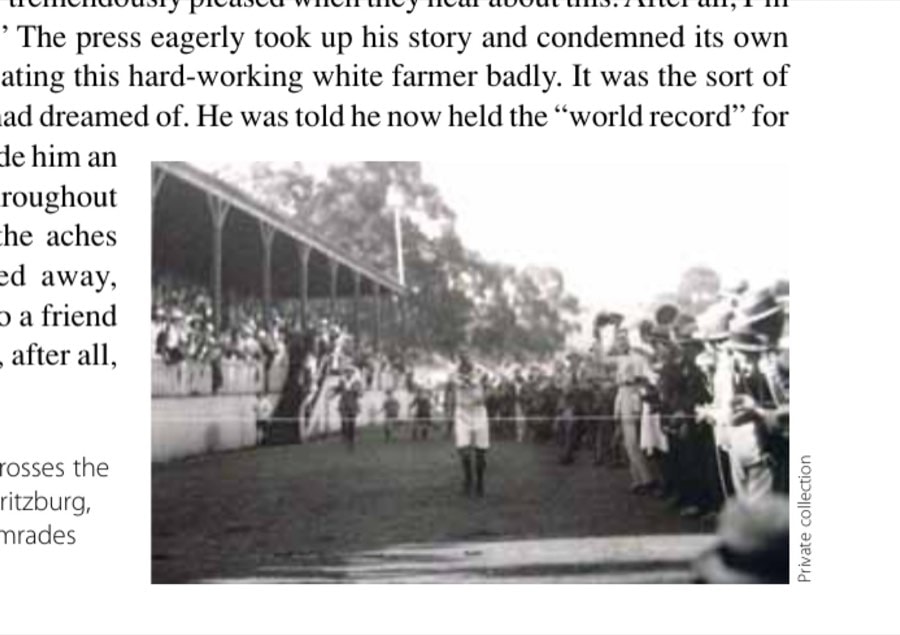
Struggling in the thin air, he crested a hill and was mightily relieved to look down and see Pietermaritzburg just four miles ahead, downhill all the way. A sip of brandy at the Star and Garter Hotel fortified him for the final stretch. He was roared home by a massive crowd that exceeded anything he had seen before. The acclaim was deserved, but for loner Newton it was an uncomfortable experience, and he felt acute embarrassment at the jubilant reception.
He finished in 8 hours, 40 minutes, nearly 20 minutes quicker than the previous winning time and nearly half an hour ahead of prerace favorite Phillips, the runner-up. It was a remarkable achievement, and press and public were desperate to speak to the unknown victor. Newton confessed he was surprised to win, and his awkwardness was compounded when the throng suddenly lifted him off his feet and paraded him shoulder high from the finish area.
Like many a distance runner before and since, his reaction was to declare he wouldn’t attempt such a thing ever again. He told one reporter his parents in England would be “tremendously pleased when they hear about this. After all, I’m 39 and getting on.” The press eagerly took up his story and condemned its own government for treating this hard-working white farmer badly. It was the sort of publicity Newton had dreamed of. He was told he now held the “world record” for 54 miles, and it made him an instant celebrity throughout the region. Once the aches and pains had died away, Newton confided to a friend that this would not, after all,
be a one-off event. He planned to continue training and reckoned he could become an even better runner in his 40s. The rest, as they say, is history. Newton quickly became addicted to his new lifestyle of daily running. The care and good sense he applied to a huge training load meant he steered clear of serious injury. He won three of the next four Comrades races (three in record time) and played a key role in getting it established as the most popular ultra in the world. He won other events and set a number of records between 30 and 100 miles, remaining convinced that the more famous he became, the better his chance of victory against the government—however long it took. With grim determination and methodically planned training, he thus built a fabulous amateur running career, but to his dismay the government in Pretoria remained stubbornly unimpressed. Even personal meetings with the prime minister failed to get the government on his side. Bitter and penniless, Newton would ultimately be forced to abandon his farm and head into neighboring Rhodesia. Typically, he did this 770-mile journey on foot rather than accept the charity of friends.
With his farming career in tatters, Newton then grabbed the chance to become a professional runner by accepting invitations to run Charley Pyle’s two TransAmerica Bunion Derbies of 1928 and 1929. And although injury and misfortune would prevent him from finishing either event, plenty of other racing opportunities cropped up in North America in subsequent months.
Contemplating the end He settled in Hamilton, Ontario, for a spell, but within a couple of years the worldwide economic depression killed off the professional running scene and Newton returned to his native England, age 49. He had by now clocked up nearly 100,000 miles in a dozen years as a runner, and although his training mileage remained phenomenally high, the passing of the years was taking its toll. Newton knew it was time to quit serious running but was keen to go out as the 100-mile record holder. He decided his final appearance would be one last crack at this distance.
He always felt he was better over 100 miles than any other distance, even though his reputation was largely built on performances at or around 50 miles. His previous 100-mile record of 14 hours, 22 minutes, 10 seconds had been set in 1928 in unhelpful wintry conditions on the Bath to London road, and he was sure he could better this mark. That run had thrilled thousands across southern England, but privately Newton had always been dissatisfied by it. And, anyway, it had since been surpassed by the Australian Mike McNamara, who clocked 14:09:45 indoors in Hamilton, in a race promoted by Newton himself.
During early 1933, Newton regularly exceeded 250 miles a week in preparation for a 100-mile record bid on his 50th birthday in May. This had to be called off, and there then followed two attempts in July, both on the Bath to London Road,
Private collection
▲
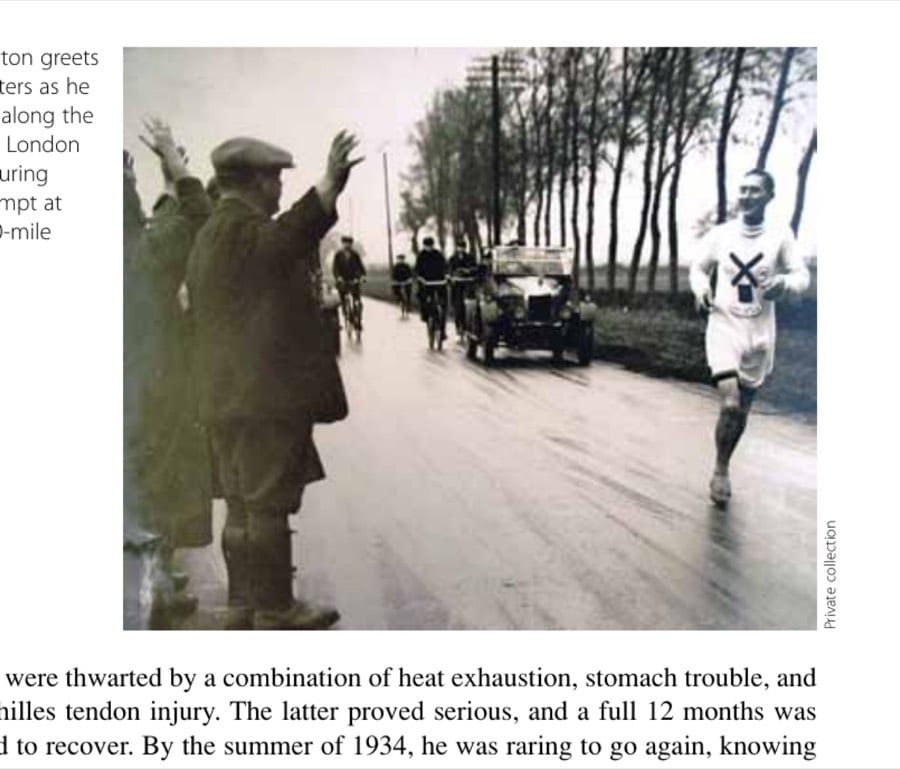
Newton greets supporters as he cruises along the Bath to London Road during an attempt at the 100-mile record.
which were thwarted by a combination of heat exhaustion, stomach trouble, and an Achilles tendon injury. The latter proved serious, and a full 12 months was needed to recover. By the summer of 1934, he was raring to go again, knowing that at the age of 51 it was now or never. As usual, former mile record holder Joe Binks, a well-known athletics correspondent, made all the arrangements. Newton was taken from London to his overnight accommodation, which overlooked the start line in the village of Box, ready for the last competitive run of his life on Friday, July 20, 1934.
There was tension in the air at 3:00 a.m. deep in bucolic Wiltshire. Sunrise was still two hours away, yet bleary-eyed locals were pulling on coats and flat caps and scurrying outside to grab bicycles. Butchers, quarrymen, farmers, housewives, and children all chattered excitedly as they emerged from their humble homes to head up the hill to congregate outside an inn called The Bear.
Their excitement was all down to “the old runner with the pipe” being back among them. It may have been summer, but in the darkness it was decidedly chilly as they gathered on the main road outside The Bear. There were no streetlamps, and thick clouds obscured the moon, so there was little to see, even though Box nestles prominently on the southern slopes of a valley. The village was best known as the home of Isambard Kingdom Brunel’s famous railway tunnel, which burrows underground for nearly two miles, but today Box was to make headlines for sporting reasons.
The main road to London snaked eastward out of the village, and Newton, the honored guest, was about to head down the road like a modern day Pied Piper,
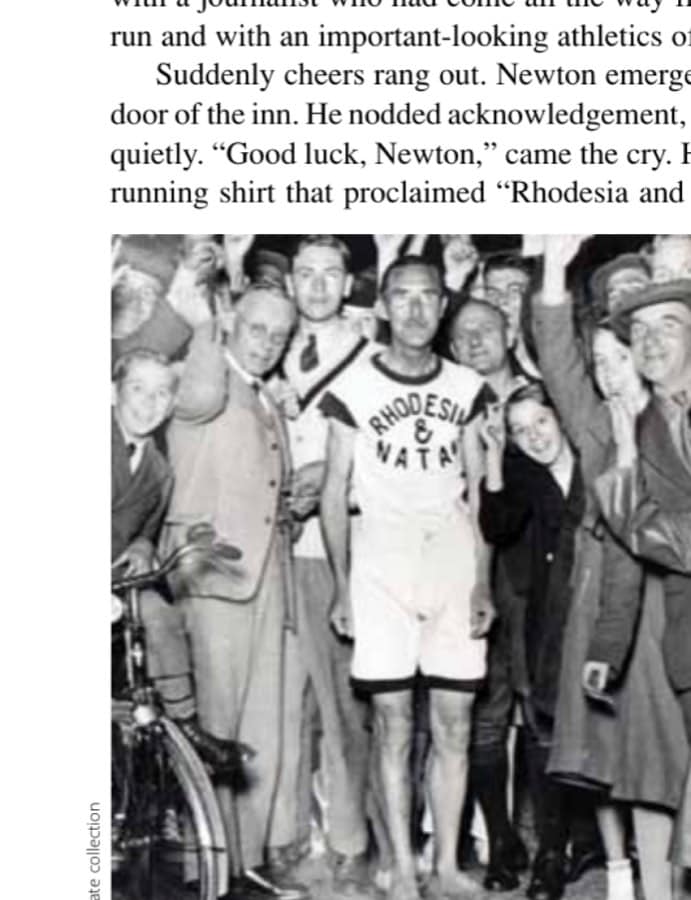
villagers in his wake lighting the way with the lamps of their cars and bicycles. They waited for the runner to appear from his upstairs bedroom at the inn, chattering about his attempt to run from here to London in 14 hours. Some laughed and shook their heads, believing the old fellow would be better off heading down the road the other way to the nearby Kingsdown Lunatic Asylum!
A hearty final meal Inside the inn, formerly a haunt of notorious highwaymen, Newton sat down to eat, his bright white running kit modestly veiled by an overcoat. He consumed a meat omelet, prepared by landlord Hatcher. There had been an inn at this spot
for nearly 350 years now, providing refreshment and accommodation to all types of visitors, but Hatcher was sure it had never before served an omelet at 3:15 in the morning to help a guest run all the way to London.
By around 3:30, the crowd outside the main door had built to well over 100, and among them was Walter George, former champion miler, carefully adjusting his stopwatch and positioning his car to accompany the run. He talked earnestly
with a journalist who had come all the way from Johannesburg to ride with the run and with an important-looking athletics official from London. Suddenly cheers rang out. Newton emerged through the white portico at the
door of the inn. He nodded acknowledgement, shyly dipping his head and smiling quietly. “Good luck, Newton,” came the cry. He may have been wearing a white running shirt that proclaimed “Rhodesia and Natal,” but deep down the crowd
knew he was one of them, a west-country lad born not far away in Weston-super-Mare. Photographers bustled around, urging him into position and arranging the crowd around him. As flashbulbs went off, Newton’s white running
uniform dominated the scene, a splash of brightness in the dark road.
Private collection
▲
In the middle of the night, crowds gathered to give Newton a send-off on his swan-song 100-mile record attempt in 1934.
As usual, Newton looked calm and collected, moving slowly to conserve energy and never outwardly betraying his desire to get away from this hubbub and begin his ordeal. He was slim, tanned, and fit, with neatly trimmed moustache and receding dark hair, but looked more like a diplomat or a bank manager than an athlete. His white kit was neatly trimmed in black, he wore no socks, and his canvas shoes with crepe-rubber soles looked far too lightweight for the grueling task ahead. So, for that matter, did his slender, well-toned legs.
As 3:45 loomed, the crowd was asked to step back to give Newton room. He took a deep breath and at a signal set off steadily along the A4 road toward Corsham. A huge cheer rang out, and the shrieking continued as a motley procession followed him. Cyclists sang and whistled, occasionally getting dangerously close to clipping his heels and hampering the official cars. The cars edged up behind Newton, and the beam from their lights helped him find the smoothest part of the road.
Newton knew that all the serious hills on this 100-mile trek were early on, and it would be foolish to attack these with too much vigor with at least 14 hours of running facing him. Settling into his well-known “pit pat” stride, his feet never rising more than three inches from the ground, he made smooth progress as the procession passed Chippenham (7.25 miles) in under 50 minutes. People came out to wave as he
passed, despite the ungodly hour, and he felt good as he cruised past the 10-mile point in 67 minutes, a little faster than he needed to go. As he entered Calne, there was a large crowd waiting. By now the sun was coming up on the horizon, and it turned into a most gorgeous sunrise. As the cheers rang out and the sky began to sparkle, Newton’s spirits were lifted.
Finessing the highest point on the course He could by now see the road properly without the aid of car lights, and gradually most of the loyal procession dropped away, shouting good luck wishes as they went. There were some serious inclines ahead, and Newton focused on maintaining a steady pace, motoring up and down hills in economical fashion, barely breaking a sweat. At 18 miles, he reached the highest point of the entire run—600 feet above sea level—and glanced across at the imposing Silbury Hill, the biggest artificial mound in Europe, which towered above them. Beyond here, Newton glanced across to look for the famous white horse etched into the chalk downs nearly 100 years earlier.
He passed 20 miles in 2 hours, 12 minutes, 15 seconds, considerably quicker than his previous runs, but didn’t see the need to slow, for so far the run felt “like child’s play.” The town of Marlborough represented a quarter of the task done, and he passed the 25-mile point in exactly three hours. Hundreds of admirers in the streets, some leaning from windows, cheered him on his way.
Leaving the town, he had a severe climb though Savernake Forest and at this point stopped for his first drink, reporting to helpers that he felt well and confident. Cresting a hill near the 26-mile point, he knew the worst of the inclines were now done. Over the next 10 miles toward Hungerford, his average pace began to slip a little, and a clocking of 4:18:00 at 35 miles meant he was now slower than on past journeys but still ahead of record schedule.
A quiet stretch parallel to the River Kennett took Newton into Newbury where, as he had anticipated, another large crowd awaited. The town’s clock tower was positioned just after the 44-mile point, and he passed in 5:20:15, at least 10 minutes ahead of target pace. Vast numbers had come out in the pleasant weather, and Newton smiled as they called his name. He hoped he didn’t appear rude by not waving back at them but was heeding advice not to raise his arms as this would only waste energy that would be needed later on.
Newton would recall later that it was around here where serious tiredness began to set in, and as a result he decided it was time to take on food. In his 1928 run, he had stopped at Thatcham to wolf down some hot minced beef to fortify himself, but it had been a big mistake, upsetting his already grumbling stomach and seriously affecting his performance. So this time he just took thinly sliced sandwiches of cheese and honey from his helpers and munched them slowly and thoroughly as he continued running.
At the halfway point, he was still moving well and reached 50 miles near the village of Woolhampton in 6:09:30. The clocks struck 10:00 as he headed toward Reading, and the weather was now noticeably warmer and beginning to give Newton cause for concern. Through the center of Reading, he encountered more large crowds, which for several minutes at least took his mind off the increasing tiredness and heat that were beginning to unsettle him. His helpers poured iced water over him at regular intervals, as requested, but Newton deliberately resisted the temptation to guzzle too much of his specially prepared drink, made up of lemonade, sugar, and salt. This so-called magic drink had worked well in the past when the going got hot, but last time out he drank far more than normal and suffered badly with stomach cramps as a result. It was a harsh lesson, and now he erred on the side of caution, even though he felt very thirsty.
Maintaining an eight-minute mile The only crumb of comfort during this difficult period was that last time here he had felt even worse than this and was forced to stop several times to be sick. Although he now felt “pretty badly done in,” it was not evidently affecting his pace. The 67-mile point, halfway between Reading and Maidenhead, was passed in 8:47:20, which was well under eight-minute miling. This was a highly
ad
encouraging statistic to think about when it was called out to him, although he knew the hardest parts of the trip were still to come and some slowing would be inevitable. Around the 70-mile mark, he passed through the village of Twyford, choosing not to use the new bypass, and passed the spot at Hare Hatch where he had been violently sick last time out. Knowl Hill marked the 70-mile point and then it was into Maidenhead, where the sun shone brightly and the crowds were out in force in their summer clothes. This was in sharp contrast to Newton’s 1928 winter run through here, when the place was flooded by melting snow and officials had erected emergency walkways to allow people through. Among the crowds, Newton was pleased to pick out a small group of friends over from Rhodesia, who shrieked their support enthusiastically as he trotted by.
Next up, the industrial town of Slough did not present a pretty picture, and Newton seemed to respond accordingly. He had his first really bad spell, the heat by now so oppressive that his helpers began to doubt his ability to reach London. He was reportedly regularly “going very groggy” although alternately having good and bad spells. The next major landmark was Colnbrook railway crossing. Here he clocked 11:33:00, which was nine minutes slower than on his previous visit—although on that occasion he had come to a grinding halt and been unable to continue.
Newton’s main concern by now was to simply keep going, and his timekeepers noticed he was slowing quite dramatically and looking likely to drop behind the pace required for creating a 100-mile record. They calculated that in the last two hours he had effectively lost 30 minutes, and his time in hand on the record was slipping away. The pressure was now on, and the helpers agreed he was now unlikely to finish in under 14 hours—which had been his burning ambition—but could still beat his previous best, the world-record road time of 14:22:10, plus McNamara’s indoor time. From Colnbrook to the finish line, his task was to cover 15 miles in two hours and 49 minutes, which sounded easy by itself, but Newton’s condition was deteriorating badly and he was stopping frequently.
He would reflect later: “It was just about here I became aware that the combination of damp heat and prolonged effort was bringing on stomach disorder again and that it was this, and not merely heavy perspiration, that was making me wilt. Yet I wasn’t as bad as on the former occasion, when I had dropped out at 85 miles, and though the pace was reduced by all of a mile an hour, I reckoned I should get through. Indeed, knew that I must, since it was my last chance.”
Three stops as he reached West London caused anxiety among his helpers, but he somehow resumed each time and struggled toward Kew Bridge, which marked the 94-mile point. He had earlier decided to use the Great West Road, despite the fact it meant an extra 400 yards or so, because he was keen to avoid heavy traffic. Along the Chiswick High Road to Hammersmith Broadway, he was
cheered on enthusiastically but stopped several times for glasses of his lemonade and salt drink, which Joe Binks handed over reluctantly, thinking it was probably doing his stomach more harm than good at this point. “He jogged along looking far more dead than alive at this point,” recalled Binks.
The end in sight Newton looked unsteady on his feet and decidedly groggy by Hammersmith Broadway, with 3.25 miles to go and 42 minutes left to crack the record. Despite their own long careers as champion runners, helpers Binks and George had never felt so nervous in all their lives. Having witnessed every inch of the struggle and the past struggles, they couldn’t bear the thought of Newton not succeeding on this final attempt.
Binks shouted the statistics out to Newton, who gasped his thanks as he plodded on. He summoned what strength he could and pulled himself together for a big final effort, the very last of his life as a competitive runner. Binks shook his head in awe, scarcely believing the resilience and courage of this man after nearly 14 hours of running. Newton lengthened his stride and brutally forced himself to ignore the cries of his tormented body to end the misery. Binks quickly moved up ahead to fix the 100-mile post at a measured spot in Knightsbridge so that it was clear to all. The run would formally end farther on at Hyde Park Corner, 100 miles and 880 yards from where they had started in Box.
Huge crowds cheered as he went by, and Newton seemed surprised as he suddenly encountered the 100-mile post, perhaps not expecting to see a marker there. Binks called out that he had done the 100 miles in 14:06, beating all previous records. Newton felt relief rather than joy and somehow managed to push on up the final slope to Hyde Park Corner, where enormous crowds roared him over the line. Within seconds the times were read out, the records were confirmed, and the noise levels rose further.
Newton was in a daze and desperate for time and space to recover himself. Head down, he slipped across to the entrance to the park opposite, the crowds parting to let him through, and slumped into a deckchair where the crowds couldn’t get at him. All he asked for was his pipe and coat. After being photographed, he was spirited away without further ceremony for a bath and a much-anticipated pot of tea. Ever the Englishman!
Some of the spectators were disappointed at the lack of ceremony after having waited all this time to see Newton. But it was true to form. He sincerely appreciated their support but really couldn’t face too much fuss. His mind was already turning to his next project—he wanted to help other runners through coaching.
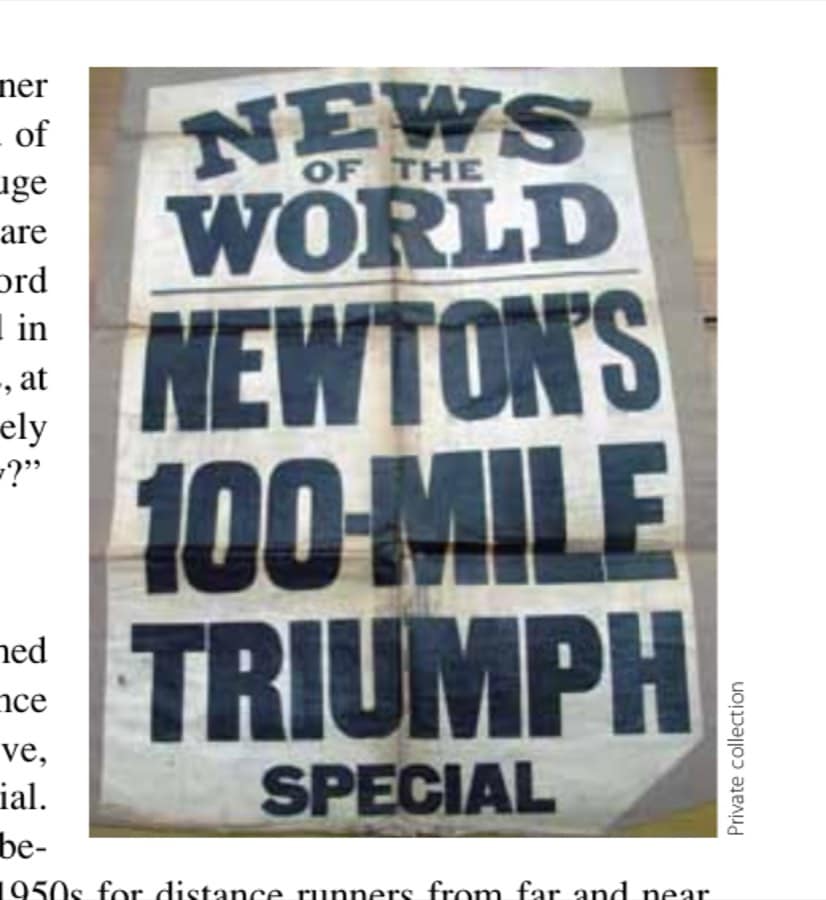
After leaving Newton to his bath, Binks sat down to compose his report. He was incredulous as he tried to analyze what he had just witnessed. He began filing his report for that weekend’s News of the World: “I am doubtful we shall ever see the
like of this marvellous distance runner again,” he wrote. “We have heard of our fast miles, flying sprints, and huge shot puts, but do they really compare with Newton’s magnificent record of running 100 miles on this road in tremendous heat, up and down hills, at just over seven miles per hour? Surely it is the running feat of the century?”
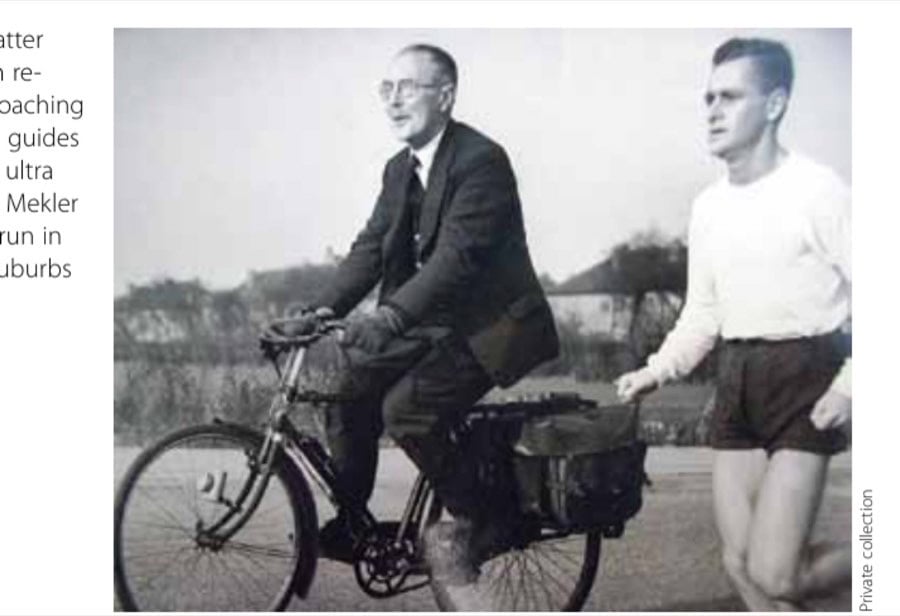
After retirement, Arthur Newton turned to coaching and writing about distance running. His views were innovative, shrewd, and sometimes controversial. His home in the London suburbs became a magnet in the 1940s and 1950s for distance runners from far and near. Champions and novices alike turned up to visit their hero. They enjoyed endless supplies of tea, cake, and advice. “Tea with Mr Newton” became an essential part of any good training schedule.
Private collection
Postscript
Private collection
▲
Newton’s latter years saw him regarded as a coaching guru. Here he guides South African ultra legend Jackie Mekler on a training run in the London suburbs in 1955.
Rob Hadgraft’s acclaimed biography, Tea With Mr Newton, was published as an illustrated hardback in 2009 (foreword by Professor Timothy Noakes) and can be obtained from www.desertislandbooks.com (ISBN: 978-1-905328-64-2).
This article originally appeared in Marathon & Beyond, Vol. 17, No. 4 (2013).
← Browse the full M&B ArchiveMore like this
1,000+ stories from 19 years of Marathon & Beyond
The complete archive of the legendary long-distance journal — digitized and free to read.
