

The Glam Circuit
Completion by an individual of a quartet of 100-mile races in the continental United States in four summer months of one year—Western States in California, Vermont (yep, in Vermont!), Leadville in Colorado, and Wasatch in Utah—is considered the “Grand Slam” of ultradistance in the United States.
I would like to introduce you to a concept in ultrarunning that has been popularized recently in the tennis and golf worlds: the career grand slam. Completion of the ultradistance grand slam (hereafter abbreviated as the GLAM) in one year has been done, but as Roger Federer found out in 2009, it is quite an accomplishment for an individual athlete to finish a grand slam in any sport in a career’s worth of competition.
Unlike athletes in other individual sports, finishing a 100-mile race is often more of a team sport with some manner of help, support, and pacing late in the race provided by friends, significant others, and sometimes complete strangers, usually referred to as the runner’s crew.
Guido Ferrari, a physician like me and a native of Italy who now lives near me in North Carolina, finished a career grand slam of the U.S. grand-slam circuit with completion of the Vermont 100 in July 2009. His ultra career began with several races earlier in the decade, but his serious GLAMMING started with the Western States 100-miler in Northern California in 2005. The WS 100 is the first of the GLAM events in the calendar year, and entry is by lottery with only 250 slots available in a given year, making attempts at the one-year version of the GLAM as much a matter of luck as of determination. Having limited experience with the 100-mile distance and having limited free time, Guido had wisely decided to take these races one per year, and his plan was thus to take at least four years to see how he would handle the distance and to explore all four courses.
Western States 100, June 2005 Being a lifelong East Coaster and not wanting to encourage my friend in what seemed to me an exercise in foolishness, I missed Guido’s initial toe dipping into
© Walter Fowler
the GLAM ocean. I thereby sealed my fate in eventually becoming a third baser of GLAM crewing to his home run of GLAM running. In the WS 100, Guido was crewed by our long-time friend Bryan, who lived relatively close to the race, as he was based in Oregon. Guido was also supported by his long-suffering significant other (and wife), Lisa.
Ultraraces in the western part of the United States have in common dryness and altitude as well as occasional snow. The WS 100 starts at Squaw Valley (now called Olympic Valley) near Lake Tahoe in the Sierra Nevada of California. Unfortunately for Guido and Lisa, through circumstances that I don’t really understand—more than one Squaw Valley in California? Not likely—they ended up flying into Fresno instead of Sacramento, thereby adding a longer drive through the mountains to an already-long trip from North Carolina. The drive through the mountains also apparently stirred up a stomach problem in Guido that would become the weak link throughout his GLAM adventures.
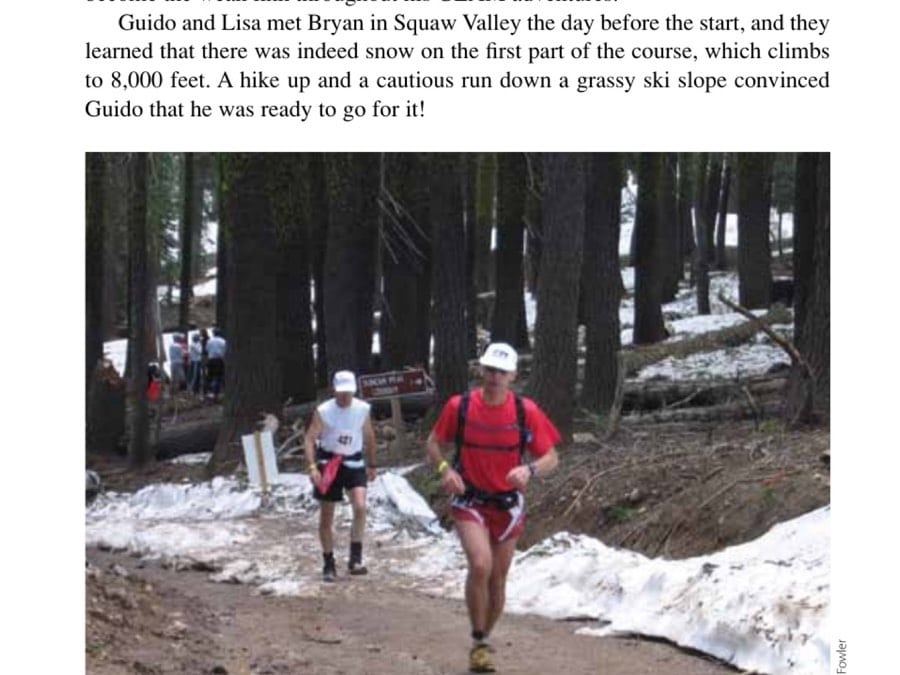
Guido and Lisa met Bryan in Squaw Valley the day before the start, and they learned that there was indeed snow on the first part of the course, which climbs to 8,000 feet. A hike up and a cautious run down a grassy ski slope convinced Guido that he was ready to go for it!
▲ Western States 100. Guido in the snow, 24 miles into the race, before getting scorched in the canyons of Northern California later in the race.
On race day, the early-morning slog through the snow gave way to an afternoon trek through blistering canyons and high points such as Devil’s Thumb that cross a desolate section of Northern California where several of the aid stations are supplied only by horseback or all-terrain vehicles. The course demonstrates what is characteristic of 100-mile races—that is, the aid station as oasis. This is exemplified by the fanciful names given to the more remote aid stations; a name seen in several of the GLAM races is Margaritaville. Volunteers, who outnumber the runners of the GLAM events by three to one or more, stock these stations with more than the necessities of life, outdoing themselves with charcoal grills, Tibetan prayer flags and bells, stuffed animals, and, above all else, loud music. These can seem to be spectacular mirages for weary runners trudging toward a noisy, brightly lit, Times Square-like flurry of activity at night in the middle of the wilderness.
Volunteers at each station take care of the runners who, late in the race, usually can’t take very good care of themselves. Families or other crew members (with the exception of pacers) are often not allowed access to the runner until the volunteers are through with them. This allows the medical personnel at the aid station to determine the physical status of each runner, which may include weight checks or even a more formal medical evaluation of the runner’s ability to continue the race.
It’s hard to leave the oasis and return to the darkness and the gnashing of teeth. Loneliness is tempered if and when a pacer joins the runner, but rules prohibit pacing until the second half of a 100-miler. The pacer is also prohibited from carrying supplies for the runner or, in ultra jargon, acting as a “mule.” Runners handle loneliness in different ways. Guido, among his many quirks, developed the habit of carrying a large stuffed bunny rabbit on top of his hydration pack; as a result, he became known as the “Bunny-man,” as in “I’m not going to let that Bunny-man beat me!” Of course, such rhetoric ignores the motivational value of a connection, however tenuous, with the Energizer Bunny.
In spite of (or perhaps because of) these quirks and with Bryan pacing him continuously for the last 40 miles, Guido kept moving down the trail throughout the night and back into daylight. The 100-mile course has a slight net downhill profile but finishes with an uphill and a final lap on a high school track, to add further insult to already considerable injury. Nonetheless, Guido bagged the first leg of the GLAM with a time of 26:51.
Although the GLAM events are spread across the country, the majority of runners at each are in-state. To complete the GLAM circuit, you have to be willing to travel, in the process becoming a circuit rider/runner. At Western States and in other ultras, Guido met people from other parts of the country, all of them with the same goal, notably Liz from Arizona. She was the veteran of several of the western ultras, and she persuaded Guido to choose the Leadville Trail 100 as his next leg.
Leadville Trail 100, July 2006 Seeing that Guido was not easily dissuaded from his fool’s errand, I agreed to join Bryan as his crew in Leadville. Bryan and I arrived in Colorado several days before the race and attempted to climb Longs Peak in Rocky Mountain National Park. We ended up turning back short of the summit due to snow and wet granite but gained some valuable time at altitude. Leadville’s altitude is 10,000 feet, and it is the highest town of its size in the United States. The 100-miler is an outand-back course that starts and ends in the town of Leadville. The course climbs over a 12,600-foot pass (euphemistically called “Hope Pass”) before descending to the turnaround at about 10,000 feet, which means—you guessed it!—the trail climbs back over the 12,600-foot pass to finish back in Leadville.
Guido had also traveled to Colorado a couple of days early to acclimatize, and we met him in Leadville at a Super 8 motel owned by a couple from Switzerland. I’m not making this up. Having been short on Longs and wanting to bag some Colorado “14er” on this trip, Bryan and I hiked up Mount Elbert the day before the 100-miler while Guido sat around back at the motel making more red blood cells.
The evening before the race, we scouted out the town of Leadville, which included mining memorabilia and the legendary Silver Dollar Saloon. It’s not true that you don’t remember what you did the night before a race even if you were in a saloon and especially if you were a member of the crew rather than the runner. In fact, I remember that the place had about 100 years’ worth of accumulated dust and cobwebs, and the bartender showed us impressive ways to open up bottles of beer. I think it had something to do with opening pressurized liquids at altitude. We were in bed well before midnight, and Guido was up at 2:00 a.m. warming up frozen pancakes to welcome race day. I was the one with butterflies in my belly since I knew that Bryan was recovering from a leg injury, and I would be Guido’s only pacer for this race.
The start was in the 5:00 a.m. darkness, and Guido was smart enough to start at the back of the pack, which was 250 strong and included the legendary Dean Karnazes, Mr. Ultramarathon Man himself. The first 50 miles included several long, flat stretches, and we were able to see Guido running several times from the our position in the car in addition to filling him back up and putting him back together at the periodic aid stations, one of which was at the well-known Fish Hatchery. There were also long stretches that were hilly and inaccessible to cars, including two aid stations where Guido was on his own. It was during the first climb up to Hope Pass that Liz taught Guido the rudimentary shuffle and jog of ultrarunning, but she was more experienced and was able to shuffle and jog more efficiently and pulled away. As Guido got closer to Winfield, the halfway point and turnaround, Bryan and I discovered that Guido had miscalculated his expected arrival time at that aid station by over
© Walter Fowler
an hour—not a huge problem in a 100-mile race but still a mental challenge for the runner. The Winfield aid station was high up a valley where there were pens with horses, allowing for some horsing around during the interminable wait for the runners. Guido finally rolled in (it was downhill from Hope Pass) and loaded up. It was here that I joined him as pacer for the climb back up to Hope Pass, and within five minutes of our leaving Winfield, it began to sleet. Weather had not been a factor up to now. Although the sleet stopped after 15 minutes, the trail back up to Hope Pass turned into slippery mud. We did a lot of walking up that slope and were passed by several other runners and their pacers. I wasn’t used to getting passed if I could help it, but Guido had a cooler head. “It’s a long race.”
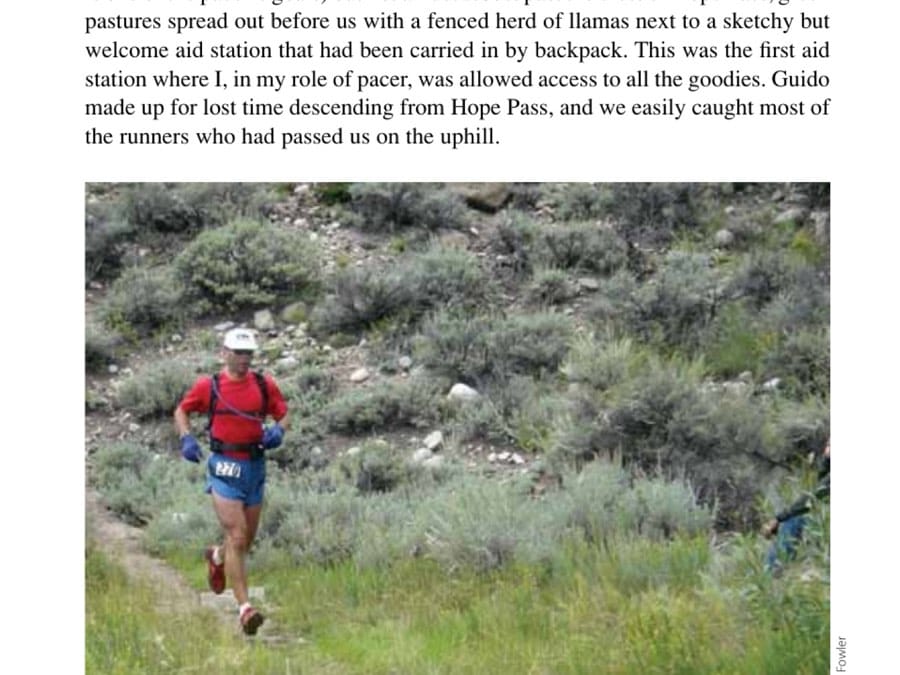
I tried to pass the time by announcing readings from my altimeter watch: “Guido, we just passed 12,000 feet!” Guido was distracted (distracting the runner is one of the pacer’s goals) but not amused. Just past the crest of Hope Pass, green pastures spread out before us with a fenced herd of llamas next to a sketchy but welcome aid station that had been carried in by backpack. This was the first aid station where I, in my role of pacer, was allowed access to all the goodies. Guido made up for lost time descending from Hope Pass, and we easily caught most of the runners who had passed us on the uphill.
▲ Leadville Trail 100. Guido moving well at 40 miles, before the first climb to the course’s high point, Hope Pass, at 12,600 feet.
© Walter Fowler
Just before we reached the Twin Lakes aid station, where I was planning on stopping, we had to cross a small river, which soaked our running shoes. On the far side we went off trail for a couple of hundred yards, and I proved my worth as a pacer by getting us back on trail. After all, I had to get to the next aid station so I could stop. It was getting dark, and Guido still had 40 miles to go.
The next 16 miles were unreachable by car and also included some of the roughest terrain with the poorest footing, and it was now night. As soon as Guido turned on his headlamp, he realized the battery was low. The trail at night is marked by glowing-green light sticks hanging from trees—approximately a quarter mile apart! Guido felt his way along this stretch, trying to stay close enough to other runners that he could follow their lead and even borrow their stray light.
Guido was now on his own, and Bryan and I could do nothing but wait at the Fish Hatchery aid station where I was preparing to start pacing again. Our runner and his crew had some trouble finding each other in the dark, and in these circumstances the runner often takes it out on his crew until he is gently reminded that he still has 24 miles to go, with a pacer for most of it. I don’t think that Guido or I wanted to think much about that next 10-mile stretch since it was hilly and dark and Guido’s legendary stomach problems made their first appearance of the day. We did finally make it to the last big aid station, the May Queen, after circling it for what seemed like hours, all the while hearing the loud music and seeing the lights through the trees.
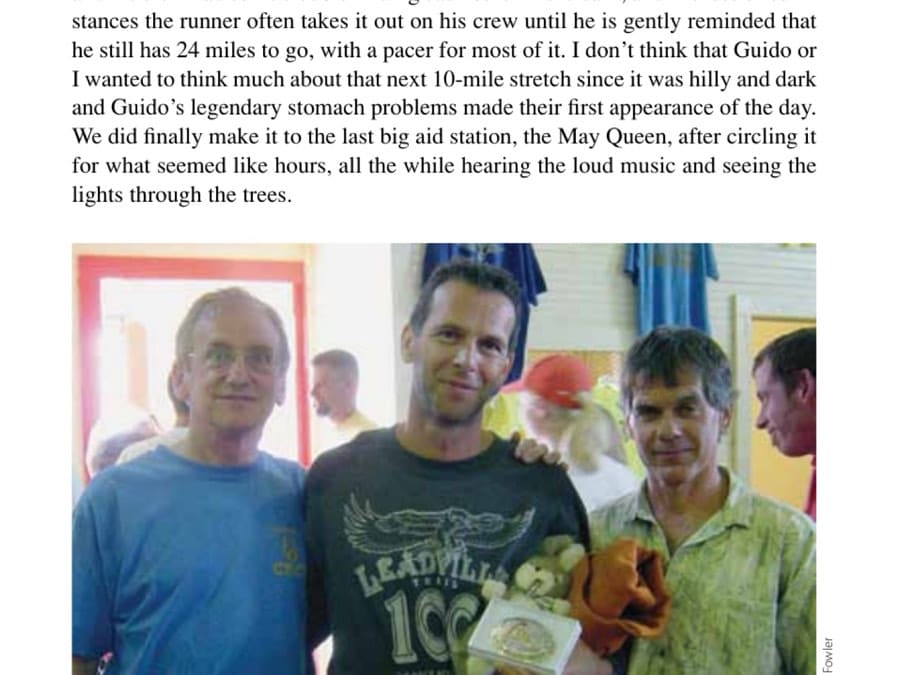
▲ Leadville awards ceremony. The team and the belt buckle—(left to right) the author, Guido, and Bryan.
Bryan and I sent Guido off on his own again one last time, and I took another short break before joining him four miles later for the final push into Leadville. It was getting light, and we were starting to catch other straggling runners. As we moved into the outskirts of town, Guido caught sight of his friend and mentor, Liz, who was walking the last few miles to the finish. She had lost her pacer in the dark, which is not as bizarre as it first sounds in a race like this. We walked and ran the rest of the way in with Guido finally pushing Liz ahead at the finish so she would pick up 98th place to his 99th. He had passed at least five other runners in the last 10 miles and finished in a time of 28:02—not bad at that altitude.
Guido developed swollen hands and feet and became hypothermic just after the finish, and we carried him back to the motel and put him to bed. He was able to recover in time to go to the awards ceremony and pick up his prized belt buckle for breaking 30 hours. I had purchased an inexpensive Leadville 100 keychain that was almost as nice.
Wasatch 100, September 2007 Wasatch is the last of the four GLAM events in the calendar year but is generally considered the hardest course, and Guido did not want to save it for last. Bryan and I were met at the Salt Lake City airport by our runner, acclimated and only slightly hyper, on Friday morning before the Saturday race. Guido navigated the rental car (which smelled like an ashtray) to race registration at the Sugar House. From the name, you would have expected that serious carboloading would be taking place, but alas, no victuals were to be had. Guido signed up and got his race number as well as spiffy hats for his loyal and dedicated crew members. After dropping all our stuff at the hotel room (which also smelled like an ashtray) and having some lunch in an Italian restaurant, we headed back to Sugar House for prerace instructions (and surely some carbs this time!). Alas, the race director said “Good luck” and little else and decided to not spoil our dinner by offering us any refreshments. We had a nice prerace dinner in a different Italian restaurant. The rest of the evening at the hotel room was filled with packing and other prerace agonizing and at least one more visit to the local REI for last-minute gear, including some magic European electrolyte tablets, of which you will hear much more later.
After a few restless hours of sleep, we were up and heading north to the 5:00 a.m. start in our ashtraymobile. Luckily, we took some deep breaths of fresh air on the way from the hotel room to the car.
We found the start at about 4:00 a.m. without much trouble and spent much of the next hour unsuccessfully trying to persuade Guido to wear a headlamp. It would not be the last time that our runner would bristle at receiving sage advice from his handlers.
So it was off in the dark toward Chin Scraper Hill for our hero and back to the ashtraymobile (from here on to be noted as the ATM) for the loyal crew. I
can allude to only sketchy information regarding Guido’s experience during the first part of the race, which I suspect may be due to a memory lapse so typical of posttraumatic stress disorder—something about terrain nearing the vertical in slope and black shapes swirling around him (remember, no headlamp).
We crew members, on the other hand, had found a Starbucks open at 6:00 a.m. and had enjoyed lattes and also bought a Grateful Dead CD to help pass the stultifying hours of mind-numbing boredom that we knew lay ahead. The drive into and up the canyon to the first (for the crew) aid station was a perilous, twisting, guardrail-less dirt road with 500-foot drops on the exposed side of our surefooted ATM. We were enjoying “Friend of the Devil” on the stereo (in which Bryan pointed out reference is made to spending the night in Utah in a cave up in the hills) when we were chased down and passed by a herd of thundering ATVs containing men and boys in camouflage suits carrying bows and arrows. (I did not imagine this! Bryan saw them, too.)
We reached the aid station and learned that it was bowhunting season; the course monitors were warning the hunters to avoid shooting two-legged deer. I wanted to test my bum right knee and ran up the trail to a ridge and yelled at Bryan to follow me. The sun was coming up! It was great to be up here in the mountains. Bryan got busy with his camping stove and filled a thermos with specially brewed tea “just like Guido likes it.” I watched intently, knowing that I would be on my own as the tea brewer at the 75-mile mark at about 5:00 a.m. the next morning. Interest and alertness on the part of the crew had started to fade by the time Guido rolled in, but we tried to show some enthusiasm. He was right on his predicted pace!
I snapped a few pictures, and he was off up the trail where we had seen the spectacular sunrise a few hours earlier. We renegotiated the winding road out of the canyon and were back in civilization briefly before we headed up another canyon to the next aid station—the 30-mile mark.
This canyon road was paved, and I believe that there were guardrails. There was supposed to be a monument to the Pony Express riders who had traveled this route in years past, but we never found it. I did have to slam on the brakes on one occasion when a mule deer decided to cross the road less than 10 feet in front of our speeding ATM. For easterners, mule deer are big deer with long ears—think big jackalope. This aid station was on a mountain pass, and it was windy. The bowhunters had followed us here, but they were all on foot and promised to stay away from the two-legged deer.
The aid station was filled with Jolly Roger flags and Tibetan bells that were clanged every time a runner was sighted. We missed the leader by about 15 minutes and were told that his lead was growing. We took the opportunity to do some reading and take some naps. I also walked up along the trail through an aspen grove to a ridgeline with great views of the valleys and other mountains.
Guido finally ambled in, still looking pretty good and still pretty much on his predicted schedule. He proceeded to down several cups of soup using the “don’t bother to swallow” technique. A single cough was followed by his first stomach-emptying event of the race. We assured Guido that he would be better off having gotten over the stomach problems early, and he headed up the trail shouting back at us that the new water in his CamelBak wasn’t cold enough. There was, however, a magic European electrolyte pill in the water—a fact that would soon become critical.
Bryan and I descended to civilization again and headed up Interstate 80 for the truck-stop aid station right off the highway that also marked the 53-mile point in the race—the point where crew members would finally get a chance to join the run as pacers.
The view looking in the direction from which the runners would be coming was nice enough, but the noisy interstate was right behind us. Bryan and I settled down with a couple of hundred other families and friends. Many pacers, including me, were to start at this point so I got suited up, initially with running shorts, a T-shirt, and windbreaker, but as the sun steadily sank, I put on more and more clothes.
The wait was becoming longer than expected, and finally it was dark and there was no sign of Guido. When he finally struggled in, he explained that he wasn’t able to drink any of the water in the CamelBak because it tasted like urine, due
ad
© Walter Fowler
▲
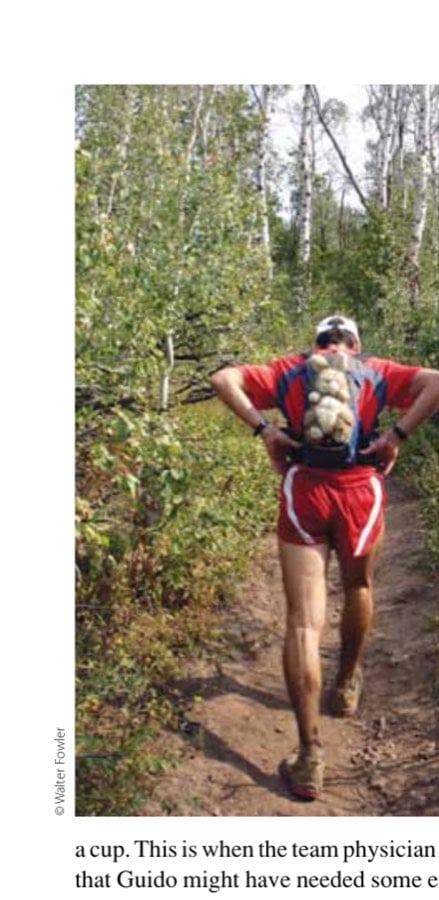
Wasatch Front 100. Guido climbs into an aspen grove just before his evening of discontent, 40 miles into the race.
at least in part to those magic European pills that he had decided to add at the last minute. Although he was visibly trembling, Guido wanted cold water instead of the hot tea that we were pushing. He
babbled something about having to keep his core temperature down as he nearly vibrated out of his chair due to violent shivering reminiscent of rigors seen in severely ill patients. His hands were shaking so much that he
had trouble drinking from a cup. This is when the team physician in me demanded to be heard. I had expected that Guido might have needed some encouragement to continue at this point, but I now found myself wondering whether the team physician (me!) could or should
permit him to continue. The crucial factor in my decision was that I would be leaving the aid station with Guido as his pacer and could therefore keep an eye on him. I demanded that Guido put on all the extra clothes that he had in his gear
bag, and he reluctantly agreed. As Guido headed out of the aid station into the dark (with headlamps on this time), Bryan urged me to be Guido’s doctor at this point instead of his friend. Guido and I walked briskly uphill for the next three to four miles, and he
rapidly warmed up. By the time we reached the ridgeline that was the high point of this stretch, he was good to go. The trail ahead was called the most technical downhill of the course (whatever that meant) as well as the coldest. Apparently,
that was all Guido needed to hear, and he took off like a bat down the trail. I learned that “technical” probably meant “dangerous,” as I tried to follow without falling as the sketchy trail ahead was lit only by my headlamp.
I decided to cool it and yelled ahead to Guido that I would catch him at the bottom when he started walking uphill again. On the downhill, we both passed many of the runners and pacers who had passed us on the uphill, and I caught Guido soon after the trail spilled out onto a relatively flat, cold road along a creek. Unfortunately, a mile before the next aid station, Guido started throwing up again. We waited for his stomach to settle down and continued our uphill walk in the dark to the aid station, where Bryan, wrapped in a sleeping bag, was waiting for us.
This aid station was equipped with a propane heater, and Guido sat down next to it and told us not to talk to him for the next seven minutes. A few minutes later, another runner sat down next to Guido and started talking about the next stretch. They chatted, and we encouraged Guido to eat and drink whatever he could. Bryan was ready to take over as pacer (for the next 40 miles!), and as soon as Guido was ready to roll they headed back into the dark. I would see them only one more time before the finish—the aid station at 75 miles, where their predicted arrival would be around 5:00 a.m.
I had four to five hours before I had to be at that aid station, so I decided to drive there, park, and get some sleep. I got a little ahead of myself and almost fell asleep on the drive down the canyon road along the creek, but I managed to stay awake and follow the directions to the Brighton Ski Resort at the end of yet another canyon road. The area was completely dark, and I didn’t see any other cars, but I kept driving until I found a dimly lit building with a filled parking lot. I pulled in, set my alarm for 5:00 a.m., and fell asleep.
Before I knew it, the alarm went off, and I just managed to get the cooler, gear bag, and other accessories from the car to the building before Bryan and Guido arrived, seemingly wide awake and complaining about the poorly marked trail over the last several miles. They had passed the time by reciting every prayer they could think of. They would walk during the recitation of the prayer, and they had to run when the prayer was over.
Since I was not trading off with Bryan as pacer, I loaded them up and sent them back out into the cold, dark night along the poorly marked trail. They were heading to the high point of the course, over 10,000 feet, and they would probably be getting there around sunrise. I now had plenty of time on my hands. There were hints of daybreak. I drove back into Salt Lake City and the smoky motel room. By now I was used to the smell. I tried to get a few more winks but mostly thought about what it must be like out on the course. Apparently, the sunrise (the second of this race) at the high point of the course was the high point of the race for Guido and Bryan, especially since it meant that it was all downhill from here.
The later stages of the Wasatch course thread the wilderness between the Alta and Park City ski resorts, which is inaccessible to automobiles (even the trusty ATM), so I did not visit any of the aid stations in the last 25 miles. Unlike the first day when the bowhunters had been the only other people near the course,
© Walter Fowler
▲ Wasatch finish line, on the afternoon of the second day, Guido and Bryan coming home.
the second day features ATV drivers on the actual running trail kicking up dust and digging grooves in what was already questionable footing on some of the steepest downhills. This was the part of the course where Guido acquired the oil slick on his legs that was to be widely admired at the finish.
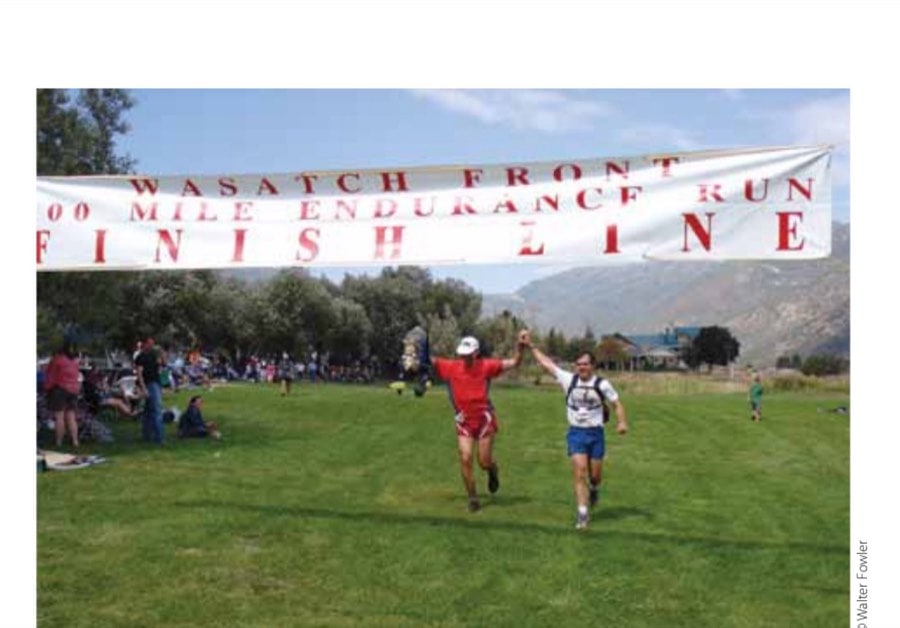
For my part, I drove around to the east side of the mountains and headed back west to Midway, the location of the finish. The finish area was picture perfect. Runners crossed a wide grassy field for the last 100 yards or so to pass under the finish banner to the applause of hundreds of onlookers sitting in lawn chairs with the Wasatch Mountains in fall colors rising in the background. I sat there looking for my charges for several hours as morning turned to afternoon. Some of the finishers looked pretty decent, like they had just run a 10-miler or maybe even a 10K, but some were definitely the walking wounded—and these people were ahead of my guy! I started to wonder if it was going to get dark again before Guido and Bryan showed up, but I managed to stay awake until I saw them start to sprint onto the grassy final stretch shortly after 3:00 p.m. Bryan told me later that Guido had started his final sprint several miles earlier, and they managed to finish together in 33:09. They actually looked pretty good if you managed to forget some of the invalids who finished in front of them.
Guido had only one desire after the finish—San Pellegrino mineral water. We had to remind him that he might want to try to clean some of that black goo off his legs before the awards ceremony. There was a hot spring called The Crater
within walking distance that I had checked out during my hours at the finish line, but the people there were not eager for our tar baby to take a dip and clean off. Luckily, we found some toilet-bowl-cleaner type solvent, and Guido’s legs eventually looked as good as new.
The awards ceremony was held next to the finish line shortly after the 36-hour cutoff was reached. A few broken runners actually straggled across the finish line shortly after the cutoff, and the crowd did its best to ignore them since we could all feel their pain.
The ceremony started with the coronation of Kyle Skaggs, who had finished the course in record time. Guido was called up for 85th place out of about 200 finishers. He was rightly proud of his effort and seemed none the worse for wear. On the way back to the motel room, we stopped off to buy several bags of ice—but no beer. Guido explained that the best way to speed recovery was to slip into a bathtub full of ice. OK.
Vermont 100, July 2009 The sole East Coast race on the GLAM circuit is unique in its altitude (or lack of it) and its lushness compared with the very dry western venues. Looking at a map shows that this race covers a relatively large portion of Vermont, which is diminutive compared with the huge western states. This last of the GLAM crown jewels had been elusive for Guido. He had attempted the Vermont 100 in 2008 but had traveled to the event without his most important asset—his crew. He had had early stomach problems and missed a weight check at 47 miles, meaning that he was pulled from the race. This first DNF of the GLAM series made it imperative that I crew for him in 2009.
Shortly before we left for the race, we were joined by Lynn, a visitor from South Africa and a veteran of several long-distance multiday mountain-bike races in Africa. The Vermont course featured flora and fauna quite different from those found in South Africa, and although there were fewer GLAM cowboys than in the western United States, this race had horses. In fact, the Vermont 100 is unique in including a parallel race for horses and riders (mostly English style). Humans and horses run the same course but have a staggered start so that the winners of both races finish at approximately the same time. Although the humans have mandatory weight checks, the horses have more extensive veterinary checks at several points. Understandably, the aid stations in the Vermont race are called “handler stations,” and the goody tables include sweet grain.
Our departure from North Carolina in the middle of a work week was stressful, but the trip up the East Coast to Vermont was a breeze. The only hitch was arriving at White River Junction in time for a late supper and having Guido drive around in circles for another hour looking for “the Italian place where I ate last
year”—not an auspicious beginning for someone who had dropped out last year. We finally settled on a café that was still open, and it had San Pellegrino umbrellas over some outdoor tables! Things were looking up, but we needed the umbrellas for the light rain that passed overhead.
The next day was dedicated to acclimatization, though altitude was not an issue in Vermont. “The highest humidity we’ve had all summer,” reported the Friday-morning TV news. Guido and I went for a short run into the fog, which kept visibility at about 200 feet. The fog soon burned off, and we trekked down to Silver Hill meadow, the start of the 100-mile course, for Guido’s weigh-in. It goes without saying that Guido had skipped breakfast to keep the prerace weight as low as possible.
It turned into a beautiful day up in the Vermont woods, and we followed the course for several miles on the way to the Vermont equivalent of REI—a big red barn by a large field of flowering mustard weed where we rented a mountain bike for Lynn. We then toured the Woodstock area, crossing the 100-mile route a few more times and passing several covered bridges before returning to the San Pellegrino café where Guido had arranged for a prerace pasta supper to make up for his skipped breakfast earlier in the day.
We slept Friday night thinking about the predicted Saturday-morning rain and awoke to find the prediction correct. Guido gobbled down several frozen waffles and donned his plastic garbage-bag rain garment, and we were off to the 5:00 a.m. start.
Runners, crews, and well-wishers crowded into a huge, dimly lit tent at Silver Hill meadow. No one was in a hurry to leave the tent and walk over to the starting line in the rain, but everyone eventually did. The only lights at the start were the runners’ headlamps, and I could not pick Guido out of the crowd as the pack started moving slowly down the hill and out into the early-morning dark. Shortly after, car headlights started blazing, and the crews and families were on their way to the first handler station at 21 miles.
We didn’t see the horses start, but they were everywhere in evidence by the time we arrived at the first station. By then it was light and sunny, and we noticed that the station was located by a brick house that was dated to the late 1700s. A female volunteer at the station noticed Lynn’s South Africa sweatshirt and introduced herself as a fellow countryman who had moved to the States a few years ago. They had a quick chat, and Lynn mounted her bike to ride back and find Guido. This was to become a pattern: Lynn would ride back up the trail, and then Lynn and Guido would appear together at the handler station after a variable period of time.
Early in the race, Guido was in good spirits but slightly behind his optimistic schedule. The scenery was spectacular: rolling hills and meadows with occasional houses, barns, and, of course, covered bridges.
There was a large block of time between the second and third stations, and Lynn and I drove back to a restaurant we had noticed the day before in our touring and had lunch. We even had time to visit a farm that manufactured maple syrup and other local delicacies before we had to get back to the matter at hand—searching for big bottles of San Pellegrino and then getting to the fourth station before Guido arrived. We actually drove past Guido on the road to the fourth station. It was the hottest part of the day, and everyone was walking that stretch. Although possibly against the rules, we were able to supply Guido with his special ice-filled bandanna, hoping that this gesture of humanity would be forgiven by the race organizers and the other runners.
After a few more stations, it started getting dark again, and I knew that my seven-mile leg as Guido’s pacer was coming up. My leg with Guido started with a steep, muddy uphill but also included an open ridge top where we could see the last of the daylight disappear, followed later by a large pasture with a black sky filled with diamonds. Even in the muddy sections, the footing was far superior to our experience out West, where it was hard to place your foot without stepping on a rock. Our runner had now been making forward motion for 18 hours and was more than 70 miles into the 100-mile course. Runners were strung out along the course and were eaten by the darkness. A certain camaraderie was maintained by
ad
© Walter Fowler
distant hooting and hollering in the woods, especially when a welcome downhill became evident and by the glow of headlamps and green light sticks hanging from trees ahead and behind. Nonetheless, I was happy to let Randy, the volunteer
pacer, take my place at the next station. He had run this part of the course several times before and was confident that he could get Guido to the finish. There were few stations in the last 30 miles, and Lynn and I decided to drive
back to the motel where I could shower. It was still dark as a dungeon, and we were lucky to find our way back to the next station—a station that was truly in the middle of nowhere. “Bill’s station” had the usual amenities but also had cots,
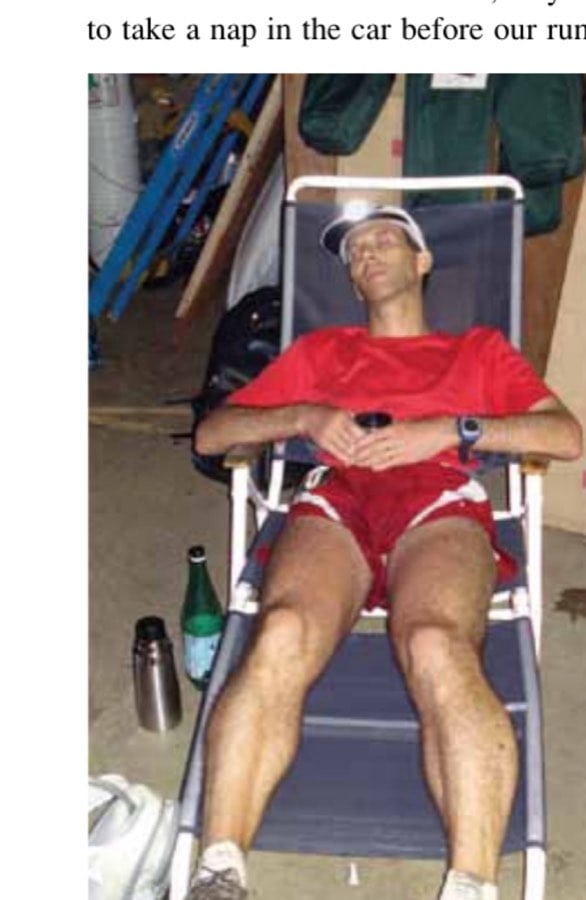
which appropriately looked like hospital stretchers, many of which were in use. When Guido and Randy straggled in, they found their way to recliners, and Guido promptly fell asleep. Lynn and I looked at each other, not sure what to do,
but after a minute I woke him up and we escorted them out of the light, back into the dark, and on their way. There was one more station, only four miles from the finish, but we had time to take a nap in the car before our runners would arrive. Other crews were do
ing the same, and we were sung to sleep by frogs in a nearby pond. By the time the alarm went off, it was getting light again, and it was a little nippy. As the barns turned from gray to red and the sun came
up, our boys weaved their way up the road to the last station. Runners were pretty spread out at this point. Guido and Randy were alone on the road and seemed to be propping each other up. Four miles to go, and
they were off, initially downhill, toward the finish. Unfortunately, we, the intrepid crew, had left Guido’s fancy Italian thermos at Bill’s station. We raced back to get it and headed toward the start/finish area so we could see him finish. It wasn’t to be.
▲
Vermont 100. Guido snoozing at 75+ miles before the final push to the finish.
© Walter Fowler
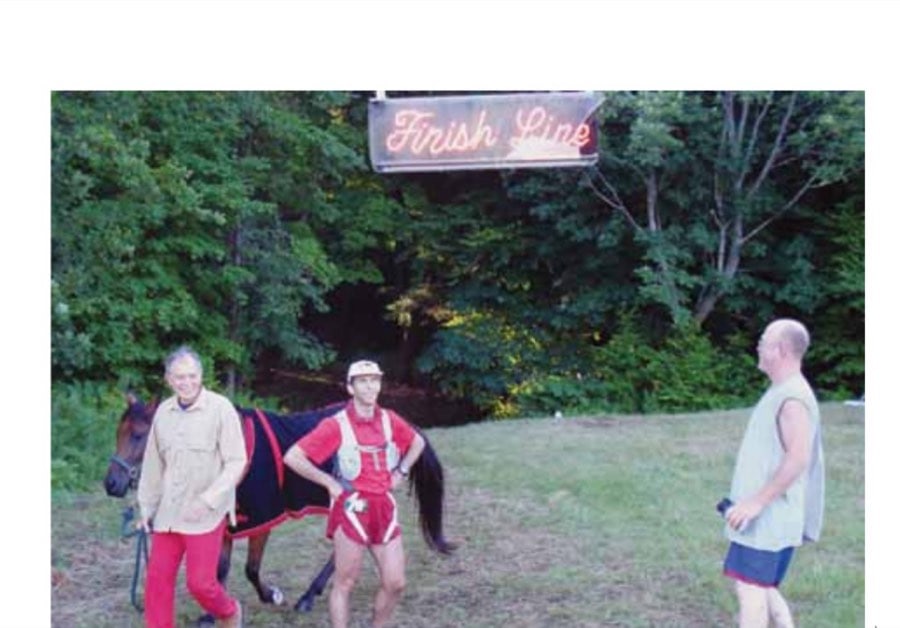
▲ Vermont finish line. Guido, Randy, and an unidentified horse and rider.
We had twice been able to find Bill’s station, but this time we got lost on the way back to Silver Hill meadow. By the time we arrived at the finish, Guido was sitting shoeless waiting for Randy. True to form, Guido had sprinted the last mile, whereas Randy had steadfastly maintained his pace, ready to pick Guido up again if he ran out of gas before the finish. There were still horses and riders finishing, too, giving a slightly western flavor to this most eastern of the GLAM events. After Guido was resuscitated with San Pellegrino, he insisted on driving Lynn and me back to the Hartford airport, two hours away. He stayed awake driving just fine, but he crashed on the plane.
Epilogue Guido had done it. He had GLAMMED, been GLAMMED, gotten GLAMMED, and touched all four bases in a five-year career. Bryan and I each had three to four years of crewing but were stuck at third base. We had not yet reached our full crewing potential—the career-crewing GLAM. Guido, of course, is not content with the career GLAM and is threatening to attempt the traditional one-year GLAM. We’ll see about that. But in the meantime, we be GLAMMIN’!
This article originally appeared in Marathon & Beyond, Vol. 16, No. 4 (2012).
← Browse the full M&B ArchiveMore like this
1,000+ stories from 19 years of Marathon & Beyond
The complete archive of the legendary long-distance journal — digitized and free to read.
