

The Great Six-Day Races
Here’s a quick summary of Part I of The Great Six-Day Races, which appeared in the premier issue of Marathon & Beyond. — Editor
In the late 18th and early 19th centuries, eccentric athletes known as “pedestrians” extended the concept of how far man could travel under his own power. Englishman Foster Powell covered 100 miles in 22 hours in 1788, and fellow Brit Captain Barclay surpassed that by covering 100 miles in 19 hours in 1806. Those marks were made to seem . . . well . . . almost pedestrian in 1874 when Edward Payson Weston walked 500 miles in six days at the Washington Street Rink in Newark, New Jersey. Fired by Weston’s accomplishments, Chicago Irish immigrant Daniel O’Leary set out to overtake Weston. In November 1875 the two met in a six-day duel, which O’Leary won by covering 503.33 miles to Weston’s 451.6 miles. Weston, who had never wanted to be tagged “champion” in the first place, had been vanquished. Both men looked east, to England, to find new worlds to conquer.
CHAPTER 3: TWO AMERICANS STORM BRITAIN
The English sporting press refused to believe the accomplishments of Daniel O’Leary and Edward Payson Weston. In fact, many were willing to wager large sums of money that neither O’Leary nor Weston could duplicate their performances when watched by English scorers.
Weston, aware that he was now a dethroned king and considered by many in the United States as an over-the-hill failure at age 36, sailed for England in January of 1876. While Weston had been soundly defeated by O’Leary, he knew that there were, at present, no English walkers or even runners who could match him over an extended trial.
Weston arrived in England possessing an astounding but suspect reputation. The British sporting elite were absolutely convinced that no man, especially an American, could fairly cover 500 miles in six days. Their contempt for the athletic prowess of Americans shouts from the pages of Lancet, a well-respected British medical journal:
But with characteristic go-a-headness it has been reserved for the Americans to develop conditions far beyond other nations in their hygienic unwholesomeness. Living habitually in their close, stove-heated rooms, bolting their food at railway speed. . . year by year Americans grow thinner, lighter, and shorter lived. Rowing and other athletics, with the exception of skating and baseball, are both despised and neglected in America.
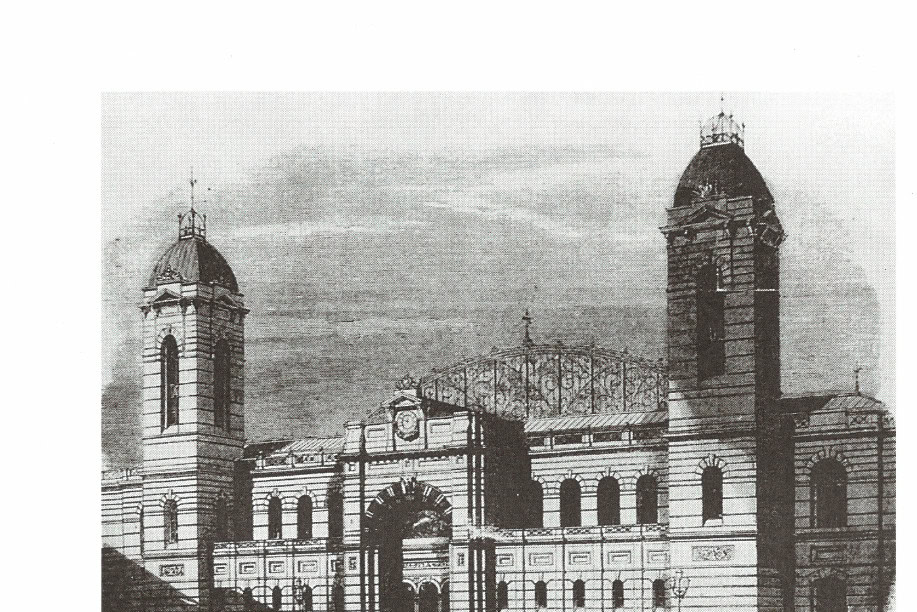
Weston’s first match in England took place in Agricultural Hall, Islington, London, on February 8, 1876. It was a 24-hour competition against William Perkins, “the Champion of England.” Weston won with 109 miles, walking Perkins to a standstill. Then, with only five days of rest, Weston walked 180.5 miles in 48 hours on February 15 and 16. At the conclusion of the event, there was “no evidence of distress perceptible. He [Weston] appeared active, cheerful, and made an appropriately expressed speech in which his tongue moved as nimbly as his legs had previously done.”
Again Weston took only five days of rest before his next competition—a walk of 275 miles within 72 hours against a little-known Englishman, Charles Rowell. During a rest period on the second day, Weston read some letters and transacted some urgent business. In the evening he led the band around the hall himself, accompanying them on the cornet. This was to demonstrate that he still possessed a great reserve of strength and was not afraid to call upon it. Within three minutes and 39 seconds of the allotted time, Weston went on to complete
275 miles. Rowell covered a mere 176 miles. Weston had walked the first 90 and the last 60 miles without a rest.
This walk, though, was not as easy as the previous two. The effort left Weston quite exhausted. He came down with a bad cold and fever for two days. He was back, however, circling the seven-lap, gravel-and-loam track inside Agricultural Hall just 10 days later. He was going to attempt to duplicate his Newark feat of walking 500 miles in six days.
The British countered with three of their best pedestrians: Newman, Martin, and Taylor. Weston again triumphed, but he walked only 450 miles. Extenuating circumstances affected this last effort by Weston, as the Lancet (now enamored with this American) tells us:
Mr. Weston has performed, not the feat which he proposed, but another which, we think, more remarkable. He has walked with a sprained, painful, and considerably distended knee-joint in the middle of the period. The praise is more justified, as Mr. Weston was from the outset very insufficiently recovered from a feverish cold which confined him to his house at Brighton with a 100-degree temperature. . . At eleven o’clock on Saturday night the pace was that of a man with whom few of us would like to walk far.
Weston had now covered 1,015 miles in competition in five consecutive weeks before 200,000 people. Weston was under constant scrutiny by the British medical profession during each of these four contests. Everything that he ingested and excreted was measured and analyzed. Numerous articles were written in Lancet, The British Medical Journal, and even the Journal of the Royal Society of England. Dr. F.W. Pavy summarized the feelings of the medical men: “We have great pleasure in bearing testimony to the genial and cheerful spirit of Mr. Weston, to the entire absence of coarseness in his athleticism, and his willingness to make his walking feats subservient to scientific purposes.” Weston had earned credibility among the British sporting elite.
Weston walked 450 miles in six days once more in Edinburgh, Scotland, from June 19 to June 25, 1876. He then accomplished what all Great Britain had been waiting for. From September 25 to 30 at the Toxteth Park, in Liverpool, he covered 501 miles within 144 hours.
In the eight months that Weston had been in England he had won $30,000 and made a host of rich, influential friends. One of these was Parliament member Sir John Dugdale Astley, who was known as the “Sporting Baron.” Astley was the epitome of the Victorian sporting gentleman. He had a large stable of horses, which he raced often, and he financially supported any athletic endeavor he considered worthy. Weston’s performance had so impressed Astley that he offered to back Weston for 500 pounds sterling a side against “any man breathing” in a six-day contest.
Besides stirring the hearts of thousands of spectators, Weston’s achievements had stimulated the British pedestrians to realize that there was a great deal of money to be made if an Englishman could defeat Weston. They watched and studied him and gradually learned the intricacies of competing for protracted periods of time. How well they learned their lesson was exhibited by Peter Crossland in Manchester, on September 11 and 12, as he covered 120 miles and 1,500 yards in 24 hours, a world-record performance that caused quite a sensation.
Since Weston had left the United States, O’Leary had dominated the pedestrian scene. His popularity spread from Chicago throughout the United States. In April 1876 he covered 500 miles in 139.5 hours at the Mechanic’s Pavilion in San Francisco.
In August, at the American Institute Building in New York City, O’Leary walked 500 miles within six days for the third time. In order to show their appreciation of O’Leary’s accomplishments, his friends entertained him at a
banquet at the Union Square Hotel on August 28 and presented him with a gold watch.
The reports of the furor created by Weston in England and the success O’Leary had met with in the United States induced the Irishman to look across the Atlantic. A more personal motive also drove O’Leary 4,000 miles to compete. Weston had told the London press that his six-day match with O’Leary in November 1875 had been tainted by “foul play.” Weston claimed that the people in Chicago had thrown pepper in his face and threatened to shoot him. O’Leary was determined to show that he had won fairly and to remove all doubt about who was the best six-day walker in the world.
Upon O’Leary’s arrival in England in October 1876 an exhibition was immediately arranged to provide him an opportunity to better Weston’s performance of the previous month in Liverpool. The British were still reeling from Weston’s walk when O’Leary became the second American within a month to demonstrate the superiority of American pedestrianism, as he walked 502 miles in 143 hours. O’Leary now challenged Weston. Thinking it best to avoid a direct confrontation at this time, Weston refused.
O’Leary had to be content with racing the best British pedestrians. Having observed Weston’s technique and training, they were now a far more experienced and toughened set of athletes than Weston had met nine months before. While O’Leary won his first match with Peter Crossland at 300 miles in November of 1876, he was defeated at the same distance by William Howes in December and then again by Crossland in February of 1877.
The Rematch Between Weston and O’Leary
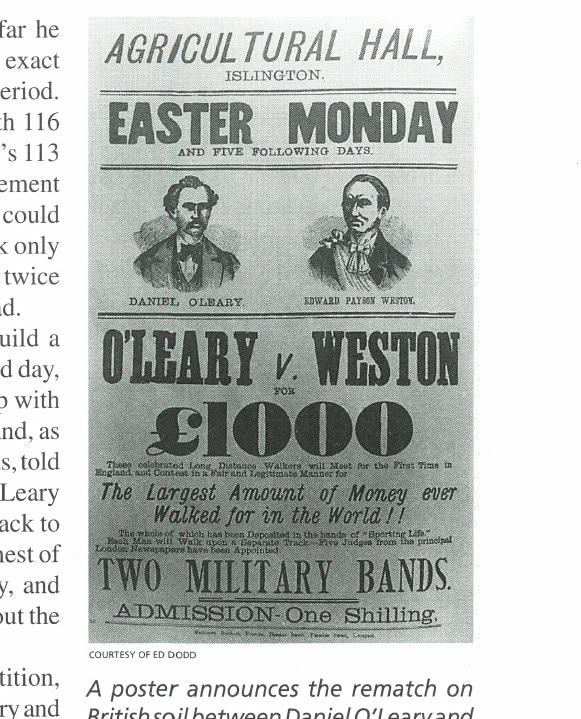
Negotiations for a Weston-O’Leary rematch had been ongoing for several weeks when the articles of agreement were finally signed on January 3, 1877. The two men would walk for six days for 500 pounds each with the winner also receiving two thirds of the gate money and the loser the balance. The editor of Sporting Life was entrusted with all the collected gate money and prize money.
Weston was backed by Sir John Astley, and O’Leary by Sam Hague, an American minstrel manager. The showdown was scheduled for April 2 through April 7, 1877, at Agricultural Hall. The two parties would appoint five judges, and if they could not agree on the rules and their application, the editor of Sporting Life would make the final decision.
Two bands—which were hired to play from 5 A.M. to 12 midnight—would be under the direction of both men at alternate hours and be discontinued while either man was sleeping. The prospect of these two rival champions meeting once again created much excitement on both sides of the Atlantic.
Weston was convinced that anyone completing 506 miles would win, and he was also confident that he would be that person. He wrote out an elaborate time schedule, detailing how far he would travel each day and the exact amount and time of each rest period.
Weston led the first day with 116 miles and 735 yards to O’Leary’s 113 miles and 135 yards. The excitement got the better of O’Leary, and he could not sleep the first night. He took only an 84-minute rest. Weston took twice as long and surrendered the lead.
When O’Leary began to build a sizeable lead early on the second day, Astley urged Weston to keep up with the Irishman. Weston refused, and, as the self-assured champion he was, told Astley he was certain that O’Leary would go to pieces and come back to him. But O’Leary was the “gamest of the game,” according to Astley, and he maintained his lead throughout the week.
On the fifth day of competition, Weston was getting very leg weary and attempted to relieve the stiffness by “all sorts of styles in his walk.” When the band began at 5 A.M., he started off in a “most suspicious manner, which finally resulted in Mr. Watson, the New York judge, objecting to the tallying of a lap.” A second judge, Mr. Conquest of Sporting Life, declared the walk fair. This left the ultimate decision up to Captain Webb, the popular long-distance swimmer who had recently crossed the English Channel in 21 hours. He said this about Weston’s walking style: “It [isn’t] much worse than [what] he has been doing since he started.” After Webb delivered this “Solomon-like” opinion, the protest was withdrawn and the lap tallied as Weston continued with his very peculiar gait.
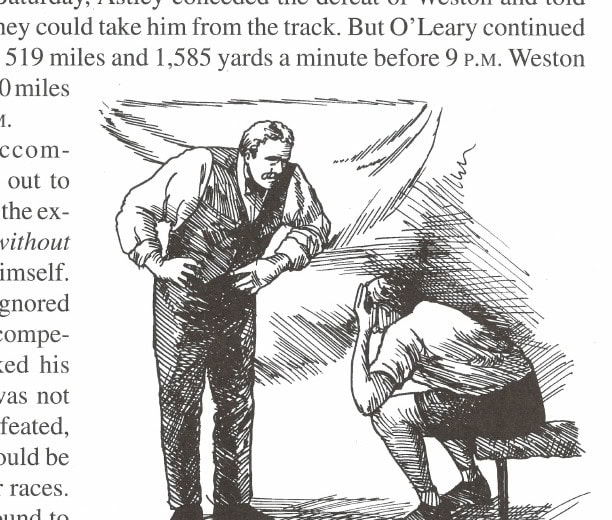
Though O’Leary was completely used up on the morning of the last day, he still led Weston by 10 miles and was increasing his lead as Weston slept in his tent. Astley was sure that all Weston had to do was get back on the track, and the race would be his. He implored Weston to leave his bed. But, as Astley recounts in his autobiography, “He [Weston] went soft, and on my telling him I should chuck some cold water on him, he burst out crying, and that settled the matter; for you can do nothing at any game with a party who pipes his eyes.”
O’Leary struggled on, and at 2:05 P.M. he finished his 500th mile. The Chicago Tribune described the scene:
Ladies waved their handkerchiefs and gentlemen threw their hats in the air, while the cheering was perfectly deafening. Bouquets began to arrive and soon the front of O’Leary’s tent looked more like a florist’s shop than anything else. The ladies who presented these would walk quietly past the barriers and hand them to O’Leary, each gift being the occasion of more vociferous cheering.
At 8:03 P.M. on Saturday, Astley conceded the defeat of Weston and told O’Leary’s backers they could take him from the track. But O’Leary continued until he had covered 519 miles and 1,585 yards a minute before 9 P.M. Weston finally completed 510 miles shortly before 10 P.M.
Weston had accomplished what he set out to do—he had bettered the existing world record without totally exhausting himself. He had essentially ignored O’Leary during the competition and had walked his own race. Weston was not disturbed at being defeated, for he knew there would be other days and other races. He wanted to be around to participate in them.
Throughout the week, 70,000 people paid to witness the contest, and vast sums of money were won and lost on the race. Astley himself was covering all bets against Weston 50 pounds to 30 and lost a reported 20,000 pounds or $100,000. But true sportsman that he was, Astley gave Weston a large purse of money for exceeding by four miles the distance he had agreed to do.
The Astley Belt Races Are Born
Astley was so taken with this long-distance business (he said that he was never more excited over any performance) that he decided to inaugurate a series of six-day races for the “Long-Distance Challenge Championship of the World.” These races would not be merely walking events but “go-as-you-please” competitions, that is, the pedestrians could walk and/or run in any fashion they chose. Two conflicting reasons are given for the advent of the go-as-you-please concept.
Astley says that he proposed the concept because the peculiar “wobbling gait” of Weston was open to objection as not being a fair heel-and-toe walk. O’Leary gave a different reason. He claimed that since the American pedestrians were so much superior to the English walkers that “it was deemed necessary to invent a style of progression which would place the legitimate champions at a decided disadvantage.”
The conditions of the races, which became known as the Astley Belt Races, were originally laid out as follows:
- The winner would receive a championship belt valued at 100 pounds and a purse of 500 pounds, second place would be worth 100 pounds, and third place, 50 pounds. Other prizes would be awarded to those who succeeded in finishing 450 miles.
- A certain percentage of the gate money would be divided to defend the belt against any legitimate challenger (as decided by Astley) within three months of the challenge, but the champion would not have to compete more than once very six months.
- If the defending champion won the belt three times in a row, it would become the permanent possession of that athlete.
The championship belt was made of solid silver and gold. Five plates of silver, plain in the center, with rustic border close around the edges, made up the greater portion of the belt. One gold plate in the center, with the words “Long-Distance Champion of the World” in raised letters, was flanked by a silver plate on each side, similar in shape and border to the others, but bearing, in the center, figures of walking and running, in high relief. The plates were each about two and a half inches in width by three inches in length.
All was now prepared for what was to be one of the most incredible series of athletic contests ever to take place in the arena of sport. The Astley Belt competitions would become the “Gold Age” of pedestrianism.
Chapter 4: The First and Second Astley Belt Races
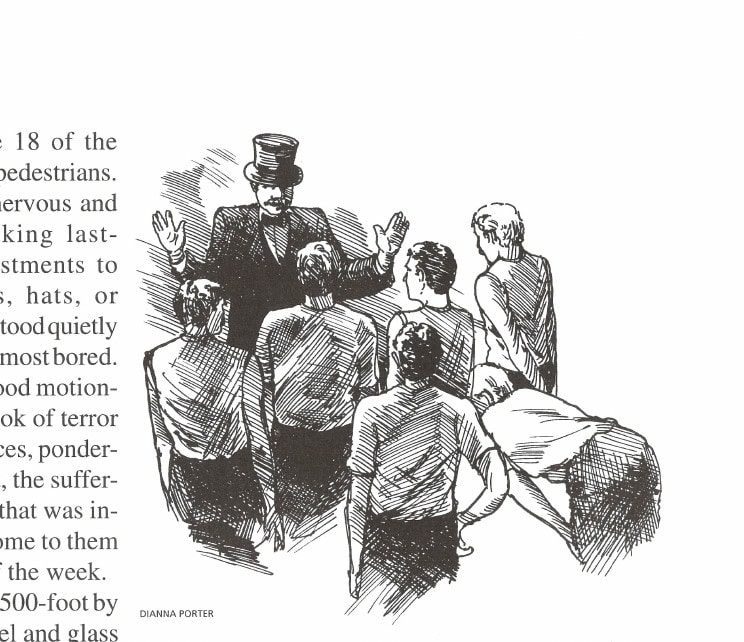
Monday, March 18, 1878—Agricultural Hall, Islington, London, England. The clock struck 1 A.M. The scorers and judges were in their places. Sir John Astley
stood before 18 of the world’s best pedestrians. Some were nervous and fidgety, making last-minute adjustments to their trunks, hats, or shoes. Some stood quietly and serene, almost bored. And a few stood motionless with a look of terror upon their faces, pondering, no doubt, the suffering and pain that was inevitably to come to them by the end of the week.
The vast (500-foot by 300-foot) steel and glass building, lighted only by three chandeliers, looked anything but festive. Two tracks—a seven-lap-to-the-mile one for Englishmen and an eight-lap-to-the-mile one for foreigners—marked the oval center of the building.
The scorers and clerks were alert and ready near the judges’ stand. The press, trainers, handlers, and the friends of Sir John (there by special invitation) filled the enclosure in the middle, around which the track was laid. No other observers were present. A New York Times reporter described the surroundings:
The great wide space of benches, set apart for spectators, looked chill and dirty. The light of a charcoal fire in a brazier fell mysteriously upon the small encampment of the pedestrians near the entrance doors. One tent stood alone near the foreigners’ track. Among the group of onlookers, the soft hats of Transatlantic visitors were conspicuous.
Sir John Astley addressed the pedestrians this way:
You are about to enter on a trying march, in which running and walking and physical pluck and endurance are necessary to compete. Every possible arrangement has been made to have a fair, straight fight, and I hope the best man will win. I appeal to you to second our efforts, for the best man to win, no matter what his nationality or where he comes from. . . . Now lads are you ready? A fair, honest, manly race, and the best man wins. Ready? Then away you go!
And so the first contest for the Astley Belt began. It had been 11 months since Astley had proposed the six-day, go-as-you-please world championship competition. The English pedestrians had used the time well. Several well-trained men were now capable of defeating the single foreign entry, Daniel O’Leary of the United States. Two in particular had conditioned themselves not only to walk but also to run. They planned to take full advantage of the go-as-you-please provision.
William “Corkey” Gentleman of London, 46 years old and a 25-year veteran of the pedestrian track, was small in stature (5’4″, 114 pounds) and had a stooping, awkward gait. He trotted “ungracefully and with a sad look on his face.” Henry “Blower” Brown, in contrast, was 6’6″, the tallest man in the field, but weighted only 138 pounds. Brown had distinguished himself in his job by the swift manner by which he carried his barrow of bricks to the kiln and back.
Before the race, both Gentleman and Brown were favorites for second place with O’Leary. The bookmakers’ choice for first place went to Chester’s Henry Vaughan, a carpenter by trade and called by Astley “a real clean-made and thoroughly respectable man.” Vaughan was admired by all, even by his fellow competitors, for his “long-striding giant-like” step and the steady pacing of his races.
Vaughan had been one of the first Englishmen to turn in a notable performance as a result of Weston’s six-day performance in 1876. In the latter part of that year Vaughan had turned in 100 miles in 18:51:35, and 120 miles in 23:45:00. Both were world records at the time.
Another hometown favorite was the novice William Lewis, 21 years old, of Islington. Just three weeks before the start of the Astley Belt, he was second to William Howes in a 26-hour contest in the same building. In that race Lewis walked 100 miles in 18:37:35 and covered 125 miles and 990 yards in 24 hours. Both of these performances were the best on record except for Howes’s performances, in the same races, of 18:08:35 and 127 miles and 1,395 yards, respectively. Lewis, however, was young, inexperienced, and untried at six days.
Weston Sits Out the First Astley
Conspicuously absent from the first Astley Belt race was Edward Payson Weston. After his defeat by O’Leary in April of the previous year, he remained in England and was quite active. In June of 1877 he walked 400 miles in five consecutive days in the Skating Rink at Bradford, and then repeated the performance in July at Bristol, in August at Newcastle-on-Tyne, and in September at Hull.
From December 26, 1877, to January 11, 1878, he walked 1,000 miles in 400 consecutive hours. Weston was in excellent condition and was expected by all to be a challenger for the Astley Belt. Weston had submitted his entry for the first Astley Belt race within the specified time period. O’Leary’s entry, however, had been late, and there was some question as to whether he would be permitted to compete. As soon as Astley decided in O’Leary’s favor, Weston withdrew, presenting a medical certificate that was regarded by many as “too thin.” O’Leary had defeated Weston both times they had met, and the prevailing opinion was that “O’Leary had made him ill.”
It was indeed a strange sight as the 18 men set about their awesome task. Some walked, some trotted, some ran. Brown and Gentleman went immediately to the front, with Vaughan and O’Leary following. An incident during the first three hours illustrates some of the brash tactics used during these events.
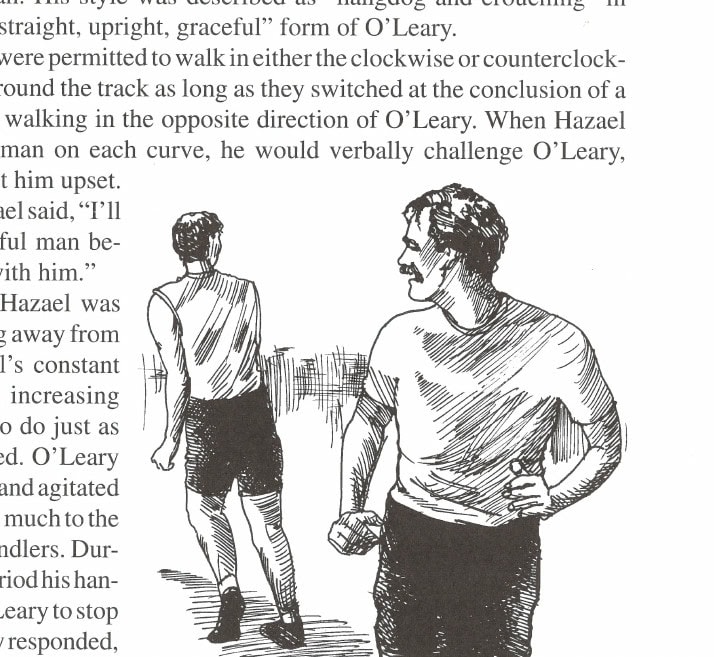
George Hazael of London began staying right up with O’Leary, “haunting him on the English track like his shadow.” Hazael was not, at this time, a well-known pedestrian. His style was described as “hangdog and crouching” in contrast to the “straight, upright, graceful” form of O’Leary.
The athletes were permitted to walk in either the clockwise or counterclockwise direction around the track as long as they switched at the conclusion of a lap. Hazael was walking in the opposite direction of O’Leary. When Hazael passed the Irishman on each curve, he would verbally challenge O’Leary, attempting to get him upset. On one turn Hazael said, “I’ll kill this wonderful man before I’ve done with him.”
At the time Hazael was gradually pulling away from O’Leary. Hazael’s constant harassment and increasing lead combined to do just as Hazael had hoped. O’Leary became worried and agitated and began to run, much to the dismay of his handlers. During a short rest period his handlers begged O’Leary to stop running. O’Leary responded, “Leave me alone. I know what I am about,” and set off again at a run to cut down Hazael’s lead.
Hazael had been threatened with disqualification several times for his conduct. The possibility of being disqualified—and the fact that he soon needed all his breath to continue moving—all but silenced the insolent pedestrian. O’Leary, walking and running, relentlessly ran Hazael down, and in the third hour passed him. Hazael quickly fell to the rear and eventually dropped out of the race. O’Leary, a bit nauseous and dizzy from his running, which was unfamiliar to him, finally agreed with his handlers to stop running and resume his standard walking form.
By 5 p.m. on Monday, Gentleman held onto a slight lead of 87 miles to O’Leary’s 83. Brown was third with 78 miles, and Vaughan fourth with 77.
The attendance slowly grew during the day so that by 6 p.m. there were 5,000 spectators encouraging the pedestrians on to glory. At 11 p.m. each night the building was closed to all people except the press and a few favored friends. This was usually the time when the pedestrians took the only real rest they allowed themselves. Generally, it amounted to two to four hours in their individual tents that were erected inside the two concentric oval tracks. On the first night, Gentleman, Vaughan, and Brown all retired around 11 p.m. But O’Leary walked on until 2:44 a.m., at which time he had taken over the lead with 124 miles.
Through the second day Gentleman’s rapid walking and occasional trotting had overtaken O’Leary, and once more placed “the thin little figure” in front. But by mid-afternoon the running began to tell on Gentleman, and by 7 p.m. O’Leary drew even at 174 miles. Brown wrestled third from Vaughan and led him by a mere mile, 170 to 169.
Gentleman then went in for a short rest. His ever-present wife, who attended to him day and night, was at the door of the tent to meet him with a steaming bowl of ellbroth, his favorite drink. His legs were in great pain, and his short rest turned into one of several hours. By the time Gentleman came back onto the track, he had lost his lead and second place as well. At 6 a.m. Wednesday the score stood as follows: O’Leary with 211 miles, Brown with 206, Gentleman with 196, and Vaughan with 191. There were still 16 men walking, but from fifth place on back, these competitors were far in arrears.
The bookmakers had moved O’Leary into the favorite roll, laying 5-to-3 odds against him. The odds stood at 5-to-2 against Vaughan, 3-to-1 against Gentleman, and 5-to-1 against Brown. O’Leary’s backer, Al Smith, the sportsman from Chicago, had wagered several thousand pounds on the Irishman’s victory, while Astley and Captain Wyndham were backing Vaughan against all takers.
Throughout the third day O’Leary extended his lead, and Gentleman slipped farther and farther behind. At 1 a.m. Thursday, after three days, it was O’Leary in first with 288 miles, Vaughan and Brown next with 270 miles, and Gentleman, all but used up, with 256 miles.
Public Interest Increases
Interest in this international pedestrian contest increased day by day throughout London. All classes were present among the spectators, from the “titled dukes and lords to the Cheapside hackmen.” The various editions of the newspapers were bought up as fast as they were printed so hourly bulletins could be sent out from Agricultural Hall. Inside the hall the excitement was intense. The cheers often drowned out the music from the band with men dancing and waving their hats.
Vaughan kept within striking distance of O’Leary throughout Thursday and Friday (13 to 16 miles behind). Late Friday afternoon O’Leary finally showed the first signs of weakening. His left leg began to swell, and a slight limp was noticeable. This was Vaughan’s chance. But he, too, was suffering. Both feet had been blistered badly since Wednesday, and they were now swathed in cotton wool. The hope in the Vaughan camp was that he could continue all Friday night, especially when O’Leary went in to rest.
As the damp night air seeped into the vast arena, O’Leary occasionally staggered, and his knees trembled. Vaughan pressed on. Spurred by O’Leary’s deteriorating condition, Vaughan started to run. For a short time he was able to keep up lap for lap with O’Leary, even though Vaughan was on the seven-lap track and O’Leary on the eight-lap track. At 7 P.M. Vaughan got within 12.5 miles of O’Leary, 426 miles to 438.5.
O’Leary rested from 11:30 P.M. Friday until 3 A.M. Saturday morning. Vaughan, sticking to his plan, rested only at intervals throughout the early morning hours. When O’Leary returned to the track, legs stiff and sore, feet in pain, he still managed to walk at a steady pace. He was cheered on by those present, especially by the Irish members of Parliament and their wives. O’Leary was able to increase his lead on Vaughan, who never again was a challenge.
At 3:30 A.M. on Saturday O’Leary completed his 497th mile; Vaughan was 24 miles behind. The closing hours were depicted by the New York Time’s London correspondent this way:
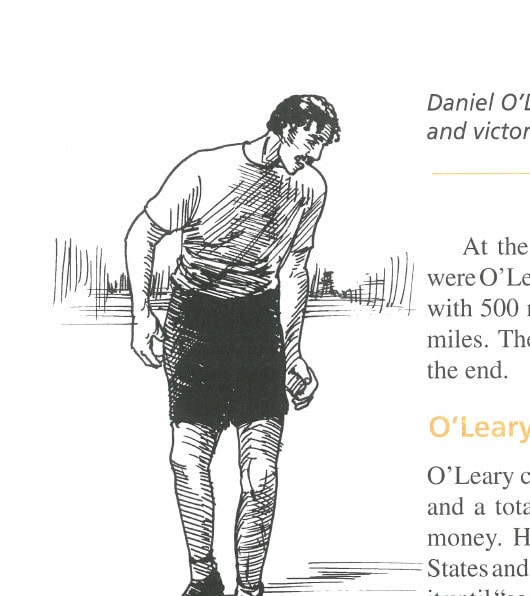
It was a sorry sight the last few hours of the week’s walk. Haggard, dazed, staggering O’Leary, his arms no longer knitted in pedestrian form and braced with muscular strength, were limp and almost helpless. His legs were swollen. He went his miserable round in evident pain, though 15,000 cheered him on. Vaughan went on until 7:30 Saturday night, and retired at the solicitation of his friends when he had scored 500 miles. O’Leary at this time was 19 miles ahead, and he was determined to make his record in round numbers, 520 miles, beating, it is said, all his achievements on both sides of the Atlantic.
At the close of the race, the figures were O’Leary with 520.25 miles, Vaughan with 500 miles, and Brown with 477.25 miles. There were no others walking at the end.
O’Leary Earns the Astley Belt
O’Leary came away with the Astley Belt and a total of $3,750 in prize and gate money. He took the belt to the United States and declared he would not part with it until “some better man came and fetched it.” Vaughan received $1,300 and Brown $525. It was estimated that a total of $500,000 was wagered during the race.
As it had done after O’Leary’s other two triumphs, the Chicago Tribune editorialized the following day:
Chicago is ahead again. Chicago is always ahead. The splendid record that O’Leary has made in his walk in London is something of which every Chicagoan has a right to be proud. It has been a great time for the United States and for Chicago and “a great day for Ireland.” Daniel O’Leary went over to England without any blowing of trumpets or waving of flags. He has not made a public exhibition of himself after the style of Weston. He left us quietly to take part in a walking match in which a score or more of the best pedestrians in the United Kingdom were his competitors, trusting to his legs rather than his tongue for success. And he has used them to such good advantage that today the one name that is blown over the world through the trumpet of fame is O’Leary.
. . . How sudden are the changes of fortune! Five little years ago no one knew O’Leary except the servant-maids on his postal route in this city, to whom he brought every morning good or bad tidings from absent swains. Little they dreamed that O’Leary was to be one of the heroes of the world, the first question in the morning and the last at night, the burden of every newsboy’s yell, and the theme of discussion in every social gathering. Little they thought of the fame those legs that went plodding along from house to house would achieve. Little he thought, perhaps, that the time would come when his name would go flashing along the oozy bed of the ocean day after day, and that two Continents would hang upon that one word O’Leary. . . .
The remarkable victory of O’Leary will not alone be a triumph of legs, but of brain. It will not alone be the result of physical endurance, but of mental and moral endurance also. It requires courage, patience, will, and intellect—a mighty concentration of willpower upon a certain object to be attained.
If, further, it is thrown out that all these qualities were exerted for money, it may be answered that all efforts are made for money, and that without the spur of money the world would stand still, stagnate, and rot. . . .
We are inclined, therefore, to congratulate our wiry little O’Leary upon the splendid exhibition of Chicago brawn and brain that he has made, and that he has beaten the Briton in the very class of exercise for which the latter has always been famous; and Chicago will congratulate herself that she is ahead again as usual, however much it may add to the discomfort of St. Louis and her other suburbs.
O’Leary sailed home, with a stopover in Ireland, and returned to Chicago May 19, 1878.
O’Leary Is Challenged
When Weston set the world record for the six-day race in 1876, O’Leary was quick to challenge him. So now, several challenges came to O’Leary in rapid succession. Vaughan, Gentleman, and Brown all wanted another chance at O’Leary in London. O’Leary refused, saying that he would walk for the belt only in the United States.
Soon after arriving home, O’Leary was challenged by John Hughes, another Irishman, from New York City. Hughes was prompted not only by a desire to be the champion but also by an intense personal antipathy for O’Leary. When O’Leary first went East in 1875, Hughes wanted to compete with him but could find no one to back him. He continually boasted to all who would listen that if he only had the money he could easily defeat O’Leary at any distance. Hughes’s constant harangue greatly annoyed O’Leary. When O’Leary returned to the East in 1878 to sail for the Astley Belt, Hughes told O’Leary he would come to England and beat him but he had no money. O’Leary replied sarcastically, “I’ll build you a bridge.” This so nettled Hughes that whenever he talked of O’Leary after this he would always say bitterly, “the rapscallion told me he’d build me a bridge!”
As soon as word arrived of O’Leary’s winning performance in England, Hughes eagerly sought someone to back an attempt to surpass O’Leary’s six-day effort in the Astley Belt. He finally found Harry Hill, who wagered former 100-yard champion Pargh Davis $1,000 that Hughes would be able to better O’Leary’s mark for six days. Hughes competed alone in his attempt to walk farther than O’Leary. A trial against time was set up for April 21 to 27, 1878, at the Central Park Garden. The track, almost oval in shape, was partly in the hall of the Garden and partly outside in the Garden. Hughes’s confidence in his ability far outstripped his actual ability. He set out at a suicidal pace, covering the first mile in 6:22. He covered the first 5 miles in 36:25, 25 miles in 3:05:10, and 30 miles in 3:41:45. Then, as would be expected, he crashed.
Hughes did finish 100 miles for the day, but he had destroyed all chances of success in the first hours. Somehow he managed to last out the six days and eventually finished 389 miles and 3,485 feet. His handlers said that this was accomplished with no real training and that he would now begin professional training for another attempt at O’Leary’s record. This Hughes did, and he was reported to have completed 500 miles in six days in Newark later that year. The result was doubted by the sporting press, however.
Hughes now formally challenged O’Leary under the Astley Belt rules. O’Leary considered Hughes a mere “speculator” and not worthy of a contest. Hughes persisted, and Sir John Astley finally decreed that O’Leary must meet Hughes or forfeit the belt. The match was set for Gilmore’s Garden at Madison Square from September 30 to October 5, 1878.
At the start O’Leary struck out on a long, body-swinging walk, while Hughes, having learned little from his failure at Central Park, dashed off on a run, making five miles in 35:41 to O’Leary’s 53:14. O’Leary was on the outer one-eighth mile track, Hughes on the inner one-ninth mile track. Members of the Harlem Athletic Club kept the scores in three separate notebooks, each lap being called out distinctly to both men. Hughes was handled by his family, trainer, and backers, and occupied a tent at one end of the Garden. O’Leary used one of the rooms in the main building. It was clear early on in the competition that O’Leary was working simply to beat Hughes and had no concern for records. O’Leary refused to believe that Hughes had fairly covered 500 miles in Newark. The match had little excitement and was concluded at 11 P.M. Saturday. O’Leary won easily with 310 miles.
O’Leary had now won two matches. If he won one more challenge match, he would become the permanent owner of the Astley Belt. The English
pedestrians anxiously inquired among themselves about who should be the man fortunate enough to regain the coveted prize.
Vaughan was considered by many as the obvious choice. Had it not been for his badly blistered feet, he may have beaten O’Leary in the first Belt race in London. Others thought either Gentleman or Brown would be better selections since they were still convinced it would take a runner to beat O’Leary.
This opinion was strengthened when Astley sponsored a go-as-you-please race for the “Astley Belt and Long-Distance Champion of England” at the end of October 1878.
This race was won by the “runner,” William “Corkey” Gentleman, who equaled O’Leary’s distance of 520 miles and 440 yards in 138 hours—one hour fewer than O’Leary. Harry “Blower” Brown, another runner, was second with 505 miles and 754 yards. This was only the third time that two men had both surpassed 500 miles in the same race.
The problem of regaining the “World” Astley Belt title intensified for the Brits when it was learned that two Americans, John Ennis of Chicago and Charles Harriman of Massachusetts, had already challenged O’Leary. Preliminary arrangements were, in fact, already being made. A competent English challenger had to be found.
In addition to the two Astley Belt races, O’Leary had walked in seven other races or exhibitions in 1878 for a total of 3,110 miles. He was “raced out.” His advisors suggested a long rest. O’Leary, seeing the wisdom of their advice, left the North and went to the hot springs of Arkansas. His rest was cut short, however, by Sir John Astley’s call that he defend the Championship Belt.
Reprinted with permission of Ed Dodd.
The illustrations on pages 92, 94, 96, and 99 were created for this revised edition of The Great Six-Day Races.
Part III of The Great Six-Day Races will continue in the next issue with
Chapter 5: The Third Astley Belt Race
Chapter 6: The Fourth Astley Belt Race
This article originally appeared in Marathon & Beyond, Vol. 1, No. 2 (1997).
← Browse the full M&B ArchiveMore like this
1,000+ stories from 19 years of Marathon & Beyond
The complete archive of the legendary long-distance journal — digitized and free to read.
