

The Hand Of Friendship
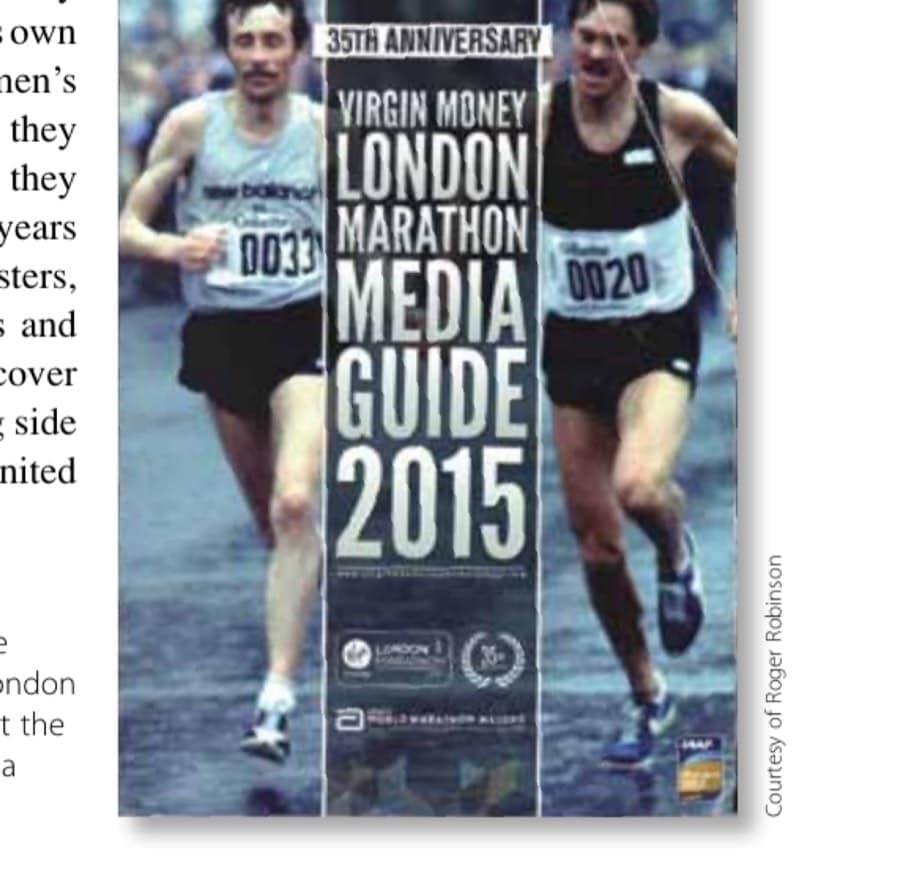
Dick Beardsley at the 1981 London Marathon: a symbol for the new running movement. by Roger Robinson
“T
▲
Images of Dick Beardsley and Inge Simonsen dead-heating in the first London Marathon in 1981 were everywhere at the 35th, including the cover of the media guide.
Courtesy of Roger Robinson
he hand of friendship” was the theme of the 35th London Marathon on April 26, 2015. All finishers, more than 35,000 of them, were encouraged by a big social-media campaign to cross the line hand in hand with another runner. Thousands did. Normally stiff-lipped Brits went soggy with goodwill as they grasped a random hand alongside and tottered united under the finish archway. Even Paula Radcliffe, the women’s world record holder and a living legend, who was completing probably her last marathon to huge acclaim, remembered to grab an astonished stranger’s wrist and flourish it aloft.
This was all because a high-spirited young American and a low-key Norwegian, total strangers to each other, neither having won a marathon before, dead-heated hand in hand at the front of the first London Marathon in 1981. Dick Beardsley and Inge Simonsen were invited back to London in 2015 as VIPs and celebrity race starters, along with London’s own Joyce Smith, who won the women’s race that first year. Everywhere they went around the British capital, they saw their younger selves of 35 years ago in giant size on banners, posters, and subway ads, in the tabloids and the race program, even on the cover of the media guide, still finishing side by side, forever young, forever united hand in hand.
Beardsley and Simonsen’s impulsive gesture has become an iconic image for the spirit of sportsmanship. More important, and more accurate, it exactly symbolized the mix of competitiveness and comradeship that is unique to the modern running movement and that was just reaching formation in 1981. The London Marathon was the first major race to be conceived from the start as a fusion of elite sporting competition with popular charity-focused celebration, and almost magically Beardsley and Simonsen captured that spirit and created an image for it.
It was a British TV commentator, the late David Coleman, who gave the moment the words that have helped keep it alive. “There it is, the hand of friendship,” he said on air. Beardsley and Simonsen didn’t plan the symbolic gesture of friendship. Far from it. To be good sporting mates self-effacingly equal on the line was the last thing they each had in mind. For the previous two hours they had done their darnedest to get rid of each other. They were young, competitive, ambitious loners who had both discovered a sport where they could excel by sheer hard work, who trained and raced with dedicated fervor, who had received one of their first invitations to a prestigious event, who needed whatever money was going to be illicitly paid to the winner, and whose only thought during the last miles of that prolonged duel of a race was to thrash the hide off the other one, preferably fatally.
Even today they are not quite sure how the hand of friendship moment happened. Beardsley has told the story vividly in his book1 and in many speeches, and he told it again (more than once) with his typical colorful exuberance in the Marathon Media Center in London’s Tower Hotel, with Tower Bridge visible through the window, while Simonsen sat alongside, nodding and muttering, “Yaa, dat good” in a laconic Scandinavian way. “
It was only my second race overseas. I’d just gotten back from Beppu in Japan. Man, that was a hard one, too! I’d never been to London before. I was overwhelmed by the crowds being so huge and cheerin’ like crazy even though it was such a rainy day. There was a big pack early on, and we passed incredible landmarks, like the Cutty Sark.2 After halfway, where the course went through an industrial area with not many spectators, they all began to fall off the pace, and soon it was just me and Inge. We were kinda stuck with each other, y’ know? With about three miles to go there were these cobblestones, and oh man, they were slippery, and my calf tightened up. But then we came off the cobblestones and I thought, Yeah, I might make it. Those last miles we both kept tryin’ and tryin’ to get away,” said the always-animated Beardsley, relishing every memory. “
Both of us try to pull away, yaa,” confirmed Simonsen, nodding.
Strangers when we met “We didn’t know each other,” continued Beardsley. “We just kept hammering each other, but no way could either of us pull away. It was like we were glued
together. Honest to God, the last thing you want in a hard marathon is a sprint at the finish. But it wasn’t like we decided, hey, why bust our tails? There was no communication. We kept on hammering. We both wanted the win. About 600 yards away, we could see the finish, the crowd and the banners. We were both dying. But Inge was still right there, on my left. It was like this race would end up as a tie, however much we both wanted to win it for ourselves. Then about 500 from the finish he was trying to say something to me in broken English. But with the crowds screamin’ and yellin’ I couldn’t understand him. I thought he wanted us to finish together. But honest to God, it just happened.” “
It just happen,” agreed Simonsen. British journalist John Bryant, in his history of the London Marathon, gives a more sentimental version. “They ran silently together, stride for stride. As they neared the tape their eyes met and they caught the spirit of that unforgettable day. “
These two winners crossed the line together in 2:11:48—smiling and hand in hand.” 3 “In a spontaneous show of sportsmanship, we grabbed each other’s hand and almost in that instant we broke the tape,” is how Beardsley’s book tells it.4
But hold on a second; what really happened . . . None of these versions is quite accurate. Still photos and the surviving fragment of film footage show that they were in fact running hand in hand as they approached the line, with 20 yards or so to go. The most familiar photo, right on the line, shows that they have let go of their hands as the tape wraps around both chests. They were very close, almost touching, so presumably they let go almost as they broke the tape. Beardsley has his arms aloft; Simonsen’s are at chest height. For sure neither is “smiling,” as Bryant wishfully said. “Grimacing with utter exhaustion” would better describe both faces, behind their fashionable 1980s Burt Reynolds moustaches. In the photo taken a moment later, Beardsley seems to be reaching out for someone to hold him upright, and Simonsen is on the brink of stumbling.
Even Beardsley’s phrase, “spontaneous show of sportsmanship,” isn’t quite right as an interpretation. They surely weren’t trying to “show” the crowd anything. They had no idea their gesture would be all over the media the next day and would remain iconic for 35 years (so far). It was more a private than a public gesture. And “sportsmanship” is an older, mainly British, notion that really means not minding when you lose. These two runners were expressing something slightly different, that sense of togetherness that every runner knows, the spirit of shared challenge and comradeship that can develop among total strangers when you race a hard marathon, the affectionate respect you can feel for someone whom
© Horst von Bohlen
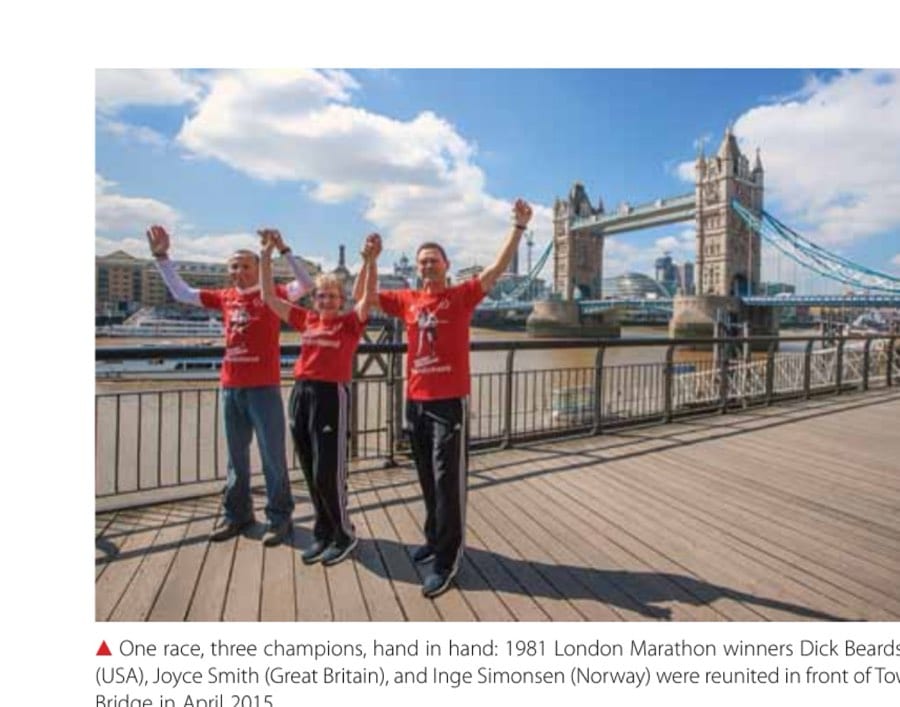
▲ One race, three champions, hand in hand: 1981 London Marathon winners Dick Beardsley (USA), Joyce Smith (Great Britain), and Inge Simonsen (Norway) were reunited in front of Tower Bridge in April 2015.
you have been trying hard but unsuccessfully to defeat. Farther back in the field, many in today’s marathons take hands, sometimes couples, sometimes groups of friends, sometimes strangers, bonded at the end of the long-shared challenging journey, impelled to unite at that moment of completion.
No sentimentality allowed Not everyone at the time was favorably impressed. To some curmudgeonly officials of that era, staging a dead heat was as improper as running with your shirt not tucked into your shorts (I’m not kidding). “
People told us it’s not cool to intentionally tie,” says Beardsley. “If they try that again I’m going to pick a winner—or disqualify them both,” grouched the race referee, according to Bryant’s book. He was also chairman of England’s Amateur Athletic Association. Probably he allowed the dead heat to pass only because it happened in this fancy new London Marathon thing, half a carnival and not a fully serious race, or so it seemed to the old guard. “
I am employed to cover marathons, not circuses,” huffed one British journalist, declining the invitation to cover the event. The referee in his bow tie would no doubt have DQ’d Beardsley and Simonsen if he had regarded it as a significant proper event, something important like the Essex County 10 Miles Championship, say.
All this is to say that the old order of running was changing, yielding place to new. The way Beardsley and Simonsen ended the first London Marathon helped change it. So did the London Marathon itself.
The marathon becomes an urban phenomenon The 1970s was the decade of the new big-city marathons and road races. New York, Seattle, and Atlanta’s Peachtree began it all in 1970, followed in 1971 by the Portland (Oregon) Marathon and the massive Round the Bays fun run in Auckland, New Zealand. Honolulu and the Cherry Blossom Road Race in Washington, DC, started up in 1972, and then in the next few years came Berlin, Marine Corps, Paris, Chicago, Toronto, and Dublin, to name only those races that traversed significant parts of their city’s downtown. New York’s move out of Central Park in 1976 to become a tour of the five boroughs was a seminal event. So was the third of Kathrine Switzer’s Avon Marathon International Women’s Championships, in London in 1980, when she persuaded the Lord Mayor to permit the first sports event ever to close downtown London streets.5
With that Avon precedent, and inspired by New York, London came as a relatively late addition to this field, in 1981, but that meant it could absorb some lessons from the major precursors. The London Marathon’s founder, Chris Brasher, with his partner and operations specialist, John Disley, had drawn up six “founding principles” when they first proposed the new marathon. Included among them were “to help London tourism” and “to raise money for recreational facilities in London,” benefits that other city races stumbled on as they went along and utilized to strengthen their hand in the sport’s unlikely success in stopping the traffic in big modern cities. London was the key pioneer in being the first to make charity fund-raising essential to its mission, another important factor in gaining community support.
Two other aims in London’s original founding principles show why Beardsley and Simonsen struck exactly the right chord. High on Brasher and Disley’s list is “to show that, on occasions, the ‘family of man’ can be united.” Closing the set of six is “to have fun and provide some happiness and sense of achievement in a troubled world.”6 These might sound a little idealistic, but Brasher had been deeply moved by the experience of running the New York City Marathon in 1979. An outstanding journalist, he wrote emotionally about the extraordinary phenomenon of that event in the Observer newspaper. “
To believe this story you must believe that the human race can be one joyous family, working together, laughing together, achieving the impossible. I believe it because I saw it happen. Last Sunday in one of the most trouble-stricken cities in the world, 11,532 men, women and children from 40 countries of the world,
assisted by one million black, white and yellow people, Protestants and Catholics, Jews and Muslims, Buddhists and Confucians, laughed, cheered and suffered during the greatest folk festival the world has ever seen.”7
Beardsley and Simonsen hadn’t studied the Observer or the “founding principles” mission statement that Brasher and Disley had drawn up, but it was as good as if they had. “To show . . . the ‘family of man’ can be united . . . To have fun and provide some happiness,” combined with the “sense of achievement”—those are exactly what their spontaneous hand of friendship expressed. Triple whammy.
And one more. London’s “founding principle” number one is “to improve the overall standard and status of British marathon running by providing a fast course and strong international competition.” That’s where Dick Beardsley came in. Brasher and Disley were both former elite athletes, both Olympic medalists. Brasher had helped Roger Bannister be the first to break four minutes for the mile and then achieved what Bannister never did, an Olympic gold medal, in the 3,000-meter steeplechase in 1956. Disley was bronze medalist in the steeplechase in 1952 and sixth in the final behind Brasher in 1956.
Seeking an elite field for the inaugural race They wanted a genuinely elite marathon as well as a giant folk festival, the same combination that their role model, Fred Lebow, was creating every year in New York. To attract “strong international competition” they needed money, even in 1981, when officially the sport was still amateur (the last year under the old rules). Their sponsorship from Gillette Razors was 50,000 pounds sterling, and their total race budget 75,000 pounds, much of that out of their own pockets. (These days, it costs several million pounds to recruit and reward the “strong international competition” for the London Marathon.)
The world’s best runners of 1981were beyond Brasher’s budget, and London was a new and untested race, so he looked a level down. Beardsley was an up-andcomer, with a PR of 2:12:41, at a time when the world record stood at 2:08:33 and when top names like Bill Rodgers, Gerard Nijboer, Toshihiko Seko, and Alberto Salazar were cranking out 2:09s. Simonsen had placed sixth at New York City in 1980 with 2:13:28, just ahead of Britain’s Trevor Wright. At that level, looking to improve and to begin to make a living, they would jump at an expenses-paid trip to London and the chance of some under-the-table prize money.
So Beardsley, Simonsen, and Wright (who was third on the day) were among what Bryant calls “a handful of elite runners hired by Brasher in a series of frantic phone calls to give the race some credibility.” According to Bryant, “Beardsley was lured over from the United States to run at the head of the field for just $2,500.”8
Beardsley’s invitation actually came via New Balance, according to his book. The company had given the eager young runner some free shoes, and then (to its
eternal credit) began to recognize his special qualities as a man gaining a reputation for total honesty, unqualified effort, and rapidly improving performance. Beardsley never took the fares or money to attend a race without giving his all. London 1981 was number 12 in his remarkable streak of improving his PR in his first 13 marathons (which put him in the Guinness Book of Records). By 1981 he had a great coach, Bill Squires, who had taken control of Beardsley’s sometimes frantic eagerness and made him capable of being a champion, partly by making him feel appreciated. Beardsley at that time was on the edge of the big time, a minor but improving player in that great 1970s-’80s generation that took running from its old fusty amateur days and transformed it into a high-level professional commitment and way of life. “
I was running twice a day, 140 miles a week. I grabbed every word from Coach Squires. If he’d told me to jump off a bridge every morning, I’d have done it,” Beardsley confessed in London. Simonsen, who was 27 at the time, remains less known. His only significant credential was that sixth place in the 1980 New York City Marathon, ahead of Wright and Beardsley, who, eager as ever, briefly led the race on First Avenue and faded to eighth. After the hand of friendship race in London, Simonsen ran New York again in 1981, placing 14th in 2:13:38, and was last heard of in sixth place in Athens in 1982 in 2:15:07. Sometime his story should be told. But that would need a quiet space, without the vivacious and voluble Beardsley anywhere within microphone range. “
I still do some easy running, one hour, two or three days a week,” Simonsen said carefully in London. As for Beardsley, despite accidents, injuries, problems, and joint replacements that would have put lesser people into a wheelchair or worse, “Even now I go to bed at night and I can’t wait to get up and go run a few miles,” he enthused, more than ever like an Irish setter let off the leash at a picnic.
They became good friends. “I’ve got Norwegian blood in me,” said Beardsley by way of explanation.
But it was a race Beardsley feels a little regret that the hand-holding finish dominated so much over the drama of the actual race, since he and Simonsen both regard it as a genuine wire-to-wire 26.2-mile dead heat. “People were talking as much about the sportsmanship as the race itself,” he said. But they have no complaint about being misrepresented. “I did get plenty of recognition, in London and after,” Beardsley said. In his book, he praises the ongoing generosity of the London Marathon. “The London Marathon is like my first love. Nothing will ever quite compare. Not just because it was my first win. But the people! Years later, after my farm
ad
accident, they sent me a few thousand dollars to help with medical expenses. In 1991 they invited us over for the 10-year anniversary of the race. They brought back all the past champions and our spouses, put us up in the best hotel, fitted us with tuxedos, and treated us to a black-tie dinner fit for kings. At the dinner they presented us with engraved watches from the year we won the race and five thousand dollars just because. Can you believe it? “

I can’t wait for the twenty-fifth.” 9 Invited again for the 35th, Beardsley was for sure enjoying himself in April 2015, a middle-aged celebrity in the ancient city where he had been a 25-year-old novice in 1981. He held court with the media, promoted the marathon’s social media #handinhand campaign on television, posed for photos alongside Simonsen with Tower Bridge in the background, and proudly told us all that his wife, Jill, was running the race, and his stepson, Christopher (19), would be running his first marathon.
The episode has paid off for him in his current career as a motivational speaker. “I use London in my corporate talks, as an example of sportsmanship,” he said. Mostly those talks focus on Beardsley’s later dramas of serious accidents, consequent problems with painkiller addiction, and his inspirational recovery to attain his present standing as a successful speaker, multiply recovered runner,
© Horst von Bohlen
▲ Dick Beardsley, Joyce Smith, and Inge Simonsen share a moment of serious reflection on the significance of their 1981 London Marathon victories.
and one of the most beloved celebrities of the running community. He speaks on all that and has written well about much of it in his autobiography. Much is also covered powerfully in John Brant’s book about Beardsley, Alberto Salazar, and their 1982 Boston Marathon, Duel in the Sun,10 and before that by Joe Henderson in his Running Commentary and the authoritative Running Encyclopedia.11
Before Beardsley became Beardsley Beardsley of the “Duel in the Sun” and Beardsley the multiple accident victim and recovered drug addict lay ahead in 1981. They are now well known and have been fully explored in print and the spoken word. The younger Beardsley who grasped a Norwegian stranger’s hand and thus became a symbol for the modern running movement has had little attention, except in London. It’s a part of his story that needs to be more widely known.
Why? Running is not a sport that readily produces symbolic moments, and even more rarely are such moments created or witnessed by someone with the word power to immortalize them. Roger Bannister and his lyrical First Four Minutes or Dorando Pietri’s Olympic marathon collapse witnessed and described by Arthur Conan Doyle are rare examples. Beardsley and the hand of friendship is another. Never underestimate Beards. He may seem boyishly exuberant, with his puppy-
dog energy and eagerness to please, always pushing his battered, often-injured body beyond all reason, but he has an astute sense of the moment and a gift for memorable phrases. After the hand of friendship finish, with the emotion and the controversy still swirling around him, this sometimes goofy young Minnesota farmer on his excited first visit to London found exactly the right words. “
What does it matter who wins, anyway? As far as I’m concerned, anyone who finishes this thing is a winner.” The 2015 Virgin Money London Marathon quoted those words everywhere. It’s a familiar thought now, but it was new in 1981. In those two sentences, spoken when he had scarcely recovered his breath, Beardsley perfectly summarized the meaning of the hand of friendship episode and how it expressed and symbolized the spirit of the vast new global running movement.
Endnotes 1 Dick Beardsley and Maureen Anderson, Staying the Course: A Runner’s Toughest Race (Minneapolis, Minn.: University of Minnesota Press, 2002). 2 The Cutty Sark, just past 10K on the London course, is a clipper sailing ship,
built in 1869, one of the last and fastest of the famous tea clippers on the route between England and India, now a tourist attraction on her berth beside the Thames at Greenwich. Few runners know that she is especially appropriate as a
landmark on a marathon course, because her name, Scottish dialect for “cutoff chemise” or “short nightie,” described a fast-running and sexily dancing young witch in Robert Burns’s great comic narrative poem “Tam o’ Shanter” (1791). “
Cutty-sark,” as Tam appreciatively calls her, almost outruns his galloping gray mare Meg, who loses her tail when the witch grabs it. The witch’s image is the ship’s figurehead. 3 John Bryant, The London Marathon. The History of the Greatest Race on Earth (
London: Hutchinson/Random House Group, 2005), p. 18 4 Staying the Course, p. 57 5 Kathrine Switzer, Marathon Woman. Running the Race to Revolutionize Women’s Sports (New York: Carroll & Graf, 2007), pp. 371-78 6 “Virgin Money London Marathon 2015 Press Release,” April 22, 2015 7 Chris Brasher, the Observer, London, October 28, 1979, cited in John Bryant,
Chris Brasher, The Man Who Made the London Marathon (London: Aurum, 2012) p. 198. 8 London Marathon, p. 107 9 Staying the Course, p. 58 10 John Brant, Duel in the Sun. Alberto Salazar, Dick Beardsley, and America’s
Greatest Marathon (Rodale, 2006) 11 Joe Henderson, “Where’s Dick?” Running Commentary, April 1999, reprinted in Richard Benyo and Joe Henderson, Running Encyclopedia (Champaign, Ill.: Human Kinetics, 2002), p. 26
This article originally appeared in Marathon & Beyond, Vol. 19, No. 6 (2015).
← Browse the full M&B ArchiveMore like this
1,000+ stories from 19 years of Marathon & Beyond
The complete archive of the legendary long-distance journal — digitized and free to read.
