

The Healing Touch
Debbie DeMauro, Bill’s massage therapist in Sherborn, Massachusetts, says Bill’s muscles require the deep-tissue work she performs. “His muscle tissue is different from other runners I see. From all his years of intense training, his fibers are very tight. Sometimes I have to use my elbows and fists to get the results he requires. Believe me, I need a massage after working on Bill.” DeMauro feels that 99 percent of runners don’t stretch enough. By its very nature, running asks the body to be tense and tight. Muscles do two things: contract and relax. When they get stuck in contraction due to overtraining, the muscles aren’t receiving the proper nutrients. Massage work helps to relax them, stimulating oxygen flow. Debbie believes that massage therapy is not an extra benefit or a luxury but a necessity for the athlete who wants to stay injury free.
The art of massage goes back thousands of years and has been used to soothe aches and pains long before a license was required to practice it. In its simplest form, massage is a basic instinctive skill we use every day. When you rub a bruise, stroke an aching joint, apply pressure to a throbbing muscle, you are practicing massage. The word is believed to be derived from the Arabic word, masah, which means to stroke with the hand. Practiced by Hippocrates and used by ancient Greeks and Romans before and after sport, massage was good enough for Julius Caesar, so why not you?
WHY SHOULD YOU CONSIDER A SPORTS MASSAGE?
According to the American Massage Therapy Association (AMTA), the oldest and largest massage therapy organization, sports massage is the fastest growing form of massage therapy in North America. Runners in particular derive many benefits from massage, including these:
- Proper body alignment to help relieve pressure caused by poor posture
- Soft, supple, and stretched muscles and reduced muscle spasms
- Injury prevention (with regular maintenance)
- Improved circulation (waste products are pushed from overused muscles into the blood stream)
- Increased athletic life span
THE COACH APPROACH
Pete Squires, track coach for Fairleigh Dickinson University and the North Jersey Masters Running Club, has always been an advocate of sports massage. A three-time winner of the Yonkers Marathon, Squires always schedules a full-workout body massage two or three days before a race. “It definitely help[s] to cut down on the injuries and my recovery time, so I am ready for the next event.” Pete runs the show at the Nike Newport Running Camp, where a lecture on the benefits of sports massage is always part of the agenda.
PRE- AND POSTRACE MASSAGES
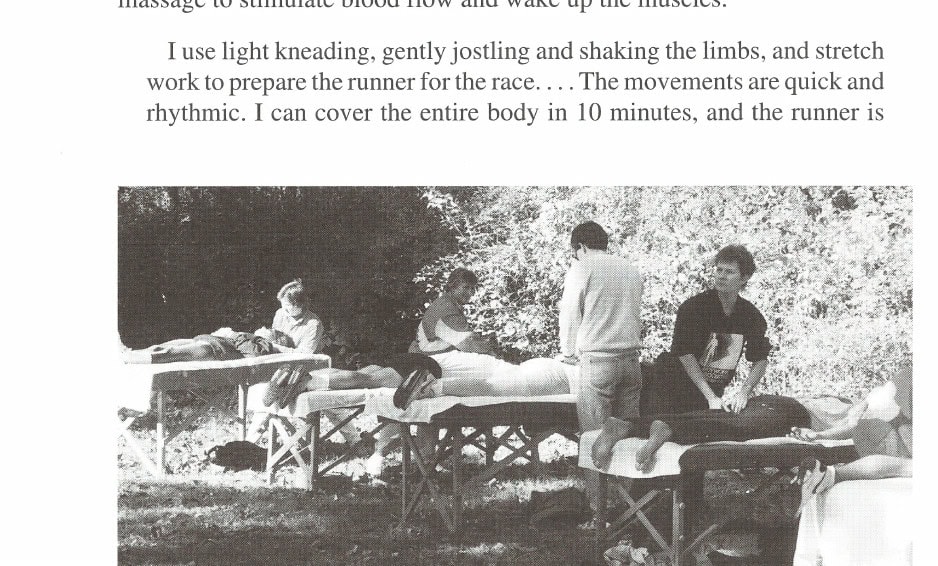
The most common problems sports massage therapists face from athletes on the table are pulled hamstrings, calves, and quads; lower back pain; sprains; and hip flexor problems. Matthew Gavzy, a massage therapist who works on world-class athletes and captains the New Jersey American Massage Therapy Association’s Sports Massage Team, has worked the massage tents at Boston and New York. To get the muscles ready for a marathon, Gavzy uses a prerace massage to stimulate blood flow and wake up the muscles.
I use light kneading, gently jostling and shaking the limbs, and stretch work to prepare the runner for the race. . . . The movements are quick and rhythmic. I can cover the entire body in 10 minutes, and the runner is ready. After the marathon, it’s a different story. I prefer the runner to first cool down with a 10-minute walk to calm the muscles. I focus the postrace massage on restoring balance and flushing out the lactic acid build-up in the muscles. I’ll use long, soothing strokes, some tapping, cupping, and stretch work.
John Mayurnik, a client of Gavzy’s and veteran marathoner, was training for the 1996 New York City Marathon when a leg injury severely threatened his ability to continue training. With four weeks to go before the race, John limped into Gavzy’s office hoping for a miracle. Gavzy set up an intensive program for John, concentrating on deep-tissue work, kneading the overworked muscles, and systematically working trigger points to release pressure. John ran the marathon injury free and has been going to Gavzy ever since.
IT TAKES ONE TO KNOW ONE
Christine Gibbons, a 2:39 marathoner and women’s division winner of the 1993 Leadville 100, is a sports massage therapist in Hackensack, New Jersey. Fifty percent of her practice is made up of runners and triathletes. They feel confident with Gibbons because she has experienced and suffered through the same pain and discomfort they have. When she buckles down to work on a client, Gibbons combines different techniques—Swedish, neuromuscular, and manual compression. During the spring, Christine sees a big increase in appointments when runners are gearing up for the training season before summer and fall marathons. Christine feels a maintenance program is the best way to go, as it gives the therapist a chance to get to know the athlete’s body and understand where the pain is coming from. Is it referred pain, genetic, chronic, or predisposed? Once the therapist has a clear picture of a runner’s physical make-up and routine, he or she will customize treatments to be specific and rewarding.
WILL IT HURT?
Some pressure is almost always required to get results, especially in deep-tissue work and when digging into trigger points. Although everyone responds differently to pressure and pain, you should never be uncomfortable. By its very nature, a sports massage is supposed to undo accumulated stress, pain, and knots in a muscle, so a quick buff and shine is not going to do the trick. It is rehabilitative work and not necessarily always enjoyable. Consider it grateful pain. However, if the pain gets to be too much, tell the therapist. DeMauro says a fine line separates just the right amount of pressure from too much pressure. “A good therapist can read body language and will know when too much pressure is being administered.” Communication between the therapist and client is crucial to the end result. By the end of the session, you should feel as if you’ve had a rewarding workout.
FINDING THE RIGHT THERAPIST
The best place to start in your search for a massage therapist is with your running buddies. Ask around to see who gets massages and where they go, or call your nearest running club for references. The AMTA will also recommend certified sports massage therapists in your area. Most therapists work out of health clubs and spas, so there’s another direction you can take. However, many therapists will travel to your home or office complete with massage table and towels. An important point to remember is that not every state requires a license to practice massage. A call to your state health department or local municipality
Be an Informed Consumer
The AMTA suggests that you ask the following questions when looking for a massage therapist:
- Where did you receive your massage therapy training?
- Are you a graduate of an accredited training program?
- Are you currently licensed as a massage therapist in this state?
- Do you have advanced training in sports massage techniques?
- Do you participate in insurance plans or HMOs?
What Will A Sports Massage Cost?
Sports massages run about $55–75 an hour, depending on locality. Insurance providers are beginning to recognize the health advantages of massage therapy and coverage is increasing, especially in the 25 states where massage therapists are required to be licensed. Check with your health care insurance provider to see if you’re covered.
can determine what is required of massage therapists in your area. Even when a state does not require a license to practice massage, most good therapists will be licensed and also be a member of a massage association such as the American Massage Therapy Association. Be sure to ask for credentials when checking around.
So you’ve decided to take the plunge. Assuming you’ve booked an accredited sports massage therapist, get ready for a treat. First, leave all jewelry at home. Loose-fitting running shorts and a T-shirt are the way to go, as they allow the therapist to reach specific areas, such as the gluts and back, without your having to undress. Being totally undressed is an option, too, depending on your level of comfort. Towels will be draped across your body during the massage.
First off, ask questions! Make sure you understand the procedure so there won’t be any second-guessing or surprises about the techniques being used. You should be as relaxed as possible, and knowing everything up front helps. Your massage therapist may use some oils and lotions, depending on the technique. Deep-tissue work and trigger point techniques normally don’t require lubrication, as the therapist needs to work specific areas and doesn’t want to be sliding all over the body. Long strokes, as in effleurage, are enhanced by the use of oils that help glide the hands over the skin. If you don’t want oils and lotions on your skin, speak up. Most therapists use towels to cover and warm the sections not being treated. As the work progresses, the towels are discreetly moved and shifted around your body as needed.
Communication is key to a good massage. If there is something you don’t understand or a technique that’s uncomfortable, speak up. This is no time to be shy. Don’t be afraid to ask questions. A professional therapist will want to do a good job and needs your feedback. You’ve invested time and money in this, and the results should be rewarding and satisfying.
MASTERS OF THE MASSAGE TABLE
Even though a massage is good for any age, masters division runners find it invaluable—they count on massage to keep them out there pounding pavement. At 68, Toshi d’Elia holds numerous national and international titles and in 1997 was inducted into the Masters Runners Hall of Fame. Raised in Japan, where massage therapy is a way of life, she continued the practice when she came to the states. Says d’Elia,
I feel totally renewed and rejuvenated from a massage. When you reach a certain age, the muscles need more care. Most runners forget this because unlike wrinkles and gray hair, there is no sign of aging muscles except in performance. After a hard speed workout, I head to my local YMCA and recover with an aqua-massage in the whirlpool. I focus the jets on my pressure points, the neck, shoulders, and lower back. It is very rewarding, and I wouldn’t be performing at this level without it.
Fluid replacement is crucial to the sports massage treatment. As the therapist works the muscles to stimulate blood flow and remove waste, fluids are needed to help flush the waste away. Even if you don’t feel thirsty, drink plenty of water directly following massage treatment and for a day or two afterward.
THE ART OF SELF-MASSAGE
Ted Corbitt, the original ultradistance running machine, received his master’s degree in physical therapy in 1950 and continued his education with advanced massage technique courses. A true believer in the healing power of massage therapy, Ted practices the art of self-massage every morning. At 78 years old, Ted still has a few patients that refuse to let him retire. Along with their prescribed massage therapy, Ted also teaches them self-massage techniques using golf balls and tennis balls. For a great foot rub, Ted suggests placing a large marble or golf ball under the bare foot and rolling it around, covering the entire sole of the foot.
Massage Lingo
Here’s a quick overview of the basic massage strokes:
- effleurage—gentle, long, sweeping strokes to relax the body and spread ointments. Hands are relaxed and mold to the contours of the body as strokes glide over the areas being massaged.
- kneading—just as if kneading dough, the hands work alternately squeezing and rolling the muscles. Strokes are firm with gentle pressure.
- percussion—cupping, tapping, and pummeling movements to stimulate and increase circulation. Involves chopping, rapid, rhythmic motion.
- twisting—a push-pull wringing motion used after the muscles have been loosened. As the skin twists, tension is wrung from the muscle.
If there is one particularly painful spot, spend more time on that area, making smaller circles with the ball until the pain is reduced or relieved. This procedure takes three to five minutes or less and is very therapeutic. When Toshi d’Elia can’t make it to the gym, she also performs self-massage, either using her hands for areas she can reach and stroke or a tennis ball to get to those annoying pressure points. By placing a tennis ball on the floor or against a wall and rolling her spine up and down against the ball, she can reach her hard-to-get-to spots.
Anyone can practice self-massage. You can do it while watching television, at the office, or even when stuck in traffic. For runners, a basic leg massage relieves that achy feeling after a race or workout and helps the muscles recover. Start by stroking the entire leg from ankle to thigh with long gentle movements, molding your hands to the contours of the leg. Calves and thighs can take a bit of a beating, so knead and pummel those areas if they feel tight. Pummeling also helps to increase circulation and relieve stiffness. The big benefit to self-massage is that you know best where your achy spots are, so you can get right down to business.
Whether you find the perfect massage therapist to heal your fatigued body or you let your own fingers do the healing, massage therapy helps keep you injury free while pounding out those miles. And you don’t have to finish a marathon in less than three hours to qualify for the massage table. Anyone can benefit from a massage.
“In France one must adapt oneself to the fragrance of a urinal.” —Gertrude Stein to Frederic Prokosch
L E MARATHON International de Paris took me by surprise. I expected something huge, polished, perhaps even a bit arrogant—something in keeping with the studied formality and careful sophistication of the French and the prestige of Paris as the legendary stunningly beautiful city of lights. Instead, the marathon was unassuming—almost retro. It had a friendly, small-town air I would associate more with, say, Lansing, Michigan, or Regina, Saskatchewan (population about 175,000), than with a major world capital of 10 million plus souls.
Consequently, as we thousands gathered on that damp Sunday in early April 1998 in the very heart of Paris, in Place Charles de Gaulle near the Arc de Triomphe, there were no security officials, no gates, no barriers, no electronic check-ins, no waiting pens, no signs barring nonrunners or casual curiosity seekers from the area.
We simply spilled out of the nearby Métro station (Charles-de-Gaulle Étoile), lined up, and waited in a milling, cheerful, restless mass as unintelligible announcements blared from the public address system. We traded tales of great successes and devastating failures on road courses around the world. We compared hopes, fears, and hometowns. We bantered in many languages, shook hands, retied shoelaces, wished each other a good race. We dashed back and forth to friends on the sidelines who held our sportsbags and camcorders for recording the potential triumphs and tribulations.
Even the sound of the starting gun was so laid back as to be inaudible.
This article originally appeared in Marathon & Beyond, Vol. 3, No. 2 (1999).
← Browse the full M&B ArchiveMore like this
1,000+ stories from 19 years of Marathon & Beyond
The complete archive of the legendary long-distance journal — digitized and free to read.
