

The London Marathon From Inside
The London Marathon was the brainchild of Chris Brasher, who won a gold medal in the 1956 Melbourne Olympics steeplechase and was one of the pace makers in Roger Bannister’s first overcoming of the four-minute mile. In 1979 Brasher visited New York at the time of the 10th New York Marathon and was so entranced by what the late Fred Lebow had achieved that he had the vision of organizing a transatlantic equivalent. However, there was no way the authorities would consider closing down so much of the city, but Brasher was like a dog with a bone and eventually wore down political opposition, and the first London Marathon was run in 1981. What a difference that first race was compared to current versions. The field of 7,000 runners was mainly made up of serious club athletes, and to beat three hours was no big deal. The joint winners holding hands over the line were the USA’s Dick Beardsley and Ingo Simonsen of Norway in 2:11:48. The leading lady was Britain’s Joyce Smith in the extraordinary time of 2:29:57, considering that she was 42 years old!
Fast track to 2011 and we find a field of 35,000 chiefly made up of recreational, nonserious runners, many in way-out costumes, staggering home in such slow times that in 1981 would have seen finish line officials long gone home, having Sunday lunch with their families! However, up at the sharp end, the standard continues to sharpen. In 2011 Kenyans took the money by way of Emmanuel Mutai in a course record of 2:04:40 and Mary Keitany in 2:19:19, just shy of the incomparable Paula Radcliffe’s course record of 2:17:42.
The course starts virtually on the Greenwich meridian and snakes its way alongside the river Thames, passing historical landmarks such as Tower Bridge, the Tower of London, the Houses of Parliament, and Westminster Abbey and
finishing in front of Buckingham Palace. Elevation is almost flat, making the track sympathetic for those with personal record ambitions.
My first London Marathon was not Chris Brasher’s 1981 brainchild but the run 33 years earlier through North London’s suburbia and finishing past the twin towers of Wembley Stadium—the 1948 Olympic 26.22, no less.
It cost nearly all my week’s pocket money, which for a 10-year-old in those early postwar days was hardly a “bob” or more (5p in today’s money, the American equivalent of 8 cents) to gain the front row at the local Odeon. I watched the film of the 1948 Olympic Games twice through. And why? Well, I was so entranced by the drama of the marathon, which ended the film, that I watched the whole thing through twice just to enjoy the suffering displayed. Couldn’t care anything about the other events, including Fanny Blankers-Koen winning four golds. They were incidental small fry compared with what I as a young lad thought the real stuff depicted by another Dutch, gallant Etienne Gailly, carving out a huge lead and then losing his legs, so hurtful to watch, and being chased down in the stadium by the winner, Argentinian Delfo Cabrera, in a time of 2:36. Then Welshman Tom Richards, bobbing up and down seemingly fresh as a daisy, scampers past the failing Dutchman to win silver. Will Etienne make bronze? He just does.
The drama of the marathon had really gotten into me, though I hardly thought then that I would eventually, in old age, enjoy (so far) 52 26.22-milers plus two 85-mile ultras in such exotic places as Barbados, Cape Town, Paris, Miami, Benidorm (Spain), and the Isles of Scilly—twice a winner.
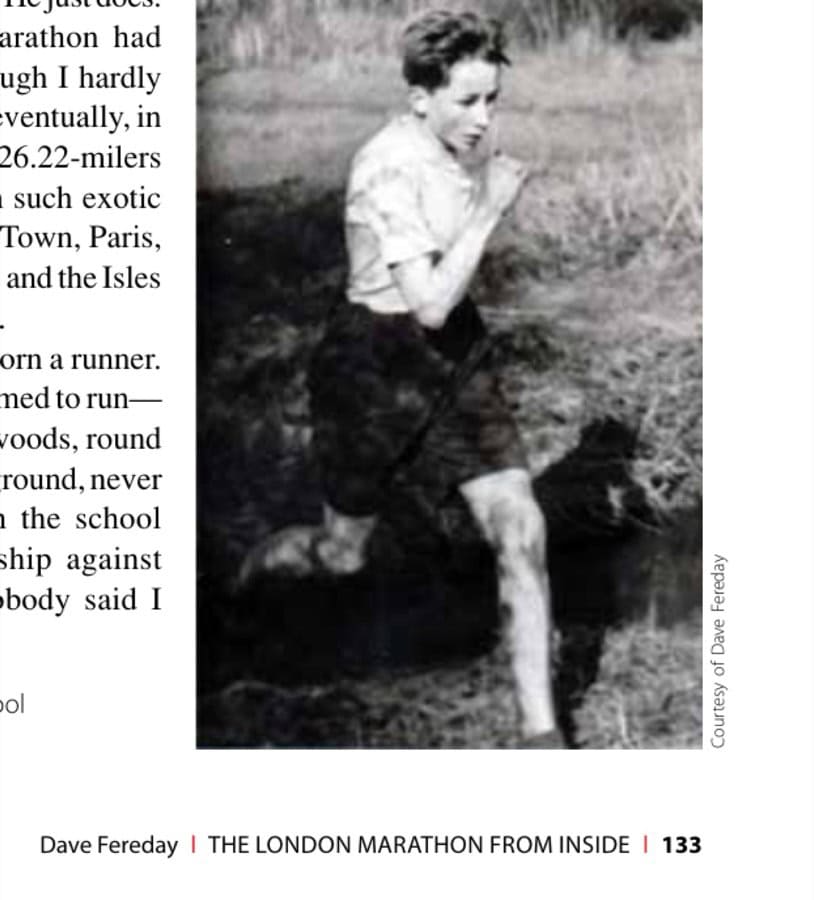
However, I had been born a runner. Since I was a toddler, I seemed to run— to the shops, through the woods, round and round the school playground, never walked anywhere. I won the school cross-country championship against much older boys, but nobody said I ▲
The author winning a school cross-country race at age 16.
Courtesy of Dave Fereday
Where I fit in
should join the local harriers—such was the hit-and-miss approach of nuturing ability. Leaving school, I ran the left wing for the old-boys football team. But the 1948 Olympic experience never died. I had always conjured thoughts of just once experiencing a marathon of my own. And in 1980, aged 42, I resolved to do it. Coincidentally, Chris Brasher introduced the now-famous London Marathon in April 1981 to give me the opportunity. August 10, 1980, became week one for my new marathon lifestyle, when I ran a total of 13 miles. I’m now up to week 1,600.
But instead of just once satisfying an ambition, like many first-time marathoners, marathon running was to become a way of life. In the summer of 1982, I ran six marathons, culminating in a PB of 2:50:08 on the hilly Harlow course, where a year later I bettered it to 2:47.
But what of the Londons? By chance, London ’81 was not my first go at the distance. I was in South Africa on business in January of that year, and there were loads of runners going along the front at Cape Town. “Doing the marathon at the weekend?” one of them asked. Always up for a challenge, I thought, Why not? though I was not yet fully prepared for the distance. But to do the race involved becoming a member of the South African Runners Association. So I duly paid up and got a last-minute entry, and the dream began at a cautious 8:30 pace, finishing at 7:30 pace for a joyous 3:29:52. However, on arriving home, I found that there was danger of being suspended for that paltry effort. It was at a time when UK athletes were barred from competing in South Africa. The previous year, South Africans had run under false identities in order to compete in the London-toBrighton ultramarathon—the complementary race to their Comrades.
And so to the meat of this article: the London marathons. Having run New York, Chris Brasher was so impressed by the concept of the big-city marathon that he bullied the bigwigs of the Greater London Council to almost close down the city for the day to accommodate his London version of the great race. Since then, the race has been run 31 times; in 2011 there were more than 34,000 finishers. I am a member of the Ever-Present Club, that exclusive club of 18 who have run in all the Londons.
Before I trace my experiences of those races, may I bore you with the philosophy I have developed that has made my marathon running relatively pleasurable most of the time? Being of scientific bent, I discovered after a while that a marathon is very much a mathematical as well as a physical endeavor.
I found that in order to successfully run a marathon in a minimum of time and pain, pace planning is absolute key. So what pace? Initially, before a first marathon, you can be guided by how fast a fairly hard 20-miler was run and use that as a yardstick.
But then, as training and marathon races progress, the required even-paced minutes-per-mile can be better evaluated.
Over the years of the London Marathon, I have correlated training intensity to marathon times, which enables me before each marathon to accurately predict the time. I have recorded the past 24 Londons, each and every mile split, and prior to that each one-quarter marathon split. After each race, this data is evaluated to assess how good the prerace planning has been and the reasons if things went wrong. The aim is even-paced running throughout, though from 65 years plus I have had to modify this as I could not physically manage the necessary volume of training to not ensure some slowdown of running. However, in my forced conversion to racewalking, even pace is now again practical.
So how to gain a measure of the intensity of training at any given time? I have considered training to be made up of components of long- and short-term intensity, respectively, the average miles per week over 32 weeks and eight weeks. The mean of these two averages is what I deem my fitness factor (FF), and any particular fitness factor at any given time should relate to a particular personal marathon time, taking into account age, and so the minutes per mile required. This does, however, assume that the quality of training is similar with a mix of long runs, speed work, tempo, and easy running. The measure is taken two weeks prior to the race as the two-week tapering down would distort the figures. (For a more thorough explanation of “fitness factor,” please see page 146 of this article.)
My various Londons detailed below show the relevant figures, and in many of the races there is a distinct relationship between the training-intensity level and the marathon time. Using this mathematical analysis, it seems rather easy to set the pace right and have the distinct enjoyment of passing all and sundry from 15 miles on—quite different from Mister Gailly in 1948.
1981/age 43 Target time/pace: None, as this is my first proper marathon Actual: 3:12:52, 7:22/mi average Each quarter average/mi: 7:20, 7:12, 7:07, 7:48 Training history: 32-wk average: 31, 8-wk average: 54, fitness factor: 42.5 Comments: Bad back two weeks prior to race; osteopath amazed I ran and completed; this explains slowdown in final quarter. 1982/age 44 Target time/pace: None, due to Achilles injury; ran carefully Actual: 3:06:31, 7:07/mi average Each quarter average/mi: 6:50, 7:02, 7:10, 7:26 Training history: 32-wk average: 48, 8-wk average: 42, fitness factor: 45 Comments: Pulled Achilles tendon 10 days prior to race—caused by suddenly sprinting away from attacking dog at start of run. Couldn’t run except a cautious
tryout for two miles day before race. This accounted for poor time in spite of high fitness factor.
1983/age 45 Target time/pace: 2:50, 6:30/mi Actual: 2:48:24, 6:26/mi: 6:24, 6:26, 6:25, 6:29 Training history: 32-wk average: 52, 8-wk average: 57, fitness factor: 54.5 Comments: Fitness factor of 55 same as before Miami Marathon in January. Flu
two weeks prior prevented a probably faster time as had run Miami Marathon in very hot weather in 2:50. Excellent even pacing. This year, with the popularity growing and applicants exceeding the limit, Chris Brasher thought up the idea of rewarding the early posting with an entry. So on the decreed day of entry acceptance, many traveled to the main London post office to secure a midnight postmark on their envelope to guarantee their place. Being keen, I was there.
1984/age 46 Target time/pace: 2:50, 6:30/mi Actual: 2:46:26, 6:21/mi: 6:15, 6:22, 6:21, 6:26 Training history: 32-wk average: 49, 8-wk average: 38, fitness factor: 43.5 Comments: Excellent run considering training reduction in last eight weeks due
to hamstring and sinus problems, with only minimal drop-off on even pace. This was the year of sleeping on the pavement to get an entry. Following the earliest postmark scheme, which did not work too well, Brasher thought the loss of a night’s sleep might restrict the ever-increasing number of applicants. Various main post offices round the country were specified as the only ones authorized to accept entry forms from 7:00 a.m. on the decreed day of November 5, and each office had a set number of entry forms it could accept. In other words, it was a queuing situation. Fortunately, the decreed office for my area was only a mile from home, and I planned to get on the queue at bedtime. To my horror on returning from work, at 6:00 p.m. the queue was considerable, so a quick rush indoors, out with the sleeping bag and provisions, and on to the queue that had grown even larger. Fortunately it was a mild night, and I was far enough up the queue to gain acceptance.
1985/age 47 Target time/pace: 2:46:00, 6:20/mi Actual: 2:44:10, 6:16/mi: 6:08, 6:15, 6:16, 6:25 Training history: 32-wk average: 52, 8-wk average: 57, fitness factor: 54.5 Comments: Almost a perfect marathon except for marginal drop in pace over
last quarter of course. There had been no niggles or broken training. Marathons
have become a complete doddle! This was the first year where gaining target times by age would secure an automatic entry without jumping through hoops.
1986/age 48 Target time/pace: 2:43:48, 6:15/mi Actual: 2:58:54, 6:50/mi: 6:18, 6:18, 7:10, 7:34 Training history: 32-wk average: 46, 8-wk average: 57, fitness factor: 51.5 Comments: First marathon when overambition caused disaster. Should have taken into account that fitness factor was down from previous year and weather was poorer. Immediately had difficulty in holding planned pace but stupidly persevered to half distance. I had been taking the marathon for granted, but it bit back. 1987/age 49 Target time/pace: None; knee injury had severely restricted training so started cautiously. Actual: 3:03:51, 7:01/mi: 7:04, 6:57, 6:50, 7:12 Training history: 32-wk average: 24, 8-wk average: 30, fitness factor: 27 Comments: Lack of mileage showed in last quarter but demonstrated that a reasonable marathon can be run on low mileage. The cautious start of nearly a minute a mile slower than last year paid dividends to give very even pace. 1988/age 50 This was the first year I recorded every mile split so I could see if and when pace suddenly reduced—that is, when I hit “The Wall.” When-The-Wall-came comment added to each year from this point on. Target time/pace: 2:57:00, 6:45/mi Actual: 2:57:00, 6:45/mi.: 6:34, 6:45, 6:44, 6:58 When The Wall came: Never; strong running right to finish. Training history: 32-wk average: 31, 8-wk average: 40, fitness factor: 35.5 Comments: No injury problems but training mileage relatively low to minimize
reemergence of knee problem. Planned pace correctly to the last second! Got the marathon sussed again! Yet again a sub-3:00 can be run on low mileage.
1989/age 51 Target time/pace: 2:54:45, 6:40/mi; estimated that four-point increase in FF should enable five seconds/mile faster than last year. Actual: 2:55:10, 6:41/mi: 6:33, 6:40, 6:37, 6:54 When The Wall came: Never; strong running right to finish. Training history: 32-wk average: 34, 8-wk average: 45, fitness factor: 39.5
Comments: No injury problems. Planned pace perfectly. What a doddle the
marathon is when pace judgment for even pace is correct.
1990/age 52 Target pace: 2:53:00, 6:36/mi; estimated that further increase in FF should enable faster pace than previous year. Actual: 2:54:42, 6:40/mi: 6:31, 6:35, 6:38, 6:57 When The Wall came: Mile 25 (7:45 pace) but recovered to run last 1.21 in 6:41/mi. Training history: 32-wk average: 41, 8-wk average: 51, fitness factor: 45 Comments: No injury problems. Pace estimate a wee bit out but not a bad result. Quite a fuss was made of this, the 10th London. The “ever presents” were invited to a get-together and interviewed at the pasta party by the late John Pickering. I was interviewed and appeared on Sky and ITV. Following on this, I appeared in a short film shown on the ill-fated BSB channel, which explored the sexual potency of a marathon runner aged over 50 compared to a similaraged sedentary man. 1991/age 53 Target time/pace: 2:55.36, 6:42/mi; FF similar to 1989, so should do similar time. Actual: 2:55:35, 6:42/mi: 6:36, 6:40, 6:39, 6:51 When The Wall came: Never; strong running to finish. Training history: 32-wk average: 33, 8-wk average: 49, fitness factor: 41 Comments: No injury or illness problems. Only a second out on overall time! Running a marathon seems to be such a simple business. 1992/age 54 Target time/pace: 3:10:00, 7:15/mi; FF down not by too much but training speeds reduced; old age coming into the equation. Actual: 3:11:19, 7:18/mi: 6:56, 7:08, 7:09, 7:59 When The Wall came: Mile 21 (at a 7:44 pace). Training history: 32-wk average: 31, 8-wk average: 43, fitness factor: 37 Comments: The message! Ignore goal pace at your peril. Just 10 to 20 seconds a mile too fast will bring disaster. The first London where I “stopped in my tracks.” Last six miles hell. Know now how Etienne Gailly felt. Won’t ever take the marathon for granted again. Knocked all the cockiness out of me. However, after all said and done, only 80 seconds slower than target. 1993/age 55 Target time/pace: 3:16:30, 7:30/mi; FF well down; bad back and sciatica; nearly
didn’t run.
Actual: 3:21:54, 7:42/mi: 7:19, 7:23, 7:24, 8:44 When The Wall came: Mile 21 (at a 7:52 pace), with agonizing drop to 9:00/mi. Training history: 32-wk average: 25, 8-wk average: 35, fitness factor: 30 Comments: Ignored target pace and consequently suffered. Am now just one of
the stupid “rest” who don’t use their brains.
1994/age 56 Target time/pace: 3:14:45, 7:26/mi; FF same as last year; no injuries so tougher target. Actual: 3:11:54, 7:19/mi: 7:12, 7:15, 7:19, 7:33 When The Wall came: Never; strong running to finish. Training history: 32-wk average: 25, 8-wk average: 35, fitness factor: 30 Comments: A pretty perfect marathon; back in the groove. 1995/age 57 Target time/pace: 3:42:45, 8:30/mi; training restricted due to long-term virus; FF down to 22. Actual: 3:43:25, 8:31/mi: 8:07, 8:04, 8:16, 9:43 When The Wall came: Mile 22 (9:43 pace). Training history: 32-wk average: 19, 8-wk average: 25, fitness factor: 22 Comments: Ignore prerace plan at peril of a horrible last few miles. Why did I go off at 25 seconds/mile faster than my fitness factor decreed? Marathon runners can be so stupid. 1996/age 58 Goal time/pace: 3:21:00, 7:40/mi; FF up to that of 1994 makes this target look
easy. Actual: 3:40:33, 8:26/mi: 7:28, 7:39, 8:21, 10:18 When The Wall came: Mile 18 (8:21), then painful deterioration to 10/11 minutes/mile. Training history: 32-wk average: 25, 8-wk average: 34, fitness factor: 29.5 Comments: Can only conclude bad performance due to heat. This was the hottest London ever after a long spell of cold weather. This was marathon pain at its very worst. Why, oh, why do we do it?
1997/age 59 Target time/pace: 3:27:00, 7:54/mi; this target looks very modest against FF of 30. Actual: 3:23:19, 7:45/mi: 7:40, 7:45, 7:45, 7:51 When The Wall came: Never. Training history: 32-wk average: 25, 8-wk average: 35, fitness factor: 30 Comments: The most even-paced London ever. Back to conquering the distance without aggravation.
1998/age 60 Target time/pace: 3:19:12, 7:36/mi; improved FF should determine faster time
than 1997. Actual: 3:19:21, 7:36/mi: 7:18, 7:29, 7:40, 7:57 When The Wall came: Never, really. Training history: 32-wk average: 29, 8-wk average: 41, fitness factor: 35 Comments: Going faster than planned pace resulted in unacceptable slowing but still bang on target.
1999/age 61 Target time/pace: 3:19:12, 7:36/mi; FF comparable to previous year so similar pace feasible. Actual: 3:26:49, 7:53/mi: 7:35, 7:34, 7:45, 8:43 When The Wall came: Mile 22 (8:33, then to painful 9:00/mi). Training history: 32-wk average: 28, 8-wk average: 39, fitness factor: 33.5 Comments: No real explanation of another wall experience except very cold day and muscles got chilled. 2000/age 62 Target time/pace: 3:40:40, 8:25/mi; while FF not much reduced from last year,
had chesty cough and felt unwell on race day. Actual: 4:01:59, 9:14/mi: 8:11, 8:22, 8:53, 11:36 When The Wall came: Mile 18 (9:00, followed by the worst marathon experience ever). Training history: 32-wk average: 27, 8-wk average: 35, fitness factor: 31 Comments: Only ran to preserve “ever-present” status; marathon runners are a stupid breed.
2001/age 63 Target time/pace: 3:53:42, 8:55/mi; FF well down; suffered broken toe then flu
and bad cough. Tuesday night prior to race, woke up with heart running away and bathed in sweat. Doctor thought may have had a mild stroke. Rushed in ambulance to hospital but heart found to be OK and cleared to run. Actual: 3:49:29, 8:45/mi: 8:21, 8:29, 8:33, 9:43 When The Wall came: Mile 21 (9:17). Training history: 32-wk average: 18, 8-wk average: 30, fitness factor: 24 Comments: Again not learning the lesson of starting at the planned pace with the consequence of extreme suffering later on. Why don’t I retire? But still beat target time.
2002/age 64 Target time/pace: 3:39:40, 8:23/mi Actual: 3:46:14, 8:38/mi: 8:15, 8:19, 8:21, 9:39
When The Wall came: Mile 20, 8:41 degenerating to over 9:00/mi Training history: 32-wk average: 27, 8-wk average: 35, fitness factor: 31 Comments: Bladder infection four weeks prior with a zero-mileage week.
Fitness factor well up on previous year so tougher target. Up to three-quarter distance, pace reflected plan, but maybe effects of the bladder infection took their toll in last six miles.
2003/age 65 Target time/pace: This year I refined the pace plan in more detail to better reflect
the fact that at my age I cannot do sufficient training to maintain a level pace, and going slowly at the start may not be the most efficient way to run. 3:40:00, 8:24/mi: each five-mile split: 8:10, 8:15, 8:15, 8:20, 8:48. Actual: 3:37:56, 8:19/mi: 7:53, 8:12, 8:07, 8:17, 8:52 When The Wall came: Not really, until mile 25. Training history: 32-wk average: 28, 8-wk average: 35, fitness factor: 31.5 Comments: A half-decent job this time but had hamstring problem six weeks prior. A chiropractor diagnosed trouble came from back. He was a marathon runner himself and told me to carry on training however painful, which I did. His manipulations worked with the bonus of a straightened spine, promoting a freer running action, which resulted in many over-60 age PBs for shorterdistance races that summer.
2004/age 66 Target time/pace: In view of a heart problem and not feeling too well, not practical to set any target. Actual: 3:47:28, 8:41/mi: 8:10, 8:36, 8:36, 8:45, 9:10 When The Wall came: 21 miles. Training history: 32-wk average: 30, 8-wk average: 38, fitness factor: 34 Comments: Had achieved highest FF since 1998 in an attempt to continue the four-year sequence of beating previous year’s time. But I had overdone things. Two weeks before the race, resting heart rate increased from 50 to nearly 70, and mild activity made the heart race. Felt additionally lightheaded, so deja vu, visited the hospital for a similar check as in 2001. No abnormality found and passed fit to run. Day before race still not better but in the spirit of Ron Hill—whose multidecade running streak is more than life and death—got on the train to Greenwich. Under the circumstances, was well pleased with the result. 2005/age 67 Target time/pace: 4:01:30, 9:13/mi: 8:40, 8:50, 9:00, 9:20, 10:00 Actual: 3:54:09, 8:56/mi: 8:33, 8:50, 8:49, 8:53, 9:25
Courtesy of Dave Fereday
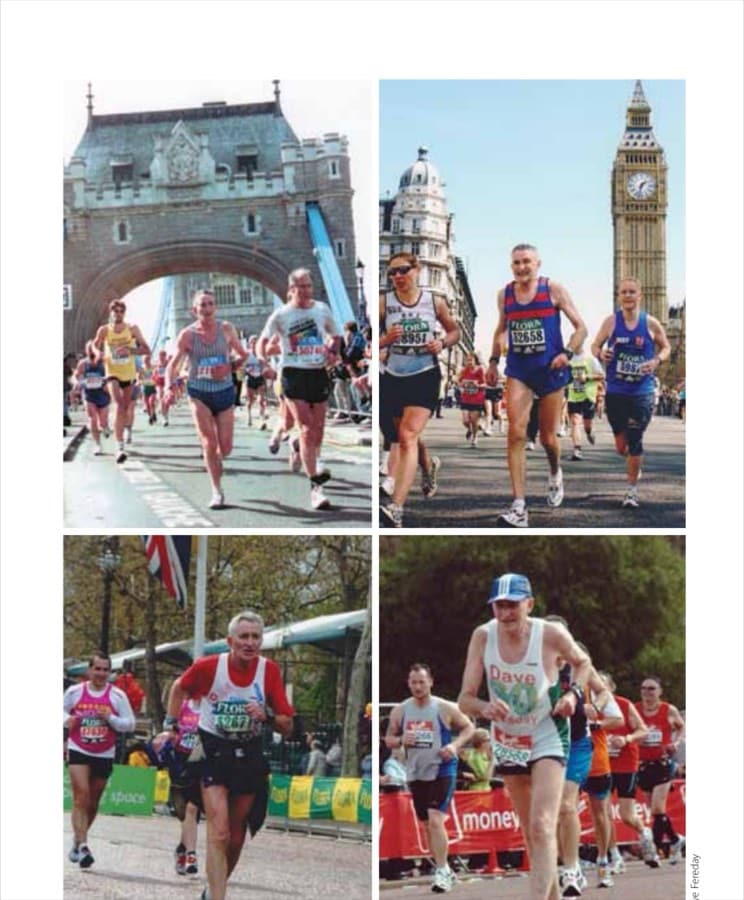
▲ The author’s London Marathon experience through the years (clockwise from top left): 1995: running over the iconic Tower Bridge (author in striped jersey); 2005: running the 25th London Marathon with the Houses of Parliament in the background; 2008: race walking into the finish down the Mall opposite Buckingham Palace; and 2010: again race walking into the finish.
When The Wall came: Didn’t, really; no mile over 10 minutes. Training history: 32-wk average: 26, 8-wk average: 25, fitness factor: 25.5 Comments: Had a three-week complete layoff due to bronchitis in February. As
a result set a none-too-ambitious target, which produced a relatively pain-free marathon—quite a piece of cake, really.
2006/age 68 Target time/pace: 3:50:15, 8:47/mi: 8:30, 8:35, 8:40, 8:45, 9:20 Actual: 4:07:08, 9:26/mi: 8:18, 8:36, 8:42, 9:34, 11:28 When The Wall came: 18 miles with deterioration to nearly 12:00 miles. Training history: 32-wk average: 27, 8-wk average: 39, fitness factor: 33 Comments: Good training but felt none too well with resting pulse of 58—normal is 48. Kept going to 15 miles, then totally downhill. The worst “Wall” experience ever. 2007/age 69 Target time/pace: 4:03:00, 9:16/mi: 8:50, 9:00, 9:10, 9:30, 9:50 Actual: 4:06:30, 9:24/mi: 8:49, 9:11, 9:06, 9:18, 10:14 When The Wall came: 22 1/2 miles. Training history: 32-wk average: 26, 8-wk average: 34, fitness factor: 30 Comments: In view of heat (73 degrees), increased my original target of 3:58:30 by 10 seconds/mile. After The Wall, managed to keep going. 2008/age 70 Target time/pace: 5:47:00, 13:14/mi: even pace. Actual: 5:40:10, 13:02/mi: 13:06, 13:01, 12:50, 13:01, 13:02 When The Wall came: Never. Maintained constant pace throughout. Training history: 32-wk average: 16, 8-wk average: 23, fitness factor: 19.5 Comments: In November 2007, I was diagnosed with a worn-out cartilage in a knee, and it became impossible to run. Fortunately, I was able, though with some discomfort, to racewalk so continued training in that mode. Unable to train sufficiently, I was not sure whether the knee or muscles would last 26 miles so set a very modest target, which I beat comfortably. Unlike in my latter years of running the marathon, when age made even-paced running really impossible, with walking there was no problem with even pace. 2009/age 71 Target time/pace: 5:38:30, 12:55/mi: even pace. Actual: 5:38:03, 12:54/mi: 13:02, 13:05, 12:50, 12:54, 12:45 When The Wall came: Never. Training history: 32-wk average: 15, 8-wk average: 30, fitness factor: 22.5
Comments: Training severely restricted for seven weeks due to sciatica and flu,
but a perfect job. Felt sluggish for first 10 miles, then picked up. The threeminute negative split showed potential for quicker time.
2010/age 72 Target time/pace: 5:34:10, 12:45/mi: even pace. Actual: 5:27:50, 12:30/mi: 12:32, 12:44, 12:34, 12:28, 12:24 When The Wall came: Never. Training history: 32-wk average: 21, 8-wk average: 36, fitness factor: 28.5. Comments: Another perfect job. Bearing in mind big increase of fitness fac-
tor compared with previous year, my target maybe was too easy. Big negative split of 3:40 again shows potential for quicker time. I had two coaching lessons from a former Olympian race walker, John Paddick, eight weeks prior. Proper technique is vital to properly race walk. John said he could increase my speed by 30 seconds a mile just by changing a few simple movements, and so it almost proved, with a 24 seconds/mile quickening compared to the previous year.
2011/age 73 Target time/pace: 5:26:46, 12:28/mi: even pace. Actual: 5:26:40, 12:28/mi: 12:26, 12:41, 12:37, 12:43, 12:14 When The Wall came: Never. Training history: 32-wk average: 25, 8-wk average: 36, fitness factor: 30.5 Comments: Training level similar to previous year so set target to just make a PB. But miles six to 19 fell below required pace possibly due to the heat—one of the hottest Londons ever. But sky clouded over and put the boot in to get back on target. Last 1.21 miles at 10:59 per mile, but cheated a little by breaking into a jog for the last quarter mile as beating last year’s time was getting rather close.
Reflections I hope to keep on for at least two more years to do London as a 75-year-old. Thereafter, the next goal would be doing it at 80—London 2018! Unfortunately, I now cannot run, but nevertheless racewalking is very strenuous, and therefore, I do not think I am cheating by not actually running. Walking takes up to 50 percent more time and so time on the feet makes training and actual marathon time consuming and teaches patience. Walking may enable me to continue far longer than if running. Heart rate at 12:30/mi. is only 125 compared with 150 or more when running at 9:00/mi., so there is less strain on the heart.
My best experiences were doing the PB of 2:44:10 in 1985 aged 47—couldn’t believe the time—and then in 1990 passing Seb Coe at around 20 miles. The worst was in 1986 attempting to PB again and completely blowing up on the cobbles
at the Tower of London. Reduced to a walk—and hundreds going by—very humiliating—but still beat three hours! Preparation as the years have gone by remains similar with a mix of tempo, LSD, short recovery, and some interval-type speed work. All that has changed is volume and, of course, speed. There is no difference since downsizing to racewalking. While I strive to keep up the mileage, one has to have rest days in respect of getting old. In my 40s, the 55-mile weeks, one after the other, were achievable with big weeks up to 70, but now in the buildup it is difficult to string together weeks of 40, with 45 only occasionally achieved.
Now that I am racewalking, there is some learning curve, particularly in the concentration to maintain efficient technique. There is the stimulus that I am back to creating PBs as I become practiced in this rather peculiar discipline.
An interesting statistic is how my best time of 2:44 from 1985 compares positionwise with today’s results. In 1985, I was 1047th, but that same time in 2010 would have placed me around 200th. This reflects the dramatic fall in standards of the club runners and the lack of depth of our top marathon men. As there are few young guys taking up road running these days, there just aren’t enough blokes at the sharp end. You go to a road race these days and the majority of participants are over 40—just loads of grizzled vets—or should I say “masters.” The over-40 age group is now being well outnumbered by the over-50s. What sane young men nowadays want to bash out training miles like us old geezers suffered? And as for getting out on the road each night after work . . .
Fitness factor The philosophy is that fitness for a distance race is directly related to miles run, and therefore, one’s marathon time can be accurately estimated from a measure derived from miles run prior to that marathon with the rider that the miles should be made up of a mix of LSD, tempo, intervals, and easy recovery runs. Fitness is gained from long-term mileage—say, 32 weeks prior to the marathon—and short-term, eight weeks prior to the race. So long-term fitness I assess as the average miles per week for 32 weeks, and short-term fitness is that gained from training eight weeks prior. Fitness factor is the mean of these two readings. So if 800 miles were run in the 32 weeks—average: 25—and 320 in the last eight weeks—the average fitness factor would be (25 plus 40) divided by two equals 32.5. This measure I found to be very reliable, and I would increase or lower my marathon target accordingly.
My results from all the London Marathons back this up. When I kept very close to the required minutes/mile from the outset, pace was maintained with target time reasonably achieved. However, whenever I started quicker than required, minutes/mile pace for the last quarter of the race was reduced to well over target, with a dismal result.
This article originally appeared in Marathon & Beyond, Vol. 16, No. 2 (2012).
← Browse the full M&B ArchiveMore like this
1,000+ stories from 19 years of Marathon & Beyond
The complete archive of the legendary long-distance journal — digitized and free to read.
