

The Long and Winding Road
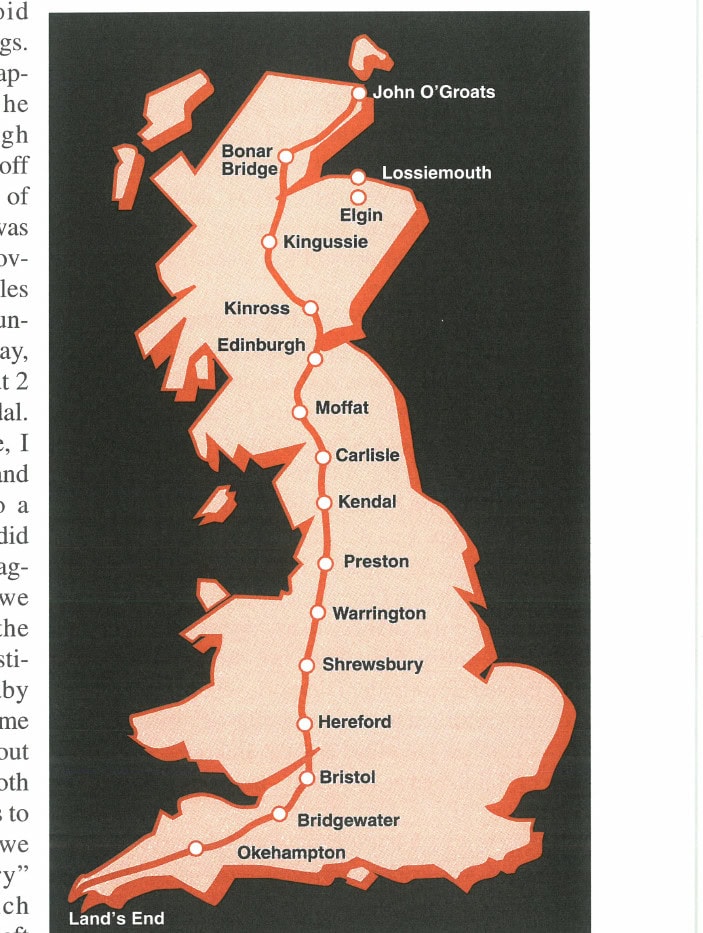
THE SEED of the ambition to run from the northernmost point on the island of Great Britain, John O’Groats, to the southern extremity, Land’s End, was sown in my mind many years ago. On long Sunday runs in the late ’60s with Alistair Wood and Steve Taylor, we used to periodically discuss the possibility of an “end to end” relay run.
Enthusiasm for the relay grew, and in April 1972 I was part of the eight-man Aberdeen AAC team that completed the John O’Groats-to-Land’s End (JOGLE) run, estimated at 847 miles, in 80 hours and 25 minutes—some 45 minutes outside the record set by Reading Athletic Club in 1967. Using the experience gained, Aberdeen AAC improved on Reading’s record by 23 minutes the following April, but I was not able to participate in this “adventure.”
Still, the idea lived on, and in April 1982 I was part of a very strong Aberdeen AAC team, which set the present record of 77 hours, 26 minutes, and 18 seconds.
After that, the idea of a solo run grew steadily stronger, until in June 1986, I decided to plan an attempt during our two-week Easter holiday from school in 1987. Both of my parents had died of cancer, my father in 1985 and my mother in 1986, so the time seemed right to attempt the run; I planned to raise funds for cancer research through soliciting sponsorships.
After months of planning, my attempt began at 7:00 A.M. on April 5 at Land’s End. I had decided to start there, at the southern extreme, to make use of the prevailing wind, which in April is from the west, and to take advantage of the “homing pigeon” effect of running toward home. My support crew consisted of Graham Milne (coordinator of the run), Peter Chalmers (in charge of navigation), Mike Francis (who looked after my requirements on the road), and Malcolm Morgan (“Magic” Morgan, the lead physiotherapist from Dr. Gray’s Hospital in Elgin).
I set a schedule for 10 days, and my strategy was to run for one hour, then walk for five minutes, before running another hour, continuing in this fashion until 1:00 P.M., when I would take a break of one hour. The afternoon and early evening would be similar. On the first day, I finished in the town of Lifton, having covered 83 miles in 12 hours, 44 minutes of running and walking.
The next morning, I set off in pouring rain, which was miserable. Mike and I got lost in Taunton, which wasted time and energy. I ended the day in Bridgewater, having covered 80 miles, plus one mile in the wrong direction.
GO LAME, GO HOME
Day three started well: the sun was shining, the road was flat for about 16 miles, and I felt quite good. However, many miles later in the early evening between Monmouth and Hereford, my attempt floundered. I was running down a steep hill before St. Wenwords when suddenly a severe pain developed in my lower left leg, making further running impossible. Treatment from Malcolm that evening proved ineffective.
The next day I spent miserably walking, or rather limping, at less than four miles per hour. At Hope under Dinmore, which I reached in the late afternoon, I abandoned the attempt, after consultation with Malcolm, who could see no chance of the injury improving. Later, the injury was diagnosed as a stress fracture of the tibia.
I made a complete recovery from the fracture and wanted again to try the solo JOGLE. However, before committing myself, I thought it best to give my leg a good test, so I accepted the invitation to run in the Cagliari-to-Sassari race of 254K in Sardinia on October 17. I completed the run in 25 hours, 28 minutes, and 52 seconds with no leg problems, apart from the normal one of not being able to move them quickly enough.
Having passed this test, I decided to make a second attempt at the JOGLE, starting on July 11, 1988, again from Land’s End. Everything was set up for the attempt, so it was a bitter blow to all involved when the attempt had to be postponed on June 19. On this day, soon after the start of a 100K race in Lincoln, I collided with another runner and fell very badly onto the pavement.
I fractured my left patella and had to endure the next three and a half weeks with my leg in plaster from groin to ankle. Following the removal of the plaster, and after daily physiotherapy and muscle-strengthening exercises, I regained full bending movement in my knee, but my leg looked rather like a stork’s. I was able to start jogging on August 7 and progressed to full training by September 12. I wanted to test the knee to see if I could contemplate another JOGLE run the following Easter.
I ran the Black Isle Marathon on September 29 in 2:34:56 with no ill effects, except increased discomfort and ache in my knee for a few hours after the race. Then on November 19–20 I ran in the indoor (200-meter track) 24-hour race in the Kelvin Hall, Glasgow, and managed 144 miles, 1,009 yards. My knee was no problem during the run, but it did swell with fluid for a few days after.
I decided that I was sound enough for another attempt. This time I planned to go from John O’Groats. My reasoning was that it’s much easier to get to John O’Groats from Lossiemouth, my home, and in the event of my knee giving out, which I thought might happen after three days if at all, it would not be so far to get home. On the negative side, going in this direction, headwinds were more likely.
OUR NEW TEAM
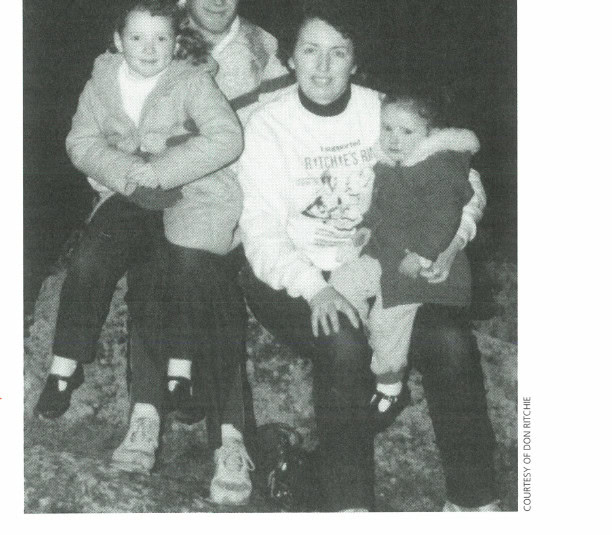
I set up the attempt to begin on the first of April 1989, at noon—no longer an April Fool, I hoped. April 1 was the first day of our two-week holiday from school. My support team consisted of Isobel (my wife), Donald Gunn and Mike Francis (teammates from Forres Harriers), George Stewart, plus Claire and Anna, my daughters. Isobel, assisted by George, was to tow our trailer, provide meals, wash clothes, and record parts of the run on videotape when she got a chance. Mike took responsibility for route-finding and keeping the log book, while Donald was to administer massage after each running session. The crew would also take responsibility for collecting names and addresses for the witness book, as required by the Guinness Book of World Records, for inclusion should I break the record, as I planned to do.
After work on March 31, we set off for Golspie, where we were to stay at Donald’s parents’ holiday cottage. Mike and Donald drove a minibus, supplied by our main sponsor, the Macallan Whisky Distillers. I had all the seating removed except for the driver and passenger seats; this way I could easily carry all our provisions, kit, and a bicycle, plus there was room to lie down for a massage.
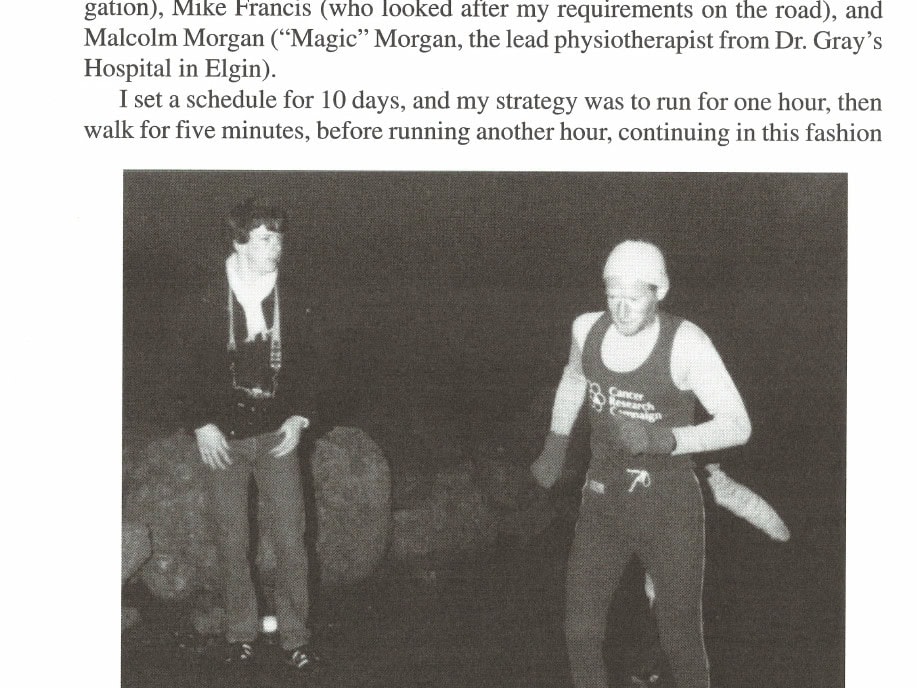
Overnight, Mike developed a severe toothache, so he and Donald set out early to try to find a dentist in Wick, while we made our way to John O’Groats some time later. My plan was to ease into the run by starting with a half-day, which would take us to Brora. At John O’Groats, temperatures were bitterly cold, and a strong southeast wind blew, so a wetsuit, hat, and gloves were necessary. Mike and Donald arrived about 30 minutes before the noon start, having found a dentist who fixed Mike’s tooth for free as his contribution to our run, which by now was known as “Ritchie’s Run ’89.”
Nine friends and supporters turned up before the start to wish me luck and see me off, a surprise treat that I greatly appreciated. I planned to start exactly at the 12 noon time signal from a BBC radio station, but in all the excitement I selected the wrong station on the car radio, and there was no BBC time signal, so my actual departure was at 12:02.
I set off to cheers and was soon alone, tackling the first of many hills, running into a strong headwind in this very exposed region. I wondered what the next 10 days would bring.
In an attempt to minimize stress and avoid injury, I had decided I would not run for more than three hours in any one session and that I would have at least a 30-minute break between sessions. I intended to run three three-hour sessions, followed by two two-hour sessions, plus whatever else was necessary to complete the target mileage for the day, if it was at all practical to do so.
During the 30-minute rest, I would change clothes, and shoes if necessary, eat and drink, and receive a massage and do stretching under the able hands of Donald. Malcom Morgan had demonstrated the techniques on me a few weeks before, while Donald and Mike observed and Isobel made a video recording for reference. We theorized that to gain skill Donald had practiced massaging his girlfriend’s legs.
After I had covered about three miles, Donald and Mike began running alternate miles with me, to try to protect me from the wind on the very exposed road to Reiss.
Soon we reached Wick, which we passed through with some encouragement from local residents. I stopped at Thrumster for a first rest period, which passed quite slowly, but I was sure this would not be the case later in the run.
GOING DOWNHILL CAUTIOUSLY
I continued down the undulating A9 road, which afforded some spectacular views of cliffs, sea, and mountains. At the Berriedale braes I was very cautious of the steep descent, fearful that excessive jarring might provoke another stress fracture, so I walked down the steepest part, a practice I would repeat on all future steep downhills. The climb from Berriedale was okay, and there were several other stiff climbs before the descent to Helmsdale at sea level again.
From there the road is almost flat, and I could see the lights of Brora, 11 miles away. This section seemed to take a long time to complete; it was quite annoying seeing the lights, which did not appear to be getting any closer. I finished in Brora at 10:45 P.M., having covered 65 miles for my “half day” of work.
I had difficulty sleeping that night and was feverish. In the morning, I was choked up with a cold—the cold that had been threatening over the past week had finally developed into a classic cold, with all the accompanying discomfort. After breakfast, we returned to Brora, and at 6:00 A.M. I began running from last night’s stop point. The wind was not a problem until the high ground from the south end of Loch Buihde to Bonar Bridge. Going over Struie Hill was very hard, as the wind at times nearly blew me off my feet. I was glad when the descent to the Cromarty Firth began, as trees lined either side of the road, offering protection.
Shortly before I crossed the bridge over the river Averon, a sharp pain on the front of my left patella developed, and I worried that this might signal the start of problems with the knee. However, some freeze spray eased the pain considerably, and eventually it faded away.
Raymond Cameron and members of the Minolta Black Isle Athletic Club joined me a couple of miles before I rejoined the A9, and they ran with me in relays from there to the Kessock Bridge at Inverness. It cheered me up to have this enthusiastic support, and they also helped to shield me from the wind. At Kessock Bridge, Colin Bailey had arranged a group of veteran Inverness Harriers to run with me from there to within a few miles of Slochd summit. Again, they were a big help against the wind and in lifting my morale.
The day became colder; by the time I reached Slochd summit, flurries of sleet were falling. I was tired and eager to see the turnoff for Carrbridge, where I was to stop. I reached there at 10:05 P.M., having covered 84.7 miles, but I was feeling very tired. It had been a hard day, with the wind and hills.
We spent the night in a trailer park in Aviemore, where we all appreciated the hot showers.
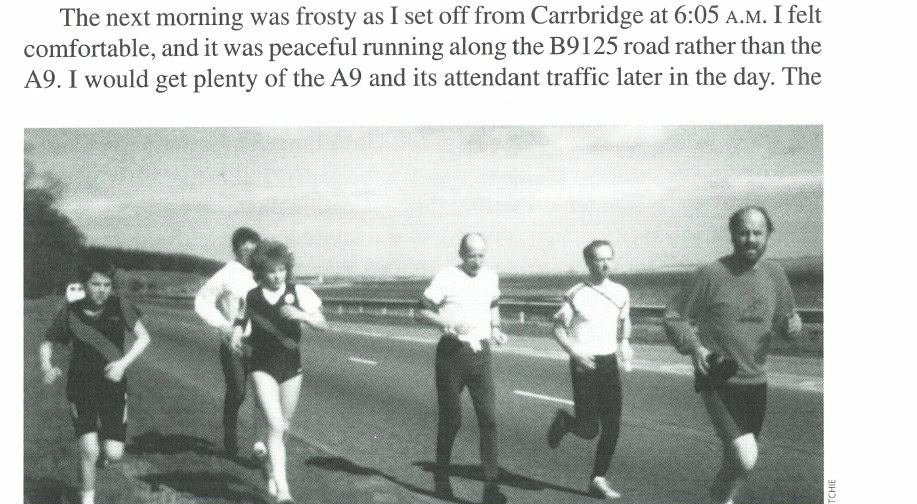
The next morning was frosty as I set off from Carrbridge at 6:05 A.M. I felt comfortable, and it was peaceful running along the B9125 road rather than the A9. I would get plenty of the A9 and its attendant traffic later in the day. The day developed into a pleasant morning, with no wind, and the sun was out, which was quite encouraging. My first three hours took me to Kingussie, only 19.5 miles, but I had come to accept this slow pace as the norm if I was to avoid injury and complete the task.
A CHANGE OF CREW
After Newtomore I rejoined the A9 and after about four miles had company from Graham Milne, who had driven up from his parents’ home in Pitlochry. It was good to have him there until my next stop at Drumochter pass. By now Isobel had arrived, and her hot soup was very welcome. Peter Scott, a clubmate of Graham’s involved in the planning of the previous attempt, also arrived. He and Graham became my support team until Pitlochry, while Donald and Mike went ahead to Graham’s parents’ for a meal and some much-needed sleep.
Peter ran with me on my next three-hour session, and then Graham took over again until we reached Pitlochry, where a refreshed Mike and Donald resumed their task.
About one mile after rejoining the A9, after the Pitlochry section, I saw a figure running toward me. As he got closer, I recognized the unmistakable running style of my good friend Ian Moncur. I knew he was pleased to see me, but he began shouting at the top of his voice: “Where the hell have you been?” I had asked Ian prior to the run if he would like to run a section, and he had readily agreed. Earlier in the day I had asked Graham to telephone Ian to let him know my location so that we could meet. Unfortunately, Graham gave him a very optimistic estimate of my arrival time at Ballingluig, so he had expected to meet us some three hours earlier. Ian ran with me for two hours, down to Dunkeld junction, by which time it was quite late.
I left the A9 soon after to go to Bankfoot, where we finished at 11:00 P.M., with a total of 81.8 miles for the day. In view of this late finish, Mike suggested something I had also been considering: moving the next morning’s start earlier by an hour.
There were no hot showers at our night stop, the trailer park near Perth, so we did without. The next morning, I began running at 5:12 and covered only 17.2 miles in the first session, arriving at Glenfarg. I was coping with the run but getting weaker daily. Certainly, I was not adapting to the run and becoming more fit as the run went on, as some people had suggested might happen. My cold had progressed into bronchitis, which worried me some.
Adrian Stott from Edinburgh joined me about five miles before my next stop at Hill of Beath. His company cheered me. I developed a nosebleed, the first of many, so I had to run along spattered in blood, a wad of toilet tissue in my nostril to stop the flow.
As we approached the Forth Road Bridge, snow began to fall, accompanied by a strong easterly wind. Isobel had passed us on the bridge and so was unable to video us coming off the other side.
Adrian ran with me around the Edinburgh Bypass, which was very busy and extremely nerve-racking to run on because of the fast and heavy traffic. We were both relieved to get off and head for Penicuick and Peebles.
I observed at my next toilet stop some evidence of intestinal blood loss—something else to try to remedy. Adrian left us at Leadburn Inn with best wishes for our “history in the making” event and a flask of fresh tea; we also received a five pound donation from the inn staff.
AND YET MORE SNOW
More snow fell on my next session down through Peebles, where I missed the most direct route onto the B7062 road. With the drop in altitude, the snow turned to sleet. I finished at Traquair House at 10:26 P.M., having covered 80.6 miles. It was quite a long drive to the trailer park at Tushielaw Inn, made difficult by the snow on the B709 road, as we drove over the hills. Again there were no hot showers, and it was after midnight by the time we had finished our “evening” meal.
Four hours later, at 4:00 A.M., we had to push the Macallan van off the site, as the tires could not get any traction on the slushy grass. At 5:16 A.M., I began running from last night’s stopping place and soon faced a long climb over to the A708 junction, and then another, over to Tushielaw.
The roads had a covering of snow, and it was quite therapeutic running through this quiet countryside as dawn broke. I was virtually alone, except for an occasional herd of sheep.
Mike and Donald took turns driving and sleeping so that they would be fresher later in the day. I followed the meandering B709 on to Eskdalemuir, then down into Langholm, and we left the hills behind us, as the flat country around the Solway Firth spread out before us. I crossed the English border in the late afternoon, which gave me a morale boost.
Apart from my bronchitis and intestinal blood loss, I was now beginning to develop stomach pains. I worried that I might be developing an ulcer. Also, the inside of my mouth was very sensitive, almost raw, so it was an effort to eat—especially anything hot or salty. I pondered possible courses of action to combat this problem. I had already given up quite diluted orange squash in favor of water, tea, or electrolyte drink after the second day. I noticed that my sore mouth was aggravated by eating bread and jam, so I decided to eliminate sugar from my diet. I ate dry wholemeal bread along with an electrolyte drink and a banana every hour. Within a day of this regime my stomach pains vanished, and the intestinal bleeding disappeared. The inside of my mouth remained sore.
I passed through Longtown and approached Carlisle along a very busy A7. It was rush hour. I was very tired and flopped into the van at my next stop at the north side of Carlisle. Following this rest stop, Donald guided me through Carlisle and onto the A6 road, which I followed as darkness fell. Mike accompanied me with a flashlight to our finishing point at the northern outskirts of Penrith, which we reached at 11:11 P.M., giving me 81 miles for the day.
The next morning I started at 5:11 and felt comfortable on the run up to Shap Fell. I did not like the steep descent after Shap summit, and I had to go very cautiously to avoid overstressing my legs. Mike joined me as I approached Kendal; he guided me through town before dashing off to buy another pair of shoes. By this time I was extremely tired and covered a mere 16.9 miles during my second running session of the day, which finished about 2 miles south of Kendal. During my massage, I kept falling asleep and going straight into a dream state. Donald did very well in his massaging sessions, but we soon used up all the massage oil. We substituted Johnson’s baby oil, but this caused some hairs to get pulled out on the insides of both thighs, causing boils to occur there. Next we tried “Crisp-n-Dry” cooking oil, which worked well, but it left a pungent sickly smell on any clothes contaminated with it and on the air bed used for massage, which doubled as Donald’s bed.
A CHANGE IN STRATEGY
I put on lighter shoes to see if this would help matters as I pushed on to Carnforth and Lancaster. I felt very weak and wondered how much longer I could keep going. My concern grew, so I decided I would run less than planned so that I could finish earlier and get to bed earlier. I finished for the day at 9:27 P.M. in Preston town center, having covered 72.4 miles.
The next morning, I got under way at 5:20, following the A49 to Wigan and on to Warrington. I felt a bit fresher but still managed only 17.3 miles in my first session. After Stretton, I ran through some attractive countryside, and just after midday I reached the 500-mile point in my journey.
During the afternoon I had another nosebleed, which became a regular occurrence until the end. I stuffed toilet tissue up my nostril and proceeded, finishing the day at Wem at 9:25 P.M., adding another 73.1 miles to the total. My plan now was to run at least 70 miles a day to the finish instead of my planned 80 miles, as 80 had proved too stressful. To continue at that level would be inviting a breakdown.
My 5:02 start the following morning was my earliest, but I felt tired and covered just 16.7 miles in my first three hours. It was frustrating to be going so slowly, but at least I was still running and had no major injuries. Going through Shrewsbury, I passed by the Lion Hotel, where we had stayed in 1987 following the abandonment of my first attempt. I passed through some attractive countryside as I followed the A49 to Church Stretton and Ludlow.
The afternoon became quite warm. I was tempted to put on shorts but discovered the day was not quite warm enough when I assessed the temperature during my next rest session. It was rather pleasant running from Ludlow through Richards Castle and Luston to Leominster along the quiet B4361. Passing through Leominster, I felt twinges in my right calf and began to worry this might be the start of an injury. But after a few more occurrences, the twinges went away.
I passed Hope under Dinmore, where my previous attempt finished, and my thoughts returned to that miserable day two years ago when I was very downcast. I reached Hereford at dusk and ran on and up the long climb to the A466 turnoff. I finished at 11:07 P.M., north of St. Wenords, with a total of 73.6 miles for the day.
At 5:08 A.M., I started out quite aggressively and gave thanks that I was still running, as I passed the spot where my stress fracture had stopped me two years before. I passed Monmouth and enjoyed a pleasant run down the Wye Valley
on this early Sunday morning. I reached the Severn Bridge at about 11:00 A.M. The day again had become quite warm.
WAY OFF COURSE
In Bristol, Mike and I navigated to the Clifton Suspension Bridge, only to discover that the road we were to have taken down to the riverside was closed. I decided to go over the bridge and go down on the other side, assuming that we could find a bridge at river level and cross back to rejoin our route. This was a mistake. Despite our city map, we became disoriented, then thoroughly lost, and wasted time going in the wrong direction. We asked directions from local people, and after clambering over a couple of fences and a railway line, we regained our route.
By my next stop, on the climb out of Bristol, on the A38, I had covered only 12.2 miles over the last three hours.
During the next session, the road was very busy. I assumed people were returning to Bristol after a Sunday afternoon outing. Mike’s sister, Hilary, joined us after Bristol and assisted Isobel in locating our night’s trailer park, where they got set up to receive us later.
Once over the Mendip hills, the road became flat, as did the batteries in my flashlight. Rain began to fall, so I splashed along, holding my nearly useless flashlight. Mike fetched the batteries from the rear light of the bicycle, but they soon faded also. Despite this, I managed to avoid potholes. I was aiming for Bridgewater and eventually reached the outskirts, where I stopped at 11:25 P.M., with 71.8 miles covered for the day.
The next morning I got rolling at 5:01, making my way through Bridgewater and onto Taunton. In my first session I covered 17.4 miles, which was quite encouraging, considering my poor condition. Tiverton was next, then a very hilly section across to Crediton. As I was still concerned about excessive leg stress, I chose to walk the steep downhill sections.
I decided to try four three-hour sessions rather than switch to two hours. During my second session I felt a sharp pain on the left front side of my chest, which was aggravated by swinging my left arm in my normal running action. I had to run along with my left arm folded against my chest to ease the pain. I thought maybe all the coughing I’d been doing had caused a pulled muscle. I began to wonder what the symptoms of a collapsed lung were.
When I mentioned my new problem to Donald, who had arrived to accompany me over the remaining few miles to Oakhampton, he suggested the pain was caused by indigestion. I took this to mean, “Stop feeling sorry for yourself and get on with the run.”
I reached Oakhampton at 8:00 P.M. but in very tired condition, with only 14.7 miles covered in the past three hours. I had a 66-minute rest before continuing with Mike and a rejuvenated flashlight toward Lewdon, where I finished at 11:18 P.M., with 74.2 miles added to the total. I was now 88 miles from the finish, so the next day should be my last day on the road.
FINALLY!
I began my last day at 5:18 A.M. with a sense of excitement and apprehension. My chest pain was gone, but I was concerned something might go wrong at this late stage of the run. About an hour into the run, a headwind began to blow, and rain followed. Amazingly quickly, the wind became a gale, as rain fell in torrents. I battled on against the elements, the gale increasing in ferocity as I climbed onto Bodmin moor.
In my first three-hour session I covered only 15.4 miles. On my next session I was concerned that some of the gusts of wind would blow me into the path of a truck or some other vehicle, so I asked Donald to drive the van ahead of me so that I could get some protection and maintain a straight course.
By the Bodmin Bypass the rain had ceased, but the wind still blew strong. This second session yielded only 15.3 miles; I notched an even poorer 15 miles during the next session. For my fourth session, I changed into lighter shoes and felt I was running better, covering 16.6 miles. However, on the next session, a two-hour segment, I managed only 9.7 miles, finishing at the St. Ivel factory at Hayle at 11:08 P.M.
I began my final session at 11:47 P.M., knowing I had to complete the remaining 16.2 miles in six hours and 38 minutes to break Richard Brown’s record.
By now the wind had died, and it was a peaceful night with a clear sky and a nearly full moon.
On reaching Penzance I took the bypass road rather than go through town, which turned out to be a mistake, as I appeared to complete a large semicircle involving some nasty climbs. As I left the bypass, a signpost indicated 9.5 miles to Land’s End. I was nearly there, but I was very tired, and it seemed to take ages to reach Sennan, where I could smell the sea.
As I ran toward the finish, a floodlight came on to allow the BBC South West camera team to record the finish. I stumbled and almost fell on a traffic ramp in the road and was confused, as Land’s End, with new buildings, looked completely different from what it had been two years earlier. I eventually found the hotel on the clifftop and then the “official” signpost, where I finished at 3:27 A.M. At last, it was over!
I had finished the journey of 846.4 miles in 10 days, 15 hours, and 25 minutes. After hugs all around, we opened a bottle of champagne given to us by Albert Middleton and drank to our triumph. Mike, Donald, and Isobel had each contributed a great deal to the success of the run.
Once the camera crew had signed our witness book, we made our way to the trailer park at Craws-an-wra. It was about 4:30 A.M. before we got to bed. Normally, we would be preparing to start another day’s run at this time. I found it difficult to sleep, as had been the case throughout the run, and got up at 9:00 A.M. It was wonderful not to have to go and run.
Later, after making some telephone calls, we returned to Land’s End to see in daylight the new developments and to sign the “End to End” book. Mike and Donald set off for home that afternoon, as Mike had to catch a flight to Boston for the marathon. He had certainly had a unique preparation for it.
Isobel, the girls, and I stayed another night at Craws-an-wra. The girls enjoyed watching the tortoise in the site-owners’ garden. That night, a stream of yellow liquid suddenly poured from my nose, as though someone had turned on a tap.
“It’s your brains running out!” Isobel giggled.
At this point in the game, I was able to laugh with her.
THE AFTERMATH
It took us four days to get back to Lossiemouth, where I had to prepare for my return to work the next day. We were certainly not refreshed after our Easter vacation. My weight on Monday, April 17, was 133 pounds, about 7 pounds below normal. Considering I had been snacking almost continuously during waking hours since I finished, I estimated that my weight had been down to roughly 126.
The aftermath of the run was not what I expected. I was not injured, only weak. And my health/immune system had broken down. Apart from continuing bronchitis, I had swollen glands on either side of my neck, and my pulse stayed 10 beats above normal. Antibiotics were prescribed, and they worked well enough for me to resume running on May 1.
I had difficulty sleeping for about five weeks after finishing the run. I would be very restless and keep thinking it was time to get up and get ready to run, or I would dream I was still running and had gotten lost.
Being an optimist, before my run I had entered the Lochaber Marathon, scheduled for April 23, and the first British AAA 100K championships on May 7. I had to withdraw from both events. My poor health continued through the summer. Each time I began to train hard, I picked up another infection. I had seven courses of antibiotics as well as two decongestant mixtures before I began to get back to normal in early September. From then on, I felt stronger each week, and I knew I had recovered when I ran 6:51:14 in the Santander 100K in Spain in October.
In association with my run, my many helpers and I raised 5,667 pounds (about $9,350 US) for cancer research, which made the run all the more satisfying.
I now have an even greater respect for anyone who completes the End to End journey on foot. I also learned quite a bit else from this adventure:
- The importance—and difficulty—of good route planning.
- The importance of correct eating.
- The importance of getting strategy and logistics right.
If I were asked for advice by someone attempting this run with the intention of breaking the record, I’d suggest using two mobile homes with a support crew of eight, who would work as two teams, on a shift system of four hours each. The runner should keep moving, jogging for up to 18 hours a day, if possible. An attempt during the summer should yield better weather.
There have been several record attempts since 1989, and most petered out after three or four days.
Richard Brown, whose record I had broken, sent me a card saying “Congratulations on your record. Enjoy it until I get it back.” I thought he was joking, but years later I realized he was not. In May 1995, Richard completed the journey from Land’s End to John O’Groats (LEJOG) in 10 days, two hours, and 25 minutes, setting what stands as the current record.
I know the record should be under 10 days, but who will accomplish this? A strong ultrarunner with the time, adequate financial backing, and an experienced support crew would be a good bet. I’m occasionally tempted to try to get the record back and finish in under 10 days. Perhaps my desire will reach such a level that I will have to do something about it. Time will tell.
This article originally appeared in Marathon & Beyond, Vol. 5, No. 5 (2001).
← Browse the full M&B ArchiveMore like this
1,000+ stories from 19 years of Marathon & Beyond
The complete archive of the legendary long-distance journal — digitized and free to read.
