

The Long Roadto Napa
“Not life, but good life, is to be chiefly valued.” —Socrates
The ultramarathon I ran last March started more than 2,500 years ago, in 490 B.C. It has likely been an annual event ever since, in one form or another, though records are sketchy. Throughout history, there have been accounts of humans covering great distances on foot; however, not all of these runners have lived to tell their stories. The venue has hopped around a bit too, with all seven continents playing host at some point along the way, so precise documentation is tricky. Still, the origin of the world’s oldest ultramarathon can largely be traced to one man: that legendary father of the modern marathon, the illustrious figurehead of endurance running, Pheidippides.
Debate aside regarding just how many miles Pheidippides covered, it does seem plausible that he ran quite some distance before running the final 26.2 miles from the Plains of Marathon to Athens. Let’s just say that the notion of Pheidippides’s running beyond a marathon exists, which was enough to get me thinking about repeating history in my own small way.
Being Greek myself, I’m partial to the story of Pheidippides’s running from the coast of Greece to Sparta—a distance of more than 100 miles—before he completed any marathon. And I favor the version in which he ran in full armament with an arrow wound in his arm, though I personally was willing to carry the theme only so far.
My endeavor began at the coast as well—actually from my front doorstep in San Francisco—to a place covered in grapevines just like the hills of Greece, the Napa Valley. Though I didn’t have blood pouring out of my arm and was in running gear rather than a suit of armor, the concept of running to the start of a marathon was similar to what Pheidippides had done more than 2,500 years ago. In my case, I wasn’t running to Athens to deliver news about a battle to the leaders of Greece; I was running to the start of the Napa Valley Marathon to meet my friend Jeff.
* * * The Napa Valley Marathon starts in the sleepy little town of Calistoga, at the far northern reaches of the Napa Valley. The shortest route to get there from my house in San Francisco is off limits to foot traffic, as much of this more direct route is high-speed freeway. So I would need to travel the long road to Napa, which juts considerably west along the back roads of Marin County and then weaves gradually up over the coastal range and down to the start. It was 100 miles point to point, following a confusing crisscross of small country roads and hidden footpaths that linked them all together. Thank goodness for MapQuest; Pheidippides should have been so lucky.
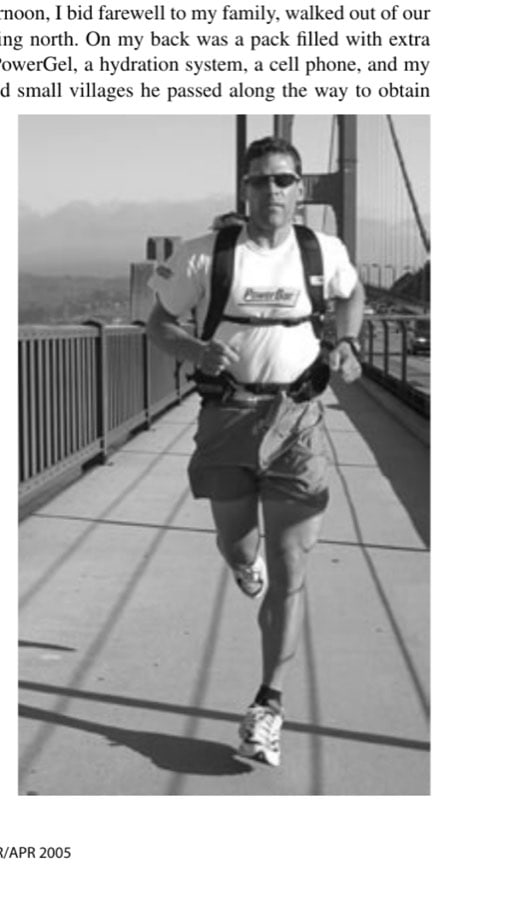
At 1:00 on Saturday afternoon, I bid farewell to my family, walked out of our front door, and started running north. On my back was a pack filled with extra clothing, flashlights, food, PowerGel, a hydration system, a cell phone, and my credit card. Pheidippides had small villages he passed along the way to obtain fresh food and supplies; I had 7-Eleven.
Running across the Golden Gate Bridge is always exhilarating, but today was even more magical. The weather was perfect—cloudless and crisp—with the San Francisco skyline shining in one direction and the vast blue Pacific sparkling in the other. Fellow joggers passed me by and we nodded to each other; a few were probably wondering why I was running with a bulky pack, but mostly we were all consumed by the splendor of the setting and the day.
Crossing the bridge and winding down into Sausalito, I found the air surprisingly
Dean crosses the Golden Gate Bridge, on his journey to the Napa Valley Marathon starting line.
warm for early March—perhaps too warm. Heat is the runner’s enemy. Running generates tremendous internal heat and forces the body to work doubly hard to keep the muscles cool. When outside temperatures rise, the stress on the body is multiplied.
For me, heat is particularly insidious. Living in San Francisco limits my exposure to heat; hypothermia is a more likely concern. Exacerbating matters, I’m bulky. Since I’m into a variety of outdoor sports—windsurfing, mountain biking, surfing, snowboarding, climbing—my upper body is fairly well developed. Carrying that extra bulk is not a good quality for a runner; a wiry body produces less heat. Still, I shouldn’t be complaining. Pheidippides had to contend with the late-summer heat of Greece during his run, where temperatures likely reached into the 90s, as the Olympic marathoners learned when they ran there in the 2004 Olympic Games.
I took a hit from my hydration hose, wiped the perspiration from my forehead, and stopped grumbling about the weather. Ice was sold at every corner liquor store if things got too bad. After I had run about 25 miles, the road left the urban landscape and proceeded west into the countryside. The sun had begun its descent, and the traffic lightened considerably. Soon I would be out of cell range, so I called home.
My wife answered. “How is everyone?” I questioned. “Fine,” she replied. “We’re just getting ready for dinner. How are you?” “So far, so good, though I’ll be out of reception soon.” “Let me put the kids on.” “
Daddy,” my 9-year-old daughter, Alexandria, came on the line, “where are you?” “I’m up in Marin, sweetie, on the way to Calistoga.” “Are you going to run all night?” “Yes, but I’ve got a flashlight and reflector vest.” “
Well, be careful, and don’t talk to strangers. Here’s Nicholas.” “Hi, Dad. I’m getting ready for my game; here’s Mom.” At 6 years old, the kid lives for basketball. His game wasn’t until tomorrow afternoon, but he was already preparing. “
Have a nice time,” my wife said. “We’re going to watch a movie tonight.” I said good-bye and started craving popcorn. Pheidippides had a family, too. He had served Athens as a hemerodromoi (roughly meaning: “all-day runner”) for over a decade and was preparing to leave the army and return to his family
at the conclusion of his commitment. Being a foot messenger was an esteemed role, and only the most elite, the toughest and bravest, held such positions. Pheidippides was the finest, though he had made sacrifices to achieve such distinction and was longing to return to his family. It’s a pity there weren’t cell phones in 490 B.C; he at least could have stayed in touch.
* * * By the time I reached civilization again, it was dark. My progress had remained steady throughout the distance, but I had put a significant dent in my food supply and was now famished. As I ran into Petaluma, the first commercial establishment I came upon was a 7-Eleven. Oh, thank heaven. I entered the store and proceeded to wander from aisle to aisle, looking. “
Can I help you find something?” the young clerk behind the register finally asked. “Do you carry popcorn?” “We’ve got caramel corn,” he said. “That’s even better.” With a large bag of caramel corn, along with a few other delectables, I left the store, grinning. Usually my diet is really good—no refined sugar, high protein, good fats, only slowly metabolized carbs—but tonight I had to be reckless. Without massive caloric intake—burgers, fries, ice cream, cookies, chocolate—my metabolic system would grind to a halt, and I would be unable to accomplish my mission.
During long runs, I found it difficult to consume enough calories by eating healthful foods alone. My calculations were that I burned 720 calories an hour. If I were to run for 21 hours, I needed to consume a whopping 15,200 calories to match my expenditure. Healthful foods are typically less calorie dense because the natural fibers are left in place and not stripped away. Because of this additional bulk, it would be difficult to stuff 15,200 calories of healthful food into my gut. The sheer girth of such a mass would bloat a hippopotamus! So I resort to eating highly refined, richly sweetened, calorie-dense foods—caramel corn, doughnuts, candy, the more calorie packed, the better.
Off I ambled down the road, munching the caramel corn in one hand, balancing a flashlight with the other. I was approaching the 50-mile mark, and it was nearing 10:00 P.M. The race started at 7:00 tomorrow morning, so there was little margin for error if I were to make it on time. I liked it that way; it kept the pressure on. * * * This wasn’t the first time I had run from my house to the start of a race. I began the practice some time ago, largely for practical reasons. After years of trying to find a parking spot at the Bay-to-Breakers, I finally came to the conclusion that it would be a lot less of a hassle to just leave my car at home and run there.
It added only a few extra miles and didn’t affect my race times much. Even if it did slow me slightly, I felt a sense of environmental stewardship that more than compensated for any lost seconds. Things got progressively “green” from that point on. Soon, I found myself running to the start of various races around San Francisco and neighboring cities, sometimes also running home afterwards if I couldn’t bum a ride with someone.
My car rarely left the garage on weekends anymore; I didn’t have much occasion to use it. Few had any idea about my extended prerace warm-ups. I would simply start several hours beforehand, time my arrival to coincide with the gun, and then run the race just like any other runner—no need to broadcast the fact.
One person, however, knew of my antics. Jeff Shapiro, MD, is the founder and race director of the second-largest relay race in the country, a 199-mile affair held each fall in Northern California from Calistoga to Santa Cruz. It’s called, simply, The Relay. It was here that Jeff had first been exposed to my aversion to car travel. I had run The Relay solo on six occasions.
When I had called Jeff to see whether he wanted to run the Napa Valley Marathon with me, I could sense his suspicion. “Sure,” he said sportingly, “I’ll run the marathon with you, but let’s meet at the start.”
In addition to being an anesthesiologist, he had street smarts as well. He wasn’t about to let me drag him 100 miles to the start. * * * Midnight had since passed as I made my way toward the last outpost for supplies along the way. I had covered over 70 miles now and would need to restock for the final push. Walking into Safeway at 2:00 A.M. in running gear always draws a few curious looks. In this case, it drew inquisitive conversation as well. “
Where you off to?” the checkout clerk asked. “Calistoga.” “Tonight?” he blurted, somewhat mystified. “Yeah,” I answered. “I’m supposed to meet a friend in the morning.” “But Calistoga.” He rubbed his chin. “That’s quite a ways. Where’s your bike?” “
Actually,” I responded slowly, “I’m running.” “Running!” he bellowed. “That’s insane. You’re going to run from here to Calistoga?” “That’s the plan.” Guess I had better not mention where I started from.
I paid for the groceries and thanked him. “Take it easy,” I said. “Yeah,” he gazed at me quizzically, “you too.” The full moon bathed the hillsides in a silvery varnish as I set a course eastward over the coastal range. From here until the start of the marathon, there would be few signs of humanity. The narrow two-lane road wove up the hillside, climbing more than 1,600 feet before reaching the summit. It was an arduous, steep ascent made all the more demanding by the added weight of fresh water and supplies in my pack. But I needed to maintain a steady clip if I were to make it to the start in time, so I kept powering onward.
Two hours elapsed and scarcely had there been another sign of civilization. Sometimes I would hear a cow moo; occasionally I would be surprised by the
skittish eyes of a deer or raccoon crossing the road. Otherwise the world, at four in the morning, was still. Running straight through the night, I watched the bluish moon rise, grow big and bright and white in the sky, crest midnight, and then begin its yellowy descent into the distant horizon. Although I was equipped with an LED headlamp and halogen handheld flashlight, that brilliant moon rendered them largely unnecessary.
Dawn emerged strikingly clear, not a cloud in the morning sky. My trajectory was right on target. I had run straight through the night on pace, and things were progressing as planned—until I made a wrong turn.
I had never approached Calistoga from this route before; when I hit the main road, instead of running toward town, I started running away from it. How could I make such a blunder? When I looked at the map again I realized what went wrong—it was upside down! Cursed MapQuest. Pheidippides was lucky not to have to deal with modern technology.
Now things were getting dicey. The clock was ticking, and the 7:00 A.M. start time was rapidly approaching. After making a U-turn and correcting my course, it was crucial to pick up the pace. This wasn’t the way I wanted to arrive at the start, but time was running out.
At 6:55 A.M., I arrived as the starting line—one of 2,200 runners. Now what? How would I ever find Jeff in this mass? I started desperately making my way through the crowd, seeing nothing but legs and race jerseys, and then ran nearly headlong into him. I couldn’t find the town of Calistoga, but I found Jeff almost intuitively. His energy emanated from a crowd like an oversized sparkler.
Upon seeing me, he immediately sprang into action. He grabbed my pack and flung it to one of the race volunteers, instructing him to bring it to the finish for us. “But . . . but . . . but.” I tried to protest as he pulled me to the starting line—after all, my phone, wallet, and nice running gear were inside—but he paid no attention to my pleas. “
Do you want to stretch, or anything?” he asked. There were now 30 seconds left until the start siren went off. “I’d like to take a nap,” I said. “Maybe right here on the pavement.” “No time. Besides, you look great. Let’s go!”
I had arrived at marathons fresher; then again, so had Pheidippides. Legend has it that after running an “out-and-back” to Sparta—a distance well over 200 miles—he was dispatched to run that fabled marathon to Athens, whereupon he crumbled to the marble floor of the Acropolis and died. I hoped that my ending wouldn’t be so melodramatic.
The starting siren sounded, and we began moving across the starting line and down the course. Jeff and I ran together for the first half of the race, spending
much of the distance chatting up a storm. We separated at the midpoint. I wanted to finish as quickly as possible to try to rest and also to escape the heat—temperatures were almost 20 degrees above normal.
My goal was to complete the marathon segment of my journey in less than four hours. I finished a little ahead of schedule in 3:15, largely because I didn’t want to spend any more time than necessary in the building warmth. I ran across the finish line drenched in sweat.
Pheidippides had ended his marathon by proclaiming defiantly, “Nike! Nike! Nike!” (Victory! for Athens). I ended my marathon by mumbling feebly, “Water, water, water!” Still, it was a proud moment. What had started 21 hours and 15 minutes earlier as a stroll out of my front door had ended at the finish of the Napa Valley Marathon. I guzzled glass after glass of water and looked for a shady place to sit. Little did I know that the real race had yet to begin.
Jeff completed the marathon with a PR of 3:42. Had he not spent the first half of the run rapping out with me and had temperatures been closer to seasonal norms, he surely would have finished even faster. Jeff’s fiancée, Maria, finished in 4:17, hardly breaking a sweat. How someone could look so good after running a marathon defies reason. “
All right, boys,” she jabbed at her two exhausted comrades who were now lying flat in the shade. “We’re on a mission.” “Huh?” I managed to gasp wearily. “The game starts at 2:00; we need to get going!”
She was right. My son’s basketball game back at the YMCA in San Francisco was rapidly approaching. I had stopped my watch upon crossing the finish line and promptly lost track of time. It was time to get moving. One race had scarcely ended, and the next had already begun.
If you think Jeff Shapiro runs fast, you ought to see him drive. Not only does the man pilot his Toyota Camry like a Formula One race car, he talks on
Printer: Insert RaceReady ad
MarathonFoto
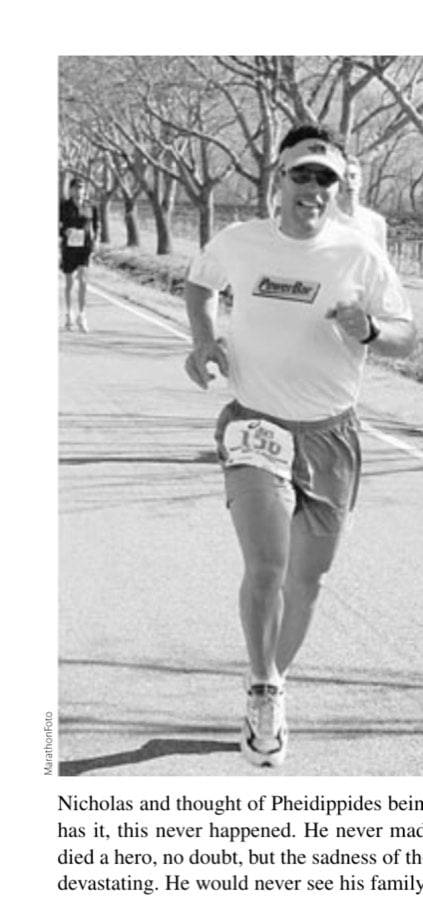
After logging 100 miles prior to the race, Dean Karnasez concludes his journey with a 3:15 at the Napa Valley Marathon.
the phone, shaves, eats lunch, and jots notes in a scratchpad all the while. By the time we reached San Francisco, my heartbeat was racing faster than any marathon could induce. We arrived just as the opening tipoff was
under way. Nicholas beamed in delight upon seeing us enter the gymnasium. We spent the entire game clapping, cheering, stretching, and generally trying not to pass out. There was no air conditioning in the gym.
At the conclusion of the match, I hugged Nicholas and thought of Pheidippides being reunited with his family. As legend has it, this never happened. He never made it back to his family. Pheidippides died a hero, no doubt, but the sadness of those last few moments must have been
devastating. He would never see his family again. Walking to the postgame pizza party, I reflected on my adventure. The run itself had been a remarkable undertaking; there really wasn’t a critical need to get
back to my son’s game. After all, what is one missed sporting event in a lifetime of basketball, baseball, soccer, and whatever other sports he chooses to pursue? But, for some inexplicable reason, I felt the overwhelming need to be there.
Maybe I did it for the pride of a father who wanted to watch his son in action. Maybe I did it for Nicholas, for him to feel the presence of his loving father. Or maybe I did it, in some timeless sort of way, for Pheidippides.
Printer: Insert TBD ad
This article originally appeared in Marathon & Beyond, Vol. 9, No. 2 (2005).
← Browse the full M&B ArchiveMore like this
1,000+ stories from 19 years of Marathon & Beyond
The complete archive of the legendary long-distance journal — digitized and free to read.
