

The Mad Mountain
This is the end of July, the apex of summer, so it’s supposed to be hot. Even here, halfway up a mountain in the Pacific Northwest. Or maybe that’s halfway up half a mountain. At any rate, it’s supposed to be warm, sunny, and clear,
with eagle-eye views of river valleys, rolling evergreen hillsides, and mountain peaks that beg to be worshipped. This is what we expected. Instead, Mike and I find ourselves floundering in a fog bank, zigzagging uphill—cairn to post, post to cairn, cairn to cairn—like a
couple of wayward schooners lost at sea, dripping drizzle from our mizzenmasts. And barely warm. We’re surrounded by what appears to be a landslide, giant black blocks of slippery, angular stone, some the size of Volkswagens, none of them easy to
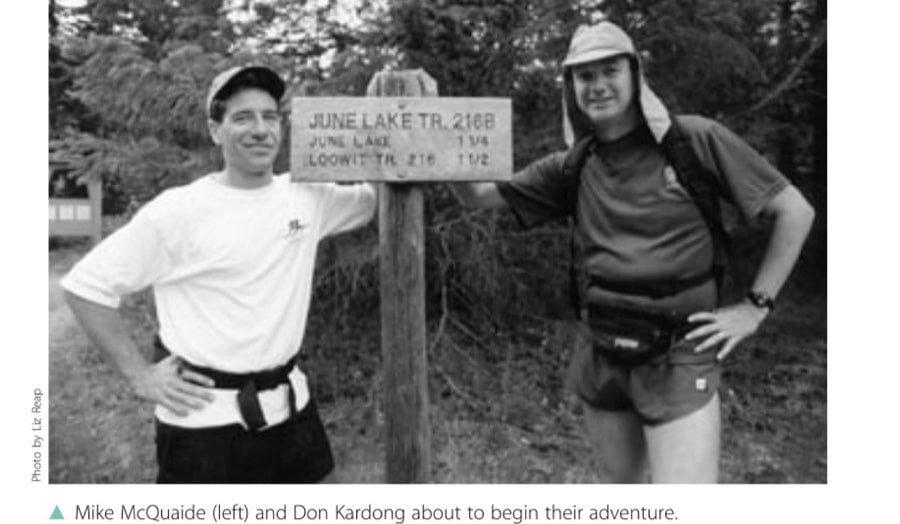
▲ Mike McQuaide (left) and Don Kardong about to begin their adventure.
scuttle across. This is, we discover later, an ancient lava flow. It is beautiful in a stark, melancholic way, the ragged edge of the hillside pasted against a foggy gray background like modern art. Lovely or not, though, we’re simply trying to follow the vaguest notion of a path up and across it, then find the next portion of the Loowit Trail. We need to circumnavigate 30-some miles of Mount St. Helens before sundown. And time’s a-wastin’.
Mike glances at his wrist. “We’re climbing 39 feet per minute,” he reports. Great. We may not know where the trail is, and we may run out of daylight and freeze to death on the side of this volcano, but at least, thanks to my partner’s altimeter, we have good information about our rate of vertical ascent.
Actually, I’m not peeved at Mike. We’re in the same boat here, caught off guard by the claustrophobic fog, the ambiguity of the route, the impossibility of doing much actual running. We both figure this section of the trail is an aberration and that we’ll soon be sailing on clearly marked, well-tended trails. The ranger, after all, didn’t discourage us from attempting the loop around the mountain. He even claimed to have done it himself. So, yes, this section of the route must be an aberration.
NO WAY TO SEE THE MOUNTAIN But while I harbor no ill will toward Mike, it suddenly occurs to me that there is a monumental, well-deserved target of ire in the vicinity. I look up the rocky flank of the mountain and see nothing but boulders disappearing into fog. There are no stunning views, no uplifting wilderness scenes, just a disconcerting gray blur. Mount St. Helens refuses to show her face.
But why should I be surprised? After all—the thought hits me like a chilly bolt of clarity—I have never liked this wench. This shrouded vixen, this ill-tempered shrew of a mountain is not nice. Not today, not ever.
Our quarrel began on May 18, 1980, at 8:32 A.M. That’s when she snapped. Two months before that, the sleeping beauty of the Cascade Mountains had rumbled awake after a 123-year nap. She continued to cough and shake, not to mention bulge, week after week, until that Sunday morning. Then she really cut loose.
The tantrum began with a massive landslide, the largest in recorded history. It was followed by a 650-mile-per-hour explosion that ripped off the north side of the mountain. One hundred fifty square miles of ancient forest were scorched and leveled like duckpins. Temperatures rose to 1,600 degrees. Floods of mud, rock, and debris raced down riverbeds. Nearby lakes were left bubbling with carbon monoxide and methane. A mushroom cloud of ash spouted to the stratosphere and began circling the planet. Experts estimate that 200 bear, 1,500 elk, and 5,000 deer were dead in an instant. Fifty-seven people died, too, mostly by asphyxiation. It was not a good day to be on the mountain.
May 18, 1980, wasn’t a good day to be 250 miles downwind of the mountain either. That’s where I was, at home in Spokane, enjoying a sleep in. I heard nothing but awoke to reports of distant disaster. “Distant” was the key. No worries on the eastern edge of the state, right?
By afternoon, though, the western horizon was black and getting blacker by the minute. Street lights came on, then the sky began to fall, first in tiny black granules of pumice, then in a snow of powdery ash. By evening a quarter inch had accumulated, dusting trees, lawns, cars, houses, and runners dumb enough not to give it up. Breathing was an act of faith. The ash was almost impossible to get rid of, and for months we felt like we were living in an ashtray.
Earlier in the year, Jimmy Carter had fumed at Russian military intervention in Afghanistan and engineered his Olympic boycott, and my aspirations to make a second Olympic team had been smothered. Then St. Helens lost her temper, and daily runs became lusterless all over again.
THE MOUNTAIN IS CERTAINLY NO LADY And now, 20 years later, here we are adrift in fog and rapidly falling behind in our quest to notch a one-day, 30-some-mile circuit of this ill-tempered mountain. I find myself annoyed all over again. Local Indians called her “Loowit,” which is said to mean “Lady of Fire.” I doubt it. Because this, clearly, is no lady.
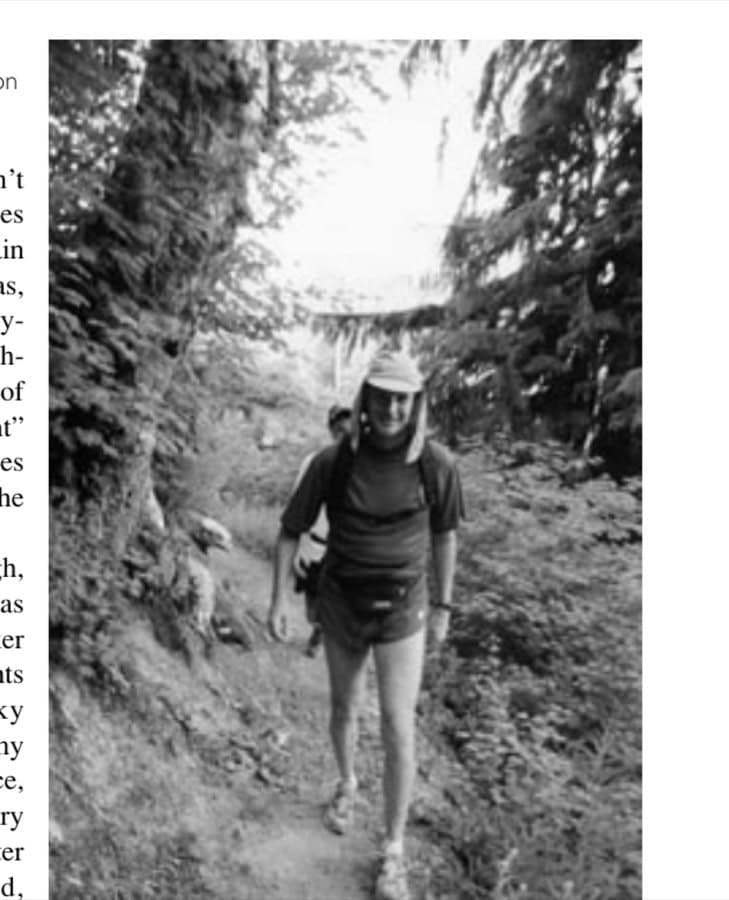
Photo by Liz Reap
▲
Before the fog, smiles were plentiful for author Don Kardong.
“I was hoping you’d look less fit than that,” Mike observes after a quick glance up and down my lanky frame. This is the night before our run, our first meeting. We have traveled from opposite ends of the state for a rendezvous here at the Lone Fir Resort in Cougar, Washington, on Mount St. Helens’s south flank. Now he is sizing me up.
I look back. Mike McQuaide, my soon-to-be running partner, is 38 years old, 13 years my junior. A former outdoor recreation reporter, he is athletically built, his torso sculpted by years of pedaling, paddling, and parading in the woods. It is McQuaide who first pitched this idea. He is an avid trail runner, and his book Trail Running Guide to Western Washington is on the fast track to publication. I notice big calves. He looks like a guy you would be confident running trails with.
In e-mails over the previous months, we have tried to figure out who might be slowing whom down on this journey. I think youth and specificity of trail running give him the edge, but Mike has demurred. “It’s somehow gratifying,” he has written, “to know that an Olympic marathoner seems concerned that he might slow me down. Ain’t gonna happen.” As it turns out, we match up almost perfectly.
In Westspeak, “resort” does not mean “wilderness lodging oasis” but rather “a place to park your rig.” And on this night, as thunder booms overhead and lightning backlights the drapes, we’re glad for whatever spare, modest comfort Cougar’s Lone Fir Resort offers. We thank Thor for indoor lodging. The flashes and booms do not portend good weather for our run. We have brought sunscreen for protection and iodine tablets to purify drinking water, and I have purchased a hat that Lawrence of Arabia would have swapped a fleet of camels for. We’re prepared for heat. We awake, though, to drizzle.
We delay our departure an hour, hoping for clear skies and sunny photos, but at 7:00 A.M. we finally settle for what we have. By the time Mike and I finally zigzag our way through the rocky, fog-bound lava flow at the beginning of the trip, we are wet and bordering on discouraged. We’ve also exhausted a good chunk of the morning.
THE FIRST LEG OF OUR PROJECT If the Loowit Trail were a clock face, we have started our loop at around number 5, after a 1.5-mile jog from the June Lake trailhead. We are running clockwise, and we’re steadily gaining elevation. Past the lava rocks, through a half-dozen snowfields, and after switchbacking up the mountainside, we finally find some consistent running on an actual path. It feels wonderful to finally hit a rhythm, to be passing wildflowers—lupine, fireweed, Indian paintbrush—and to sense, incorrectly as it will turn out, that we’ve managed the worst of it. At just past
10:00, Mike reports that we’re at 4,600 feet now, having gained 2,400 cumulative feet since our start. At 10:30, we reach the junction with the Butte Camp Trail. Mike estimates that in the 3 1/2 hours since our start, we have gone about seven miles. On the clock face, we are barely past number 7. This is not great progress, but we console ourselves with the notion that we’ve wasted time with photos and floundering in lava fields, and all that is past now. Most of the area we find ourselves running through was sheltered from the 1980 blast. Fir and hemlock thrive, and we notice frequent signs of wildlife. We see single elk tracks in the sandy soil, followed by a frenzy of prints. We stop and look closely. “
Someone was making the elk with two backs,” Mike remarks. I’m stunned. I know this line, or something like it. Bawdy Shakespeare. “Othello!” I blurt. My spirits, dampened most of the morning, soar. I’m running with another English major!
We continue our trek around the southwest skirt of the mountain, making good progress now. At this elevation, we’re on the edge of alpine spring, and the flowers are prolific—white, purple, bright red, yellow, and gold. Life and our spirits are renewed. Even the fog seems ready to lift. Perhaps, I muse, this mountain has a sweet disposition after all. Perhaps, I hope, she will give us a good look before the day is done.
A nice thought. Later, though, we’ll remember this as the last section of our journey where running is relatively smooth and steady. We pass the junction with the Sheep Canyon Trail, about number 9 on the clock face. Shortly after, a horrific descent begins.
When it’s all over, and we have dropped way, way down to the Toutle River, we will sit and, once again, try to gather our spirits. We’ll remember the drizzle, the sloppy downhill skid of mud, the wet slap of every bush and fern draped over our path. Mostly, though, it is the surrendering of so much elevation that tweaks our spirits. According to Mike’s watch, we have given up 1,400 feet. It seems like much, much more.
A BREAK FOR WHAT PASSES FOR LUNCH We break out sandwiches, energy bars, and my favorite ultrarunning food, Fritos. After five hours on the trail, though, I should be more hungry. Thirsty, too. I watch Mike mix iodine tablets and Gatorade powder into bottles of silty Toutle River runoff. Anticipating warm weather, we’ve had e-mail discussions about whether we’ll need to do much filtering of water in an area that should be free of contaminants. “I’m from New Jersey,” Mike has insisted. “So I assume one should pretty much filter all water.”
While he performs his experiment, I look around at our picnic area. The Toutle braids its way noisily from above, cutting a deep gorge through mud and rocks deposited in 1980. In places, the cliff sides drop vertically 50 feet and more. Scrub alder and cottonwoods are reclaiming the muddy banks, and other signs of nature’s renewal are evident. On a sunny day, this might be a fascinating place to rest and ponder. Today, though, I’m struggling with a question I want to ask Mike. Unfortunately, deep in my soul, I know the answer. No.
The question is, Are we halfway yet? I hold my tongue. It is past noon, and we both know we need to get a move on. It takes us a while to find the trail on the other side of the Toutle, but once on the path we begin rising rapidly above the river gorge. Switchbacks help us steadily regain most of the elevation we’ve lost, and we’re soon managing a sandy traverse on a barren, 45-degree slope high above the river. The hillside is eerily devoid of most of nature’s gifts. This perch, I’m confident, would yield a spectacular, dizzying view of Mount St. Helens on a clear day. For once today, though, I’m glad of the fog. There is not much to grab on to on the precipitous downside. Fog and deep breathing help keep vertigo at bay.
By 1:30, Mike and I have climbed out of the Toutle gorge and are beginning to enter the blast zone. We meet a couple who have abandoned their hike in the canyons ahead because of “howling winds” and are heading back down to the Toutle. This is not encouraging news, but we press on.
At around 11 on the clock face, the running suddenly improves again. There is a chilly wind, to be sure, but the path is clear and well tended. It’s a stark landscape, with just the hint of regrowth—dun-colored moss covering the pumice valleys, random tufts of grass, flowering weeds, lonely stunted firs. “
Is there any kind of landscape we haven’t run through?” Mike remembers. “Boulders, rain forest, plains . . . ” Well, yes actually, and it’s just ahead. It is a vast delta with millions of black, gray, and salmon-colored rocks, volcanic jetsam ground into ovals by ice and water. This section is known as Pumice Plain. It’s unlike anything either of us has ever seen, and Mike dubs it the “Bocci Ball Desert.” On our map, the trail proceeds straight through it. There is really no trail, though, just periodic piles of rocks meant to give a sense of the prevailing easterly direction we’re supposed to travel. Run, stop, locate another pile—that’s our method for the next hour.
A PROMISE OF BLUE SKY Near three o’clock we emerge on the other side of the Bocci Ball Desert. We’re on a real trail again, enjoying bouts of steady running. Better still, we’ve been noticing patches of blue sky above the volcano. St. Helens might finally, it appears, fling her gray veil to the winds.
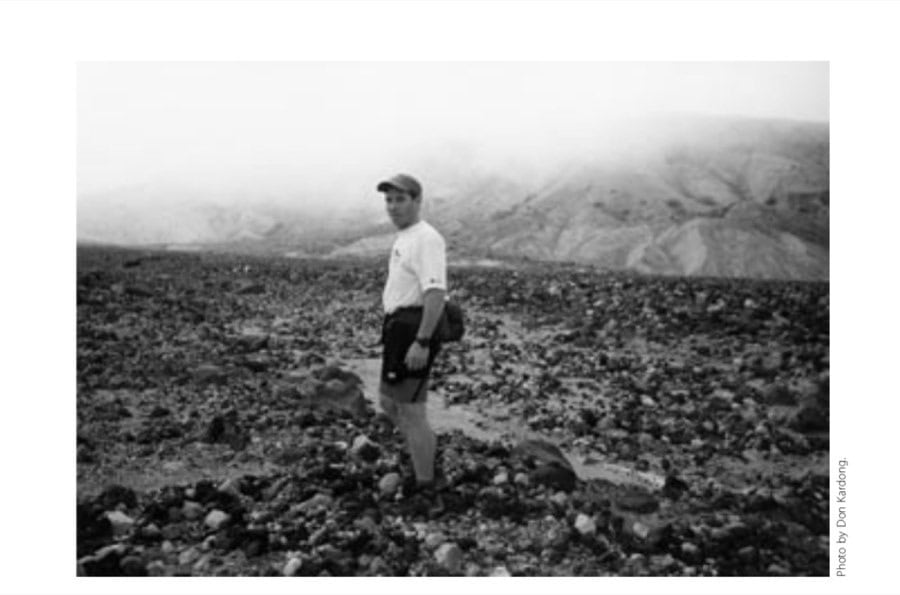
Photo by Don Kardong.
▲ Mike McQuaide crossing the “Bocci Ball Desert.”
When the mountain exploded 20 years ago, it spewed millions of small, white, porous rocks toward the north. From a distance, the plain appears to enjoy a light-colored ground cover. In reality, there is little vegetation. The barren plain sweeps down to Spirit Lake, and with the lifting clouds we’re able to see the lake in the distance, considerably higher than it was before the blast and now brimming with downed timber.
In ancient times, natives gave a spiritual significance to Mount St. Helens and the surrounding territory. I remember reading in one guide book that Spirit Lake was considered the dwelling place of the seeahtiks, giant, big-breasted, shaggy monsters that were neither human nor animal. Remembering this, I rack my brain for a cheap joke.
The best drinking water of our journey is halfway across the Pumice Plain, where a spring bursts pure and cold from the side of the mountain. Mike fills his bottles, adds iodine. Deciding to trust the mountain, I don’t.
Trust, apparently, is rewarded. We have been trying for the past hour to get a clear photo of the summit, but we’ve mostly been teased. Each glimpse has been followed quickly by returning gray out. Just past 4:00, though, it happens. There is a rift in the shroud, and a spectacular view unfurls to the summit, where clouds boil in blue sky over the peak. She is stunning. A hot, tempestuous beauty, to be sure, but a beauty nonetheless.
Photo by Barbara Shaw
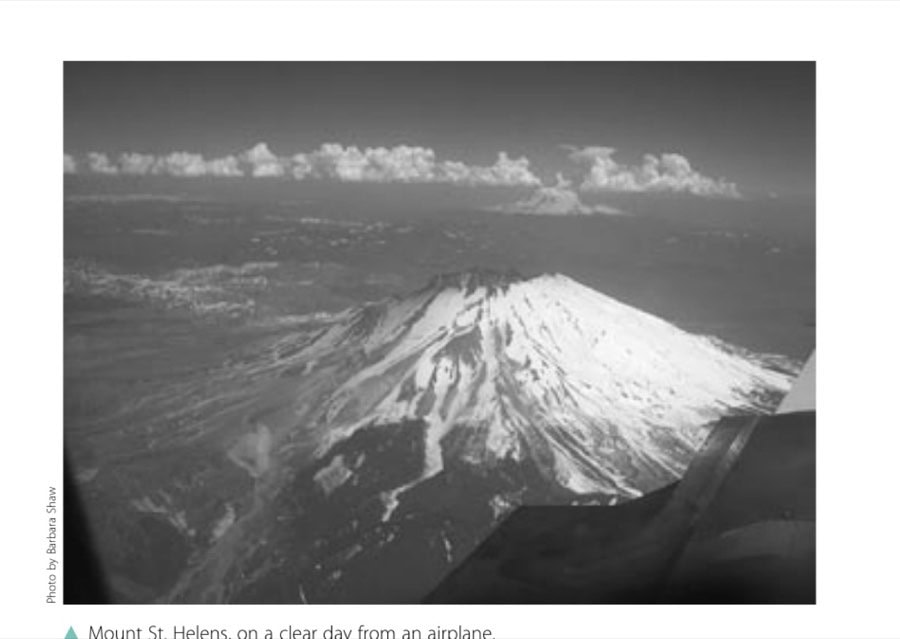
▲ Mount St. Helens, on a clear day from an airplane.
We’ve been on this loop for nine hours now. On the clock face, we are near 2. Tired as we are, the view, or more likely the sense that we are finally on the homestretch, begins to sink in. We spend a half hour deftly picking our way over
a steep, tricky climb through Windy Pass—at 4,885 feet the highest point on the trail—and descend to the Plains of Abraham. The biblical gravitas of the name feels apt. We’ve passed only a few other people on the trail, but just before Windy
Pass one couple has asked, “Are you the Runner’s World guys?” We know what this means. Runner’s World photo editor Liz Reap, who is planning to meet us on the other side of Windy Pass, has been stewing about our tardiness. We are
very, very late. We finally catch up with Liz at the far end of the Plains of Abraham, where she has been huddling behind a cairn of rocks with her mountain bike for the past three hours. She seems extremely pleased to learn that we haven’t fallen into a crevasse. Or at least she’s glad to be able to finally get moving.
ON THE FINAL STRETCH—MAYBE Mike and I are also elated. We are in the final stage of this journey, trotting toward the barn. We’ve survived the worst insults the mountain has hurled. We’ve even
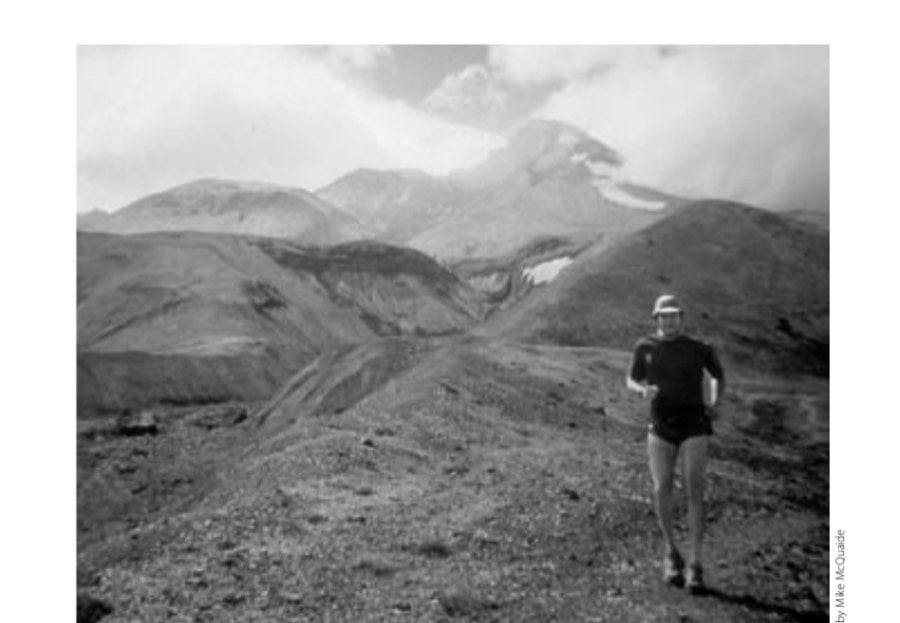
Photo by Mike McQuaide
seen her face levitating in the clouds. And now we’re on a steady, gentle downhill that will take us back to the trailhead. Seven easy miles. Or so we think. Mike has enjoyed several conversations with one of the rangers before our run. The man claimed to have done the Loowit loop in one day. Midway through our own journey, we wondered about this. He also told Mike that the final miles, from the top of Windy Pass, were “pretty easy” and “mostly downhill.” The worm.
That’s one of the nicer characterizations that come to mind later. At first, we enjoy our elation and the thought of the easy miles ahead. We scoot along smartly, Liz riding behind. We even—I hate to say this—prance a bit.
Mike looks at his altimeter. “We need 10 more feet to get 6,000,” he reports, referring to our total elevation gain today. “Jeez, I sound like an announcer on a telethon.” We consider heading up a hill to get the distance, but then agree that we’ll certainly notch 10 feet of gain somewhere between here and the finish.
Indeed we will. In fact, it will be another 600 feet. That may not sound like much, but almost all of it is on the slippery slopes of gullies and canyons carved into the western flank of the mountain. The path is barely apparent, treacherous
▲ On the Pumice Plain, the mountain finally shows her face.
with sand and mud. We drop down the side of one, pick our way across a rocky stream bed, scramble nimbly up the other side, commence jogging, and then . . . another one. And another. And another. I lose count after a while. “
I feel like I’ve been doing this my whole life,” I tell Mike. Worse than our plight, though, is our photographer’s. Mike and I begin to wonder whether Liz can possibly negotiate this kind of route with a bike over her shoulder. We agree that if either of us found himself in her position, that bike would now be free to find its own way home. Liz, though, hangs on to the bike, skillfully managing the muddy chasms. Somehow. I never thought I’d look forward to a field of blocky lava rocks again, but when we finally negotiate our last gorge and enter a boulder field, I’m relieved. It’s tricky going, but it’s dependable. There are even caves here where someone could survive the night. Someone other than me. Me, I’m getting out of this place.
Later the boulders yield to trees and to vegetation, rich dirt, and a decent trail. Tired, wet, achy, but—truth be told—damned proud to have shown this shrew of a mountain we wouldn’t be intimidated, we reach our starting place, number 5 on the clock face, at 7:15 P.M. It has taken 12 hours, maybe twice as long as expected. But we have looped the lady. Or whatever she is. “Wanna go around again?” Mike quips.
AN AUDIENCE FOR THE FINISH We jog the final 1.4 miles back to the trailhead. Liz rides ahead and forewarns some campers of our impending arrival. We had spoken to them the day before, and now, trotting to the end of this epic, we are greeted by a family that claps and cheers as we jog to a stop. I almost, blast me, start to cry.
That night, we hobble stiff legged and ravenous into the Cougar Bar and Grill. “Let’s ask for the left half of the menu,” Mike suggests. It’s not quite that, but we do pull out all stops. Mike’s watch does not report caloric intake, but the total must be considerable. And then, exhausted, we head back to our resort, modest shelter in the tiny town of Cougar, on the southern edge of this fascinating, beautiful volcano.
We have endured 12 hours of combat with a very ill-tempered landform, one that once covered my hometown in choking dust. If nothing else, we and the mountain have learned mutual respect. She is awesomely powerful. But we have survived.
I am dead to the world for 10 hours. When I awake, my running partner, the guy who shared this sharp-edged adventure with me, is long gone. I spy a note he has left on his bed. I pick it up, wondering what words Mike has left to sum up. I smile. “We’ll always have Cougar,” the note says.
This article originally appeared in Marathon & Beyond, Vol. 10, No. 4 (2006).
← Browse the full M&B ArchiveMore like this
1,000+ stories from 19 years of Marathon & Beyond
The complete archive of the legendary long-distance journal — digitized and free to read.
