

The Miracle Man
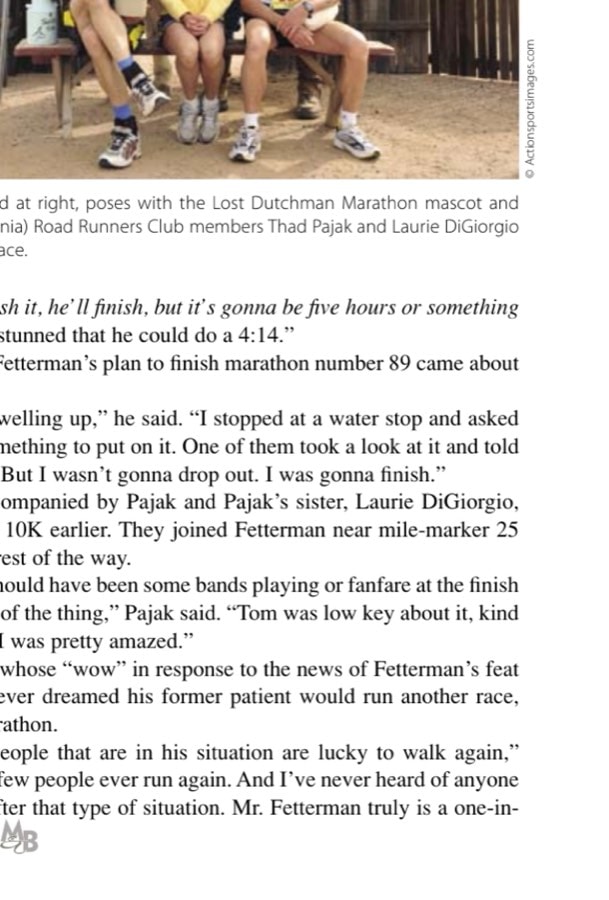
Tom Fetterman, shown running the 2008 Lost Dutchman Half Marathon, has recovered from a medical emergency suffered only hours after he finished.
© Actionsportsimages.com
om Fetterman couldn’t believe what he was hearing. Before operating on a blood clot, Dr. Grayson Wheatley told Fetterman there was a possibility he would lose his right leg. The 69-year-old retiree from Penn Run, Pennsylvania, feared he was finished as a runner, especially when he awakened following surgery and couldn’t feel the leg or see anything beyond the bulky bandage at his knee. After 88 marathons and hundreds of other races, the book had apparently closed on the remarkable running story of Tom Fetterman, ageless wonder.
A year later, the roles were reversed: It was Wheatley who couldn’t believe what he was hearing. Told Fetterman had finished a marathon, Wheatley paused for a few moments, as if unable to comprehend the news, and then uttered a single syllable: “Wow.” * * * Fetterman had long led a charmed life as a distance runner. He put in his miles, stayed healthy, and regularly vanquished his contemporaries in everything from 5Ks to ultramarathons.
But Fetterman’s good fortune suddenly ran out on February 17, 2008. Several hours after he took top honors
in his age group at the Lost Dutchman Half-Marathon in Apache Junction, Arizona, searing pain knocked him off his feet. Fetterman was rushed to Arizona Heart Hospital in Phoenix. The diagnosis: a blood clot.
Wheatley removed the clot and saved Fetterman’s leg, but Fetterman’s longdistance career seemed beyond saving. “A couple of days later,” Fetterman recalled, “the doctor came into my room and I asked him, ‘How soon can I start running?’ He said, ‘I like your attitude, but I don’t think you’ll ever run another marathon.’ He didn’t tell me but he told my wife that, because of nerve damage, he didn’t know if I would ever get the use of my foot back.”
On February 15, 2009, almost a year to the day after surgery, Fetterman returned to Apache Junction and ran the Lost Dutchman Marathon, the 89th—and indisputably the most extraordinary—marathon of his running career. He took more than four hours to finish, but finish he did. “
He’s really a miracle patient,” Wheatley said. “Most people that come into the hospital, if the doctor tells them ‘You’re never going to walk normally again,’ they take that to heart and just kind of live with it. “
Fortunately,” he added with a chuckle, “Mr. Fetterman didn’t listen very well to his doctor.” * * * When Fetterman launched his distance-running career, said distances were measured in feet, not miles. Even a brief jog would leave him doubled over, gasping for breath. “
I used to laugh and call him ‘That’s-far-enough’ Fetterman, because he would run from one telephone pole to the next. He’d say, ‘That’s far enough,’” recalled Fetterman’s son, also named Tom, himself a marathoner. “But he got bit by the road racing bug, and one thing led to another.”
The soft-spoken great-grandfather has since completed 95 marathons and has tackled even longer races on occasion. Fetterman figures he has run 76,000 miles—the equivalent of three trips around the globe at the equator—since that day in 1980 when he resolved to give up a two-packs-a-day smoking habit, shed the excess 40 pounds he was carrying, and adopt a healthier lifestyle. If he hadn’t, Fetterman suspects, he would be “on the wrong side of the grass” by now.
Running probably saved him from an early grave, though he initially feared it was more likely than cigarettes to kill him. “It was really tough at first,” Fetterman said. “I’d start down the road here and I’d go about one telephone pole, maybe two, and then say, ‘That’s far enough.’ Then I’d turn around and walk back home. But I just kept at it until I was able to make a two-mile loop. I thought I’d won the Olympics or something.”
What Fetterman has won since running his first race—a 10K in 1981—are hundreds of trophies, plaques, and medals that fill his home in Penn Run, a rural
community about 50 miles east of Pittsburgh. For years he dominated his age division the way Joe Louis dominated his weight division. Fetterman is still a force among the over-60 set. “He continues to win his age group easily,” said John Swauger, a fellow member of the Indiana (Pennsylvania) Road Runners (IRRC). “Even with the health issues he’s had, he can still run circles around people 10, 15 years younger. The times he was running before were exceptional for his age group. They’re still very good. Just about any race you go to, you can count on him to win his age group.” * * * In 2008, Fetterman claimed yet another age group title at the Lost Dutchman Half-Marathon by finishing in 1 hour, 52 minutes, 24 seconds. A few hours later he was reeling in agony, his calf “screaming.” “
He was in so much pain,” said Fetterman’s wife, Betsy. “And from the knee down, his leg looked like it belonged on a corpse, it was so bad.” The skin was as white as chalk. Following a 911 call, Fetterman was flown to Banner Baywood Medical Center in nearby Mesa and then transferred to Arizona Heart Hospital. Wheatley was the cardiovascular surgeon on call. “
I immediately saw that his leg had no circulation,” Wheatley recalled. “It had been a number of hours before he came into the emergency room, so we knew it was pretty advanced. We were able to remove the clot and open up the blood flow, but he was left with some nerve damage to that leg. I told him later there was a very good chance he would never have good control of his foot. So at that point, I never envisioned he would be able to run a marathon again.”
In fact, the odds of Fetterman’s ever running a race of any kind were as long as a Siberian winter. * * * Fetterman entered his first marathon in Johnstown, Pennsylvania, in 1981 when he was 40 years of age. He ran an excellent time (3:37) for a novice, but the experience didn’t exactly leave him yearning for more. “
He wasn’t ready for it at all. He hadn’t trained very long, and he paid the price,” Tom Jr. recalled. “Boy, he could hardly walk afterward. I didn’t think we were gonna be able to get him in the car—my parents had a little Nissan Pulsar. We laugh now, because he said then that would be his last marathon.”
The only marathon-related pledge Fetterman makes nowadays is that he will someday finish his 100th. He has already reached one major milestone by completing marathons in all 50 states. Cheered on by members of his running club, Fetterman placed 30th overall at the Green Mountain Marathon in Vermont in 2005 with a time of 3:23:33 to wrap up his 50-states quest. Fetterman won his age group, like Secretariat at the Belmont, by a mind-boggling margin: 17 minutes, 45 seconds.
Courtesy of Tom Fetterman
▲
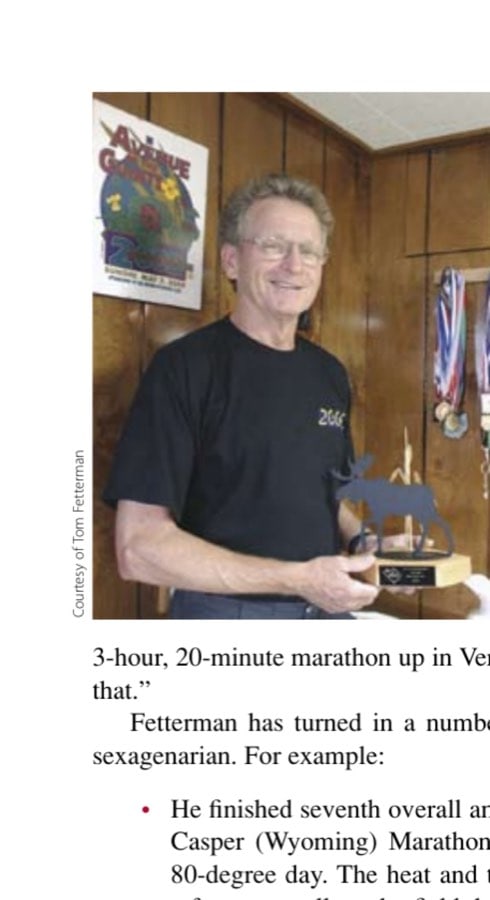
Tom Fetterman has won a multitude of medals, plaques, and trophies since entering his first distance race at the age of 40.
“There’s a club nationally made up of people who do marathons in all 50 states, but most of them are slower runners,” Swauger said. “When Tom ran his 50, he ran them competitively. He didn’t just go out and jog through them
just to say he did another one. He ran good times. He did a 3-hour, 20-minute marathon up in Vermont at age 64. I was pretty impressed by that.” Fetterman has turned in a number of other impressive performances as a
sexagenarian. For example: • He finished seventh overall and won the 60-and-over age division at the Casper (Wyoming) Marathon in 2004 with a time of 3:27:45—on an 80-degree day. The heat and the 5,120-foot elevation combined to take
a fearsome toll on the field, but Fetterman persevered. “I think that was one of my better efforts,” he said. “I was picking off guys from Colorado a lot younger than me—they were used to the altitude, but the heat got to
them. And the guys who were used to the heat, the altitude got to them. For some reason, I just clicked in between.” • Fetterman completed the Tussey Mountain 50-mile ultramarathon through Pennsylvania’s Rothrock State Forest in 2006 with a time of 8:49:54 to
finish seventh overall and set a state age-group record for the distance. “He shepherded a bunch of people through about 40 miles or so,” recalled IRRC member Bill Winters, who was running alongside Fetterman. “We’re
a significant way into this race, and he says, ‘I can still beat nine hours if I pick up the pace. There’s a goal out there I can make.’ And he just took off. That competitive spirit took over.” • Fetterman celebrated his 65th birthday in 2006 with an ambitious enterprise
of his own design: the so-called Medicare Run, a 65-mile jaunt along the Hoodlebug and Ghost Town trails in western Pennsylvania. He finished
in 13 hours, 34 minutes. “I thought it would be a challenge,” Fetterman replied when asked why he would even attempt such a grueling undertaking. “Most people who are 65, they retire to the rocking chair and don’t
do too much. But I think if you don’t have a challenge in life, you might as well dig a hole in the ground and climb in.” Fact is, Fetterman regularly embraces challenges others—especially at his age—would avoid like a rabid Doberman. And he invariably succeeds. So how does this self-proclaimed “average” runner manage to outstrip those even half as old? His mellow disposition masks a warrior’s mentality. The starter’s gun triggers a Jekyll-and-Hyde transformation in which the usually laid-back Fetterman turns as fierce as a tiger. “
He’s a very passive person most times, but when you catch him on a race day, he gets really competitive,” Tom Jr. said. “I think there’s a lot of people that have as much talent as my dad, but not too many have his drive. He’s just like Jordan. Michael Jordan used to always step up in the big games. Dad’s always been that way.”
It was Fetterman’s deep reservoir of determination that enabled him to pull through after surgery. * * * Wheatley made 8-inch-long incisions on both sides of Fetterman’s calf and let the muscles hang out, exposed, to give them room to expand once the blood flow was restored. Even after the leg was sewed back up several days later, the sight was so gruesome that visitors couldn’t help but cringe. “
I remember when I saw his leg for the first time,” IRRC president Thad Pajak said. “I was like, ‘Oh, my gosh.’ I mean, it looked like a football—it was puffy and swollen and the stitches looked like the laces on a football. It wasn’t pretty.”
Nor were Fetterman’s first steps when he was at last permitted to leave his bed. He lurched forward like a zombie in a horror flick, his face contorted from the extreme effort required to place one foot in front of the other. The man who once thought nothing of running 26 miles labored just to hobble 26 feet. “
He couldn’t even walk that far,” said Mary Fletcher, the president of Mahoning Physical Therapy, who supervised Fetterman’s rehabilitation. “A couple of steps was excruciating pain. But runners are very self-motivated and want to get back to running, so Tom was very determined and worked very hard.”
Even so, progress was measured in the tiniest of increments. “At first I had a hard time just walking up the driveway,” Fetterman recalled. “Then I’d go a little farther and a little farther. Pretty soon I was able to walk a mile. Then I started jogging a little bit, but it wasn’t a very pleasant experience.”
Fetterman fought through the pain, returned to racing, and began dominating his age group, just as he had before surgery. The transformation was mind bog-
© Actionsportsimages.com
gling to those who, only months before, had witnessed his halting first attempts just to walk again. “Mary Fletcher didn’t let Tom know until after he was pretty well healed,” Betsy said, “but she told him, ‘When you first came in here, I would have only given you a 50-50 chance of getting the use of your leg back.’” * * * Fetterman embarked on the comeback trail by winning his age division at the Bloody Run 5K in Everett, Pennsylvania. He gradually built up his endurance, began entering longer races, and finally fixed his sights on a marathon—not just any marathon, mind you, but the Lost Dutchman Marathon in Apache Junction, where his running career had nearly ended a year before. “
Well, his famous line is, ‘When you’re walking on thin ice, you might as well dance,’” Pajak said. “I’m sure there was something symbolic in wanting to run there, kind of an ‘I’ll show you’ thing.” Fetterman pushed off from the starting line at dawn, wound his way through spectacular desert scenery, and, running at a comfortable pace, reached the finish line in 4:14:54, good for first place in the 65-69 age division. He had run far better times—Fetterman set his personal best of 2:56:57 at the Isle of Palms Marathon in South Carolina in 1985—but all things considered, it was a phenomenal performance. “
It would have to be up there as one of his best, when you look at everything that went down before that,” Tom Jr. said. “I trained with him over the winter, and a lot of our training runs weren’t very good, actually. I thought, ▲
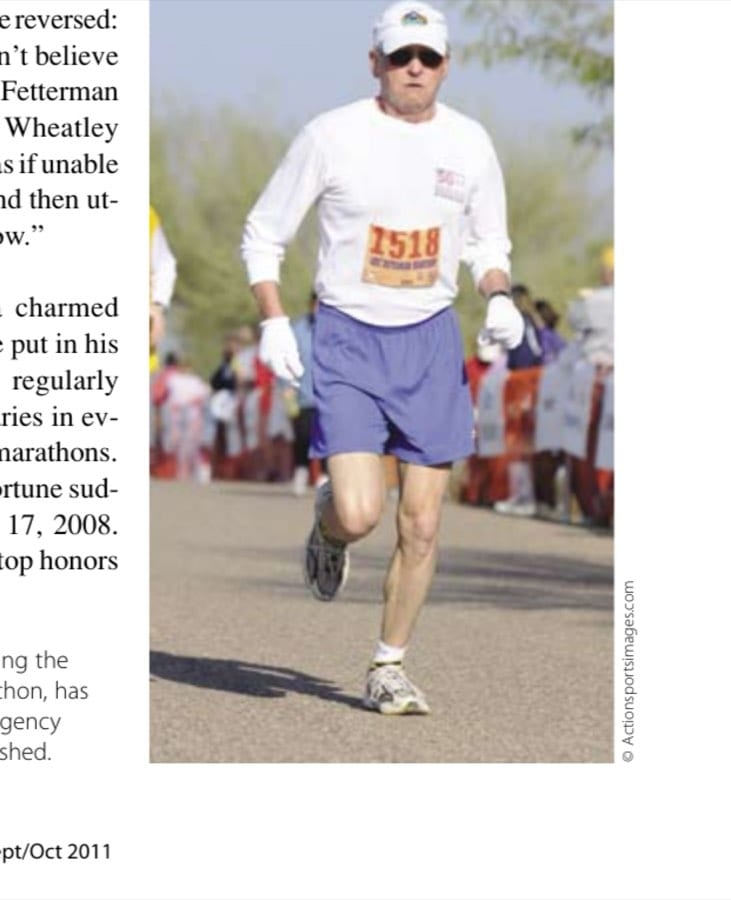
Tom Fetterman appears relaxed and joyous as he runs in the 2009 Lost Dutchman Marathon, his first marathon since a health scare nearly ended his racing career.
© Actionsportsimages.com
▲ Tom Fetterman, seated at right, poses with the Lost Dutchman Marathon mascot and fellow Indiana (Pennsylvania) Road Runners Club members Thad Pajak and Laurie DiGiorgio after finishing the 2009 race.
Boy, if he wants to finish it, he’ll finish, but it’s gonna be five hours or something like that. I was really stunned that he could do a 4:14.” The only hitch in Fetterman’s plan to finish marathon number 89 came about 17 miles in. “
My calf started swelling up,” he said. “I stopped at a water stop and asked the ladies there for something to put on it. One of them took a look at it and told me I should drop out. But I wasn’t gonna drop out. I was gonna finish.”
Which he did, accompanied by Pajak and Pajak’s sister, Laurie DiGiorgio, who had both run the 10K earlier. They joined Fetterman near mile-marker 25 and escorted him the rest of the way. “There probably should have been some bands playing or fanfare at the finish given the background of the thing,” Pajak said. “Tom was low key about it, kind of matter of fact. But I was pretty amazed.”
So was Wheatley, whose “wow” in response to the news of Fetterman’s feat spoke volumes. He never dreamed his former patient would run another race, much less finish a marathon. “Honestly, most people that are in his situation are lucky to walk again,” Wheatley said. “Very few people ever run again. And I’ve never heard of anyone running a marathon after that type of situation. Mr. Fetterman truly is a one-ina-million individual.”

This article originally appeared in Marathon & Beyond, Vol. 15, No. 5 (2011).
← Browse the full M&B ArchiveMore like this
1,000+ stories from 19 years of Marathon & Beyond
The complete archive of the legendary long-distance journal — digitized and free to read.
