

The Naziolympics
Adolf Hitler, as a young man, was a runner. He did not run on cinder tracks or across lush green meadows but through the lethal fields of fire on the western front during the First World War. A volunteer in the Bavarian Regiment, he was assigned to staff headquarters as a dispatch runner whose mission was to deliver messages to battalion and company commanders at the front. It was very perilous work under fire, so if feasible, two runners were sent out with the same dispatch to guarantee its delivery should one of them be killed.
Hitler performed well as a runner, displaying sufficient bravery and courage that less than a month after he began delivering messages he was awarded the Iron Cross, Second Class. It was, he claimed, “the happiest day of my life.”1
Hitler believed that physical training was an important element in the education of German youth and thought the strength and agility they developed were critical in reviving the prowess of the defeated fatherland. Personally, though, he was not interested in sports, which were alien to his sedentary and reclusive nature. Indeed, before he was appointed chancellor in 1933, he dismissed the Olympics as “a play inspired by Judaism which cannot possibly be put on in a Reich ruled by National Socialists.”2
The 1916 Olympic Games were scheduled to be held in Berlin but were canceled because of the outbreak of hostilities in Europe. Following the conflict, many prominent Germans urged the International Olympic Committee to renew the offer and, finally, prior to the 1932 Games in Los Angeles, the committee selected Berlin as the host of the 1936 Games. The people of Germany were elated, certain this offer of a second chance signified a genuine reconciliation with the other nations of the world. It was an opportunity they could not afford to squander, and yet with the rise of Hitler to the chancellorship, they became concerned that once again politics might interfere with their plans and prevent the Games from taking place on German soil.
Once he was in charge of the government, Hitler modified his position considerably and agreed to support the efforts of the German Olympic Committee to put on the festival in Berlin. He changed his mind because he believed the Games
would increase interest in physical activity among German young people, but he still was not enthusiastic about the event.
WINNING OVER GOEBBELS Hitler’s propaganda minister, Joseph Goebbels, also was not initially interested in hosting the Games, which he regarded as inconsequential compared with the larger concerns of the government. Others, though, convinced him that the sports competition provided a unique opportunity for the new German government to present itself as a benevolent and worthy member of the international community. It was an opportunity not to be missed, Goebbels was told, and he agreed and reiterated the point to his leader. Hitler was, above all else, an opportunist, forever seeking to take advantage of situations that advanced his interests, so he too became a vigorous supporter of the Games. He believed that with the Olympics, he would be able to demonstrate to the thousands of visitors to Berlin from around the world that they had come to a country that desired to live in harmony with its neighbors and that enjoyed the enthusiastic support of its citizens.
Hitler became so enthusiastic in his support of the event that he insisted that the new track and field stadium be the largest in the world. And it was, surpassing the Los Angeles Coliseum, even though Hitler still was not satisfied and complained that everything was too small. The following year, he discussed plans for an even larger facility, one that would hold 400,000 spectators, with his favorite architect, Albert Speer. When Speer observed that the enormous structure would not comply with “the prescribed Olympic proportions,” Hitler dismissed his concern, noting that after the 1940 Games in Tokyo, “they will take place in Germany for all time to come, in this stadium. And then we will determine the measurements of the athletic field.”3
THE PROMISE OF GERMAN DOMINATION The 1936 Olympic Games were an enormous success for the Nazi regime. On the first day of competition, a German man set a new Olympic record in the shot put and a German woman surpassed the record for the javelin throw, seeming to validate the Nazi promise that the German team would dominate in track and field.
This did not happen, but the German athletes did better than they had in any previous Games. And the German contingent, as a whole, won more medals than any other country. Even more important, the Nazi regime gained enormous prestige as a result of its performance as hosts of the Olympics.
A year earlier, many nations, appalled by the repressive racial politics of the new German government, threatened not to participate in the Games. Indeed, the Amateur Athletic Union in the United States voted for a boycott if the Nazis
Courtesy of Dr. Karl Lennartz
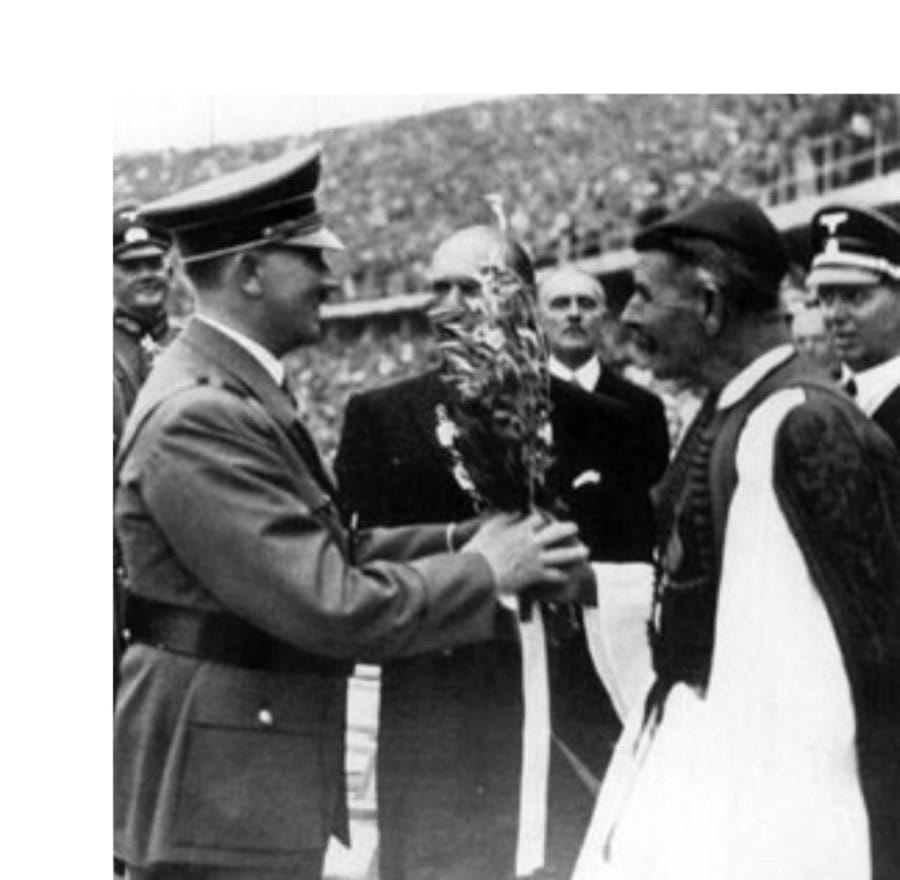
▲ Spiridon Louis, winner of the marathon in the 1896 Games, presents an olive branch from the Sacred Grove of Zeus at Olympia to the host of the 1936 Games.
continued to discriminate against its Jewish athletes. Determined to avoid such a calamity, Hitler, through his emissaries, assured the International Olympic Committee that his government supported the equality of all athletes and promised that all people would be welcome to participate in the Berlin Games.
The city visitors to the 1936 Olympics saw not the real Berlin, not the Berlin that people who resided there had known since the Nazis gained the levers of power. It was an illusion, a place of artifice, more of a stage than a metropolis. Goebbels, in his determination to present a wholesome image of the capital, suspended the orchestrated repression of Jews in Germany. The national press was instructed not to report disputes with Jews or to present them in an unfavorable light. He also made sure that prevalent anti-Semitic road signs, such as “Jews Not Welcome” and “Jews Enter This Place at Their Own Risk,” were removed for the duration of the festival. For two weeks, the odious nature of the Nazi regime was concealed beneath a carapace of garlands and ribbons and smiles.
“THE CLASSIC RACE”
Courtesy of Dr. Karl Lennartz
The concluding event of the remarkably successful Berlin Games was, appropriately, the marathon, which the Germans referred to as “the classic race” because it demanded strength, determination, and endurance. These were qualities much admired by Hitler who, in Mein Kampf, maintained that they would contribute to a young German’s “faith in the invincibility of his whole race and nation.”4
There were 56 entrants in the race, but no German runner was regarded as a serious contender for a medal. Many Germans were inclined to support the defending Olympic champion, Juan Carlos Zabala of Argentina, because for the past several months he had been living and training in Berlin in preparation for the defense of his title.
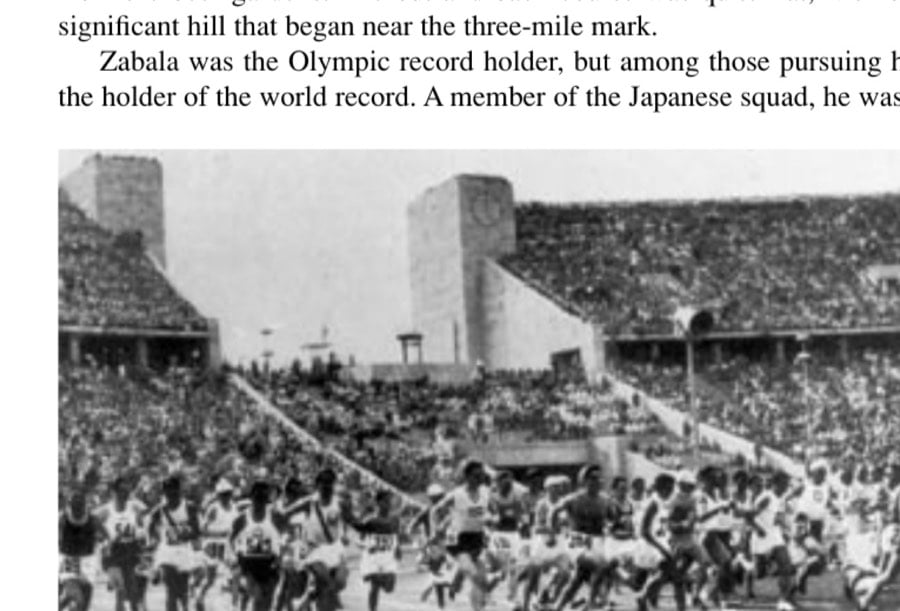
More than 100,000 spectators were in the stadium, including Hitler and several members of his government, when the race started Sunday afternoon at 3:00, and at least a million more waited along the route. The sky was clear and bright, the temperature a warm 72 degrees. As expected, Zabala led the field out of the stadium after one and three-quarters laps around the red clay track. Because of the heat, Zabala had covered his head with a white kerchief. After charging through a tunnel under the stands, he proceeded west along a shaded street of asphalt road that wound past Lake Havel. There the air was ripe with the smell of sauerkraut from the beer gardens. The out-and-back course was quite flat, with only one significant hill that began near the three-mile mark.
Zabala was the Olympic record holder, but among those pursuing him was the holder of the world record. A member of the Japanese squad, he was known
▲ More than 100,000 spectators in the Olympic stadium cheered the start of the Olympic Marathon with its 56 entrants.
as Kitei Son, but his actual name was Sohn Kee-chung, and he was of Korean descent. His country had been annexed by Japan in 1910, and the only opportunity for him to compete in the Olympics was as a member of the Japanese delegation. It was a paradox that gnawed at him because he detested the oppressive Japanese empire. It was a nation that was determined to eradicate the language and culture of his people, and the only way he could affirm his nationality was to run against Japanese competitors and defeat them on the track—a modest victory over his oppressors, to be sure, but a victory nonetheless.
The Argentinean set a withering pace through the first part of the race, leading his immediate challenger, Manuel Dias of Portugal, by 45 seconds after five miles and by a minute and a half a couple of miles later.
A BLISTERING PACE It appeared as if Zabala was going to break his Olympic record, perhaps even the world record of 2:26:42 set by Sohn the previous November. The three Finnish runners in the race were not worried, however, and stayed back, doubtful that Zabala could maintain such a wicked pace. As disciples of Paavo Nurmi, the dominant distance runner in the 1920s, they were shrewd tacticians who knew it was reckless to start out so quickly in such warm weather.
Unlike the Finns, Sohn was concerned that Zabala might not taper off, thereby developing an insurmountable lead. Ernest Harper, the Englishman running alongside the Korean, cautioned him “not to worry about Zabala but to let him run himself out.”5 Though neither one spoke the other’s language, Harper repeatedly said, “Slow,” which Sohn understood, and it helped put him at ease.6
To observers along the route, the talkative pair seemed the complete opposite of one another. Sohn, at 22, was one of the youngest entrants in the race, while Harper was 34 and the oldest. Short and sparse, with a placid expression that concealed any discomfort he was feeling, the Korean appeared as if he were running beside a perturbed uncle who was much taller and whose perpetual frown suggested that every step he took was sheer agony.
Gradually, the curious pair closed on the leaders, and by the 12th mile they had passed Dias and side by side cruised into second place. The heat and the demanding early pace began to take the measure of the Argentinean, who started to slow down. At the halfway point, Zabala was 50 seconds in front of Sohn and Harper. Then, with a brief spurt of speed, Zabala increased his lead to a minute and a half as he headed back toward the stadium.
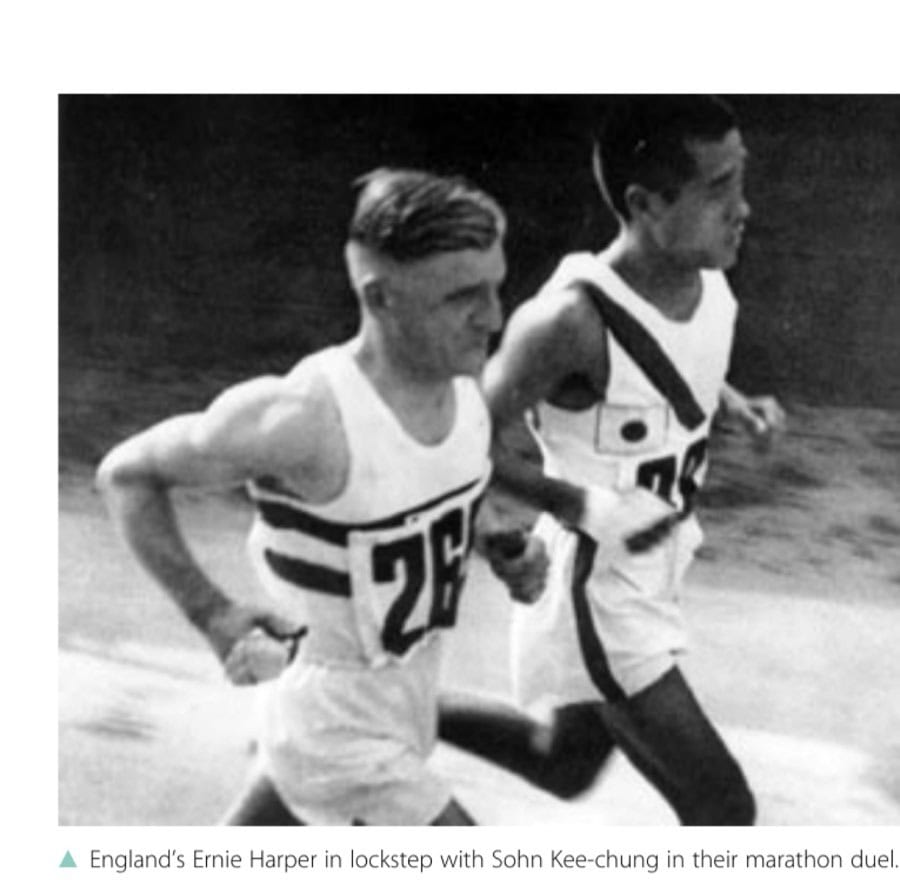
Sohn and Harper did not panic but maintained their strong, consistent pace. Indeed, proceeding along the Avus motor racetrack, Sohn even picked up the tempo, and Harper responded and stayed right with him. Side by side, as they had been almost from the beginning, they charged across the stern concrete surface. Their duel was so impressive that the celebrated German film director Leni
Courtesy of Dr. Karl Lennartz
▲ England’s Ernie Harper in lockstep with Sohn Kee-chung in their marathon duel.
Riefenstahl later invited them back to Berlin to re-create portions of the race for her documentary film Olympia. Soon after the 17-mile mark, his strength diminishing, Zabala stumbled and fell. Moments later, after his recovery, he was stunned when the pair of pursuers caught up with him, and he doggedly managed to stay with them for the next hundred yards. Sohn, moving to the front, passed the defending champion first, with Harper close behind. Zabala, who had led the entire race up to then, was now in third place. Though crushed, he pursued the pair for nearly two more miles, then dropped out of the race just before starting up a small hill.
AN APOLOGETIC MOVE Once he was past the Olympic champion, Sohn pulled farther and farther ahead of Harper who, he hoped, “wasn’t angry” at him.7 Confident now that he would prevail, Sohn ran smoothly, effortlessly, as if the race had just begun. Though Sohn held the world record, some in the crowd were convinced that his unusual shoes explained why he was now in control of the race.
Made of sturdy white cloth, they resembled sandals with a separate slot for the big toe and were assumed by some observers to have been designed specifically for running long distances. Actually, they were just plain Japanese shoes that Sohn had purchased because they were the cheapest he could find. Others in the race also began to move up in the field. The Finns, approaching the 20-mile mark, had surged into third, fourth, and sixth, while another Korean runner, Nam Sung-yong, was in fifth. Nam, too, was a member of the Japanese team, where he was called Shoryu Nan. At this point Sohn and Harper were so far ahead that it became a battle for the bronze medal.
Tactical as ever, the Finns tried to rattle Nam by taking turns passing him, letting him catch up, and then passing again. Nam was not distracted, however, and continued on at a steady, fluid clip. By the 21st mile, he had passed the Finns and moved into third.
Sohn entered the tunnel of the stadium alone, the sound of trumpets blaring in his ears, and when he emerged from it into the sunlight, he received a thunderous ovation. Excited, and still feeling strong, he lowered his head and sprinted to the finish line, breaking the tape in a time of 2:29:19.2. He had set a new Olympic record and had become the first reigning world record holder in the distance to win an Olympic marathon. Harper finished a little more than two minutes after Sohn and collapsed into a blanket offered by someone on the track. He was completely spent, his face contorted in pain, one shoe soaked in blood from a severe blister. Nam, closing strongly, came in almost 19 seconds behind the Englishman. Two of the Finns finished fourth and fifth, and the other was ninth.
KIND WORDS FOR HARPER Sohn was a gracious winner but not a happy one. Afterward, at a press conference, he credited much of his victory to Harper for warning him not to squander his
Courtesy of Dr. Karl Lennartz
▲
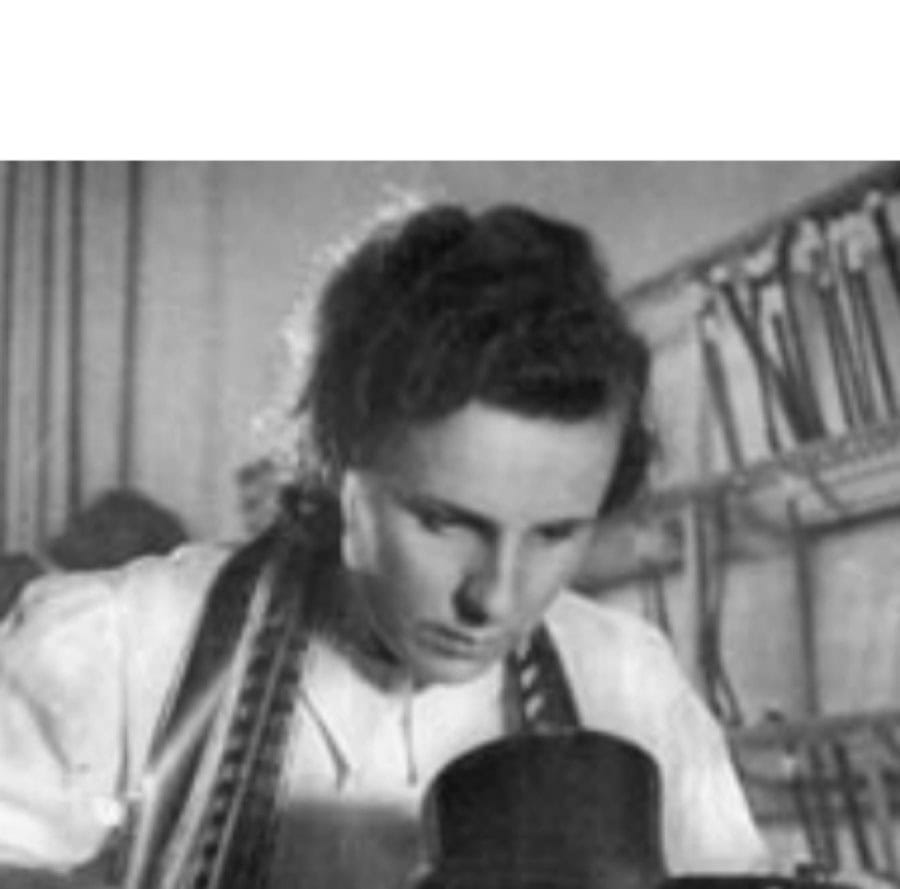
Celebrated German film director Leni Riefenstahl, an artist at work, shot 1.4 million feet of film at the 1936 Games.
Courtesy of Dr. Karl Lennartz
strength by trying to stay up with Zabala at the start of the race. “Please say Mr. Harper is a very fine man for telling me about Zabala,” he asked the reporters.8 The Japanese journalists were not interested in his humility or in his expression of gratitude to a foreigner. They were too jubilant, many of them weeping for joy because finally they had the champion they had been waiting for since the opening of the Berlin Games.
Sohn did not share their jubilation because he did not regard his achievement as a victory for Japan. He was from Korea, not from Japan. Always he wrote his name in his native language, and sometimes he drew a map of his country beside his signature.
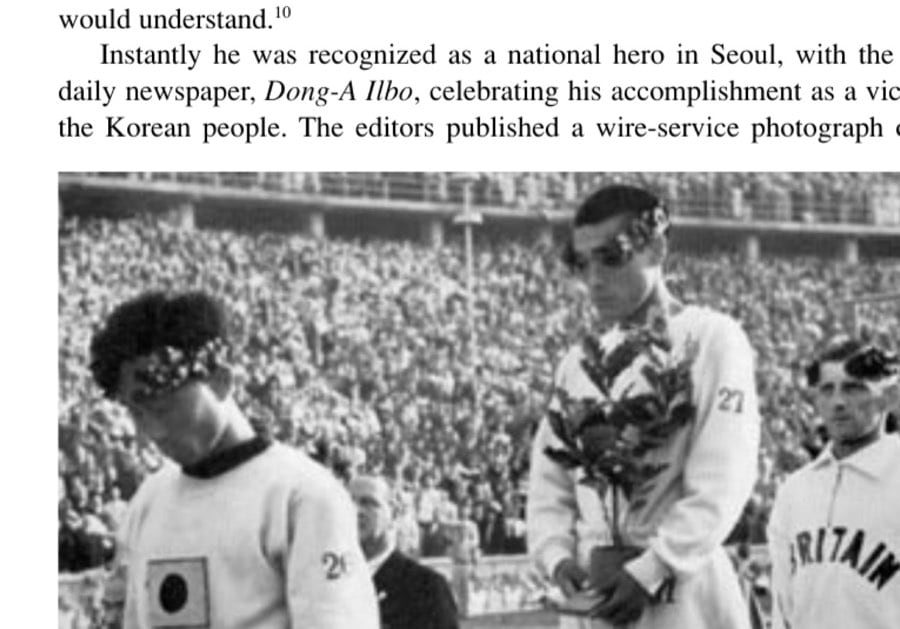
At the medal ceremony Sohn vividly expressed his “shame and outrage” that his country had been forced to live under Japanese rule.9 Along with Nam, he bowed his head in silent protest as the Japanese anthem was played, making it clear he did not recognize Japan as his country.
Afterward, he had an audience with Hitler, who urged him to return to Japan and promote athletics, but though Sohn wanted to tell him that he was “a man without a country,” he kept quiet because he did not think the German leader would understand.10
Instantly he was recognized as a national hero in Seoul, with the leading daily newspaper, Dong-A Ilbo, celebrating his accomplishment as a victory for the Korean people. The editors published a wire-service photograph of Sohn
▲ On the victory stand, from left, are bronze medalist Nam Sung-yong, gold medalist Sohn Kee-chung, and silver medalist Ernie Harper.
on the victory stand but decided to erase the Japanese rising sun flag from his sweatshirt. The Japanese authorities were incensed. Subsequently, eight members of the newspaper’s staff were incarcerated for 40 days, and publication of the newspaper was suspended for nine months.
Sohn was too prominent for the Japanese to imprison him, yet they were concerned that the continued success he was likely to enjoy might incite further displays of dissension among their Korean subjects. So they allowed him to enroll in law school with the understanding he would never again compete as a runner. He agreed, realizing how few people outside Korea cared about its subjugation. And the man without a country, the man who held the world record in the marathon and won the gold medal at the Berlin Games, never ran another competitive marathon.
NOTES 1 Ian Kershaw, Hitler, 1889-1936: Hubris, p. 91. 2 Duff Hart-Davis, Hitler’s Games, p. 45. 3 Albert Speer, Inside the Third Reich, p. 83. 4 Richard D. Mandell, The Nazi Olympics, p. 264. 5 New York Times, August 10, 1936, p. 12. 6 Ibid. 7 Ron Fimrite, “A Hero in His Native Land,” Sports Illustrated (September 14, 1988), p. 40. 8 New York Times, loc cit. 9 David E. Martin and Roger W. H. Gynn, The Olympic Marathon, pp. 175-76. 10 Fimrite, op cit, p. 41.
BIBLIOGRAPHY Bullock, Alan, Hitler: A Study in Tyranny, revised edition, New York, Harper and Row, 1964. Fimrite, Ron, “A Hero in His Native Land,” Sports Illustrated, LXIX (September 14, 1988), pp. 36-42. Hart-Davis, Duff, Hitler’s Games, New York, Harper and Row, 1986. Hitler, Adolf, Mein Kampf, Boston, Houghton Mifflin Company, 1971. Kershaw, Ian, Hitler, 1889-1936: Hubris, New York, W.W. Norton, 1999. Kruger, Arnd and William Murray, eds., The Nazi Olympics, Urbana, University of Illinois Press, 2003. Mandell, Richard D., The Nazi Olympics, New York, Ballantine Books, 1971. Martin, David E. and Roger W. H. Gynn, The Olympic Marathon, Champaign, Human Kinetics, 2000. New York Times, New York (August 10, 1936). Reuth, Ralf Georg, Goebbels, New York, Harcourt Brace & Company, 1993. Riefenstahl, Leni, A Memoir, New York, St. Martin’s Press, 1993. Shirer, William L., The Rise and Fall of the Third Reich, Greenwich, Fawcett Publications, 1959. Speer, Albert, Inside the Third Reich, New York, The Macmillan Company, 1970.
This article originally appeared in Marathon & Beyond, Vol. 10, No. 6 (2006).
← Browse the full M&B ArchiveMore like this
1,000+ stories from 19 years of Marathon & Beyond
The complete archive of the legendary long-distance journal — digitized and free to read.
