

The Origins Of The Marathon
The Marathon’s 2,500th Anniversary
The Origins of the Marathon Why was the 1896 Olympic Marathon held over the longest route from Marathon to Athens? And was the odd 42K eventual standard distance an arbitrary choice? by Andy Milroy
To many people the marathon event began in 1896, but covering such a distance on foot has a much longer history than that. Putting aside the myth of the Pheidippides connection (www.arrs.net/AR_Pheid.htm), the origins of the event go back to
an era very different from the present. “Foteman that runnen” have a history that goes back way before Columbus discovered the New World. Such a footman carried the messages of his master and also would run
ahead of a slow-moving coach to warn the inn or house that his master or mistress was coming. Over long distances the footman was the fastest means of communication, primarily because of the bad state of the roads.
It would have been strange if the exploits of such footmen had not resulted in boasts from proud masters, and this naturally led to wagers and races. A Venetian reported of England: “It is . . . the custom of this kingdom to make the footmen run races of
15 or 20 miles.” (It should be noted that all runners and walkers were generally known as footmen until the 18th century, when the term “pedestrian” came into use.) Possibly due to increased road traffic, following the
restoration of Charles II to the British throne in 1660, running races in England were seldom held on roads; instead, racecourses or other open spaces
were often used. In the 1660s the famous diary writer Samuel Pepys saw a race between an Irishman and a footman named Crow covering three laps around Hyde Park in London, then considerably larger than it is today. Crow won by more than two miles. The aristocracy was not above deception when arranging these matches. A notable runner, Preston, who was by profession a butcher, was recruited by a lord to run for him as his miller in the 1680s. This scheme also involved the disfigurement of the runner so that no one would recognise him. It was successful and won many thousands of pounds for the aristocrat.
Increasing the distance One of the first contests over 20 miles recorded in detail was held around 1700 when a match between an Englishman and a Scot on “measured ground”—a round ring that had been cut to be almost four miles—took place at Windsor near London. The men were to run the circuit more than five times, the 22 miles/35.4K being the same distance as from Charing Cross to Windsor Cross. The race was won by the Scot in two and a half hours. This race foreshadowed the development of the event that was later to become known as the marathon.
Running footmen were not uncommon in continental Europe, but why the sport of running and walking, “pedestrianism,” developed and flourished in Britain in
Early Ultrarunners Running messengers were seen as the most effective means of communication from earliest times; by the 16th century some runners would undertake to run down in seven or eight days the best horse that could be bought. On a more mundane level, foot posts would collect mail at specified inns and carry them across the country to be delivered elsewhere. In England in the 18th century, there was at least one female foot post, who used to walk from Keswick to London and back regularly carrying mail.
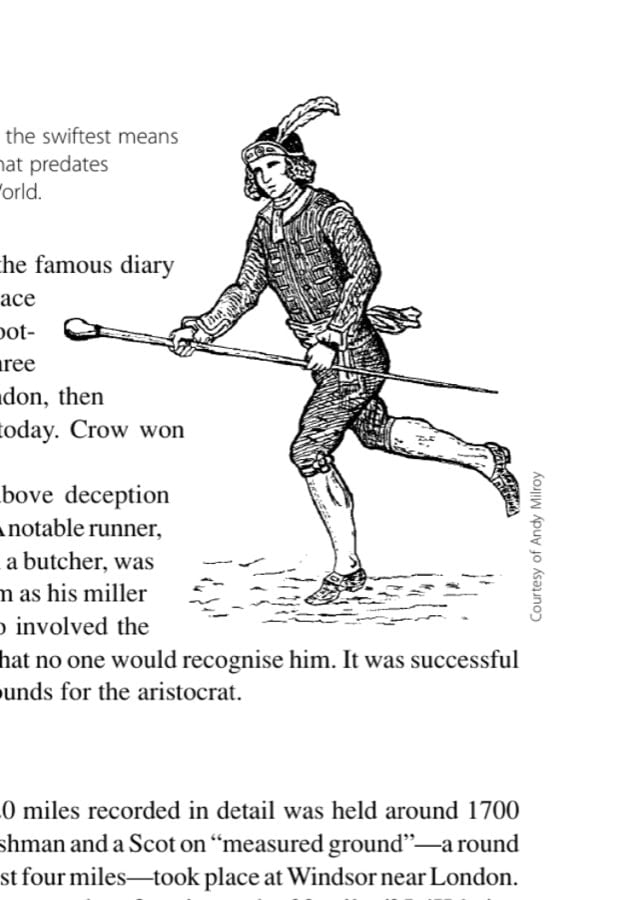
Courtesy of Andy Milroy
▲
Running footmen, who provided the swiftest means of communication, have a history that predates Columbus’s discovery of the New World.
the 18th and early-19th centuries is not immediately clear. The increasing interest in such performances does fit with the development of good turnpike roads marked out with milestones, making suitable courses readily available. (Gunter, an Englishman, had invented a 66-foot wrought-iron measuring chain for accurate surveying in the 17th century.) In parallel with this development, relatively cheap, accurate pocket watches were being made, enabling performances in different races to be compared for the first time.
The conditions for the growth of the sport were in place, but equally good roads existed in France. The unique factor that made pedestrianism viable and popular in England was the gambling craze that gripped the upper classes. When £200,000 could be won playing whist and one aristocrat lost £23,000 in an evening in the gaming rooms, athletic events provided an ideal vehicle for wagers. Young aristocrats were willing to bet on the merits of a professional or gentleman pedestrian completing a specific distance within a time that had been achieved by him or another or on the chance of some new feat being accomplished. Such wagers were not without danger. Running long distances at speed was a new experience for many, and knowledge was hard won. Famous runners like Woolley Morris and Gruffydd Morgan died after overextending themselves. Only gradually by trial and error was the speed at which a runner might cover 10 miles and upward discovered. However, the deaths of Morris and Morgan meant that runners were wary of running distances beyond 20 miles, and such distances became regarded as being more suitable for walkers than for runners. (It was accepted in those days for long-distance walkers to run to ease cramps, so their progress was really “go as you please.” Competitors used a combination of running and walking.)
During the 18th century the running footmen in the service of the nobility were gradually supplanted by their competitors in the growing class of professional pedestrians. These professionals competed in parallel with the gentlemen pedestrians but seldom against them.
Although pedestrianism was common in Britain, there are also records of such performances in continental Europe. A German walker, Jean-Georges Wille, walked approximately 40K from Strasbourg to Saverne in seven hours in 1736, a speed of under four miles/6K an hour. Although this performance appears more notable for its early date than its speed, the frequent problems with the roads of this period may need to be taken into account. A traveler in England at around this time remarked that very deeply rutted bad roads meant “that I was near 11 hours in going but 25 mile,” and that was almost certainly on horseback.
Performances improve From 1750 the great British walkers came into their own. In 1762 Child, a miller from Wandsworth in London, went 44 miles on foot in 7 hours, 57 minutes—at a
Horrendous Roads The condition of the roads in the 18th century in England could be horrendous. Arthur Young in 1770 described roads “full of ruts, whose gaping jaws threatened to swallow up any carriage less than a wagon.”
He measured ruts four feet deep filled with water even in summer. An Ipswich newspaper in the east of England reported in 1769 on an inquest on a man who had been thrown from his horse and “suffocated by mud and filth.” speed of over five miles/8K an hour, perhaps with better road conditions. However, most of the matches by British walkers of this period were over either much longer or much shorter distances than that of the later marathon distance.
The Napoleonic Wars that spanned the end of the 18th and the first decade of the 19th century, ending in 1815, were a period of great economic activity and therefore also for such matches. The first solo matches against time over the approximate marathon distance took place in 1805, when an optician named King wagered 30 guineas that he could cover the 26 miles from Hammersmith to Colnbrook and back within four hours. He succeeded, taking 3 hours, 43 minutes. The following year, in another match against time, a clerk named Ensor equalled the feat in the same duration, this time for a wager of 50 guineas.
The great era of gentlemen pedestrians competing for wagers seems to have come to an end with the economic depression that followed the close of the Napoleonic Wars. The remaining professional pedestrians were left to try to drum up interest by issuing public challenges in the press but often were reduced to earning money through collections, performing novelty feats such as picking up stones, walking backward, and rolling cartwheels.
There was still some interest in longer events, and in 1820 James Bigmore covered a loop course of 24 miles in three hours in Norwich in eastern England. It was in the public challenges and the matches between the professional pedestrians that the 25-mile distance came to establish itself as a championship event. As early as December 1824, the pedestrian John Phipps Townsend challenged Robert Skipper, who had assumed the title “Champion of England,” to a match over “25 miles of ground.”
The ladies also took part Shorter events still attracted interest as gradually the experience and knowledge of running and walking such distances was gained in matches against time. In Germany earlier that year, Peter Bajus had gone from Mainz-Kastel to
Frankfurt—around 33K (just over 20 miles)—in 2:15, and the British pedestrian Edward Rayner went the 22 miles from Hastings to Rye and back in 2:45. In 1828 another British pedestrian, John Shepherd, went from Leadenhall Market to Romford and back in London, some 24 miles, in 2:45. Women did sometimes offer challenges: in the 1820s a young woman took part in a mixed race to cover 15 miles in two hours.
By 1837 Townsend would cover the first 25 miles of his match to go from London to Brighton in 3:34, but it was six years later that the 25-mile match came into its own. In November 1843 the acknowledged champion pedestrian of the time, Robert Fuller, was beaten by George Bradshaw in a match over 25 miles in 3:59 “after a struggle never surpassed.” Less than a year later there was another “Great Footrace” over the same distance between Bradshaw and B. Butler, who had not covered such a distance before in competition. They were described as “the two greatest pedestrians of this or of any antecedent period.” Within the previous three years, Butler had beaten all the competition. He stood around 6 feet, 2 inches and was powerfully built, while Bradshaw was only 5 feet 8 and very thin and spare. For the first eight and a half miles, the pedestrians were shoulder to shoulder, but Bradshaw was forced to resign after 15 miles and Butler continued to the finish, taking it very comfortably in four hours and a half.
The 1840s saw a real revival in professional racing. In part this was due to the early growth in the railway system, which enabled swift, easy transportation of large numbers of people to an enclosed venue, making large crowds of paying spectators possible. Men like John Barlow and William Howitt not only inspired interest in Britain but even crossed the Atlantic to compete successfully in America. Watches accurate to a quarter of a second for timing such events were already in widespread use by the 1840s.
Racing distances up to 10 miles in America actually dated back to at least 1829, when Owen Atkins won a race of that distance in Virginia, and by 1835 Henry Stannard was recognized as the first American distance-running champion, covering 10 miles within the hour. At Metaire racecourse in New Orleans in 1846, John Gildersleeve set a 15-mile world best of 1:32:30 and in 1851 won a 20-mile race in San Francisco for a $4,000 purse. But running races over such a distance as 20 miles was rare, with usually 12 to 15 miles still being the longest events run.
By the 1850s there were a dozen running tracks established in the major industrial cities in Britain. In the United States, existing horse-racing and trotting tracks were brought into use. The British running tracks were often owned by the landlords of adjoining or nearby public houses or inns; these publicans would act as stakeholders and referees. The races were often just a two-man affair, with the main interest focused on the betting. As soon as one runner found
himself outclassed, he would retire and the remaining runner would be declared the winner, doing just enough to satisfy the remaining bets, stopping short of completing the distance. Despite these limitations, long distance “records” began to be established as professional athletes began to specialize in track racing. These are perhaps the first reasonably reliable marks compared to modern day standards. These races were usually over 10 miles, with the longest races over 15 miles. There was at least one scheduled race over 20 miles, but the match was concluded well short of that distance. From this emerged an organized schedule of championship and match events held on measured tracks of varying sizes.
The arrival of Deerfoot Just as Barlow and Howitt had stimulated interest in long-distance running in America, so an American was to have a profound effect on the British scene. When Louis Bennett, a Seneca Indian better known as Deerfoot, arrived in Britain in 1861, his races aroused great interest. Even the Victorian ladies came to see the American Indian runner, clad in breechcloth and moccasins and racing over 11 miles in an hour. Deerfoot’s appearance at such venues as Fenners in Cambridge also stimulated the interest of amateur runners and led to the formation of early athletic clubs in England.
But the likes of Deerfoot, Barlow, and Howitt did not run the marathon distance or anything approaching it. Twenty miles within two hours had been achieved by Thomas Maxfield on the Staines Turnpike near London in 1845, a feat emulated by Richard Manks in London three years later, but longer distances were still viewed as primarily the preserve of the walker, or as go-as-you-please events. When rare longer events like the four-hour race between the British runner George Frost and the Spaniard Antonio Genaro did take place in 1856, Genaro resigned after 14 miles.
It was a walker, Charles Westhall, who was to raise the level of competition in events lasting three hours, with his remarkable “Westhall Feat.” In 1858 he walked 21 miles in under three hours, that is, seven miles an hour walking “fair heel and toe,” always maintaining contact with the track. His time of 2:59:01 was regarded with awe. As a result, three-hour track walking races became popular. In 1865 George Topley improved on Westhall’s time for 21 miles, but still there was no incentive for runners to tackle such protracted events.
This was to change in 1874 with the popularization of a much longer event. American Edward Payson Weston had a gift for self-promotion, which began when he made a wager in 1861 to walk from Boston to Washington to attend the inauguration of Abraham Lincoln. Heavy snow delayed Weston and he missed the inauguration, but he had averaged 51 miles a day over the 453-mile course.
Over the next 13 years, Weston continued a career of long-distance walks. In 1874 he made a series of attempts to achieve the widely regarded as impossible feat of walking 500 miles in six days (the maximum time allowed between Victorian Sundays). When he finally achieved that feat in the Washington Street Ring, Newark, New Jersey, in 1874 he aroused so much interest that a craze for six-day races followed.
Because of disputes about the fairness of Weston’s walking action, these events became go as you please. Other versions of the six-day event followed: competitors would race 10 or 12 hours a day for six days. There were even shorter races like 50 miles. It was in such races that professional runners first gained the experience of running longer distances well beyond 20 miles.
When amateurs began contesting long distances, their development mirrored that of the professionals. The first 10-mile track mark was set in 1873 by William Fuller in London, the first amateur to run the distance within the hour. Later that year Sydney Weall covered 18 miles in two hours on the road. (Road racing in this period, being a “free show,” was very unusual.) However, a 25-mile track walk, in May 1876, was successfully completed and marked the beginning of the amateur events at the longer distances.
The ascension of the amateurs Although the professionals had shown the way, in the longer term it was to be the amateurs who would inherit their mantle. The first go-as-you-please track event for amateurs took place in 1879. By 1881 development of amateur distance running had progressed so swiftly that in an open 25-mile track race at the London Athletic Club grounds, the British runner George Dunning, leading throughout the race, “beat any previous record, either professional or amateur.” He improved on professional George Mason’s previous absolute world best time of 2:36:34 by nearly three minutes with a time of 2:33:44.
On the other side of the Atlantic, Canadian William Harding had walked 25 miles on the track in 4:30 in April 1878 in Rutland, Vermont, and by 1882 D. Driscoll of the United States had improved this time to 3:37:03 in Massachusetts. In February 1884, J. Gasmann had posted a U.S. amateur track running record for 25 miles of 2:52:24, and by 1887 professional runner Peter Hegelman was credited with running 2:41:32 for 25 miles on the track in Philadelphia.
From the popularity of six-day races also arose pedestriennes, women professional walkers. From endurance events covering 2,700 quarter miles in 2,700 consecutive quarter hours, walking a quarter mile each and every quarter hour, to six-day races, walkers like Ada Anderson, Bertha Von Hillern, and Mary Marshall roused great interest in women’s competitions. Some women specialized in shorter events.
▲
In the late 1870s, Madame Ada Anderson walked 2,700 quarter miles in 2,700 consecutive quarter hours.
Ed Sears Collection
In February 1879 in Montreal, Canadian Jessie Morahan won her first professional match unexpectedly against the more experienced American Laura Warren, completing the 25-mile event in 5:21:30. She also competed over this distance in mixed matches, her male opponent handicapped to cover 35 miles to her 25 miles. Over the next year or so she competed fairly regularly at 25 miles, her best time being 4:03 in Toronto in September 1879. Morahan appears to be the strongest female performer in the event in the Victorian period.
In continental Europe, races approaching 25 miles/40K were being held. Reputedly in the early 1870s Ingemann Petersen of Denmark ran the 5.5 Danish miles (25 miles/40.3K) from Copenhagen to Helsingor in 3:39. Around 1881 the Italian Achille Bargossi ran 22.3 miles/36K indoors in 3:04:24 in Vienna. Four years later Frenchman Louis Saussus won a 38K (23.6-miles) race from Paris to Versailles in 2:36:30. Such early performers were regarded with amazement and some attracted impressive nicknames. Bargossi was called Uomo-cavallo (man-horse) and Saussus L’Homme Electrique (The Electric Man).
The year 1888 saw the peak of the six-day races when the British runner George Littlewood covered 623 miles at Madison Square Garden, New York. His record was to stand for nearly 100 years. Thereafter the event went into decline, in part under pressure from the more dynamic and exciting six-day cycle races.
The rise of mass participation events It was the bicycle that was to stimulate the next upsurge in interest in covering long distances on foot, this time on the roads. Pierre Giffard, chief correspondent of the Parisian newspaper Le Petit Journal, saw the popularity of a cycle race from Bordeaux to Paris in France held in May 1891 over 572 kilometers. Giffard became involved in organizing a more challenging event that would keep its readers’ interest for an even longer period. After he organized the Paris to Brest to Paris cycle race, a new concept was proposed—a mass-participation event that would combine running with hiking, go as you please.
The 380K race from Paris to Belfort in early June 1892 was probably the first large-scale long-distance footrace on record. The Le Petit Journal’s circulation showed a major increase as the readership followed the event day by day.
Mass Participation Long-Distance Footrace Pierre Giffard (1853–1922) was a French journalist, a newspaper publisher, and one of the pioneers of using modern sports events as vehicles to increase newspaper circulation. In 1891, he organized the Paris to Brest
to Paris cycle race. The following year he promoted the first recorded mass-participation long-distance footrace over 380 kilometers from Paris to Belfort. With more than 1,100 entries and over 800 starters, there
was great interest from the readers of the promoting newspaper, Le Petit Journal. Three hundred and eighty of the starters finished in less than 10 days. In 1896 Giffard subsequently organized the first mass-participation
marathon with 191 starters for the Marathon de Paris, just three months after the inaugural Athens Olympics. As editor of the sports daily le Vélo, Giffard’s opposition to the carmaker Albert de Dion led de Dion to create a rival daily, L’Auto. Newspaper
circulation wars led L’Auto to create the Tour de France cycle race. From footraces like the Paris to Belfort developed the ultradistance race walk, the classic 310 mile/500K Paris to Strasbourg event (now the
Paris to Colmar). Giffard’s influence on the development of modern endurance sports was profound.
The concept of road races lasting several days attracted attention elsewhere. There was a 147K race from St. Brieuc to Brest in France in August that year, and then in October the Austrian Wilhelm Starhemberg covered the 580 kilometers from Berlin in Germany to Vienna in Austria-Hungary in 71 hours, 35 minutes.
Just as with the six-day races, the promotion, publicity, and reports of such events prompted others to emulate them, albeit on a somewhat lesser scale. In 1892 a Frenchman, Auguste Marchais, ran 36.7K (22.4 miles) in Paris in three hours. Also in 1892 a race (23.3 miles/37.6K) held in Copenhagen was won by an amateur, Jorgen Peter Muller, in 3:00:28.5. (The Dane Ingemann Petersen had been a professional runner.)
Elsewhere in Scandinavia, from 1892 onward in Sweden, races at a similar distance between Stockholm and Sudertalje, Norrkoping, and Linkoping were held, with the former becoming a regular event, varying in length up to 23 miles/37K. In 1894, Julius Olsson recorded a time for the course of 2:27:17.6. In 1895, a 22.3-mile/36K race was held in Frankfurt in Germany.
The idea of incorporating a road race from Marathon to Athens in the first Olympic Games to be held in Athens came from Michel Bréal, an associate of Baron de Coubertin, the founder of the modern Olympic Games. Obviously the mythical story of Pheidippides gave a basis for such a run, but the idea of running from the recently discovered site of the battle of Marathon to Athens was possibly also inspired by the reports in newspapers of the popular point-to-point races of the period. It is probably no coincidence that Bréal’s letter to Pierre Coubertin was sent in September 1894, two years after the Paris–Belfort race.
The actual route taken between the battlefield and Athens had not been part of the story of the mythical run. It seems likely that the length of the Olympic Marathon was not just an accident of geography, the distance that needed to be covered between Marathon and Athens.
In David Martin and Roger Gynn’s book, The Olympic Marathon, the comment is made that “The legendary run from Marathon to Athens could have taken one of two routes . . . The longer choice, about 40 kilometers (25 miles) in length . . . The shorter route, about 34 kilometers (21 miles) . . . the total ascent of this latter route is greater, but it occurs during the early portion, when the runners are fresh, and the route is 15 percent shorter in total distance. (A long gentle descent . . . through pine-filled forests then allows entry into Athens.)”
Choosing the first Olympic Marathon course Therefore there was a choice of routes and of distance. The race did not have to be over the longer and more difficult route. The route of the original Olympic Marathon in 1896 was supposed to replicate the mythical run from the battle of Marathon to Athens by a running messenger bearing urgent news that the Athenians had won. Any running messenger in that situation would choose the shortest route, which was 34K. The organizers of the original Olympic Marathon chose to ignore that logic and went for a tougher, longer route over 40K.
The book The Olympic Marathon also makes another important point: that the course was one of just four Olympic Marathon courses with a net uphill gradient, more ascent than descent. The others are much more recent: Mexico City in 1968, Los Angeles in 1984, and Barcelona in 1992.
From an organizational point of view a shorter race, with a long downhill, would ▲
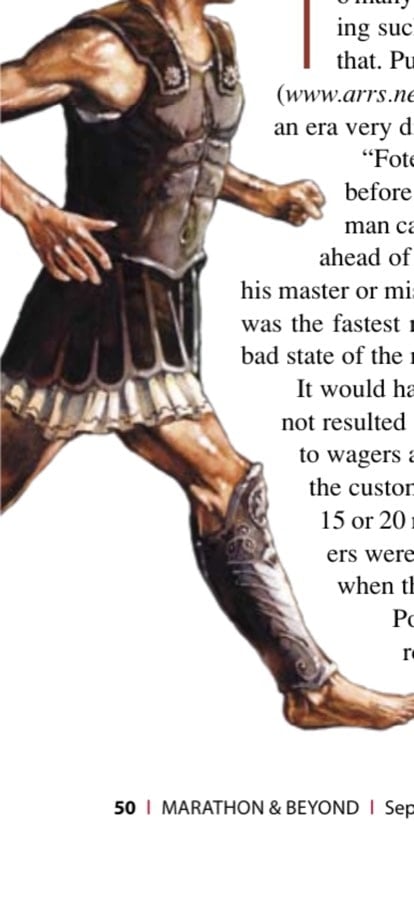
The all-day runner, known as a hemerodromos.
Courtesy of Andy Milroy
have been a safer, less-risky option. The choice of the longer, tougher course for what was to be a showcase event would appear to be a high-risk strategy, unless there was a good reason. In The Olympic Marathon the comment is made: “We also do not know why the longer seacoast route was selected in preference to the shorter mountainous route. Perhaps it was because the distance of 40 kilometers is also familiar to nations accustomed to the imperial measurement system. Forty kilometers is close to 25 miles.”
Road running was in its infancy. Track-oriented officials in the 1890s would probably have looked to the most comprehensive set of records available for a precedent. The record of the amateur Dunning appeared as the absolute best for the 25-mile distance, which would have appealed strongly to the staunchly amateur athletic establishment determined to keep any taint of professionalism out of the Olympics. (The entry for the marathon of Italian Carlos Airoldi, who had journeyed on foot all the way from Italy, was rejected because he had received payment for competing in an earlier race.)
Possibly in choosing the longer distance of 25 miles/40K, Dunning’s amateur mark was a significant influence. A race over 34 kilometers would not have the same resonance or significance for the members of the new Olympic establishment, keen to stress its strong amateur credentials.
A distance appealing to most fans In terms of PR, it would also have been desirable to sell the event to the thenstrongest athletic nations in the world, which were familiar with the 25-mile distance. The British and Americans had pioneered the sport of track and field athletics. Even elsewhere in the 1890s, in the first athletic championships held in Berlin in Germany, races were held over 100 yards and one mile.
The Athens Olympic Marathon reinforced the 25 miles/40K as the championship distance, and during the early years of the 20th century, subsequent Olympic marathons were held over approximately the same distance. The 1900 Paris Olympic marathon was 40.260K, the St. Louis Marathon in 1904 was 40K (reported as such in the daily program), and the Intercalated Athens Olympic Marathon in 1906 was 41.860K. (This was part of an unofficial Olympics held to celebrate the 10th anniversary of the original event.) The actual exact measurement of all these races is uncertain, but the key point is that the official nominal distance was around 40K.
In the meantime, across the globe, countries had held their inaugural “marathons” over the approximate 40K distance. In July 1896 Le Petit Journal and Pierre Giffard seized the marketing opportunity created by the interest in the Marathonto-Athens race in the Olympics and organized the first international marathon from
Paris to Conflans over 40K. With 191 participants it was the first large-scale event over such a distance. (The Olympic race had had just 17 starters.) The British professional runner Len Hurst was one of the early great “marathon” performers in late 19th and early 20th centuries. His background was the British professional circuit of 10-mile and go-as-you-please events. He was successful in the Paris–Conflans 40K races held during the 1896–1904 period. His time of 2:26:47.6 in 1900 was the best performance over the distance until the marathon craze that followed the dramatic 1908 Olympic race. Hurst’s career also gives important insights into the importance and significance of the 25-mile/40K event at the beginning of the 20th century.
In September 1901, Hurst won the professional 25-mile world championships at the Tee-To-Tum ground at Stamford Hill in London, beating American Bob Hallen in front of a large crowd. Two years later, in August 1903 in Brighton on the south coast of England, Hurst set a professional and absolute world track record over the 25-mile distance of 2:32:42, just clipping Dunning’s 1881 time. He had been paced to break Dunning’s mark, which one must suspect had been an affront and a challenge to the pride and status of professional runners.
The 40K distance circles the world Although the professionals had been quick off the mark to exploit the renewed interest in the 25-mile/40K distance, interest was also growing elsewhere. The first Hungarian championships were held in October 1896 over 40K. Norway also had its first marathon over 40.2K that month, as did Denmark, with a race over a 24.2-mile/39.1K course.
The first non-European marathon was held in New York that year over 25 miles (40.2K). The first marathon race in Africa, between Mateur and Bizerte in Tunisia, also held that year, was over 40K. In 1898 Arthur Techtow won the first German marathon, yet again over 40K. The first Swiss and Austrian races in 1901 in Geneva and Vienna were over 40.2K and 40K respectively.
In June 1904 the first marathon over 40K in the Russian Empire was held in Warsaw, then the third-largest city in the empire. The first Finnish race in 1906 was over 40.2K, while 40K was chosen for the first marathon race in what was to become Czechoslovakia, at Dobris in 1908. Across the Atlantic in Canada the same year, 25 miles was selected for the first such race in that country. In June that year the first Italian marathon championship was contested in Rome over the 40K distance.
The first union championship in South Africa, also in 1908, was also over a distance of 25 miles. An earlier event held in September 1903 over 25 miles from Durban to Isipingo and back had attracted 148 entrants.
Dr. Edward H. Kozloff Collection
The first marathon run within what was later to be the Soviet Union was in Kiev in the Ukraine in 1913, a race of 38 versts or 40.2K, won by Aleksandr Maksimov. Twenty-five miles was the distance of the first Japanese marathon, held in 1911. The marathon that was held as part of the Far Eastern Games in 1917 in Tokyo was once again 25 miles—indeed, the 25-mile distance looks to have been standard in Japan up until 1919. As late as 1921 the national title was contested over 25 miles.
The early Olympic Trials held by the USA show the same degree of consistency. The 1900 race was held over 24 miles/38.752K, the 1908 over 24.6 miles/39.750K, and the two 1912 Trials over 24.6 miles/39.750K and 25 miles/40.233K.
The original program for the 1908 Olympics submitted by the British organizers and approved by the International Olympic Committee at its meeting at The Hague in the spring of 1907 stated: “The marathon race of 40 kilometers will be run on a course marked out on public roads by the Amateur Athletic Association and will finish on the running track inside the stadium, where the last one-third of a mile will be run (one lap equals 536 meters).” (Official Report of the 1908 Olympic Games, page 410.) This would have been sent out to the various competing nations. It is more than likely that the Italian Dorando Pietri and other marathon competitors came to London expecting a 40K race.
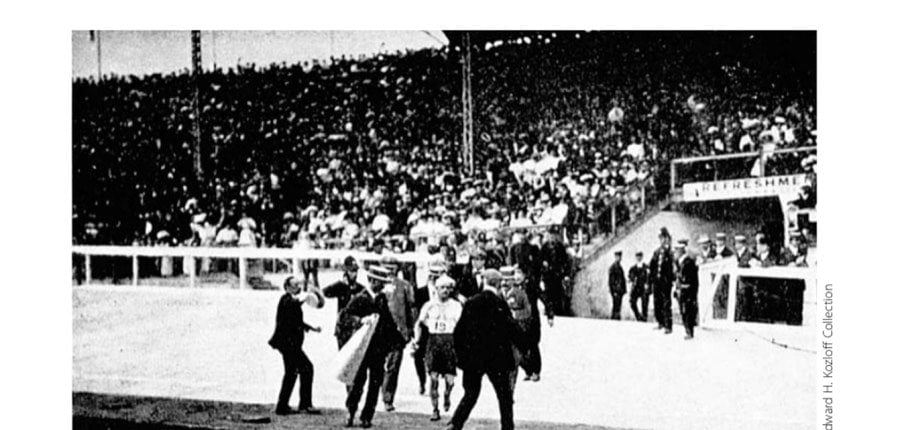
Although it is very well known that Dorando Pietri was the catalyst for the change to the present somewhat arbitrary distance, ironically he was selected to run in the 1908 Olympics because he set a 40K track record of 2:38:00!
▲ The first time the marathon was competed at the 42K distance, in the 1908 Olympic Marathon, Italian Dorando Pietri collapsed repeatedly during the final stretch and was disqualified for being helped across the finish line.
To cover familiar territory, for various reasons the 1908 London Olympic Marathon had been extended to well over 26 miles/42K. Dorando Pietri collapsed as he was coming into the stadium. The controversy over his disqualification for being helped over the line created a whole series of lucrative professional marathon races, the Marathon Craze, which to sustain the link with the controversy were held over exactly the same distance as the 1908 Olympic Marathon.
There had also been a number of amateur races over that same distance, most notably the Polytechnic Harriers race held over the 1908 Olympic course. However, by 1912 the novelty of such races was in decline, and there was increasingly a move to go back to the original default setting of 25 miles/40.2K. Even the Olympic marathon that year in Stockholm was held over 40.2K.
25 miles not 42K chosen as world record distance In 1912, the International Amateur Athletics Federation (IAAF) was formed and in May of the following year the British runner Harry Green set the world’s fastest time for the 1908 Olympic Marathon distance of 26 miles, 385 yards/42.195K on the track. However, it was not that mark of 2:38:16.2 that the IAAF chose to ratify and include in its new world record schedule. Instead the IAAF selected Green’s 25-mile split—2:29:29.4—which had broken George Dunning’s 31-yearold track record of 2:33:44.
Why Green’s 25-mile split was chosen in preference to his final marathon time is unknown. However, as we have seen, the 25-mile/40K distance had been widely accepted internationally as the marathon distance.
By 1913 there were just four races over the 26.2-mile distance, all in Europe, with well over 20 races contesting 25 miles/40.2K held across the globe in locations such as Tokyo in Japan, Milan in Italy, Yonkers in New York, and Scandinavia.
The First World War saw a further decline in popularity in the 26.2-mile event. In 1915 there were just two such races, in San Francisco and St. Louis, compared with some 16 races at 25 miles/40.2K. In 1916 and 1917 marathon interest was entirely focused on the shorter distance, with no 26.2-mile races held anywhere in the world to the best of our knowledge.
In 1918, the final year of the war, there was just one 26.2-mile event, and that was for professionals in France, with other marathon activity focused on the 25mile/40.2K event, including an unofficial South American championship.
For the 1920 Olympics, the marathon course was extended to 42.75K. Subsequently, on 27 May 1921 at its meeting in Geneva, the decision was made by the IAAF to standardize the marathon distance at 26.2 miles/42.195K. Why this apparently arbitrary decision was made to standardize the distance at the 1908 Olympic event in preference to the more commonly contested 25-mile/40.2K distance of the 1912 Games, ignoring the latter’s reestablished and globally recognized status, is unknown.
Looking at the development of the event since 1913, the only real reservoir of interest in this specific 26.2-mile distance appears rooted within the British Empire, which viewed the Polytechnic Marathon, held on the 1908 Olympic course, as an event second only in status to the Olympic Marathon. Races in Melbourne and Adelaide in Australia, for example, were held over the 26.2-mile distance that year. Possibly the authority of the British Empire as a major pioneer in athletics carried the day. However, the decision was not without opposition.
The 40K persisted, virtually everywhere Despite the IAAF and IOC decisions in the early 1920s, in Scandinavia and elsewhere the 40K and 40.2K distances continued to be often recognized for the “marathon” event for decades afterward, even into the 1940s and beyond. The German Olympic Marathon trial in 1928 was held over 40.25K. In Denmark the national title was contested at 40.2K or 40K until 1936. Finland held 40.2K events up until 1939, and during the 1930s both the Soviet Union and Romanian championships were held, at least on one occasion, over 40K or 40.2K. In 1938 the Balkan Games marathon was also held over 40K. Even as late as 1946 the European marathon championship in Oslo, Norway, was held at 40.2K.
In Sweden the attachment to the 40.2K or 40K event was to last longer, and it was not until 1948 that the first national championships over the now-standard distance was held. Even more recently, in 1957 and 1958, major 40K road races were held in France, at La Baule and Fontainebleau, and in 1961, the Dane Thyge Togerson ran 2:15:30 for a recognized national 40K record on the track at Zaandam in the Netherlands.
There were also other variations in distance, of course. The International Turin Marathon in Italy was usually over the longer distance of 42.750K until well into the 1930s, and other national championships, like those of the French from 1928 to 1945, were several kilometers short of 40K. (The French seem to have been very precise in their courses in terms of their nominal length—they don’t appear to have been accidentally short. This points to the 1957 and 1958 races being planned as 40K races, not as standard marathon races that turned out to be short.)
The 25-mile track world record was to stay on the IAAF record schedule for years. In October 1934, the Italian Michele Fanelli set a world record at 2:26:10.8, a time that was still listed when the IAAF finally removed the event from its record list in 1954. Harry Green’s British record and former world record had been broken by Frank Farmer in 1939.
The British Road Runners Club was to recognize the world records for the 25-mile event after the event was dropped by the IAAF, and the current best is held by Eric Austin with 2:10:48.0, set over 40 years ago. More recently, John
Cramer (1974) and Barney Klecker (1981) set U.S. national 25-mile records: 2:28:50 and 2:15:56.9. The best marks by women were set in the mid-1990s. American Ann Trason’s world track best of 2:41:17, set at Santa Rosa, California, in 1995, was beaten by Britain’s Carolyn Hunter-Rowe the following year with 2:40:12. Following the metrication of athletic events in the USA, Klecker’s mark on the slightly shorter 40K distance at 2:15:05 remained on the USA Track & Field record books until 1992.
The even longer-standing link to the 25-miles/40K race walk is even more up to date, with the U.S. record for 40K on the road by Curt Clausen (3:02:18) and Susan Armenta (3:32:08) set in 1999 and 2002, respectively.
If the aberration of the longer Olympic Marathon in London in 1908 had been ignored and the distance continued to be standardized at 25 mile/40K, then the subsequent history of the event would have been changed, probably resulting in different winners of major events. Etienne Gailly might have won the 1948 Olympics and perhaps Jim Peters the 1954 Vancouver Commonwealth Games Marathon, instead of collapsing before the finish.
The sub-2:00 40K and 25-mile The two-hour marathon would now be a reality. The splits by Haile Gebrselassie in his recent marathon world record show he passed 40K in 1:57:34 and would have also clocked well under the two hours for the slightly longer 25-mile run.
▲
Haile Gebrselassie holds the current world best in the marathon: 2:03:59.
© Victah/www.PhotoRun.net

So the marathon distance has a history that extends well before 1896, its origins rooted in the 25-mile/40K event. It is a history obscured by the IOC’s decision to standardize the Olympic Marathon at the 1908 length, thus cutting the event’s link with the original Greek race in the first Olympics and with even deeper roots into 19th-century distance running and beyond.
ACKNOWLEDGMENTS My thanks go to Peter Lovesey, Jacques Carmelli, and Alain Bouille for their help with this article. However, the opinions expressed are my own.
This article originally appeared in Marathon & Beyond, Vol. 14, No. 5 (2010).
← Browse the full M&B ArchiveMore like this
1,000+ stories from 19 years of Marathon & Beyond
The complete archive of the legendary long-distance journal — digitized and free to read.
