

“Y
ou should train for a marathon. Philly is in November,” I said. “I’ll do it if you promise to train and pace me,” she said. And before I realized what I was saying, and before I knew what I was committing myself to, I was committed. Funny how things work: you pretty much can change the dynamics of your hopes, your dreams, your plans, and your life in the matter of a few short conversations. “
Sure, I’d love to pace you. It’ll be fun,” I told her. I’m pretty sure this is how a lot of bad things start . . . “I’ve got tickets for the play, Mary.” “Sounds great, Abe. Hope you got the presidential box.”
Maybe a little background would help. First thing is, I’m not a pacer. I’m one of those people who does something once or a few times and thinks he’s an authority. It’s not beyond me, for instance, to tell the doctor what to write the prescription for based on the fact that I’ve had a few sore throats. Seriously, we can both save a lot of time if you write me up for the Z-Pak.
How hard could it be? I’d run a few marathons. The concept isn’t rocket science. I run; she follows me; we finish together. When you really think about it, all the pressure would be on her—she’s keeping up with me, right?
Aileen, for the record, is an excellent athlete. She’s 26 years old, a current high school basketball and soccer coach, and I’ve known her since she was 12. I taught her while I was in my first few years as a teacher in the Haddon Township School District in Jersey. When she was hired as a teacher three years ago right out of college and placed on the same middle school teaching team as me, it was very cool to find a good kid from a great family coming back to teach where she had grown up and graduated. From her perspective, it might seem strange to work alongside the teachers who once taught her, but anyone in education will tell you that’s sort of the way the wheel spins. We teach, we mold brilliant young minds, and when one of us retires, one of those brilliant young minds hopefully takes our place.
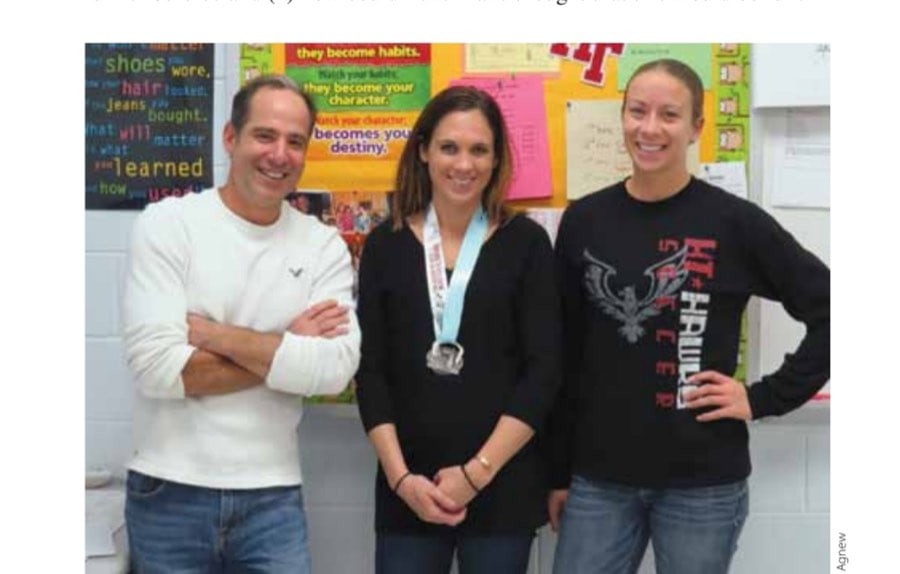
As teaching peers and runners with the same break schedules, it was inevitable we would end up, from time to time, training together. The third wheel in our running group was Joni. Joni is two years older than Aileen and a former high school track star. Now the high school girls’ cross-country and track coach, Joni and I had trained together two Philly Marathons ago. Joni is an exceptional runner who, while I was promising to pace Aileen, was plotting how she would qualify for Boston. “
I hear you’re training Aileen for Philly,” Joni said as she caught me in the hall the next day. “Yeah,” I said. “She wants me to pace her.” “Oh. I was hoping you’d train me to qualify for Boston.” “No problem. We can all train together. It’ll be fun.”
There were several things that should have been obvious
© Brian Agnew
Now, two things should have occurred to me at this point: (1) how could I train two people to run two drastically different marathons, having never coached a runner before? and (2) how could I ever have thought that this would be fun?
▲ Mike, Joni (center), and Aileen are all sixth-grade teachers and coaches in Haddon Township, New Jersey.
Ignorance being bliss, rather than think, I simply got to work drawing up, printing out, and copying 10-week training schedules. We would work as a well-oiled machine and stick to the daily schedule. On weekdays we would run on our own most days, together when we could, and on the long weekend runs we would make every effort to train together. These were exciting days. Texting about the runs we completed and the long runs to come made me feel capable and important. Any question they asked, I had an answer. I was so sure that I knew what I was talking about that I dispensed information as if I was Stephen Hawking and Aileen and Joni were elementary schoolchildren asking if the sun was a star.
One of them: “My shins hurt.” Me: “That’s normal. It’s just your body adjusting.” One of them: “Is it OK if I only eat toast before our long runs?” Me: “You might want to add in a piece of fruit or a granola bar.”
One of them: “Should I replace my sneakers a few weeks before the race?” Me: “God no, that’s a waste of money. Your shoes are fine.” Even I was impressed with how easily I gave out definitive information. In fairness to them, having never been a pacer/trainer before, I may not have had a complete appreciation for my responsibility. In retrospect, had I been thinking logically, I might have realized it requires sufficient credentials to flippantly tell another person how to safely take on a demanding exercise program. Hawking, when he explains the intricacies of the universe, at least has a PhD. I’m not sure that completing a few marathons and reading some books and a few articles on running makes me an expert, but of course, that doesn’t stop me. I’d assigned myself the job of marathon coach, and besides, my price was right—I was working for free.
We started smoothly and at week 5 we met for a long Saturday morning run along the river. There’s a sculling course on the Cooper River, just over the Ben Franklin Bridge in Pennsauken, that all serious college crew teams get to at one time or another during their rowing careers. It is also a haven for runners and bikers. On a typical Saturday morning, you can capture in one line of vision hardworking Ryan Hall wannabes, a long line of Lance Armstrongs, and the UCLA Division I rowing team.
On this particular Saturday, I have planned what I tell the girls will be an “epic” training run. It is a two-and-one-half-hour run along the Cooper, through Camden, across the Ben Franklin Bridge, and into Philadelphia. I’m so excited about this run that I fail to realize that, as great as it may sound, a majority of it will be along the Admiral Wilson Boulevard. This horrible road is a major four-lane highway with a cement center barrier where there is constant high-speed traffic and no sidewalks. Joni had bought in but Aileen, who is more of a green-trails and chipmunk-spotting type, was not pleased. “
You do realize we’ll be running on the highway?” Aileen asked.
“No problem; it will be worth it once we get to the bridge,” I answered. “Sounds good,” Joni added, which, of course, fueled my resolve. “I don’t think there are any sidewalks for a few miles . . . ?” Aileen persisted, adding, “but whatever” to punctuate her point. “Epic! You’ll be thanking me in a few hours,” I said in a hyper, high-pitched voice. I can be such an extreme ass.
The steeplechase as cross-training Sometime after we skittered past the oil-slicked gas station entrance and precariously straddled not one but two major road dividers (at one point having to literally turn sideways to keep from being killed), it hit me that maybe an “epic” run from the Cooper River to Philly wasn’t the best idea. In fact, a normal person, confronted with the reality of the actual circumstances, would have said, You know what? I was wrong. We should turn back and run our familiar course. On the other hand, I was the one in charge, and this was only week 5 of training, so how would it look if I admitted I had no clue what I was doing? “This is awesome! Wait till we get to the bridge! Stay tight and in a straight line in case an 18-wheeler comes by.”
Runners who train seriously for marathons make a commitment to a long-range goal. A large part of the accomplishment is the months of training that lead up to the event. When we finally made our way over the bridge and into Philadelphia, I felt vindicated. Passing by Independence Hall and reflecting on the trials and tribulations that our forefathers overcame in order to all be present to sign the Declaration of Independence made our little dodging-21st-century-traffic run seem pedestrian. As patriotic as I was feeling, I kept it to myself. We still had to return the way we came, and any of us getting hit by a car (on the way over or the way back) would not be good. Now that I thought about it, Jefferson and Adams probably weren’t worried about getting sideswiped by a Lexus.
Safely back at the river, I checked the time only to learn we still had 30 minutes of running to get in. I knew a local high school track bordered the river and decided to take our group onto the track and add in a measured mile or two. Aileen, who had been fighting off knee pain, began to falter on the track. Joni realized we were now on the track and decided to pick up the pace.
There is an unspoken etiquette to group marathon training. You all work together. Prior to this moment, the three of us had paced together for all our group runs. Now, because I put us on a track two hours into a run, I had one runner (Aileen) who was training to complete her first marathon running a nine-minute pace and another runner (Joni) whose goal was to qualify for Boston by running a seven-minute pace—which left, the presumptuous, unqualified, self-appointed coach (me) to sort things out. I fell back and ran with Aileen while Joni continued to push ahead. I listened to Aileen and emphatically gave her advice: “You’re
doing great. It’s all part of the process, blah, blah, blah.” I was faking it, and she knew it. We both were thinking the same thing: Who the hell does Joni think she is? To our minds she was showing us up. Had she said, “Hey, guys, mind if I go ahead?” then, yeah, sure, we would have been sort-of-OK with that. But this was just sprinting away from the group, if you can call three people a group. We left the track and began the last two miles to where our cars were parked. I looked at Aileen and knew she could make it back on her own from here. Joni was fading from view. “I’m going to catch up to Joni,” I said. “
That’s fine,” she said, but might have added: “Hurt her ass,” as I started to hunt Joni down.
When reality sets in Unless you have experienced the empty feeling of not being able to keep up with another runner when you are trying to, it is impossible to identify with why runners are neurotic about who they train with. It hurts to admit someone is faster. It also hurts to try to keep up with someone you think you can stay with. Good training partners make you better by comfortably running with you and also by pushing you. Lousy training partners make you worse by humiliating you. Joni and Aileen are both excellent training partners. They both love to run and both love to be pushed. I was the stupid coach who put them both in a no-win situation. Of course Joni would want to pick it up on the track, and of course Aileen would suffer on long runs. I couldn’t, however, excuse Joni completely. She should have asked. “
You coming or what?” I run with her stride for stride and, with a mile to go, I was picking up the pace on her. “I’m trying.” “Well, try harder,” I said. “I can’t go that fast,” Joni said. “Sure you can.”
As we finished, I forced her to sprint and felt that I had at least made her hurt some. Like I said, she is really good. We walked around a bit, and when we looked back, coming around the bend was Aileen. She ran right past us. “
Where are you going?” “You guys have been finished for six minutes. That means I have six minutes to run.” Whatever she was saying didn’t make sense, but she was making a point. It was epic all right. It was the moment I realized, with a month until the race, that I had no clue.
Two weeks passed and we were scheduled for our last important long run. This one would be a 3 1/2-hour killer. We would return to the Cooper River but this time, rather than leave it, we would run its 3.8-mile loop six times. More than 22
miles in 3 1/2 hours seemed to me the perfect plan for all of us. Aileen’s goal was to complete her first marathon in less than four hours. Joni would need to finish under 3:40 to qualify for Boston. This run, exactly two weeks before the race, would set us up for success. It was precisely the right run for the right date, and we all worked it out to meet at 6:00 a.m. so we could be back at our respective homes by 10:00 a.m. What I didn’t account for was the weather. “
They’re calling for heavy rain and wind starting at 4:00 a.m. and going all day.” “They’re always wrong; it won’t be that bad,” I said. I’m not sure where this inability to listen to anyone comes from, but I’m beginning to appreciate why I frustrate friends. “
Maybe we should do it later in the week.” “No way. That’ll screw up everything. We’ll layer up. It will be fine. Trust me.” It’s amazing to me how they forgot the “epic” run. I’m pretty sure that by now they knew I’d been bluffing my way through the last eight weeks. The thing about teachers in general is our inherent, uncompromising belief in everyone.
I was the first one to arrive at our meeting spot. To illustrate the severity of the storm, even though I live one block from the meeting spot, I drove my car. Sitting there, I was certain that a text was coming from either one or both saying that, even if I wouldn’t, they would demonstrate maturity and common sense and
ad
reschedule this run. Surely, two people could overturn this bad decision. Anticipating a mutiny and eager to return to my dry house, I was more than surprised when first Joni’s and then Aileen’s car cut through the sideways rain and parked in the lot. Well, I guess we’re doing this, I thought, and ironically organized the water bottles in the back seat before getting out of my car to join them.
When the going gets tough . . . It would not surprise me to read about people running through monsoons and tsunami conditions. But those things tend to present themselves to innocent, unsuspecting victims. Our ridiculous 22-plus mile, six-loop training run on Saturday, November 6, 2010, was completely voluntary. I can tell you definitively that no one else in that highly populated section of southern New Jersey was out that day. Yep, only we were that dumb. As lap four finished and I realized we still had two laps to go, I looked at Aileen and thought to myself that I owed her an apology. She was sheet white, cold, and the wind was blowing hard rain directly in her face. I knew right then that she was already doing something way harder than the marathon, but before I could say anything to her she said to me, “Tell me a story, Mike. Get me through this lap with one of your stories.”
It goes without saying that I talked for a half hour and got her through lap five. I was glad to do it. For a lot of weeks I had been pretending to know a lot of stuff about something I knew very little about. I was faking my way. All along my heart was always in the right place, and maybe this was a strange twist of fate. Since talking was my strength, and it was what she needed, I was more than happy to do it. As the story ended and we were through lap five, Joni said she was going to push. Aileen and I smiled as much as we could and watched her go.
A few days later I ran into a real running coach and told him about our runs and our goals for the upcoming marathon. I was sure he would have me arrested for taking the girls out in the storm. “Best thing you could have done,” he said. “A marathon is about the unexpected and knowing how to handle it. Doubt race day can be worse than that.”
It was a backward way to get there, I thought, but maybe he was right. “Those girls are going to kill it,” he said. “Let me know how you guys make out.” When race day arrived, I was selfishly feeling sorry for myself. Over the past 10 weeks, in an effort to train for the two races, I had somehow managed to get myself into surprisingly good condition, so good that I was thinking that maybe I should scrap pacing Aileen and go for a PR. To make matters worse, I was dead certain that Joni was going to crush 3:40 and maybe even pull in a 3:20. A few years ago I had qualified and had run Boston. Now, a few years older, my qualifying time was up to 3:30. The way I felt, I knew I could get that time easy,
and having listened to Joni talking about Boston, I was thinking I wanted to go back and do it again. The sticking point was my promise to Aileen. She expected me to pace her, and she was counting on it. This is why I’m a bad trainer. When it comes down to it, I can’t get past myself.
The closer the race came, the less I was interested in being a good person. Aileen was ready and was going to finish. Joni was ready and was going to qualify. The problem was that although I was sure of these things, they were not. Joni had been nervously asking me for days if I thought she had a chance, and Aileen was more nervous (having never run the distance before) that she would even finish, let alone break four hours.
Maturity for me is selective. If my wife or children need me, I know I can act my age. I’d like to think I have life’s priorities in order, and when it’s important, I will make the best decision rather than the rash one. I’d made a promise to a friend, and she had more than lived up to her end of the deal. She had trained for 10 weeks, run through pain that I had no right to tell her to run through, and endured dozens of bad ideas for long training runs. I wish the traffic and the storm were the only ones that I called wrong. It was not just the pacing that was important now. It was seeing through a promise. As much as I wanted to be a selfish child and have my way, I realized my promise as a friend was more important. Maturity can also clear a person’s head and give focus.
Moments before the race, I was calmer than I had ever been before a marathon. I would pace Aileen. As the crowd thickened and the starting gun fired, I was excited about her meeting her goal. Unlike the last long training run, event day was perfect running weather: no wind and in the high 40s. I explained to Aileen that we would run an even pace with a target time of 3:50. Shooting for 10 minutes faster than goal, I hoped, would enable us to bank time if she hit any problem late in the race. Joni was given similar instructions. Joni would shoot for a 3:30 finish, and if she struggled near the end, she would also have a 10-minute cushion to make Boston.
The easy early going Ten miles into the race, I was feeling pretty good about everything. I could only assume that, miles ahead of us, Joni was on track. Aileen was hanging in and running well. Over the earlier miles, the only two things to note were my spotting some running friends that I insisted we run with for a half mile until Aileen reminded me I was pacing her, not running with them (oops!), and every three miles or so spotting one of Aileen’s brothers who, upon seeing us, would scream her name over and over (corny but adorable). We were right on 3:50, even a bit under. I was even thinking that if we held this to mile 22 we could push the pace a notch and shock the world with something sub-3:40 and both girls would qualify
for Boston. It was around mile 16 or 17 when I realized that dream had no shot. Aileen was losing her form and her confidence. Pain was creeping in, and as much as she was trying to stay even with my pace, I could feel her tugging me back.
In the Philly Marathon, miles 17 and 18 head into Manayunk and miles 19 and 20 head out. In other words, you get to see who is ahead of you and they get to see you. I thought it was critical to keep Aileen at the 3:50 pace at least until mile 20. A full 10 minutes extra time to use over the last six miles would be great to have, and psychologically, knowing she could throw in a few 10-minute miles and still break four hours couldn’t hurt. As I was doing the mental calculation, Aileen casually announced a Joni sighting. Sure enough, heading out as we were heading in, Joni was bunched in with the crowd running the 3:30 pace. Awesome! She was nailing it. She had less than six miles to go and 10 minutes banked. Who said I couldn’t coach?
The first time I ran a marathon, I was in a ton of pain from mile 20 on. It was also cold that day, and I felt like my fingers were going to snap and break off. No one had explained to me (not that I would have listened) about gel packs or nutritional aids, and my body rebelled. If I’d known then what “bonked” meant, I would have been the poster child for bonking. Unlike Aileen, when I ran my first marathon I had no real help, and somehow I made it to the end. OK, I walked some, and I was closer to five hours than I was to four, but that doesn’t change my point. My point is she had no excuses, and no matter how much pain she was in, the sympathy and any permission to pack it in and walk was not going to be coming from me. Anyone who has had a puppy or has seen a cat with big sad eyes knows what a pathetic please-let-me-have-my-way look looks like. My sense was that by mile 23, that’s the tactic Aileen would be considering. “
Don’t you dare walk!” “It really hurts, Mike.” “It comes in waves. It will go away. Think about something else.” “Just a few steps. You don’t understand.” “You’ll stiffen up and never get it back.”
I hear nothing It was time to tune her out and force her to keep at it. If she had said Pleeeaseeee, I still wasn’t going to let her walk. The honest truth is she is much tougher than I am now and much tougher than I was during my first marathon. She slowed, she slowed a lot, but quitting was not part of her makeup. Somehow, as we approached mile 25, she was back and running a steady pace and realizing she was going to make her goal. Aileen is a nice person, and as is the case with many nice people, she comes from a nice family. Just after the 25-mile sign, on the left side of the road behind
Courtesy of Aileen Fallon
▲
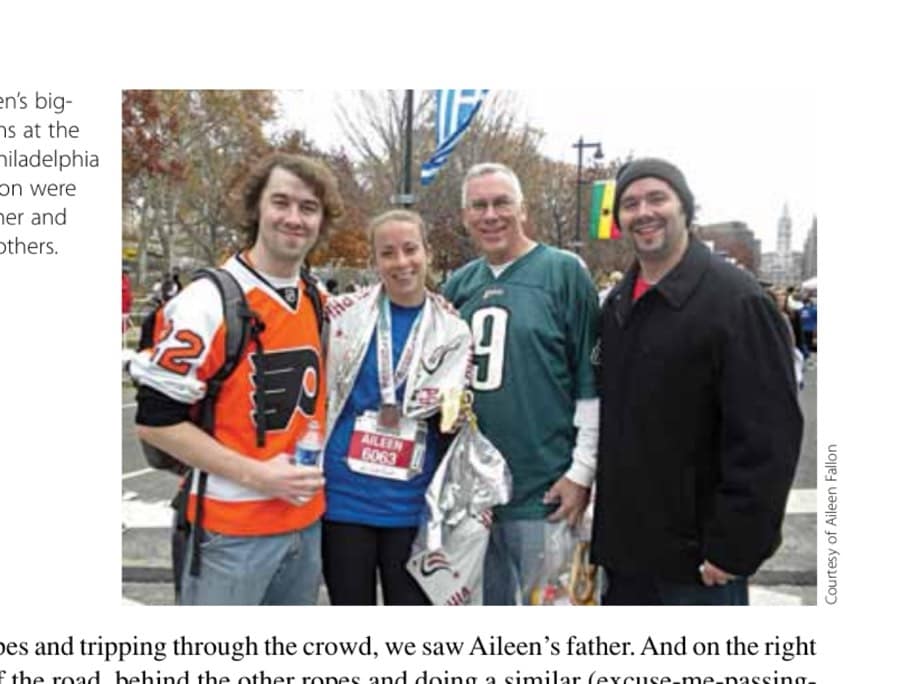
Aileen’s biggest fans at the 2010 Philadelphia Marathon were her father and two brothers.
the ropes and tripping through the crowd, we saw Aileen’s father. And on the right side of the road, behind the other ropes and doing a similar (excuse-me-passingby-didn’t-mean-to-bump-into-you dance) was her brother. Yes, they were going to run us in the last mile. It didn’t seem to matter to them that 30,000 other runners were in this race and a few of them had friends and family. Aileen was their hero and, damn it, they were going to provide a last-mile escort. She now had three pacers and it was pretty touching and pretty cool. With a few hundred yards to go she turned to me and said, “Is that the finish line?” Before I could say whether it was, we were in full sprint and crossing.
Aileen’s official time (and mine) was 3:58, better than a half hour faster than my first. For the record, Joni qualified for Boston and had time in the bank. She couldn’t be happier, and I hear about it every day. As for the pacer, I’m pleased that I did it and will never do it again. I got lucky. They both made their times and neither one got physically hurt. I would never trade the experience of that day. I don’t care who you are; completing your first marathon is an incredible and noteworthy achievement. My involvement helping and pacing Aileen was priceless, but here’s what I should have thought about: (1) I’m still learning how to do these things myself, (2) training and pacing for a marathon or an ultramarathon should be left to experts who know exactly what they’re doing, and (3) I could have easily done more harm than good.
So to all you so-called experts (the ones with the drawers full of race T-shirts and the subscriptions to six running magazines), if some good friends say, “If you train me . . .” or “If you pace me . . .” heed this advice: smile nicely and send them to the local running store to find a real expert. And don’t forget to say, “Meet you at the race.”
This article originally appeared in Marathon & Beyond, Vol. 19, No. 1 (2015).
← Browse the full M&B ArchiveMore like this
1,000+ stories from 19 years of Marathon & Beyond
The complete archive of the legendary long-distance journal — digitized and free to read.
