

Editor’s note: On November 15, 2002, the 1936 gold medal winner in the marathon at the Berlin Olympics died at the age of 90 in Korea. Kitei Son won the marathon wearing the uniform of Japan—and sporting a Japanese name. He was not, however, Japanese. He was a Korean named Sohn Kee-chung [sometimes listed as Kee Chung Sohn]. In the wake of the Russo-Japanese War, Japan made Korea its protectorate and annexed it in 1910. Koreans who wanted independence were brutally treated by the Japanese, but a government-in-exile formed in 1919 and led by Syngman Rhee kept the spirit of independence alive. Sohn had set a world record of 2:26:42 in 1935. His fellow Korean Nam Sung-yong was also forced to run for Japan using the name Shoryu Nan; Nam Sung-yong placed third at Berlin. Dr. Karl Lennartz, one of the world’s foremost students of the marathon, put together the following overview of Sohn Kee-chung and his impact on the world of marathoning.
In the early 1930s, the world’s top marathon runners had already achieved times under 2:35:00. While performances stagnated in the United States, Great Britain, and above all in Europe, a big boost in performance was recorded in Japan. During the championships in Tokyo on November 3, 1933, Kozo Kusunoki finished in 2:31:10, thus improving the Japanese national record and setting the second-best time of the year in the world. Other Japanese participants in that race were also fast enough to make the top 10 list that year:
2. Kozo Kusunoki, 2:31:10 3. Shoryu Nan, 2:32:33 4. Tamao Shiaku, 2:32:44 8. Tanji Yahagi, 2:37:11 Heading the world list at the time was Leslie Pawson of the United States with a 2:31:01. In the following year, this improvement among Japanese marathoners continued.
November 18, 1934, Tokyo: 4. Yasuo Ikenaka, 2:34:30 November 23, 1934, in Osaka: 3. Tamao Shiaku, 2:32:56 5. Shigenobu Arai, 2:35:14 6. Shinichi Nakamura, 2:35:19 9. Kozo Kusunoki, 2:36:07 The top-ranked runners in the world in 1934 were Patrick Dengis of the United States in 2:31:30 and David Komonen of Canada with a 2:32:58. The world definitely took notice on March 21, 1935, when Kitei Son ran 2:26:14 in Tokyo. The time was so outstanding that there were questions regarding the length of the course. It was assumed the course was short. Kitei Son (known as Sohn Kee-chung in his native Korea) had run some outstanding times previously on courses a bit shorter than the marathon distance. In his first “marathon” in Seoul on October 10, 1933, he had run 2:29:34, and on April 22, 1934, he had run 2:24:51, followed by a 2:32:19 on October 8.
Kitei Son’s apparent smashing of the world record on a full marathon course seemed to unleash a surge in outstanding performances. One of those performances was turned in by 22-year-old Fusashige Suzuki 10 days after he had placed second to Son in Tokyo; he ran 2:27:49 on March 31, 1935, again in Tokyo.
Only three days later, on April 3, 1935, Suzuki and Son competed anew in Tokyo. But the winner this time was Yasuo Ikenaka, who, for his part, improved the world record by finishing in 2:26:44. The times of Suzuki (who took second with a 2:33:05) and Son (who took third with 2:39:24 and who was leading at the halfway point) were still remarkable.
On the very same day, another marathon took place in Tokyo, with these results: 1. Tamao Shiaku, 2:31:45 2. Kozo Kusunoki, 2:32:05 3. Shinichi Nakamura, 2:33:52 On June 5, 1935, Kenichi Sagara finished a marathon in 2:34:37 in Tokyo.
FAST TIMES IN KOREA Following these incredibly consistent times, Kitei Son returned to Korea and ran in a series of shorter-distance “marathons” in which he ran 2:24:28 (May
18, 1935), 2:42:02 (in a full marathon on September 29, 1935), and 2:33:39 (for second place on October 9, 1935). He soon after returned to Tokyo, this time to compete in the national championships of Japan. In spite of suffering a side stitch during the early kilometers of the race, he finished in 2:26:42, thus setting a new world record. A good four minutes later, Tamao Shiwaku and Shinichi Nakamura crossed the line together after a sprint finish. Thus:
1. Kitei Son, 2:26:42 2. Tamao Shiaku, 2:31:21 3. Shinichi Nakamura, 2:31:21 4. Shoryu Nan, 2:36:52 On November 23, the 2:30 mark was beaten for the fourth time: 1. Shinichi Nakamura, 2:29:55 2. Kozo Kusunoki, 2:34:05
3. Nobaru Hikoe, 2:34:45 The top 10 list for 1935 was almost completely in Japanese hands, as they took the first seven spots as well as the 10th spot. Americans John A. Kelley (eighth in 2:32:07) and Patrick Dengis (ninth in 2:34:11) were able to squeeze in.
The Japanese continued to run well in 1936. On March 15, 1936, Tamao Shiaku finished in 2:26:53 in Sakaide on a probably shorter distance. Yasuo Ikenaka finished in 2:33:56 on March 29 in Tokyo. On April 18 in Tokyo, the top three were:
1. Kitei Son, 2:28:32 2. Shinichi Nakamura, 2:32:48 3. Fusashige Suzuki, 2:37:01 The deciding qualification marathon for the Olympic team from Japan took place on May 21 in very bad weather for a marathon. It was a surprise to see Shoryu Nan win the competition, as he had gone into the race with a best time of 2:32:33, dating back to 1933. The results:
1. Shoryu Nan, 2:36:03 2. Kitei Son, 2:38:02 3. Fusashige Suzuki, 2:39:41 4. Tamao Shiaku, 2:40:50
Yasuo Ikenaka and Shinichi Nakamura, who had both beaten the 2:30 mark in 1935, dropped out of the race and therefore had to stay home. The top four Japanese finishers—though Nan (sometimes listed as Nam) and Son, of course, were Korean—were picked to travel to Berlin for the 1936 Games. But once in Berlin, it would be the decision of the coaches which runners would actually line up on the starting line.
THE ISLAND OF MARATHONERS In 1937, the track and field journalist Arthur Grix visited Japan. While there, he visited the village of Sakaide on the island of Shikoku, where marathoner Tamao Shiaku had finished a race slightly shorter than the marathon in 2:26:53 on March 15, 1936. The primary occupation of the island was producing sea salt. To do this, sea water was let onto the land, where the sun dried it in wide fields. Once enough water had evaporated and left a sufficient depth of salt behind, men would rip open the salt crust by running up and down the field all day pulling long rakes, very much like draft animals. Kanematsu Yamada, who placed fourth in the marathon in the 1928 Amsterdam Olympic Games, and his disciple Tamao Shiaku both earned their living performing this daunting job, much like fellow marathoners Shinichi Nakamura, Toshio Kawaguchi, and Isushima, who ran a 2:34:16 in 1936. In all, some 150 Japanese marathoners supposedly lived in this village, running several kilometers beyond a marathon around the fields after work.
Shortly before the Berlin Olympic Games, the world marathon ranking showed a clear Japanese superiority in the distance (* behind a name indicates a runner who participated in the 1936 Berlin Olympic Marathon):
1. Kitei Son,* JPN, 03NOV35, Tokyo, 2:26:42 2. Yasuo Ikenaka,* JPN, 03APR35, Tokyo, 2:26:44 3. Fusashige Suzuki,* JPN, 31MAR35, Tokyo, 2:27:49 Kitei Son, JPN, 18APR36, Tokyo, 2:28:32 4. Shinichi Nakamura,* JPN, 23NOV35, Osaka, 2:29:55
5. Tamao Shiaku,* JPN, 03NOV35, Tokyo, 2:31:21 Shinichi Nakamura, JPN, 03NOV35, Tokyo, 2:31:21 6. Choshun Ryu*, JPN, 18OCT35, Seoul, 2:31:27 7. Johannes Coleman,* SAF, 11APR36, P. Elizabeth, 2:31:57 8. Kozo Kusunoki,* JPN, 03APR35, Tokyo, 2:32:05
9. John Kelley,* USA, 19APR35, Boston, 2:32:07 10. Henry Gibson,* SAF, 11APR36, P. Elizabeth, 2:32:09 Shinichi Nakamura, JPN, 18APR36, Tokyo, 2:32:48
Fusashige Suzuki, JPN, 03APR35, Tokyo, 2:33:05 Kitei Son, JPN, 09OCT35, Seoul, 2:33:39 11. Ellison “Tarzan” Brown*, USA, 19APR36, Boston, 2:33:40 Yasuo Ikenaka, JPN, 29MAR36, Tokyo, 2:33:56 Kozo Kusunoki, JPN, 23NOV35, Osaka, 2:34:05 12. Patrick Dengis,* USA, 19APR35, Boston, 2:34:37 13. Kenichi Sagara,* JPN, 05MAY35, Tokyo, 2:34:37 14. Duncan McNab Robertson,* GBR, 11JUL36, London, 2:35:02 15. Ernst Harper,* GBR, 11JUL36, London, 2:35:03
Courtesy of Dr. Karl Lennartz
16. Bert Norris,* GBR, 13JUN36, London, 2:35:20
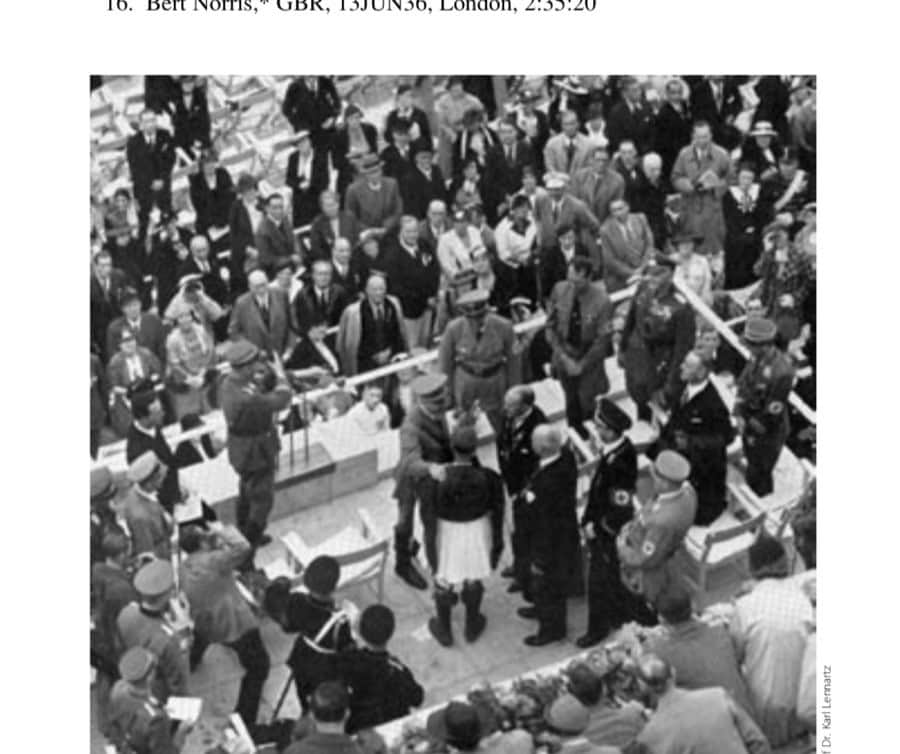
▲ Spiridon Louis presents Hitler with an olive branch during the opening ceremonies of the 1936 Olympics.
17. William McMahon,* USA, 19APR36, Boston, 2:35:27 18. Melvin Porter,* USA, 10APR36, Boston, 2:35:48 19. Shoryu Nan,* JPN, 21MAY36, Tokyo, 2:36:03
THE BERLIN MARATHON ROUTE AND CONDITIONS Similar to previous marathons held in Berlin, the 1936 Olympic marathon course led from the German stadium through the Grünewald and back. The route was almost identical to the German marathon championships held in 1931, when Paul de Bruyn won in 2:47:19. Looking back at the course from today’s standards, the course was far from ideal.
The course featured some short stretches on potentially ankle-twisting cobblestone, as well as segments on the Avus Betonstrasse paved with tarmac and macadam/tar, while most of the course was on hard-packed sand lanes.1 The first 10K and the last 10K led along the winding Havelchaussee through the forest and alongside the river Havel, but there were challenging hilly sections between kilometers five and seven and 32 to 35 on the return trip. There was also a dreadfully straight section of course on the Avus from kilometers 13 to 21.
There were also challenges to be had from the turnaround point to the 30K mark. This is how it was described by the German organizing committee: “At the Rupenhorn, where the many sailing boats lie, the road leads uphill a bit: we have reached Schildhorn. A short, rough ascent and the gravel road leads into the forest, where a long and strenuous ascent at kilometer seven leads up to the Kaiser-Wilhelm-Tower, the highest point in the Grünewald. Down it goes again on the other side and the road turns towards the right, where it meets the Havel. On the right the beach and on the left wooded hills, this is how the runner passes by the 10-kilometer mark. Then a small ravine, which leads the road away from the Havel into the forest, and a long ascent is to be mastered again. Once again a shady road, whose high trees even defy the powerful sun during the early afternoon. And then the end of the so-called Havelcourse is reached . . . “
The marathon runners turn left at the end of the Havelstrecke until they reach gate #13 of the Avus, the big motor racing circuit. Here the athletes await their biggest challenge yet! Nine kilometers on a dead straight like a shiny runway, opens the door for the tactical runner.”2
The course was cordoned off or, as the police and volunteers referred to it, “hermetically” sealed off. The volunteers spread out alongside the course, one every 100 meters. Many doctors and paramedics were standing by and also telephone booths were put up. The entire 42 kilometers were sign-posted and 15 control points and food supply-points were erected. A million spectators were supposed to have stood alongside the course during the race.
It was dry and sunny on August 9, 1936—the “Marathon Sunday,” as it was called. There was hardly any wind blowing. Between 3:00 P.M. and 6:00 P.M., the temperatures varied between 21 and 22.3 degrees Celsius (70-72 F). According to the program, 59 athletes from 28 countries had entered the competition, but at the start of the race at 3:00 P.M., only 56 athletes from 27 countries lined up.
THE PROGRESS OF THE RACE
Courtesy of Dr. Karl Lennartz
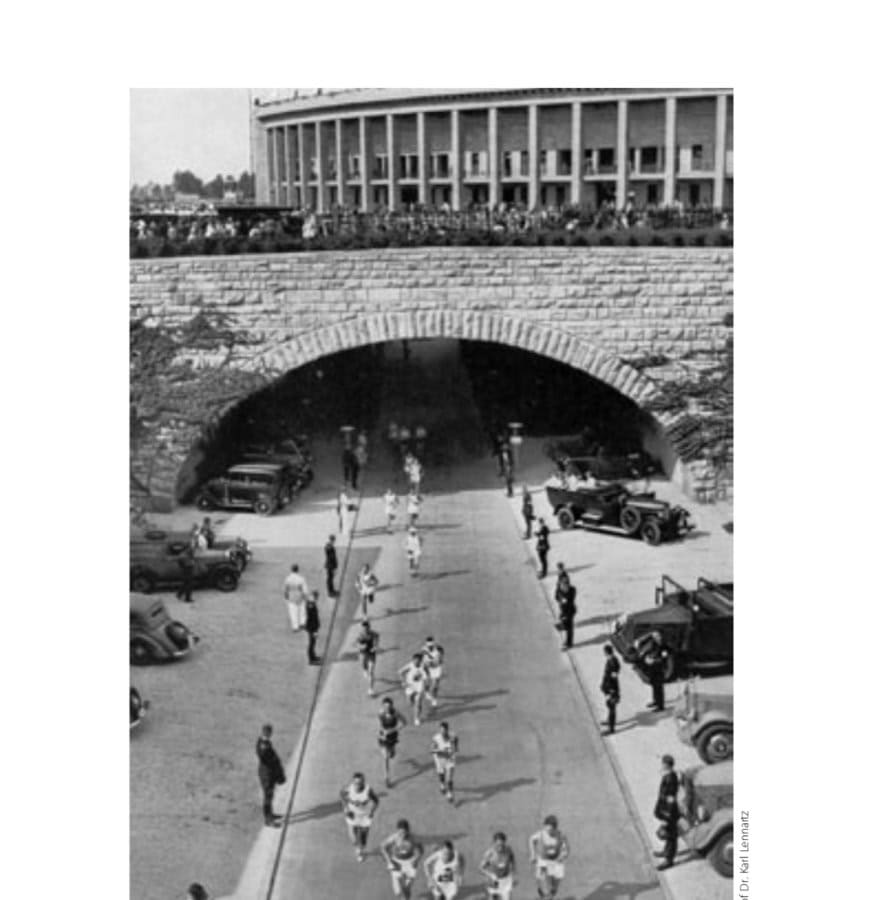
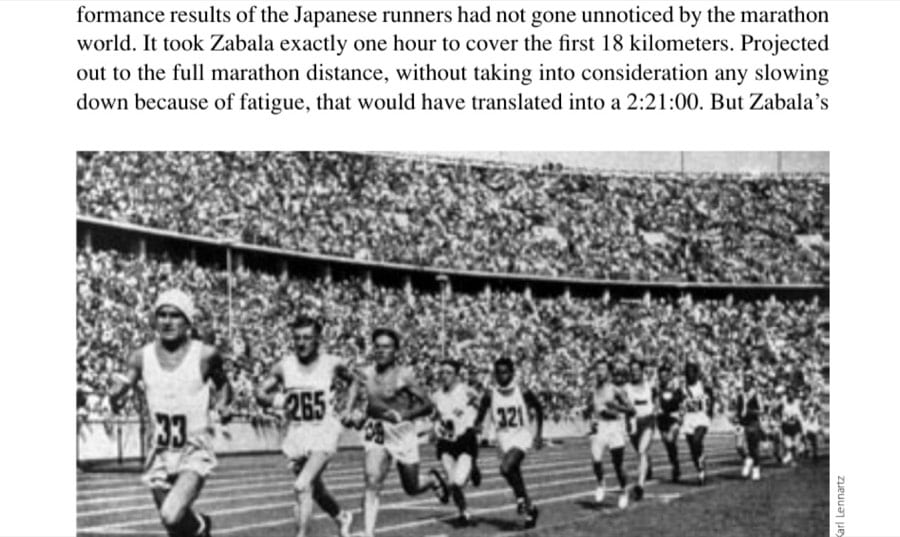
Immediately after the start of the race the titleholder, Juan Carlos Zabala,3 shot to the front of the pack and consequently increased his lead regularly, running kilometers between 3:15 and 3:20. The distance between Zabala and the second-place runner, Manuel Diaz4 of Portugal, increased to two minutes. Diaz had made a mistake by running in new shoes. At 20 kilometers, he had to stop to put on different shoes, which he borrowed from a “Hitler-boy” who was a spectator. As a result of his shoe-wear mistake, Diaz finished 17th in 2:49:00. Was Zabala that confident of his victory or was it for fear of the Japanese runners that he wanted to put some time in the bank? Certainly, the recent performance results of the Japanese runners had not gone unnoticed by the marathon world. It took Zabala exactly one hour to cover the first 18 kilometers. Projected out to the full marathon distance, without taking into consideration any slowing down because of fatigue, that would have translated into a 2:21:00. But Zabala’s
▲ Juan Carlos Zabala takes the early lead in the race.
Courtesy of Dr. Karl Lennartz
▲ The marathoners just outside the Olympic stadium.
pace was already slowing at that stage of the race. His consistent 3:15-3:20 kilometers had slipped to 3:35s, and by the time he reached the halfway point, they had slipped even further, to 3:45s. In the meantime, Kitei Son and Ernest Harper5 of Great Britain, neither of whom had gone all out at the start, were consistently closing the gap between themselves and Zabala. They were averaging 3:30 per kilometer, and it was quite obvious at that point that Zabala had already lost. Shortly after the 28K mark, the two runners overtook the 1932 Olympic champion. As they did, he collapsed,
Courtesy of Dr. Karl Lennartz Courtesy of Dr. Karl Lennartz
disappointed, but pulled himself together again, only to drop out of the race a few kilometers down the road, simply too exhausted to continue. After the Games, it was reported in the press that Zabala had been suffering from an inflamed jawbone.
Once they had passed Zabala, Son was able to break away a few meters from Harper, between 28 and 31 kilometers. During the last fifth of the race, he was able to increase his lead to more than two minutes.
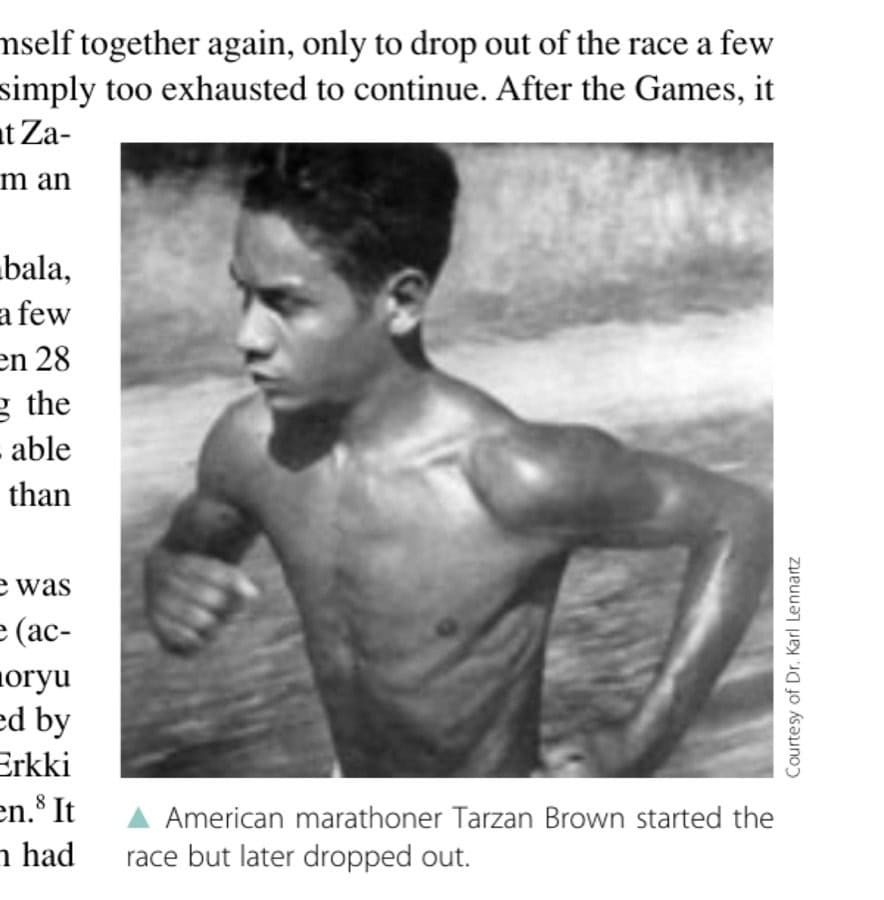
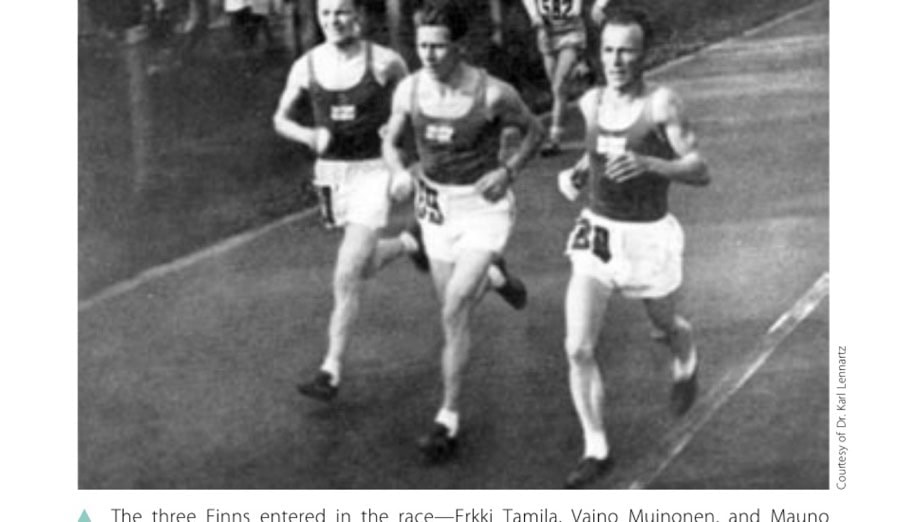
The battle for third place was won by the second Japanese (actually, Korean) runner, Shoryu Nan,6 who was being chased by the two Finnish runners, Erkki Tamila7 and Vaino Muinonen.8 It ▲ American marathoner Tarzan Brown started the was reported later that Nan had race but later dropped out.
▲ The three Finns entered in the race—Erkki Tamila, Vaino Muinonen, and Mauno Tarkiainen—work together in the early miles.
to run in this group to give Son the necessary backup support he needed. In any case, the Finns would not have been able to come anywhere near Son’s time.
THE ANNOUNCER’S WORDS
Courtesy of Dr. Karl Lennartz
Let us now listen to an authentic transcript of the announcer at the stadium finish: “The Olympic Stadium is already close by. From the pinnacle of the marathon tower a flourish of trumpets is to be heard. The Olympic signal announces the arrival of the first runner. Only seconds later a thin, tanned athlete, wearing white
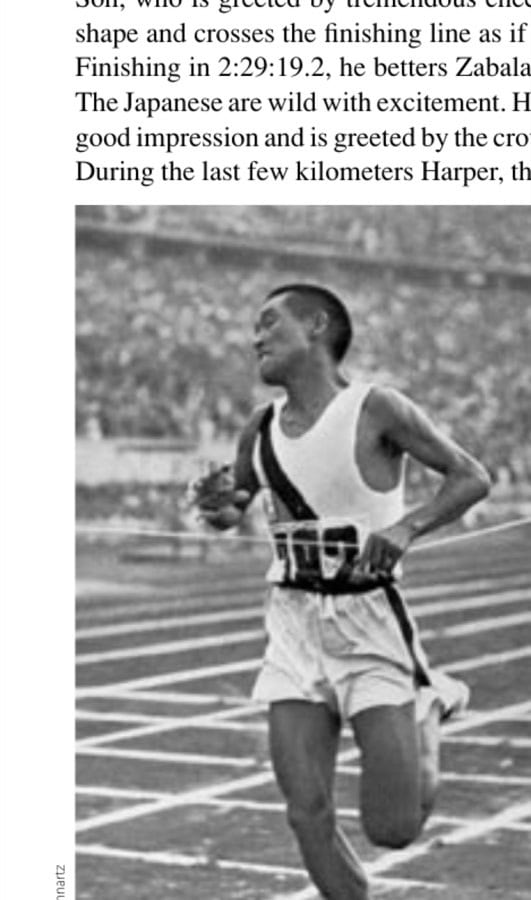
clothes with a red Japanese sun on the chest, crosses the marathon gate. Kitei Son, who is greeted by tremendous cheers, runs the last 200 meters in brilliant shape and crosses the finishing line as if he had only run one lap in the stadium.
Finishing in 2:29:19.2, he betters Zabala’s existing record by over two minutes. The Japanese are wild with excitement. Harper, who finishes second, also makes a good impression and is greeted by the crowd in the same manner Son was greeted.
During the last few kilometers Harper, though, had to battle with Nan for second place, who himself had become stronger and stronger as the race progressed. Nan finished in third place to the great excitement of
his fellow countrymen. The following runners were the Finns Tamila and Muinonen, followed by the South African Coleman and in seventh position the English athlete Robertson, who had put on the pace in the closing
stages of the race.”9 The two German athletes, Paul de Bruyn10 and Franz Barsicke11 (muscle injury), dropped out of the race. The only German runner to cross the finishing line was Eduard Braesicke.12 It took him just under three hours. ▲
Sohn breaks the tape in Olympic record time, 2:29:19, to become the first reigning world record holder in the distance to win an olympic marathon.
THE RESULTS13 Following are the results of the marathon run: 1. Kitei Son (JPN) 2:29:20 2. Ernest Harper (GBR) 2:31:24 3. Shoryu Nan (JPN) 2:31:42 4. Erkki Tamila (FIN) 2:32:45 5. Vaino Muinonen (FIN) 2:33:46
6. Johannes Coleman (SOA) 2:36:17 7. Duncan McNab Robertson (GBR) 2:37:06 8. Henry Gibson (SOA) 2:38:04 9. Mauno Tarkiainen (FIN) 2:39:33 10. Thore Enochsson (SWE) 2:43:12 11. Stylianos Kyriakides (GRE) 2:43:21
12. Nouba Khaled (FRA) 2:45:34 13. Henry Palme (SWE) 2:46:09 14. Franz Tuschek (AUT) 2:46:29 15. James Bartlett (CAN) 2:48:22 16. Francois Duval (FRA) 2:48:40 17. Manuel Dias (POR) 2:49:00 18. John A. Kelley (USA) 2:49:33
19. Miroslav Lunak (CZE) 2:50:26 20. Felix Meskens (BEL) 2:51:19 21. Jan Takac (CZE) 2:51:20 22. Rudolf Wöber (AUT) 2:51:28 23. Ludovic Gall (ROM) 2:55:02 24. Robert Nevens (BEL) 2:55:51 25. Anders Hartington-Andersen (DEN) 2:56:31
26. Gabriel Mendoza (PER) 2:57:18 27. Tommy Lalande (SOA) 2:57:20 28. Arturs Motmillers (LET) 2:58:02 29. Eduard Braesicke (GER) 2:59:34 30. Percival Wyer (CAN) 3:00:11 31. Fernand Leheurteur (FRA) 3:01:11
32. Wilhelm Rothmayer (AUT) 3:02:32 33. Bronislaw Gancarz (POL) 3:03:11 34. Max Beer (SUI) 3:06:26 35. Guillermo Suarez (PER) 3:08:18 36. Boris Kharalamtsiev (BUL) 3:08:54 37. Arul Swami (IND) 3:10:44
38. Josef Sulc (CZE) 3:11:48 39. Franz Eha (SWI) 3:18:17 40. Tsung-Ling Wang (CHN) 3:25:37 41. Stane Sporn (YUG) 3:30:47 42. Jose Farias-Rios (ARG) 3:33:24 DNF Juan Carlos Zabala (ARG) DNF Ellison “Tarzan” Brown (USA)
DNF Luis Oliva (ARG) DNF Tamao Shiaku (JPN) DNF Paul de Bruyn (GER) DNF Franz Barsicke (GER) DNF Jaime Mendes (POR) DNF Aurelio Genghini (ITA) DNF Giovanni Bulzone (ITA) DNF William McMahon (USA) DNF Juan Acosta (CHI)
DNF Kazimierz Fialka (POL) DNF Harold Webster (CAN) DNF Bert Norris (GBR)
RATING THE IMPORTANCE OF THE MARATHON OF BERLIN For the spectators, the organizers, the press, and the other media, the marathon probably was the most important event of the Games of 1936. Of course, we do not want to forget the outstanding performances of Jesse Owens. In many publications, there was always talk about the Athenian runner who ran the first “marathon” run. Of course, the mythical death of the messenger just after the Battle of Marathon was of great ideological value for the Nazi regime. From 1912 to 1948, competitions in the different kinds of arts had taken place during the modern Olympic Games. Was it a coincidence that the German actor,
poet, and director Felix Dhunen-Sondinger (1896-1939) received a gold medal in the competition of lyrical work for his verses “Der Läufer” (The Runner), which describes the run from Marathon to Athens after the great battle?
The previous year, the Austrian author Alexander Lernet-Holenia had written an Olympic hymn called “Der Marathonlauf” (The Marathon). Carl Diem, the secretary general of the Olympic Games of Berlin, enlarged his 1923 novella “Der Läufer von Marathon” (The Runner of Marathon) and published it in the Olympia-Zeitung (Olympic Newspaper) in 1936 with the title “War haben gesiegt” (We Won). In the same year, it was published as a book in the Reichssportverlag and later in the Reclam-Verlag in 1941 and 1943 with the old title Der Läufer von Marathon (The Runner of Marathon).
SHADES OF PHEIDIPPIDES In his novella “Der Läufer” from 1939, Hermann Stahl describes how a German boy discovers his passion for running, trains nonstop, and finally takes part in a marathon, only to die happily after crossing the finish line.
The importance of the marathon could already be seen during the weeks preceding the Games. As the Greek team arrived in Berlin, the Olympic newspaper of July 31, 1936, put a large photo on its front page of the aged Spiridon Louis, who received a bouquet of flowers from the orderly officer of the reception committee. The caption of the photo shows us that Louis had been invited to Germany as a special guest. This gesture was later also used by Munich in 1972 when the organizing committee invited the then-paralyzed gold medal champion of the 1960 and 1964 Olympic Games, Abebe Bikila, to attend the Games as its special guest.
When I visited the descendants of Louis in 1989, I saw the invitation from the president of the organizing committee, Theodor Lewald, the Olympic passport, and the ticket of honor. During the opening ceremonies on August 1, Louis was the first athlete to enter the stadium, walking directly behind the Greek flag and next to the team captain.
During the ceremonies, Louis, a fan of Adolph Hitler, presented the chancellor with a twig of olive tree from the grove in Olympia.14 In his book The Nazi Olympics, the American sport historian and marathon runner Richard Mandell describes the scene as follows: “
The following incident swore to history and produced nostalgia. A thin man, wearing a Greek fustanella, stepped forward from the Greek delegation. He had recently attracted attention, walking at the head of the Greek team as they entered the stadium. It was the aged Spiridon Louis! As the hero of heroes of the Games of 1896 stepped forward to meet Adolph Hitler, tears trickled down his dark, wrinkled face. He presented the Führer with the green twig from the olive tree
Courtesy of Dr. Karl Lennartz
▲
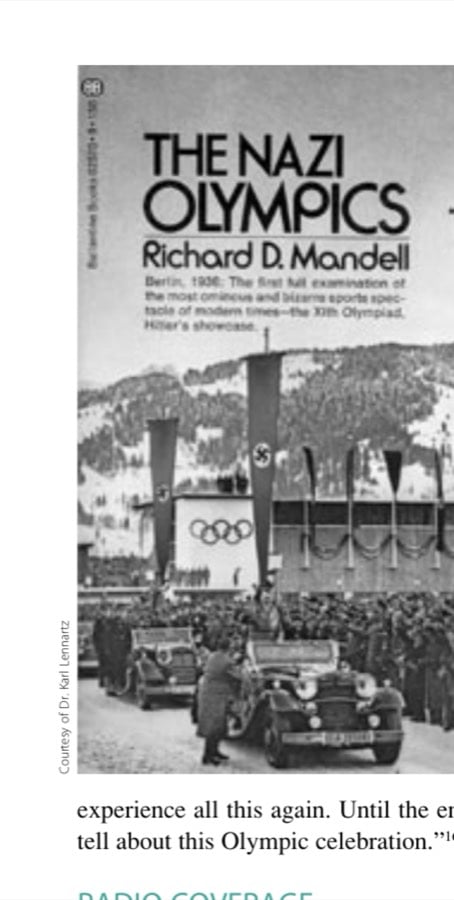
The cover of The Nazi Olympics by American sport historian and marathon runner Richard Mandell.
of the holy Olympia—the seat of the Greek gods of antiquity. Louis said: ‘I present to you this olive twig as a symbol of love and peace. We hope the people of the world will only meet for such peaceful contest.’”15
The photo of this incident was to be seen in all the newspapers, and of course this created even more excitement and interest for the upcoming marathon. After the Games had finished, the Greek team let Louis represent it in
his written response: “When you invited me, I started on a journey to Germany, which I was very anxious to get to know, full of expectations. But everything I saw beat these expectations. I thank you,
that you gave me the opportunity to experience all this again. Until the end of my days I will have many a story to tell about this Olympic celebration.”16
RADIO COVERAGE Being the “biggest track and field event of the Olympic Games,” the marathon also played a special role in radio broadcasting: “It was therefore decided upon, that a special music was to be created in order
to underline the radio feature. The composer Herbert Windt was chosen to do the job. The task would have been easy had the composer portrayed the expected proceedings of the marathon in an orchestral succession: the course of events,
the battle, tiredness and collapse and victory. Instead of wasting a richness of atmospheric harmonies, he confined himself to just a few topics, which he wove together contrapunctually, and played recurrently. He arranged his composition in
three settings, a short scherzo at the beginning, a continuous, first slow, then faster ‘Laufschrittsatz’ [doubletime movement] and a short but victorious and mighty end. The trick was that a single running rhythm, which never stopped and pulled
the different parts together, dominated the whole composition.
“The persons in charge of the program now had to fit the different parts of the music into the alternating stages of the race: start, race, and finish. The same procedure had to be applied for the transition between music and radio report. Here the music had to begin with the last spoken word of the radio announcer.”17
The radio feature can be heard on one of the Olympia LPs. Windt’s music was also played by the Berlin Philharmonic Orchestra during the premiere of Leni Riefenstahl’s Olympia film, which was shown on April 20 to celebrate Hitler’s birthday. Windt had incidentally also composed the music for Riefenstahl’s films Triumph of the Will (1934) and the Olympic films Festival of the People and Festival of Beauty (1938).
Of course the marathon played a big part in Riefenstahl’s Olympic film. Richard Mandell describes it: “And finally the marathon. Kitei Son drags himself on and on. The camera focuses on his legs, his arms, on his face, which reveals only little of his racked, but untamable will. Even Windt’s music to the film tries to depict the battle between mind and body. Exhausted marathon runners lose their natural running rhythm. The body refuses to obey. Is that a simile? Is it supposed to characterize this event? But Kitei Son is able to increase his pace in the final sprint. His weaker rivals fall into the arms of their coaches, who await them with warm blankets and comforting words. The film comes to an abrupt end with shots of flags and the Olympic bell.”18 Leni Riefenstahl confirms this interpretation in her memoirs from 1987: “
I drove to Bad Harzburg for a few days with some of my employees, to discuss the marathon. On the way there I thought about how to dramatize a 42-kilometer long run in a film. I tried to put myself into the runner’s position: his weariness and exhaustion, how his feet stick to the tarmac and he tries to reach the stadium with all his willpower. I could also hear the whipping music, which keeps the tired body going throughout the race, before it goes over into the cheers of the crowd, as the athletes arrive in the stadium and cross the finishing line. Until then it was only an optical vision and we had to try to make it real.”19
The winner, Kitei Son, was seen as the perfect marathon runner because of his looks and posture. The Asian with the inscrutable face, as he was called, allegedly personified the ascetic hero, who the marathon runners were seen to be: “
Kitei Son is certainly the ideal marathon runner. Small and lightweight, gifted with a very economical stride, which he can keep up over a long distance. For this long-distance battle he also possesses the natural toughness of his race. The inexhaustible patience, that is always ready to take great strain upon itself and exemplary and traditional practice of willpower, form the basis for the successes since 1928.”20
A “simple” gold medal was not prize enough for his effort. The newspaper Vradini from Athens donated a valuable antique helmet. Because the amateur status did not allow this, the IOC intervened.
THE “JAPANESE” KITEI SON Being the designated host of the 1940 Olympics, the Japanese had put a tremendous effort into the preparation for the Olympic Games of Berlin—the marathon being the main focus because of the excellent results since 1930.
In order to have enough time for preparation, Coach Sato and the four athletes had already made their journey to Berlin some weeks in advance of the Games on the Trans-Siberian Railway. Son roused great attention when running because of his strange running shoes. They were split at the front, and the big toe had its own pocket. He was later asked about his shoes and admitted that it had been a gag.
On photos, however, it can be seen that many Japanese long-distance runners wore these shoes. This was due to the Japanese sandals, which had a binding for the first two toes. As it felt strange for many of the Japanese athletes to wear European shoes, they produced the running shoes in the same sandal-like style.
On the day of the race, nothing was left to chance. The other Japanese athletes had to spread out along the course. In order to reach as many different points as possible, Coach Sato used a car. Team Captain Hiranuma waited at one of the checkpoints. Here is where all the strategic strings came together.
But the winner Kitei Son and third-place bronze medalist Shoryu Nan were not Japanese but were born in Korea, which had been annexed by Japan in 1910. In Berlin, Son did not hide the fact that he felt Korean. When signing autographs, he always wrote his name in Korean and outlined the borders of his native country. Because of this, he got into trouble on his return to Japan. The newspaper Donga-Ilbo from Seoul printed the photo of the presentation ceremony and removed the Japanese sun from Son’s tracksuit top. As a result, eight editors were arrested, and the newspaper was not allowed to be published for the following nine months.
THE LAST RACE Son did not enter another marathon after Berlin, but he coached the (South) Korean marathon runners (even though he was born in the North) from the London Olympics through the Melbourne Games (1948-56). During the opening ceremony of the Olympic Games in London in 1948, the first Games to be held after World War II, he carried the Korean flag.
He is supposed to have taught literature at a Japanese university in 1937. In 1942, it was reported in a German newspaper that he had been killed in the war. After the Korean War, the North Korean–born Son became a successful businessman in South Korea. He was the president of a milling company based in Seoul; he visited Germany in 1956 for the first time since the Berlin Games of 1936.
Later he owned a department store in Seoul. Two of his sons were cadets at the American military academy at West Point. His daughter is married to Lee Changhoon, fourth finisher in the 1956 Melbourne Olympic marathon and winner of
the Asian Games in 1958. As a member of the South Korean National Olympic Committee, Son promoted his country’s sporting interests around the world. In doing so, he was also in Germany many times—for instance in 1981 as guest of honor for the first annual Berlin Marathon.
As had been indicated in 1928 by the IOC, the names of the Olympic champions had to be put up at the entrance to the stadium in Berlin. In fact, this took place shortly after the end of the Games on the side walls of the marathon gate.
Since then, Kitei Son is accounted for as the Olympic champion in the marathon. But during the late 1960s, South Korean politicians and the countries of the NOC (National Olympic Committees) tried to have the name changed to Kee Chung-sohn (his Korean name) and the country for which he ran changed from JPN to KOR. Berlin’s senate was unable to decide on this matter, and the IOC was called upon to mediate. The IOC did not allow any changes to the original inscription, because in 1936 the athlete had started the race for Japan as Kitei Son. From a legal perspective, it is definitely correct to insist on JPN. In 1936, Korea was not a recognized independent country, had no NOC, and had technically not taken part in the 1936 Olympics.
But the correct name of the athlete is, indeed, Kee Chung-sohn and should have been changed on the tablet. In October 1970, the Korean representative, Park Young Rok, had a stonemason change the inscription from JPN to KOR21 in the dark of night and in total secrecy. The “damage” was soon after repaired, however.
In 1982, South Korea, which had taken part in the Olympic Games as an independent country since after the war in 1948, was selected as host country for the 1988 Olympic Games. The 70-year-old Sohn was a member of the organizing committee at the time.
SOHN’S CONTINUING ROLE In Korea, the upcoming marathon was also very important. From autumn 1984 onward, the Koreans organized a pre-Olympic marathon, and it was Kee Chungsohn who honored the winners. In 1987, Korea organized the Marathon World Cup in Seoul.
Although it had been decided after the Games of Paris in 1924 that special prizes of honor were not allowed, another exception was made in the marathon of Berlin 1936. The Greek newspaper Vradini, you’ll recall, had donated an antique helmet for the marathon winner. It had been found during excavations in Olympia in the 1920s and was an armored helmet with cheek and nose protection dating to the sixth century BC. It was part of the booty of a war and had been displayed in a temple, serving as a consecrational object. The newspaper had acquired it from an art dealer.
The present was supposed to create a connection between the mythical run of the soldier at Marathon and the Olympic marathon. Following the veto of the IOC that made it impossible for Sohn to accept the prize, it was taken by IOC Secretary General Carl Diem and placed at an aquarium on the Museum Island. After the war, it was displayed in an antique collection at the palace of Charlottenburg, the Stlerbau. Since 1972, Korean officials had wanted to take the helmet home. It had been displayed during the 1972 Olympic Games in Munich. Lengthy correspondence between the German NOC, the IOC, and the Stiftung Preussischer Kulturbesitz (Prussian Cultural Heritage Foundation) followed. Finally, on August 17, 1987, the helmet was handed over to the winner of the 1936 Olympic marathon, Kee Chung-sohn, by the president of the German NOC, Willi Daume.
During the opening ceremony of the 1988 Olympics in Seoul, Kee Chung-sohn carried the torch into the stadium. He entered the stadium, happily hopping like a young child, and then handed the torch to 19-year-old runner Chun-Ae Lin,22 who carried the torch to the pedestal of the Olympic flame, which towered 22 meters above the athletes.
Kee Chung-sohn, long free of the imposed name Kitei Son, glowed in the adulation of his countrymen.
NOTES 1. Organizing Committee for the XI Olympiad Berlin 1936. Official Report. (Berlin, 1937), 2:646. 2. Organizing Committee for the XI Olympiad Berlin 1936. Olympic Games 1936. Official Organ of the XI Olympic Games (Berlin, 1936), 15:26. 3. Carlos Zabala (1911-1983) was Olympic champion in Los Angeles in 1932 in 2:31:36 (best Olympic time) and came in sixth in the 10,000 meters in Berlin on August 2, 1936, in 31:22; he had been in Germany for months in advance to prepare for the Olympic Games and had had astonishing results in the shorter distances, including in Munich, a 20K in 1:04:00.2 (world’s best), a 27:04 10K in Nuremberg, and a 25K in 1:26:54. 4. Manuel Diaz (b. 1905), Portuguese champion from 1937 to 1941, came in second in 1937 at the Polytechnic Harriers Marathon in London. Best time of 2:37:20; later did a 2:30:36 in 1937. 5. Ernest Harper (b. 1902), 22nd in the Olympic Games in 1928 in 2:45:44, finished second in the British Championships in London on July 11, 1936 (2:35:04); British champion over 10 miles in 1923, 1926, 1927, and 1929; 1927 British cross-country champion. 6. Shoryu Nan (b. 1912), fastest time of 2:32:33 on November 3, 1933, in Tokyo while taking second place in Japanese championships.
7. Erkki Tamila (b. 1911) had finished the 25K in Joensuu, Finland, in 1:21:27 (a world’s best). 8. Vaino Muinonen (b. 1898) stood at the beginning of his career as European champion in Paris on September 4, 1938, in 2:37:29; achieved a personal best time on July 21, 1946, at 2:33:03 in Vuoksenniska, Finland; second in the European championships in Oslo one month later on August 8, 1946, in 2:26:08 (40K), at the age of 51; and still finished in 2:36:23 (eighth) on October 2, 1949, in Turku. 9. Cigaretten-Bilderdienst, ed. The Olympic Games 1936. (Hamburg-Bahrenfeld, 1936), 2:55. 10. Paul de Bruyn (1907-1997) had emigrated to New York in 1930 and worked there as a technician (janitor) in a hotel. His talent for long-distance running was discovered by chance. De Bruyn, who started for the DSC New York, representing Berliner Sports Club, was the German champion in 1931 in 2:47:19.2. Surprisingly, he won the Boston Marathon the following year in 2:33:36.4 (German best time), being the only German male runner ever to win the Boston Marathon. He only came in 15th in 2:53:39 in the 1932 Olympics in Los Angeles. In 1934, he finished fourth in 2:38:26 in the Port Chester Marathon (his second-best time). 11. Franz Barsicke (1905-1944). Member of the Post SV. Stephan Breslau had qualified for the race as German champion in 1936 in 2:49:38. 12. Eduard Braesicke (b. 1905) started for the SV Werkverein der Bewag Berlin representing Osram Berlin, and had run his fastest time at the German championships of 1932, where he finished second. He had qualified for the Olympic marathon of Berlin in 2:55:37 at the German championships of 1936. 13. Organizing Committee for the XI Olympiad Berlin 1936. Official Report. (Berlin, 1937), 1:646-647. 14. Organizing Committee for the XI Olympiad Berlin 1936. Official Report. (Berlin, 1937), 1:576.
ad
15. Richard Mandell. The Nazi Olympics. (New York: Macmillan, 1971), 145. 16. Diem-Archives. 17. Organizing Committee for the XI Olympiad Berlin 1936. Official Report. (Berlin, 1937), 1:341-342. 18. Richard Mandell. The Nazi Olympics. (New York: Macmillan, 1971), 240. 19. Leni Riefenstahl. Memoirs. (Munich: Knaus, 1987), 260. 20. Cigaretten-Bilderdienst (ed.). The Olympic Games 1936. (Hamburg-Bahrenfeld, 1936) 2:55. 21. Letter from Gerd Steins, November 21, 1999. 22. Chun-Ae Lin (b. 1969), medium-distance runner, three times champion in the Asia Games of 1986 in Seoul at 17 years old, did not manage to qualify for the final heats in Seoul.
This article originally appeared in Marathon & Beyond, Vol. 10, No. 6 (2006).
← Browse the full M&B ArchiveMore like this
1,000+ stories from 19 years of Marathon & Beyond
The complete archive of the legendary long-distance journal — digitized and free to read.
