

The Quiet Explosion In 24-Hour Running
For most races, the goal is to determine who can run the fastest. This goes for all distances, including marathons and ultramarathons. For those of us in the middle of the pack, it may be more a question of How fast can I run? rather than Can I run faster than everyone else? Regardless of your prospects, the elementary nature of the event is still a race to see how fast everyone can get to the finish. In 24-hour and other fixed-time runs, the question changes entirely. The query becomes How far can I run?
Happily, running events of nearly all distances are experiencing a great deal of growth in both the number of events and the number of participants. That growth applies to ultramarathons as well. UltraRunning Magazine reports that the number of runners who finished ultramarathon races increased to 52,000 in 2011. This represents an increase of 12 percent more than 2010 and triple the number of finishers of 2001. There are, unfortunately, no known statistics regarding the number of these finishers that participated in a fixed-time ultramarathon.
We can postulate with reasonable certainty, however, that the number of fixedtime ultramarathon races is growing at least as fast as other trail and road ultras. Although no one seems to be collecting overall statistics for these events, some informal information gathering tells us that well over 30 24-hour runs are now held annually in the United States, whereas only a handful existed as recently as just a few years ago. (See the table: A Sampling of 24-Hour Running Events on pages 140-142.) The rapid growth, at least in the number of these events, mirrors the growth of the sport of ultrarunning itself.
The word “race” usually means a contest to determine who can cover a given distance the fastest and is used rather loosely here. Other than calling the fixedtime races “runs” or “events,” there is simply no other word for them than “races.” Although we mention other timed events here, this article focuses mostly on the 24-hour variety.
Courtesy of International Association of Ultrarunners (IAU)
© John McCarroll
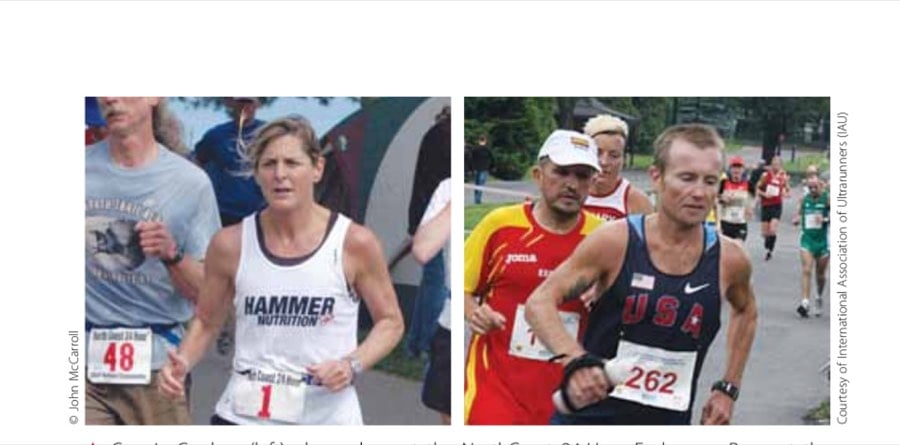
▲ Connie Gardner (left), shown here at the NorthCoast 24-Hour Endurance Run, set the American women’s 24-hour record at the 2012 IAU World Championship. Mike Morton (right) won the 2012 IAU World Championship and also set the new American men’s record.
Besides their growth in popularity, these races are also seeing more and more outstanding performances. In 2012, for example, runners broke both the US men’s and women’s 24-hour records. Mike Morton set the men’s record of 172.458 miles,
smashing the old record of 165 miles set by Scott Jurek. And Connie Gardner set the US women’s 24-hour record with 149.368 miles after very narrowly missing the mark several times in past years. Both records were set at the International
Association of Ultrarunners (IAU) 24-Hour World Championship in Katowice, Poland. Unfortunately, all of this—the growth and the great running—appears to be happening under the radar. Little awareness is displayed from running resources.
We can say that ultrarunning in general gets little attention, but even so, timed racing gets even less. This dichotomy of high popularity without much attention explains the title of this article.
How do these things work? Fixed-time races come in a variety of shapes and sizes, but they have elements in common. Here are some of the components. Although 24-hour runs are by far the most prevalent, six-hour, 12-hour, 48-hour,
72-hour, and even six- and 10-day timed events are also popular. The combination of a 24-hour run with one or more additional fixed-time events is common. Still, the 24-hour runs are often the marquee events.
The course may be on any surface. Most ultramarathons in the United States are run on trails. A quick look at the table list of 24-hour events shows that several of these, too, are on soft surfaces, but many are run on paved roads and
all-purpose trails. Some are on 400-meter synthetic or rubberized tracks. The
advantage of dirt trails is that the softer surface translates to less impact over the course of a full day of running. The advantage of a paved surface is the potential for improved performance; most runners will be able to cover more miles on a road or all-purpose trail than on a dirt trail. Tracks may provide both a softer landing and possible top performances. For tracks, however, the constant turning, the shorter length (which increases traffic and allows for fewer competitors), and the decreased scenery add their own challenges.
Many courses are flat. The ones with significant hills are usually the trail variety. Hills inevitably result in less ground covered. Most records are achieved on flat courses. That said, some runners might find that some slight amount of altitude variation on a course provides a benefit of more varied muscle use.
Runners of fixed-time events usually prefer that the courses contain as few sharp turns as possible. In fact, the fewer and wider the turns, the better. Courses with many of them, such as 400-meter tracks (meaning two large turns per loop, about eight per mile), often call for a reversal of direction at regular intervals in order to reduce the amount of stress that runners experience due to the constant turning.
None of this is to say that any particular surface, hilliness, or number of turns is in any way superior to others. Just as fixed-distance roads and trails feature different challenges that affect top or record performances, so do fixed-time courses.
The USA Track & Field Mountain, Ultra, and Trail Sport Council designates one event as the men’s and women’s 24-hour national championship each year. The top runners from the championship as well as other races are picked to represent the United States at the IAU World Championship. Both the national championship and the world championship are usually held at a venue with a paved surface. The participants want to get as far as humanly possible.
Timed ultramarathons are held on loop courses so the distances can be measured. Runners are scored by their total overall distance achieved within the given time limit. This means they must complete the loop as many times as possible. The distance might be anything from 400 meters to several miles. Most runners feel that they can achieve their greatest distance on an asphalt (not concrete) paved trail that is at least a half mile in length and has no sharp turns or hills. Loops of one mile or thereabouts are the most common. Many races take place within a park or other closed area where traffic control is not a concern.
Timing is a critical component. Of course, it is necessary to count the number of circuits for every runner in order to determine the distance. This can be done manually in one of several ways, but in order to track a large number of runners accurately, including their lap-split times required for USATF records, electronic chip timing is practically a necessity. The rapid growth of timed races could not have taken place without the emergence of electronic timing in the past 15 years.
Race rules vary, but in general, runners may have their own support crews in addition to any aid provided by the race organization. Runners may stop running for aid or even to rest, but the clock, as they say, keeps on ticking.
End-of-race procedures vary as much as the other, more general race rules. In some cases, participants drop a marker when the final horn blows so that they can be given credit for any partial lap. In other cases, an hour or so before the finish time, runners are moved onto a smaller loop area, such as a 400-meter track, and are given credit for the number of full smaller laps, in addition to their previous mileage. In a third scenario, only the full laps are counted regardless of the loop length.
The state of the sport It may surprise you to learn that there is an active and rapidly growing subculture of fixed-time ultrarunning specialists. Arguably, a runner who is capable of running long distances ought to be able to do so over different terrain, whether by running loops or by traversing a nonrepeating course. And this is indeed the case with many runners, including some of the best. But others, including some of those on the US National Team, appear to do well mainly at the fixed-time variety of ultramarathon. Still others, who may have excelled at trail ultras, have had disappointing results at 24-hour and longer fixed-time runs.
The top performances just keep right on coming. The records set at the 2012 24-Hour World Championships are only the most recent examples. As noted, Connie Gardner had narrowly missed the US women’s record—by less than four miles in 2010 and 2012 and by less than one mile in 2007 and 2011. She was the second overall female at the world championships. Sabrina Moran had set the US mark only a few months earlier in Cleveland. Also at the world championship, US runners Suzanna Bon and Anne Lundblad also turned in great performances, and the US women won the team title.
Scott Jurek had set the previous men’s record at the 2010 24-Hour World Championships, eclipsing Mark Godale’s 10-year-old record. When Mike Morton won the 2012 world championship meet overall, he broke Jurek’s record by an astounding seven miles. The US men, including Morton, Harvey Lewis, and Joe Fejes, scored third in the world behind Germany and France.
At other events, Fejes also ran a monumental distance—over 329 miles—at the 2012 Across the Years 72-hour run. Another US National Team member, Phil McCarthy, set the American record for 48 hours of 256.771 miles in the 2011 Three Days at the Fair run.
So, yes, American runners are among the best in the world, and they keep getting better. One reason for this is that American fixed-time events are also among the best in the world. Most are well organized and manifest outstanding attention to detail. Some of the most prominent of them are:
• 24 the Hard Way: Runners have a choice of running 24, 12, or six hours on a dirt trail or a paved path. The event takes place in Oklahoma in October. The 24-hour race will serve as the USATF National Championship in 2013. •
Across the Years: This Arizona race features 24-, 48-, and 72-hour runs. Depending on their choice of event, runners may be running from New Year’s Eve into New Year’s Day. Operational since 1983 (with a hiatus in
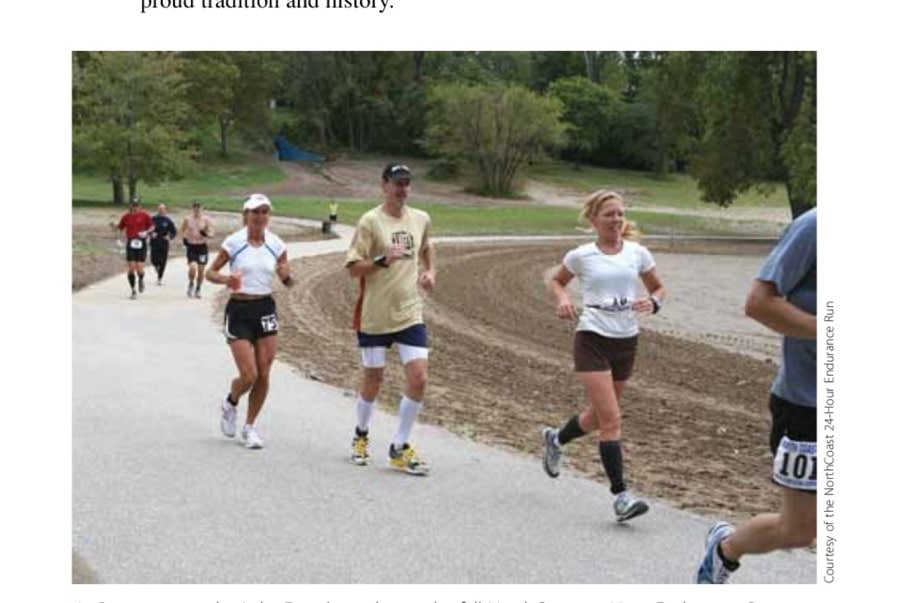
2009), this is one of the longest-running fixed-time events in the country. ATY has a proud tradition and a loyal following. • NorthCoast 24-Hour Endurance Run: There are spring and fall versions of this run at Edgewater Park on the shore of Lake Erie in Cleveland, Ohio.
It was the national championship from 2009 through 2012, and it will be again in 2014. There have been some great performances over the years, including those of Connie Gardner and Sabrina Moran.
Courtesy of the NorthCoast 24-Hour Endurance Run
• The Sri Chimnoy Self-Transcendence 6-Day, 10-Day and 3,100-Mile Races: It sounds like a lot and it is. Although the 3,100-mile race is not strictly speaking a fixed-time race, it features many similarities to those types of events. The Sri Chimnoy family of events, too, has a long and proud tradition and history.
▲ Runners near the Lake Erie shore during the fall NorthCoast 24-Hour Endurance Run.
• Three Days at the Fair: Runs of 72, 48, 24, 12, and six hours are featured at the Sussex County Fairgrounds in New Jersey. All events except the six-hour race finish at 9:00 a.m. on a Sunday morning in May. Runners can also enter marathon and 50K distance races. The US men’s 48-hour record was set here in 2011.
So you think you may want to run one? Not so fast! The first question is why. For most of us, the answer is something like to see how far I can go. As with any quest, the more specific you can be, the better. You stand a better chance of accomplishing something meaningful if you say to yourself, I want to run 100K, rather than simply, I want to run until I crash. Goals are good because they keep us focused. And focus is definitely something you will want to hone if you’re thinking of tackling a fixed-time race. On the other hand, it’s also important not to set your expectations too high, especially if you’re a first-timer. Many an experienced ultrarunner has underestimated the difficulty of running for 24 hours. For example, an elite ultrarunner may complete a 100-mile trail race in 14 hours, but after 14 hours of a 24-hour run, there are still 10 hours to go. Our hypothetical runner, perhaps used to running for only so long, might simply crash shortly after the completion of those first 100 miles. Despite the fact that, depending on the terrain and surface, you can generally travel for more miles in a timed event than a fixed-distance race, it’s easy to become overconfident. Yet some of the records—such as the ones noted above—are simply phenomenal. They reflect an extraordinary amount of focus and determination.
Fixed-time races are also an excellent opportunity to run a first ultramarathon. While focus and determination are still required, new ultramarathoners may be surprised at what they can accomplish, given enough time.
Fixed-time running certainly isn’t for everyone. Many ultrarunners strongly prefer to run on trails through remote and scenic areas. Loop courses are, in the eyes of some ultrarunners, decidedly more boring and tedious. However, a runner who can master the sometimes mind-numbing effort may be able to achieve a distance not possible under other circumstances.
Believe it or not, timed events can also be loads of fun. For some, the joy comes from seeing and running alongside all the other competitors during the entire time of the run. Having a crew, perhaps at a campsite with a tent, also adds to the enjoyment. On the other hand, some runners prefer the challenge of supporting themselves without the benefit of a crew. Think of these events as parties where people run, as opposed to races . . . where people party.
The competitive aspect can be intensely interesting as well. Each runner is often within sight of others who may be rivals. There have been exciting instances
Event name Lockport, NY
Location January
Month
.65 mile
25 miles
Length
Dirt trail
Towpath trail
Surface
http://www.dumassevents.com/24hrs-of-hostelity.html
http://winter100.com/
Website
A Sampling of 24-Hour Running Events
Beast of Burden Winter January
http://Howardaslingerfoundation.org/
Dahlonega, GA
Paved
24hrs of HOSTELity
1 mile
http://www.ultimateracemanagement.com/index. php/race-list/icalrepeat.detail/2013/03/09/66/8/ lappers-delight-2013
Cape Girardeau, March MO
Lapper’s Delight Pinnacle, NC March 1.5 miles Grass and dirt trail
Howard Aslinger 24/12/1
Moab, Utah
March
5.37 miles Dirt trail
http://24hour.pickledfeetultras.com/
http://geminiadventures.com
Pacific Rim One Day Longview, WA March 1 mile Gravel pathway http://cowlitzvalleyrunners.org/prr2013.pdf
with some sidewalk Moab
Dirt trail and gravel 3.75 miles Dirt trail
Pickled Feet 24/12/6Eagle, ID March 2.5 miles Hour & 100 Mile Runs April
http://www.va24hourrunforcancer.com/
Hampton, VA
Virginia 24-Hour
http://claudesinclair.com/RaceApps/Landsford-Canal24-hr.pdf
6.25 miles All-purpose trail http://www.athletic-equation.com
Landsford Canal Lock-In Catawba, SC April 4.25 miles Paved road Run/Walk for Cancer & canal trail May
Asphalt http://www.northcoast24.org/ all-purpose trail
Triangle, VA
Spring NorthCoast Cleveland, OH April .9 mile 24-Hour Endurance Run
Crushed gravel http://www.getguts.com/e-oe24.shtml
24-Hour Adventure Run
Operation Endurance Ft Benning, GA March 1 mile
Event name April
Month 1 mile
Length Dirt trail
Surface
http://outrun24.blogspot.com/
Website
Location
Outrun 24-Hour Trail Race Kirtland, OH
http://www.cornbelt.org/
http://www.njtrailseries.com/
Track
CBRC 24-Hour Run
Pavement and crushed gravel
http://www.oldgoatrunners.com/
400 meters
3 Days at the Fair Augusta, NJ May 1 mile
Dirt trail
http://www.solechallenge24.com/
May
Nanny Goat
Asphalt all-purpose rail
https://www.hermosa24.com/
Eldridge, IA
Sole Challenge Fayetteville, PA May 1.55 miles 24-Hour Race
Soft sand
http://20in24.com/
3.36 miles
Paved path
http://geminiadventures.com/new/?page_id=100
June
8.4 miles
Dirt trail
Hermosa, CA
1 mile
Hermosa 24-Hour
Dirt roads and trail
May
Silverton 6/12/24-Hour Silverton, CO June 1 mile
Asphalt http://www.fans24hour.org/ all-purpose trail
Riverside, CA
FANS 12 & 24 Hour Run Minneapolis, MN June 2.42 miles
Black Mountain, NC
July
5.9 miles
http://www.raceofawesome.org/
Black Mountain Monster 6/12/24
Philadelphia, PA
July
Dirt trail
Stroehmann Back on My Feet 20 in 24 Lone Range Challenge
Laramie, WY
3 miles
24 Hours of Laramie
Paved Sidewalks http://www.srr.org and trail
June
24-Hour Around Wakefield, MA July 3.17 miles The Lake
Location
http://www.badgerlandstriders.org/home/Races/ Badgerland24126HourRun.htm
Website
Surface
Event name Germantown, August 400 meters Track WI
http://www.etinternet.net/~runrbike/ hinsoninfo.htm
Length
BLS 24/12/6-Hour Run
Rockingham, Sept. 1.52 miles Soft clay NC
Month
Hinson Lake 24-Hour Ultra Classic
.9 mile
Oklahoma City, October 1 mile OK
Boulder, CO
October
Paved path
Asphalt or dirt trail
Dirt trail
http://www.aravaiparunning.com/desert-solstice/
http://www.fortheshirt.org/
http://24thehardway.com
http://geminiadventures.com/new/?page_id=105
http://www.northcoast24.org/
Boulder 24-Hour Run
December 400 meters Track
http://www.aravaiparunning.com/acrosstheyears/
Asphalt allpurpose trail
24 the Hard Way Warren, OH
Gravel path
NorthCoast 24-Hour Cleveland, OH Sept. .9 mile Endurance Run
For the Shirt Phoenix, AZ
December 1.04 miles
http://www.stpats24hour.com/
Desert Solstice 100 Miles and 24 Hours
Glendale, AZ
http://www.peanutisland24.com/
St. Pats 24-Hour South Bend, IN October 3 miles Grass, dirt, gravel
Across the Years
Pavers-oversand trail
http://www.my-bmrc.org/
7.14 miles
Peanut Island 24 Hour, Peanut Island, FL December 1.23 miles 12 Hour and 6 Hour Fixed-Time Races
Asphalt allpurpose trail
October
Freedom Park New Morganton, NC December .98 mile Year’s Ultra
where one runner has overtaken another for place or two top runners have run together nearing the final lap of a 24-hour run. Nevertheless, there is still that simple challenge of seeing how far you can go. For many runners, being able to run 100 miles within 24 hours is a great and worthy goal. Mathematically, it doesn’t sound so tough: just average 14:24 per mile. Many people can do this simply by walking fast. And the best chance to accomplish such a mission is most likely a well-organized 24-hour run. But beware—sticking to it gets harder as time goes on. No matter how slow and easy the early pace may seem, things always get tougher late into the night.
Should you go in with a detailed plan or just run all out until you crash and burn? Framing the question this way makes the answer fairly obvious, but it may surprise you to learn that many runners—even some very good ones—go into fixed-time races without any strategy whatsoever. This is not to deny that some of them have accomplished much by starting out hard and staying with it. But for most of us, a strategy will provide us the best chance of reaching our goal. Many runners employ a race plan that includes walking breaks at regular intervals. And as with runs of any length, pacing yourself, especially in the early part, is of vital importance.
Your chance of success will naturally depend mostly on your preparation. Those who include long-distance running, ideally over several years, in their training will have an advantage, but so will those who practice running at various times of the day and night as well as those who practice their pace along with planned walking breaks.
All this serves to answer one little question. You know the one: How far can you run?
Resources American Ultrarunning Association (AUA): http://www.americanultra.org/ International Association of Ultrarunners (IUA): http://www.iau-ultramarathon.org/ Multidays website: http://multidays.com UltraRunning magazine website: http://ultrarunning.com/index.shtml iRunFar website: http://www.irunfar.com USATF Mountain Ultra Trail site: http://usatf.org/Sports/MUT.aspx Washington Post article about ultramarathon growth: http://articles. washingtonpost.com/2012-05-23/sports/35458185_1_trail-races-runnershope-marathons
This article originally appeared in Marathon & Beyond, Vol. 17, No. 4 (2013).
← Browse the full M&B ArchiveMore like this
1,000+ stories from 19 years of Marathon & Beyond
The complete archive of the legendary long-distance journal — digitized and free to read.
