

The “Real” 100th Boston
A good idea takes on a life of its own, while a bad idea tends to die, even if shored up by all the fortunes of the world.
In less than a century, major institutionalized world powers boasting tremendous resources can rise, shine, and decline. Yet a modest idea such as the American Sanitary Fund, established to provide medical supplies and services to combatants in the Civil War, rolled itself into the American Red Cross and survives today as a viable institution, well over a century after its inception.
A similar record of longevity has accompanied another institution—namely, the marathon, an event created as a special one-time-only novelty race to honor the host Greeks during the revival of the Olympic Games in Athens in 1896. Today, well over half a million people around the world annually compete in marathons. This year the marathon celebrates its 101st birthday.
Aside from the Olympic Marathon held every four years, the most famous marathon in the world is run in Boston every April. It could be argued that the importation of this marathon event to Boston in the wake of the 1896 Olympic Games by members of the Boston Athletic Association (BAA) played a major role in keeping the marathon alive. Something, after all, was needed to sustain the event during the four years between the Games in Athens in 1896 and the Paris Olympics in 1900. Boston filled the bill.
The marathon captured the imagination of the times, and its first running on April 19, 1897, was front-page news, in spite of a field that numbered a mere 15. The race was won by John J. McDermott of New York in 2:55:10. McDermott had also won the first marathon held in the United States the previous autumn—a race from Stamford, Connecticut, to the Knickerbocker Athletic Club at Columbus Circle in New York. Under atrocious conditions, McDermott won in 3:25:55.
Of the 14 U.S. athletes who sailed to Athens in 1896, four were Princeton men from the New York City area, and five were members of the BAA. The powerful New York Athletic Club, considered to have the best athletes in the world, refused to send any to the Olympic Games in Athens. In spite of the club’s refusal to help field the first U.S. Olympic team, the small contingent of Americans still dominated the sprint and middle distance events. However, the one American entered in the marathon, the BAA’s Arthur Blake, did not medal. But the obvious physical challenge of running nearly 25 miles and the subsequent drama of Spiridon Loues’s win in the Olympic marathon branded itself in the minds of the New York and Boston athletes and fans.
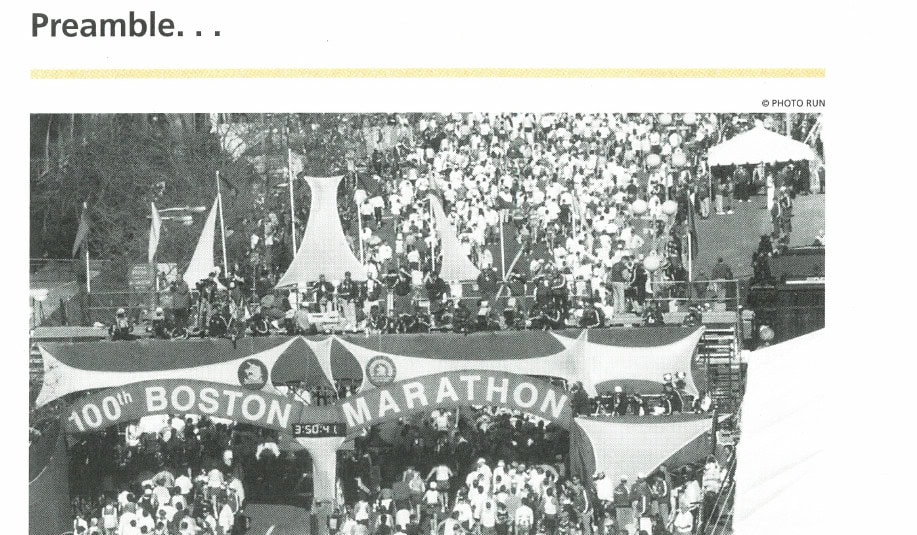
And with their enthusiasm and their influence with the U.S. sporting press, the BAA made certain that their marathon took on a life of its own—a life that most certainly has had its ups and downs through the decades, but a life that was vibrant enough to elevate the Boston Marathon starting line at Hopkinton to the status of 25th largest city in Massachusetts (9,191 residents plus 38,000 transients) on April 15, 1996, in what the BAA billed as the “100th” running of the race.
Of course, Boston 1996 was not the 100th but the 99th running, as author and Boston Marathon veteran Tom Derderian explains in the lead story of our special Boston section. Derderian, a hard-core racer and statistical stickler, is not alone in declaring a false start for the celebration of the 100th. But Tom also freely admits that he greatly enjoyed the largest moving block party in the history of the world.
Tom’s definitive 664-page book on the Boston Marathon wouldn’t fit in our special section, so we asked Scott Hubbard of Michigan to write a concise history of the race, summarizing each year in 25 words or less. We picked Scott because of his encyclopedic knowledge of long-distance running. Scott has never attended the Boston Marathon, but we felt that lapse kept him free from undue influences and prejudices. The only potential for prejudice is that in college in Michigan, Scott competed against 1983 Boston winner Greg Meyer.
In the wake of Uta Pippig’s most heroic and courageous come-from-behind win at the 1996 Boston Marathon, it seemed appropriate to ask Mike Sandrock to give us a major profile on the German star. We didn’t want a quick 1,500-word summary of her life; we wanted a piece that gives insights into what makes Uta so willing, even eager, to do the long and hard miles in training, to do what it takes to win the big ones. Mike has the advantage of living in Boulder, a running mecca, where Uta lives a good part of the year.
In reviewing Boston winners, it became apparent how few West Coast runners had enjoyed the feel of winner’s laurels on their heads. Could there be a distinct disadvantage for runners travelling from the West Coast and Hawaii to Boston to compete? Dr. Roger Smith, who lives and works in California but who grew up in the Boston area and is an expert on jet lag and sleep problems, offers ways runners crossing multiple time zones can level the playing field at Boston.
And finally, no special Boston section would be complete without consulting Johnny (the elder) Kelley, who’s completed more Boston Marathons than any other runner in history and who won the race twice, in 1935 and 1945. We asked Johnny to relate his most unforgettable marathon, and he threw us a curve. The man most closely associated with Boston, the 1996 grand marshall himself, contends that his fourth-place finish at the 1962 Yonkers National Marathon is his most unforgettable race. In the course of his piece, we also learn that marathoners too often overlook the accomplishments of 1957 Boston winner Johnny (the younger) Kelley, who won the grueling Yonkers race nine times in a row.
Here, then, is our tribute to the marathon in general and Boston in particular, as they roll like juggernauts into their second centuries.
This article originally appeared in Marathon & Beyond, Vol. 1, No. 2 (1997).
← Browse the full M&B ArchiveMore like this
1,000+ stories from 19 years of Marathon & Beyond
The complete archive of the legendary long-distance journal — digitized and free to read.
