

Most forms of sport are contested in a tightly controlled field of play: soccer, football, tennis, wrestling, track and field, basketball. Baseball is a hybrid: a strict 90 feet between the bases within the diamond but an arbitrary distance to the outfield fences. Then there is the other extreme: road and trail running, from cross-country through the marathon and out beyond to the ultra, over hill and dale, down country or city streets, off into the country’s tallest peaks and its deepest valleys.
Although the marathon in 2010 celebrated its 2,500th anniversary, and although cross-country and ultrarunning (on roads, trails, and closed courses) have been around for well over a century, big-time road racing is relatively new. Yes, there have for well over a century been road races, but they have primarily been smaller club-type races. Even the esteemed Boston Marathon fielded fewer than 1,000 runners until the late 1960s.
The rise of the modern big-time road race began in the 1970s. Some would cite 1976, the year the club-type New York City Marathon was brought out of Central Park and onto the streets of the five boroughs to resounding applause and to the inevitability of copycats around the world.
Since that time marathons have proliferated, and many in big cities have grown enormous. The trend pretty much started when Brit Chris Brasher visited New York City and decided London needed a similar spectacle. With such growth in the 1970s came a bandolier of potential problems, not the least of which was standardization and enforcement of the 26.2-mile distance.
An inherent problem was that the overnight growth of road racing in America and then the rest of the world caught the IAAF (International Amateur Athletic Federation) napping. Its concentration had always been on track and field, as had the American federation, the AAU (Amateur Athletic Union).
The closest thing amateur road racing had to a guiding organization was the Road Runners Club of America, founded in 1958 to harness the fledgling road28 l MARATHON & BEYOND l Jan/Feb 2013
Courtesy of AIMS
▲
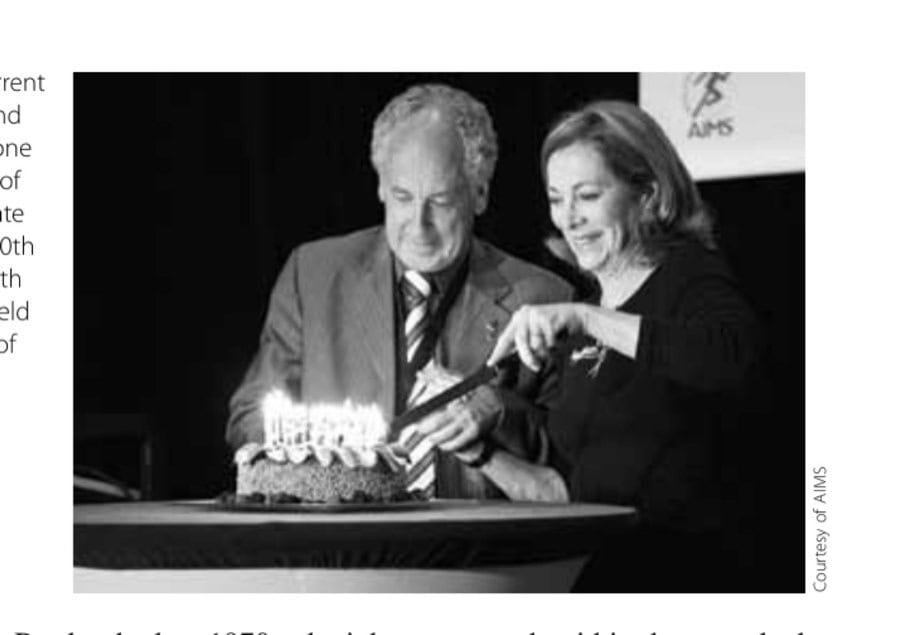
Paco Borao, current AIMS president, and Kathrine Switzer, one of the originators of the group, celebrate the association’s 30th birthday at the 19th World Congress held in Prague in May of 2012.
race movement. But by the late 1970s, the inherent growth within the sport had outpaced the grass-roots RRCA. And the whole affair was complicated by the fact that virtually every marathon (and every road race) had a race director who was unique unto himself—a cat with his own ideas of how things should be run, a cat who saw an inherent schism between the remote officialdom of the IAAF and the AAU on one side and the growing horde of road racers on the other. (At several points in the 1970s, the AAU attempted to require road racers to purchase a membership to the AAU before they could compete in American road races. The response from the road racers was typically, “What has the AAU ever done for me? They barely acknowledge that road races exist.” The AAU evolved into the USATF—USA Track & Field—and the IAAF into the International Association of Athletic Federations, which these days concentrates on professional athletes.)
Seeing a protracted battle ahead bringing a clash between the rebellious road racers and the establishment IAAF/AAU, a group of the “cats” at the head of some of the most important marathons of the time decided to be proactive by forming AIMS (at the time the Association of International Marathons, more recently the Association of International Marathons and Distance Races). “
AIMS was founded to improve the quality of road running by standardizing course measurement techniques as well as many other factors of races which all members have adapted,” stated Allan Steinfeld, at that time right-hand man to Fred Lebow, honcho of the New York Road Runners Club and the New York City Marathon and one of the “cats” present at the creation of AIMS in 1981.
The uniqueness of marathons The problem—if it could be considered a problem—was that beyond the prospect of running a measured 26.2 miles, no two marathons were alike. Each marathon
Courtesy of AIMS
took on the personality of its founder(s) and the environment in which it was run. New York City’s five boroughs had little in common with a marathon through the streets of San Francisco on the other side of the country, and San Francisco’s marathon had little in common with the Avenue of the Giants Marathon, a fourhour drive north, where the course wended its way through 2,000-year-old, 300foot redwoods.
In its way, that difference has been one of the charms of the marathon road race. Runners don’t travel to Big Sur to get a fast time; they travel there for the spectacular scenery as they cling to the edge of the continent. On the other hand, runners who do Chicago do it for the opportunity to have a shared experience with tens of thousands of their fellow runners while racing on a very flat, fast course.
The sport (one where its first practitioner reputedly died at the end of his race) has drawn—to its benefit—its share of visionaries and eccentrics. It has also benefited from its demographics. Ne’er-do-wells and the lazy do not tend to do well when it comes to marathon running. It has drawn the focused, the bullheaded, the intellectual, the colorful, and the dedicated.
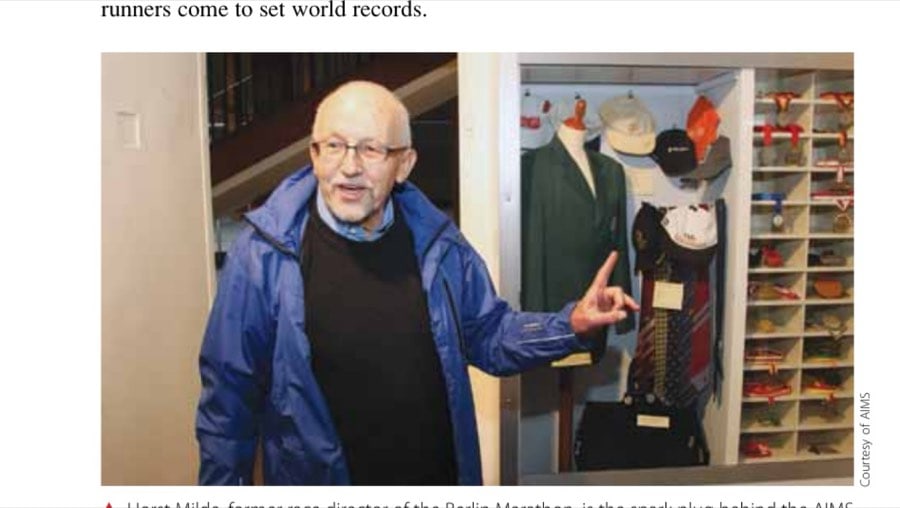
To consider even a handful of the marathon crazy cats who worked together for two years to make AIMS a reality is to appreciate the herding of cats by cats. Horst Milde was a German baker who loved running. In 1974, he founded the Berlin Marathon, a modest affair where several hundred runners ran 42 kilometers through the German forests. The Berlin Marathon has grown into a mass race of 40,000 runners and has become the site where the world’s best long-distance runners come to set world records.
▲ Horst Milde, former race director of the Berlin Marathon, is the spark plug behind the AIMS Museum in Germany.
Courtesy of AIMS
Will Cloney served as the race director of the Boston Marathon from 1947 to 1982. A sportswriter for the Boston Globe, he had attended Harvard and taught English and journalism at Northeastern University from 1937 to 1953. When he started as Boston’s RD, the race featured 184 runners; when he stepped down in 1982, the race had 7,647 runners.
Japan’s Hiroaki Chosa served as race director of the famed Fukuoka Marathon, for a long time considered the annual world championship of marathoning. Through his connections with the IAAF, he managed to cement an association between that international sanctioning organization and the fledgling AIMS. He served as the fourth president of AIMS.
Andy Galloway of New Zealand started running at age 5 when he attempted to run away from his first day of school. For 60 years, he was a member of the Hamilton Harrier Club. He became the first secretary/treasurer of AIMS.
Chris Brasher of England participated in two expeditions to the Arctic before he was 22 years old. He was one of the runners who paced Roger Bannister to the first sub-four-minute mile. At the 1956 Melbourne Olympics, he won gold in the steeplechase. After a visit to the New York City Marathon, he determined to bring the same kind of big-city race to London, which he did.
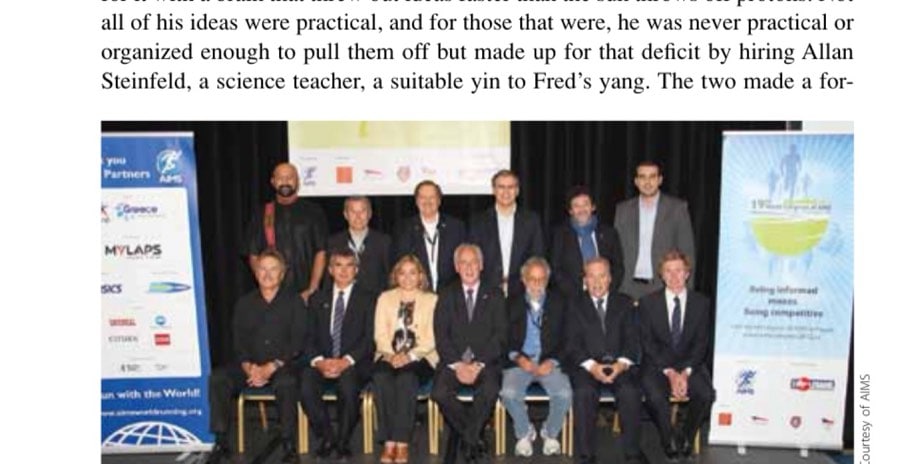
An eccentric’s eccentric, Fred Lebow emigrated from Transylvania, made his fortune in the Manhattan garment district as a knockoff artist, and in 1970 translated his love of running to being the founder of the New York City Marathon, which ran loops through Central Park and which featured 127 starters and 55 finishers—and Fred was one of the finishers. Never a fast runner, he made up for it with a brain that threw out ideas faster than the sun throws off protons. Not all of his ideas were practical, and for those that were, he was never practical or organized enough to pull them off but made up for that deficit by hiring Allan Steinfeld, a science teacher, a suitable yin to Fred’s yang. The two made a for-
▲ The new AIMS board is seated at the end of the 19th World Congress in Prague in 2012.
midable team and together brought tremendous innovation to the art and science of big-time road racing.
The germ of an idea comes together The original idea of gathering together these influential race directors and organizers at each others’ marathons for the purpose of exchanging ideas and thereby improving the sport seemed too casual. Although eccentric, this who’s who of early big-time marathon moguls was practical enough to know that escaping from the doldrums of their winter homes and meeting at the Honolulu Marathon in December was a good idea. At the 1981 Honolulu Marathon, the core group founded AIMS, but in a more formal format than they had originally conceived.
This new, more practical AIMS came up with this mission statement: AIMS is established “to foster and promote distance running throughout the world; to work with the International Association of Athletic Federations on all matters relating to international road races, and to exchange information, knowledge, and expertise among the members of the Association.”
Its first Congress was held in London in 1982 in conjunction with that city’s marathon. Subsequent congresses have been held roughly every 18 months, always in conjunction with a major race. It was decided at the Fifth World Congress, held in Melbourne in 1989, to extend membership beyond just marathons. At the 16th World Congress held in Xiamen, China, in 2007, membership was extended to include off-road races.
In November 2011, AIMS, in conjunction with the Greek government, opened a permanent headquarters within the Olympic Complex in Athens. The membership has grown from 28 in 1982 to more than 320 member events in 95 countries. The work AIMS has done on setting firm standards of course measurement has been recognized and adopted by the IAAF. AIMS and IAAF began to recognize world road records after developing acceptable criteria for their recognition.
As though not content to have grown the Berlin Marathon to one of the premier races in the world, Horst Milde has turned the day-to-day operations over to his son, Mark. Horst now expends much of his energy building and promoting the Berlin Sports Museum (www.Sportmuseum-Berlin.de), which as the AIMS Marathon Museum of Running, is a depository for everything from athletic measuring devices to prizes and trophies, flags and pennants, medals, films, and more. Dave Martin, one of the foremost scientists working with distance runners and coauthor of The Olympic Marathon, recently donated his vast collection of running books and magazines to the museum.
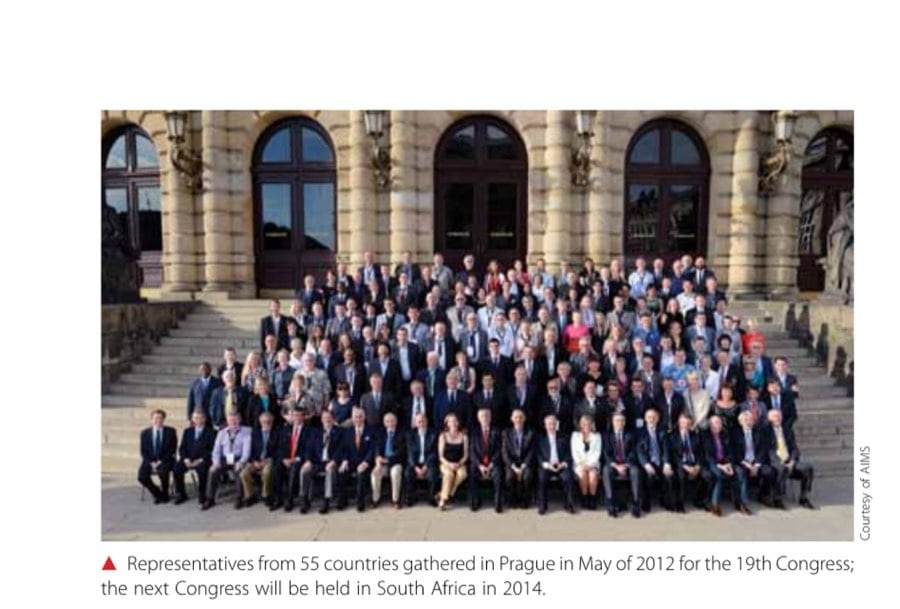
In May 2012, the 19th World Congress of AIMS was held in conjunction with the Volkswagen Prague Marathon. The event was hosted by Carlo Capalbo,
Courtesy of AIMS
▲ Representatives from 55 countries gathered in Prague in May of 2012 for the 19th Congress; the next Congress will be held in South Africa in 2014.
president of the organizing committee of the Prague International Marathon. When asked where he sees AIMS going over the next decade, he said this: “AIMS has the biggest opportunity [to lead the running world] because it is the only global road running association, joining at the moment more than 320 races from 95 countries. It has a great potential in the industry promoting distance running in general and helping the race organizers to exchange know-how, experience, and new ideas to improve the events. “
And further, if you want for one moment to forget about the sports aspect, just two things: (1) how to use the static energy produced by each runner that does a marathon in 30,000 to 40,000 steps, along with [the attendant] arm movements, and (2) how to use Wi-Fi devices which the runner would wear during the race and integrate the data collected into social media—you can imagine the networking of runners, their friends, and spectators. “
The potential developments are just unimaginable! “AIMS has a huge capability to change and to adapt to the new situation. And I am sure that the team headed by the [AIMS] president, Paco Borao, is working very hard on that.”
It was decided at the Prague World Congress that the next World Congress will be held in 2014 in Durban, South Africa, in conjunction with the famed Comrades Marathon, where the coolest cats behind road racing can mix with the crazy cats of ultra road racing.
Information about AIMS is available on its website, www.aimsworldrunning. org.
This article originally appeared in Marathon & Beyond, Vol. 17, No. 1 (2013).
← Browse the full M&B ArchiveMore like this
1,000+ stories from 19 years of Marathon & Beyond
The complete archive of the legendary long-distance journal — digitized and free to read.
