

The Runner’s Nightmare
INTRODUCTION
Bells, gongs, burning incense, colorful flowers, and pilgrims. Peter joins the pilgrimage to the Ganges River on his third and final run and stops at the holy Hindu cities of Rishikesh and Haridwar. His daughter, Joanne Lane, reports. * * * To begin his run to the holy Hindu religious cities on the Ganges River, Peter has to scale the 6-foot-tall Presbyterian Seminary wall in Dehra Dun with a bamboo ladder. He had lectured there all week and knew the gates would not open until 6:00 A.M.
He safely negotiated the rickety heights and dropped on the other side: “Outside the gates were six students who had traveled two weeks by train, bus, and foot from the hills of northern India to return to seminary. They were amazed to see me dropping over the wall!”
As he ran down the narrow lane from the seminary, he glanced back at the hills of Mussoorie, silhouetted against the rising sun. He could just see the route of his first “Temple of Doom Run.” After only 500 meters, he was a lather of sweat. The temperature was 25 degrees Celsius and humidity was around 90 percent—bad running conditions. But Peter knew that as long as he had plenty of water, he was OK.
Dehra Dun, the railhead of the north, was starting to come alive, but most of its 300,000 people were still asleep. “For the first few kilometers out of town, I followed a river of filth: an open sewer that ran outside shops and houses. It was full of filthy water, rubbish, and vegetable scraps and also served as the toilet,” he said.
Strangely, no shops were open yet, so Peter was pleased he was carrying water and food, even though it was already feeling heavy. “The first hour was uneventful, but it was hard to imagine I was in India as I passed a Baskin-Robbins and shops with the latest designer clothes.”
Around 7:30 A.M., Peter entered a small village and stopped for a breakfast of honey and bananas and fresh water. To his horror, no shops sold water, only tea and soft drinks. So he had some delicious sweet milky Indian chai [tea].
At this point, Peter decided he would stop the run if his water ran out and there was no water to buy along the way. Fifteen kilometers out of Dehra Dun, he entered the holy town of Doiwala. It was built on the Ganges River but was grubby and busy. It had taken Peter two hours to cover this short distance! The heat and humidity had taken their toll, and the weight of the water slowed him down.
There was no water to buy, but he cooled off at a service station. He rationed his drinks carefully.
THE PATH TO THE HOLY RIVER IS PAVED WITH . . . As Peter ran out of Doiwala, he crossed the Ganges River. He ran down to splash off in the cold waters. To get there, he skirted endless pools of human feces left by pilgrims who had gone to the riverbanks to relieve themselves. However, the river was refreshingly cold, and it took only 10 minutes before he had dried off again. It was warm!
Fortunately, huge gum trees lined the road, providing a wealth of shade for several kilometers. Even here on a hot Indian road 6,000 kilometers from his Australian home, amidst the sickly sweet smell of buffalo and cow manure and rotting vegetables, there was a cheerful reminder of home. The trees were planted by early settlers and resembled the cheering crowds at the Brisbane or Gold Coast marathons (annual events on Peter’s running calendar) with their slightly swaying branches.
In the gum trees, Peter found another treasure—a billabong. It was really a buffalo water hole: dirty, muddy, but deliciously cool. “I lay down in it to cool off,” he said smiling. “I didn’t care what I smelt or looked like!”
There were other encouragements from passing pilgrims as they headed to the holy towns in convoys of trucks, scooters, cars, and coaches. It seemed they also knew Peter was on a type of pilgrimage. “At one point, a truck pulled up in front of me, and while the male occupants got out to relieve themselves, one fellow ran back to jog with me. “
The man said to me ‘Keeare kurray sahib?’ (What are you doing, sir?) “I told him: ‘Mai Rishikesh or Haridwar co jarrahar hun.’ (I’m going to Rishikesh and Haridwar). “At this he replied: ‘Bohut acha!’ (Very good!) “
He delivered this news to his friends, who also gave me their roar of approval.” Soon after, a hill loomed ahead. Peter felt tired and started to walk. At this moment, he did what all pilgrims do: pray, especially for rain! The road signs to
Rishikesh indicated he had another 10K to go. At this pace in the heat, he would never make it another 35K to Haridwar.
HUNG OUT ON HIS OWN
Joanne Lane Photos
The final 10K into Rishikesh was the worst of all with no water, houses, or shops—only the Ganges flowing about 2K away. It was a tough stretch. He eventually arrived at 11:00 A.M. amidst a slight drizzle. There remained another 25K to Haridwar. It was hot, and there was no certainty of water. Peter decided to hitch. “
Who would pick up a sweaty, smelly runner? I needn’t have worried. Within seconds, a truck carrying five other hitchers had stopped. But after only 5K, we stopped at a police blockade diverting traffic. The driver decided to wait until the blockade was lifted, but I wanted to keep moving. “
Again, within a few seconds, I had another lift on the back of a scooter with a man in his late 50s. The breeze was cool, and I was not worried about being on the back of a scooter in running gear without a helmet. Everyone travels like this, and often there is mum, dad, and three children on a scooter.”
There is no such thing as road rules in India, or traffic police, traffic lights, or markings on the road. There is only one road sign that appears regularly in India. It says: SPEED SLOWLY. Peter was dropped off 5K outside Haridwar near a group of brightly painted temples and ashrams [meditation centers].
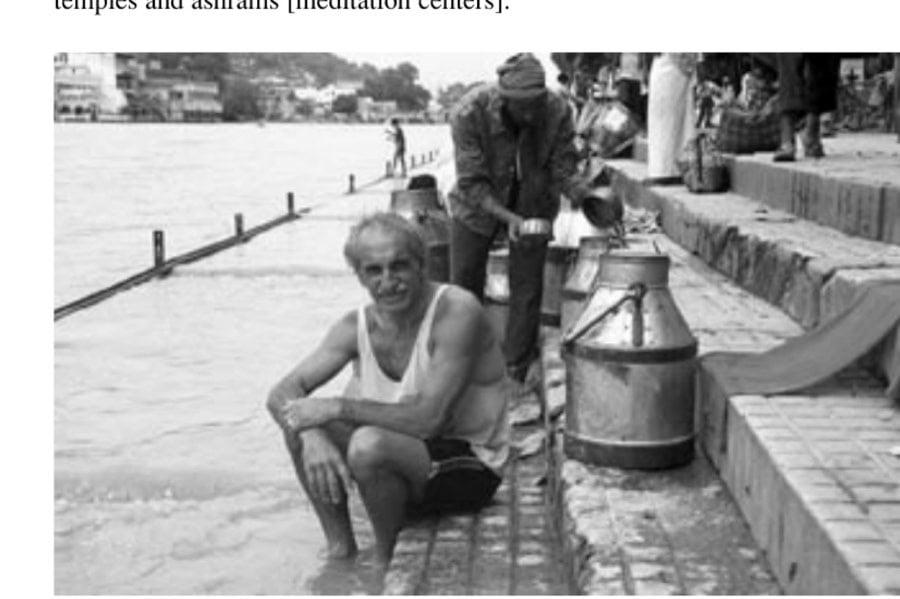
▲ Peter Lane rests by the Ganges River in Haridwar.
“Half an hour later I was still pushing my way through a rabbit warren of narrow bazaar streets, jampacked with sweaty, smelly shoppers. At last I arrived at the bus station to be met by my wife and daughter. All I wanted was to find water and clean up. Yet amazingly in this land where they have a three-month monsoon season that drowns people, closes roads, and floods homes, there was only one tap working in the entire bus station!”
The Ganges was only 1K away, and Peter was able to relax and refresh himself in the cool waters with the other pilgrims. The riverbanks were full of life. Dudh wallahs [milk carriers] washed their empty containers in the river. Families rested under shady trees beside chai shops. Small boys dived into the murky waters from the riverbanks. Others did puja [prayers] and floated flower offerings into the river. They were quickly carried out of sight by the fast-moving waters. At night, candles were floated in the water.
IT WAS A WISE DECISION But Peter was unsatisfied. He was hot, tired, and thirsty and knew he had made the right decision to get a lift. But he felt he had not really completed the run. “The cool Ganges waters certainly put me in a better frame of mind to consider the 25K run back the next day to Rishikesh.”
ad
Joanne Lane Photos
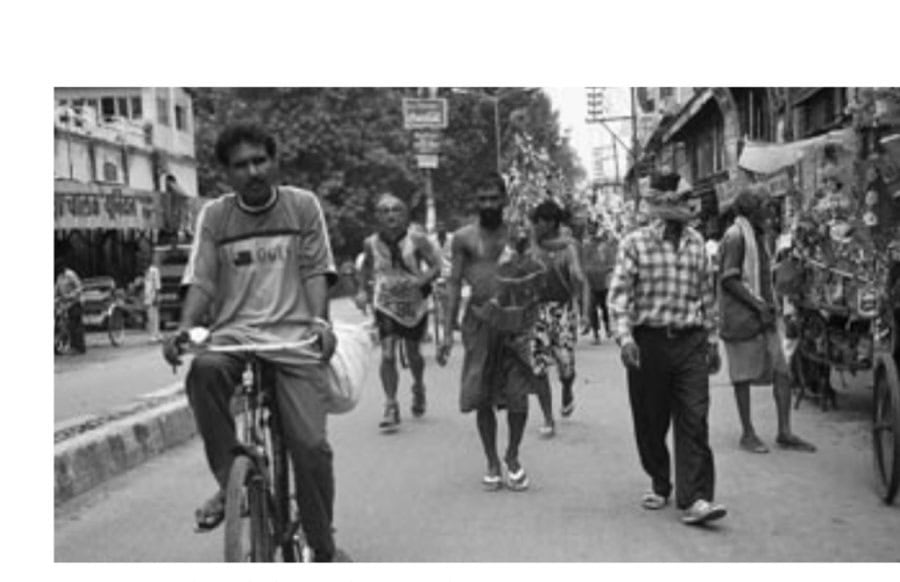
▲ Peter runs through the Haridwar crowds.
But before he did this, there was time to enjoy the sights. Haridwar has an amazing festive atmosphere that goes on day and night with singing, dancing, and parades of brightly dressed people blowing trumpets, ringing bells, and beating gongs. Men in bright blue T-shirts and shorts ran through the bazaar in groups chanting and shouting, “Ram! Ram!” [God, God]. They came up from the Ganges carrying water on a spiritual run that ended around a statue in the middle of the main road into Haridwar.
Other groups of men in orange and red lungis [skirts] carried Ganges water in small containers attached to gaudy, tinsel-covered wooden poles. Many of them walked hundreds of kilometers back to their homes.
At 6:00 the next morning, a beating gong sounded from a temple below the hotel. It awakened Peter. He spent a brief moment debating whether he should run in another day of humid conditions with a sore throat and runny nose.
Then he donned his running shoes and headed out into the Haridwar streets. He soon reached the outskirts of town. The road to Rishikesh was packed with singing, chanting, laughing pilgrims as far as the eye could see. They had begun their long walk home, and the road was filled with young and old.
As Peter passed through the crowds, a gentle rain fell and cooled him off— seems like his prayers were heard after all! The laughter and encouragement from the crowd reminded Peter of the camaraderie that exists at the beginning of a marathon. The road to Rishikesh was also filled with a religious version of the Australian Driver Reviver stations (free driver refreshment stations on national highways). These started just 5K out of town for the pilgrims, but Peter was also invited to
Joanne Lane Photos
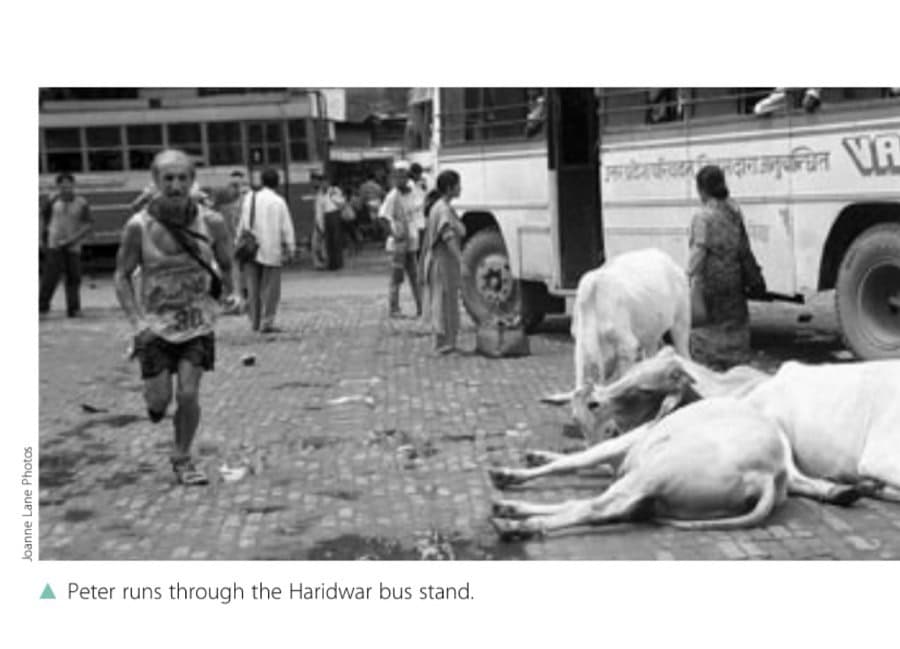
▲ Peter runs through the Haridwar bus stand.
eat and drink there. People manning the stations called to him. “Sahib-ji, khana or chai kayay.” (Sir, please eat some food and drink). Peter needed no second invitation and enjoyed steaming hot tea and bread with the other footsore pilgrims. These stalls were stationed every few kilometers, and there was plenty to eat and drink from water taps and wells. It was a runner’s dream.
RACING THE SUN At 18K (8:00 A.M.), the rain stopped and the last pilgrims were passed. A weak sun fought to come out, the humidity rose, and so Peter stepped up the pace. The last 7K were uneventful, but it was encouraging for Peter to pass the landmarks of
yesterday’s run, like the place where the truck and motorbike had picked him up. He soon entered the Rishikesh industrial area with its garages and greasy mechanics. Buffalo carts ambled past a Western woman, conspicuous with her
shaved head as she waited at a bus stop. The last leg of the run was down a narrow alley, the entrance marked by a series of smelly urinals. At the end of the alley was the bus station, now a quagmire
of mud from the recent downfall. As Peter ran into the bus stop, the sun burst through the clouds and the temperature rose dramatically. Peter was delighted he had not run in the sun. He wandered into the toilet to clean up. Fortunately there was water, but the
toilet attendant demanded money for the water! Peter was in no mood to be hassled and wandered off to sit under a tree, pouring with sweat.
Joanne Lane Photos
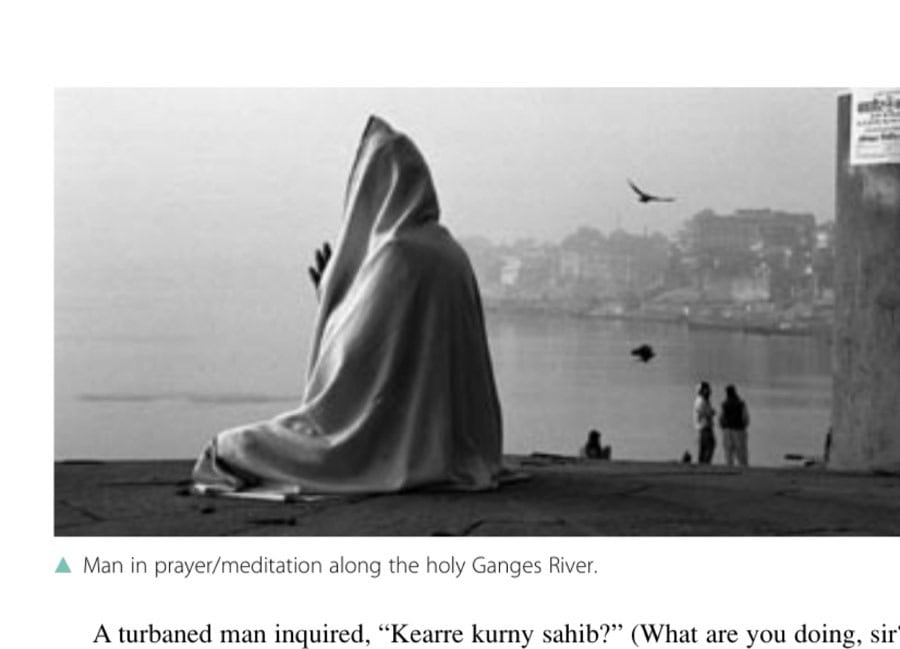
▲ Man in prayer/meditation along the holy Ganges River.
A turbaned man inquired, “Kearre kurny sahib?” (What are you doing, sir?) Peter managed a “Dorrahar” (running) and lay down to rest. “I needed to cool off, so I meandered through the bazaar to the river. When I got there, a friendly English-speaking sadhu [a Hindu holy man] informed me this place was an intersection of three holy rivers: the Ganges, the Yamuna, and the Bhagirathi.”
Peter sat on the sandy shores of the river among the washed-up flower offerings and thought about the three runs, now finally completed. “As I cooled off in the dirty, cold waters, I reflected how, as part of my preparation for these runs, I had made a 10-hour drive, followed by an 18K hike to the Ganges origins—a 250-foot glacier at Gurmukh in spectacular snow-covered peaks some 300K away. Now I was sitting in the warm sun. Nearby, sadhus were talking, pilgrims bathing, and a buffalo was grazing peacefully. India is truly the land of incredible and bizarre contrasts.”
Peter had beaten the challenges of altitude and narrow mountain roads on the run to the Temple of Doom and on his descent into Rajpur. Now on this final run, he had dealt with humidity on the polluted plains, the absence of a suitable backup team, and worst of all, no clean water.
That night back in Mussoorie, Peter again looked down on the Ganges River and the Doon Valley. The lights flickered by the holy cities, but there was no longer a pull for him to go there. “I was finally satisfied. My dream had come true, and it was inspired by a quote I’d memorized. It goes something like this: ‘Some men look at things and ask why. But I dream of things that never were and ask why not.’ Let your running dreams come true.”
This article originally appeared in Marathon & Beyond, Vol. 10, No. 3 (2006).
← Browse the full M&B ArchiveMore like this
1,000+ stories from 19 years of Marathon & Beyond
The complete archive of the legendary long-distance journal — digitized and free to read.
