

The Spy Who Ran In From the Cold
The very last place you would ever expect to find a Cold War-type spy story— complete with clandestine operations, political intrigue, sworn secrecies, flying under the radar, and falsified passports—would be a 100-kilometer footrace.
Wouldn’t you think? Especially if it is supposedly a highly touted competition expected to challenge the best ultrarunners on the planet in a one-shot, winnertake-all ultimate 100K that’s secretly being heralded as a “world championship”? Yes, even so. It was an international, elite-level, Olympics-scale road race that was all done hush-hush! Why?
Because it couldn’t be done, really, any other way. The time was 1989, the place was South Africa, and the reason was apartheid. Actually, the reason was a total ban on all things athletic involving South Africa by international sporting authorities (including the Olympics) and by American national organizations, such as The Athletics Congress (TAC) that later became the USATF and which, then and now, is ultimately governed by the IAAF.
If a banned country with banned athletes wanted to engage in something like a world championship footrace and invite the world’s best—who were all prohibited from competing there—to race within its borders, it had better do all of it under the radar.
And that’s exactly what the sports promoters did in the RSA (Republic of South Africa). They actually pulled off a cloak-and-dagger spectacle right under the very noses of those international authorities, at which those who organized and ran were, in effect, thumbing their noses.
It was the Standard Bank World Challenge 100K Ultramarathon held in Stellenbosch, near Cape Town, in the RSA on the fourth of February 1989, and very, very few people alive today have ever heard of it.
A plot worthy of SPECTRE
▲
South African publicity brochure given to all participants in the Stellenbosch 100K “Ultra Marathon Challenge” and also apparently distributed locally.
Courtesy of Barney Klecker
Trying to understand everything that happened in that southern corner of South Africa some 25 years ago is like trying to read an old Ian Fleming novel with pages missing. Typically, James Bond inserts himself into the bad scene, discovers who the bad guy is (along with his evil plans for world domination), and then proceeds to destroy it all and save the planet.
In the case of Stellenbosch, the world’s best ultrarunners were vying for world domination (which is a good thing), but they were forced to do so under the spectre of looming sanctions and possible bans on ever competing again in their lives. In Fleming’s world, SPECTRE was the fictional “SPecial Executive for Counterintelligence, Terrorism, Revenge, and Extortion.” In the reality of world-class athletics, IAAF stands for International Association of Athletics Federations, and if it catches you competing in an off-limits venue, you can indeed be (at least careerwise) destroyed.
This is not to say that the IAAF was bad. Actually, it was a very good organization struggling politically with a very bad situation: apartheid South Africa. What that amounted to was racism, pure and simple. Apartheid basically means “apartness,” by which the prevailing government enforces racial segregation to the extreme. In South Africa it meant that the white minority held dominion over the overwhelming black majority, which had evolved from the colonization centuries ago of a wholly black territory by invading white Europeans, mainly Dutch.
It is considered unfortunate, by most, that politics and athletics should ever be entangled, but the precedent had long been set before Stellenbosch. In 1980 the United States totally boycotted the Moscow Olympics, mostly as a political reaction to the USSR’s invasion of Afghanistan. (Interesting which country is there today, while the Sochi Olympics were taking place in Russia. But no boycotts in 2014.)
In 1984 the RSA was totally banned from the Los Angeles Olympics. Later that same year, one of South Africa’s greatest ultramarathoners, Bruce Fordyce, was technically banned from racing in Chicago (where he happened to set the still-standing world record for 50 miles). However, in a smoothness worthy of 007 himself, Bruce held dual citizenship and was able to compete in America under his British passport. Such smooth operations had been perfected earlier at the L. A. Olympics by Zola Budd, another South African, who, in her case, suddenly became British.
And so on and on and on. The history of international competition is just chockfull of examples of bad politics interfering with good sports. The Stellenbosch 100K, banned and sanctioned due to political pressures by athletic organizations against apartheid, was no exception.
Consider the unbelievable “James Bondness” of actually staging an entire world-class competition, attended by the best long-distance runners on earth, completely in secret! Well, almost. The actual race was televised, but only nationally—and half of the commentary was spoken in Afrikaans. ABC’s Wide World of Sports didn’t cover it.
Oh, and it was an international race for men only! Despite the fact that women doubtless started running during the caveman days, it was only in 1984 that the very first Olympic women’s marathon ever was held, and women were finally allowed into the Boston Marathon not much prior to that. In South Africa, women just weren’t considered for a 100-kilometer race vying for world domination and the ultimate crowning of a world champion. Presumably, no one could imagine a woman beating the field. Of course, almost no one had heard of Ann Trason yet, either. Never mind outrunning the caveman. In 1989 women were running up against prejudices of the save-man days.
And one more thing, also “James Bondish”: money. Before 1989, world champions at ultradistances received just about zero in prize money. Marathons, of course, offered prize purses, as did quite a few popular races of lesser distance throughout the world. This helps to explain, for example, Kenyan domination at nearly every distance up to 26.2 miles but near-zero participation beyond. There’s just no money in ultramarathons.
South Africa’s Bruce Fordyce had won the RSA’s most famous ultra, the Comrades Marathon, eight years in a row prior to 1989. But it was all achieved, as he said in person in 2011 in New York City, without winning a rand. Nothing! SPECTRE may not have been controlling the money in the early days of ultrarunning, but neither were other international organizations able to accord its champions any kind of a living.
So the lure of big bucks was another force in creating the Stellenbosch race. As the South African TV (M-Net Sports) commentators often pointed out, first prize for the 100K World Challenge was 30,000 US dollars, which gave it a certain
international appeal, although they did say that equalled about 72,000 rand. Also, the sponsor Standard Bank guaranteed prize money for the top 10 finishing places. [Thanks are due to Bruce Fordyce and his wife, Gill, for generously providing their own videocassette recording of that telecast.]
Fordyce’s biographer, John Cameron-Dow, in his book Bruce Fordyce: Comrades King (published and available only in South Africa), tells how the Stellenbosch 100K took shape. After winning yet another prize of zero money at the 1988 Comrades Marathon, Fordyce got together with his friends John Burgess and Mike Gahagan and began hashing an idea of staging a 100K world championship in the RSA itself, despite the politics, despite the ban, despite apartheid. “
Burgess and Gahagan realized that real initiative was required,” Cameron-Dow writes. “Fordyce had watched the growing popularity of 100-kilometer events in Europe and America. He dearly wanted to compete with the best in the world. In his forays into Britain and the States in the early 1980s, he had been invincible, but these were 80-kilometer races, just short of Comrades distance. The idea of running 100 kilometers intrigued him.”
To add some perspective here, there had already been founded (in 1984) a worldwide organization designed to foster ultramarathon racing called the International Association of Ultrarunners (IAU). It exists to this day. On its website (http://www.iau-ultramarathon.org) the association notes: “The IAAF granted its patronage to the IAU in 1988 and the 100km race became a standard distance recognized by the Federation.” Already by 1989, the IAU had staged two very specifically designated “100Km World Championships”—in 1987 at Torhout, Belgium, and in 1988 at Santander, Spain.
One of the founders of the IAU, Dan Brannen, responded to questions and shed further light on this but declined taking full credit. “I accept my fair share of that credit,” he stated in an e-mail, “but my IAU founding colleagues Malcolm Campbell and Andy Milroy deserve equal credit. It was the three of us who got the ball rolling in the mid-’80s.”
Brannen acknowledged that the 1987 100K in Belgium and the 1988 100K in Spain were the first world championships for that distance. Obviously, Bruce Fordyce would have known this. Regarding 1989, Brannen wrote, “From 1989 onwards the IAU was committed to staging an annual 100km World Championship event. The 1989 IAU 100km World Championship was originally scheduled for Paris, France (in the summer. I believe it was June; I’m writing this from memory, without looking it up). However, there were some organizational problems and political issues involving the French Federation and the IAAF, and eventually the ‘World Championship’ designation was removed, and it was officially billed somewhat nebulously as an International 100km race endorsed by the IAU.”
By 1990, as Brannen indicated further, all those “political issues” were resolved and the now IAU 100K World Challenge was hosted by the popular Edmund
Fitzgerald 100K along the shores of Lake Superior and finishing in Duluth, Minnesota. This was Barney Klecker country, but more on that later. Notice that none of these “World Championships” included Stellenbosch, South Africa—despite the fact that it was scheduled between Santander and Duluth and must obviously have conflicted with Paris. According to the IAU website (which now calls these events “World Cup 100 Kilometers”), that 100K, which took place in Paris-Rambouillet, “was not officially recognized by the IAU.” Neither, of course, does it mention Stellenbosch. However, during the 1989 national telecast of that Stellenbosch 100K, the sports commentators did mention the IAU several times, but a lot of those mentions were in Afrikaans: secret code language, eh?
Gold fingers? Biographer Cameron-Dow noted that “the sporting isolation of South Africa precluded any chance of Fordyce venturing into Europe in order to compete there,” although he did run and win England’s famed London-to-Brighton ultramarathon three years in a row (’81−’83), no doubt enabled by his British passport. Nevertheless, by 1988, as Cameron-Dow wrote, “Attitudes against South African sportsmen had hardened considerably since the early 1980s.” So if Fordyce couldn’t leave the country for a true world contest at 100 kilometers, Cameron-Dow concluded, “it was clear that his only chance of competing at top international level lay in the unlikely prospect of the world’s major long-distance runners coming to South Africa.”
Cameron-Dow’s book explains the planning, the financial backing, and the political difficulties and ramifications involved with staging a world championship 100K footrace in what he called a “pariah” country, then arranging media and television coverage of the event, and finally getting everyone to cooperate in hiding the thing. “
Secrecy was an absolute essential,” Cameron-Dow writes. “If European governments had got wind of what was being planned, they would surely have placed enormous pressure on their athletes not to go.” He also states, “Overseas runners would risk their reputations and their careers coming to South Africa, not that they were well remunerated for running.” But money was, indeed, one key to making it all happen.
The organizers Burgess and Gahagan were convinced that “lucrative prize money” was needed. They managed to get Standard Bank of South Africa to provide the financing and thus “the first big hurdle had been overcome.” As Cameron-Dow writes, “Money was required to lure the runners to South Africa.”
If all this seems like a major plot to fool the world, that is precisely what it was. Cameron-Dow goes on to discuss finding and “luring” the international runners and, at the same time, keeping the media quiet.
“Burgess and Gahagan personally traveled abroad in order to interview the top candidates. They resolved to make the proposition as attractive as possible. For this purpose, a scenic route in one of the most beautiful parts of South Africa was needed. Not surprisingly, Stellenbosch was chosen. It was decided that a figure-of-eight course, combining the finest features of the Stellenbosch and Winelands Marathons, would be used. The race would thus be held in the heart of the famed Wine Route. 4 February 1989 was selected as race day. This would be midsummer, a perfect time for tourists to visit the area but a torrid time of the year for running an ultramarathon. The only overseas runner to decline his invitation was Don Ritchie, the Scot who had been well beaten by Fordyce in the London-to-Brighton race some years previously.”
Cameron-Dow continues: “With finance in place and the top ultramarathoners signed up, secrecy was the last major problem. It is quite amazing that plans were not leaked. Twenty South Africans were chosen. All competitors had approximately four months in which to prepare themselves. . . . Television coverage had to be arranged. Wisely, Burgess and Gahagan took the media into their confidence and obviated the possibility of a ‘news scoop’ spilling the beans. “
It is to the credit of everyone involved that the public only heard about the impending event when the visiting runners were all in South Africa. Even then, two French runners were persuaded by their government to withdraw at the last moment. Secrecy had certainly been necessary. “
The clandestine manner in which the event was arranged caused a further complication. Not wanting the news to get out, Burgess and Gahagan delayed the appointment of the race organizer until the last moment. Sensibly, they named Western Province Road Running chairman Chet Sainsbury as their man. Sainsbury, legendary organizer of the Two Oceans Marathon, was given barely two weeks to put everything in place. With his customary attention to detail, Sainsbury managed, with the help of his Celtic Harrier club mates and others, to make the necessary arrangements and to show overseas visitors the quality of top-notch South African organization.”
And there was something else afoot also. In addition to the politics, the prize money, the organizing, the secrecy, and the entire clandestine operation in general, there was also the weather, the time of year, and the baiting of the hook. At first glance, all these stalwart South Africans were seemingly concerned with: (a) wanting a world championship 100K race that all the world’s best could participate in, (b) going to great, secret lengths to achieve it, but also, (c) not wanting the race to conflict, if possible, with the country’s most famous footrace, the Comrades Marathon.
Comrades usually takes place around the end of May, this Stellenbosch 100K was to happen in February, and the organizers believed that it might just be possible for the great South African ultrarunners to do both. February in the RSA is
hot as Hades, but in northern climes throughout the rest of the world, February is as frigid as a walk-in freezer. Who among the great ultrarunners of Europe and America is heat trained in February? Is that why the UK’s Don Ritchie declined his invitation?
So, part of the hook, it was believed, was to lure the greatest overseas ultrarunners to South Africa—Fordyce country—so that Bruce could beat them. (Think perhaps of Auric Goldfinger luring James Bond to play golf—or was it vice versa? Whatever it was, wasn’t that also a setup?) Something involving all this planning as being most favorable to Fordyce is alluded to by his biographer as well as by commentators during the South African TV broadcast of the race.
Cameron-Dow writes, “Once they [Burgess, Gahagan, and Fordyce] had accepted that a 100-kilometer race, billed as a world championship event, should take place and that they were the ones who had to put the plan into practice, the dream was over.” The author here wasn’t saying (as Americans might interpret) that that was the end of the dream. No, he meant that it indicated the wishful thinking or daydreaming part was over. Now began the nuts and bolts work of putting the actual event together. “
They moved swiftly,” Cameron-Dow continues, “into the planning stage. Fordyce’s role was to win the race. They wanted him to focus his attention solely on preparing himself for the event. It was imperative that he went to the start in the best condition of his life. ‘Bruce, get yourself in peak shape and leave the arrangements to us,’ was the message they conveyed to him.”
Then, during the national TV broadcast, at least one unidentified off-camera commentator talked about the prize money: $30,000 for first place, or “about 72,000 rand,” he said, adding “for a lot of our local runners this is a tremendous amount of money.” “
Yes,” agreed another commentator, “it is designed to attract the runners and in fact to reward South African road runners for many years of hard slugging out on the road.” Another commentator acknowledged that prize money was to be awarded to the first 10 places. Since 20 of the 30 starters were South Africans, it was a good bet that quite a few RSA ultrarunners would get paid that day.
Another commentator, in trying to put the money into perspective, mentioned that one of the internationals, Attila Kovacs, from Hungary, earned only about $200 a month at his job. So the Stellenbosch purse “is top money,” he said. Another commentator opined that Kovacs “can be tight for about 10 years if he wins it.”
Still another commentator, identified as Tom Zimmerman, said, “The prize money is very appealing to most of these runners. It is almost unheard of in the United States as well as the rest of the world.” Tom Zimmerman was the other American mentioned by Dan Brannen who traveled to South Africa but chose not to run. Apparently, he then became useful to M-Net TV as a commentator.
Money may or may not be the root of all evil, but it certainly can be the root plot of a good spy story. Isn’t the Krugerrand a gold coin of South Africa? Perhaps Mr. Goldfinger ought to have paid more attention to the RSA than to the USA; and by the way, the Krugerrand itself was banned throughout much of the western world during apartheid.
For your eyes only, 0045125 Into all this intrigue runs one Barney Klecker. Mr. Barney had captured the attention of the entire ultrarunning world when he virtually came out of nowhere, basically ran his first official 50-mile race ever, and set the world record. On October 5, 1980, he ran that distance (which is around 80 kilometers) along Chicago’s Lakefront in 4 hours, 51 minutes, 25 seconds. [Stories of that Chicago event were twice published in Marathon & Beyond. See the issues of March/April 2001 and May/June 2010.]
Four years later, on October 14, 1984—amid all the “pariah” intrigue of apartheid, the USA and IOC banning of South African runners from the 1984 Summer Games, and perhaps even the covert finessing of sudden British citizenship for Zola Budd and dual citizenship for a certain South African—into America strides one Bruce Fordyce. He goes to the same Chicago Lakefront, runs the same AMJA 50-Mile Ultramarathon, and achieves the same result: a world record.
Interestingly enough, just as Mr. Bond has endured over the decades, so has Mr. Bruce’s record. To this day it stands at 4:50:51 for 50 miles. It is also interesting to note that, just as Bond does his work for love of queen and country, Barney and Bruce must have done their work for love of road running. Neither Klecker nor Fordyce won any prize other than a trophy for these universally admired achievements. And by the way, Klecker’s 50-miler has also endured to the present day. It is still the American record for that distance.
Those records were set in the early 1980s, and yet these two world champions were never able to race head-to-head in any effort to determine who was the better runner until February 4, 1989. It was by invitation, for sure, and deep within a banned country, under the “spectre” of apartheid, amid one of the most politically charged sporting events in known history—with itself being mostly unknown!—and set up to be run under the radar without the world’s knowledge and also without women. Bond girls weren’t apparently needed.
This reporter was able to contact Zola Budd, Olympian and potential Bond girl, but she said she wasn’t present at the Stellenbosch 100K. She thought that maybe Frith van der Merwe, another potential Bond girl, might have witnessed it, but this reporter was unable to contact her. South African Frith might well be the female Fordyce: her women’s world record for 50K on road (3:08:39) still
stands! She achieved that feat at Claremont, RSA, just over a month after Stellenbosch. Maybe she was inspired? Mr. Barney was indeed fingered for the gold. Who could blame him for accepting the challenge? Quite a few people, apparently, and not only those in the European ministry (the IAAF) but also those in his own country belonging to the TAC federation. But this surprise twist in the plot will be discovered later.
Your mission, should you choose to accept it, is impossible Mr. 0045125 received a letter dated 23 December 1988 from none other than Michael R. Gahagan, of Sports Business Management out of Johannesburg, RSA. In it Mr. Gahagan mentioned that a contact named Dirk Strumane from Belgium would be coordinating all European athletes. Apparently, Klecker was now among them. “
This race remains strictly confidential,” Gahagan’s dispatch reads, “and we have not in any way publicized the event yet. I trust that this letter will remain closely guarded by you.” And for a quarter of a century, it was.
Sometime before 0045125’s arrival in Johannesburg, his first port of call, he was given solemn assurance that his flight would indeed be under the radar. Not even his passport would reflect the journey. How was this even possible?
In recent interviews, given in 2013 to Marathon & Beyond exclusively, 0045125 himself revealed how it was done. “They gave me a slip of paper,” he said, “which I was to insert into my passport. Then the customs agents would stamp the paper going in and coming out of the country. After I got back home, I could throw the paper away.”
There you have it: international “espionage” on the order of the highest professional risk possible—all of it pertaining to footracing and none of it fiction! See the accompanying image of that very piece of paper on page 89, which, thankfully, for the past 25 years wasn’t thrown away.
But neither was it successful in proving Mr. Barney wasn’t in South Africa. As mentioned, no big publicity actually began until all international runners were safely within the RSA. But then the floodgates opened. Brochures were handed out, the press was given the go-ahead, and national television readied its broadcast. Photos were taken, interviews were done, and the Standard Bank 100 Ultra Marathon Challenge was hyped nationwide.
Klecker was interviewed by M-Net TV. In fact, his interview was the first one aired during a lull after the race start on February 4, 1989. “I’m from Minneapolis, Minnesota, living in the Midwest in the United States,” he said. “I’m 37 years old. I’ve been running for about 22 years.” He gave some more of his background—including running 112 marathons and 15 ultras, three of which were
100K finishes and two other 100Ks that he didn’t finish. Then he basically told the world that he had in fact come to South Africa to race against Bruce Fordyce. “In 1980 in Chicago at the US Championships,” he said, “I set a world record at that time for 50 miles, which was later taken care of by Bruce Fordyce on the same course.” He then described his recent training, admitting that “it’s been directed toward this race.” “
I think I have as good a shot at winning the race as anybody,” said Klecker. “I don’t think anybody’s a clear-cut favorite.” The South African TV sports commentators, however, did have a clear-cut favorite: Fordyce himself. Among those commentators were Nick Bester, a nationally famous Comrades front-runner who spoke only Afrikaans throughout the broadcast, and Dr. Tim Noakes, who is famous among ultrarunners worldwide as the author of the book Lore of Running, published just four years before the Stellenbosch race.
Jumping out of sequence for a moment, Mr. 0045125’s hometown newspapers caught wind of the whole clandestine affair before “The Spy Who Ran in From the Cold” could even get home. One paper’s reporter called Barney’s wife, Janis— herself a champion marathon and 50K ultrarunner—and agreed not to publish anything until he did return home. But of course (this is a spy story, right?) the reporter reneged on his promise and printed a story anyway. To this day, Klecker refuses to mention his name.
Later the Star Tribune of Minneapolis quoted Klecker’s motives by mentioning his 1980 50-mile world record followed by Fordyce’s breaking it in 1984. “That’s something nobody else can understand unless they’re a world-class athlete,” Klecker is quoted as saying. “You hold a world record. Then somebody you can’t run against breaks it.”
Courtesy of Barney Klecker
▲
Paper “insert” from Barney Klecker’s passport designed to keep his visit to South Africa completely secret.
The Star Tribune also reported, “Klecker says an athlete should go where the competition takes him.” In a large-type highlighted box on the Sports page, the paper printed: “‘I don’t think the IAAF has any right to ban a runner from a country for political reasons. We don’t ban Russians when they invade Afghanistan. We don’t ban Americans when the United States invades Vietnam.’ –Barney Klecker.”
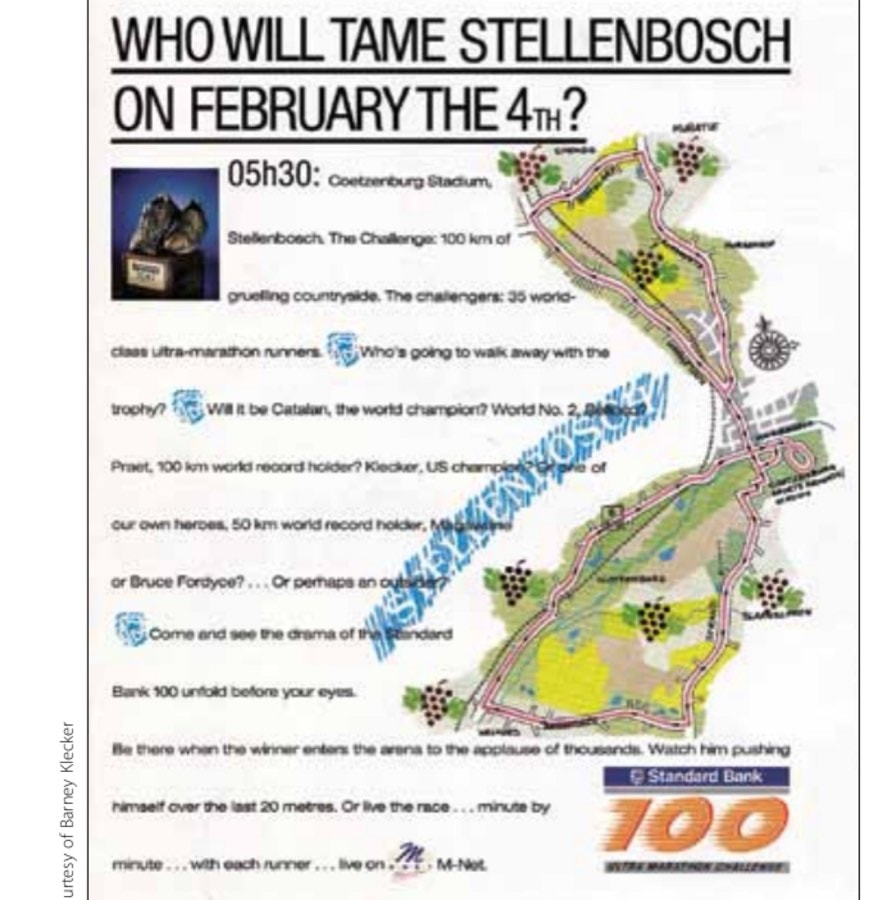
The race itself: the plot thickens It was around 19 degrees Celsius, or 66 degrees Fahrenheit, at 5:30 a.m. local time on February 4 when the Standard Bank 100 Kilometer Ultra Marathon Challenge started on the track inside Stellenbosch’s Coetzenburg Stadium. Ahead the runners faced a country road course laid out, as the TV commentators said, “in a figger of eight.” A triangle composed of three roads was established to the north of the town of Stellenbosch, and a similar route was set to the south. Each triangle equaled
Courtesy of Barney Klecker
▲
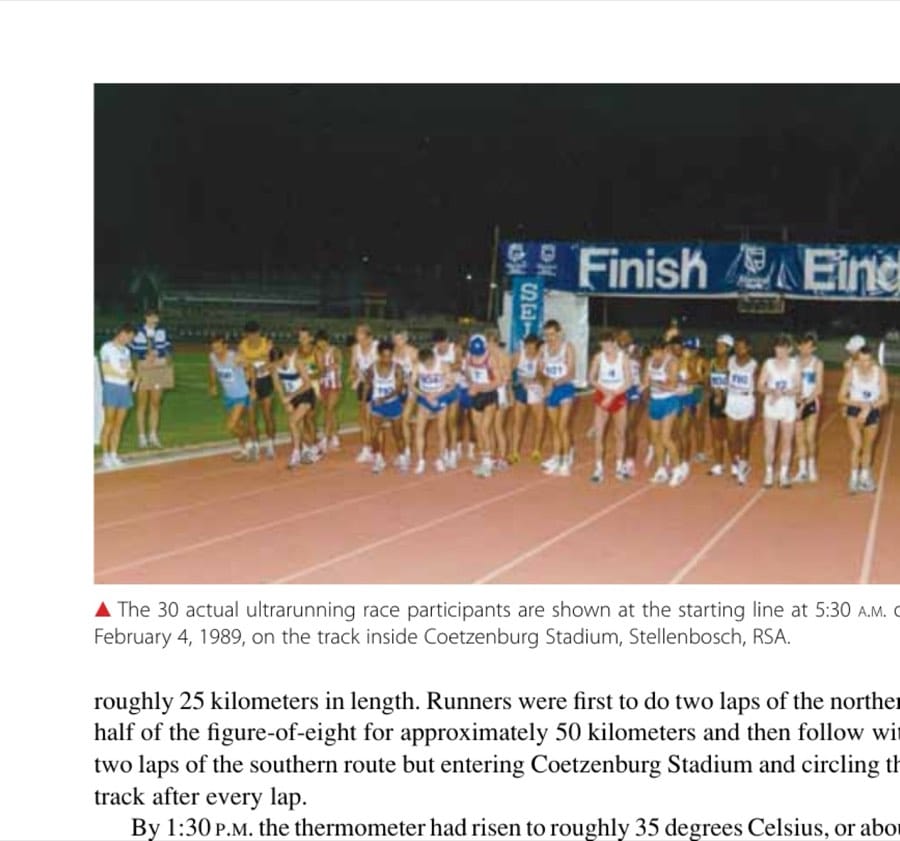
Back page of the South African publicity brochure, depicting the racecourse, given to all participants in the “Ultra Marathon Challenge.” Although 35 worldclass runners were supposed to race, only 30 actually started.
Courtesy of Barney Klecker
▲ The 30 actual ultrarunning race participants are shown at the starting line at 5:30 a.m. on February 4, 1989, on the track inside Coetzenburg Stadium, Stellenbosch, RSA.
roughly 25 kilometers in length. Runners were first to do two laps of the northern half of the figure-of-eight for approximately 50 kilometers and then follow with two laps of the southern route but entering Coetzenburg Stadium and circling the track after every lap.
By 1:30 p.m. the thermometer had risen to roughly 35 degrees Celsius, or about 95 degrees Fahrenheit. The Cape Town Cape Times for February 6 reported that during the second half of the race “the temperature on the road was announced 45 C.” That’s 113 degrees Fahrenheit! Since the last finisher recorded a time of 7:49:02 for the 100K, the whole race was over by 1:30 in the afternoon.
Thirty men started—touted as the best ultrarunners in the world—although 35 of the world’s best were supposed to start, according to the brochure hyping the race. But even the 30 who actually started weren’t the 30 (out of the 35) who were scheduled to start. Even more political intrigue! And of the 30 who did start, only half finished.
The spy who came in from the brutal Minnesota winter only to run in the blistering heat of 113 degrees Fahrenheit on those rural roads near Cape Town beat his goal time of 7:30 for the 100K and finished in 14th place. He ran 7:25:29 (indeed a blistering pace by today’s stats) but nevertheless looked on television like he was dying. The only runner he beat was a South African, Louis Harmse.
Louis Harmse wasn’t in the brochure. Neither was Johnny Halberstadt, another South African who had run Comrades many times and was beaten many times by Fordyce. These two local runners were more than likely replacements for two
other international runners who were in the brochure. Two Frenchmen, Christian Roig and Bruno Scelsi, had flown to South Africa and were all dressed and ready and had posed for the prerace group photograph, but at the very last minute their own government strong-armed them not to run the race.
According to the M-Net TV commentators, Roig and Scelsi “had to pull out before it started, and that was due to political pressure.” Again more than likely, it was the French Federation of the IAAF, and not the republic’s central government in Paris, that did all the applying of that pressure. Nevertheless, there was another, apparently rebellious young Frenchman, who thumbed his nose and ran—and finished—the race. Jean-Marc Bellocq’s time of 6:37:48 was good for fourth place and—although unconfirmed—prize money amounting to something a bit less than $5,000. Third place, won by the black (yes) South African, Philemon Mogashane, was for $5,000 in prize money. Again, as with any good spy movie, big bucks can trump political allegiance.
Presumably then, two out of three drops from the French contingent opened the door for Harmse and Halberstadt, thus making a starting field of 30. Presumably also, among the five international runners who were included in the field of 35 were Don Ritchie, whom the TV commentators also acknowledged as having refused his invitation, and the American Tom Zimmerman, who apparently then found a job helping to comment. He is identified several times during the broadcast, although not appearing on camera.
This reporter cannot help but wonder whether the American Federation of the IAAF (TAC) exerted its political muscle in Zimmerman’s case as well. With Ritchie and Zimmerman, that made 32 of the 35, but who the other three were remains a mystery. Maybe their cover was just too deep.
One exceptionally famous international ultrarunner who always felt superior to Greek politics (this can be gleaned from other writings, his own fan-club-like website, and his later choosing to live in Australia) is Yiannis Kouros, who was there, who is pictured in the brochure, and who was among the 30 that did start the race.
But Kouros did not finish! His official results show an ending 50-mile time of 5:27:59 and nothing for 100K. He must have dropped either at 50 miles or between 50 and 62 miles. Throughout the TV broadcast, commentators were idolizing the famous Greek as the best ultrarunner in the world, since he had by that time set world records in distances mostly beyond 100 kilometers. They were saying that, for Kouros, this 100K Stellenbosch race was “like a sprint.” Even Fordyce himself, who was also interviewed, thought so. He and everyone else who expressed an opinion of Kouros on television just automatically assumed Kouros would finish, and finish strong!
Not so. And other surprising dropouts included famous (either already or soon to be) South Africans and Comrades front-runners Alan Robb, Mark Page,
Charl Matteus, Johan Ebersohn, Arthur Lemos, and Thompson Magawana (another black competitor). By 1989 apartheid had apparently relaxed its stranglehold on black South Africans who were athletes and runners. Many were running Comrades by that time. As one commentator quoted in the Minneapolis Star Tribune put it: “Of course, the race he [Klecker] ran was integrated. Whenever a South African team comes here it’s integrated, too. Sport is used in an attempt to show the soft side of apartheid.”
Actually, it took only one more year before apartheid was disbanded in South Africa itself—in fact, almost one year to the day. As Cameron-Dow recorded it, “On Friday, 2 February 1990, President F. W. de Klerk opened Parliament with a speech in which he unbanned political organizations including the ANC and effectively ended apartheid.” Fordyce himself said everything then was “hopeful,” and nine days later Nelson Mandela was released from prison.
That might seem the perfect happy ending to this running story about a nearly unknown underground road race that took place in the sizzling heat above ground, but no. There’s more, much more.
“M” figures into this undercover adventure also But “M” in this case isn’t 0045125’s boss back at Her Majesty’s Secret Service headquarters. No, it’s the South African television network M-Net—or, as the suave, young, yellow-shirted commentator Darren Scott called it, “M-Net Super Sport.”
Perhaps reminiscent of the American television program ABC’s Wide World of Sports, all of the South African commentators wore yellow shirts, whereas the ABC broadcasters wore yellow sports jackets. Mullet-coifed Scott hosted what was called the “studio panel,” which featured various commentators at different times. Noteworthy besides Scott himself were the already-mentioned Dr. Tim Noakes and Nick Bester, runners Bernard Rose
Courtesy of Barney Klecker
▲
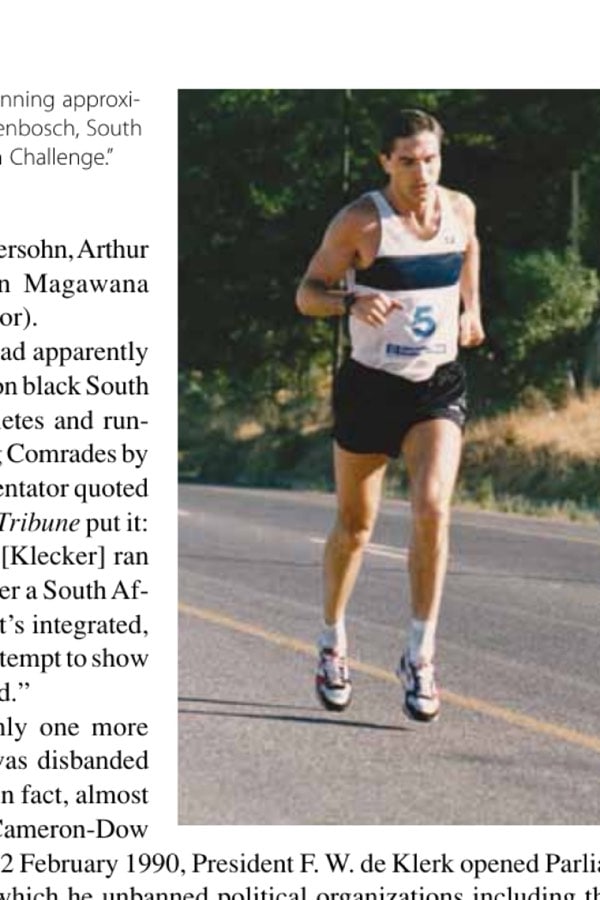
Barney Klecker shown running approximately midrace in the Stellenbosch, South Africa, 100K “Ultra Marathon Challenge.”
Courtesy of Barney Klecker
and Tony Dearling, and another medical expert, Alan Edwards. The main subjects of their discussion seemed to be: “Where’s Bruce?” “How far behind is he?” and “Are they still on world-record pace?” Other commentators on the course, either in the lead van or along the roadsides, included the already-mentioned Zimmerman, Derek Watts, and Mike Gahagan himself. There was a Robert Walsh positioned along Klapmuts Road heading into Stellenbosch on the north loop and very likely others as well. Someone called “John” headed up the other half of the TV coverage, which was spoken entirely in Afrikaans. Thus one-half of the show could be kept indecipherable to American and European audiences simply by using the native code language.
Biographer Cameron-Dow said by e-mail that he was there also. “Yes, I did attend the 100K race,” he wrote. “In fact, race organizer Chet Sainsbury, a club mate and good friend, asked me to help out as a marshal. I did so and took up a position on a corner which marks the entry into Stellenbosch itself during the second half. The spot was about 1K from the stadium and I have a vivid recollection of Bruce speeding past me, looking light on his feet and remarkably fresh. The fact that he finished in a state of collapse is an indication of his total focus and mental strength.”
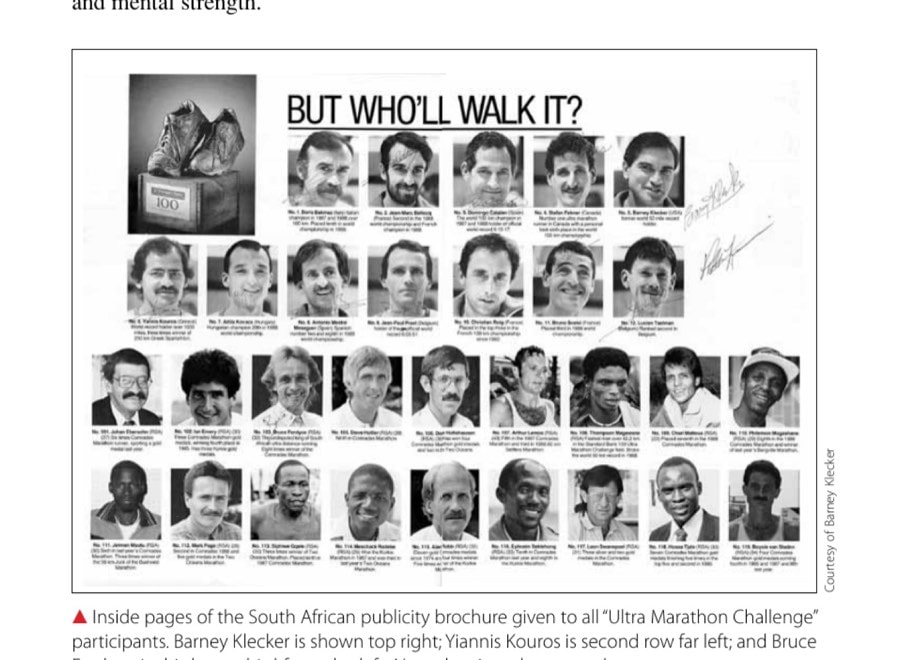
▲ Inside pages of the South African publicity brochure given to all “Ultra Marathon Challenge” participants. Barney Klecker is shown top right; Yiannis Kouros is second row far left; and Bruce Fordyce is third row, third from the left. Note the signed autographs.
Typically, other TV commentators in awe of Fordyce made remarks like that of Tony Dearling after the first 25K: “I sincerely believe Bruce is the king of logistics. He knows exactly what it’s going to take to win this race, in terms of a time. If it’s a 6:15, he knows he must do 3:40 minutes a kilometer, and I believe he knows through major checkpoints what time he should be on, going through, to get the world mark and to get a win; and I really think he’s going more for a win than for a world record.” It may have been Tom Zimmerman, off camera, who talked a bit more about 0045125. “Barney is a very big runner,” he said. “It’s amazing he runs as well as he does.” The commentator also remarked that Barney is “outspoken” and that he “likes to spur people on,” perhaps apply a little psychological pressure, and “get them to make mistakes.” Zimmerman also acknowledged having been a runner in Chicago at that very AMJA 50 Mile/100 Kilometer Ultramarathon in 1984 when Bruce broke Barney’s record. “I was amazed,” he said, but he was speaking about Bruce, not Barney. According to Zimmerman, Barney had predicted that the winning time for the Stellenbosch 100K would be 6:15. As part of the whole Saturday show on M-Net TV, more runners than just Barney were interviewed before race day, and those segments were aired during lulls in the race. Certainly Fordyce was one, and he couldn’t resist commenting on 0045125 either. “I have a lot of respect for the American Barney Klecker,” Bruce said, “because I have the world’s fastest time for 50 miles, 80 kilometers; but he has the world’s second-fastest time—and it’s not much slower than mine—and he’s actually billed it [Stellenbosch] as a two-man race. But he’s very confident about himself. He says that it’s the two greatest ultramarathoners in the world, Klecker versus Fordyce, and forget everybody else! I’m not quite as confident as he is that it’s just a two-man race.” As another off-camera commentator said during the broadcast, “It’s good to have the present and the former 50-mile champion here.” Near the end of his interview, Bruce added: “To be quite honest with you, I really know my ultramarathoning well. I know I’m very passionate about the sport, I know a lot about it, I do a lot of reading about it, and this is undoubtedly the finest quality 100-kilometer race ever. There’s hardly anybody missing. And you never ever will get a field like this together again.” Bruce mentioned the difficulty
the South African 100K runners had in prepping for the race. What it involved, of course, was having to train hard during December when every other serious Comrades runner was resting. He writes a newspaper column, he said, that gives running advice—among which is his stern advice to relax during the Christmas holidays. Meanwhile, for that particular Christmas, his readers saw him outdoors running hard.
Hypocrisy? No, Stellenbosch, but nobody could be let in on the secret! Bruce did say, though, that wives and girlfriends had to be told what was up, but he also thought “they were excluded from the fact that there were overseas runners coming.” It was interesting that he should make such a remark about wives and girlfriends, since he and his fiancée Gill had just been married on December 2, 1988. “I’m very surprised that it’s actually stayed as quiet as it has for so long,” he said regarding the clandestine nature of the Stellenbosch event. “I’m just amazed that it has kept so quiet.”
Coming in from the cold, going back to the cold, and facing the heat! The very last thing you would ever expect from living in frozen northern climes, traveling halfway around the globe to an entirely different climate and culture, beating yourself up for 62 entire miles on sizzling hot roads in 100-plus-degree heat for nearly one-third of a day, and finishing well out of the prize money in 14th place is to be punished for it.
Wouldn’t you think? Especially if you’re an American champion, an American record holder at a number of distances, a 2:16 marathoner, an otherwise totally law-abiding citizen, an ambassador of athletic goodwill—also, by the way, an inventor of an improved type of snowshoe—and yet haplessly thrown into the unwitting role of ultrarunning’s James Bond. For that, apparently, you have to suffer.
As Dan Brannen recalled, “Shortly afterwards the Secretary-General of the IAAF announced that all who had competed were immediately suspended from further competition.” TAC/USA (before evolving into USATF), which was the American federation of the IAAF, took formal action against Klecker within months. Brannen recalled that “Klecker was informed by USATF that he would be subjected to a suspension hearing panel, which he was.”
The previously mentioned Star Tribune carried a huge news story on this in its issue for June 21, 1989, right smack on page one of the Sports section. The headline reads: “Running battle: Klecker disputes reasons for South Africa boycott.” The article’s first paragraph tells how Klecker “became an outlaw” for running a race just like “he’s been doing from Singapore to Duluth for 20 years.” “
But this race . . . was held in Capetown [sic], South Africa,” the second paragraph reads, which “gained him the wrath of The Athletics Congress, the governing body of track and field in the United States.”
The Star Tribune goes on to say, “Sometime this summer, a three-person TAC panel will conduct a hearing in the Twin Cities that could lead to Klecker’s suspension from TAC-sanctioned races. TAC is a member of the International Amateur
Athletic Federation [sic], the world track and field governing body. Since 1976, the IAAF has banned competition in South Africa.” Quite a bit of the information in that article was wrong—such as Klecker’s age at the time and his reported 15th place finish—but the possible suspension was real. Brannen rightly remembered that the TAC panel never actually met, but there was a reason for that. The reason was Klecker’s prehearing diplomacy, negotiations, and willingness to compromise.
Instead of 007’s license to kill, which would have solved the problem for James Bond, 0045125 used his license to talk (per the First Amendment of the US Constitution). Publicly, he expressed himself all over the newspapers; privately, he negotiated with TAC under the spectre of suspension.
As written on the second page of the Star Tribune’s article, “Klecker wonders why US companies can do business with South Africa, consumers can buy South African jewels, and black workers from surrounding nations can work in South Africa while athletes are barred. Klecker, too, recognizes the contradiction. ‘Why should sport be holier than thou?’”
At the article’s end, Klecker is quoted as saying, “It’s not like robbing a bank or committing a murder. To me, running in South Africa is not a crime.” Nevertheless, no matter how illogical TAC’s and the IAAF’s official position was, they seriously did mean to enforce their ban. The appointed head of TAC’s hearing panel on Klecker, Julia McKinney, a California lawyer, was also quoted in that Star Tribune article. “
If [Klecker] believes an athlete should be able to compete anywhere, that’s fine,” she is quoted as saying. “But then the athlete has to be willing to take the consequences, just like anything else in life. Nobody can stop him from competing in South Africa. But if the charges are upheld, he’ll be doing a lot of running in South Africa because he’ll be precluded from running anywhere else.”
But a superstar like 0045125 does not attain such fame without wielding considerable influence, athletic and otherwise, nor does such a one need to suffer without help and technical support. In the case of the movies, 007 had Q. In 0045125’s case, he had Klitzke.
Louis L. Klitzke, EdD, was at the time a psychology professor at Klecker’s alma mater, the University of Wisconsin−Stout. He was also a longtime friend and mentor who voluntarily insisted on helping Klecker to defend his cause.
The short history of Klitzke’s battle of the letters with TAC’s hearing panel (now called “Board of Review”) is a study in how lawyers pick nits—as are nearly all such battles that utilize their own license to kill (more and more trees to make paper).
One letter in Re: TAC v. Klecker was dated June 22, 1989, just a day after the Star Tribune had published its big story. But instead of coming from Julia McKinney, it was sent by Alvin Chriss, special assistant to the executive director
of The Athletics Congress of the USA, apparently headquartered in Indianapolis. Chriss’s letter seemed to officially put the clamps on Klecker and summon him to a hearing. Lou Klitzke wrote back to Chriss on July 13, suggesting that an agreement might be negotiated that could avoid the time and expense of an in-person hearing. Basically, he proposed a letter from Barney that would acknowledge his racing in South Africa despite the ban, explain his reasoning, suggest as punishment a voluntary ban from all racing for one full year from the date of that Stellenbosch 100K as well as volunteering to work for TAC as its goodwill ambassador regarding all athletic matters, and finally that the purposes for holding a hearing in the first place could simply be accomplished by TAC’s agreeing to Barney’s proposal for making amends.
Chriss fired back his “several good reasons for my position,” which was: “I am unable to dispose of the matter along the lines you suggest.” To his credit, he was able to squeeze all those many reasons into the confines of just two single-spaced pages (perhaps saving who-knows-how-many trees). One of his more interesting ones: “I am uncomfortable at equating service to TAC/USA as a form of punishment.”
A question that might well have been asked of him was (but of course wasn’t): if he were a prison warden, would he be uncomfortable with equating chain-gang highway cleanup services as a form of punishment? It apparently didn’t dawn on the powers that be that they were engaged very specifically in the business of punishing Barney Klecker.
He and Lou Klitzke were merely suggesting more positive and constructive ways to do it. Much more telling was the private correspondence between Lou and Barney. Here’s an example from Lou’s written notes sent to Barney on August 15, 1989. His log entry for August 7 reads in part: “2:20 p.m. called Mr. Chriss and he received the call. His manner was very different from the last few calls, much more like the first couple of times—abrupt and interruptive. He said the letter was unacceptable without suggesting an alternative hearing date. He commented that basically nothing beyond our telephone conversations was in the letter and that this was his first day back from vacation and that he was very busy. When I said: ‘You realize that this is a requirement of the letter not previously indicated,’ he said, ‘I don’t have to realize anything. I am the antagonist in this case. It is for your convenience that we are negotiating.’ Some other comments were made, several interruptions when I tried to speak. ‘I will give you through tomorrow to suggest a date for the hearing. Unless you are prepared to suggest one now, I have nothing further to discuss with you.’”
Slam! Eh? The upshot of all this was that perhaps Mr. Chriss and Ms. McKinney (indeed TAC/USA and perhaps the IAAF itself) were not very easy to negotiate with.
And so the matter of TAC v. Klecker dragged on. And on. But it wasn’t litigation, actually, so the Plaintiff v. Defendant legalese wasn’t appropriate here. Of course, neither was apartheid, and neither was the ban. Nevertheless, it took more than another whole year for the matter to be resolved anyway—which, for lawyers, is blinding speed. Maybe something like world record pace? And just for the record, the official TAC/USA record of these proceedings is labeled: “In the Matter of Barney Klecker: OPINION OF THE BOARD OF REVIEW.” So the verdict finally came down on October 12, 1990. Two days prior, there apparently was finally a hearing. But it took place by telephone conference call between and among Julia McKinney, Steven Bosley, and Candy Young (for the prosecution); Alvin Chriss, “witness for TAC/USA”; and Barney Klecker (for the defense). In brief (yes), the facts, findings, conclusions, and holdings were all listed. Thankfully, no one disputed the fact that
the South African race took place or the fact that Barney Klecker ran it. Among the “facts” listed were that Klecker and his representative, Dr. Klitzke, began negotiating “after the Notice of Hearing dated June 2, 1989, was received”; then Klecker submitted an unsigned letter dated September 22, 1989, “to the National Athletics Board of Review”
basically apologizing and agreeing to other things—including voluntary suspension from competition for one year (to February 1990). Basically, since this was already October 1990, you could say that Klecker’s sentence was commuted to time served. And so that very month (October 1990) saw his return to competition at his old haunt, the Edmund Fitzgerald 100K, running from Little Marais to Duluth, Minnesota. Also, as it just so happened, that race was designated the official IAU World Cup Championship for that year, just as Belgium, Spain, and Paris were 100K world championships for 1987−89 previously. [This information, though not easily searchable, can yet be found on the IAU website using this direct link: http://www.iau
ultramarathon.org/images/ file/IAU%20100km%20World%20Cup%20Results%201987%20to%202008.pdf. Another way to find this is to click on “Races, Results and Rankings,” then on “Rankings,” and finally on “IAU 100km World Cup 1987 to 2008.”]
And a most interesting loophole can be found in the hearing panel’s “findings,” to wit: “The IAAF rules do not expressly include ultra-marathon competitions (i.e., running competitions of a length greater than 26.2 miles) within IAAF jurisdiction.”
So the panel’s “conclusions” basically said what you might expect lawyers to say: that everything happened precisely as stated, that some ambiguity in the rules allows all present to escape—without, of course, admitting any wrongdoing—and that everything that has happened so far has happened so far.
The three-page document was signed and dated by Julia McKinney “For the Panel.” (Here is an imagined corollary: All present attorneys would like for this nondecision to be appealed ad infinitum so that all attorneys can be paid ad infinitum, until that inevitable day when the same nondecision can finally not be rendered just the same as it wasn’t today.)
Anyway, better heads prevailed and the whole thing was dropped like a hot potato French-frying on the sizzling rural roads of summertime South Africa.
Here, then, are the credits rolling at the end of this movie While the script might call for Agent 0045125 and his Barney girl to run (at breakneck pace) off into the sunset along Highway 61 toward Duluth next to Lake Superior (which he and Janis actually have done), in truth, shortly after all this, Barney Klecker fell on black ice during training and permanently injured his foot and ankle, thereby taking him right out of all future competition—just as TAC, USATF, IAAF, and even the Olympics might have wanted to do to him themselves for having the audacity to race “illegally” against a rival in that rival’s home country.
Other credits are deserved, too. For example, this reporter contacted the IAAF repeatedly for well over a year without that organization responding to a
single e-mail. This reporter also airmailed an inquiry letter to IAAF headquarters in Monaco, addressed to America’s representative Robert Hersh, titled “Vice President, USA,” but no response was ever received from him, either. No official in this organization ever acknowledged anything whatsoever regarding that Stellenbosch international 100K race or the IAAF’s sanctions against it.
After more than a year of asking whether a sanction might still exist against those who ran there in 1989, someone at IAAF named Sean Wallace-Jones finally e-mailed this response on December 4, 2013: “There are currently no bans or sanctions currently [sic] in place against the RSA relating to the apartheid period.”
After this reporter inquired further about Klecker, in particular, at Stellenbosch, that same Sean e-mailed back: “I am afraid that I cannot help you further with this one as I am not aware of the incident in question—occurring some years before I actually joined the IAAF.” Subsequent requests to Sean that he forward the inquiry to someone else at IAAF who might know went unanswered.
Credit is also due to John Burgess, one of the originators of the Stellenbosch 100K and a personal friend of Fordyce, who was kind enough to forward an e-mail. Mr. Burgess e-mailed back his reply-to-all: “Hi Rich. Would be a pleasure to talk to you and Bruce. Rich might find the secrecy and MNet/SABC/Sponsorships/ Tax deductions/Oakley Sponsorship all interesting unless maybe a hot potato! Will discuss with you tomorrow! John.”
That was on July 12, 2012. Apparently tomorrow never came, and further questions e-mailed to Mr. Burgess were never answered. But there was that secrecy thing again, causing further reportorial frustration at not being able to investigate South Africa’s frustrations, too, in trying to make it all happen.
And of course since apartheid itself fell apart—just months before that “Opinion of the Board of Review” in the matter of Barney Klecker did—some credit is also deserved by sporting authorities around the globe for having the wisdom to stop persecuting athletes long after the politicians stop persecuting people, against which persecution those sporting authorities were reacting in the first place.
This too: how about credit being given to Bruce Fordyce for actually winning the damned race—as expected, and thus collecting that 72,000 rand first-place prize money—and the fact that he ran it in world-record time!
Oh, one last thing. Remember how all of this came about in the first place because of that IAAF ban on all things athletic involving South Africa? How about now giving the IAAF credit for this: Today if you go to its world-athletics-ruling website, http://www.iaaf.org/home, and click on “ATHLETES,” and then type into the top-left box the name “FORDYCE” and press Enter, watch what happens!
Want a hint? Well, the IAAF itself—instead of banning all this—will now tell you Bruce’s personal best time for the 100K (then a road world record) and exactly where and when he set it.
This article originally appeared in Marathon & Beyond, Vol. 18, No. 5 (2014).
← Browse the full M&B ArchiveMore like this
1,000+ stories from 19 years of Marathon & Beyond
The complete archive of the legendary long-distance journal — digitized and free to read.
