

The Third Olympian
Editor’s note: During the 1970s, the United States dominated the marathon, especially when it came to international competition. During that era, the Fukuoka Marathon in Japan served as the unofficial world championship. Frank Shorter won Fukuoka every year from 1971 to 1974; Bill Rodgers won it in 1977. On the Olympic front, Frank Shorter won the gold in 1972 at Munich; Kenny Moore took fourth and Jack Bachelor took ninth. In 1976 in Montreal, Frank Shorter took second and Don Kardong took fourth. After the fall of the Berlin Wall, it was discovered that the 1976 gold medal winner, Waldemar Cierpinski, was on performance-enhancing drugs and should have been disqualified, which would have moved Shorter to first and Kardong to third. Closer to home, Bill Rodgers repeatedly won Boston and New York, and Don Kardong won Honolulu in 1978.
Kardong, a graduate of Stanford, also developed as a humorous writer and was a frequent contributor to Runner’s World. On several occasions he collected his writings into book form, the most famous of those Thirty Phone Booths to Boston. But perhaps his most lasting legacy was the founding of the Bloomsday 12K in Spokane, regularly one of the largest road races in the world, and the linchpin of Spokane’s annual sporting calendar.
As we approach the 40th anniversary of Kardong’s 1976 fourth (or third) place marathon performance in Montreal, Hal Higdon shares the profile of Kardong he wrote in 1980 for The Runner Magazine. The article also appears in Higdon’s eBook, An Olympian Feast. “PEOPLE ARE flabbergasted. They say it was only three seconds you lost by! And to run 26 miles, for over two hours, and come down to the last half mile, where you’re with somebody, can’t you somehow find the strength to sprint, or pick up the pace, to take that bronze medal? I always tell them. ‘Yeah, that’s what the other guy did.’” “
I have this theory,” says Don Kardong. There is this glint in his eye, what might even be described as a malevolent twinkle. Kardong, perhaps more than
any other top-class distance runner today, has theories. One does not think of Frank Shorter or Bill Rodgers as having theories. Perhaps they do, but one accepts at once, instantly, the fact that Dingy (to use his nickname from his days as a summer-camp counselor), the third member of the US 1976 Olympic Marathon team, has theories, stratagems, ideas, conceptions even, schemes maybe, so that despite being extremely talented and similarly dedicated, he, more than anyone else, will think his way, not merely sprint his way, to the finish line of races of 26 miles, 385 yards, in which his fastest time (set in the 1976 Olympics) is 2:11:16, by the way.
Kardong is sitting this afternoon in the living room of a home in Hamilton, Bermuda, where he has run a 10,000-meter race earlier in the morning, finishing, for Pete’s sake, two places behind Grete Waitz—for let it be said that Don Kardong has his ups and downs, one of the downs being that day’s race in Bermuda, two of the ups being the surprise of his making the 1976 Olympic team followed by the shock of his fourth-place finish at Montreal. If you are going to have ups and downs, it is nice to be able to organize your ups into an Olympic year.
Kardong has his feet on a coffee table on which rests an unsipped cup of tea. He is about an hour away from his second workout of the day: 10 miles at 6:30 pace with Herb Lindsay and two other runners. “I have this theory,” Dingy continues, “that the first half of the marathon you do your disassociating, then you associate the second half. At Montreal I carried it to an extreme, really trying to keep my mind off the marathon until the last 10 miles. And to do that I would wave to people I knew, look around, and distract myself. It got to where I would pick up one of the water bottles at the aid station, drink some, and then throw it to some young kid: ‘Here’s a souvenir!’”
Kardong shifts his long frame now and reaches for the cup of tea, sips, continues: “At about eight or 10 miles, I took the water bottle, drank, looked up, and there were some guys sitting on the front porch of this house. So I decided, ‘This will be funny. I’ll throw it up to them,’ A real mature Olympic athlete here. “
I gave the bottle a toss, but it was a little off, and I realized it was heading right toward this picture window. I had visions of the window shattering, and these guys didn’t believe what was happening. All of a sudden they had to put their hands up over their heads. And if the toss had been three inches lower it would have gone through the window. As it happened, it hit the eave of the house. Afterward, people suggested that if the bottle had broken the window and they had come after me, I would have run those three seconds faster that I needed.” DON KARDONG also tells a story about riding in a taxi to the airport with Frank Shorter after a race in Charleston, West Virginia, several months after the 1976 Olympics. Frank won in Charleston; he had been second at Montreal. The taxicab driver, looking over his shoulder, commented: “So you won some hardware, huh?”
Frank’s response was simply, “Yeah,” so Don decided to inform the driver of the identity of his passengers. “That’s Frank Shorter.” “Nah,” said the driver. “That’s not Frank Shorter.” “Yes, it is,” said Don.
The driver turned around again: “Are you really Frank Shorter?” “Yeah.” The driver paused a minute, thinking, then frowned: “Say, what happened to you in Montreal?” Kardong uses the story, which he tells with relish at clinics, to illustrate the ambivalence of the general public, its attitude toward excellence where even a silver medal in the Olympic Games might be considered a failure, but it also illustrates the relative anonymity of Kardong himself, who finished a mere two places behind Frank in that Olympic Marathon, missing by those three seconds a chance to stand on the victory steps and watch his country’s flag raised on the flagpole. The United States Olympic Marathon team in 1976 had three members. The identity of Frank Shorter had been imprinted on the public consciousness by his previous gold medal in 1972. Bill Rodgers, who experienced a rare bad day in Montreal, achieved fame and financial security through four victories at Boston and four at New York. Don Kardong remains, simply, the third Olympian.
Even in his chosen hometown of Spokane, Washington, Kardong returned not to a ticker tape parade down Main Street but rather to nonchalant indifference. Soon after Dingy’s arrival home, he went for a haircut. The barber remarked that she had not seen Don in a few months, asking where had he been. “I was up in Montreal,” Dingy replied. “
What were you doing there?” asked the barber. “Running.” This puzzled the barber even more. “From what?” Fame nevertheless has come finally to Don Kardong, ironically not so much by his running exploits as by his organizational efforts in founding a race, the Bloomsday Run, which attracted 10,000 entrants in Spokane last May but in so doing attracted the ire of the local AAU, which agonized over the fact that all those fun runners were not officially registered as amateurs. You look at Don and know that in his youth he must have collected postage stamps, or gone on canoe trips with the Boy Scouts, or been a camp counselor, or liked girls.
He has this gentle voice, and cowlike eyes, and wavy-brown hair that fits on his head like a Doonesbury football helmet. Dingy is, well, unintimidating. He does funny things, like once appearing in a TV commercial dressed as a Rainier beer can. As a 16-year-old youth, he and several friends waited outside a movie theater trying to talk some adult into taking them inside to see Who’s Afraid of Virginia Woolf?, which was restricted. Dingy succeeded; two of his friends failed. He was even bought popcorn. Let his sins be known.
THREE SECONDS! That was the margin separating Don Kardong from third-place finisher Karel Lismont and a bronze medal, a massive distance in a 100-meter dash, the flick of an eyelash in a race as long as a marathon. Three seconds! Where did Kardong lose those moments that added up to three seconds? A slight jostling at the start, a pause too long at a water station, a turn negotiated too widely, a lapse in concentration as he watched a bottle thrown toward a picture window? Three seconds! Don Kardong has to live with the fact that somewhere on the roads of Montreal he may have wasted some hundredths and tenths of seconds that, added together, resulted in a near miss.
Kardong, however, seems unshattered. He smiles. Perhaps the measure of the man is that his near miss at Montreal seems to worry his friends more than him. A month before, Don and I were running along an abandoned road near Hilo on the Big Island of Hawaii, the week of the Honolulu Marathon. It was like the middle of the jungle with massive green bushes, palm leaves, cliffs overhanging the road, darkening our path even though the sun shone above. The scenery reminded Kardong of that in Apocalypse Now. “Have you ever read Conrad’s story Heart of Darkness, on which Francis Ford Coppola based his movie?” asked Kardong. (Dingy studied English literature in graduate school after majoring in psychology at Stanford, one reason why the race he started in Spokane, Washington, is named Bloomsday, after the protagonist, Leopold Bloom, in James Joyce’s novel Ulysses.) “I feel like that sometimes when I’m halfway through a 20-mile run in Spokane. I know there’s no turning back. Here at least nobody rolls heads out of the jungle at you.”
Kardong, who had arrived only a few hours before, questioned me about the training being done by Garry Bjorklund, who also was on the island. I could offer him little information other than that Garry seemed to be off on one of his 175-mile training weeks, going out two or three times a day, the hairs of his beard bent backward like palm trees after a hurricane from the force of the gale. Dingy assimilated the knowledge and discussed his own training plans. Despite his intellectual disposition, Kardong seems to take almost a casual approach to his training, other than running hard. In 1976 he was not even keeping a diary so knows little (or tells little) of what he did to reach a peak of condition at the best possible moment. In this current Olympic year (whether there is an Olympics for Americans or not), Kardong is running 100 miles a week, alternating two workouts of 10 miles one day with a single workout of that length the next. “I just got tired of getting in and out of my clothes just to do a five-mile run,” he explained.
We were running on the main highway back to Hilo then, having left the jungle behind. Sugar-cane trucks overloaded with their green cargo bore down on us and forced us onto the shoulder. A light rain brushed our foreheads. Kardong, a bit of a beanpole, nevertheless strode along with effortless grace. He is 6 feet, 3 inches tall and weighs 150 pounds. He avoided the draft during the Vietnamese war by
overtraining and undereating, arriving at his preinduction physical at 138 pounds, less than the Army’s acceptable standard for good health. “Whatever you’re doing,” the examining officer told him, “It must be the right thing.” Writer Roy Kissin once suggested that Don’s legs seemed to converge less than a foot below his neck, adding: “You have to be alert constantly to the possibility of being kicked in the chin.” Kardong claims that the most discomforting thing about running in the Olympics was that all the Ethiopians, Japanese, and Mexicans seemed to come up only to his hips. “I felt guilty about having an unfair advantage.”
Kardong was running in a Diet Pepsi T-shirt, now soaked with rain and sweat, a tribute to one of his frequent battles with the establishment. Three hundred competitors in an unsanctioned Spokane race sponsored by Diet Pepsi temporarily were banned from the AAU until Don’s club, the Bloomsday Road Runners, took that organization to court and won a settlement that included full reinstatement and payment of $4,000. Kardong was surprised when, soon thereafter, he was appointed as an athlete’s representative to the newly formed Athletics Congress. One of his first actions was to recommend that Ollan Cassell not be retained as executive director, causing Track & Field News to identify him in its report on the meeting with the adjective, “firebrand.”
The adjective does not quite fit, since, if anything, Kardong seems, well, whimsical. When asked in 1974 by a reporter from Track & Field News the reason for his improvement that year to 12:57.6 for three miles, Kardong pointed to his typical diet of Froot Loops and orange juice for breakfast, peanut
butter and jelly sandwiches and a small bag of cookies for lunch, and pizza and beer for dinner. “I was kidding,” admits Don, “but that same issue they published an interview with an Italian shot putter who described his daily diet as 6 pounds of kelp—and he was serious.”
Sometimes it is difficult to determine when Dingy is serious. Before last year’s Honolulu Marathon, he appeared at a clinic with marathon director Jack Scaff, MD, and former world mile record holder Jim Ryun. Scaff’s talk centered on the virtues of beer as a replacement fluid for marathon running. Ryun described the virtues of Christianity. Don’s first words on taking the podium were, “If you want to run well, you probably need to be a beer-drinking Christian.” DONALD FRANKLIN KARDONG was born on December 22, 1948, and grew up in Bellevue, Washington, a farming community becoming a suburb on the outskirts of Seattle. His father, Ray, was a physician; his mother, Charlene, a housewife. He had two older brothers and a younger sister.
His brother Ken, now a zoology instructor at Washington State University, ran track in high school. Don says: “I can remember him when I was 10 or 12, running from our house to one of the bridges and back, and I just couldn’t comprehend it. It was probably a three-mile trip. He used to run the mile, but he still won’t tell me how fast.”
Their parents encouraged them to participate in sports, although without pressure. Because of his height, Don showed an early interest in basketball. When Don was a sophomore in high school, the basketball coach asked him what he was doing to get in shape. “I didn’t have a clue what I was supposed to be doing,” recalls Don. “All I did was shoot hoops. He suggested I go out for cross-country, but I didn’t want to at the time.”
The physical education instructor held weekly two-mile races during gym class, however, and encouraged (Don says “coerced”) the top two each week to join the cross-country team. After a period of weeks, when most of the better runners had won and moved on, Don finally won a race and joined the team. On his second day out for practice, Don ran with the squad three and one-half miles to a track at Green Lake, did five interval miles, and then ran back to school. “Somehow I survived that,” says Kardong. “I guess when you are that age you can do almost anything.” By the end of the season he was the top runner on the team, ending his career in basketball.
He ran 4:31 for the mile and 9:40 for the two mile as a sophomore. He failed to improve much beyond that because of lack of motivation. He never trained off-season. “I got lazy,” Don admits. “I was wrapped up in school, homework. I was sports editor of our paper, active with the CYO. I had a girlfriend and that took a lot of time.” He ranked third in his class (receiving only one B, that in analytical geometry) and was a National Merit finalist. As a junior he qualified
▲
Don Kardong showed promise running at Stanford—but only promise.
© Stanford University/Lawrence Mueller
for the state meet in track and field and was lapped when his current running store partner, Rick Riley, set a national high school record of 8:48. Senior year, he failed to qualify for the state meet in track, although he placed second in a smaller division in cross-country.
His high school times (9:24 two mile; 4:30 mile; 1:58 half) were respectable but not fast enough to excite any recruiters. He decided he wanted to attend college in California and visited Stanford, where one of the track team members pulled him aside and asked: “What do you want to come here for?” The implication was that no serious runner would attend Stanford, but Dingy did not consider himself a serious runner, was not even certain he would bother with track in college.
Don says: “I remember Brook Thomas (a Stanford steeplechaser) asking me sometime during my freshman year whether I would continue running after I graduated, and I told him, ‘No way!’ I was certain that if I even continued to the end of my collegiate career, that would be it.”
Mostly by coincidence, Stanford had an excellent crew of distance runners in the fall of 1968, Don’s sophomore year. In addition to Kardong and Thomas, the team included Al Sanford, Greg Brock, Chuck Menz, and Bob Anchondo. Duncan Macdonald was in school but was not in the top seven. He was the only person with an athletic scholarship. “
When we went to the NCAA as a team, we were not favored at all. In fact, there was an account in the New York Times, and they listed about 50 teams, including about a dozen from the West Coast, who had a shot at the title—and we weren’t among them. We didn’t
have anybody of any notoriety except Greg Brock, who was running fairly well in track.” Nevertheless, Stanford finished second to Villanova, then well-stocked with Irish imports. Kardong remembers little of the race in Van Cortland Park other than, “I got about 40th,” but recalls more vividly a trip to the Statue of Liberty three days before: “That was one of the stupider things I’ve ever done. We had to see the statue fast and get back to the city in time for a connection. So we jumped off the boat, ran to the top, looked out, and ran back down. My legs were still sore the day of the race.”
Kardong failed to run track as a sophomore, participating instead in a foreign exchange program. During six months in England, he failed to train and returned badly out of shape, failing to qualify for the NCAA cross-country meet. Outdoors in track, however, he placed fourth in the NCAA three-mile behind Steve Prefontaine, Garry Bjorklund, and Dick Buerkle. His time? “Nothing spectacular: 13:30, maybe 13:28, something like that.”
He majored in psychology but became more interested in English literature. He began to increase the intensity of training, covering 90-100 miles a week, doing interval workouts such as 20 440 in 61.5 seconds with a minute recovery. “I used to look at these computerized running tables, and based on workouts, they told you how fast you could run. I was capable of running five seconds faster than the world’s record. But I may have left my races on the practice track.”
Don placed third in the NCAA and AAU cross-country meets his senior year. “It takes a while after a breakthrough like that to realize it wasn’t a fluke,” he states. “After I’d run well a couple of times, I started believing in myself more.” At the Pacific Eight meet in his home town of Seattle in the spring of 1971, Kardong battled Steve Prefontaine in a three-mile, passing and repassing him, losing by only three seconds. Since the NCAA meet also would be in Seattle, Kardong was one of the favorites.
Maybe it is Don Kardong’s system of disassociating during races, or maybe it is his own philosophy toward life, but the stories he tells about events that happen around races often take on more significance than the stories about the races themselves. So it is with the description of his trip with teammate Duncan Macdonald to the NCAA championships: “
Since it was my senior year, I wanted to drive to Seattle and take all of my stuff home. We got some expense money instead of airplane tickets, so it would have worked out nicely if after about three hours the engine of my car hadn’t overheated. “
We pulled into a gas station and the guy opened the hood and said, ‘You need a new thermostat.’ “We put in a new thermostat and we drove down the road, then the car overheated again, so we pulled into another gas station and the guy said, ‘You need
a new thermostat.’ I said, ‘We just put in a new thermostat,’ but he said, ‘Well, sometimes when they’re new they get stuck,’ so he put in another one. “So we continued down the road and the car overheated again. In the next gas station we were told, ‘You need a new thermostat.’ “
I said, ‘Look, I just put in two new thermostats,’ so he said the best thing to do is take the thermostat out.’ “So we took it out, drove down the road, the car overheats, pull into a gas station, and the guy says, ‘You need a new thermostat.’ I told him we were driving without a thermostat, and he says, ‘Oh, you can’t do that.’ He puts another one in. “
We drove on and overheated again, and I realized that at 20 miles a crack, we would never get home. We put in a new gasket, but it overheated again. We finally climbed on a Greyhound bus in Redding, California, but we had lost a day and a half with all of the hassles. It wore both of us down. I had no zip in my legs. “
I finished eighth or ninth and was really discouraged, and my coach, Marshall Clark, came over, and I don’t know how a coach knows what to say in a situation like that, but he said the right thing, something to the effect of, ‘You had a lot of success, a lot of good performances, and a lot of enjoyment, and I hope you are wise enough not to judge your entire collegiate career on one performance.’ That didn’t help much immediately, but after a while the pain went away and I decided to continue running.
ad
“I guess I wasn’t going to quit anyway.” With the Olympic year approaching, Kardong had no great expectations of making the Olympic team, but he had no great expectations for anything so he returned to California and rented an apartment with Duncan Macdonald and two others, Dan Cautley and Rick Ferguson, planning to devote himself to training, “just to see what happens.” Ferguson was the only nonrunner in the group, but after six months of living with runners he, in Kardong’s words, “caught the disease and ran Bay to Breakers,” a popular road race in San Francisco. “That was my first experience in having someone who was not a competitive runner take up the sport.”
Kardong ran between 120 and 140 miles weekly, his first experience with very high mileage, possible mainly because his lifestyle centered on running. He would rise at 10:30, go for his morning run of 10 miles, return, eat breakfast, shower, and then eat lunch. He then would sit in a poof chair and read a book before going for an afternoon workout around 4:00. He would return, watch Dragnet on TV while somebody else made dinner, read some more, watch Johnny Carson, go to bed, and start over again the next day. “I just wanted a shot at it. I wasn’t a Prefontaine or a Bjorklund who was at the top of the heap. I was a little below that, still am. But I didn’t want to look back over the years and wonder if could have been a good runner.” ALTHOUGH DON KARDONG sometimes approaches his training almost casually, with less structure than that of most runners, often not knowing exactly how fast or how far he will run even when he starts his workout, he has given deep thought to his sport. During a seminar in Hilo, he explained: “I know that the interest in running and marathoning started as a health and fitness kind of thing, but when you get down to it, people are not that interested in health, and after they get into it, they start looking for ways to improve their times. “
If you want only health and fitness, it’s incredibly simple: you go out and jog easily for a half hour four times a week. And that’s it. When you start talking about performance, it becomes more complex. Now you’re talking about formulas. “
The marathon formula has two aspects: speed and endurance. Endurance is rapidly increasing the mileage to whatever you think is right. But even people running 15 years are not quite sure how many miles a week they can handle. A general rule of thumb is no more than 10 percent increase a week. The second aspect is speed training. I find that if I can put in at least one speed session a week, probably no more than two, I can maximize my potential. “
The problem with any formula is that it’s very constrictive. If we could actually find out what was right for ourselves, we’d probably get bored with the sport and give it up. Part of the interesting thing about running is you can always come up with some new training secret for yourself, something you think is going to help. I’m constantly experimenting and trying new things.”
About diet, Don Kardong says: “Sometimes I think diet is a cop-out for a lot of people. Instead of actually training hard, they want to find a secret that they can use sitting down.” In short, 6 pounds of kelp a day doesn’t make it. IT IS a characteristic of Don Kardong that he does not seem to relate well to times, his own personal records. Ask him how fast he ran in a certain race and the answer comes back: “8:34 about” or “maybe 2:18.” No tenths. You have to rush to back copies of Track & Field News to authenticate his performances. During the winter of 1972, he completed an unusual double: an “about 8:34” two-mile indoors Saturday night in Oakland followed by six and one-half hours of sleep and a “maybe 2:18” Sunday morning winning the West Valley Marathon, which Don claims as a world record, if not for a double, then naiveté. “No way in the world would I ever recommend doing that,” he admits. “There wasn’t too much information back then about running the marathon, and I probably would not have read it anyway.” For the record, his exact time in his first marathon was 2:18:05.6, and it qualified him for the Olympic Trials, but he was more interested in making the team on the track. Later in the indoor season he placed second behind Leonard Hilton (but ahead of two Russians) at the US/Soviet track and field meet in Richmond, Virginia.
Alas, he contracted mononucleosis two months before the Olympic Marathon Trials. For two weeks he rested, then gradually accelerated his mileage. At the Trials, he finished sixth in the 10,000 meters, a full lap behind Jon Anderson and Jack Bachelor sprinting for the third place on the team.
He ran the 1972 Olympic Marathon Trials conservatively, finishing sixth again in “2:24 or so.” But Dingy learned a valuable lesson: “I was running with Jeff Galloway and Bachelor at about 15-18 miles, with a whole bunch of runners ahead of us, and that’s when they started moving up. When later I saw they finished third and fourth, I realized you could run a marathon strategically and still make the team. That experience stuck with me for 1976.”
Don and Duncan Macdonald traveled in Europe that summer, racing in track meets, then he returned to school for two years at the University of Washington, obtaining another bachelor’s degree in English and a teaching certificate in elementary education. Dingy wanted to continue running and thought a teaching career would provide him with enough flexibility to train immediately after school during daylight hours. He decided to avoid the high school level for fear that he would be expected to coach. “Being a coach-athlete is the worst possible combination,” Kardong says. “You get too wrapped up in others’ competition rather than your own.”
But when he went to work teaching in Spokane (an area he liked because he had been a camp counselor in eastern Washington for three summers), he found
himself in a district with an extensive grade-school sports program. During three years in the district, he coached flag football, cross-country, basketball, soccer, track and field, and softball, as well as supervising free-throw shooting and table tennis. “Everything that came along was mine. I would leave the classroom at 3:00, coach until 4:00, and get home at 5:00, so I was like everyone else in the world, except maybe with a half-hour advantage. I’d come home tired after standing up all day, sit down and watch TV so I could put my feet up, and pretty soon I was asleep. I had to start drinking coffee to wire me up enough so I could stay awake and work out.”
In the winter of 1975 he qualified for a three-week trip to China. While traveling he wanted to post a qualifying time so he could run three miles in the AAU championships. In a race in Shanghai, he had a teammate reading him lap times: “I came sprinting down the home stretch, stopped, and realized only after everybody went by me that I was in a 5,000, not a three-mile. That was in front of 60,000 spectators. They would come up to me later, point in recognition, slap me on the back, and laugh. I probably entertained more Chinese people than Bob Hope.”
A substitute teacher had taken over Don’s class, but when he returned from China at the end of three weeks, he realized the students knew less than when he left. “If they didn’t learn it was my responsibility,” he states. “That’s when I realized that if I wanted to make the most of my running, I eventually would have to find some other job.” COMING INTO the Olympic year of 1976, Don focused his training mostly on the 5,000, although he ran 2:16:09 at the Nike/OTC Marathon in Eugene, Oregon. When he flew into Eugene for the Olympic Marathon Trials in May, he encountered Paul Geis en route out of town for a track meet. “Paul asked me what I was doing, and he thought it was kind of stupid that I was there, and I sort of agreed with him.” Everyone assumed Frank Shorter and Bill Rodgers would make the marathon team, so speculation centered on who might be the third Olympian. Runner’s World’s Joe Henderson made a list of a dozen possibilities. “Kardong wasn’t on my list,” Joe admitted later. When I mentioned this to Don recently, he conceded Henderson’s assessment was accurate—except he thought he had a chance. He also remembered the lesson taught to him by Galloway and Bachelor four years earlier.
Before the race Kardong roomed with Tony Sandoval, who attended Stanford after him. Much has been written about Kardong and Sandoval running the marathon together with Don turning to Sandy with one mile to go and saying, tears in his eyes, “I’ve got to go.” It reads like the script for Love Story, with one of the two main characters dying in the last reel. It did not happen that way. There was no prerace strategy of pacing each other except that Sandoval, advised by Don’s former coach, Marshall Clark, also decided to run conservatively. When you
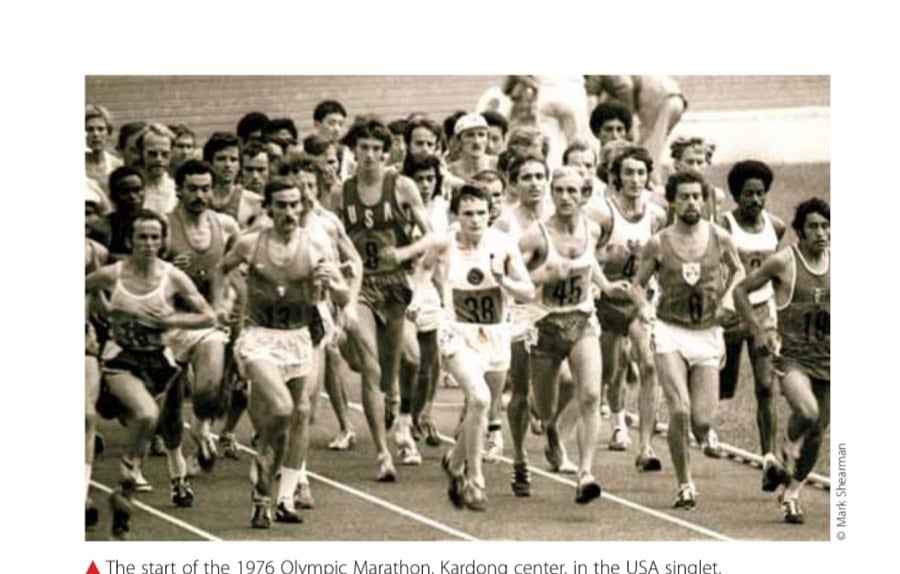
© Mark Shearman
▲ The start of the 1976 Olympic Marathon, Kardong center, in the USA singlet.
examine the splits, you see that although the two were together in 22nd place at five miles with 25:10 (a half minute behind the leaders), Kardong had moved nine seconds ahead of Sandoval in 26th place at 10 miles reached in 51:22 (nearly two minutes behind the leaders). At 15 miles, Sandoval held 11th place with 1:16:48, four seconds ahead of Kardong, and at 20 it was still Sandoval sixth in 1:41:20, seven seconds up on Kardong. The pair actually had run the second 10 miles faster than the leaders, Shorter and Rodgers. Between 15 and 20 miles, Sandoval ran 24:32. At that point most of the runners who had attempted to match the pace of the two leaders were in distress, drifting back, their Olympic prospects blighted. This included Barry Brown, who was with the leaders at 16. He still held third at 20 but dropped out at 22.
Somewhere before 10 miles, Sandoval and Kardong had been together. Sandoval looked at the leaders far ahead and asked: “Are they supposed to be that far ahead?” Don told him: “Yeah, that’s fine. We’re in good shape.” But it was more that the two were running near each other than with each other. Around 22 miles, Kardong caught and passed Sandoval, who by then had moved into third, and in so doing realized that he would be the one to make the team. “People knew that we were good friends,” says Don stoically, “but we were also in a race, and it came to a point where one person wins and one person loses.”
Shorter and Rodgers finished first and second with 2:11:52 and 2:11:58. Kardong’s third-place time of 2:13:54 was his fastest marathon by more than two minutes. Sandoval ran 2:14:58. Tom Fleming did 2:15:48; Bob Varsha, 2:15:50.
“I told everybody afterward, ‘Well, if I make the team in the 5,000, Sandy can run the marathon.’ Then I started to realize, what if I’m third in that race and Duncan Macdonald, who is an even closer friend, is fourth?” In the 5,000 trials one month later, however, Dick Buerkle, Macdonald, and Geis qualified for the Olympics with Kardong fourth. “That is when I became a marathoner.”
Don Kardong had been training without apparent patterns. “I wasn’t keeping a diary, so I can’t look back and see what I was doing. I was just running the way I felt like running.” With the advantage of hindsight, he now realizes that his successful effort at Eugene was not a peak, merely the start of a peak. Also, he decided that while starting conservatively was a good marathon strategy, he need not start as slow at the Olympics in Montreal—or could not.
Don Kardong describes the Olympic Marathon: “I started with about 30 runners in front of me and had no idea what place I was in through the middle of the race. A kid came along on his bicycle in an open stretch and wanted to know who was winning. That irritated me. The leaders were probably three minutes ahead at that point. “
So it was a matter of continuing to pass people but still not knowing my place. I remember catching Bill Rodgers at around 16 miles, and he looked really horrible. Somewhere around 18 or 20, somebody finally yelled, ‘You’re 30 seconds out of a bronze medal.’ I looked up and I was trying to figure out how far 30 seconds was because I could see a group of three running ahead.”
The three, who indeed were battling for third (Shorter and East Germany’s Waldemar Cierpinski already having broken contact), were Finland’s four-time track gold medalist Lasse Viren; Belgium’s Karel Lismont, second in the Olympic Marathon four years before; and Canadian Jerome Drayton, who would win the 1977 Boston Marathon. Kardong recognized only Viren, because, “I was not a marathon runner; I didn’t keep up with marathoning.”
Within a few miles Kardong pulled to within six seconds of the group but had difficulty closing this last gap. Then at the next water station, all three slowed to drink, and Don simply surged without pausing. He knew he had to pull away at that point—otherwise, someone might come back on him—but he was afraid to look back.
He began having difficulty maintaining his stride. His calf muscles started to cramp. Nevertheless, he felt he had third place, and in moments of blind exhilaration began to visualize his name in headlines in the Spokane papers. Then he began to hear footsteps. “
I still can almost hear the resonance of those footsteps,” says Kardong. There is no trace of sadness in his voice as he relates the story of these most important minutes in his running career—how many people come this close to an Olympic medal?—but even with only two people in the room, Don and I, it seems very,
very quiet as he continues: “That somebody was catching me was shattering! And it was Lismont who had come out of that group. I got passed. “Coming back into the stadium I was only a few yards back, and I figured that if I could be with him on the track I had a good chance. But there was a downhill stretch of 200-300 yards, and because of the state my body was in from the cramping, I could not run downhill as fast as he could. He really moved away from me. I understand from people who were in the stadium that once we got on the flat I about cut his lead in half, but it just wasn’t going to be enough. “
I don’t think I’ve ever run a marathon that hard before, because I was actually tingling all over, either from dehydration or emotions. Funny, but I would look up in the stands, and I felt awful, really, and I saw some friends and they were waving, like, ‘Way to go!’ It tore me apart. I had to stop myself to keep from blubbering. I felt elated because I had done well, but I just missed! So I had these conflicting feelings, but the overwhelming one was just relief to be done.” THAT WAS the last Olympics, 1976, four years ago, and in the interim Don Kardong has left his job as an elementary school teacher, has opened a sports store in Spokane called “The Human Race” in partnership with Rick Riley, and has organized a running event (Bloomsday) that in three years has grown to 10,000 runners and probably has done more to make him a folk hero in his adopted town than even his Olympic near miss.
He also has become a celebrity on the running circuit, his gentle nature and subtle humor making him one of the more popular clinic speakers, and his running career has continued to have its ups and downs: his victory at Honolulu in 1978, his failure to finish at Boston in 1979. He does not know if he likes his life as a “professional” runner, talking running all day in his store, training, lecturing, racing. He speaks about getting into some other business, writing, going back to teaching, coaching, “but it’s hard to beat the excitement of being in a race and
ad
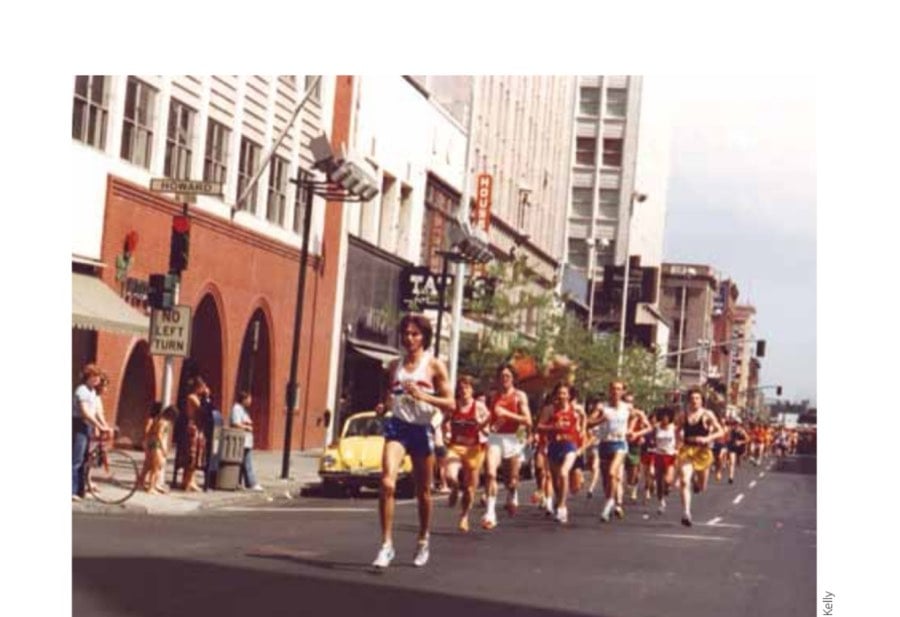
© Doug Kelly
▲ Don Kardong leads the pack in the inaugural running of the Lilac Bloomsday Run, in 1977.
really running fast and feeling good about your performance and beating a lot of people who you like as friends but you hate as fellow athletes. It’s hard to beat that thrill. I don’t know if I can give that up to become a fun runner.” THE DAY following our long talk, after the awards ceremony at the Bermuda Marathon, I was leaving the main room and spotted Don sitting at one end of the hallway at a table with Garry Bjorklund and Mike Roche. Garry was telling Mike about his training in Boulder, how he was covering 175 miles a week, how he got up, ran, ate breakfast, slept, ran more, had a sauna, got a massage. It was a lifestyle totally centered on running, not unlike that followed by Kardong his first year out of Stanford. Mostly it was Garry talking and Mike listening while Don leaned forward drumming his fingers on the table, glancing first at Garry in amazement and then looking toward Mike to plumb his reaction, his eyes intent, his expression sober, his fingers continuing to drum.
He is the third Olympian, the man nobody expected to make the team in 1976 and nobody expects to make it again in l980, if there is an American team. Before he finally began to acknowledge that because of the world situation, no American athletes might be going to Moscow, Don Kardong figured he had maybe a 10
percent chance, despite the consistency of Rodgers, the comeback of Shorter, and the ascendancy of Pfeffer, Wells, Lodwick, Sandoval, and others. He hoped that a combination of training, intelligence, strategy, attitude, weather, and just plain luck would return him to the threshold of glory. But Don Kardong, more than anyone else, understands that fame is fleeting, that medals are quickly packed into drawers, that even memories soon fade, and that the chase is sometimes more satisfying than the catch.
In 1980, Don Kardong did not make the American Olympic team in the marathon. He did not even show up for the Trials in Buffalo, New York, nor did Frank Shorter, nor Bill Rodgers. The Trials had become meaningless when President Jimmy Carter in January announced a boycott of the Games in Moscow to protest the Soviet invasion of Afghanistan the year before. The boycott seemed meaningless then; it seems even more meaningless now, given US involvement in another messy war in Afghanistan two decades later. Tony Sandoval, Benji Durden, and Kyle Heffner placed 1-2-3 in the Trials and, as a consolation prize, they were given a trip to the Fukuoka Marathon in Japan later.
While Don Kardong would achieve no more great successes in major marathons, his greatest achievements may have been developing Spokane’s Bloomsday Run (7.5 miles long) into a race that annually attracts 50,000 runners or more, plus his work as a contributing editor for Runner’s World, writing some of the best (and funniest) articles printed in that magazine.
But did Dingy actually miss that Olympic bronze medal by only three seconds? The winner of the marathon in Montreal, and also in Moscow in 1980, was Waldemar Cierpinski of East Germany. Years later, after the Berlin Wall fell, East and West Germany merged into a single nation. The medical records of East German athletes were resurrected from the files of the Stasi, the Ministry for State Security. Most of the East German athletes who competed in the Olympics, including their dominant female sprinters, did so with the benefit of illegal drugs that went undetected. This included Cierpinski. The International Olympic Committee never took action against Cierpinski to remove him from the list of Olympic champions. If the IOC had, Shorter might have acquired a second gold medal; Don Kardong might finally have claimed the bronze that eluded him by three seconds. ▲
2015 will mark the 39th running of Bloomsday. Don Kardong founded the race and has been the race director since 2004.
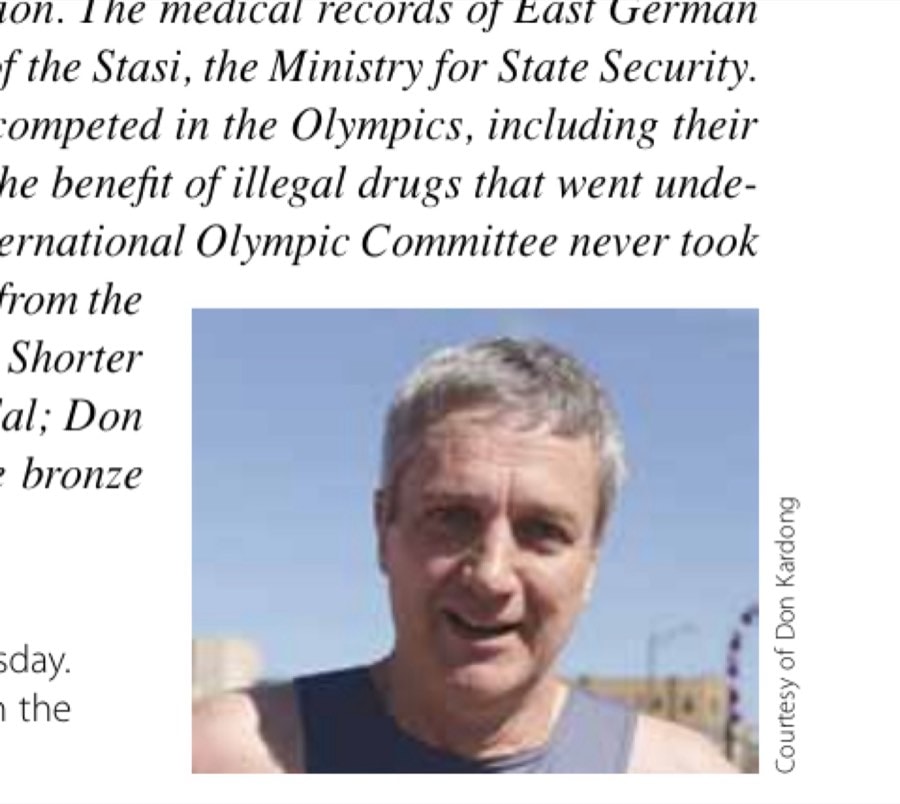
Courtesy of Don Kardong
Epilogue
This article originally appeared in Marathon & Beyond, Vol. 19, No. 1 (2015).
← Browse the full M&B ArchiveMore like this
1,000+ stories from 19 years of Marathon & Beyond
The complete archive of the legendary long-distance journal — digitized and free to read.
