the tribe’s center. Go out 8 to
The race Expo at Disney’s Wide World of Sports also returned to it, with an exhibition of wax sculptures of runners, most dressed in Greekstyle tunics. I was glad to see sport made the subject of art: the Muses would approve. But I regretted that the art and the whole Herculean race “theme” were so prettified as a version of the gutsy power and rich meanings of Greek athletics history and the Hercules myth.
At mile 20 on the course, for instance, the runners passed through “The Gates of Hades,” an amusing Disney equivalent of The Wall. Patrolling the Gates were Hades himself (a villain from the movie) and his two comically inane attendants, Pain and Panic. As a runner, I thought that was one cutesification too many. In the creation myth of our sport, the messenger Pheidippides was running back from Sparta with the news that Athens would have to fight the invading Persians alone, when he met Pan, the God of Nature. Pan assured the weary runner that he would bring divine help. At the Battle of Marathon, Pan ran among the enemy spreading confusion, which took the name of Panic (Pan-ikos). ’’m no cultural snob, but I didn’t like Panic being turned into a bumbling sidekick at the gates of hell.
All Disney productions have gone soft-edged and superficial like this, I regret to say. When Fantasia or Pinocchio drew sounds from Beethoven and images from Hokusai, they were significantly closing the gap between “serious” art and popular entertainment. Pinocchio may have been a softer version of Collodi’s story, but there was real moral menace in his downfall on Pleasure Island. The pathos of Bambi’s mother and Snow White’s poisoning required a real effort of response from characters and audience. In those days, Melpomene, the Muse of Tragedy, was a real force in Disney’s art. The original Depression-era Mickey Mouse was a figure close to Charlie Chaplin for comic resilience under adversity.
Today’s Disney movies reduce that darker dimension to warm-fuzzy sound-bites like “Zero to Hero” or “take your place in the Circle of Life.” The “toga-themed” Hercules and Megara have about as much mythic resonance as those endless fitnessmachine commercials starring Walker Texas Ranger and assorted bimbos. Victor Hugo’s evil hunchback is the brave, vertebrally-challenged Quasi. The Mickey Mouse who presides over Orlando and the Disney Marathon is a merchandise logo with a plasticsurgery smile. Melpomene wears pink.
But it was all harmless fun. The races were run in the 1990s Disney spirit of happy self-improvement, and the day turned sunny and warm.
I chatted with half-marathon winner Keith Brantly, who had run at a workmanlike 5:30-mile speed well clear of the field, and is focused on serious marathons ahead, starting with Pittsburgh in early May.
I watched Joan Benoit Samuelson, committed as ever, kick past Laurie
Corbin (from Morristown, N.J.) to win the women’s half-marathon. That was another contrast: Joanie comfortable in her big hat and baggy white shirt, like a librarian on holiday, while Laurie ran her 1:18:10 PR in a trim black bikini, her blond hair flying.
I cheered wildly for my “On the Road” predecessor, and wife, Kathrine Switzer, shrugging off conference and overwork to run arespectable 2:03. And for Gary Jensen, jogging comfortably through withno sign of ill-effects from German beer or getting shrunk.
Iremet Marty Liquori and Hal Rothman, weary from a_ hard morning’s work. Eavesdropping on the media bus as they prompted their cameras by radio, I had been impressed by their hands-on professionalism.
I talked with Craig Virgin, whom I knew quite well in the days when he twice won the World Cross-County title, though less well now in his reincarnation as a politician. He was so boyishly eager and nice about that career that I began to doubt again whether I was in reality. A genuinely nice politician? I was about to prod him to see
KATHRINE SWITZER
if he were a wax model but thought better of it.
By now I had given up trying to tell the difference. At the awards ceremony, Minnie Mouse kissed Keith Brantly. Joanie wore a set of mouse ears. (See what I mean?) I took Kathrine’s photo with Mickey and Minnie. She took my photo with Minnie and Mickey. I went back to the hotel and souvenired the soaps and shampoos with the Mickey merchandising logo. I’m still enjoying them.
So itadded up to a good weekend: great expo, good races, lots of fun and entertainment. I’ll go again. I’ll take my most rugged mountain clothing for the media bus. Or better, I’ll take grandchildren or go as a runner. Yes, that way I’d get to see the inside of the parks.
WESTERN STATES 100 SPECIAL SECTION
Western States Endurance Run
Necessity Is the Mother of Invention— A Lame Horse Precipitated One of the World’s Greatest Footraces.
When Gordy Ainsleigh’s horse came up lame and couldn’t compete in the Western States 100-Mile One-Day Ride (for the Tevis Cup) over the High Sierra, the high-spirited Gordy set off on his own to do that which was supposed to confound mere human beings. Less than 24 hours later, Gordy had become a running legend and had spurred into existence what became the Western States Endurance Run. In turn, that race spawned a bounty of ultradistance trail races.
But through it all, the Western States 100 has remained the granddaddy of them all—a granddaddy who turns a mere 25 years old this June. In admiration of and celebration of this seminal ultra trail race, Marathon & Beyond is proud to present a special section contributed by a handful of the people who have been instrumental in making the Run a landmark:
¢ Gordy Ainsleigh recreates the nearly 24-hour-long labor pains to birth the footrace.
Race director Norm Klein jogs through the entire 24-year history leading to the race’s silver anniversary.
Great-grandmother Helen Klein recounts her long-standing love affair with the granddaddy of all trail ultras.
Doug Latimer takes us to a Western States 100 finish that should never have happened but miraculously did.
Tony Rossmann struggles through the slowest, last, and most glorious of all his Western States finishes.
Sometimes, an opportunity grasped defines a lifetime.
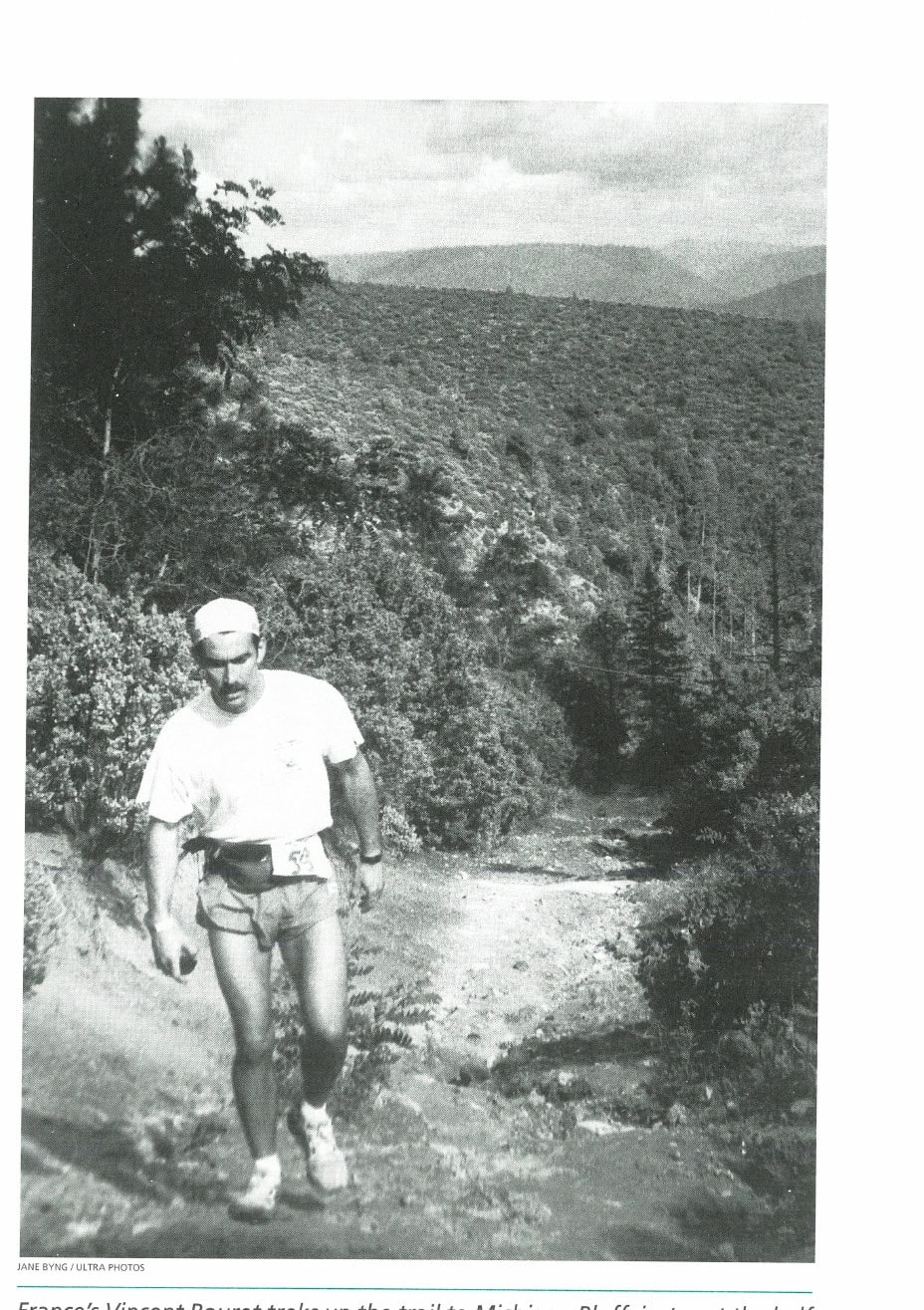
JANE BYNG / ULTRA PHOTOS
France’s Vincent Bouret treks up the trail to Michigan Bluff, just past the half way point of the Western States Endurance Run.
Ma ylJune 998
WESTERN STATES ENDURANCE RUN fm 13
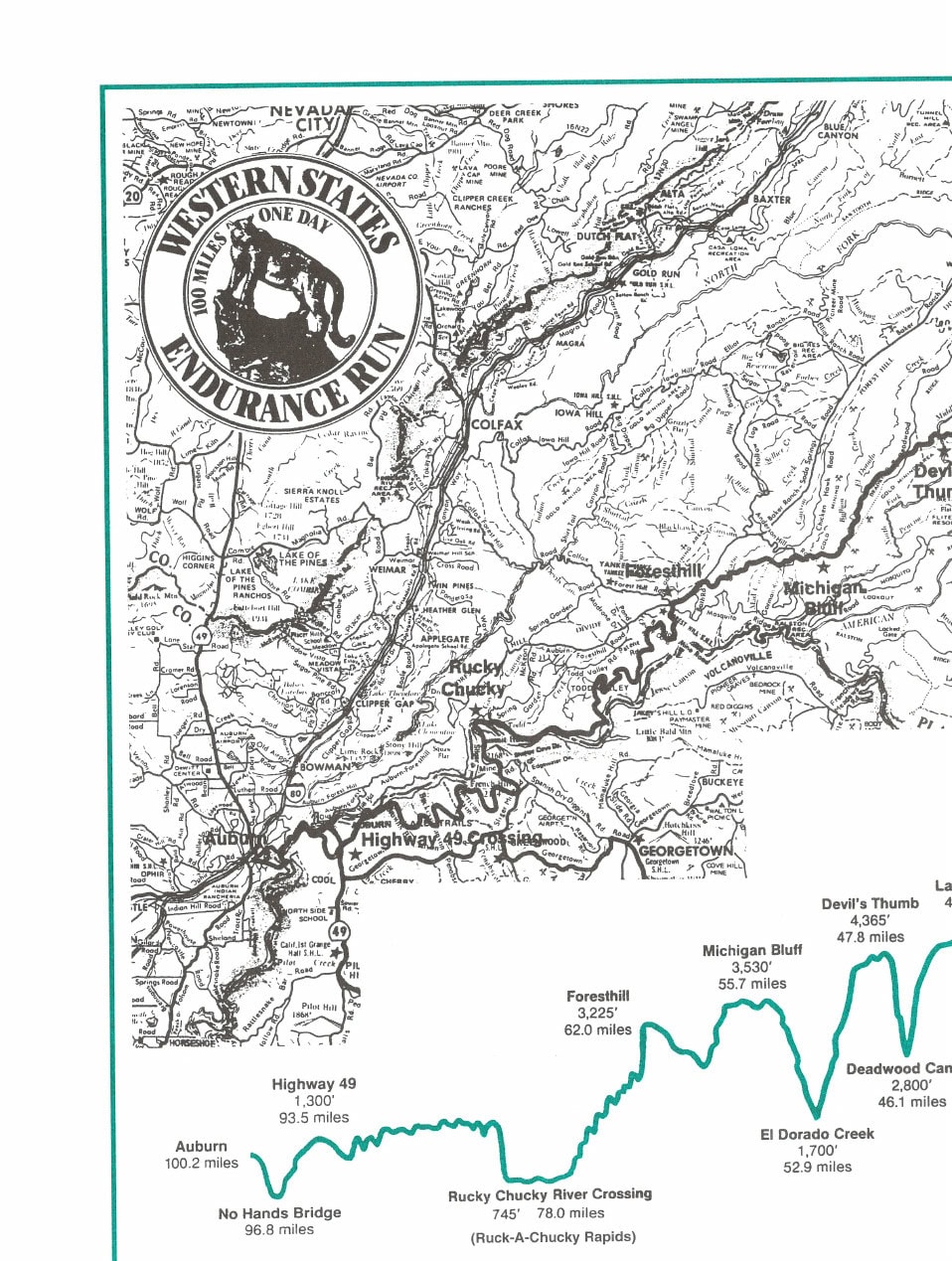
Devil’s Thumb 43. 4,365″ 478 miles Michigan Blutf 3,530″ 55.7 mil bc a Foresthill Sales Ne 3,225″ LF 62.0 miles
Highway 49 Deadwood Canyo 1,300° 93.5 miles
El Dorado Creek 1,700″ 52.9 miles
Auburn 100.2 miles
Rucky Chucky River Crossing No Hands Bridge 745! 78.0 miles
8 mil 96.8 miles (Ruck-A-Chucky Rapids)
L Hell tole Wf Reservoir
BA Seep ey ali
SP eu 9 ee ~~
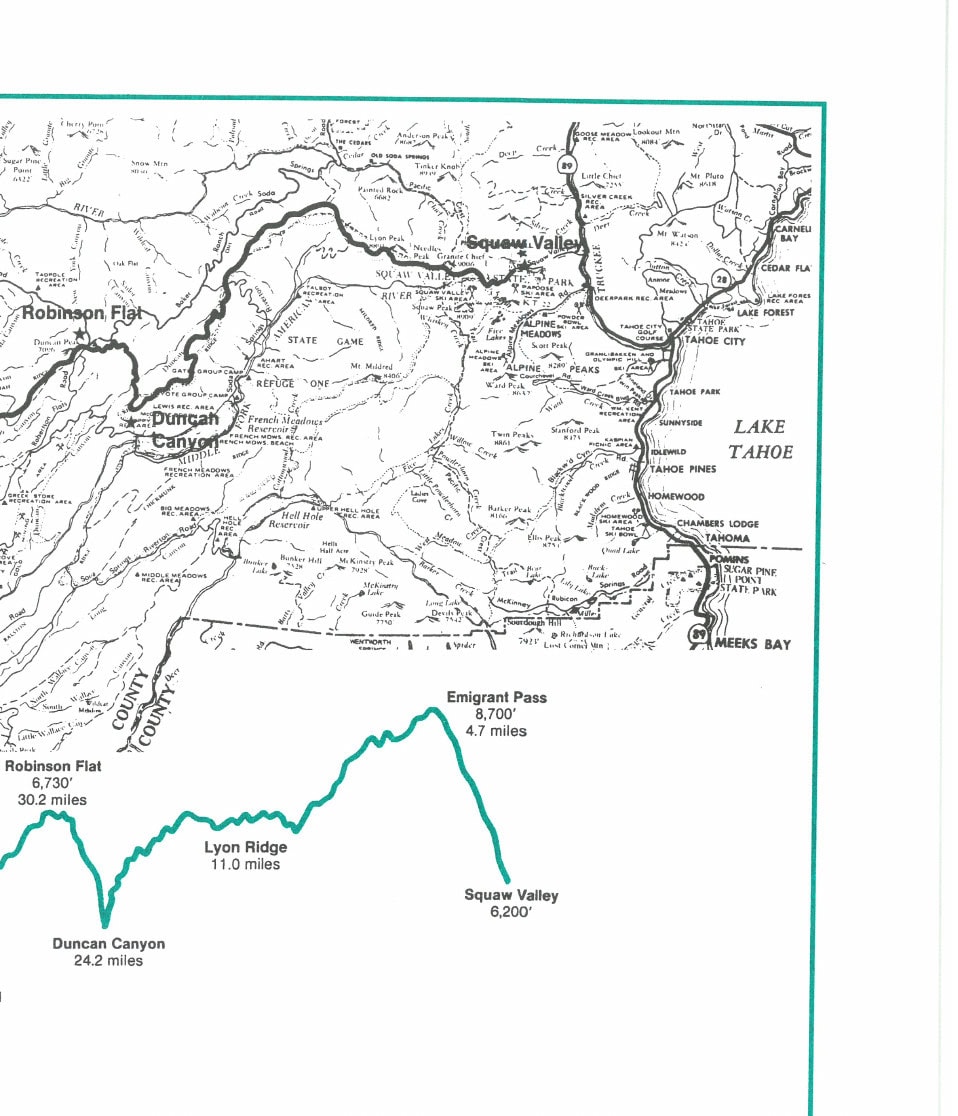
Emigrant Pass 8,700° 4.7 miles
rs om ae Robinson Flat 6,730° 30.2 miles
Lyon Ridge 11.0 miles
Squaw Valley 6,200
Duncan Canyon 24.2 miles
The Trail of the Western States Endurance Run
—. js May/June 1998 WESTERN STATES ENDURANCE RUN mm 15
WESTERN STATES 100 SPECIAL SECTION a Inventing 100- = = = ‘Mile Trail Racing
(And Living To Tell About It)
T HERE ARE defining moments in every person’s life when he or she must decide either to be sensible and do the reasonable thing or to embark on a perilous journey through a fog of uncertainties and attractive unknowns that cannot possibly be estimated for their risk potential. Faced with such a choice, we make our best guess and then either turn back or press forward.
Those who go forward and make it through the fog-shrouded unknown to the far shore often partake of great adventures—and possibly even become famous in the doing. Those who don’t make it through in one piece often end up devastated or dead—and possibly famous, also.
For me, the afternoon of August 3, 1974, was one of those defining moments.
AN INAUSPICIOUS START
As so often seems to happen with events that change so much in a person’s life—and in our world—the day began with a conspicuous absence of fanfare. Roughly 10 minutes before the 5:00 a.m. start of the world’s premier horse endurance event, the Western States 100-Mile One-Day Ride, I approached Betty Veal, the head veterinary secretary, and Ralph and Betty Dever, the head timers, who were quietly making their preparations for the start of that year’s big event.
“Well, I guess I’ll head out now,” I said.
They said, “Good luck, Gordy,” and timed me out.
With that, I disappeared into the darkness before dawn: an endurance rider without a horse but with a good bit of running talent and savvy, sidelined for over a year by a lameness-prone steed, going for a day and night of great adventuring with my horse-riding comrades.
E BARIEAU
Gordy Ainsleigh giving his horse a break on the downhill into Michigan Bluff (56 miles) during the 1972 Western States 100-Mile One-Day Ride, back when he was still riding horses, two years before his famous 1974 run.
My earlier training for the 42-mile Levi’s Ride & Tie race in Klamath Falls, Oregon (which my partner Jim Larimer and I had won), had left me in excellent condition to run in the marathon-through-50K distance. On top of that base, I did six weeks of specific training to prepare myself to run with the horses at Western States. I continued with my regular workouts, but I also ran from Michigan Bluff to Auburn (a distance of 44 hilly miles) every 9 or 10 days.
As the daylight of August 3 dawned and the morning wore on, I shared the trail with my favorite people and their magnificent beasts. I ran with exuberance and vigor, occasionally racing with the horses, happy to be alive and still part of it all (even though horselessly), after having missed out the year before when my horse went lame at Robinson Flat (30 miles).
IN TROUBLE EARLY
Not surprisingly, by midday I was tired and dehydrated. But I was still having a great adventure—until I pushed myself up out of Deep Canyon (which isn’t
ss SSS Gordy Ainsleigh INVENTING 100-MILE TRAIL RACING m 17
This article originally appeared in Marathon & Beyond, Vol. 2, No. 3 (1998).
← Browse the full M&B Archive