

The Ultimate Cross-Country Run
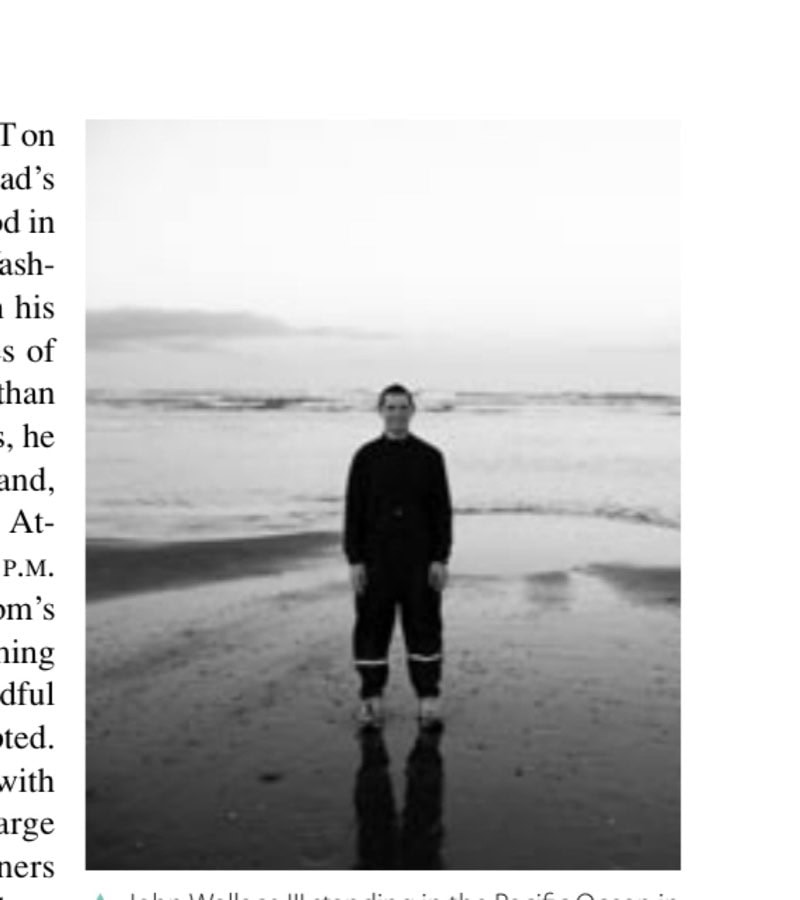
At precisely 7:09:14 A.M. PST on September 26, 2004 (his dad’s birthday), John Wallace III stood in the Pacific Ocean at Westport, Washington, then started running on his quest to cross the United States of America. After covering more than 3,800 miles on foot in 124 days, he stopped running at Tybee Island, Georgia, where he stood in the Atlantic Ocean at exactly 4:53:19 P.M. EST on January 27, 2005 (his mom’s birthday). His saga is a rare running adventure, one that only a handful of hardy souls have ever attempted.
John Strumsky sat down with John and his family and a large gathering of friends and runners the next day to chat with him about ▲ John Wallace III standing in the Pacific Ocean in Westport, Washington. The adventure begins! his exploits. Marathon & Beyond: The running feat you just accomplished was a massive undertaking by anyone’s standards. Running across the length of the United States is one of those remarkable endurance accomplishments much like completing the Tour de France. It took not only an incredible amount of stamina and the development of a high tolerance for enduring continuing pain over a sustained period but also an immense amount of willpower on your part. What possessed you to try it?
John Wallace: Well, I wasn’t in too much pain, only the first couple of weeks. After that, it was a lot more pleasurable. I think what possessed me was just starting over 15 years ago running every day. That was like having a bug to run. It’s like having an itch that you just can’t scratch enough, and you just want to run and run and run. Having the time to do it was also a big factor, because my wife and I relocated out to Seattle. I think seeing an article back in February of two guys who ran from New Jersey out to Oregon and seeing how they did it with a running jogger. Logistically it was possible to do, so why not add my name to the list of runners who did this thing by themselves? M&B: What was it like getting started? I know you modified your starting plans on a few occasions. It was as if you had several false starts. What was going through your mind? John W: Well, I really didn’t want the full journey planned out from start to finish where I knew where I was going to be every single night. I wanted to see the journey kind of evolve and just have each adventure lead to another one and have more of a spontaneous type of trip across the country. I don’t know that they were really false starts. It was more like running down a trail and coming to a right fork and a left fork and you can choose either one. I just wanted the trip to be as free-flowing as possible, something that I could just follow whatever I wanted to do that day. I could just stop and enjoy whatever type of scenery I was seeing that day. If I wanted to stop early that day, I could. If I wanted to run extra miles, I could. Just planning every two or three days out and saying I have a campground up ahead so I can go to that place or I have a motel here so I can go there. It was really just keeping the journey open and not having it too focused. M&B: Were you bothered about whether you should even attempt to start such a run? John W: Not at all. It was kind of difficult to have it start just because of the timing, because I would be missing a lot of big events. Everyone said it’s not the best time of the year to do it. It was hard for everyone else to see the dream and everything involved. So to be stubborn enough to say, OK, I’m going to do it no matter what; you’re just going to have to deal with it. That was one of the difficult decisions, but it was something I wanted to do and I felt strong enough to do it, so it was going to get done. M&B: Once started, how long did it take before you began feeling comfortable about what you were attempting to do? John W: It was difficult. The first day I started out with 35 miles, so I really got into it quickly. The last two miles, the run was pretty much uphill to a state park out in the woods. It was more off my main course than I thought it was going
to be, so I knew if I could survive the first day and the first week, everything else would go well. I had my initial shinsplints, but other than that I was really comfortable right from the start. M&B: Describe for us what it was generally like for you out on the road on a typical day, if there was such a thing. John W: Most likely it would be—in the first part of the run at least—beautiful weather, blue skies, a little bit of traffic, not too much in the beginning. There were a lot of cities. Toward the middle of the country, you came upon much more different ranging types of weather. I was going through mountains and deserts. Those were also the barren areas, so there wasn’t as much traffic. Then you knew you were really out there by yourself, just enjoying the whole solitude part of it. Yeah, it’s really hard to say if there was any typical day. You just have so much going through your head. You’ll be thinking about your pace; you’ll be thinking about how to take enough fluids for the day. M&B: What was your nonrunning daily routine like? John W: The first night, it took me almost a half hour to set up my tent. I wasn’t used to getting ready. My equipment wasn’t in the jogger in the right place yet. I had too much poundage. Just trying to get everything streamlined and doing it so that I wouldn’t have to think about it, so I could enjoy the run more. It took a while to do that. M&B: OK, could you speak to some of the unique experiences you had during the run? John W: I got to do a little interview with some fourth-, fifth-, and sixth-graders at a school in Oregon. They asked all the fun questions, like: “Have you ever collapsed out on the run?” “Are you going to go through Phoenix?” You know, what kids ask. I was there for an hour and a half, two hours, and had the big map behind
▲
John, just into the first mile. Only 3,804 more to go.
me. I showed them the route, showed them I was from a small town just like them. They seemed excited afterward. The librarian who hosted me during that night told me they were very excited and that a lot of them said they were going to start running. So that was good to do.
After that, I had an experience in Idaho where I had an entire observatory to myself. They had a 25-inch telescope, the biggest one available to the public in the United States. No one else showed up that night, so I got views of the moon, the galaxies, and everything in outer space. There were three curators there with me with binoculars and the telescopes. So I was rotating from one to the next, and they were showing me their presentation. It was really neat.
Going through the mountains of Nevada, not only unique but surprisingly picturesque. It surprised me a lot that Nevada had that type of terrain. I really enjoyed it. It’s called the Great Basin Highway, going right down through the Humboldt Mountains, and I think I had 200, 250 miles where there were mountains on both sides, snow peaks, and that’s where I really started getting into the elevation. I think running in Portland and Maryland, being at sea level pretty much made getting up to altitude a totally different experience. I was probably at 7,000 to 8,000 feet for a couple of months, so doing that was interesting.
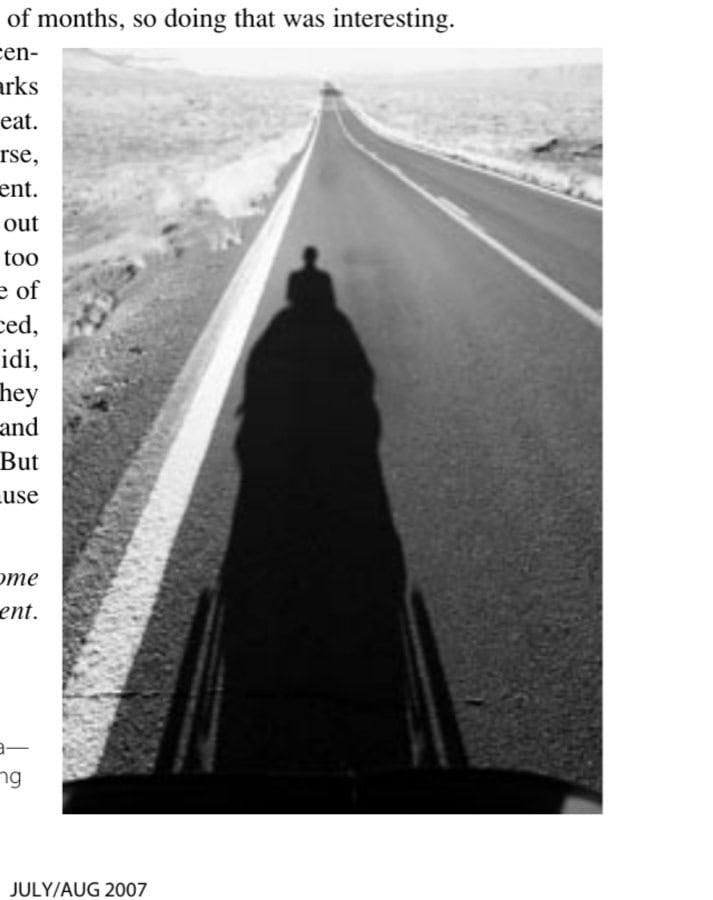
Utah had amazing scenery, all red rocks. The parks through there were really neat. Arizona and, oh, of course, the infamous jogger incident. Before that even, wearing out the tire on the jogger from too much poundage in it. One of the tires had to be replaced, and when my wife, Heidi, and her dad came out, they brought me to a bike shop and we got to repair the tire. But it didn’t last too long, because the jogger was stolen. M&B: We’re going to come back to the jogger incident. What else was unusual?
▲
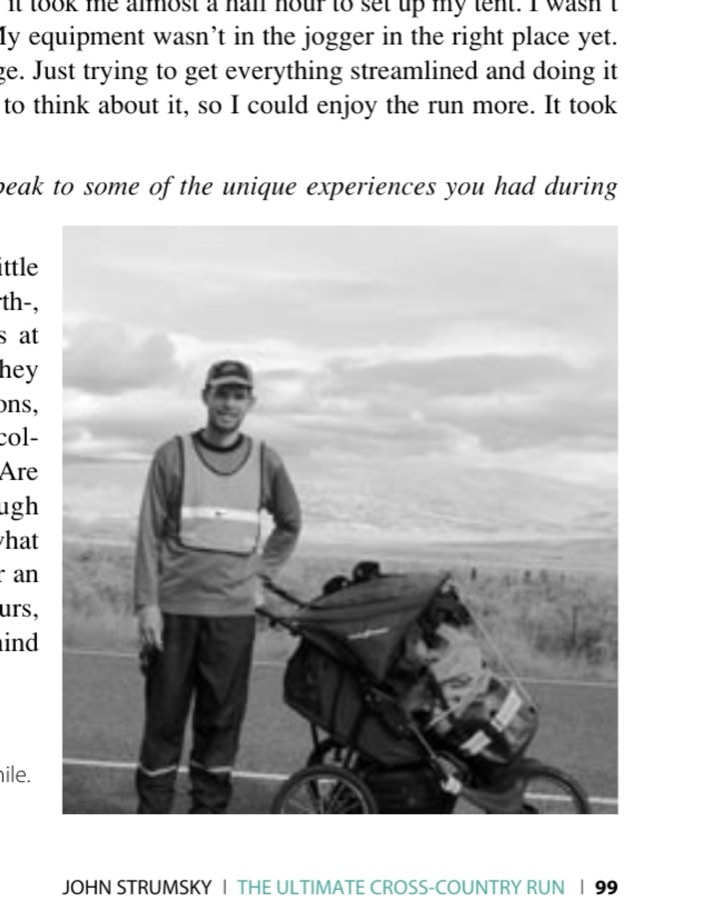
Near Cliff Dwellers, Arizona— long roads, long shadows, long days.
John W: All right. Coming over the Continental Divide was really neat, too. I stopped at a town called Pie Town on National Pie Day. I met some great people there and enjoyed a lot of pie. M&B: I understand they do some really artistic work with their pies. John W: Absolutely. Interesting designs they do on top. Not only is the flavor good, but the look of the pies is really cool, too. Until then I had been going up. Then after the Continental Divide, I started going down. Their slogan is: “It’s all downhill from here,” and it really was true, because once I left there it was pretty much downhill until outside New Mexico.
That reminds me, too. I met a couple of transcontinental bicyclists in Arizona. They actually met me. I was stopped for the night, setting up at a campground near the Grand Canyon. I went into the lodge to get something to eat. They had already set up their tent and found my jogger and wanted to know what I was up to. They were on a big adventure, going from the tip of Canada down to the tip of South America. Their 20,000 miles makes my trip pale in comparison. M&B: They were still on wheels, though. John W: Yeah. They said they were covering about 50 miles a day, so not much more than I was running. They caught up to me a couple of more times. We spent some time in Socorro and in Roswell. We had a unique bond. We could talk back and forth and had some good conversations and spent good time together. M&B: Any unique experiences coming east? John W: Yes, Texas was really cool. I got stopped in the first three counties of the state. The troopers wanted to find out what was going on, I guess. At that time it was Christmas, so I wasn’t really sure where I would be staying. Luckily, through some of our streaking friends like Ken Johnson and more running-club people, I was taken in. There was a guy north of Dallas who had a running club in the county. He, along with his wife, who just had baby twin girls, took me in. I spent the night of Christmas Eve and all of Christmas Day with them, and then he dropped me back off where I left my route. M&B: Did you still get your mile in? [We both belong to the U.S. Running Streak Association for runners who run at least a mile every single day.] John W: Certainly. I got one point five miles in. Yeah, a rest day for us means a mile. And he put a nice course together for us. He had a fun run. He was a runner from South Africa, and running is really big down there, where they have the Comrades Marathon. They give this really tiny medal, because it’s just about the run, not really what you receive at the end. He had all these great stories. I think that was the first real runner I had stayed with. Before, it was normal people, the
bicyclists and folks like them. Average people, you know, who wouldn’t necessarily understand things that maybe only we can. So it was great talking with him and hearing his stories. Just the fact that he was doing the ultraruns made it kind of comparable to this.
Oh, by the way, up in Oregon is a city named Vale, where all these Old West murals are painted on the town buildings. A runner who was a local veterinarian there took me on a truck tour of the town and showed me all the sights. He pointed out that on one of the murals it was actually him. He’s holding up his daughter, and the rest of the people were actually his neighbors. So that really personalized it for me.
Crossing over, Alabama had no shoulders on the road. There were shoulders, but they were grass. I crossed the entire state on grass, which was much different from all the other states. It was harder pushing the jogger. You had to have it pretty much parallel, as you’re pushing it rather upright. You were constantly working at it. There were different types of pavement, rocky pavement, no pavement. There are 6-inch shoulders, 20-foot shoulders. In Texas they have cars that drive on the shoulders. You had to be aware of that. Whenever you see the sign that says road narrows, there are no shoulders. That doesn’t mean the road has narrowed, it means you haven’t got a shoulder anymore. I didn’t like to see those signs. I did like to see the reduced-speed-ahead signs, because I knew I was getting into a city. Those were the type of signs you would look forward to.
All the states up through Texas had mile markers, but in Texas they had these little mile markers that were on the speed-limit signs so that you couldn’t tell exactly how far you had gone. So it was harder calibrating my mileage. The next three states changed their mile markers in every county, so that also made it harder to keep track across the entire state. For instance, if you went 17 miles through one county, then came to the county line, it would reset at one again. So it made it harder to figure out how many miles you had gone for that day, and that was tough.
The Continental Divide and the Mississippi River were the two big highlights getting across the country. M&B: How about the Mississippi? John W: Mississippi was tough. I knew I was going to be on a smaller road, but I knew there was still going to be traffic without a shoulder or anything. It turned out I went with traffic so I wouldn’t stop everyone else on the side. But the bridge over the Mississippi River was very long, probably a couple of miles long. During that time, I called my folks on my cell phone, and they talked me through about three-quarters of the bridge until the battery died on my phone. Right after my battery died, I was so close to the side of the railing my tire got caught. So I had to stop and readjust the tire. If it had happened before the battery went out, my
folks would have had the helicopters coming in to rescue me. [General laughter from his family and friends.] M&B: Were there any places where you actually did not have room to run on the road? John W: Other than across a section of Texas where you had to go through towns where they didn’t have shoulders and also had curbs that were such that you couldn’t go above them, you had to stay out in the road. There was about 10 miles of construction in this 30- or 40-mile stretch, so it was a safe place to go behind the barriers. Besides that and the bridges, everyplace else had enough room to be out there with the cars. M&B: How were most of the people you met during the trip? John W: There weren’t any bad incidents except for one night when I wasn’t allowed to stay in an RV park. Everyone was totally amazing. People gave me soft drinks and batteries, bananas, nuts. They would just roll down their windows and hand me $20. It was crazy. These were the people that I met while I was running. The people I met when I was stopped and stayed with would give me complimentary rates on their rooms. They would set me up with interviews in their small towns, which was fun to do with the newspapers. There were really no mean people. Everyone thought I had a child in the jogger, so they would wave or honk or give me enough room in their path. M&B: So Americans aren’t as bad as you see on the nightly news? John W: No, far from it. It’s not violence and murder and mayhem, all those negative aspects of it. For the most part, everyone is really nice. There were a couple of ranchers in Idaho who were having their Budweisers while I was mixing my Gatorade. They wanted to give me a ride up to the next town, but I told them I had to stay on foot. They couldn’t understand any of it at all. There was a farmer out on a 50-mile-an-hour road, and he was worried that I would be killed out there. I told him I had already been out on the road for a thousand miles or thereabouts and that it was not any more dangerous today than all the others.
Many people wanted to shake the hand of the runner who was crossing the country. The first time it happened was early on in Washington. It was a fellow named Pearson. We have a streaker by that name, but I don’t think they were related. A few days ago, a guy wanted an autograph. That felt weird. M&B: How about officials? Did you encounter any problems with the police or anyone else while out on the roads? John W: No. For the most part, they just did checks. I’m not sure when the first one was, but I was stopped in Washington, then in every single state except for Arkansas. Up until Utah, no one asked me for my identification; then after that,
a few asked for my social security number to verify who I was. I was stopped by the military police outside Columbus [Georgia] at Fort Benning for taking pictures. But for the most part, all the law enforcement folks were really nice. A lot of them gave me money. A lot of them would say they had received a call, and they just wanted to check up, but I knew about half of them hadn’t received a call. They just wanted to know what was going on with me. A couple of officers actually escorted me to motels, just because they didn’t think their area was safe. So that was good.
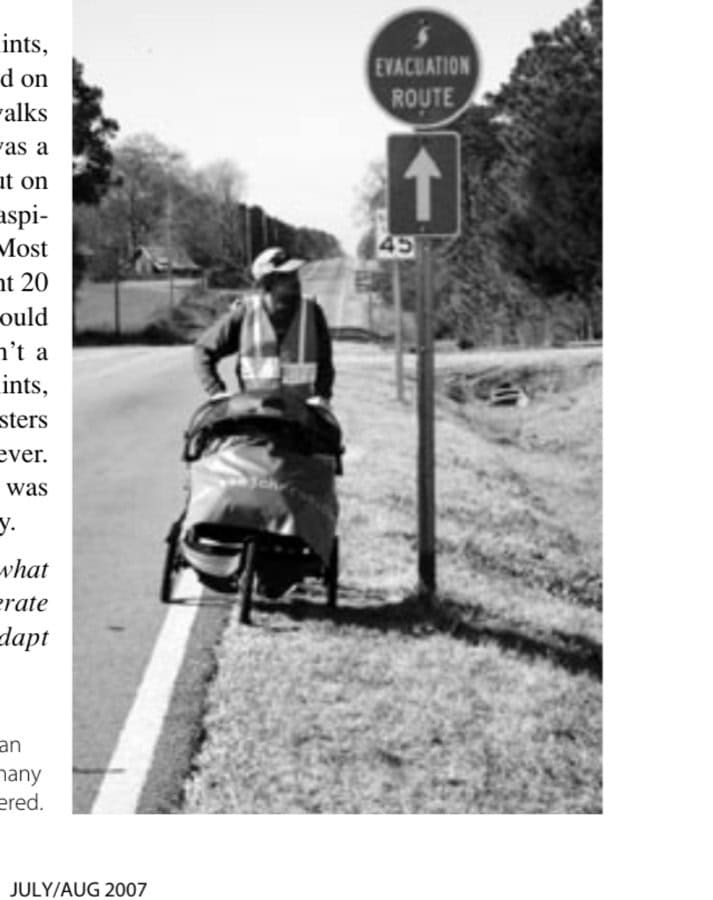
Yeah, law enforcement was great. I was surprised when some of them didn’t stop. You would see them going up and down the road all day, but apparently they had already talked to each other, radioed, knew I was in the area, so they didn’t have to. It was good to stop every now and then and give them my information. Some of them were excited, some of them didn’t care one way or the other, and some of them just wanted me off the road. So it varied depending on who it was. M&B: Did you develop any major or ongoing injuries during the run? John W: Just the shinsplints, which I pretty much based on the fact that I was on sidewalks for a lot of the time. It was a much harder surface. I put on cold washcloths and had aspirin just to get them down. Most of the time, once you went 20 miles or more your legs would go numb so that it wasn’t a problem. Besides shinsplints, I didn’t have any major blisters or other problems whatsoever. It seemed unusual, but I was happy that it was that way. M&B: I think it’s amazing what the human body can tolerate once you allow it to adapt itself. ▲
Outside Vidalia, Georgia—an interesting sign among the many roadway signs John encountered.
John W: It is. That’s the thing, too. Just because of our streaks, we’re used to the ongoing everyday part of it. This was just an increase in miles. You still had the same mind-set that you would be running every day, but then you had to tell yourself you would be running far every day. M&B: Just a slight difference. [Laughter.] John W: It is. M&B: Forty miles a day. Slight difference. [More laughter.] John W: It is. At least for me. You’re running a slower pace. It’s more relaxed. You’re constantly seeing new sights, and your adrenalin is so high that 30 miles is not much. I covered as much as 60 miles during a day. M&B: About how many nights did you spend in hotels or motels and how many did you camp out? What percentage of each did you do? John W: I’m thinking it’s probably about half and half, but the parts I spent under a roof weren’t all motels. A lot of them were people’s homes. Camping is broken down into campgrounds or the side of the road, and then there were campgrounds with facilities. So there were different types of camping as well. There were also different types of motels. There was one place where the guy had to light the heater. You go from that to one where there are wrenches on the shower handles. Then on to a bed-and-breakfast where there are antiques everywhere, and they serve you and wash your laundry. There were all sorts of levels of accommodations I had. M&B: Would you share with us what it was like running and living in all the elements? John W: I like to use the term “press on regardless.” It’s an old military term. We had a running group that did a relay race, and the name of our team was “POR,” Press On Regardless. So, no matter if it was going to rain that day, I just put my Gore-Tex on and my waterproof shoes and headed out. In the snow, you just layer up, put your hat and gloves on, and go. M&B: How was the weather when you got up to places where it started snowing? John W: It was a little tougher to get up in the morning. Sometimes you’d have to wait for the sunrise to warm it up just a tad, but you just have to think, I’m going to warm up once I start running. It’s tough to get out of your warm sleeping bag or your warm motel room, and you’re seeing the wind and the snow out there. For the most part, I would have varying days where it would be an extremeweather day, but the next day it would usually clear up. So I didn’t have a full week, or even a string of days, where it was one or the other kind of day. So it really wasn’t too tough.
M&B: Did the weather ever dampen your spirits? John W: In fact, my two favorite conditions are running in the rain and at night. Running in the rain is fine, but camping in the rain is not. If I was to run in the rain and it got cold enough to snow, then I’d pluck down in a motel. The heat was actually worse. With the sun bearing down on you every single day, you’re consuming a lot more water, then you have to stop a lot more to go to the bathroom. M&B: That was the first thing I noticed about you when you came running into the beach at Tybee Island yesterday, the amount of sun in your features, how it was so embedded. Anyone can tell that you have been living out in the elements for the past four months. John W: The strange thing was that I was running west to east the whole time. As I was expecting the sun to rise in the east, I thought it would be straight out in front of me and that it would always be behind me at night, which was never the case for me. I guess you must have to be at the equator for that to exactly happen. The sun was always to my right no matter what happened, running eastward. I always had to switch the brim of my hat that way or put screen or suntan lotion there. M&B: John, how many calories did you consume on a daily basis? John W: It was about double the normal calorie count, so about 4,000. I compare it to pregnancy—you eat what you want, when you want, and have lots of it. I was really eating just anything I craved. M&B: What did you normally eat on a daily basis? John W: There really wasn’t a normal daily meal along the entire route. I wanted to experience the local cuisine, so I would stop in local cafes and small-town eateries. In fact, many places didn’t even have those anymore, so I would go to gas stations with food marts in order to get a deli sandwich or an energy bar. Each day that I could, I would start off with a good-sized breakfast with 1,000 to 2,000 calories. I loved the country breakfasts with two or three scrambled eggs, two or three strips of bacon, and a heaping pile of hash browns. I would order that up whenever I could. The usual replacements to that were banana nut muffins, oatmeal, pecan twists, cinnamon rolls, Apple Crisp Harvest Bars, or anything bready with some sweetness. For lunch, like I said, I would look for a deli sandwich and would often have Ritz crackers with it and maybe a king-size Reese’s Peanut Butter Cup pack. I would mix my own Gatorade with the powder and consume about 75 percent Gatorade and 25 percent water all day long. Depending on the terrain, weather, and other factors, I would drink between 2 to 6 liters of liquid each day. Every now and then, more often than I would have liked, I had a 20-ounce or 1-liter bottle of Coca-Cola, a 16-ounce cup of coffee, or a 20-ounce bottle of apple, grape, or cranberry juice.
But mostly I stuck to Gatorade. For dinner, I would try to find a local restaurant again and have some protein with a big hamburger or chicken fingers. I ate lots of Mexican foods. They were great with beans and rice. I would have a craving for salty foods every now and then and get some Chinese takeout. Many places were interested in the run and often gave me additional helpings, larger portions, or on-the-house desserts. It was never any problem to go through each and every course from appetizer through dessert and still go out and run 10 to 20 miles or more. M&B: Did the trip across the country cause any significant alteration to your weight? John W: It sure did. It took about a month of tapering to get to a stable weight. I started off around 185 pounds and dropped down to about 165 pounds. My dad brought out a scale with him near the Arizona–New Mexico border. I was at 166 pounds with 13 percent body fat. I would venture to guess that over the run, I lost 30 pounds of fat and gained 10 pounds of muscle for a net loss of 20 pounds. My upper body was strengthened the most, which was surprising at first because there was no normal running arm movement. But with the weight of the jogger both on the uphills and downhills, my arm muscles became much stronger throughout the run. Other than that, I personally didn’t think I had lost that much weight until putting on a pair of jeans and seeing two or three inches of space between my waist and the material. That, along with shaving off my beard to reveal a skinny face! M&B: We know you did have one really negative experience that I’m aware of when your original running jogger was stolen. How was it handling that episode? John W: It wasn’t something I’d planned for, of course, but I knew that there would probably be some sort of incident along the way. Up until that point, day 50ish or so, with 1,200 or 1,400 miles behind me, I had always left my jogger outside of a motel or outside of a store when I went in. I was always in such a small town, so I always thought no one would ever think about taking it. I stayed at a Quality Inn in Tuba City [Arizona] and even asked at the front desk where was a safe place to put it. It was right in front of the building, viewable from the front desk. Because it was raining, I brought most of my gear into the room, except for a few odds and ends. When I went out in the morning, there was a patch of clear cement where it had been. Everywhere else, the ground was wet. I thought, Well maybe the motel personnel moved it in because they didn’t want it to get wet out there. When I inquired, no one at the front desk knew anything about it. I had a look around, then called the police. They found my hand-squeeze water bottle, but the jogger was gone. Apparently, someone just picked it up, stuck it in the back of a truck, and took off with it. I spent almost the whole day looking
around for it. It was near Thanksgiving, so my dad was coming out, and we were going to have Thanksgiving dinner together. During that day, I called him up and told him my jogger was stolen. He was going to take a couple of days to come out, but he drove pretty much nonstop to get out there. M&B: I believe the term I heard you use was that the cavalry was on the way. John W: That’s exactly it. Being in that part of rural America, you’re not going to go down to your local store and find another twin jogger. So we traveled to the bigger cities in the area trying to find anything that we could use and pretty much struck out with that idea. We ended up having to order another one online and having it overnighted to the police station. I ran two or three days without the jogger. At that point, the new jogger arrived and we were about 120 miles or so away from Tuba City. My dad went back to get it, dropped it off in my room on Route 66, gave me the key, and turned around and went back home. He had put on the tires, but I had to get the jogger ready and get it fitted with a new odometer. Even though it was basically the same, it had a different feel, which took some getting used to. M&B: A lot of people didn’t realize until they saw it on the beach yesterday just how heavy that jogger is. Did you think about how much it weighed and what it would be like pushing it? John W: Sure. It’s supposedly able to carry 50 pounds in each one of the seats, like small children. Then you’re supposed to be able to put 5 pounds of gear into each of the two bottom pouches. All told, I had about 120 pounds of gear in it. The jogger itself weighs about 35 pounds. Pushing that along for the first 850 miles was the reason the tire separated from the spokes. So I trimmed down my weight to about 75 pounds. M&B: So I guess pushing a 100-pound jogger also helped your body to develop? John W: It did. Yep. Especially on the uphills, because you have that constant resistance. It was like weightlifting 100 pounds every day. Also, if the front wheel isn’t aligned properly, you’re constantly adjusting to keep it straight. Someday you might see it as the new type of Bowflex machine. You know, you might do 10 of this exercise, or 10 of pushing, or lifting in another way. [General laughter.] M&B: Other than that episode, were there any other troubles or negative aspects to the run? John W: I wouldn’t say so. In all reality, I don’t even call that trouble or negative. I just call it part of the adventure. It’s always been my philosophy that if that didn’t happen, the sequence of events down the road wouldn’t have happened. Maybe it’s getting good use by someone out there right now. That’s the way I look at it.
▲
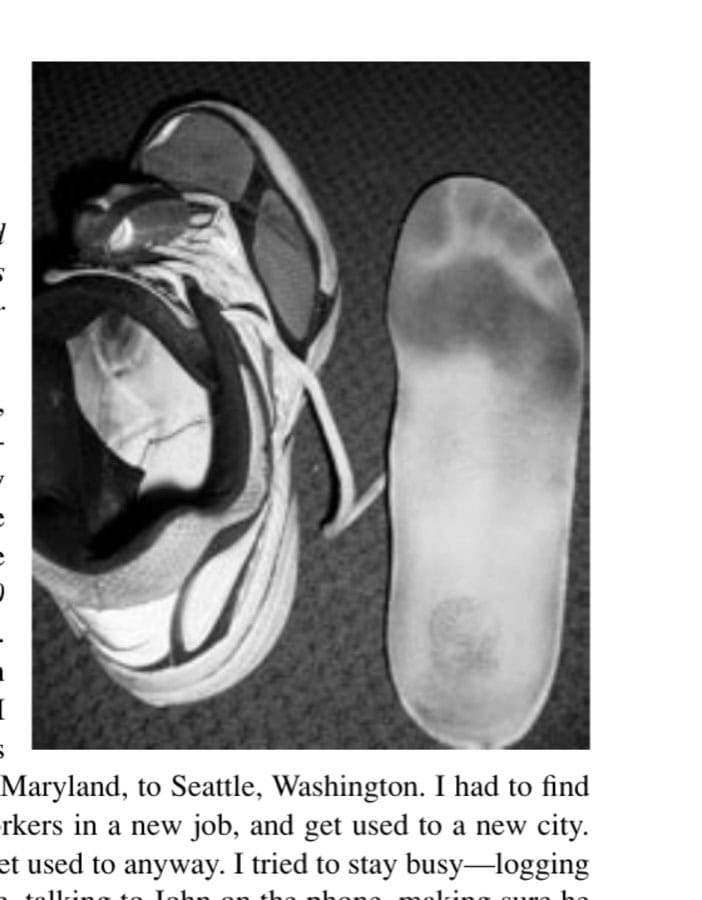
Tybee Island, Georgia—the last of 12 pairs of shoes averaging over 300 miles each.
M&B: And, Heidi, we also wanted to talk about you, too. How was John’s great adventure from your perspective? Heidi Wallace: I have to tell you, the month of November was probably the longest month ever. By that point, looking at his Web site when he still had 100 and some days still left to go, I thought, 100 days, this is going to take forever. Besides not having the countdown move fast enough for my taste, I just tried to stay busy. I moved us 3,000 miles from Gaithersburg, Maryland, to Seattle, Washington. I had to find us a new place, meet new coworkers in a new job, and get used to a new city. Everything took me a while to get used to anyway. I tried to stay busy—logging into the Web site once in a while, talking to John on the phone, making sure he updated me on where he was and so on. December went quickly because of the holidays, but November was the longest month of them all. Then I started experiencing so many new fun things out in Seattle, thinking John would love this and John would love that. Then I realized that I had to bring John back to all these places, and that was one of the things that made it a little lonelier, because John and I go everywhere together. M&B: How worrisome was the day-to-day reality for you? Heidi W: It really was more at the beginning. I mean Nevada was still the most worrisome. That state is so empty, and I always wondered where he would end up for the night, because he really had no idea. As much as he says he likes to be spontaneous, he still writes his mileage for every single step of the way. When he doesn’t know that mileage because he isn’t sure where he is going to be for the next two or three days, that’s when I got worried because I knew that he was probably worried, but he won’t say it. M&B: Was any of it really fearful for you? Heidi W: No. I wouldn’t say it was fearful. It was more that you had to go ahead and prepare for anything because you never knew what was going to happen.
Once you got over that, you felt as long as he keeps calling, as long as he keeps saying he’s OK and you can tell he has a smile over the phone, then I knew he was all right. That was good enough for me. M&B: Speaking of fearful, John. Were there any real or anticipated dangers that bothered you as you traveled the countryside? John W: No. Every state I went through, the locals said this is cougar country, this is coyote country, but I didn’t see one. I saw one skinned cougar at a rancher’s fence, and that was the extent of it. Oh, there was one coyote that was more interested in a jack rabbit than me. I took some photos of him. There wasn’t any other animal except a few dogs that would join me for a few miles, some for several miles, but even those—it seemed like a lot of dogs would stop whenever I told them. The dogs that didn’t bark would follow me forever. If there were barking, loud, crazy dogs that were after me, I’d be a little more worried. So there were no problems as far as animal life. And I guess weather—there wasn’t any dangerous weather. Mount St. Helen’s was spewing a little bit of ash when I was in that area. M&B: Well, wait a minute. A week or so ago, I guess going through Alabama and Georgia, weren’t you going through some major thunderstorms? John W: They didn’t come near me. They were all north. It seemed like I was really close to major weather all the time, but it always went around me. In fact, I thought it funny, because I always like to check the weather forecast. Whenever it said rain or whatever type of weather it was, I would always go through it, and it would only be a half hour of rain or it would only rain at night. It’s kind of like the news forecasts; the weather forecasters like to be negative. So you have to be prepared for everything.
Mostly, I was in and out of the rain so quickly, but they thought that was going to be their entire day, that it was going to be downpouring. I did have a few downpours in Mississippi, where they came out of nowhere. It would go from blue skies to downpour, but it was over so quickly as well that you cover up and go through it. I never thought of it as dangerous or anything else; it was just part of the adventure. M&B: OK. This question is for both of you. You’ve only been married a short time, I think about three years now. Do you feel that this adventure and the period it forced the two of you to be apart helped or hindered your relationship with each other? Heidi W: Do you want to go first? [General laughter.] John W: I am trying to think if it did either. Just because physically we were not in contact, we were in contact every single day, at least 95 percent of the days by phone, e-mail, video messages, and Heidi coming out to meet me. So she always knew where I was at and what I was doing.
M&B: So this would have been much harder 20 or 30 years ago? John W: Yeah, if I had to write letters that got to her a week later, that would be a different type of experience. M&B: OK, well how about from your viewpoint, Heidi? Heidi W: You know the reason I passed this question off is because I didn’t think it did either. I don’t think it really helps to be apart, other than growing fonder by being apart. I mean it’s just one of those kind of things. John W: I think 2004 was where we got to spend a month together. Heidi W: Yes, pretty much. It really wasn’t a hindrance though, because we did talk. I got whatever I needed to say out. I may have had to wait a day, but I just made a list up of all the things we had to cover the next time I talked to him. John W: Heidi was talking about the things she was seeing in Seattle, and I was seeing a ton of sights, of course, on my trip. A few things that come to mind were when I saw Smokey Bear’s final resting place in Capitan. There were different national parks, and Roswell was really neat. Then Texas; she’s always wanted to bring me down to Texas. There were a whole bunch of places that I wished she was there as well to experience them. We are going to try to see a lot of the road and people there together. We’re going to bike the route, and I’m going to swim the route. [More general laughter.] M&B: Well, let me ask you another really difficult question now. How do you think it’s going to be to adjust to the real world once more? John W: I don’t think it will be too tough, just because I wasn’t so isolated. I mean, I didn’t run across Antarctica. I was still within technology. I went through stretches where I didn’t see many businesses or houses, but I was more in the real world than a lot of people get just because I was seeing so many different places. M&B: That’s really true, but in another sense it was kind of like a sabbatical or a vacation. Now you are going to have to face the realities that the rest of us have to live with every day. John W: Right, right. I mean I had it before and lived through it before, so I’m not sure it’s not going to be much different. Not only was it a distance run, but it was also a time-travel type run, going through all the small towns and different settings. It was almost like you were going back to a different era, experiencing a more laid-back type of atmosphere. It will be a little different, but I don’t think it will be too tough to adjust. M&B: What is it that you are most looking forward to, and what are you happy to leave behind you?
▲
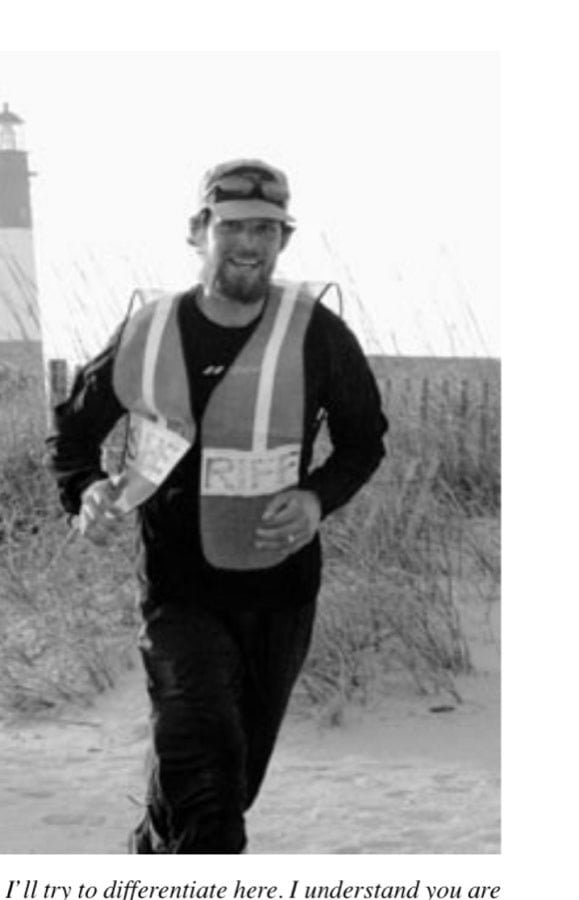
John’s final steps to the Atlantic Ocean, with the Tybee Island Lighthouse in the background.
John W: I’ll be excited to have my Internet connection back. You know, 24/7. I’d like to keep that. It’s tough to think of anything that I’ll be happy to leave behind, because I just enjoyed the whole experience so much. M&B: What will you miss the most? John W: That strange feeling of running for 30 or 40 miles, then camping underneath the stars. That made me feel really good. And I could do that day after day after day. I’ll miss that a lot, but I’ll have memories of it so I think it’ll be all right. M&B: John the elder [John Jr.], I’ll try to differentiate here. I understand you are also planning a running adventure of your own for sometime in the future. Do you want to speak about it? John Jr.: I told Margaret Sherrod [fellow streaker] that on seven, seven, oh seven [7/7/07], we’re going to start our journey from Lake Superior to the Gulf of Mexico. We’re going from north to south. M&B: So you’re going to crisscross what was your son’s route? John Jr.: Right. M&B: Heidi’s father is sitting behind this interview kind of shaking his head a bit. [Laughter.] Also, the two of you, Karen and John, would you like to take a minute to share with us what your son’s adventure means to each of you? John Jr.: Sure. When John started, there was no doubt that I knew he could do it. There was no doubt in my mind that he would be able to finish it. My major
concerns were the weather and how he was going to get through certain areas. I was concerned about him having to travel through some of the higher-crime districts. [Both John’s and Heidi’s fathers are retired police officers.] M&B: How about you, Karen? Karen W: Knowing John’s personality, you know that he was the person to do it anyway. So if he was streaking for 15 years already, this was an ultimate goal of his. As his mother, and he as my son, it was difficult, but I had to keep always in the back of my mind that he would be safe. [Her voice is quivering.] That a car wouldn’t run over him or someone wouldn’t kill him. [She’s crying.] M&B: You are really happy to have him home. I can tell that. Karen W: But on the other hand, there is that pride that you could have in visualizing that the person who did this was your son. M&B: It’s really quite a feat. Karen W: It’s really overwhelming. M&B: John, how was your reception at the end of the trail? John W: In addition to the two-police-car escort over the last few miles of the run, I was extremely surprised by an award presentation and reception at the Tybee Island town-hall meeting. Todd Smith, the director of information services for the city, was out in his shorts on this windy, cool day and greeted me with about a half mile to go to the ocean. My brother, Michael, and his girlfriend, Natalie Patron, were surprise visitors over the small sand berm just leading up to the Atlantic Ocean. The mayor pro tem, Jason Buelterman, welcomed me to the city on the beach as well. Along with many friends and family, it was an amazing ending to an amazing journey. There was a quick interview with KTOC, Channel 11, then a prolonged photo shoot with the jogger, a banner, and various groupings. As it was getting windier and colder, it was time for a shower. Next, there was a trip over to City Hall. A large contingent, if not everyone who was at the finish, attended the meeting all decked out in their Run Across America T-shirts. It was most likely one of the first town-hall meetings we had been to considering we all sat down after the invocation but had to stand back up for the Pledge of Allegiance. After that brief faux pas and a warm reception by the town folks, I was even more surprised to receive the runner of the year award from the United States Running Streak Association. It truly was unexpected. M&B: How about that great dinner celebration? John W: Yes, the celebratory dinner! Along with celebrating my mom’s 50th birthday, we chatted all about the run and had a great time visiting with each other. Bringing together family and friends is tough considering the distances
Heidi and I have lived on each coast. So being surprised by such a show of love and support really made the finish that much more special. M&B: Any other special events? John W: The next morning everyone was invited to go for a short run around the historical fort area as well as past the Tybee Island Lighthouse. Those belonging to the USRSA, my mom and dad, Margaret and Lowell Sherrod, you, and Heidi and I were taken on a running tour by Todd Smith. Todd was the local expert and pointed out a number of sites of major interest. After doing three miles, I raced Heidi back to our motel, where despite my better judgment, I sprinted about twice as fast as any of the 124 previous days. We then enjoyed a tasty continental breakfast, followed by this interview. M&B: John, now that you’ve run across this vast nation of ours, you will forever be defined by the experience. Do you already have a sense of that? Either way, can you explain how you feel you are the same person as before and how you think you may differ from who you were prior to your kickoff? John W: I do feel that it was a monumental achievement. However, it wasn’t like I cured a disease or ran for president. All I really did was go for a long run. I would say that for the most part, I’ve changed very little during the entire experience. I am still the same stubborn, curious guy who was determined to complete what I started out to do 124 days ago. The biggest change, I think, that came about is my feelings toward materialism and how I would like to limit the amount of things I
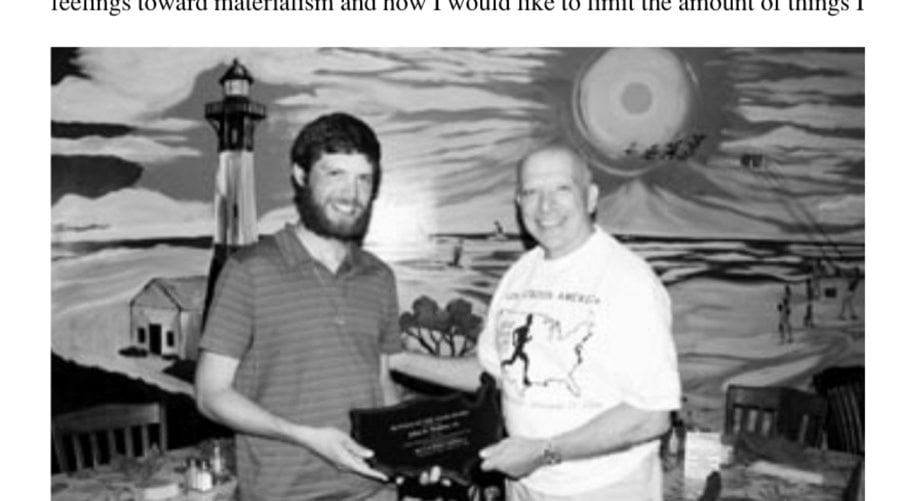
▲ Tybee Island, Georgia: John Strumsky, president of the United States Running Streak Association, presents John with the Runner of the Year Award for his run across America.
buy from now on. I would love to start doing some philanthropic work, donate to certain organizations, museums, causes, and spend money on experiences rather than physical objects. That is a big step for me considering I have a large CocaCola collection, among other things. But it is something I feel strongly about and whenever I think back to the folks who would roll down their windows and give me $5, $10, or $20, or a can of Dr. Pepper, or some batteries or whatever. I want to be just as generous. As far as being defined by the experience, I know I will be on the books for crossing the country on foot all by myself. That has not really sunk in yet. I just hope it inspires others to chase their dreams. M&B: Now that you have to return to the real world, what are your future plans? John W: I guess the first thing I need to do is find a job. That is the main objective once I reach Seattle. Other than that, we are still looking for our first house, and we want to get that process finished as soon as possible. That will be an entirely new adventure, I’m sure! M&B: To sum it up, was it worth it? John W: Absolutely! It was everything I expected and much more. I would do it all over in a heartbeat!
THE STATS Approximate mileage through each state 295.78 miles—Washington 336.99 miles—Oregon 244.47 miles—Idaho 365.94 miles—Nevada 170.97 miles—Utah 349.12 miles—Arizona 493.42 miles—New Mexico
584.02 miles—Texas 203.62 miles—Arkansas 220.76 miles—Mississippi 310.66 miles—Alabama 230.13 miles—Georgia 3,805.88 miles—Total
Approximate mileage through each month 153.08 miles—September 760.90 miles—October 927.89 miles—November
1,009.21 miles—December 954.80 miles—January 3,805.88 miles—Total
Total running time 1,163 hours, 35 minutes, 56 seconds (48.48 days) Percentage of each of 124 days spent actually running: 39.1%
This article originally appeared in Marathon & Beyond, Vol. 11, No. 4 (2007).
← Browse the full M&B ArchiveMore like this
1,000+ stories from 19 years of Marathon & Beyond
The complete archive of the legendary long-distance journal — digitized and free to read.
