

The Ultimate Run of Doug Davis
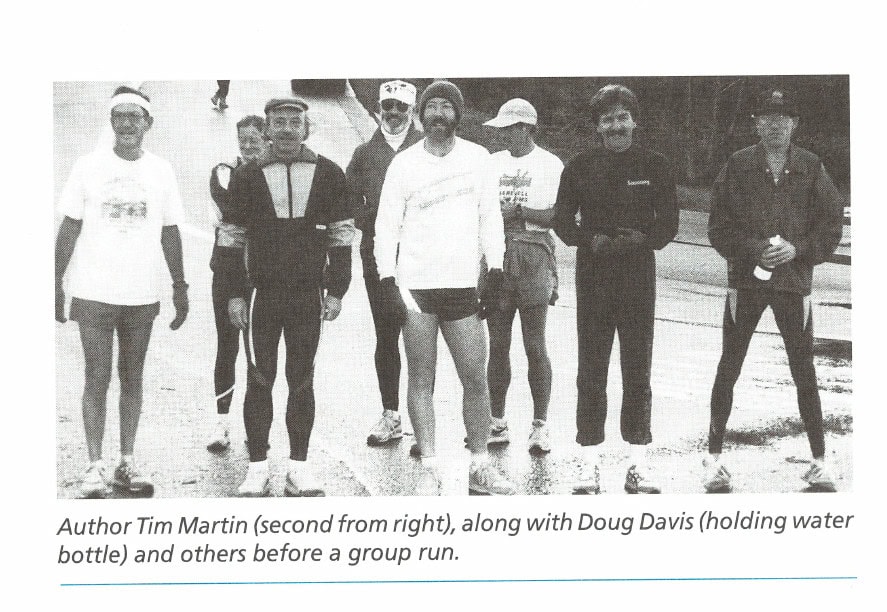
His legs were lean, almost stick-like, with rock-hard calves tapering down to delicate ankles. He moved with a grace and litheness that was not common of boys his age, who seemed mostly made up of knees and elbows. His legs swallowed up ground. His feet flickered over the playing field, moving the way eyes do in deep sleep.
Doug quit running when he entered high school. Like most teenage boys’ dreams, his revolved around girls and cars. Then, a few years later, during his senior year, he began to run again. Not for the usual reasons, though. Not to set a school record or to letter in a sport. Doug ran because it relieved his anxiety. Running gave him a feeling of motion, a sense of direction. Running became a metaphor for the continuum of life.
A NORMAL AMERICAN FAMILY
There were no tragic overtones to Doug’s childhood. He was a normal, seemingly happy young man. He grew up in a positive-thinking family with seldom an unkind word from or toward anyone.
“The whole family was athletic,” says his mother, Alberta Davis-Kalisch. “One of our favorite pastimes was to drive to Oceanside and play football on the beach. All six kids and their father played football. Those were good times for our family.”
The good times ended when Doug became passive and withdrawn. He spent much of the day locked in his room, away from family and friends. At first the changes seemed little more than a mild case of teenage angst, but it soon became obvious to his mother that he was suffering from something far more serious.
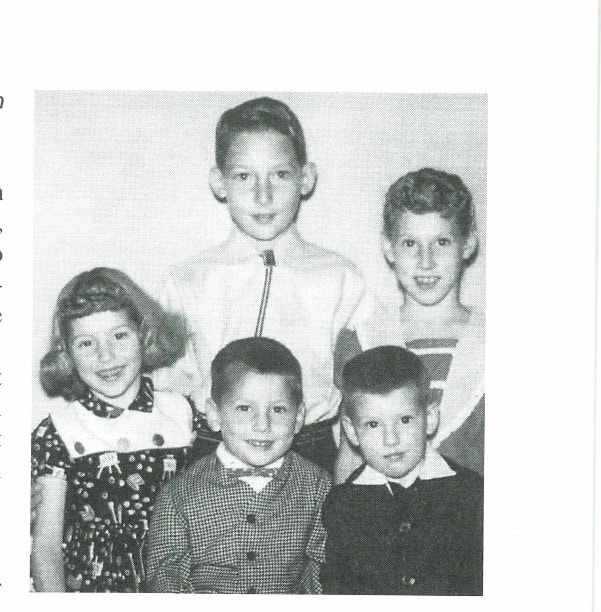
“I was worried about Doug,” says Alberta, “but even his brothers and sisters thought there was nothing wrong with him. They thought he was lazy.”
Doug’s moods grew worse. Often panic would spike up inside him, electrical charges of fear registering off the scale, and he would spend weeks hiding in the dark recesses of his room. One evening, as the family gathered for dinner, Doug excused himself and drove off in his car.
“We were all a little shocked and wondered what was going on,” says Alberta. “Some time later we had a call from the Tri-City Hospital. They said we should come and pick up Doug. He was severely depressed. He had gone to the hospital asking for medication for his condition. Shortly afterwards he was diagnosed paranoid schizophrenic.”
You will not find paranoia in a dictionary. The word is there all right, but not the feeling. In the past, Hippocrates and other Greek physicians viewed paranoia as “a mind distraction.” But distracted by what? The dictionary’s definition claims the distraction is caused by false beliefs that someone is tormenting and persecuting you. But for the person afflicted with the illness, these are not delusions. People are tormenting and persecuting you. Who are these people? Why are they following you? What do they want? There are few clues in the dictionary.
“We took Doug to several doctors and hospitals, but nothing helped,” explains his mother. “He was given [anti-psychotic] medication. It made him sick and left him weak and sedated. His father and I had no idea what to do.”
A short time later Alberta received a letter from a woman who lived in Thousand Oaks, California, whose son had also been diagnosed paranoid schizophrenic.
“She recommended a local doctor who treated with mega-vitamins. The treatment had helped her son. We decided to give it a try,” Alberta says.
Doug’s illness subsided once he went off his medication and on a course of mega-vitamins and minerals.
“Doug began to function fairly well, although the delusions would still come and go unpredictably,” says his sister-in-law, Judy Davis. “He tried a few jobs, but he couldn’t stick to them. He eventually went on disability, but that only made things worse.”
RUNNING AS A “CURE”
The bouts of paranoia were like a waking nightmare. Doug’s mind turned and twisted in confusion. Once again, he began to isolate himself. The more he drifted into isolation, the more his mental and physical health went downhill. He began to wonder: Was there really a cure for this illness? And if so, was it worth waiting for?
Then, late one night, in a rare moment of emotional courage, Doug left the house and drove 20 miles to the coastal town of Encinitas. He parked his car and walked to the water’s edge. The beach was deserted. The ocean was flooded in moonlight. For long moments he stood there, watching the waves unravel. Suddenly, and without knowing why, he slipped off his shoes and began to run.
It was a night to remember. And he would. Doug would remember it all, the cool sand under his feet, the rich smell of salt and seaweed, the feeling of peace and calm, the reassuring rhythm of his breathing to match his exertion, his own waves lapping his own shifting self.
Doug ran deep into the morning hours, going nowhere, just running. When fatigue came, it was as sweet as silver, as green as still water at dark fathoms. He returned home tired but recharged, knowing that something magical had happened.
He ran the next day and the day after that, increasing the distance and intensity with each workout. And when he felt ravaged by his illness, when he wanted nothing more than to lock himself in his room and shut out the world, he would hold fast to his commitment to run. Time and distance were not important. Movement was all that mattered. And his illness vanished like conquered ghosts.
Doug’s enthusiasm for the sport was contagious. First, he convinced his younger sister, Margie, to start running.
“I saw how much Doug enjoyed it, so I thought I’d give it a try,” says Margie. “Running became a social thing for me, but for Doug it was something he could excel at.”
Getting Margie to run was great, but when his older sister, Jennie, joined in, Doug was elated.
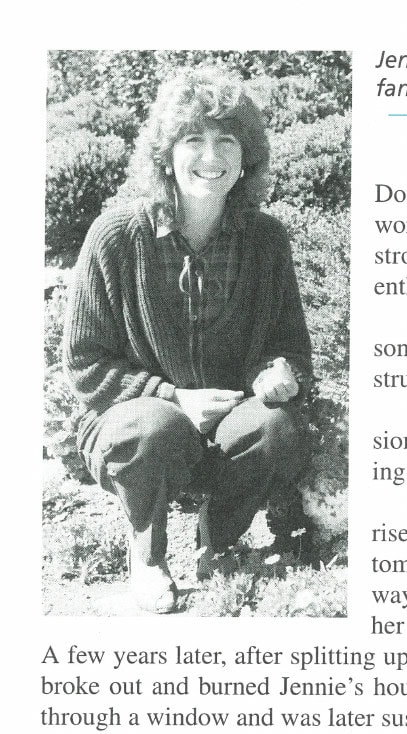
“There was a special connection between Doug and Jen,” says Judy. “Doug thought the world of her. She was the life of the family, strong, intelligent, always effervescent and enthusiastic.”
But there was another side to Jennie’s personality, a grave and disconsolate side that she struggled to hide.
“Jen experienced severe bouts of depression,” says Judy, “but she had a way of keeping it submerged with her bubbly personality.”
Periodically, though, the depression would rise to the surface like a monster from the bottom of a cold, dark lake. The results were always disastrous. At age 16, Jennie nearly took her own life with an overdose of sleeping pills.
A few years later, after splitting up with her first husband, a mysterious fire broke out and burned Jennie’s house to the ground. She narrowly escaped through a window and was later suspected of setting the fire.
“It was kind of a crude attempt to destroy everything,” says Judy. “She was hospitalized again and put on medication for depression.”
Was Jennie also a victim of paranoid schizophrenia? Probably not. Although first-degree biological relatives of individuals with schizophrenia have a risk for the illness that is about 10 times greater than that of others, Jennie’s illness was different than her brother’s.
“Paranoid schizophrenia is a thought disorder more than a mood,” says Dr. Lou Ann Wieand, a professor of psychology at HSU. “Based on the available information, it sounds as though Jennie might have been suffering from major or bipolar depression rather than schizophrenia.”
OFF TO THE RACES
A year after that first run on the beach, Doug entered a race—the San Diego Zoo Fun Run 10K. He finished far back in the pack, with a smile on his face. It was everything he had expected, and more. On the way home, Doug was extolling the virtues of the racing just as a pitchman might sing the praises of a patent medicine or a thrilling sideshow.
“The competition gave his running a focus, something to train for,” says Judy. “He lived and breathed it. His running became an occupation. He was always training hard, trying to improve his personal best.”
Doug pushed harder, running new races, breaking new barriers. As his confidence grew, so did his goals.
“He ran the San Diego Marathon in 1981,” says Judy. “It was a horrible day, windy and rainy. The whole family tracked him along the route. He was one of the last runners in.”
One of the last, but without a doubt one of the proudest. The race was tough, demanding. But it was as if a spirit had entered his body, urging him on, giving him the strength and endurance to finish. Doug ran as if in a trance, a fog, pulled along by the support of his family. And by the loud cheers of his sister, Jennie.
“Jennie was Doug’s biggest supporter,” says Judy. “She kept up on his races, always wanted to know how he was doing. Sometimes she would train with him on the beach.”
Doug began to dream of future races. He ran fiery sessions of speedwork on the track and long training runs in the mountains—runs capped with heat and deep fatigue.
“During that time Doug began to do a lot of marathons,” says Alberta. “He also ran a 50-mile race near Sacramento [the American River 50] for the first time. He was becoming a very good runner.”
The long hours of training paid off. At the ’91 Russian River Marathon in Ukiah, California, Doug seemed to come fully alive. He ran the race with an inspired and passionate intensity. He finished in 2:43, floating in with a fluid stride, lifted by the applause and encouragement from spectators. It was his first marathon win. And his last.
DISASTER
Shortly after that, disaster struck the Davis family.
“Jennie and her second husband were having marital problems,” says Judy. “They had just split up. She was 38 years old at the time and had already been through one divorce. It was the trigger for her. She decided to take her own life.”
“Our family was ignorant about mental illness,” adds Doug’s older sister, Carol. “The history was there, but we didn’t see it. When we finally woke to the problem, it was too late to help her.”
Jennie’s death left the family emotionally drawn and quartered. Most devastated was Doug. The shock of those first several days had been the worst. He threw himself deeper into his running, but even that didn’t help. Jennie’s death was an outrage, and this one crack in the wall caused his whole structure to crash.
ESCAPE TO THE NORTH
Doug needed to get away. He bought a small motor home and headed north for Arcata, California, a small college town wedged tight against a mountain range blanketed with giant redwoods. If there ever was a place where Doug could escape from his sadness, this was it.
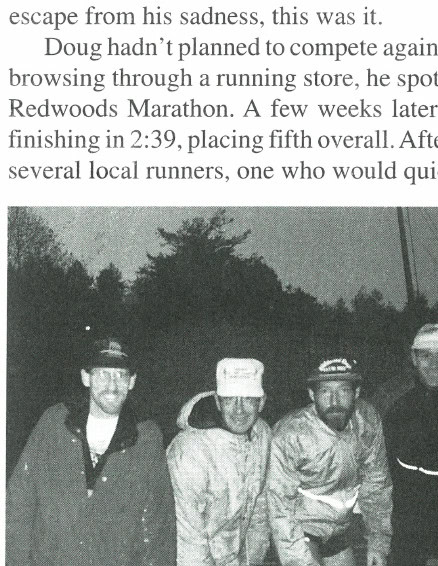
Doug hadn’t planned to compete again. Not for a while, anyway. But while browsing through a running store, he spotted an entry form for the Humboldt Redwoods Marathon. A few weeks later he ran the race in Jennie’s honor, finishing in 2:39, placing fifth overall. Afterwards, he became acquainted with several local runners, one who would quickly become his closest friend.
Dane Hart, of the Six Rivers Running Club, was tall, colorful, broad, brash, and self-confident. Doug was impressed. Hart was equally impressed by Doug’s running ability. For the next hour they sat beside the finish line exchanging training tips and discussing their mutual passion for running.
The following weekend Doug was introduced to other club members and invited on a training run. He was surprised by the thick, visceral camaraderie of the group and left the workout feeling like he had just been taken in by the world’s nicest family.
“Doug became a close friend,” recalls Hart. “He encouraged me to train hard. He would always take you beyond your human limits. I remember one 40-mile run where I came back thrashed, limped home, and climbed into bed. He ran over to the HSU track and put in another 10 miles. For Doug, running wasn’t just a sport, it was a path. And the more you gave, the more you got back. He was proof of that.”
Work harder. Go faster. It is a balancing act on a very sensitive scale, one that Doug intuitively understood.
“Not long after Doug moved up here, he traveled to the San Jose Fijitsu Five Miler with several members of the Humboldt Track Club. His goal was to run fast enough to compete with them. His time that day was 25:50. He was proud of that.
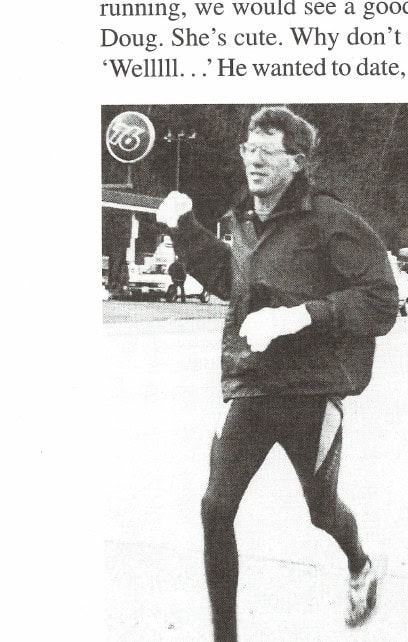
“Doug always kept to himself,” adds Hart. “He was very shy. When he wasn’t running, he would disappear into his trailer. Sometimes, when we were running, we would see a good-looking girl and I would say, ‘Check her out, Doug. She’s cute. Why don’t you go over and introduce yourself?’ He’d say, ‘Welllll. . .’ He wanted to date, to lead a normal life, but he couldn’t quite break out of his shell.”
Doug did break into the local ultramarathon record books by winning the grueling Arcata-to-Willow Creek Run, a hilly 40-mile event that attracts only the strongest and most dedicated athletes. Doug took the lead immediately and held it throughout the race. The next finisher was over an hour back.
Next he entered the ’93 American River 50, a race that would become the highwater mark in his competitive career.
“Doug was pretty realistic with the distance,” says Hart. “He knew his limits. He ran even splits throughout the race and finished in six hours, 30 minutes. It was good for seventh overall.”
The American River 50 was a moment of supreme grace, but already Doug’s sights were set on other events. Within some inexpressible area inside of him, a place no one knew, a competitive fire continued to burn. “Keep your eye on Davis,” said his friends. “The running world does not know him so well. Maybe one day soon they will.”
A VICTIM OF MOOD SWINGS
But Doug was still prey to odious mood swings, and periodically his mind would roll out at the ends of human passion, and he would come back from his journeys radically altered, both mentally and physically.
“He had a number of up and down periods,” says Hart. “Sometimes he wouldn’t even talk to me. Or I’d say, ‘What’s the matter?’ and he’d say, ‘Well, I’m just having a bad day.’ Then he would come back a few days later and his head would be shaved. Or he would grow a beard. It was like he was hiding from someone, or that something was after him.”
Instead of pitying his friend, Hart developed a “tough love” approach to his illness. He would say, “Come on, Doug, stop being ridiculous.” He would say, “Snap out of it.”
The words were a salve. Forced to behave, Doug behaved. Forced to cope, he coped. It was as if Hart intuitively understood that indulgence only made his friend’s condition worse, that the worst thing he could do to an extremely depressed person is be nice and allow that person to remain comfortable in his current miserable state.
“Knock it off, Doug,” Hart prodded and provoked, forcing his friend into confrontations, giving him sufficient incentive to push himself out of the caged fog of anxiety. Through the help of his friend, Doug strained to cope with the ebb and tide of his illness.
Until, finally, Doug could cope no longer. Rock bottom is everything out of focus. It’s a failure of vision, a failure to see the world as it is, to see the good in what it is, and only to wonder why things look the way they do and not some other way.
“I was going to do some landscaping around my house,” says Hart. “Doug helped me. We spent three or four days cleaning up the yard. Doug wasn’t running much at the time, only a sporadic jog here and there. His back was bothering him. And he seemed worried about everything. Just after we finished the job, he moved back to his brother’s house in San Marcos, California.
“A week later, he called and asked if I had seen the video. I told him I didn’t know what he was talking about. Doug said, ‘The video that those people took.’ I asked, ‘What people?’ He said, ‘The ones who were watching me working at your house.’ I thought he was kidding. I told him, ‘Who would want to watch a video of you working?'”
Hart tried to change the subject. He asked if Doug was coming up in May to run the Avenue of the Giants Marathon. There was a long silence. Then Doug said, “I don’t know, Dane. . . . I’m not sure I’ll be able to keep in touch.”
Off his medication, injured, unable to train, Doug felt his illness unfurling, slowly, like a creature waking and stretching after a long sleep. The calligraphy of his mind took control and began filling in the darkness with a script from a horror movie: People were watching him. They were following him. He could hear their voices as they plotted against him. He could see the web slowly closing in.
“In the three weeks before he disappeared we saw a decline in Doug’s mental behavior,” says Judy. “His relationship with others became laced with a certain paranoia. He thought everyone had turned against him. He was convinced that the whole family was trying to have him arrested for Social Security fraud.”
“He gave away a lot of his personal belongings beforehand,” says Alberta. “There was still $600 in his savings account. Only his T-shirts and medals were missing. The night before he disappeared, he called and said, ‘Mom, I love you.’ That was the last time I heard his voice.”
DOUG’S LAST RUN
On the very last morning of the very last day, Doug cleared the kitchen table at his brother’s house and placed a photo of Jennie in the center. Then he pulled on his running clothes, climbed into his motor home, and pointed it in the direction of Mount Palamor.
He knew he had come to the end of something. At the entrance to the park Doug stopped the vehicle, hooked a hose from the exhaust to the interior of the camper, and climbed inside. The small compartment quickly filled with carbon monoxide gas. He sat in the camper, shaken, confused, thinking, It will end here, in this camper, on this road. Alone. . . .
But it would not. Doug bolted from the camper, gasping and coughing. The rain was coming down in great, whistling cataracts. It felt good on his cheeks, unexpected. The cold air steadied his breathing. Doug’s instincts urged him forward, toward the mountain, away from the fear and anxiety that plagued him.
Halfway up the mountain the rain turned to sleet. Seeps and springs glistened from the rock, as if the mountain were leaking, or bleeding life. There was so much green, everywhere, lush and dripping and wet. His back ached, and he was drenched, but he was running. Once again, he was moving.
His thoughts hurtled up the trail before him, blurry with speed. By the time he reached the top of the mountain, the sky had dropped around him in a wall of white. Snow began to fall. It caked his eyelashes and filled his nose. His body convulsed with shivers. He could feel the exposure slowly creeping in. His momentum was wavering. Yet there was no thought of turning back. He pressed forward, head down.
JENNIE’S PATH
Suddenly there was a catch in the wind, as though the beast was drawing a short breath. A change, a lightness of spirit moved through him. Being in that sanctuary soothed him, as if someone had placed their hands and fingertips over his face, covering his eyes, and then run their fingertips slowly downward, drawing out all the worry. That’s what it felt like, over Doug’s heart.
Through his inner calm he knew what was happening. It was somehow all inside him, integrated, accepted, in some astonishing way. He was no longer cold. A warm breeze was blowing. Waves lapped at his feet. And there, a short distance away, stood Jennie.
Jennie had picked the perfect line to run, a ribbon of dark, moist sand, neither wet nor dry. Smiling, she motioned for him to follow. As he moved forward, a new element buoyed him. It was happiness, unasked for, as totally spontaneous as the waves’ now visible spray. Once again, there was an oasis of calm in his mind, an almost inexplicable harmony.
Doug moved up the trail in the footsteps of his sister, his white singlet and blue shorts taking a long time to melt into the white landscape of the surrounding trees.
A second storm blew in that evening, dumping more snow. Temperatures on the mountain dropped into the low 20s.
STILL LOOKING FOR DOUG
“On March 22, 1995, they found Doug’s motor home near the entrance to the park,” explains his older brother, Ken. “He hooked up the exhaust into his motor home but evidently changed his mind at the last minute. He took off running. He just disappeared.”
San Diego Search and Rescue and the Sheriff’s Department scoured the mountains for two weeks. Divers checked Doane Pond, where Doug was seen by several fishermen. They used dogs, riders on horseback, hikers, helicopters, and fixed-wing planes. But they came up with nothing.
“They did a thorough job,” says Ken. “Dogs picked up his scent all over the mountain. But there had been a lot of snow, and they lost the trail.”
Search and Rescue brought in cadaver dogs. Still, they found nothing.
“I wasn’t surprised,” says Ken. “They found an airplane in the park that had been missing for over 15 years. There’s just too much wilderness there.
“My brother and I go up there and hike,” he adds. “When I see a jogger that has a similar gait, I do a double-take. We vacillate, but we’re still holding out hope that Doug is alive.”
Take a look at the primitive and remote landscape into which Doug Davis disappeared. The high ridges and steep ravines. The dark, dense forests. He ran off into these mountains to find happiness. And he did. Even ravaged by illness, even with something intangible coursing through him, he discovered peace and contentment. He was a champion at last, his potential set free by a sport that he loved. Here, in this place, he is what he could be.
This article originally appeared in Marathon & Beyond, Vol. 2, No. 5 (1998).
← Browse the full M&B ArchiveMore like this
1,000+ stories from 19 years of Marathon & Beyond
The complete archive of the legendary long-distance journal — digitized and free to read.
