

The Unfinished Race That Stuck In My Craw
Every step promised disaster. I placed a foot in the loose grit on the steep slope in the crook of the next switchback and shifted my weight slowly to see if it would hold or if I would go sliding off Topatopa Bluff, taking the loose stones that marked the edge of the trail with me. The tightening switchbacks were down to about 6 feet long. I looked up. My headlamp flashed over an endless jumble of rock debris that seesawed back and forth up the mountain. The trail was a narrow, slippery ribbon threading up through the loose stones, and somewhere beyond where my light failed was the top, where I would leave the stone I was carrying with the other stones brought there by runners in memory of Vicki DeVita, a fellow trailrunner who had succumbed to cancer the year before. Only then would I be allowed to return to life on earth.
If it had been daylight and I had been feeling human, this trip up Topa might have been manageable, but I was slammed. My running buddy, Rob Mann, and I had been running since four o’clock Friday afternoon. It was two o’clock Sunday morning, so this was our second night on the trail: no sleep and little rest, except when we occasionally flopped down in the dirt on the trail unable to continue and closed our eyes for a restless moment.
Besides being dead tired, exhausted, and catatonic, I was parched. My water had given out long ago. Rob and our pacer, David Nakashima, who was with us on our final 20-mile loop, had water, but I figured I would just drain their supplies and still be thirsty, so I was sucking it up. Meanwhile, painful blisters on both heels were exploding with each step, and my stomach had gone south so I was bent over and dry heaving and wishing I could just throw up and be done with it.
Suddenly rocks came tumbling by me, dislodged by Rob tripping and sliding down the trail. He had been leading the way up. “I’m not going up there,” he growled. “Where’s your rock?” “I left it there.” He pointed up to a rock formation about 20 feet above us. “It’s another mile to the top. I’m not doing that. He said we could tell our own
story. Well, this is my story.” “He” was Chris Scott, past director of a race called the Coyote Two Moon 100. Chris had blessed our efforts to come out here by ourselves to try to recreate the race. I carefully braced my feet and straightened up so I could look farther up the mountain. I didn’t want to tumble over backward. Thank God I wasn’t dizzy . . . yet. Beyond the rock formation, there were many more switchbacks disappearing over a rim high above. The weight of the 90 miles we had covered to get here seemed to settle on my shoulders. I shifted beneath the straps of my backpack /hydration pack. My head ached. My feet hurt. My stomach was a mess. My legs had been dead for hours.
The need for something big—no, bigger In the year before my 60th birthday, I was determined to do something to thumb my nose at this venerable milestone. I searched out 100-kilometer races, thinking that a 62-mile run just after turning 60 would be perfect. But somehow that didn’t seem like enough. I was an ultrarunner. In ultrarunning, I reasoned, you go big or you go home. I needed a 100-mile race to really goose that venerable milestone in the butt.
Then circumstances intervened. In the spring, when I was several months shy of my birthday, still a spry 59 years old, Rob and I had gone to Ojai, California, for the final, unofficial edition of the Coyote Two Moon 100-Mile Run. Now, the only reason there even was an unofficial running of the race was that the year before, during what was supposed to be the final Coyote Two Moon, a severe storm hit about 30 hours into the race, and the race director had to cancel the race while it was in progress. I was out there at the time, freezing and cursing, and had put about 85 miles together. The next thing I knew, I was standing there in the driving snow in shock, hearing from a woman in a black cap and a red vest that, “It’s canceled. It’s over. Everyone’s supposed to get down off the ridge.” So that was it for that year.
Then in our final chance to “git ’er done” this spring, Rob and I screwed up. The challenging course, which climbs up and down the 5,000-foot Nordhoff Ridge that looms behind Ojai like a nightmare, beat us into submission. We both quit short of night number two.
Naturally, the unfinished race stuck in my craw. I didn’t care about the cancellation. That had to be done. Runners were at risk. I was fine with that. What I was not fine with was almost finishing in terrible conditions the one year and then blowing my big chance at redemption the next. Plus the race was kaput. No more chances at redemption . . . unless . . .
It struck me like a cicada slamming into my forehead on a warm summer evening. Do the race ourselves! Do it right after my birthday! I could kill two
© Robert Josephs
▲
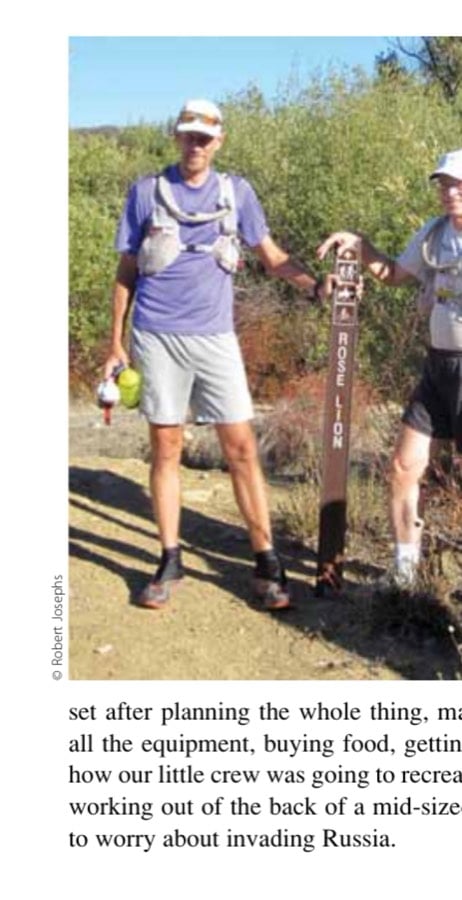
Rob Mann (left) and I are all smiles at the start at the trailhead of the Rose Valley/Lion Canyon Connector Trail.
birds with one stone: thumb my nose at 60 and put the big kibosh on this Coyote Two Moon curse. Golden! There was even a full moon—a standard Coyote Two Moon prerequisite—the weekend after my birthday in October. Kismet! Karma!
I enlisted David and Robert Josephs to help as crew, and of course, Rob had the same itch that needed scratching as far as finishing the run, so we were set. Well, we were set after planning the whole thing, making hotel reservations, pulling together
all the equipment, buying food, getting everyone down there, and working out how our little crew was going to recreate six major aid stations all by themselves working out of the back of a mid-sized SUV. It seemed like Napoleon had less to worry about invading Russia.
Then there’s the question of where we are But at four o’clock Friday afternoon on October 26, Rob and I duly left the Rose Valley Falls Campground and headed up the Rose-Lion Connector Trail on the first leg of our 100-mile solo journey, feeling equally exuberant and apprehensive.
Right away it was hard to follow the trail. We had a map that gave us the broad outline of our route, but the trail didn’t want to cooperate. It wandered around through landscape that didn’t look familiar to us at all even though we had been
there before, shot up a slope when we thought we should be down in a valley, shot down a slope when we thought we should be escaping the valley, split into two directions, got faint, got jiggy, and at one point after dark in the woods, left
us clambering over a jumble of rocks following a dried-up streambed. Totally stumped, we pored over our map looking for clues. It did look like the trail and the stream converged. Since we could find no trail to follow, we talked
© Rob Mann
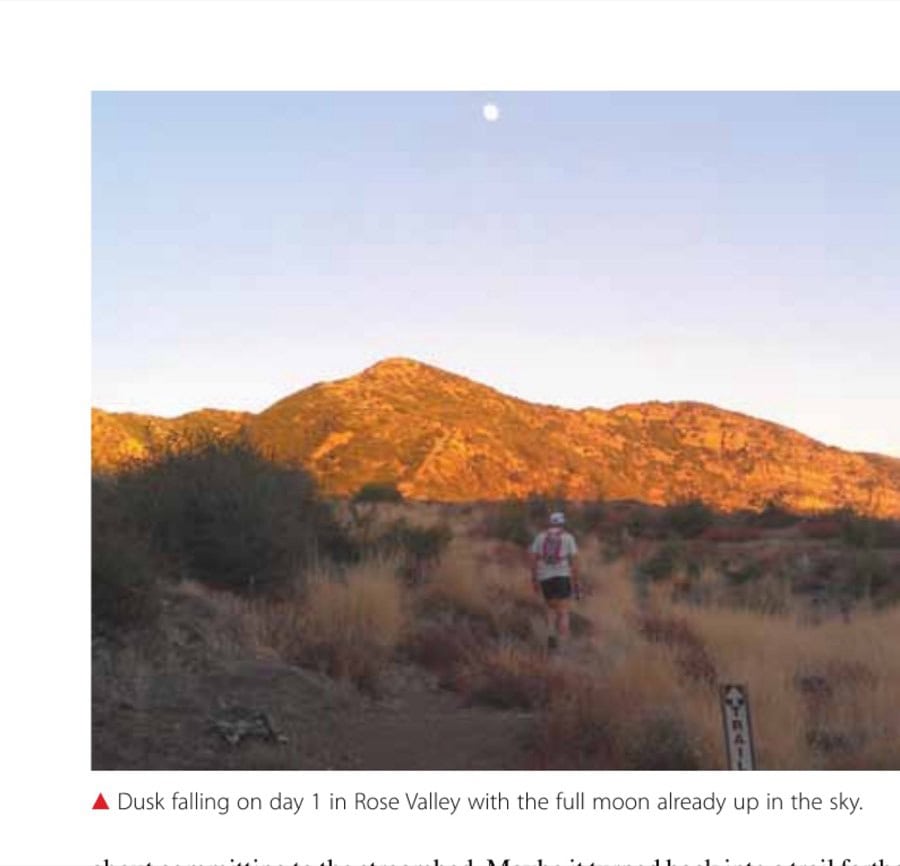
▲ Dusk falling on day 1 in Rose Valley with the full moon already up in the sky.
about committing to the streambed. Maybe it turned back into a trail farther down, we surmised. The stream eventually had to connect with the road we wanted. I looked down the long dark tunnel of the streambed falling away through the woods and the jagged boulders we’d have to scramble over. The lack of flags, of other runners, of a race’s infrastructure suddenly loomed in my mind. Were we crazy to be doing this? Was this whole thing needlessly dangerous?
We’d back-tracked two times before looking for where we might have gone wrong, but before plunging into the totally unknown, we tried one last time. We went back up the trail and found nothing, turned, and headed back to the stream. Then Rob ducked under some low-hanging branches on our right. I followed and our lights lit up a solid bank that looked like a dead end, but we could just make out an incline angling up the bank. A few steps up the incline, and there was the trail as clear as day. A toppled tree had obscured the correct route and almost cost us the whole venture. The trip down the streambed would have been a disaster, we later realized, miles of bushwhacking, and we probably would have triggered our three-hours-late alarm that stipulated that our crew would call for help if we overshot our projected time by that much.
Back on jeep roads and a more familiar part of the course, we sailed down to the bottom of Sisar Canyon where David and Robert had the first aid station
set up. We languished in their experienced care and picked over the supplies of sandwiches, soup, chocolate, soft drinks, and water. The whole venture started to seem like a good idea again. Recharged, we loaded up with plenty of food and water and set out to climb
back up onto the ridge. From the top of the ridge, we would shoot down Horn Canyon Trail once more to the bottom in Ojai. This was the nature of the beast. Climb up the ridge, follow the road along the top for a while, and then drop all
the way to the bottom—then back up, again and again. After Horn Canyon, we reached the top of Gridley Trail back atop the ridge at three in the morning and were met by ribbons blocking the trail entrance. A
notice tacked up there informed us that just six days earlier a bear had attacked a woman who had apparently surprised the bear and its cub lower down on this trail. Trail closed for two weeks. So we had no choice but to skip it and go on
to the next trail to get down off the ridge. We figured we would make up the distance somehow later. Of course, it was not ideal that a pissed-off mother bear was running around out here. Had she gotten the memo that she was supposed
to stay on the closed trail and not wander over to all the other trails where we were? I doubted it.
A detour around the mama bear We reached the bottom of Pratt Trail at a place called Cozy Dell just as Saturday morning broke. Cell phones worked on this side of the ridge so we had called ahead to David and Robert about the bear-induced change in plans. They were waiting with hot soup, coffee, sleeping bags to throw over us, and camp chairs
© Rob Mann
▲
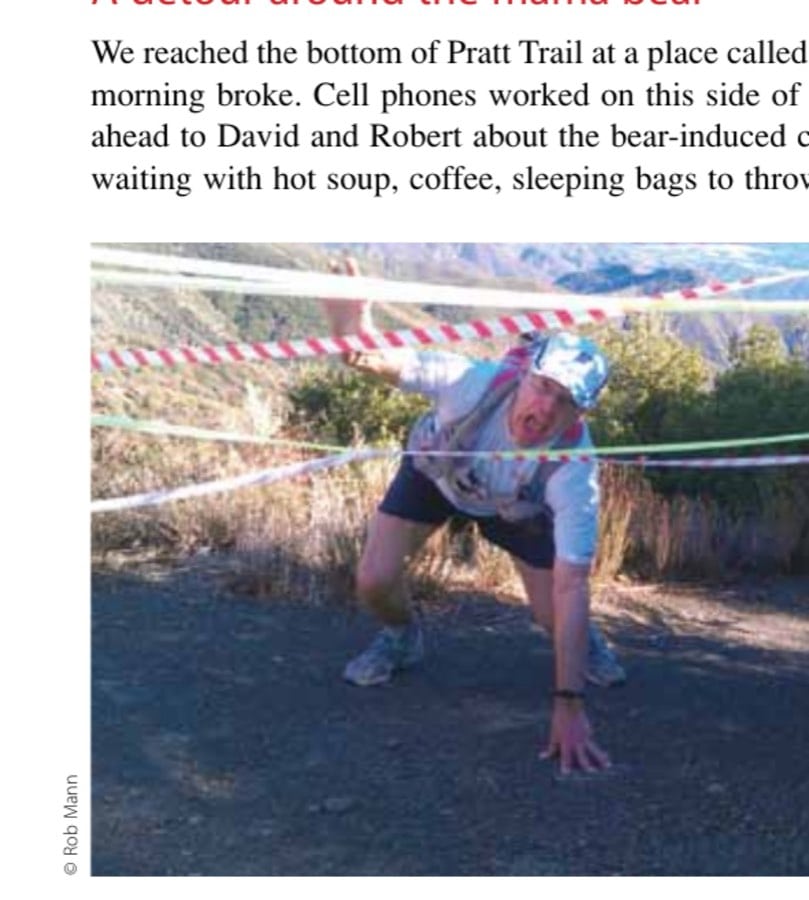
I am demonstrating how we were going to die by bear attack at the top of Gridley Trail.
to settle into. The morning light always gives all-night runners a surprisingly big boost, so after a brief nap, we blasted back up the trail ready to rumble. From there it was a brutal seven-mile climb to get back up on the ridge and then a couple of more miles to get to the next trail down, Howard Creek Trail. This one we doubled up, going up and down twice to get back most of the distance we had lost by skipping
Gridley Trail. We killed the whole day on the Howard Creek Trail loops and then getting back over to the start/finish at the Rose Valley Falls Campground. We were at about 80 miles at this point and faced a big 20-mile loop back onto the ridge and then around to the trails where we had started. While we were on the loop, there would be no more aid stations, and part of the course was an out-and-back to the top of the Topatopa Ridge.
Night had fallen once again on our little enterprise, and things had gone a little grim. We had picked up David as our pacer for the final loop, but the excitement of having him along didn’t last long. There were several false summits on the climb up Rose Valley Road, which kept fooling me, so by the time we got to the actual top, I was feeling discouraged.
Earlier in the run, I would anticipate a landmark, and quick as a bunny it would be there. Now the landmarks would not come. My anticipation would turn to despair as nothing appeared, then to hopelessness, then to anger, and it would go on and on, until I got beyond hope or longing or desire and became numb to it, and still it would not come, and I would trudge on and on, and only then would it finally appear. But by then, reaching the goal was inadequate. Nothing could fill the
© David Nakashima
▲
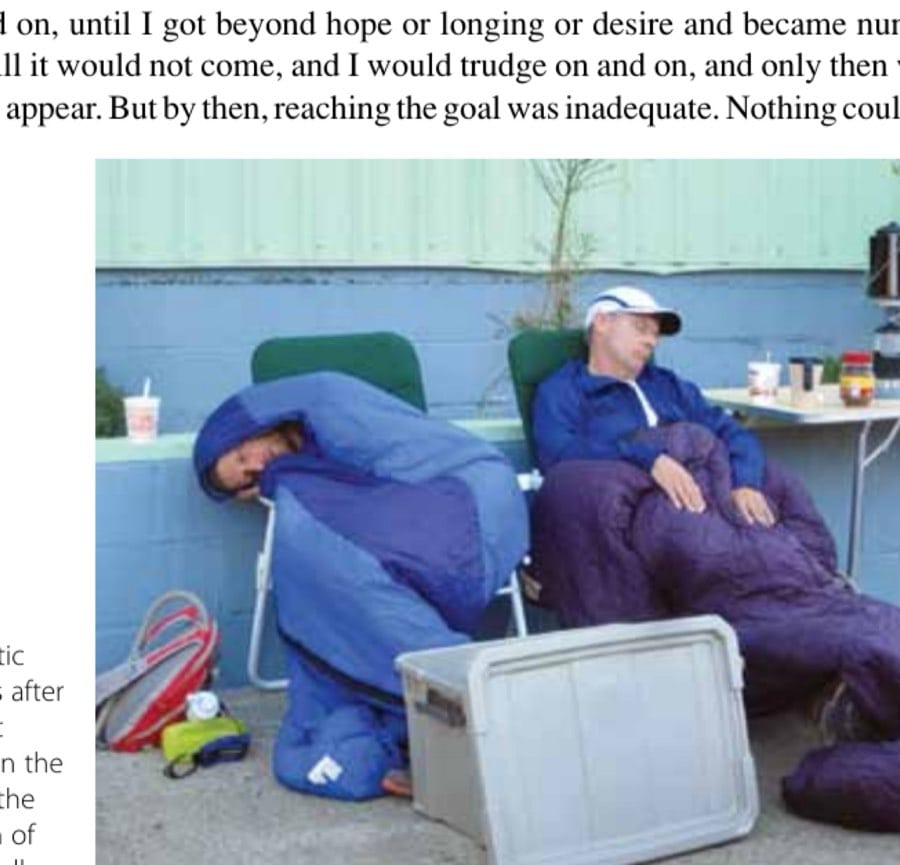
The energetic runners after the first night on the trail at the bottom of Cozy Dell.
© Robert Josephs
▲
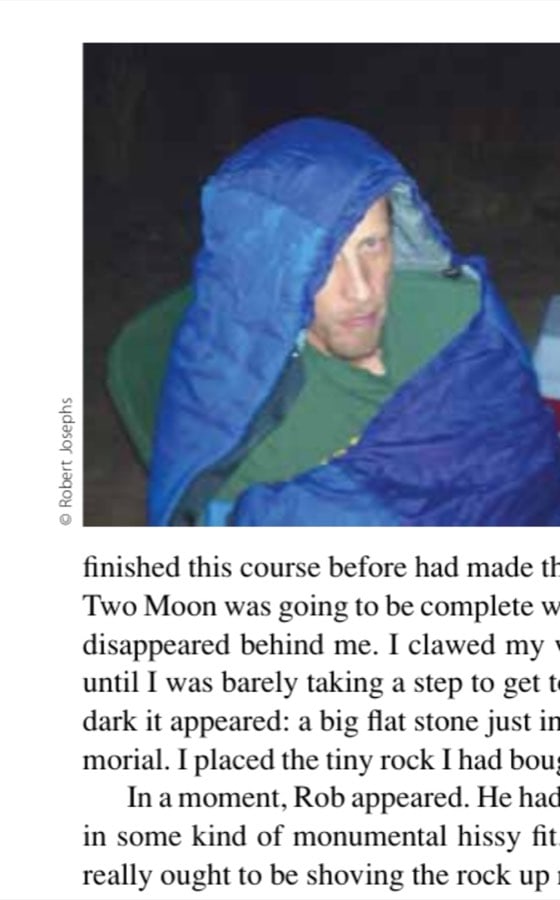
Rob Mann in Rose Valley during night 2, as he contemplates the final 20-mile loop to come.
void left by the long struggle to get there. That’s how the loop was going. Back on Topatopa Bluff, I pushed past Rob and muttered, “I’m going to the top.” My one coherent thought was that everyone who had
finished this course before had made this climb. No story about finishing Coyote Two Moon was going to be complete without the top of Topa being part of it. Rob disappeared behind me. I clawed my way up the ever-diminishing switchbacks
until I was barely taking a step to get to the next switchback, and then out of the dark it appeared: a big flat stone just in front of a large pile of rocks, Vicki’s memorial. I placed the tiny rock I had bought with me on the flat stone and sat down.
In a moment, Rob appeared. He had changed his mind, but now he was locked in some kind of monumental hissy fit. He flung his rock down and told me he really ought to be shoving the rock up my where-the-sun-don’t-shine and that he
felt like shoving all the rocks on the whole mountain up my where-the-sun-don’tshine. It’s possible that he also said that when we got back down he was going to shove David up my where-the-sun-don’t-shine, but happily, I wasn’t following
his logic. I was in such a deep-funk stupor from the whole 30-plus hours of running that I was registering almost nothing mentally. First of all, I didn’t get why he was mad specifically at me. Second, I had other fish to fry.
By the time we got down off the steep slope and on to the last five miles of single track to the finish, I had stopped functioning independently. I was like a child. I was just dumbly tagging along, going wherever everyone else was going.
My thinking was on the level of an amoeba: ooze here, ooze there. Meanwhile, Rob had gotten himself into such a lather back on the mountain that now he seemed to be operating on pure adrenaline. He was flying down the trail, which
was suddenly taking an ominous route along the edge of several cliffs. David and I could barely keep up with him.
Maybe I need a hug From time to time, the confusion in my brain would coalesce around a question. I would yell out, “Are you sure this is the trail? Are we going the right direction?”
Rob would stop and we would huddle around the map, which indeed showed that there was only one trail and we had to be on it and going in the right direction, and my pea brain would register that, but five minutes later I’d be asking again, “Is this the right way?” Luckily, Rob had become the adult to my child and kept us moving and on course.
At last we descended to the bottom of Lion Canyon, got beyond the cliffs of death, and came to the last trail junction, which put us unmistakably back on the map and on the right route. We had less than two miles to go. Our new problem was that down on the valley floor it felt like we had stepped into a deep freeze. I struggled into the warmer jacket, hat, and gloves that I had been carrying all night.
It started to get light, but now we were back where the trail was hard to follow. The growing light revealed a weird, unfamiliar landscape of scrub and mesquite and sandy ridges and dead trees. The trail disappeared up a naked, rutted ridge of red sandstone that didn’t look at all right and we came to a halt, convinced once again that we were lost. Instead of being just a few minutes from finishing, we imagined we had gotten sidetracked into some lost canyon and were probably headed for Nevada rather than the parking lot at Rose Valley Campground. We tried backtracking, but the only semblance of a trail was what we were on, so we turned around and followed it and hoped for the best. When we reached some high ground, we could see the Rose Valley Road climbing the ridge in the distance,
ad
© Robert Josephs
▲ The strange, low, furtive gesture we made at the end of almost 40 hours on the trail. No one can explain what we thought we were doing. David Nakashima, on the left, was our pacer over the final 20 miles.
so at least we knew we were going in the right direction. We recommitted to the mystery trail and after what seemed like forever, we saw the trailhead where it had all begun, the finish, though we seemed to be coming at it from the wrong direction. Whether we actually got back to the finish on the right trail is not clear, but our guess is that we ended up getting back more of the distance we had lost by skipping
Gridley Trail. We stepped out onto the blacktop and saw our car parked across the road. Robert appeared and took a picture of the strange, furtive gesture we made to mark the end of our journey. It was not a handshake or a high five. It was our fists held downward close to one another. No one knows where that came from or what it meant, but it captured the moment.
Strangely, arriving at the end, I felt no joy. I was so beaten up I wanted to cry. It seems that I had visited such a deep and dark place out there on the trail that I hadn’t come all the way back yet. That was going to take some time. We sat in the warm car with blankets over our laps and got used to the idea that we were done. We had been running for 39 1/2 hours. We had covered about 100 miles, maybe more, maybe slightly less.
Rob and I had accomplished what we had set out to do and yet . . . I was uneasy. It felt like I had set out on some bright new journey but had found my way instead to a dark beginning that could only lead eventually to an end. But then all things end, don’t they?
This article originally appeared in Marathon & Beyond, Vol. 19, No. 4 (2015).
← Browse the full M&B ArchiveMore like this
1,000+ stories from 19 years of Marathon & Beyond
The complete archive of the legendary long-distance journal — digitized and free to read.
