

The Universal Ultra
Although any race beyond 42.195K/26miles385 yards is reckoned to be an ultra, across the world one particular distance has become universally popular—100K/62.1 miles. One hundred kilometer races have been held as far north as Baffin Island in the Northwest Territories of the Canadian Arctic and as far south as Puerto Varas in Chile, and the frozen wastes of Antarctica, as far west as Honolulu in Hawaii and as far east as Lake Saroma in northern Japan. The races are held on tracks, on trails, on road loops, and from point-to-point; through cities, towns, and villages; through forests, across deserts, and over mountains. Some cater to a mere handful of enthusiasts, while others feature a cast of thousands. This year there will probably be over 150 such races around the world.
The mile has been around since Roman times, but the kilometer is a relative newcomer. Following the French Revolution of 1789, a new scientific basis for measurement was devised. A new measure for length was proclaimed—the meter, which was to be one ten-millionth of the distance from the pole to the equator. The kilometer, a multiple of the meter, took a century to gain acceptance on the Continent as the recognized unit of long distance. (As late as 1881 the Germans, for instance, were still using German miles.) Thus, competition over the 100K distance did not really begin until the end of the 19th century.
There are, however, accounts of walkers and runners tackling distances that approximated the 100K for many years before 1900. The first known race over something approaching the 100K was held way back in ancient Egypt in around 690-665 BC. An Egyptian Pharaoh, Taharqa, ran his troops out to an oasis, some 50K, and then back. The winner reputedly took around eight hours. The race was commemorated on a rock stele and discovered by Egyptologist Ahmed Moussa in 1977.
Sixteen hundred years later, in the 10th century AD, Alswith, a walker in the Isle of Man, an island between England and Ireland, reputedly covered 112K/70 miles in a day. Some 200 years later, an English shoemaker named Gilbert walked the 106.2K/66 miles from Canterbury to London in a day.
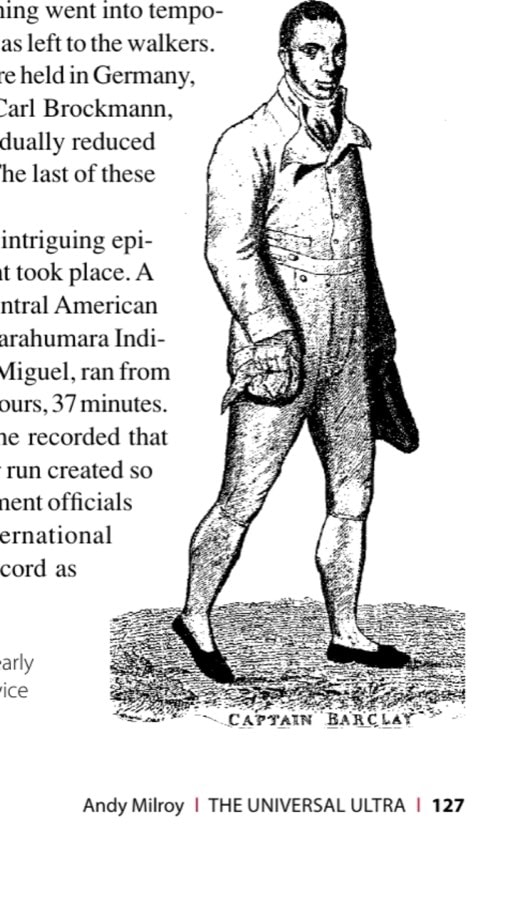
Captain Barclay does it twice Coming into more modern times, in 1709, a Russian, Vronov, walked 100 versts (about 107K) between daybreak and sunset. In Britain the great pedestrian of the early 19th century, Captain Barclay, twice walked 102.9K/64 miles in 10 hours—once from Charing Cross to Newmarket (1802) and on the second occasion from Charing Cross to Seaford in Sussex (1805). Perhaps the most precise mark from this period was achieved by a Mr. Hooper, who covered 101.3K/63 miles in 11:38:45.
The best mark for the approximate 100K distance came in the six-day era of the 1870s and ’80s. In a shorter event, the British pedestrian George Cartwright produced an eight-hour record of 101.2K/62miles1,584yards in 1884.
Thus when French ultra-long-distance racing flowered in the 1890s, there were already well-established marks at the approximate 100K distance and beyond. It was from this “belle epoque” in France that the 100K at last emerged as a recognized distance in its own right. In 1902 one of the top French walkers and runners, Emil Anthoine, produced a startling 7:25 for the distance on the road, en route to a longer performance. How accurate the distance was measured is hard to say after all this time.
After this brief flourish, ultrarunning went into temporary decline, and the 100K distance was left to the walkers. One hundred kilometer road races were held in Germany, Italy, and France, and walkers like Carl Brockmann, Harold Ross, and Donato Pavesi gradually reduced the walking best to under 10 hours. The last of these performances came in 1922.
Four years later, one of the most intriguing episodes in the history of the 100K event took place. A 100K race was held as part of the Central American Games in Mexico in 1926, and two Tarahumara Indians, Tomas Zafiro and Leonicio San Miguel, ran from Pachuca to Mexico City in a time of 9 hours, 37 minutes. Newspaper reporters at the finish line recorded that the two were not even panting. Their run created so much interest in Mexico that government officials and sportsmen petitioned the international athletics authorities to accept the record as
▲
In Britain the great pedestrian of the early 19th century was Captain Barclay, who twice walked 102.9K/64 miles in 10 hours.
official and, moreover, to include the 100K event in the 1928 Olympic Games at Amsterdam. Nothing came from these efforts. The leading ultrarunners of the ’20s and ’30s, Arthur Newton and Hardy Ballington, surpassed the Tarahumaras’ time for the approximate 100K distance, if we look at their splits for 65 miles/104.6K in their Bath 100K runs. Newton ran 8:51 in 1928 and Ballington ran 8:17:30 in 1937.
These marks were to be improved in the 1950s when the South African Wally Hayward clocked 7:41:36 for 62 1/4 miles/100.18K on the track en route to his 24hour world best, and Britain’s Ron Hopcroft clocked 7:33:29 for 64 miles/102.9K on the Bath road. Hopcroft’s mark was set in 1958, just before the 100K road event was to begin its reemergence on to the world stage.
French walkers like Florimond Cornet and Henri Caron had gradually edged closer to the absolute 100K best of the Mexican Zafiro, and in 1953 Caron recorded 9:32:52. The Biel 100K event in Switzerland began as a walking race in 1959, but it rapidly became a go-as-you-please event, and by 1961 the winning time was down to 8:43. The Swiss race was joined by the Liberec (Reicheneau) race in the then-Czechoslovakia in 1965, the Czech race being won in 11:54 that year, with walkers leading the way once more.
Four years later, the Unna race in West Germany began and was won by Helmut Urbach. (Urbach subsequently won the race four more times—as compared with his seven wins at Biel.) The now-defunct Jeugdtehuis 100K in Belgium began in the same year.
The year 1972 seems to have been a watershed in the development of the event. The inaugural Millau race in France was won by Serge Cottereau, and the first Italian 100K at Turin went to the Italian Bonini. The Finns had their first race at Järvenpää, switching to Hartola in later years. Also in Scandinavia, the Danish event at Aarhus, Copenhagen, joined the rapidly growing list of 100Ks.
The distance begins to spread Two years later, the world’s then twin superpowers, not wishing to be outdone, introduced their own 100K events. Lake Waramaug was to be the first such race in the United States and Odessa the first in the then-Soviet Union. By 1977 there was a 100K club organizing track races in South Africa, and a track 100K had taken place in San Sebastian in northern Spain. During the ’70s and early ’80s, the spread of the road 100K event in Europe proceeded steadily. Winschoten (Netherlands), Hirtenberg and Bruckendorf (Austria), Santander (Spain), Lincoln (Britain), and Varazdin (Yugoslavia) were added to the calendar of 100K events.
The first such race in Australasia/Oceania was probably a track 100K held in Canterbury, New Zealand, in 1980, although Australian George Perdon had clocked 7:26:14 en route to his 100-mile track run in 1970.
In the mid-’80s, 100K running began in South America with races in Brazil and Chile, and in 1986 the Saroma 100K began in Japan. At the last count there were 100K events in close to 50 countries around the globe. Many countries are content with just two or three a year, but two nationalities seem particularly addicted. The French put on well over 20 such races each year. The Japanese go in for numbers in 100K races, as opposed to numbers of 100K races. There are currently six Japanese 100K races with a thousand or more starters each year, and they also have several other 100Ks with over 500 runners. Lake Saroma is the biggest conventional 100K road race in the world with at least 2,500 starters in 2010.
However, the largest 100K race is held not in Japan, but in China. The Trailwalker 100K in Hong Kong had 4,116 finishers in 2010. The biggest 100K in Europe has been the Millau race in France, with 3,687 starters and 2,502 finishers in 1991. By 1996 these numbers had dropped back to 2,039 starters and 1,474 finishers to be overtaken by the grandfather of them all—Biel in Switzerland, with 2,813 starters and 1,849 finishers. That year another large field also tackled the Italian Faenza race, which had around 2,500 starters. By 2010 these numbers had stabilised at a lower level—1,301 for Millau, 1,260 for Biel, and 1,026 for Faenza. However, the time limits in such 100K events are often generous— sometimes 24 hours, which thus throws the event open to a much wider spectrum of walkers and joggers.
Expansion to a serious series In the early ’80s, the 100K event developed a stage further, and national championships at this distance began to be recognized first in France and the United States, then in Germany and Spain. From there it was a short step to international competition, and in 1984 a Three Countries Cup was developed by Harry Arndt. This was an individual and team competition based on the results of Vogelgrun
ad
(France), Winschoten (Netherlands), and Rodenbach (then West Germany). From this competition in 1986 emerged the 100K Europa Cup circuit competition, which was enlarged to include Torhout (Belgium), Hartola (Finland), Hirtenberg (Austria), Geneva (Switzerland), and Santander (Spain).
In 1987 the first World 100K Championships was held, at Torhout in Belgium. This was a competition just for individuals. The following year, at Santander, came the first World 100K with IAAF recognition. In 1990 the event went out of Europe for the first time, when it was held in Duluth in the United States. In 1994 the race went to Asia, hosted by the Japanese Lake Saroma event. The Duluth event had seen the first international team competition, which by the late 1990s had grown to 23 national men’s teams and 13 national women’s teams.
The year 1990 was very significant in the development of the event. At an IAAF Council meeting at Athens in September, the 100K was added to this list of officially recognized road distances. Also in that year the Inter-Continental 100K Cup replaced the Europa Cup competition, enabling runners around the world to compete internationally in races that were reasonably close to them.
Also in the early 1990s, the European 100K Championships, under the patronage of the European Athletics Association, was first held. The concept of a 100K race open only to teams (called Trailwalker 100K) began in Hong Kong, and by 2002 that event had 888 teams and 3,552 competitors start the race. In 2010 there were 4,116 finishers in 1,029 teams. This concept has now successfully spread to Australia and the United Kingdom.
The greatest and most prolific 100K runners Over the years, several runners have made a major impact upon the 100K event. The original “Mr. 100K” was Helmut Urbach of the then-West Germany. Since the 1960s, he won some 22 races in five different countries. The Swiss Biel race was a particular favorite of his: He won it seven times, from 1967 onward. He was also the first man to duck under seven hours for the track 100K. In 1975 he ran 6:59:57 to hold the world best for a week. (The following weekend Cavin Woodward won the Tipton 100-miler in a world best of 11:38:54, passing the 100K point in a world 100K track best of 6:25:28.)
The most prolific 100K runner of all time is Henri Girault of France, who has run well over 588 thus far (through November 2010). (He ran his 500th 100K on February 28, 2004, in Houston, Texas, USA.) His 100K total changes almost weekly. In 2007 he completed his ambition of running a 100K in every continent, including Antarctica, and at the last count had run 100Ks in some 35 countries. He is aiming to complete 600 by 2012, a distance of one and a half times around the world at the equator—he has already accomplished the equivalent of one global circuit years ago!
The most remarkable 100K performance belongs to a runner who ran 6:18 in his first 100K. In his second he ran 6:10:20. After 25 years, Don Ritchie’s great track record is still in a class of its own. On the road, the world loop best is 6:16:41 by Jean Paul Praet of Belgium, and the point-to-point best is 6:13:33 by Takahiro Sunada set in 1998. Sub-6:20 marks are very rare, and even performances under 6:30 are uncommon.
The greatest 100K competitor of recent times has been Konstantin Santalov of Russia, who has won the World 100K Challenge three times. He was famed for running high-class 100K races very close to one another. The most remarkable example of this was when he won the European 100K at Winschoten in 1993 in 6:26:20 one weekend and then the next weekend next ran 6:23:15 at Amiens.
On the ladies’ side For women, the 100K was opened up internationally by two of the runners who also set world marathon bests, Christa Vahlensieck (then West Germany) and Chantal Langlace of France. In 1976 the German woman ran 7:50:37 at Unna; four years later Langlace ran 7:27:22 at Amiens, and in 1984 she ran 7:26:01 at Migennes. On courses measured by calibrated bicycle, it was to be the Americans Sandra Kiddy (7:49:16) and Marcy Schwam (7:47:28) who led the way.
ad
▲
Valmir Nunes wins the 100K World Cup in 1991, held at the 100K del Passatore in Italy.
It was at the World 100K Championships at Santander in 1988 that Ann Trason (USA) first came to international prominence. She won the world title in a world best of 7:30:49. Germany’s Birgit Lennartz improved this
first to 7:26:52 a year later, and then the following year reduced it still further to 7:18:57. In 1993 Ann Trason took the world best once more, with 7:09:44 at Amiens, but her greatest 100K was to come in the 1995
World 100K Challenge at Winschoten, when she ran 7:00:48 to set the current world best on a loop course. In the late ’90s, the Japanese emerged as a force to be reckoned with. First Noriko Kawaguchi became the second-best female performer of all time with 7:11:42, and then Yasufumi Mikami produced the best male mark seen for three years in 1997, followed by the fastest road time yet on a calibrated-bicycle measured course, 6:13:33, by Takahiro Sunada set in 1998. Mikami won the world title in 2001.
The year 2000 saw the biggest breakthrough yet by a woman, who, incidentally, was also Japanese. Using the Lake Saroma race as a training run in her marathon preparation, Tomoe Abe ran 6:33:11 to surpass the previous best mark by some 27 minutes. Although the Saroma course is point-to-point and there is evidence of wind assistance, these factors cannot detract from her phenomenal performance. Sunada and Abe’s marks are the best debuts at the 100K distance. Another Japanese woman, Norimi Sakurai, took the world track record, with 7:14:05.8 in 2003, and also has the fastest time on a loop course, improving on Ann Trason’s previous mark, with 7:00:28 in 2007.
Another nation to emerge as a major power in the 100K is Brazil. Valmir Nunes, winner of the Faenza World 100K Cup in 1991, showed the potential
of South America in ultrarunning; he followed this up with another decisive win in the 1995 World Challenge at Winschoten. In 1998 he was joined by the most significant South American woman to emerge in world ultrarunning: Maria Auxiliadora Venancio, who ran 7:20:22 at Cubatao in August 1998, convincingly defeating the then-holder of the world title, Valentina Lyakhova.
Africa has the potential to challenge With Asia, South America, and Europe contending for supremacy over the 100K, the strength and talent of Africa must not be overlooked. South Africa has over 25,000 ultrarunners, with several of its ultraraces having over 2,000 runners. The 90K Comrades alone attracted over 20,000 runners in 2000! The top 100 in the Comrades race is massively dominated by the black South African runners. Potentially, they are a threat to anyone in the world over the 100K distance, but with their primary focus being on the 90K Comrades, that potential may not be realized.
In 2010, 36-year-old Kenyan Erick Wainaina, a two-time Olympic Marathon medalist, ran 6:39:52 at the Lake Saroma 100K to smash by nearly two hours the previous best national mark of 8:37.13 set by Andrew Tomo. It could be said that Erick Wainaina is no ordinary Kenyan distance runner, that living in arguably the top ultrarunning nation in the world—Japan—for 17 years gave him a background and experience that the vast majority of Kenyan, and indeed Ethiopian runners, lack. Whether Erick Wainaina represents the thin end of the wedge remains to be seen, but his performance does show once again the huge potential of African runners at the 100K distance. He was, in fact, aiming for a faster time and intends to run the Saroma race again this year.
▲
Don Ritchie (number 104), shown here going head to head with Cavin Woodward on the Brighton Road, still holds the 100K track record of 6:10:20.
As to the future, Don Ritchie’s 6:10 will still take a few years to surpass. The first sub-six-hour 100K will probably take a 2:10 or faster marathon runner. Sunada ran 2:10 for a marathon personal best
at the Berlin Marathon in 2000, but the pressure on such runners will be to make money in big-city marathons. The increased pressure of the international competition in the 100K has made runners more
cautious and less willing to go for all-out assaults on records. With perhaps just two or three opportunities to excel in a season and positions in national teams and international championships at stake, runners are reluctant to push through 50K in under three hours and take the risk of crashing or not finishing when a more conservative strategy will bring them success. When Don Ritchie ran his 6:10, he had no such responsibility; if he blew up and was reduced to a walk or did not finish, the only person affected was himself.
Unlike the prize money on offer in big-city marathons, there are not yet the financial incentives in the 100K to persuade runners to run fast. However, the 100-mile track event held in London in 2002 showed that such financial incentives can inspire runners to produce superlative performances
As far as the women are concerned, the first sub-seven-hour 100K by a woman has already been achieved, but it could take some time before another woman breaks through this barrier. Ultrarunning encompasses a huge range of races from 50K to multiday monsters stretching to 5,000K and beyond. Classic races like the Comrades, the Spartathlon, and trail 100-milers like the Western States will always be major attractions for many runners, but to tens of thousands of others around the world, ultrarunning will mean one particular event: the 100K—the universal ultra.
This article originally appeared in Marathon & Beyond, Vol. 15, No. 4 (2011).
← Browse the full M&B ArchiveMore like this
1,000+ stories from 19 years of Marathon & Beyond
The complete archive of the legendary long-distance journal — digitized and free to read.
