

The Unstoppable 21St-Century Marathon Boom
The Marathon’s 2,500th Anniversary
The Unstoppable 21st-Century Marathon Boom Is there no end in sight to the growth in marathoning? by Don Allison
As odd as it may seem to those who have recently joined the swelling ranks of marathoners, there was a time when events were not ruled by the Internet, when runners signed up for races by mailing in printed entry forms and even registered
on the day of the race, if so inclined. In that stone age, chip timing was a novelty seen only in megamarathons, and GPS was something used by NASA scientists. The fastest men’s marathoner in the world was neither a Kenyan nor
an Ethiopian but a Moroccan-turned-American, and no women had yet broken the long-sought 2:20 barrier. Dean Karnazes was a littleknown ultradistance runner, and the Rock ’n’ Roll Marathon was a new, odd kind of marathon. It seems hard to imagine that time was
just 10 short years ago. It is remarkable how monumental the changes in marathon running have been during the past decade. Although the sport steadily evolved throughout the latter part of the 20th century
after being turbocharged by the running boom of the 1970s, that evolution is now happening at warp speed in the new millennium. Whether it has been good for the sport as a whole depends on your perspective, of course. It would
be worthwhile in any case to try to make sense of what has taken place in the marathon through
© Competitor Group, Inc.
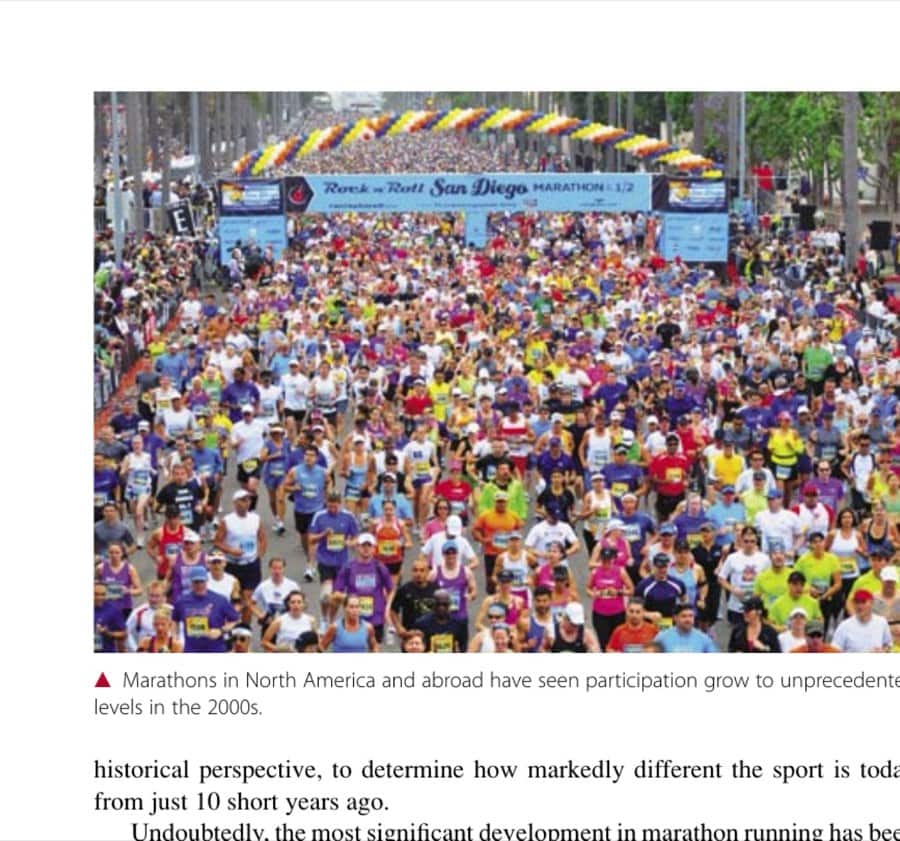
▲ Marathons in North America and abroad have seen participation grow to unprecedented levels in the 2000s.
historical perspective, to determine how markedly different the sport is today from just 10 short years ago. Undoubtedly, the most significant development in marathon running has been the tremendous increase in its overall popularity, reflected in participation numbers and the sheer number of marathons now offered in North America and abroad. Although participation grew throughout the 1990s, it has risen to unprecedented levels in the 2000s, driven by a powerful combination of technology, popular culture, and the knocking down of perceived barriers. Marathon running has now reached a place never before seen, one few could have envisioned. Entry into the biggest, most visible, and most prestigious events in the United States—New York, Chicago, and Boston—has become so coveted that organizers can virtually name their price and still see an avalanche of demand far in excess of available entries into those events. The same is true of most “second-tier” marathons as well, races such as Twin Cities, Houston, Los Angeles, Philadelphia, and others. That in turn has given rise to numerous smaller, local races, one in nearly every city, it seems. Many of those marathons also close out well in advance of the date of the race. Remarkably, all of this has taken place in the face of a historic economic downturn that has wrought the most severe unemployment since the Great Depression. If ever a recreational pursuit has proven to be recession proof, it is the marathon.
Winners at the top The elite side of the sport has grown in tandem with (some would say because of) the sheer number of marathoners. Flush with money from ever-increasing entry fees and sponsorship dollars, race organizers have lavished much of it on the top runners in order to attract mainstream media, enhance the prestige of their events, and thus attract bigger fields. The real winners (both literally and financially) have been the elite marathoners, as prize-money awards and appearance fees for top performers are now measured in the hundreds of thousands of dollars.
There is no free lunch in the sport, however; in return for big paydays, race organizers want results, specifically eye-catching fast times. Winning times of 2:05 and 2:06 and course records are nice, but now the holy grail of a world record (currently standing at 2:03:59 for men, set by Haile Gebrselassie at Berlin in 2008; and 2:15:25 for women, set by Paula Radcliffe in London in 2003) is what every major marathon seeks and is more than willing to pay for. Any runner who has a chance at it is a highly marketable commodity.
This focus on fast times has completely changed the way marathons are run at the front nowadays. Some are elaborately staged, with rabbits and pacemakers to set up the favorites for a run at a record; others simply stack their fields and turn them loose at the starting gun. In either case a manic race strategy is often employed by front-runners who go for broke from the starting gun, hoping to have that magical day that will yield a huge cash windfall. Other contenders are forced to keep pace or take the chance that they may never catch up. The days of conservative race tactics, in which runners could carefully allocate their physical resources over the 26.2 miles and still be able to win, have vanished.
Times of elite runners have reflected this new strategy, trending downward and increasing in number. In 1999, Khalid Khannouchi established the men’s world record in Chicago, clocking 2:05:42, the first runner to break the 2:06 barrier. Now, 2:05 is considered a fast but expected result on a flat course and hardly guarantees victory. Once considered nearly impossible to achieve, there have now been more than 100 sub-2:07 marathons. Also in 1999, no woman had been able to break through the 2:20 barrier, as Ingrid Kristiansen’s 2:21:06 world record had stood for 14 years. The 2:20 barrier fell to Japan’s Naoko Takahashi a little more than a year into the new decade, and shortly thereafter the UK’s Paula Radcliffe took women’s marathon running into previously unheard of territory, eventually setting the current mark of 2:15:25 in London in 2003. While no one has approached Radcliffe’s mark in the ensuing seven years, results in the low 2:20s (and occasionally below) are far more common nowadays.
Elite American marathoners have not been left out of this bounty of fast times and hefty prize money, fees, and bonuses. To appreciate how far the top U.S. runners have come, you need look back no further than the beginning of the last decade. Floundering for much of the latter half of the 1980s and nearly the entirety of the
1990s, the nadir for U.S. marathon running was reached in 2000, when both the men’s and women’s Olympic Trials races failed to produce a single athlete able to achieve the Olympic standard qualifying times (2:14 and 2:33, respectively). That meant that for the first time in Olympic history, the United States would be allowed to send just a single man and single woman to the Games, rather than the regular complement of three men and three women. Results in the top U.S. marathons were similarly dismal, with African runners annually dominating Boston, New York, and Chicago. Often you would have to go well beyond the top 10 finishers to find an American runner. Despite much public angst and finger-pointing, the prospects for top American marathons appeared bleak. Those days are long forgotten now, relegated to the faded pages of history. A grassroots resurgence has yielded a pair of Olympic medals, a slew of fast times (including a women’s American record of 2:19:36, set by Deena Kastor in London in 2006), and finally an American victory by Meb Keflezighi in New York last fall. U.S. runners are now able to compete with premier African marathoners, certainly not in the sheer number of elite marathoners, but the top American contenders now have a legitimate chance to win major marathons, a reality that simply did not exist just 10 short years ago.
Where does it go from here? What has wrought this metamorphosis of marathon running? How has the sport been so completely overhauled in such a short period of time, both on the elite and the participatory levels? Will the trends that have emerged over the past decade continue, or is the sport currently at its zenith, with nowhere to go but down? No one can say for certain, but studying the underlying factors that have brought us to this point can perhaps allow for a glimpse into the future and how marathon running might look 10 years from now, in 2020.
Like most growth patterns, the evolution of the marathon has not taken place overnight, although it may seem that way now. The phenomenon known as the “people’s marathon” (in which there were no qualifications for entry and anyone could feel comfortable participating regardless of ability or finishing time) can be traced back to 1976, when the New York City Marathon established its first citywide, five-borough race. That event, the first true big-city marathon, attracted a then-record field of more than 2,000 runners. Unlike Boston, which to that point had been the bellwether event of the sport, there was no time standard for entry, nor was there a strict cutoff finishing time, as in Boston, which stopped recording finishers before four hours had elapsed.
Even more important, the first five-borough, citywide New York City Marathon changed the face of the sport, turning it into something more than just a 26.2-mile footrace. It showed that a marathon could be a happening, a mustdo, have-to-be-there kind of event, in which even nonrunners were interested.
© Disney Photography
Furthermore, little of the buzz that emanated from that race was not planned; it simply mushroomed into a runner’s Woodstock of sorts. The cheering crowds of New Yorkers that appeared all over the course—rich, poor, from every part of the city—turned the race into a unique experience, something foreign to traditional long-distance runners.
It should be noted that even before that historic New York race in 1976, the Honolulu Marathon had begun to capitalize on its all-inclusive attitude and relaxed approach. An outgrowth of a popular low-key training program established by Dr. Jack Scaff, Honolulu provided a glimpse into the future by welcoming slower runners into its race. Some participants were minimally trained to go the distance but slogged through the 26.2 miles regardless. However, held in the tropics in December far from the mainland, the impact of that race was muted to a large extent, seeming to many continental long-distance runners like more of an exotic oddity than a real marathon.
Another key historic landmark occurred in the 1994 Los Angeles Marathon. Struggling to find the marathon’s niche in a growing roster of events, organizers added a new feature to their race that year: local entertainers and musicians performing along the route, creating a more festive and interactive atmosphere for the runners. Other marathons had occasionally featured amateur musicians on the sidelines, but Los Angeles was the first to officially incorporate this kind of entertainment into the event. That same year a new marathon was staged on the
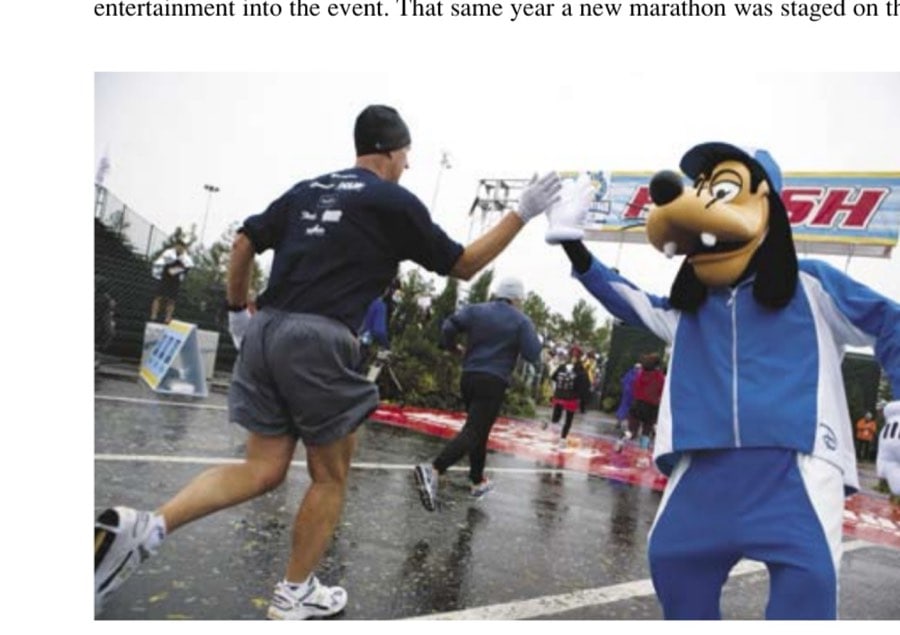
▲ Only at the Walt Disney World Marathon can you get a finisher’s high-five like this.
grounds of Disney World in Florida. At first, it may have seemed an odd venue for a marathon, but it proved to be an instant hit with runners, who loved the clean, flat, quiet roads of the park, punctuated by fireworks and celebrations, Disney characters in costume, and jaunts through the theme parks. These two marathons showed that running 26 miles and being entertained did not have to be mutually exclusive. The image of the marathon as a Spartan test of will and character was beginning to be overtaken by fun-seeking participants who cared more about what they experienced along the course than what the clock said at the finish.
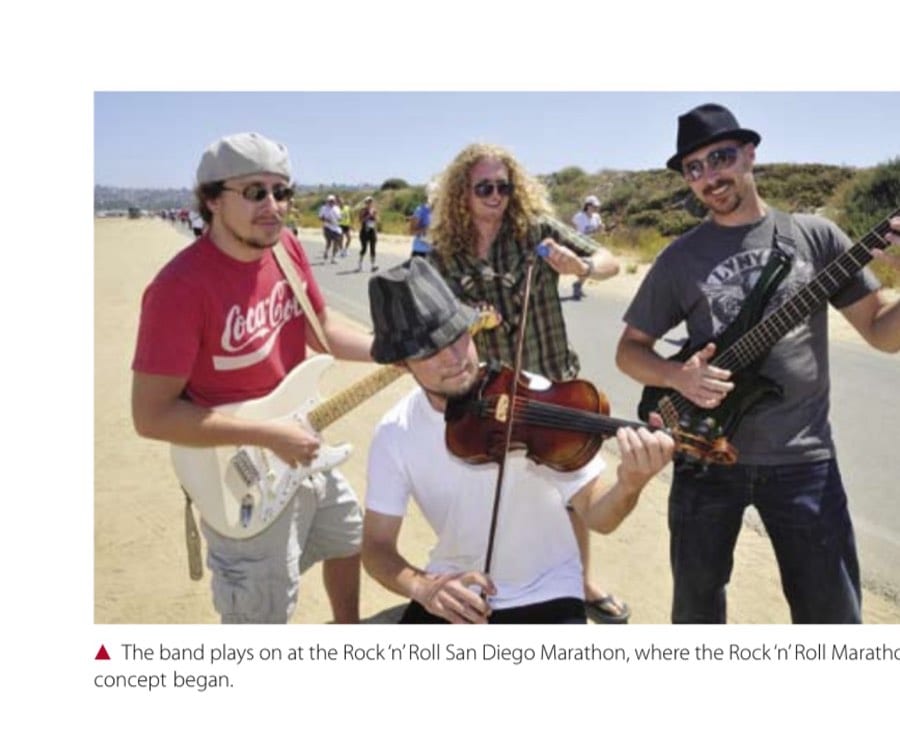
Then there was the Rock ’n’ Roll concept Four years later, in 1998, a promoter from San Diego named Tim Murphy took the entire concept a step further by unveiling the inaugural Rock ’n’ Roll Marathon, in which rock bands entertained runners at every mile. The actual running in the Rock ’n’ Roll Marathon seemed almost secondary, aside from the perfunctory elite and subelite runners who sought to achieve fast times and haul in prize money. For others, the race was like a moving concert and feast, perfectly situated in sunny San Diego. Dozens of runners in full Elvis regalia quickly became a trademark of the Rock ’n’ Roll Marathon, a brand that was destined to grow quickly.
Runners of all ability levels soon began to realize that marathons did not necessarily have to be grueling affairs (an adjective frequently linked with marathon running) in which the goal was to reach the finish line depleted of physical, mental, and emotional reserves. Rather, the distance could be covered at a relaxed pace and enjoyed, rather than endured. Runners employing that mind-set could also be comforted in knowing they would have plenty of company along the way, not left behind to fend for themselves, as had often been the case not so many years earlier.
Although this shift in philosophy was not embraced by everyone within the sport and would be unlikely to yield fast finishing times, it opened the door to a huge population of runners that had previously considered the marathon too intimidating, too daunting, too serious. As a greater number of casual runners flocked to the marathon, it in turn created an even bigger groundswell of interest. If your slightly overweight and out-of-shape brother-in-law could finish a marathon, then you darn well could, too.
Eventually a tipping point was reached, and the once-prevailing sentiment of the marathon as an elite, closed insider’s club was pushed aside by the new majority, although a determined few traditionalists continued to fight against this new attitude. The door had been flung open, however (never to be closed again), for nearly anyone to try a marathon, regardless of age, body shape, or even the ability to run much at all. Women in particular began to populate the marathon, no longer put off by the once-prevalent demographic of stoic, gaunt-looking men, for whom the marathon was a test of character, commitment, and speed.
© Competitor Group, Inc.
▲ The band plays on at the Rock ‘n’ Roll San Diego Marathon, where the Rock ‘n’ Roll Marathon concept began.
Along with this shift in the sport’s demographics, another radical change was taking place in the marathon. Walking during a race—once considered anathema— had surprisingly begun to gain favor. Rather than an admission of failure, taking planned walking breaks was starting to be touted by some coaches and advice columnists as an intelligent race strategy. The role models for 1970s marathoners, Bill Rodgers and Frank Shorter, both ran with graceful, fluid strides and were emulated by the masses who sought to cover ground in a similar fashion. Now Rodgers’s former college teammate Jeff Galloway had become a spokesman for the less fleet-of-foot marathoner. The lynchpin of Galloway’s training strategy was “It’s OK to walk.” Not only was it OK, but taking systematic walking breaks was preferable to continuous running, a better way to allocate one’s physical resources over the full 26 miles.
Led by Galloway’s first lieutenant John “the Penguin” Bingham, slower marathoners even had their own brand and social group. Bingham told Runner’s World of the new band of marathoners, “The paradigm has completely shifted. Running has embraced people who aren’t buying the arbitrary standard that speed is the only criterion.” He added, “In the old days, marathons were the exclusive right of very fit runners who saw these races as final exams. Now we have ‘lifestyle’ runners with social needs asking, ‘What’s the rush? Everyone gets the same shirts, the same medals.’ Just because you walk/run a marathon doesn’t mean you’re dumbing it down.”
The charity-running concept blossomed
© Justin Knight
Yet another factor emerged that helped propel the marathon into its current growth state. Without the pressure of having to push for a personal best every time out, slower marathoners began to discover a meaningful reason for participation, beyond just enjoying the experience and having fun. Raising money for charity, which first gained popularity in the London Marathon, found its place in U.S. marathons in the late 1980s and early 1990s.
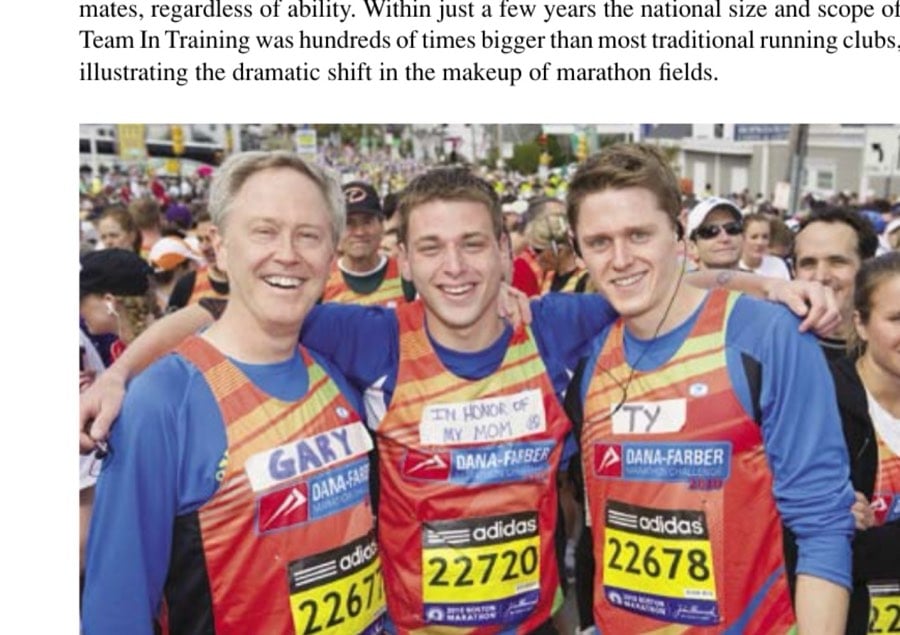
With modest beginnings at Boston through the Dana-Farber Marathon Challenge team and at New York when a runner named Bruce Cleland ran the 1989 marathon to raise money for the Leukemia and Lymphoma Society, dedicating a marathon to charity quickly gained traction. That organization soon established its Team In Training program. Combining getaways to desirable locations such as Honolulu, Disney World, and Alaska with marathons held in those locations gave (primarily noncompetitive) marathoners purpose to their efforts. It was the ultimate win-win as both parties—the runners and the charity—prospered. The program mushroomed, and purple-clad TNT runners soon became ubiquitous in marathons all over the country. Whereas many runners considered themselves too slow to join an organized track club, here was a group that anyone could join and find like-minded teammates, regardless of ability. Within just a few years the national size and scope of Team In Training was hundreds of times bigger than most traditional running clubs, illustrating the dramatic shift in the makeup of marathon fields.
▲ Lifelong friendships are forged on charitable fundraising teams. More than $43 million has been raised since the inception of the Dana-Farber Marathon Challenge in 1990.
Welcoming an entirely new and different demographic into the sport and infusing the marathons with purpose served to swell marathon fields to previously unimaginable levels. More customers means more money, a business principle not lost on race organizers. Increasing demand for entries into the most desirable marathons allowed those events to escalate entry fees well into triple digits. While old-timers grumbled, newcomers willingly accepted this new reality.
The role of technology In addition to the breaking down of perceived sociological barriers that had previously prevented many people from reaching the starting line of a marathon, more subtle factors have played a role in reshaping the sport. As in many other industries, technology has allowed the marathon to become more visible as well as allowing for the expansion of the size of race fields, previously hemmed in by technological constraints. In particular, compiling race rosters and results has become much faster and more efficient, largely due to the timing chip, a device that first appeared in the mid-1990s and has become standard in marathons of all sizes but especially in the megaraces featuring fields upward of 40,000 runners. Whereas once both start and finish lines had been unwieldy and cumbersome in the biggest marathons, now both are far more streamlined and easier to manage, allowing the size of race fields to grow even bigger.
In addition, the emergence of the Internet as an indispensible part of daily life has also played a huge role in marathon running. The ability to communicate instantly has had obvious implications: not only are race results known to virtually anyone in the world as soon as a race is complete, in many events a runner’s progress during a marathon can be followed in live time. Web sites, blogs, and message boards—not to mention Facebook and Twitter—have also served to stoke interest, as is the case in all aspects of life.
Another somewhat underappreciated impact of the Internet on the marathon has been online race registration, which from modest beginnings at the turn of the decade has now become integral to the sport. By registering for races online, runners can sign up instantly without the hassle of writing a check and mailing in a printed application (and, as often as not, without significant thought into what training for such a race might entail).
Online registration has allowed races to eliminate cumbersome data entry and, more importantly, to create demand for their events by appealing to the impulsebuy nature of their consumers. The effect has been profound: some marathons have filled their fields in a matter of minutes. A convenience for runners (but sometimes a headache as well, since races close out so quickly), it has been an absolute boon to race organizers and even better for race-registration companies, which haul in significant money through processing fees.
Then there is the celebrity marathoner Another often little-recognized factor in the inexorable growth of the marathon has been the role of the celebrity marathoner. Some serious marathoners consider them a joke, but in today’s pop culture-driven society, the actions of well-known actors, musicians, politicians, and athletes are incessantly chronicled and frequently emulated. Some celebrities have taken on the challenge of the marathon, seeing a public relations bonanza in the attendant media coverage. The first true big-name celebrity marathoner, Oprah Winfrey, famously completed the Marine Corps Marathon in 1994 and garnered worldwide media attention for her efforts. Since then others have followed, including unlikely candidates such as rapper P. Diddy and comedic actor Will Ferrell. Perhaps the most celebrated pop-culture marathoner turned out, ironically, to be already one of the world’s most accomplished athletes. That, of course, was cancer survivor turned champion cyclist Lance Armstrong, who in 2006 created a huge national buzz at the New York Marathon. Armstrong notwithstanding, these celebrities further drive home the message that the marathon is no longer exclusively for the fleet of foot; even those with little athletic ability can join in.
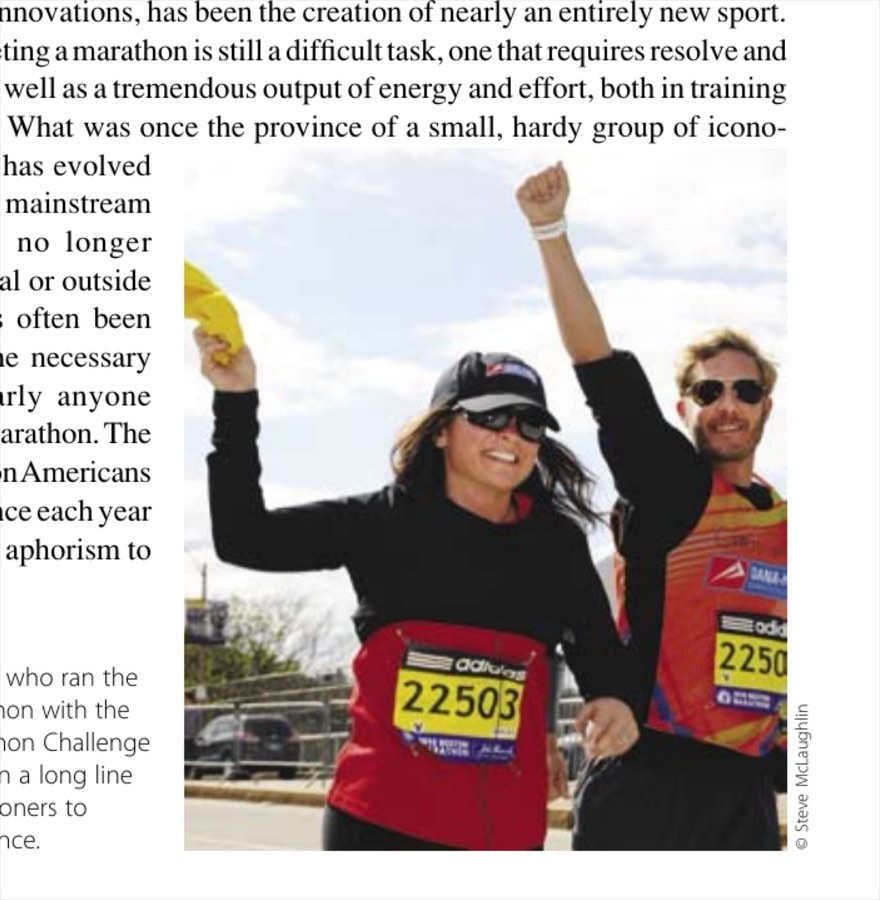
The net effect of the radical overhaul in demographics, in addition to improved technology and innovations, has been the creation of nearly an entirely new sport. Certainly completing a marathon is still a difficult task, one that requires resolve and determination as well as a tremendous output of energy and effort, both in training and on race day. What was once the province of a small, hardy group of iconoclasts, however, has evolved into a massive, mainstream activity that is no longer viewed as unusual or outside the norm. It has often been said that with the necessary motivation, nearly anyone can complete a marathon. The nearly half-million Americans who go the distance each year have proven that aphorism to
© Steve McLaughlin
▲
Valerie Bertinelli, who ran the 2010 Boston Marathon with the Dana-Farber Marathon Challenge team, is the latest in a long line of celebrity marathoners to complete the distance.
be true. Interestingly, this has reduced the appeal of the marathon for some, who have taken on ultramarathons or Ironman triathlons in order to be part of an even more exclusive club of high achievers.
What will the future hold? Can the popularity of the marathon continue its current growth trajectory? Some people think so. Carey Pinkowski, the executive race director for the Chicago Marathon, which caps its registration at 45,000, said, “Could we take 60,000 participants? Sure, but that’s not a simple process. Right now we’re at a number we feel very comfortable with.” New York’s director, Mary Wittenberg, said, “The number one driver to get bigger is that more people can run the race and there is more economic impact. We think it makes sense (to grow the field) just as long as the quality of the experience remains high . . . We want to be the biggest marathon, but never at the cost of being the best.”
Despite these lofty ambitions, the effect of so many marathons (not to mention half-marathons and other shorter distance races many use as stepping stones to the 26.2-mile distance) on the infrastructure of society has already strained the limits of acceptability, especially among residents of cities and towns suffering from event fatigue. After all, how many road closures are too many? How many more requests for marathon charity donations can one take (or make)? Will there always be a seemingly inexhaustible supply of eager marathon aspirants willing to pay pricey entry fees, enough to support the hundreds of marathons held in the United States and even more abroad? Will the sport eventually reach a breaking point? Will the manic drive to run marathons begin to dissipate? Ten years from now, in 2020, we may well look back upon the current era as the golden age, astounded that the marathon was so ingrained into popular culture.
In fact, on a smaller scale, we have been down this road before. More than a century ago there was a boom in marathon running following the famous finish at the 1908 Olympic Games, in which American Johnny Hayes was awarded the gold medal after the Italian runner Dorando Pietri collapsed just yards from the finish and received illegal assistance in order to cross the line. That pair, along with a few other elite runners, contested in hugely popular one-on-one indoor match marathons, thus creating a surge in popularity of traditional marathon running, races mostly in and around New York City (along with Boston, of course, which was held annually). New York-area marathons in 1909 and 1910 boasted fields of several hundred participants, although a large majority of participants stopped well before covering the full distance. It proved to be a passing fad, however. By the time the United States entered World War I, interest in the sport had faded, not to be revived until another American, Frank Shorter, earned an Olympic gold medal in the marathon in 1972.
This time, however, there seems to be no letup in the marathon boom, at least for the foreseeable future. A million marathoners in a single year in the United States? You never know—it just might happen.
This article originally appeared in Marathon & Beyond, Vol. 14, No. 5 (2010).
← Browse the full M&B ArchiveMore like this
1,000+ stories from 19 years of Marathon & Beyond
The complete archive of the legendary long-distance journal — digitized and free to read.
