

There And Back
Isat in the dark theater, gazing up at the image on the screen. It was of a man pumping his arms rhythmically as he ran over brown, unpaved earth. The man was Haile Gebrselassie, the great Ethiopian middle-distance runner, and the movie was Endurance, the film that chronicled his rise from poverty in Ethiopia to Olympic gold in Atlanta. The opening scene was of Gebrselassie on a training run, covering the African countryside with long, powerful strides, gliding over rocks and hills, with no display of effort. He looked like a running god, and the land looked primeval. This, to me, was Africa.
Scientists now tell us that we are biologically predisposed to run. We live on a planet that seems itself predisposed to be run upon, crisscrossed with a complex network of running trails, interrupted here and there by mountains and oceans. Some trails are paved and measured, most are not. Some haven’t even been discovered yet. The scenery might change, but the effort of running makes everything familiar. There is no place in the world that feels truly foreign to a runner in motion.
I knew this all to be true. Why, then, did the thought of Africa seem so strange to me? Held in my hand like a puzzle, turned end over end and inspected, the continent was a mystery. It seemed a mythical land, full of large animals roaming free, expansive grasslands, and superhuman runners like Gebrselassie. But it was also a land of war, oppression, corruption, and disease—great beauty sitting beside great hardship, in a place unlike any I had ever visited. Try as I might, I couldn’t imagine running there. It was a gap in my theory of the world, a place where my running shoes would not feel at home. Clearly, something had to be done about this. I went online and signed up for the Two Oceans Marathon and booked a trip to South Africa. One way or the other, I was going to sort this out.
INTO AFRICA The itinerary I had organized was a challenging one. My wife, Stephanie, and I were to fly to Johannesburg, then to Hoedspruit for a safari, and then down to Cape Town, where I would get a chance to pit myself against the challenging course of the Two Oceans Marathon. All that sounded fine, except that our return flight was
booked for the afternoon of race day. Not an ideal plan, I realized, but that was the only schedule that met all of the conflicting requirements of our work lives and the available flights and excursions, so that was the way it was going to be. If nothing else, I reasoned, the fear of missing an international flight would be a great incentive for me to run faster.
The conceit of our age is that we live in a world that is becoming ever smaller. Interconnected economies, e-mail and online services, and fast, relatively cheap flights make almost any part of the globe as close as your next-door neighbor.
Don’t you believe it. Africa is still a long way from the United States. From our home in Washington, D.C., my wife and I had to make our way to New York for a flight to Johannesburg, with a layover in Dakar, Senegal. The entire adventure would require almost a full 24 hours, but instead of moaning about the discomfort of it all, I actually appreciated the difficulty involved. If I were able to blink my eyes, genielike, and instantly find myself standing in downtown Cape Town, I think I would have lost some of the magic of separation from my normal, everyday routine. As I boarded the South Africa Airlines flight at JFK airport, I knew I would have plenty of time to think about how far I was traveling.
That was the intellectual argument in favor of a long flight. The physical arguments weighed in against it. I tossed and turned in my seat, bent and straightened my legs in a futile attempt to find a truly comfortable position, all to no avail. There were some bright spots, though—plenty of good movies to watch and one truly memorable sight: a predawn liftoff from Dakar, with a view of dozens of fishermen slowly heading out to sea in their small boats, hundreds of feet below us, as the dark blue of the sky bled crimson and orange. It was an impossibly beautiful moment. I settled in for the remainder of my flight, contemplating Africa.
STREET CRIME IN JO’BURG Eight hours later, the sun was setting as we touched down in Johannesburg, called Jo’burg by the locals. We would be spending only one short night in Johannesburg before leaving first thing in the morning for another flight to Hoedspruit. As we drove from the airport to our hotel on the edge of town, any guilt I felt about not spending more time in Johannesburg was allayed by our driver, who, while insisting that security was improving downtown, warned us about the prolific and violent street crime. The end of apartheid, and with it the pass laws that restricted movement by nonwhites, had the unintended result of drawing millions of people to the cities in hopes of finding better-paying jobs. When those jobs did not materialize, these dispossessed people survived as best they could, building shanty towns on the fringes of the city and, in some cases, preying on those around them. Our driver told us that some downtown hotels had closed because of the crime, to which the government responded by installing street cameras. This was one of the ugly faces of Africa.
During the ride, our driver taught us a few basic words of Zulu. Nine official African languages are spoken throughout South Africa, and most people speak at least several of them, in addition to Afrikaans and English, including Zulu. I suddenly felt very small. Like many Americans, I am limited to English and a smattering of high school Spanish. Stephanie and I were entranced as he ran through several dialects, occasionally making clucking sounds that no Westerner could emulate. As we drove past some abandoned buildings and gold mines, I wondered at this unique place. Egoli, the Zulu name for Johannesburg—City of Gold.
In the morning, I made use of the treadmill in our hotel for a quick run, not wanting to get lost on the city streets. On the television was Nelson Mandela, who, even in retirement, is generally looked upon as perhaps the world’s foremost moral authority. He was onstage at a concert on Human Rights Day, the national holiday memorializing the murder of 69 protesters in Sharpeville. Taking the stage after a performance by Annie Lennox, Mandela said that women were also victims of the AIDS epidemic. I had read that AIDS was becoming a disaster of epic proportions in South Africa, fueled by misconceptions about its origin and how to cure it. While in South Africa, I read that some men believe that the virus can be cured by sleeping with virgins. The day after Mandela’s speech, the local newspapers reported that a man was arrested for brutally killing his wife, his wife’s child, and his wife’s mother because his wife refused to sleep with him anymore because he had AIDS.
OFF TO HOEDSPRUIT With these events still in my mind, I joined Stephanie for breakfast, and then just a few hours later we boarded a small plane bound for Hoedspruit. After our long journey the day before, we were happy that this flight would last only a single hour. As our plane descended, I nervously scanned the countryside for a sign of an airport, but found none. Nevertheless, the plane continued to drop, and then I felt the touchdown. Stepping out into the bright sunshine, I was struck by the unlikeliness of the place. The airport in Hoedspruit is a tiny former military airstrip that was converted to civilian use, consisting only of a small building outfitted with a couch and several comfortable chairs, not unlike a living room in which you might rest with a drink in your hand after a long day traversing the grassy veldt. After collecting our bags, we stepped through the building to our transport and immediately saw a waterbuck—a deerlike animal—leap across the road into the bush. We weren’t even off the airport grounds and we had had our first wild animal sighting. This was the Africa of our dreams.
The wildlife preserves of Hoedspruit are large, but not the endless open miles of our imaginations. Fences—some of them electrified—defined the boundaries of the various preserves. Nonetheless, these areas are large enough to get lost in and
for even the largest animals to hide. With the beautiful Drakensburg Mountains as a backdrop, we made our way to our campsite within the Gwala Gwala game preserve. For those of you wondering about camping safaris, rest assured that this is nothing like a Boy Scout fiasco you might have had years ago. These tents are mounted on large wooden platforms and enclose modern accommodations, including a bed, proper bathroom, and electricity. There was also a treehouse bar in which to meet other travelers and an open-air dining area.
Our hosts were Darian and Anne, a couple who had decided late in life that they wanted to make a change and took a gamble in buying untilled farmland and converting it into a game preserve. It soon became apparent, however, that Darian and Anne were still trying to figure out their proper place in this environment. Anne had unwittingly managed to adopt several animals, including a young, wayward warthog, despite concerns that it might not be good for a wild animal to become too accustomed to being in close quarters with humans. Still, the little warthog had a certain charm, and it was fun watching him try to chew the elastic laces on my running shoes. He pulled back the laces several times, only to jump with a start when it snapped out of his mouth. After several attempts, he grunted and turned away, much to our amusement.
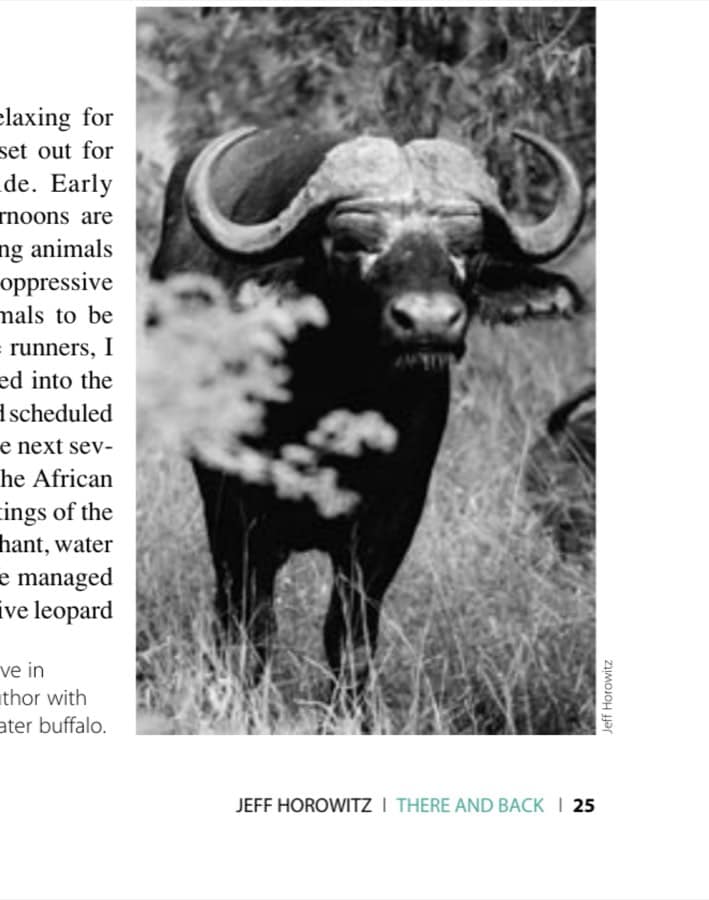
IN SEARCH OF THE BIG FIVE After settling in and relaxing for a bit, Stephanie and I set out for an afternoon game ride. Early mornings and late afternoons are the best times for viewing animals since the sun is the least oppressive then, allowing the animals to be more active. Not unlike runners, I thought, as we clambered into the open Land Rover. We had scheduled three game rides over the next several days, in search of the African safari Holy Grail—sightings of the big five: lion, rhino, elephant, water buffalo, and leopard. We managed to see all except the elusive leopard ▲
Jeff Horowitz
A trip to a wildlife preserve in Hoedspruit provided the author with upclose encounters with water buffalo.
and saw many others as well, including giraffe, hyena, and impala. The impala were perhaps the most memorable, leaping gracefully like springs, as if staying planted on the earth took more effort than getting airborne. Locals referred to the impala as their “McDonald’s,” which had nothing to do with the actual fast food but instead referred to the pattern made by the distinctive black streaks running down their haunches and their tails, creating an ebon version of the golden arches.
I wondered what it would be like to have so much power in my legs, to be able to leap so quickly and gracefully. Watching wild animals filled me with a sense of awe and also revealed the limitations of my own body. Humans are not the fastest, strongest, or most graceful creature found in nature, and I could only imagine how pitiful even the fastest among us must look to the rest of the animal kingdom. I recalled reading, however, that humans can track and run down game on foot over long distances, due in large part to the amazing shock-absorbing properties of our feet and our sophisticated cooling—read that sweating—apparatus. We might not be the fastest, but as long as we can keep the game in sight, we can eventually overtake it, like the proverbial tortoise beating the hare.
This all reminded me of some trash talk I had recently engaged in with a friend at a local gym. He was younger than I, was naturally very fit and athletic, and had just started running. He boasted that he was already a faster runner than I was. I assured him that I could beat him. He told me that he was faster than I was in the 5K. I told him that might be true, but I would race him in a 10K. He thought he could still beat me at that distance. I told him that if it took a half-marathon, a marathon, or a 50-mile ultramarathon, I would eventually beat him. I could run all those races and would eventually find a distance where I would win. He was silent after that.
Remembering that conversation, I began to feel a bit less intimidated by the animals around us, beautiful as they were.
THE WILD IS HIS SMORGASBORD Not everyone among our group seemed enamored of the aesthetic beauty of the animals in quite the same way, though. One great big strapping fellow—a former rugby player—seemed to look at nature as one big all-you-can-eat smorgasbord. He talked a great deal about the South African taste for meat. From wild buck—especially one type called kudu—to crocodile and ostrich, South Africans will eat it all, as long as it moves. They are carnivores with a capital “C.” My wife is no vegetarian, but she was astounded. “Don’t you ever eat any salad?” she asked. Winking, our companion said, “When we want vegetables, we eat chicken.” I suddenly wondered whether a prerace carbo load might be harder to find than I thought.
Managing a game preserve isn’t all fun, though, as Darian told me. There was a young giraffe that he pointed out to us that was limping. His right hind leg showed
a gaping wound, and his footprints were marked with spots of blood. He had been attacked by a hyena. As we watched the suffering animal, our instincts told us to get aid for it or, if it was beyond help, to put it out of its suffering. But that is not how things are handled on a game preserve. To maintain the balance of things, the animals must be left alone in all but the most extreme circumstances. The hyenas have to eat also, of course. It seemed cruel, but this was nature’s way.
At dinnertime we sat under the stars, drinking South African wine, eating a delicious dinner that did, thankfully, include some fresh vegetables, and compared stories with our fellow travelers. Several of them were South Africans on holiday, and they were open about their feelings about their country and recent events. Their mood seemed hopeful, although they had their doubts about particular politicians. Their criticisms seemed reaffirming, though, because not one of them stated any disillusionment with the overall direction their nation had taken over the previous decade or even with much of what the current administration was trying to achieve.
Eventually the conversation drifted around to my upcoming challenge, and everyone wished me good luck in my race. The Two Oceans Marathon seemed to be quite well known; even people who were not runners were aware of it. Finally, the dessert was over, the last of the wine had been drunk, and it was time for Stephanie and me to get our things together for our flight out the next morning. We would be departing from Hoedspruit for Cape Town in the morning, and suddenly the race, which had not seemed real before, loomed large in front of me.
CAPE TOWN ADVENTURES Cape Town is a beautiful, wondrous city, embodying much of what is best and worst about South Africa. Nestled between the sheltered waters of Table Bay and the majestic heights of Table Mountain, Cape Town has a long and checkered past. Phoenicians and Arabs thought it had magnetic powers that would draw ships to their doom along its rocky coast, and the Portuguese explorer Vasco da Gama sighted it as he rounded the Cape of Good Hope in 1498. The town was laid out in 1652 by the Dutch East India Company as a replenishment station for its fleet, and the Dutch quickly built a strong fort to protect their African foothold. The local population mostly succumbed to smallpox brought inadvertently by the colonists. The surviving indigenous population mostly worked as poorly treated laborers.
In 1795 and 1806, the British invaded South Africa as part of their strategy against Napoleon and by 1843 had annexed large parts of the country. Over the following decades, the British clashed with native Zulus and the rising population of Dutch-speaking farmers known as Boers, culminating in the Anglo-Boer War of 1880-1881, in which the Boers won their independence. The discovery of gold
Jeff Horowitz
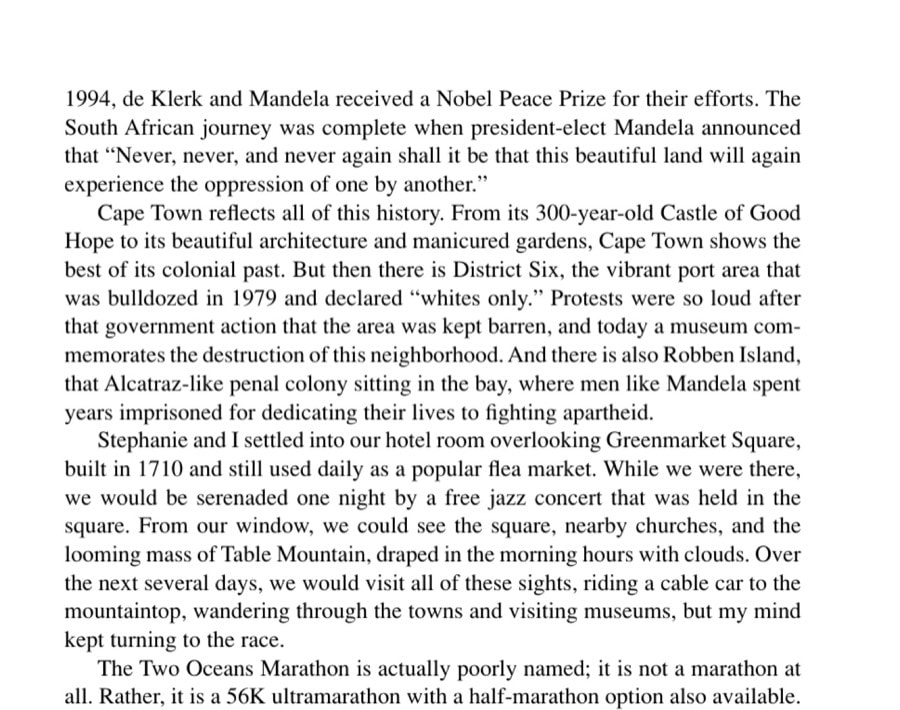
▲ The author and his wife, Stephanie, overlooking Houk Bay, along the marathon course.
in the Transvaal region in 1886 changed the political dynamic, however, resulting in the Second Anglo-Boer War of 1899-1902. The Boers started out well enough but were soon outmanned by the British and began to rely on guerilla tactics. The British crushed the Boers with a scorched-earth policy, burning farms and establishing the world’s first concentration camps. Eventually, over 136,000 Dutch Afrikaners were imprisoned in these camps, in which more than 26,000 women and children would die from typhoid, dysentery, and neglect.
AN END TO APARTHEID The Union of South Africa was formed in 1910, and the policy of oppression against the native population, already a part of South African history, began in earnest in 1920, with the legal entrenchment of the separation of the races.
This policy reached full fruition in 1948 when the newly elected National Party established apartheid, a complex system of regulations that required registration by race, banned marriage between the races, and established the pass laws. This
system would continue for decades, despite international boycotts and domestic protest and violence, until President F. W. de Klerk unexpectedly declared the end of apartheid in 1990 and announced that negotiations would commence with
his formerly jailed adversary, Nelson Mandela. This culminated in South Africa’s first full and open election, won by Mandela’s African National Congress. In
1994, de Klerk and Mandela received a Nobel Peace Prize for their efforts. The South African journey was complete when president-elect Mandela announced that “Never, never, and never again shall it be that this beautiful land will again experience the oppression of one by another.” Cape Town reflects all of this history. From its 300-year-old Castle of Good Hope to its beautiful architecture and manicured gardens, Cape Town shows the best of its colonial past. But then there is District Six, the vibrant port area that was bulldozed in 1979 and declared “whites only.” Protests were so loud after that government action that the area was kept barren, and today a museum commemorates the destruction of this neighborhood. And there is also Robben Island, that Alcatraz-like penal colony sitting in the bay, where men like Mandela spent years imprisoned for dedicating their lives to fighting apartheid.
Stephanie and I settled into our hotel room overlooking Greenmarket Square, built in 1710 and still used daily as a popular flea market. While we were there, we would be serenaded one night by a free jazz concert that was held in the square. From our window, we could see the square, nearby churches, and the looming mass of Table Mountain, draped in the morning hours with clouds. Over the next several days, we would visit all of these sights, riding a cable car to the mountaintop, wandering through the towns and visiting museums, but my mind kept turning to the race.
The Two Oceans Marathon is actually poorly named; it is not a marathon at all. Rather, it is a 56K ultramarathon with a half-marathon option also available. The most striking feature of the ultra is its course profile. Starting with a small hill early on, the race meanders over flat roads for the first 28 kilometers, but then it takes a nasty turn as it makes a precipitous ascent of Chapman’s Peak at kilometer 34. It then screams back down over the next 6K, and, at the point when a regular marathon would be over, it begins an ascent of Constantia Nek. It’s the kind of course profile to strike fear into the heart of even an experienced marathoner.
ASSESSING THE BEAST I was concerned about the race and decided that seeing the beast might allay my fears. Stephanie and I decided to take a tour of the Cape of Good Hope, and the driver readily agreed to drive along as much of the race course for us as he could.
Soon, we were driving up to Chapman’s Peak, called simply Chappies by the locals. Even in a microbus I could appreciate the steepness of the climb. After severe rock falls plagued the area, the road up Chappies was closed, and the course was altered to skirt around Chappies from 2000 to 2004. I could see why so many runners were disappointed. The view, after all, was amazing. The road hugged the pale, orange cliff side, overlooking a beautiful view of Hout Bay to the west.
Our driver pointed out the 1,560 meters of fences that had been installed and the concrete canopy, both part of the safety measures that had been taken that allowed the race to return to Chappies in 2004. Still, the netting looked quite fragile to me. I imagined struggling up this road on race day, conquering Chappies, and pausing to celebrate one of the greatest moments of my running life, only to be clunked on the head by a falling boulder. I made a mental note to remember not to pause if I could help it.
Finally, Stephanie and I found ourselves at the Cape of Good Hope, the storied tip of Africa, where the rough waters of the Atlantic meet the warm waters of the Indian Ocean and where the ship the Flying Dutchman famously foundered in the 1600s. We stared out over the open expanse of water before us and marveled at how far we had come. Ahead of us still was a visit to a penguin colony at Boulders Beach—yet one more sign that we were far, far from home. But standing at the Cape seemed to be the crowning moment. There was, finally, no farther to travel.
FINALLY, THE RACE After feeling the race would never come, I found it suddenly upon me. I picked up my race packet at the University of Cape Town, meandered through the expo, had a pasta dinner in the hotel restaurant, and then settled back in our hotel room to organize my gear. After pinning my number onto my race shirt, attaching the timing chip to my shoe, and laying out my sports gels, I settled back in bed with some good reading: the racing instructions. Among the papers included was a booklet titled “Information and Statistics.” It was a compendium of minutiae about the race. There were 7,830 participants registered in the ultra, which was down from 2004 but was still the highest total since 2000. There were nearly four times as many male ultra runners as female, though there were 339 husband-and-wife teams. (I was disappointed to see that there was no statistic on divorces resulting from couples running the race together.) Continuing on, I saw that three runners were going for their 30th finish and also that 24 runners would be celebrating their birthday on race day. The oldest registered runner was 76, and the youngest was 19. Sixty-three countries were represented, although only 360 were from overseas and only 33 were from the United States. I grinned at that last piece of information, realizing that the worst I could do as a finisher would be to place 33rd in my category—not bad for bragging rights back home as long as there were no follow-up questions. With that thought in mind, I dimmed the lights and drifted off to sleep.
A few scant hours later, I stood in front of the hotel with some other runners in the predawn darkness, waiting for transport to the starting line at the University of Cape Town. The other runners were visiting Germans. One, in fact, was here
on his honeymoon. I wondered whether he had even bothered to tell his bride that he was running a race or whether he was hoping to finish before she awoke. As the van sped along the highway, we talked about our hopes for the race and offered each other energy bars.
Our van dropped us off on the main commercial street near the university, in the suburb of Newlands. I wished the Germans good luck and joined the throng of runners making their way to the starting line. Despite the darkness, it was already quite warm, and I quickly shed my throwaway long-sleeve shirt. I settled into a spot in the crowd behind the starting line and listened to the last-minute instructions that bellowed from the speakers. The various countries represented were named, to sporadic cheers and applause, and certain noted runners were introduced. The crowd then sang the traditional African song “Shozaloza.”
AND WE’RE OFF Finally, the announcements were over, and I felt my body tense as I awaited the starting gun’s blast, my finger poised on my watch’s start button. I recognized this moment, and I realized that I was indeed at home, even here in Africa. As the gun roared at precisely 6:00 A.M., I surged forward with the crowd, buoyed by a familiar wave of adrenaline. The asphalt below my feet, the smiling faces and cheers of the onlookers, the sight of the runners around me, and even the smells of the race seemed familiar. The gap in my worldview quickly closed, and Africa, wonderful and exotic, also became, for me, simply another place to run. I realized that I had successfully ended my quest. There was, however, still the matter of finishing the race. As we streamed along the dark city streets, I thought about my race strategy. The Two Oceans Marathon has a unique system for awarding finisher’s medals. Rather than dividing the field into elite runners and everyone else, the organizers reward different levels of achievement. Runners breaking the four-hour barrier in the race would earn a silver medal, and those breaking the six-hour barrier would earn a bronze medal. Previously, the race had a six-hour time limit, but several years ago an additional hour was added, and runners who beat the seven-hour time limit now earn a blue medal. However, many veteran marathoners still consider six hours to be the limit and aim to break that barrier to make the race “official.” Factoring in my recent training, jet lag, and the great unknown of the two ascents, I pegged myself as coming in somewhere between 5:15 and 5:30, placing me solidly in the bronze group. In those first few minutes of the race, I calculated the pace necessary to hit my goal and settled back into an easy stride.
As the sun broke the darkness, I looked at the runners around me. Although they looked like any race field I would find back in the United States, I quickly noticed one key difference: their conversations. Many of them were in the native
tongues of South Africa, and even when the conversation I was eavesdropping into was in English, I was treated to the clipped cadences of an Afrikaans or Zulu accent. Despite this language barrier, however, I still felt our bonds as runners and enjoyed the exotic voices around me. Passing the first refreshment station, I realized yet another unusual feature of the race. There were no rows of cups, as are found in most other races I’ve run in the United States and abroad. In Cape Town, volunteers handed out water and sports drink in sealed plastic pouches. The convenience of this approach became immediately apparent to me as I ripped a hole in the pouch with my teeth and spurted the water into my mouth.
Newlands gave way to Kenilworth, which became Plumstead, and the city melted into open spaces and small towns. I spotted the pacer for the six-hour finishers group, and I reasoned that as long as I keep that group behind me, I would be certain to have a bronze finisher’s medal. I passed them and didn’t look back.
ADVICE FROM THE EXPERTS Being new to the race, I asked several other runners questions about the course as we ran and was introduced to another unusual feature of the course. All runners who persevere through 10 editions of the race are awarded a permanent blue number to mark their achievement. For me, this meant that veteran ultramarathoners were all the easier to identify for words of wisdom. They seemed more than willing to oblige me.
Dawn was now breaking the sky as we entered the town of Lakeside, followed by Muizenberg, which gave us our first views of water. This is False Bay, and beyond it the Indian Ocean, the first of the two oceans for which the race is named. The road fell before us as we passed the old stone homes in St. James and Kalk Bay, and then, as we entered Fish Hoek and turned inland, we were greeted by a young couple painted entirely in green, cheering us as we streamed past. The views were beautiful and there was still plenty of energy in my legs. These were the good miles.
As I felt energy surge through me, I spied a runner up ahead holding a banner aloft. I wondered if it could be possible, but no, it couldn’t be. But it was. It was the sub-five-hour pace group. I caught the group and stuck like glue. As we ran, I asked the pacer about the South African racing circuit. Although the Two Oceans seemed to be a challenging course, he told me that many runners use it as preparation for the Comrades Ultramarathon that follows several months later in mid-June. I let that thought roll around in my mind for a moment—using a brutal 56K race as a training run for a more difficult race. Perhaps these were a different breed of runners after all.
We ran through Sun Valley and then entered the town of Noordhoek, passing the 28K marker, the halfway point of the race. Craft shops and restaurants that lined the road eventually gave way to trees and parkland, and our pacer announced that it was time to go to work. Chappies lay just ahead. Chapman’s Peak was built after World War I, and the Chapman’s Peak Drive, the road taken by the race, was opened to the public in 1922. A popular tourist and sporting destination, it actually consists of two peaks: “Little Chappies,” at the 30K mark of the race, followed by “Big Chappies” four kilometers later.
THE APPROACH TO CHAPPIES Stands of trees thinned and then disappeared altogether, and the grass melted away as we began our first ascent. The sun was shining brightly above us now, but I felt comfortable and strong as we followed the road upward. The incline felt like a nice change from the earlier flats, and I was surprised at how good I felt. Soon the pace group was cresting the first summit, and we eased into a short easy stretch of road before the next peak. Talking to the pacer, I learned that the difficulty with Chappies is often not the climb but the quick descent that followed, which can wreak havoc with the quads. Other than keeping proper form and trying not to go too fast, I couldn’t do much about that, I guessed. After all, I never expected to get through this race without some pain.
My thoughts were interrupted by the pacer’s announcement that we would be climbing again around the next curve. Feeling confident after conquering Little Chappies, I surged forward ahead of the pack, and after rounding the corner, I was able to see the road winding up ahead to the top of Big Chappies. The ascent is 2.5K and 180 meters, but the views were even more spectacular than they had seemed from the van window a few days earlier.
Finally, I was there, the top of Chappies. Fear that had been gnawing at me since signing up for the race melted away. The climb of Constantia Nek was still ahead of me, but with 17K left to go, things were looking awfully, awfully good. My legs swallowed the descent without a problem, and I said a silent farewell to Chappies as we entered Hout Bay.
Hout Bay was the site of a battle between the Dutch settlers and a British naval force in September 1795. The Dutch were victorious in a battle that resulted in little loss of life, and cannons used in that victory are still guarding the town from the old fort. The proud residents of the “Republic of Hout Bay” have maintained a tradition of firing a cannon as the lead runners enter the town. As good as I was feeling, I was too far back of the lead pack at that point to hear anything other than the sound of thousands of feet slapping the asphalt, but the spectators and refreshments along the streets of Hout Bay were a welcome sight nonetheless.
Fatigue began to seep into my legs and my earlier soaring confidence leaked out. I realized that I would probably not be able to maintain the sub-five-hour pace, but I resolved to stay with the group to the 42.1K mark. I would not have a sub-five-hour finish this day, but making it to the regulation marathon distance with this pack would be my moral victory.
PASSING THE MARATHON MARK Time ebbed past as I continued to press forward, clinging to the pace group. Finally, I saw an inflated archway spanning the road up ahead; it was the 42.1K mark. I had earned my victory in the race within a race. As I crossed the timing mat set up near the distance marker, I fought the urge to consider the race finished. After all, the visual cues all said that I had completed a marathon. Like trained dogs sensing when it is time to go home, my legs were sure that it was time to downshift into cool-down mode. Not yet, I told them. There was one last big challenge immediately ahead: Constantia Nek.
With a climb of 215 meters, Constantia Nek is the biggest hill on the course, higher even than Big Chappies. But it wasn’t just that it was a bigger hill than Chappies; it was that it was completely different. Gone were the rough stone walls and commanding bayside views; here the roadside was thick with trees and dotted with residences. The race organizers, knowing this was where the most suffering would occur, squeezed refreshment stations closer together here, and spectators lined the roads in groups to cheer us on. At first, the climb didn’t seem bad at all. Just as I had started to relax a bit, however, the road suddenly soared up toward the treetops. I had earlier resolved to run the ascents, but this stretch of road made me break that promise, and I briefly joined those others around whose plodding gait gave way to walking during the worst parts of the climb. This was where we all had our heads in the mouth of the lion, and the strained faces of the runners around me—runners in name only at this point—mirrored my own determination. Finally, I could see the top of the hill just ahead, and like a swimmer reaching for poolside, I surged forward with one last push and crested the summit. Constantia Nek was history. Only 10K left to go. With all of the fearsome hills finally behind me, I settled into the final task of finishing the race. I shortened my stride and searched for my last reserves of energy as I ran the rolling hills of Rhodes Drive out of the shaded woods of Constantia Nek and down to the open, sun-drenched avenues of Kirstenbosch, where the glorious Gardens are found. There was now less than 6K to go. The bright sunlight pulled sweat from our bodies, but I saw no quitters around me. Up ahead was the sweeping turn known as “Harry’s Corner,” named for a course marshal named Uncle Harry, who manned that corner for years until his death.
BACK TO THE UNIVERSITY AT LAST The crowd of spectators thickened as we rolled over Chet’s Hill, named for race director Chet Sainsbury, who rerouted the course in 1998 over this hill and onto a new finish at the University of Cape Town. And then, finally, we entered Rondebosch, and the university came into view and, within it, the football field, where the finish line patiently waited. Mustering the last of my strength, I flew across the line. My final time was 5 hours 15 minutes, the time that I had originally hoped for.
As I slowly moved through the crowd, my newly awarded bronze medal around my neck, someone pressed an application for the New York City Marathon into my hand. I continued moving, grabbing fluids and a goody bag, and made my way to the steps leading out of the university and down to the main thoroughfare, where I would catch a city bus back to Greenmarket Square. As I sat on the bus, an anomalous figure among the Sunday riders, I considered the race application in my hand.
I had come so far, had experienced so much, but this piece of paper in my hand shrank all that, had shrunk the world. It was as if I had journeyed to the farthest reaches of the North Pole, beyond the edge of civilization, only to find a note from my family waiting for me. And then I knew that I had been right all along: the world is indeed a matrix of running paths, all connected together, stretching from Haile Gebrselassie’s flying feet to Chapman’s Peak and over to Central Park in Manhattan. In a few short hours, I would board a jet back to the States, but standing there with that paper in my hand, I knew that I was already home.
This article originally appeared in Marathon & Beyond, Vol. 10, No. 1 (2006).
← Browse the full M&B ArchiveMore like this
1,000+ stories from 19 years of Marathon & Beyond
The complete archive of the legendary long-distance journal — digitized and free to read.
