

There Could Be Magic
he would never walk again following a terrible bicycling accident that had shattered his leg, hip, and shoulder. And of course, there was the most exciting finish in Western States history, 1983, when Jim King made an incredible run from far back in the field after being lost in the snow, built a 26-minute lead at Foresthill, only to be run down and passed by Jim Howard in the streets of Auburn.
ONE STANDS ABOVE THE REST
Offered the chance to write something for this issue of Marathon & Beyond, it was hard to winnow out a single topic. What finally emerged was the 1991 Western States race, when something happened to me that was strange, wonderful, and difficult to explain.
After running the 1978 Western States purely as an adventure into the unknown, the race became my obsession for almost a decade. I would begin serious training early in January, building to 120-mile weeks that included solitary 50-, 60-, and 70-mile runs on the trail (Squaw Valley to Rucky Chucky; Robinson Flat to the finish; Squaw Valley to Robinson Flat and then back to Squaw). Then, after getting my tenth buckle and tenth top 10 finish in 1988, my motivation and training tailed off. In 1989 I dropped out at Green Gate (79.8 miles) for no good reason other than tiredness. Embarrassed, I came back in 1990 and finished.
Force of habit led me to enter Western States again in 1991, but when January rolled around, the notion of taking a year off surfaced in my mind. It grew larger as spring turned to summer, and work limited my “training” to one or two 10-mile runs a week. My plan to gear up in May fell through, and then in June the bottom fell out. My total June training was just 54 miles, of which 19 miles were an out-and-back from Squaw Valley to Hodgson’s Cabin the Saturday before the race. It didn’t go well, and upon returning home I advised family and friends that I wouldn’t be running in the race.
In the 1980s, when I still lived and breathed the race, my packing for Squaw Valley had all the atmosphere of preparations for D-Day: multiple shirts for multiple weather conditions, spare hats, bandanas, Vaseline, Band-Aids, the latest sports drinks, aspirin, candy, detailed directions for my crew, safety pins. (One year chickens were even considered. My brother suggested tying them to my feet at Last Chance, his idea being that they would fly me over the canyon to Devil’s Thumb. His impressively innovative concept was voted down only after heated discussion.)
Packing for the 1991 event, still planning not to run but wavering slightly, I casually tossed a couple of shirts and two Bodabelts into my bag (“Just in case,” I said to myself) and left for Squaw. On the drive up, the rational part of my brain, nervous and suspicious of my sanity, began whispering prudent thoughts like, “You fool, you’ll be a whimpering wreck by Cougar Rock,” and, “If you even make it to Red Star Ridge, they’ll need an ambulance to haul you away!”
Then, of course, the crowd of excited runners at the check-in stirred up that old, familiar flow of endorphins and awakened the fundamental lunacy that lurks in the heart of every long-distance runner. Rationality sank faster than I could say Titanic, and suddenly someone with my voice was telling friends that, “Yes, I was indeed going to run.” Propitiously, one of the friends was Mo Livermore, one of the Run’s founders and (with Shannon Weil) its first director. Mo, an accomplished runner and rider with six 24-hour buckles (one Western States Endurance Run and five Tevis Cup), offered to pace me from Rucky Chucky. (“If you even get there,” a traitorous voice muttered in my head.)
UNFAVORABLE WEATHER PORTENTS
When I looked out the window the next morning, I nearly went back to bed. I was already experiencing severe self-doubts, due to my total lack of two fairly critical ingredients for the run: physical conditioning and a support crew. In my ambivalent frame of mind, it wasn’t reassuring to look out and see dense fog being blown at treetop level by swirling winds and a hard rain pelting down underneath. The mountains were completely obscured, puddles glistened wetly, and, of course, I had neglected to bring any rain gear.
After briefly weighing the warmth of my bedcovers against the cold, wet discomfort of the trail, I made the predictably irrational decision to pile on all the clothes I had brought with me and head for the starting line.
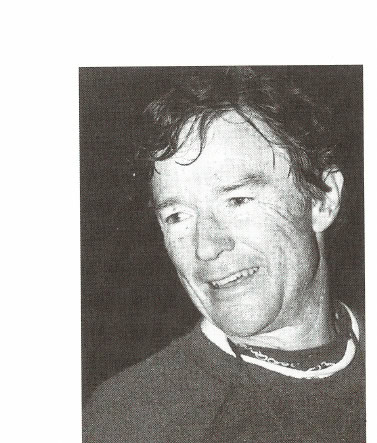
“All the clothes I had brought with me” didn’t amount to much: nylon shorts, a T-shirt, then another T-shirt, and then a light wool sweater on top. And, of course, a “Foreign Legion Cap,” to the back of which I had attached a hawk feather found on the trail the weekend before. The feather was tied with red yarn to a short thong, and I hoped it would float above my shoulders as I ran, bringing me luck.
The first 30 miles were cold, beautiful, ghostly in the mist, and absolutely saturated with wet. Little American Valley was hidden in the fog as we passed along the ridge above it, the stream roaring loudly from below. I remembered once missing a jump and falling into it, up to my shoulders in icy water on a lone, crack-of-dawn adventure run from Squaw through virgin snow, then shivering uncontrollably all the way to Duncan Canyon, when the sun finally cast some warmth.
I remembered another time, also in snow, when a friend and I clambered up and over Emigrant Pass and stood in deep snowdrifts along the stream, catching beautiful, multi-hued brook trout, which we then cooked for dinner in our hotel room fireplace. Not today, I thought.
The Red Star Ridge and Duncan Canyon checkpoints went slowly due to my lack of a crew, and my quadriceps began hurting alarmingly early, on the long descent to Duncan; but at Robinson Flat (30.2 miles) I was exactly on the schedule I had set. Apart from my quads, which I knew from bitter experience would become an increasing and potentially crippling problem later on, I still felt surprisingly good.
Then things immediately began to fall apart. My quadriceps really suffered from the long, rocky, staccato pounding they took descending Cavanaugh Ridge. The pain made it impossible to run freely, and thoughts of dropping out began nibbling at the edge of my mind. They intensified during my wobbly approach to Last Chance (43.3 miles), but these thoughts were balanced by another voice protesting that dropping out this early would be humiliating. “Stick it out to Michigan, maybe even Foresthill,” it argued, and “then withdraw with at least a shred of dignity.”
GOING DOWNHILL IN THE CANYONS
The two big canyons, Deadwood and El Dorado, extracted far more penance than usual. My rapidly deteriorating quads were no longer responding fully to commands from my brain, which lead to several near falls. Then at Devil’s Thumb I embarrassed myself by staggering and actually falling to the ground while being weighed. (“Has Latimer come through yet?” I imagined someone asking. “Yeah, he’s the one who fell off the scale!” would come the reply.)
At Michigan Bluff (55.7 miles) I flipped a mental coin, lost my wager, and decided to go on to Foresthill before confronting any decisions about the rest of the day. When I got there, the skies were finally clearing, but runners were being told that the California Street checkpoints were too muddy to be accessible. There would be no aid until the river, which at my struggling pace would be four or five hours away. (This would prove to be untrue, as race management was able to establish the aid stations.) It was already 7:00 p.m., I was tiring rapidly, my battered quadriceps were limiting me to an awkward, painful shuffle on the downhills, and even though Mo and a few other friends dutifully chirped the traditional runner’s lie that I was “looking good,” it was clear that a 24-hour finish was beyond reach.
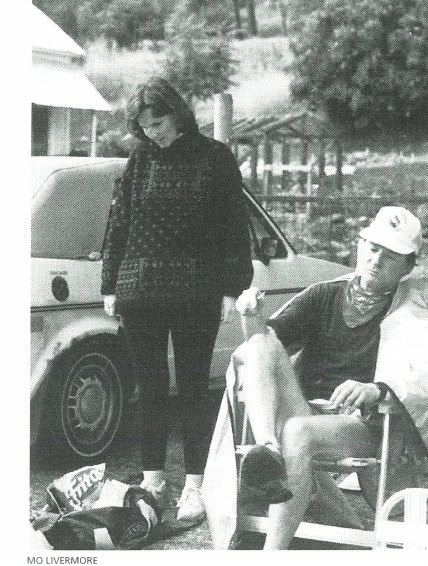
Dropping out seemed prudent, since becoming immobilized on the California Loop would mean a long, cold wait for rescue. But there were only 38 miles ahead, and 16 hours remained for a 30-hour finish. Walking steadily at 2.5 miles per hour would do it, so I hauled myself to my feet, walking stiffly through most of Foresthill before loosening up enough to break into a shambling, slow-motion run. Before long, the steep downhills stole the last shreds of resilience from my legs, and all running became impossible. It grew dark, the moon rose over the canyon, and I walked on through the night.
Halfway to the river, lost in thought (mostly the self-pitying, “Why on earth are you doing this, you fool?” variety), descending a series of switchbacks cut into the steep hillside, I was suddenly startled by a little avalanche of dirt and pebbles just ahead of me. Immediately after the pebbles followed a large skunk, sliding down the embankment on its rear, front legs braced, obviously skiing out of control. He (she?) did a little head-over-heels cartwheel at the bottom, shook itself off, and then stood still for a second, looking confused.
Then it saw me. It faced me, giving me a long, appraising look. I stared back, trying hard to appear confident. Then the skunk spun around, turned its back and curled its tail high into the air. Recognizing the imminent escalation of our encounter, and lacking the equipment necessary to retaliate in kind, I bid a hasty adieu down the trail.
AT THE RIVER CROSSING
I finally reached the river crossing a little after 11 P.M., having gone no faster than a walk for the past two hours. My energy meter was down to zero, my quads so tight and painful that every step took mental effort. Dropping out was more tempting than ever, but now there were only 22 miles left and nearly 12 hours to complete them—less than 2 miles an hour would be enough for a 30-hour finish.
I crossed the American River in the moonlight, the water feeling refreshing for a change. (Usually the cold comes as a violent shock, and I scream and shiver my way across.) Mo was a welcome sight on the far side, and she persuaded me to pause briefly for some coffee and a cup of potato soup. As we headed slowly up the hill to Green Gate, I noticed for the first time that it had become a wonderfully clear night. A nearly full moon lit up the river canyon, casting mysterious, dark shadows under the trees. Venus, Saturn, and Mars made a bright triangle in the west, and thousands of stars sparkled brilliantly. I began to feel a little better, and with Mo’s cheerful encouragement, walked a little faster.
Another runner was just ahead of us, chatting with her pacer. It turned out to be Judy Milkie-West, a past winner of the race whom I greatly admired. As we passed, I observed dispiritedly that we were both just slogging in for 30 hours. Judy replied by encouragingly pointing out that she and Bjorg Austrheim-Smith had both been here at the exact same time a year ago, and both had finished in just under 24 hours.
The effect of her words was electric. Something clicked “on” in my mind, the special kind of transforming energy that sometimes springs up when a glimmer of hope beckons long after everything has been given up for lost. An excited voice in my mind said, “Amazing! If Bjorg and Judy could do it, then so can I!” Mo and I began walking faster up the hill, finally breaking into short, stiff-legged runs on the flats.
At Green Gate my watch said 11:45 P.M. That left five and a quarter hours for a sub-24 hour finish, and in the past, better conditioned, I had regularly made it from there in under 5 hours. “There’s really a chance,” I thought to myself, “maybe only a small one, but at least try!”
A feeling of absolute determination swept over me, and we ran off toward Auburn Lake Trails. At first it was difficult, but then I began to feel fresh again, my legs somehow strong and supple, all pain suppressed. We began passing other runners and their pacers, first glimpsed as little sparks of moving light flickering intermittently through the trees, then gradually drawing closer to reveal shadowy human forms, then falling away into the darkness behind. With Mo urging me on, I ran faster and faster under the moonlight, moving from exhaustion and pain into a dream world of rhythm, balance, and momentum. In the back of my mind I thought how wonderful it would be not only to finish, but also somehow, magically, to do it in 24 hours.
A DISCOURAGING WORD . . .OR TWO
At Auburn Lake Trails someone casually commented that we were hopelessly behind 24-hour pace and “could just take it easy and enjoy the rest of the run.” Mo glared quietly, but neither of us replied and we sped on our way. I felt strangely detached from my body yet completely at one with it, running through the night with more strength and purpose than ever before or since, vaguely conscious of the hawk feather floating in the air behind me. Bobbing fireflies of light shouted encouragement to us as we went by.
The climb from the river to Highway 49 (93.5 miles) seemed effortless, and we were now only 11 minutes behind 24-hour pace. Pausing just long enough to strip off my two Bodabelts and sweater, we set off once again into the night. I was in an amazing new world, running in a trance, without conscious thought, yet simultaneously aware of many presences: the night, the moon, the winding trail, Mo behind me, the finish line ahead, and the moving hands of the clock. There were also brief twinges of pain and a detached sense of tiredness, but they were somewhere far away. My body seemed to have vanished; the numerals “24:00” floated in the air ahead.
Somewhere in the void between Highway 49 and No Hands Bridge, we passed another runner and pacer walking slowly along, chatting casually. We urged them to hurry, inviting them to run with us; 24 hours was right on the edge. One of them yelled back, “Thanks, but we’ve still got plenty of time,” and then they were gone behind us. (I’ve often wondered who they were, why they weren’t hurrying, and when they finished.)
We ran every step of the way to No Hands Bridge (96.8), finally dropping onto it at 4:03 A.M. Jim Howard and I had run in together from there in a little over 30 minutes in 1981, but it had been daylight, we were in the lead, and we had both been well trained. In 1990, the year before, it had taken me more than an hour. I realized that the finish would be decided by a few minutes, one way or the other. Rejecting the “other,” we set off across the bridge without stopping.
The climb to Robie Point was simultaneously endless and effortless, Mo urging me faster, everything hanging in the balance and still no way to tell with certainty which way it was tilting. Finally, we heard voices and then stepped onto the pavement at Robie Point. It was 4:36 A.M., and for the first time reality came sharply into focus through the haze of the dream. Barring a last-minute disaster, we were going to make it!
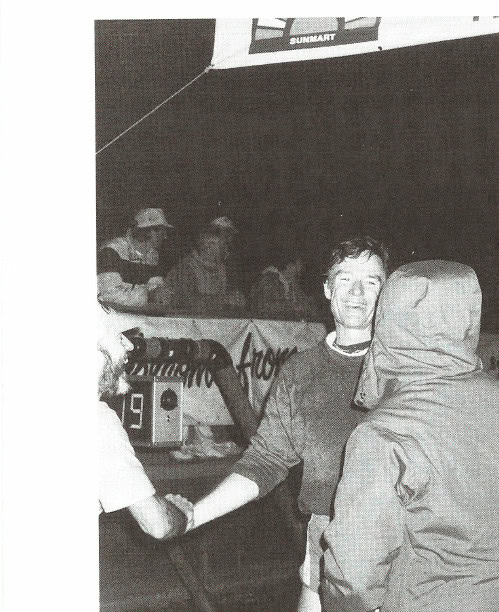
We ran most of the steep hill leading into town, and then at the crest picked up the pace as if we were finishing a 10K. We crossed the railroad bridge, half a mile from the finish line, at 4:49 A.M. Running down the final hill to the track, pulled along by the beckoning lights of the stadium, an ecstatic, ear-to-ear grin covered my face, and I let out several long shouts of joy. As I circled the track, my eyes blurred, and tears trailed down both cheeks as I crossed the finish line in 23:53.
Looking back on it, I still don’t understand how I finished in 24 hours. Part of it, of course, was Mo’s impeccable “pacerwomanship.” But what created the rest? What turned 14 miles a week of training and a shambling shipwreck of a walker at Rucky Chucky, into a fluid, pain-free, exhilarating dash to the finish? It certainly wasn’t me, or at least, the “conscious” part of me. Was it the full moon and starlit night? Was it the hawk feather? Was it some strange power of the unconscious mind? Was it magic? Is it even necessary to know?
What I do know is it wasn’t just a dream, because it’s right there in black and white in the 1991 finisher’s list: “Doug Latimer, 23:53″—to me, my most memorable run.
On the Trail With Doug…
by Mo Livermore
Perched on a log not far above the American River, shivering in the stillness of that bright, clear, moonlit night, I chuckled at the incongruity of my situation: me, Western States tortoise, still recovering from recent abdominal surgery, waiting to pace Doug Latimer, Western States legend. The powerful magnetism of this event had inexorably drawn both of us to it once again, probably against our better judgment, yet we would both give the trail our best and be richer for the effort. So, in the darkness, I waited . . .
An uncharacteristically gloomy, somewhat disheveled, familiar figure finally emerged from the shadows. As we slogged up Sliger Mine Road, Doug spouted a litany of reasons why a sub-24-hour finish was out of reach, including an intimidatingly specific recitation of his personal split times on various sections of the trail while “feeling good” and “feeling bad.” I could remember only one of my personal split times: five and a quarter hours to the finish from Rucky Chucky, which happened to be exactly what we needed. “Let’s just TRY!” I said.
Maybe it was the boost from Judy Milkie-West, whom we had just passed, maybe it was the Pavlov’s dog response evoked by Doug’s familiarity with this part of the Run, or maybe it was the magic of his hawk feather, but at Green Gate, Doug suddenly turned on the afterburners.
With a steady, rhythmic pace, we wound purposefully through the canyons, the miles falling away beneath our feet. Sometimes we talked, sometimes we ran in silence, but we never seemed to slow down.
Doug was completely focused on this singular act of making his way through the night, unwilling to be stopped by anything (including calls of nature). Once I took a brief trailside break, and it was probably a half mile before I caught Doug again! The man was driven . . . .
A positive mental state is absolutely crucial in an event like this, particularly as runners race that second sunrise. Arriving at Auburn Lake Trails (85.2 miles) just slightly off the suggested 24-hour pace time, we exchanged grins of satisfaction as Doug moved quickly through the checkpoint. An (continued)
encouraging voice shouted as we left: “Congratulations! You’re well on your way to a 30-hour finish!” I almost throttled the guy.
On and on and on we ran, fixated on doing the best we could with every step. Dawn began to break, bringing with it the soft colors and gentle animal sounds of the canyons and forests waking for the day. It became more of a struggle to keep up with Doug as he leapt down the trail to the No Hands Bridge with seemingly invincible quadriceps. He had become Superman in Sauconys, and as we loped across the span at 4:03 A.M., I knew we really “had it,” if we could just keep up the pace.
Fueled by the excitement of this amazing 24-hour finish—so different from his experiences of the past—Doug ran faster and faster, while his faithful pacer began to have visions of lounge chairs, hot chocolate, and sleep.
We seemed to fly down the last hill, entering the stadium with unbridled joy and relief. My run ended there at the entrance gate, and I watched Doug circle the track. 23:53—just seven minutes to spare! What an incredible effort!
As I collapsed onto the damp grass of the infield, I felt very lucky to have been part of it all. I had given my best to help Doug meet his extraordinary challenge and in so doing, had met one of my own. That truly is the gift of the Western States.
Mo Livermore is one of the original trustees of the Western States 100 and was co-race director for four years (1978–81), and race director in 1983. She is a two-time finisher of the Western States Endurance Run—once under 24 hours, once under 30—and a five-time silver buckle winner in the Tevis Cup.
My Most Unforgettable Western States 100
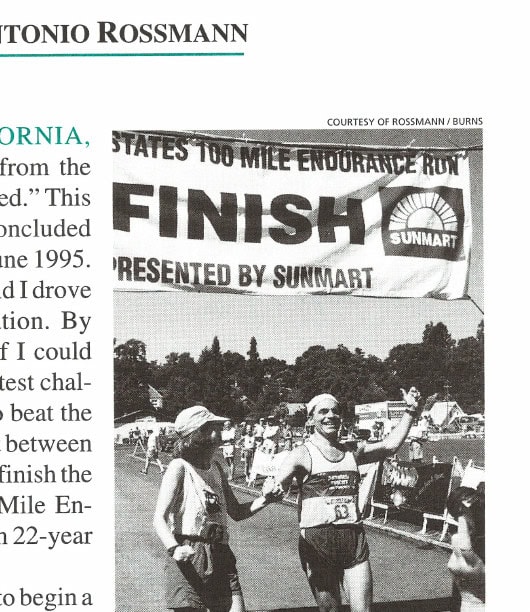
SQUAW VALLEY, CALIFORNIA, June 24, 1995—”Depart not from the path which fate has you assigned.” This fortune cookie admonition concluded our dinner in Oakland in late June 1995. The next day my wife Kathy and I drove to our Squaw Valley destination. By week’s end we would know if I could fulfill that mandate in the greatest challenge of my running career: to beat the extremes of ice and fire on foot between Squaw Valley and Auburn and finish the toughest Western States 100-Mile Endurance Run in the event’s then 22-year history.
Because of our aspirations to begin a family, I had resolved that the 1995 Western States 100 would be my last. Naturally, I wanted very badly to retire a finisher, not a DNFer. But the forces of nature refused to make the task routine, even out of kindness to a five-time Western States finisher.
The winter of 1994–95 produced more snowfall in the upper American River watershed than any year in recorded history: 836 inches at Emigrant Monument, almost 50 inches more than the previous record, which left the 10-foot monument under at least that much snow at the summer solstice. While an average year may produce several
This article originally appeared in Marathon & Beyond, Vol. 2, No. 3 (1998).
← Browse the full M&B ArchiveMore like this
1,000+ stories from 19 years of Marathon & Beyond
The complete archive of the legendary long-distance journal — digitized and free to read.
