

They Practice On Mountains
SEPTEMBER 18, 2004, MAMMOTH LAKES, CALIFORNIA
It is 10:30 A.M. on a sunny, windy day. The whole town of Mammoth Lakes has turned out to honor its hometown heroes: Meb Keflezighi, the 2004 Olympic silver medalist in the men’s marathon in Athens, and Deena Kastor, the 2004 bronze medalist in the women’s marathon. Meb’s is the first U.S. men’s medal in the marathon since 1976, and Deena’s the first since Joan Benoit’s gold in 1984.
Nestled in high mountains, the charming town is best known as a top 10 ski resort. Not today. Red, white, and blue banners hang from every light post: “Congratulations Meb and Deena from Mammoth Lakes Residents.” Shop windows are pasted with pictures of the medalists; small children wave American flags. The cheering crowd is 10 deep in the open-air shopping plaza as Deena and Meb drive through on decorated golf carts, waving, laughing, wearing their medals over their snug sudden-winter jackets.
The mayor makes a speech: he declares that from now on in Mammoth Lakes, August 22 will be Deena Kastor day and August 29, Meb Keflezighi day. What indeed could be more fitting? Deena’s and Meb’s journeys to the victory celebration in Mammoth Lakes began long ago; both were blessed with immense natural talent, strong family, wise coaching, sound character, and determined focus. This is not that tale. Both have recently been profiled in these pages, and the full-scale cinematic version awaits the Disney bio-pic. (A slimmed-down Kirsten Dunst playing Deena, a slimmed-down Will Smith as Meb?) Rather, it’s a personal view of the Olympic summer of 2004, when Deena on August 22, then Meb a week later, surprised the world, if not their coaches or themselves.
AUGUST 3, COURSE TOUR, ATHENS Athens is brimming with wide new highways, graceful new sporting facilities, a new artistically engaging metro system. It’s dusty and hot, but the town seems to
Dan Benardot
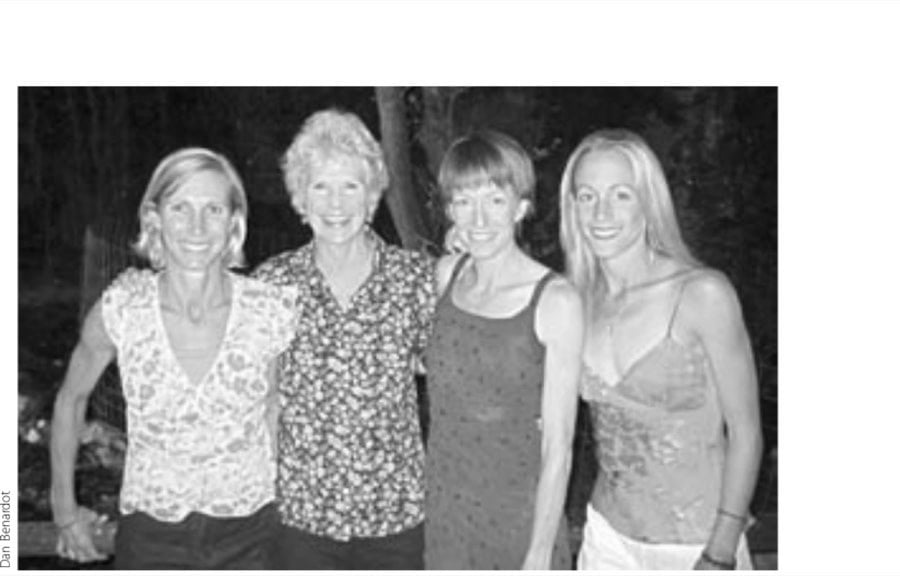
Julia Emmons, second from left, with Team U.S.A.: Colleen de Reuck, Deena Kastor, and Jen Rhines.
have its act together. I am on the U.S. Olympic Women’s Track and Field Team as assistant coach for endurance events; my task is to smooth the path for the women marathoners and race walker (actual coaching rests with personal coaches). Having arrived a couple of days earlier (in time to enjoy my first vast Greek meal at a local taverna), I meet the Olympic team charter plane the morning of August 3 and whisk off the women marathoners, along with Bob Larsen, the Olympic men’s endurance coach, for a tour of the marathon course. We are off the next day to train in peaceful isolation on Crete.
Colleen de Reuck has missed connections because of bad weather, so it’s just Deena Kastor, Jen Rhines, Bob, and I. The U.S. men marathoners (Alan Culpepper, Meb Keflezighi, Dan Browne), whose race is the final event of the Games, will come later. We are driven by Ginia Konstantinou, a joyously effervescent Athenian with a turquoise streak in her curly dark hair. The cousin of a colleague, Dan Benardot, she is renting rooms to the women marathoners’ families during their stay in Athens; she has offered to show us the course, which goes near her house at 30K.
Though no one has seen the course, it is nonetheless familiar. The previous May, Deena, Jen, Bob, and I had been among the U.S. Olympic marathoners, personal coaches, Olympic coaches, and sports medicine experts whom Dave Martin, the world’s leading authority on Olympic marathons, had pulled together for a marathon summit. The group had gathered at the USOC Olympic Training Center outside San Diego and huddled for two days in an equipment hut by the track. The hut had been converted into a makeshift conference room, and the hut’s
harsh window light was muffled by blue sheets. Presentations were occasionally punctuated by imposing hammer throwers strolling through to deposit imposing implements. Kilometer by kilometer, Martin had described the course: flat 10K near sea level, tumbling uphills through 31K, the fast final downhill 10K into the historic Panathinaiko Stadium, shaped like a paper clip and used in 1896 at the inaugural Olympics of the modern period.
Martin also had described the likely weather conditions. The race would start at 6:00 P.M. with temperatures in the 90s. “Respect the heat and the hills, and start conservatively,” he had urged in his signature raspy voice, recalling Steve Spence’s bronze medal win at the 1991 World Championships in Tokyo. “Conditions were similar, and he started midpack and just worked his way up methodically.”
The other experts were equally effective: USOC sports physiologist Randy Wilber on Athenian air pollution; the ever-engaging Gloria Balague, of the University of Illinois at Chicago, on preparing psychologically (“Worry early”); and Martin’s Georgia State University colleague, nutritionist Dan Benardot, on how to best balance the intake of food and fluids in preparing for such challenging conditions. With high heat and hilly terrain, Athens would be the toughest Olympic marathon in memory. Though we could not flatten the hills nor chill the heat, we had striven to prepare the athletes with the best sports science available.
A World of Marathons Safaricom Marathon & Half-Marathon
Lewa Wildlife Conservancy, Kenya July 2th “The only marathon run in a game park”
Experience every runner’s dream of running amongst giraffe, zebra, impala, rhino, elephants and other game in their natural habitat. This is Kenya’s only marathon open to non-elite runners. Enjoy a 6 night package with lots of sightseeing and game viewing.
Post-race extension to Governor’s Camp, a deluxe resort in the Masai Mara Game Park Fund raising requirement is expected of all race entrants. Event is limited to only 400 runners. Visit our web site or call for info on this and other great marathon adventures
Register for our email Newsletter and get the latest on international running adventures. Since 1979 Marathon Tours & Travel has been bringing runners and their friends to the world’s greatest running events on all 7 continents.
Marathon Tours & Travel
261 Main Street, Boston, MA 02129 ph 617.242.7845 / 800.444.4097 / fx 617.242.7686 www.marathontours.com / marathon@shore.net
Dashing adroitly through Athenian traffic, Ginia, whose driving matches her exuberant conversational style, gets us quickly, though somewhat hair-raisingly, to the sleepy town of Marathonas, on the seaside east of Athens. We get on the course and pick up the blue line, which wobbles a bit, as if the striper had laid it down after a wine-enhanced lunch. Ginia calls the kilometers off her odometer since we cannot pick up official markings. The first 10K is indeed nearly flat, following the coast. The course then turns left, and we climb slowly, steadily toward Athens until 31K. “I’d never realized there were all these hills,” Ginia jovially remarks, as the car grinds up incline after incline.
We all knew differently but remain silent. Ginia chats on in excellent English, pointing out the sights and describing the neighborhoods. The marathoners and Bob are quiet, making notes on course maps; I gaze out at the dusty landscape, shimmering in the heat, thin dogs panting in the shade of shop doorways. To avoid notoriously heavy traffic near the finish area, we leave the course. “What do you think?” I ask. “It’s not as hard as I expected,” says Deena. “I’ve been training for something tougher.” Ginia, who had been exclaiming on the course’s length and difficulty, falls silent.
AUGUST 13, OLYMPIC TRAINING CAMP, CRETE
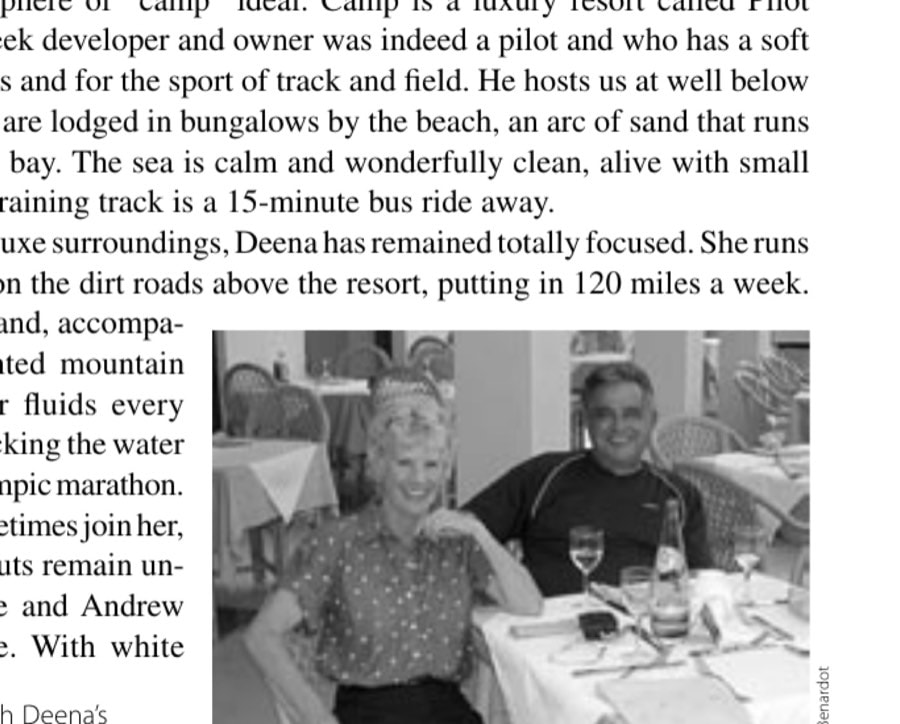
Julia Emmons with Deena’s legendary coach, Joe Vigil.
Dan Benardot
Joe Vigil, Deena’s coach, has arrived at the U.S. Track and Field Training Camp on Crete. Deena, Jen, and Colleen have already been on the island for a week, finding the atmosphere of “camp” ideal. Camp is a luxury resort called Pilot Beach, whose Greek developer and owner was indeed a pilot and who has a soft spot for Americans and for the sport of track and field. He hosts us at well below market rate. Most are lodged in bungalows by the beach, an arc of sand that runs 10K along a wide bay. The sea is calm and wonderfully clean, alive with small darting fish. The training track is a 15-minute bus ride away.
Despite the deluxe surroundings, Deena has remained totally focused. She runs hard twice a day on the dirt roads above the resort, putting in 120 miles a week. Andrew, her husband, accompanies her on a rented mountain bike, handing her fluids every 15 minutes, mimicking the water stations of the Olympic marathon. Other runners sometimes join her, though her workouts remain uncompromised; she and Andrew often finish alone. With white
hat to ward off the sun, green eyes focusing mid-distance, Deena covers the miles seemingly without effort. In between, she eats, naps, and enjoys a brief swim before dinner. Colleen is gamely nursing a sore foot—doing many of her workouts in water—and Jen, who made the team with an impressive 11-minute PR, is tapering to one hard effort a day.
Vigil’s arrival does not intensify Deena’s efforts; she has been following his penciled instructions faithfully. Ever gregarious, however, he is eager to tell their story, which lies nestled in a manila folder never far from reach: month after month of daily workouts that he has designed to strengthen her body and mind for the Olympic marathon. “It’s all here,” he says, brown eyes beaming. “She’s never missed a workout all year. One tough lady.” Vigil rides along to the morning workouts, swapping tales. His wife, Caroline, who has heard them all, sleeps in. I often drive.
Vigil and Meb’s coach, Bob Larsen, are at the heart of Team Running USA, which is managed by Running USA, a modest non-profit organization that is quickly showing how U.S. distance running can revitalize. With a budget that would make a shoestring look plump, the two coaches have gathered a handful of gifted postcollegiate runners and carefully analyzed their abilities, giving them workouts that push their potential. They train together at Mammoth Mountain for altitude and at the Olympic Training Center near San Diego. Much of the spring and summer, Deena has had Meb to train with.
August 13 is the day of the opening ceremonies. Much of the team, athletes and coaches, have flown over to Athens to take part. Being part of opening ceremonies will be exhilarating and exhausting: plane ride, hours lining up and marching forth into the Olympic Stadium, an early-morning flight back. The three women marathoners, whose race is nine days away, opt to stay in Crete: running, eating, napping. I stay with them (driving, eating, napping), as does Vigil (talking, chatting, eating, laughing, napping, holding his folder of Deena workouts and a stopwatch).
With typical Greek warmth and hospitality, the resort owner’s son, Dimitrious (a sparklingly dashing fellow in his mid-30s, who is likely the most eligible bachelor in Crete, if not all Greece), has arranged for us all to watch the ceremonies on a large screen during dinner on the twilight-dark patio. We enjoy the historyheavy beauty of the early sequences. The marathoners then drift off, preparing for another day of running-eating-napping-running, leaving the rest to ponder the mystifying alphabetical arrangement of countries marching in. (How did the USA ever get into the first third of the alphabet or St. Lucia start with “A”?) In its tape-delayed broadcast, NBC will tell listeners the arrangement is the Greek order of the alphabet. NBC has insider information, along with eight hours and a research library to figure it out. We are, however, watching hours earlier, live on Greek TV, and delight at our confusion (“No, no,” I exhort, laughing to tears,
“Guam cannot start with an ‘N’”). We yell enthusiastically as we spot Bob Larsen, bedecked in USOC opening ceremony attire, hat slightly askew, as ever looking thoughtful as chaos swirls around him.
AUGUST 18, CRETE AND ATHENS The final week on Crete has been less tranquil. The male marathoners are now here and will stay on; their event is not until the 29th. Meb gets bitten by a farm dog on a morning run. He and Larsen spend hours looking for dogless dirt-road circuits,
a tough challenge in an agricultural community where every farm is guarded by a yappy pack. Deena has begun tapering to 80 miles a week and hates it. Used to a heavier load, she sleeps poorly and has lost appetite. She maintains her humor
and watches the Olympics on the German-speaking channel. Western Crete is a German tourist mecca, and the German channel gets best reception. Most of the Pilot Beach regulars are German, strapping people for the most part, who some
times overwhelm their bathing suits. Our athletes, especially the sprinters with their exquisitely chiseled bodies, are a huge hit as they do strides near the beach. They charm the towheaded children, showing them high-kick drills.
Aside from the male distance runners, much of the team flies to Athens on August 18. Most go to the Olympic Village, a fairly stark, isolated, sprawling, well-secured complex on the far northwest side of Athens. I have lobbied instead
to house the marathon women in a dormitory suite at the American College of Greece for the three days until their event, August 22. Taken over by the USOC as a processing and training facility for the entire multisport U.S. team, the college
has trails and a track for light training, and is in quiet, leafy northeast Athens. Moreover, all three families (Andrew Kastor; Jen’s husband, Terrence Mahon; Colleen’s husband, Darren, and daughter, Tasmin) are staying nearby with Ginia and
can visit the athletes far more easily than in the Village. With typical graciousness, Ginia has lent them a car. The shopping streets nearby are geared to students. We find a Starbucks, which quickly becomes the informal family headquarters.
AUGUST 22, RACE PRELIMINARIES
Dan Benardot
The three days have passed quietly. The marathoners have trained lightly and lounged a lot. There are free laundry machines
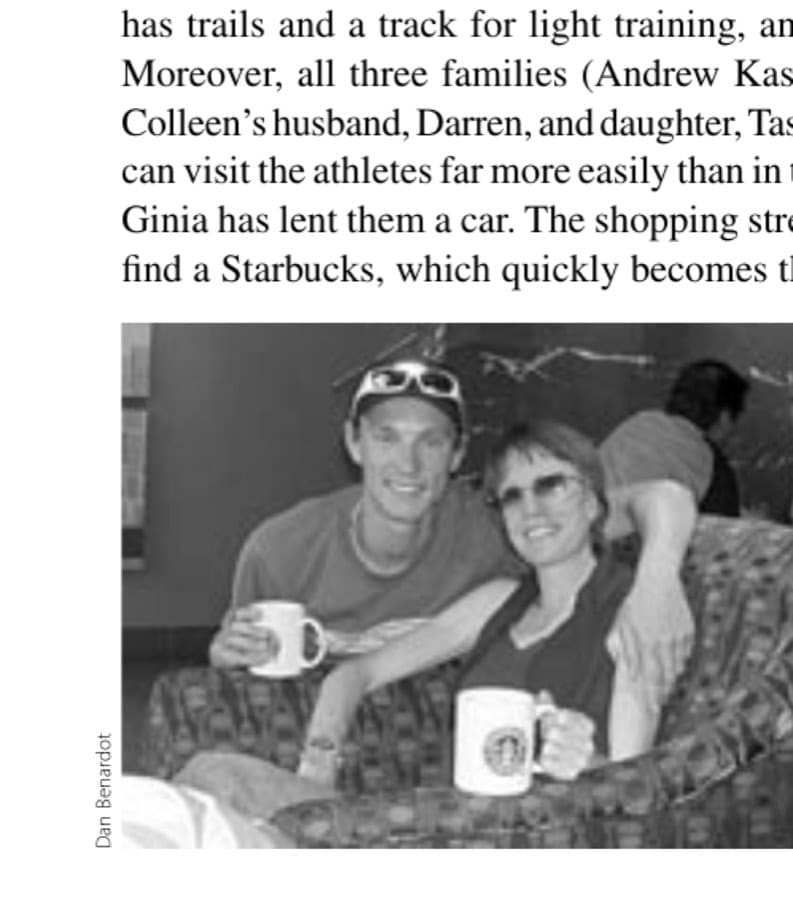
Andrew and Deena Kastor relax at Starbucks, the informal family headquarters.
of ponderous efficiency in the dorm basement; doing a load burns up the hours. I have found a family bakery and bring in fresh bread each morning for breakfast in our suite’s kitchen. We lunch at the college on hamburgers and Tex-Mex enhanced with Greek oregano. The athletes dine with their families and visit with friends in for the Games. The neighborhood abounds with pasta places, patrons glued to Games coverage on ever-present TV. The dormitory also has a TV, which picks up the Games in Greek.
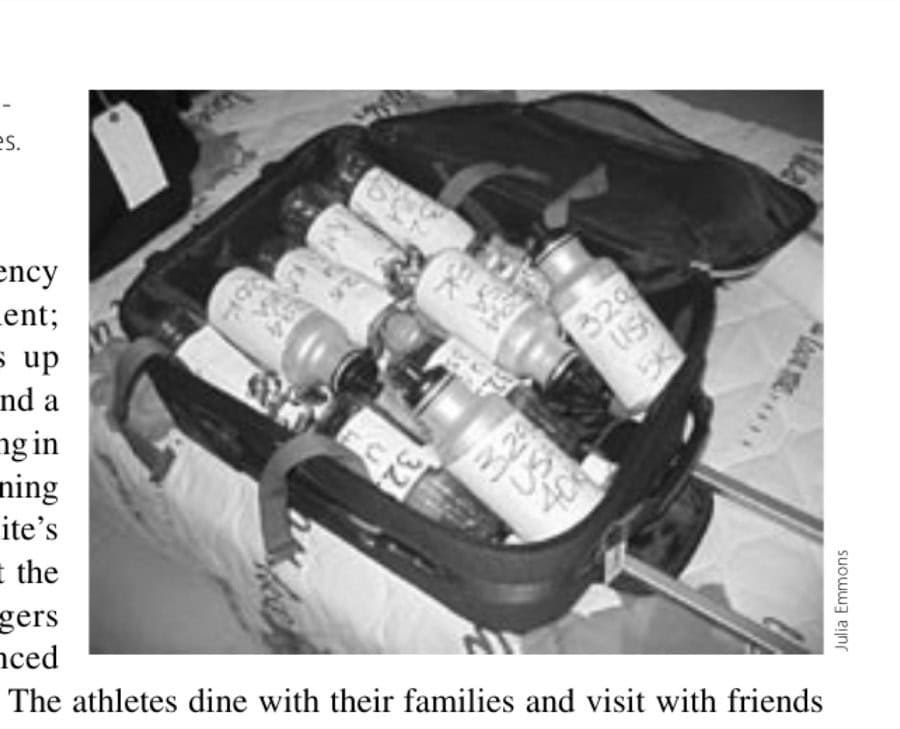
Race morning, August 22, I pack a suitcase with the athletes’ personal aid bottles. Deena has adjusted her formula for each of the eight aid stations, spaced at 5K intervals. Nutritionist Dan Benardot has stressed the importance of getting enough nonwater fluids during the event, and she is taking this seriously. Poor hydration was a fault in her slower-than-expected race at the Olympic Marathon Trials in St. Louis in April. (She came in second to Colleen in 2:29:38, well off her American record of 2:21:16.) I take a bus to the Village from the college—there is regular service between the two venues—and wheel the liquid cargo to the Sports Information Center where I deposit the bottles, signing off. I am assured they will be kept cool. I see no coolers.
The athletes come over by bus at noon. They eat lunch in the cavernous dining hall, all sticking to white dull foods: bread and sauceless pasta. We walk to the residence halls through blistering heat; it’s the hottest day of the Games. The athletes rest in a darkened, air-conditioned bedroom in the U.S. cluster while I confer with Bob Larsen, who is trying to arrange to have Cool Vests for the athletes. The vest looks like a khaki flak jacket with two dozen pockets, each pocket filled with a gel sac that can be frozen. The idea is to cool one’s torso before competition, thus keeping cooler during the early part of the race. We have the vests but no freezing unit to cool them. Bob makes friends with dining-hall management, and he takes them to the food freezers.
The athletes’ buses are scheduled to leave for Marathonas at 3:30. Bob and two male athletes lug over the Cool Vests in a foam cooler. They are semicool. Bob will be on the course, driving to several points to urge the athletes on. We walk
Julia Emmons
Suitcase with the athletes’ personal aid bottles. (Deena’s are the blackcapped ones.)
through the heat and board the buses. I sit with Deena on the ride out, chatting about the book she has just finished, A Practice of Mountains. Written by her friend Andrea Lawrence, it’s about life-changing experiences. It flits through my mind that Deena may be about to have one. With her signature thoughtfulness, she has asked me to pass along the book to Philip Dunn, a 50K racewalker who has his own challenging event later in the week.
A WARM WELCOME AT MARATHON We go to Marathonas by back roads, arriving just before 5:00. The bus doors open, blasting us with ovenlike heat. It is over 100 degrees. “Oh my God,” says Deena. “Don’t focus on it,” I say. (Yeah, sure; my trip back to Athens is by air-conditioned bus.) Deena gives a quick NBC interview, while I commandeer a TV assistant to haul the Cool Vests to the Call Room/Athletes Lounge. The USOC medical staff are there to greet us. U.S. medical staff will be at several points along the route, relaying our athletes’ conditions (“Looks strong” “Looks troubled”) to the next position. The heat is so intense that I “look troubled” just standing there.
THE ARRIVAL OF RADCLIFFE The Call Room/Athletes Lounge is in an air-conditioned building. Only athletes are allowed in. As the three marathoners and I stand outside under a shady overhang, looking down at our not-very-cool Cool Vests in the foam container (now splitting at its seams) and arranging for USOC medical staff to get the vests back to the Village, there is a flurry of activity near the building. Six middle-aged men in matching crisp, white British Olympic Team golf shirts bustle in, one hauling a massage table, another an athlete’s bag. In their midst is Paula Radcliffe, world record holder in the marathon and favorite to win Olympic gold. She wears a white Cool Vest, sunglasses, though not her legendary knee-high elastic socks. The men quickly put up the massage table under the shady overhang. Looking tall, strong, and cool (we have no doubt her Cool Vest is correctly prepared), Radcliffe assembles herself upon the table, still in Cool Vest, and begins stretching. The men continue bustling about. I watch balefully. Should I have found a car to take us to Marathonas? Should I have had really cold Cool Vests? With a final hug good-bye, the three American marathoners disappear into the Call Room, dragging the Cool Vests in the foam container behind them by its tattered strap. Radcliffe continues her stretching in her white Cool Vest, the men their bustling.
THE START The U.S. marathoners remain in the Call Room/Athletes Lounge until final call to the start area at 5:40. Many in the field of 82 athletes have chosen to warm
ad page
up out on the track despite the stifling heat. Just before the call to the start line, the Americans do a few strides and assemble. At 6:00 P.M., the 2004 Olympic Women’s Marathon takes off, the spectators, soaking with unearned sweat, clapping encouragement. It is 93 in the shade, 104 in the sun.
Most of the coaches now dash out of the area, looking for the bus that has been promised to take us to the finish at Panathinaiko Stadium. We find it and settle in for what we hope will be a quick ride downtown. The coach has no TV, no radio. We cannot take the marathon route; it is closed to traffic. The one road to town is a single, winding, two-lane country road, the only way anyone will get back to Athens, including the British entourage and any doting loved ones who accompanied their athlete to the start rather than wisely opting to watch the event in the stadium on Jumbotron.
THE RACE BY TEXT MESSAGE Gridlock quickly ensues as the bus inches toward Athens. There is no TV, no radio, but I have an ally watching the event at Panathinaiko Stadium, Dan Benardot. The nutritionist had been on Crete for a few days consulting with the marathoners and had come over to Athens to see the race we had all been planning for so meticulously. Others watching in the stadium included Joe Vigil and the families of the three U.S. marathoners.
I text message Benardot: on bus taking back route into stadium. be there in hour. no call on developments. pls. inform. Response from Benardot: radcliff (gb)1st. otherwise no news. The bus continues to inch its way. My seatmate, a young Romanian, falls asleep. It is close to 6:30. Shadows are lengthening on the landscape, which is handsome in a sunburned manner. I am in no mood to enjoy it. Thin dogs lie in the shade, panting.
Message from Benardot: moroccan running in 1st now. japanese running strong. Message from Benardot: deena 28th at 5k Message from Benardot: jen 45th at 5k I respond: we crawl along in disastrous traffic. must learn patience.
Message from Benardot: colleen 44th at 5k I respond: thanks. pls. continue as approp. It is now well after 6:30. There is no clue as to the pace per kilometer or how the women look. Though the race is using chip technology, the times posted on the Jumbotron seem many minutes after the women have run over the 5K split. My seatmate continues to sleep. I try to make heads or tails of what is going on in the race by eavesdropping on other conversations in English. Via their cell phones, they are hearing Radcliffe and a Japanese runner are in the hunt. Minutes
drag. Shadows outside the window lengthen. Dogs continue to lie in the shade. It must still be hot. (Finally) Message from Benardot: deena 17th at 10k I respond: good place I hear later that the sports commentators on TV, especially the BBC, were wondering what was wrong with Deena, who had the fourth-fastest time coming in. Surely she should be running with the front pack. Having attended the marathon summit, however, where I heard Martin’s wise advice to run conservatively at the start, and having seen the workouts Vigil had designed for Deena and watched her hammer them, I had little doubt this is where she wanted to be at the end of the flat stretch along the coast. The hills into Athens, for which she had so carefully prepared by running full tilt up mountains, would be next.
Message from Benardot: jen and colleen 34-35 at 10k I respond: crawl crawl. chap next to me snoring The Romanian is indeed snoring, his head bobbing up and down. He obviously has no cell phone nor allies at Panathinaiko. His athlete may have a sore ankle and be planning to drop out. Perhaps he has been testing out Athenian nightlife with abundant enthusiasm. I stare at the cell phone, willing good news. Finally, I get it.
Message from Benardot: deena 13th, jen 32nd, colleen 35th at 15k I respond: thx (should have been Thx!) Message from Benardot: deena 13th, jen 32nd at 20k. radcliff back to 7th. Message from Benardot: deena 12th at halfway
Message from Benardot: jen and colleen 32-33 at half Message from Benardot: deena looks good running on camera This is the first time I learn how Deena is looking as she runs up the hills into Athens. She had run strongly through all her workouts on Crete and resented the need to taper. Chatting to Benardot on Crete, she said she has never felt so strong in her life, noting she has adjusted her eating patterns to follow his advice. While at the resort, the nutritionist analyzed the eating patterns of all three women marathoners. All eat well and are getting the requisite calories. Deena, however, is closest to the ideal pattern of balancing her intake of calories with her expenditure of energy throughout the day. She eats frequently and adventurously, shunning few foods.
The bus is now moving more freely as my companion snores on. We are moving through city neighborhoods, the driver anxious to avoid the downtown gridlock caused by the marathon. We are an hour and a half into the race, and none of us has seen a step. We rumble our displeasure in a dozen languages. I continue to stare at the cell phone. More good news. Message from Benardot: deena now 11th at 25k
IN PANATHINAIKO STADIUM
Dan Benardot
We near downtown. The bus driver begins to circle away from the stadium area to avoid closed roads. In squawking revolt, we yell for the doors to open so that we can scamper to the stadium, in the near distance across a park. I find Benardot (
rt side of stadium, entry 4-5, 5 rows up, look left) and plunk down on the ancient marble seat just in time to catch the places at 30K: Deena eighth, Jen 32nd, and Colleen 36th. What had seemed possible when we clustered together in May is
increasingly within grasp. I get my first look at the race as the runners top the hills at 31K. Japan’s Mizuki Noguchi leads. Ethiopian Elfenesh Alemu is in second, followed by Radcliffe in third. Radcliffe looks bad, though her style has never been graceful. This time
it’s extra raggedy. Deena, short brown-blonde hair tucked up in her white hat, is smooth and strong, the way she looked in the 10K final at the U.S. Olympic Trials in Sacramento. She ran that race as a hard workout, lapping nearly the entire
field, and won at near the American record. Deena is in the second pack, two minutes back from Noguchi. By 35K, Deena is in sixth place. It is hard to get her splits, but we later learn that she has run her fastest 5K so far, 17:02. In the next two kilometers, Radcliffe
falters and finally drops out, the strain of her countrymen’s high expectations and her aggressive performance in the hills and heat taking its toll. No one who sees her bitter tears can remain unmoved. Deena is not aware: she has not seen
Radcliffe leave the race. At 40K, Deena is in fourth place, though she thinks, we learn later, she is in fifth. With a kilometer to go, she passes Alemu and approaches the stadium. Only when someone in the crowd tells her does she realize that she
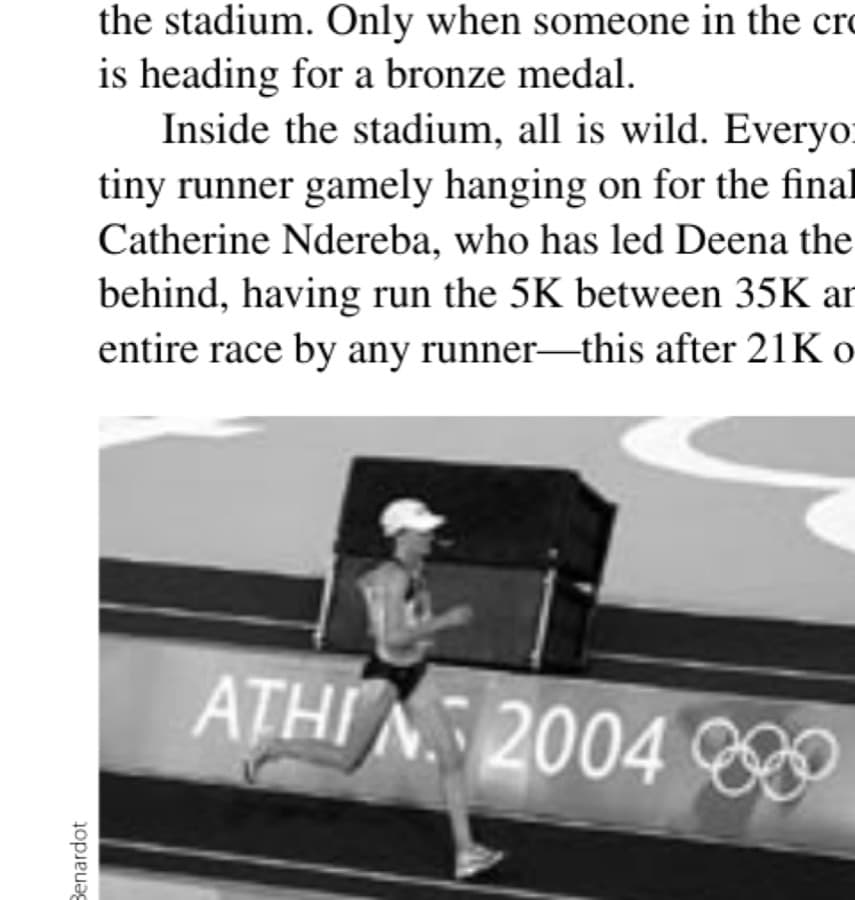
is heading for a bronze medal. Inside the stadium, all is wild. Everyone is on their feet. Noguchi enters, a tiny runner gamely hanging on for the final 500 meters. Close behind is Kenya’s Catherine Ndereba, who has led Deena the whole way. Deena bursts in a minute
behind, having run the 5K between 35K and 40K in 16:20, the fastest 5K of the entire race by any runner—this after 21K of hills in 90-degree heat. By comparison, Noguchi ran that leg in 16:56, Ndereba in 16:40. Head high un
der the white hat, her slender body looking so strong that she seems to have another dozen miles in her, Deena circles the stadium, crying with happiness. She finishes in
Deena enters the Olympic Stadium looking like she could run another 12 miles.
2:27:20, the last half-marathon three minutes faster than her first. A nearby group of Brits graciously offer congratulations. I cannot breathe for joy. Jen finishes 34th and Colleen 39th, despite her troubled foot, fine performances in these conditions. Of the 82 who started, 66 finish. The U.S. team is fourth in combined times.
AUGUST 23, OLYMPIC STADIUM, MARATHON MEDAL CEREMONY A U.S. runner has medaled in the Olympic marathon for the first time since 1984. Ever gracious, Deena, now a media darling, gives credit to others: Vigil, Andrew,
her running partners, her family, Dave Martin, dozens of others. All know, however, it is her talent, character, intelligence, and focus that enabled her to so skillfully absorb these gifts from others.
The medal ceremony is early evening the next day in the packed Olympic Stadium, seating 80,000. She receives her medal, bouquet, and laurel wreath from the great middle-distance runner, Sebastian Coe. How fitting. Later, dining outdoors
at a taverna, she gives her bouquet to Ginia. Ginia will put it under glass.
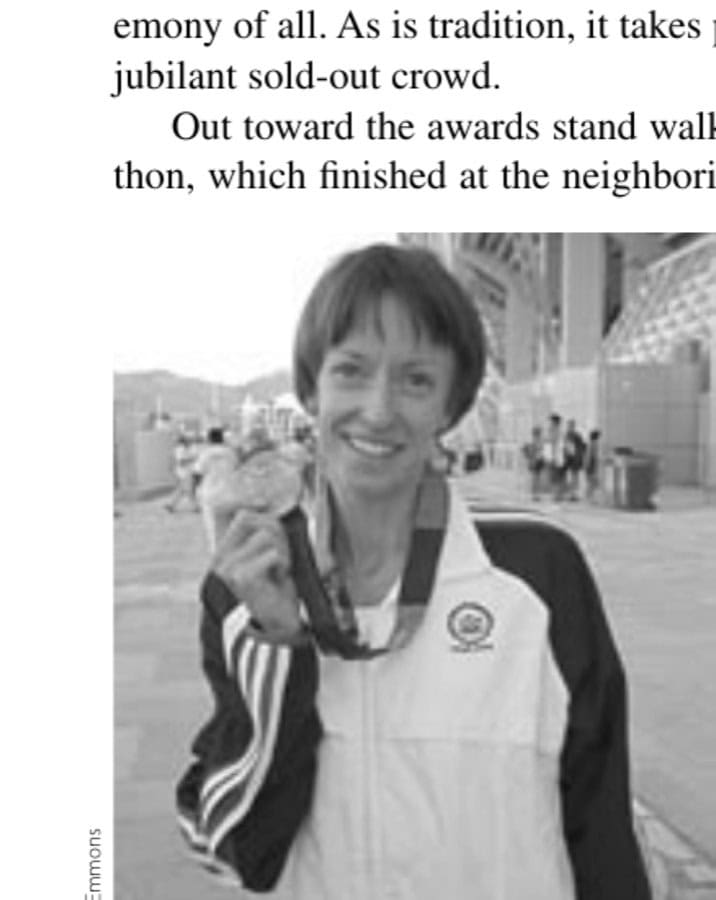
It is the second marathon medal ceremony of the Games and the concluding ceremony of all. As is tradition, it takes place within the closing ceremony before a jubilant sold-out crowd. Out toward the awards stand walk the winners of the Olympic Men’s Marathon, which finished at the neighboring Panathinaiko Stadium a scant hour and a half before. Meb Keflezighi, dressed in his USOC Awards Ceremony attire, approaches the podium for the silver. This time, I had watched the entire marathon
in Panathinaiko Stadium on Jumbotron. Though I had seen Meb win the 10K decisively at the Olympic Trials and run tough workouts on Crete, I doubted his chances to medal. After all, his marathon PR was over three dozen
places slower than others in the field while Deena’s was fourth best. Meb’s story is told well in the last issue of Marathon &
Julia Emmons
AUGUST 29, OLYMPIC STADIUM, MARATHON MEDAL CEREMONY
Deena after the medal ceremony in Athens.
Beyond: he kept close to the thick lead pack of over 30 runners through 15K, then waited for someone to break. Italy’s Stefano Baldini eventually did, and Meb opted to follow—thinking, as he later said at the press conference, “Well, why not me?” Like Deena, he never faltered, never hit The Wall, and closed with a swift (14:20) final 5K. His last half-marathon was nearly four minutes faster than his first. As he strode into the stadium second to Baldini, finishing in 2:11:29, once again I could not breathe for joy.
Meb steps up to the podium to receive his Olympic silver medal. This, coming on the heels of his teammate Deena’s receiving her bronze the week before, cannot but herald a fine new day for U.S. distance running. Some gangly kid in scruffy running shoes, glued to the TV throughout their performances, will ask, like Meb, “Why not me?”
See you at the Games in 2016 or 2020, Kid. Work hard. And practice on mountains; the hills will seem small.
Adventure Running At Its WORST! In 1989, two runners set off to become the first to run from Death Valley to Mt. Whitney and back—in mid-summer. Lottsa luck, fellers! Send $22 in US funds (shipping/handling included) to: Rich Benyo, Box 161, Forestville, CA 95436, USA Please Print
Name ___________________________________________________________________________________ Street ___________________________________________________________________________________ Town___________________________________ State/Province____________________________________ Zip/Mail code _________________________ Country ____________________________________________ Allow 6 weeks for delivery. If you wish a personal autograph, please include name of person for whom book is intended.
Julia Emmons
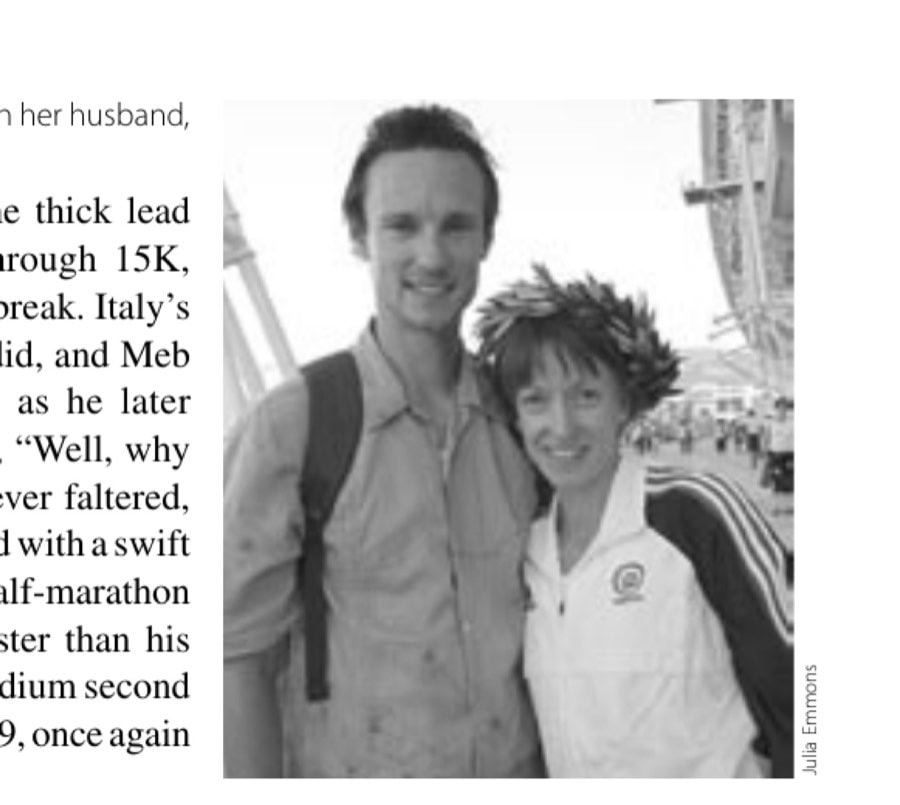
Deena shares the moment with her husband, Andrew.
This article originally appeared in Marathon & Beyond, Vol. 9, No. 1 (2005).
← Browse the full M&B ArchiveMore like this
1,000+ stories from 19 years of Marathon & Beyond
The complete archive of the legendary long-distance journal — digitized and free to read.
